Feverfew for Migraine Prevention
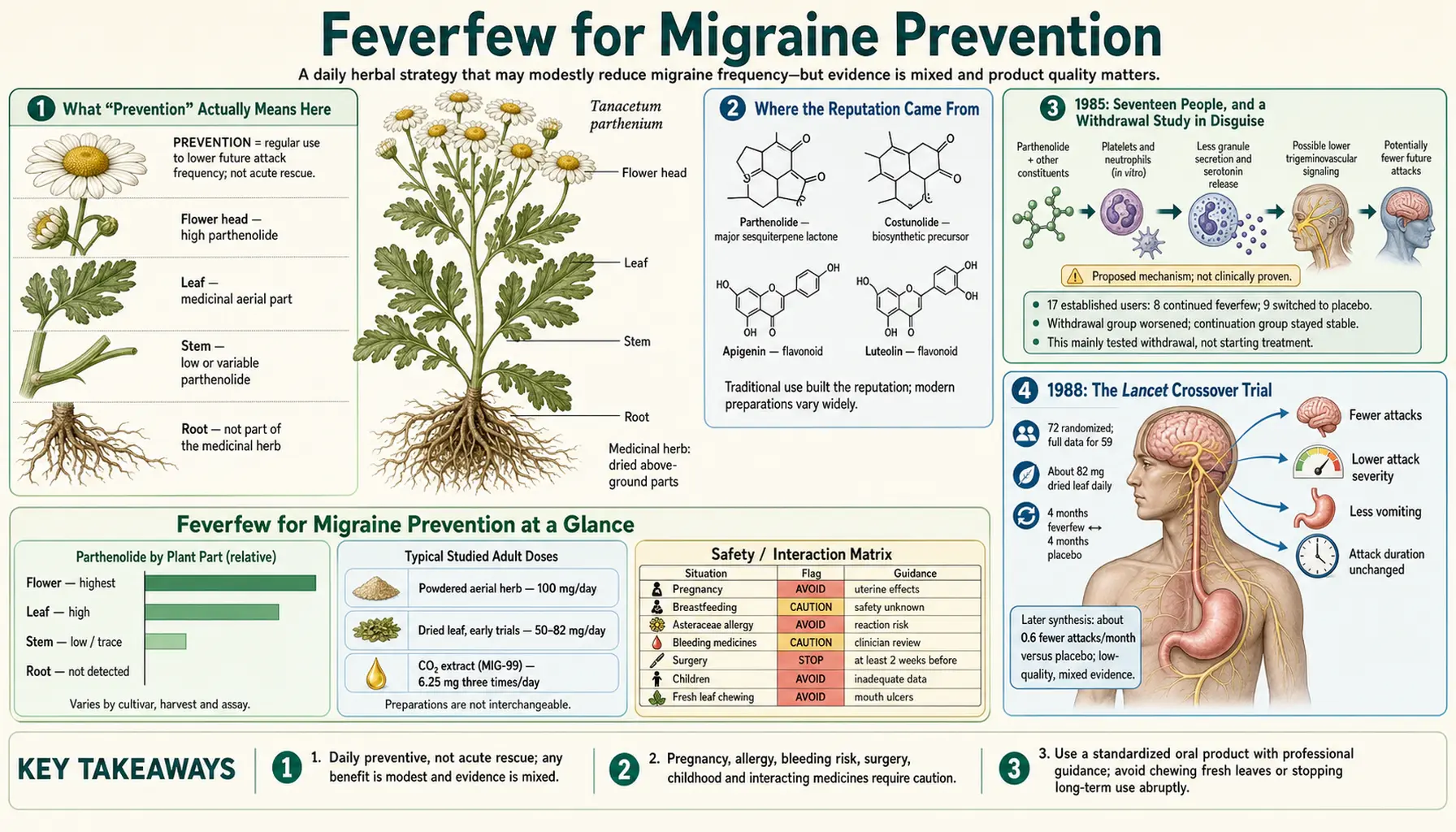
If you have read anywhere that feverfew “is proven for migraine,” this article is going to be a little deflating — and, we hope, more useful. Feverfew has been tested properly. Six double-blind randomised placebo-controlled trials exist, covering 561 patients. That is more real clinical testing than the vast majority of herbs ever get.
The results are genuinely mixed, and they are mixed in an interesting, informative way rather than a random one. This page goes through the trials one at a time — who was in them, what preparation they used, how long they ran, and what they found — instead of blending them into a single verdict. By the end you should be able to see for yourself why reasonable people read this literature differently.
Table of Contents
- What “Prevention” Actually Means Here
- Where the Reputation Came From
- 1985: Seventeen People, and a Withdrawal Study in Disguise
- 1988: The Lancet Crossover Trial
- The Two Rigorous Trials That Found Nothing
- MIG-99: The Best-Conducted Trials
- What the Cochrane Review Says Now — and What It Said Before
- Why the Trials Disagree
- What the Guidelines Recommend
- How Feverfew Compares With Other Preventives
- Running a Fair Trial of Feverfew on Yourself
- Cautions
- Key Research Papers
- Connections
What “Prevention” Actually Means Here
Migraine treatments split into two categories that get confused constantly.
Acute (abortive) treatment is what you take when an attack starts — a triptan, a gepant, ibuprofen. Success is measured in being pain-free at two hours.
Preventive (prophylactic) treatment is taken every day regardless of symptoms, for months, and success is measured in attacks per month. Propranolol, topiramate, amitriptyline and the CGRP monoclonal antibodies all work this way. So does feverfew, in every trial that has tested it.
This matters for expectations. A preventive that works does not abolish migraine; it shifts you down the frequency scale. In drug trials a preventive is usually considered a success if it halves attack frequency in a reasonable proportion of patients. Nobody in a feverfew trial was cured. The realistic question is whether a month with five attacks becomes a month with three or four.
It also matters for patience. Preventives are judged after eight to twelve weeks at a stable dose. The MIG-99 trial treated patients for 16 weeks and measured the effect during treatment months two and three — deliberately excluding month one, because month one is too early. If you take feverfew for a fortnight and conclude it does nothing, you have not actually tested it.
Where the Reputation Came From
Feverfew's migraine reputation did not come from a laboratory. It came from British gardeners.
Through the 1970s, word spread — by neighbours, by the popular press, and notably through the enthusiasm of a Welsh doctor's wife whose case circulated widely — that eating two or three fresh feverfew leaves each morning prevented migraine. Enough people were doing it by the early 1980s that researchers at Nottingham could recruit a study population made entirely of existing users. That is an unusual and slightly awkward starting point for evidence, and it shaped the first two trials in ways worth understanding.
Before that, feverfew's traditional reputation was for fevers — the name descends from Latin febrifugia — along with a scattering of folk uses for menstrual problems, childbirth, insect bites and joint pain. Headache appears in the older herbals, but it was not feverfew's headline indication until the twentieth century. The modern use is essentially a grassroots discovery that the research establishment then went and checked.
1985: Seventeen People, and a Withdrawal Study in Disguise
The first controlled trial, published in the British Medical Journal, enrolled 17 patients who were already eating fresh feverfew leaves daily for migraine. Eight were switched to capsules of freeze-dried feverfew powder; nine were switched to placebo, without knowing which (Johnson 1985).
The result: the placebo group had a significant increase in the frequency and severity of headache, nausea and vomiting, with unpleasant effects emerging during the early months. The feverfew group stayed the same.
Read that carefully, because it is not quite the study it is usually described as. Nobody got better on feverfew. Rather, people taken off feverfew got worse. The authors themselves called for confirmatory studies “preferably with a formulation controlled for sesquiterpene lactone content, in migraine sufferers who have never treated themselves with this herb” — a remarkably clear-eyed statement of both the trial's limits and the whole field's problem.
Two things follow. First, seventeen people is a very small trial, and everyone in it had a prior belief that feverfew worked. Second — and this is the origin of a caution that runs right through feverfew's story — those “untoward effects” in the withdrawal group are the first documented description of what later became known as post-feverfew syndrome. The trial that made feverfew's reputation is also the trial that demonstrated stopping it abruptly is a bad idea.
1988: The Lancet Crossover Trial
Three years later the Nottingham group published a larger and better trial in The Lancet (Murphy 1988). Design:
- One-month single-blind placebo run-in to establish a baseline.
- 72 volunteers randomised to one capsule of dried feverfew leaves daily or matching placebo for four months, then crossed over to the other arm for another four months.
- Outcomes from diary cards issued every two months, plus visual analogue scores.
- 60 patients completed; full information was available for 59.
Feverfew was associated with a reduction in the mean number and severity of attacks in each two-month period, and with less vomiting. The duration of individual attacks did not change. Visual analogue scores also favoured feverfew. No serious side effects occurred.
This is the most convincing of the older trials. It is still, however, a 60-patient crossover study in a population where many participants were experienced feverfew users, and feverfew's distinctive bitter taste and the possibility of mouth soreness make true blinding harder than it looks on paper.
A third small positive trial — a 1997 study in Phytotherapy Research by Palevitch and colleagues in 57 patients — is counted by the Cochrane reviewers among the favourable results. It is not indexed in PubMed, so rather than print an identifier that might be wrong, here is a PubMed search for it.
The pattern Cochrane noted is the important one: all three positive trials had between 17 and 60 participants.
The Two Rigorous Trials That Found Nothing
Two of the six trials were methodologically rigorous and larger, and both were negative.
De Weerdt 1996 — the Dutch crossover trial
Fifty patients who had never used feverfew before took part in a randomised, double-blind, placebo-controlled crossover study lasting nine months. Forty-four completed. The capsules contained a dried alcoholic extract of feverfew on microcrystalline cellulose, delivering 0.5 mg of parthenolide per day.
Both groups had the same number of migraine attacks. No prophylactic effect could be demonstrated. The authors offered the obvious explanation themselves: the two earlier positive studies had included patients who already believed feverfew helped them (De Weerdt 1996).
There is a second explanation they were more cautious about, and it may matter more: 0.5 mg of parthenolide daily is a low dose by any standard, and an alcoholic extract on cellulose is a specific and unusual preparation. This trial may have tested a weak product rather than a weak herb. Both readings are legitimate, which is precisely the problem.
Pfaffenrath 2002 — the dose-response trial that failed
This one is routinely miscited, including on plenty of otherwise careful websites, as the study that “established the effective dose.” What it actually reported is more complicated.
147 patients with migraine were randomised to one of three doses of the stable CO2 extract MIG-99 — 2.08, 6.25 or 18.75 mg three times daily — or placebo, for 12 weeks after a 4-week baseline. In the authors' own words: “MIG-99 failed to show a significant migraine prophylactic effect in general,” and no dose-response relationship was observed in the intention-to-treat analysis.
The positive signal came from a predefined subgroup of 49 patients who had at least four migraine attacks during the baseline month. In that subgroup, frequency fell in a dose-dependent way (P = 0.001), and the best result was at 6.25 mg three times daily: −1.8 attacks per 28 days versus −0.3 on placebo (P = 0.02). The authors explicitly flagged the small numbers and said the finding needed verification in a larger sample (Pfaffenrath 2002).
So: a failed primary endpoint, a hypothesis-generating subgroup, and an honest call for confirmation. That is not nothing — it is exactly how a dose-finding study is supposed to feed into a confirmatory trial. But describing it as a positive dose-finding result without the caveats misrepresents it.
MIG-99: The Best-Conducted Trials
MIG-99 is a feverfew extract produced by supercritical carbon-dioxide extraction and manufactured to a reproducible specification. That is the whole point of it. Ordinary dried leaf varies wildly (see Choosing a Product and Dosing); a CO2 extract made to a fixed process gives researchers something they can actually dose.
The confirmatory trial, published in Cephalalgia in 2005, is the single best piece of evidence feverfew has (Diener 2005):
| Element | Detail |
|---|---|
| Design | Randomised, double-blind, placebo-controlled, multicentre, parallel-group |
| Participants | 218 randomised; 170 in the intention-to-treat efficacy analysis (89 MIG-99, 81 placebo); 215 in the safety analysis |
| Diagnosis | Migraine by International Headache Society criteria |
| Dose | 6.25 mg MIG-99 three times daily (18.75 mg/day of extract) |
| Duration | 4-week baseline, then 16 weeks of treatment |
| Primary endpoint | Average migraine attacks per 28 days during treatment months 2 and 3 versus baseline |
| Result | From a baseline of 4.76 attacks/month: −1.9 on MIG-99 versus −1.3 on placebo, P = 0.0456 |
| Responder analysis | Odds ratio 3.4 in favour of MIG-99, P = 0.0049 |
| Tolerability | Adverse events possibly related to treatment: 8.4% on MIG-99 versus 10.2% on placebo (P = 0.654) |
Look hard at the effect size, because this is where honesty is required in both directions. The net benefit over placebo is 0.6 attacks per month. If you have five migraines a month, feverfew might give you back roughly one migraine-free day every other month. The P value is 0.0456 — statistically significant, but only just, and a whisker from the conventional 0.05 threshold.
On the other hand, the responder analysis is more encouraging than the average: an odds ratio of 3.4 with P = 0.0049 suggests the average is hiding a subset of people who did substantially better than the mean while others got nothing. That is typical of migraine preventives generally, and it is the honest basis for saying feverfew is worth a trial in an individual even though the average effect is small.
Tolerability was excellent — side effects were no more common than on placebo. Whatever else is true, MIG-99 at this dose is a gentle intervention.
What the Cochrane Review Says Now — and What It Said Before
The Cochrane review of feverfew for migraine prevention has been published three times, and its conclusion has shifted. That shift is itself informative, so here is the sequence.
- 2000 and 2004 versions (Pittler & Ernst): five trials, results not poolable, conclusion that the evidence did not convincingly establish that feverfew is more effective than placebo.
- 2015 update (Wider, Pittler & Ernst): one new study added — the 2005 MIG-99 trial — bringing the total to six trials and 561 patients.
What the 2015 review reports, in its own terms:
- Pooling was impossible. The trials used different outcome measures and differed in participants, interventions and design. There is no meta-analytic summary number for feverfew, and anyone who quotes one has invented it.
- Five of six trials were “generally of good methodological quality,” but all six were at unclear or high risk of bias for sample size.
- The new large trial (n = 218) reported the 1.9-versus-1.3 attack reduction described above, “resulting in a difference in effect between feverfew and placebo of 0.6 attacks per month.” No significant differences were found for attack intensity or duration, nausea and vomiting, or global assessment.
- “Results of previous trials are not convincing: three trials reporting positive effects of feverfew are all of small sample size (17 to 60 participants), while two rigorous trials (n = 50, 147) did not find significant differences between feverfew and placebo.”
- Adverse events were “only mild and transient, most commonly gastrointestinal complaints and mouth ulcers.”
The authors' conclusion, verbatim in substance: the new study “adds some positive evidence to the mixed and inconclusive findings of the previous review. However, this constitutes low quality evidence, which needs to be confirmed in larger rigorous trials with stable feverfew extracts and clearly defined migraine populations before firm conclusions can be drawn.” They add that feverfew “is not associated with any major safety concerns.”
That is a real change from 2004 — from “not convincing” to “some positive evidence, low quality.” It is not a change to “proven.” And note the two conditions Cochrane attaches to any future confirmation: stable extracts and clearly defined populations. Those are the two things the older literature lacked.
Why the Trials Disagree
Four explanations, roughly in order of how much weight they deserve.
1. The preparations were different drugs
This is the big one. Compare what was actually swallowed:
| Trial | Preparation | Result |
|---|---|---|
| Johnson 1985 (n = 17) | Freeze-dried whole-leaf powder, in habitual leaf-eaters | Placebo group deteriorated |
| Murphy 1988 (n = 60 completing) | Dried feverfew leaves, one capsule daily | Fewer and less severe attacks |
| De Weerdt 1996 (n = 50) | Dried alcoholic extract on cellulose, 0.5 mg parthenolide/day | No effect |
| Pfaffenrath 2002 (n = 147) | MIG-99 CO2 extract, three dose levels | Failed overall; positive in a 49-patient subgroup |
| Diener 2005 (n = 170 analysed) | MIG-99 CO2 extract, 6.25 mg t.i.d. | 0.6 fewer attacks/month than placebo |
Independent analyses have found that commercial feverfew products vary 160-fold in the daily parthenolide dose their labels deliver, and that some contain no detectable parthenolide at all (Nelson 2002; Heptinstall 1992). Against that background, treating “feverfew” as one intervention across five studies is not a small simplification — it may be the central error in the field.
2. The early trials enrolled believers
Johnson 1985 and, to a large extent, Murphy 1988 recruited people who were already using feverfew and already convinced by it. Withdrawal effects, expectation and imperfect blinding all push such a trial toward a positive result. The one trial that deliberately enrolled feverfew-naïve patients — De Weerdt 1996 — found nothing.
3. The populations were different
Pfaffenrath's positive subgroup was patients with at least four attacks per month. Diener's population averaged 4.76 attacks at baseline. There is a consistent hint that feverfew does more for frequent migraine than for occasional migraine — which makes arithmetic sense, since you cannot subtract two attacks a month from someone who has one.
4. The trials were small
Every one of the six was at unclear or high risk of bias on sample size. Small trials are noisy in both directions, and small positive trials are the ones that get published and repeated.
What the Guidelines Recommend
In 2012 the American Academy of Neurology and the American Headache Society published an evidence-based guideline update on NSAIDs and complementary treatments for episodic migraine prevention. It rated Petasites (butterbur) as Level A, established as effective, and placed a standardised feverfew extract at Level B — “probably effective” (Holland 2012). That Level B rating is the source of most confident statements you will read about feverfew.
Two pieces of context stop it being the last word. First, the guideline predates nothing important on feverfew but has not been formally updated for it, and the Cochrane assessment three years later still called the evidence low quality. Second, the same guideline's Level A recommendation for butterbur was subsequently withdrawn from practice by the AAN — not because the efficacy data changed, but because of hepatotoxicity concerns and product-quality problems with unregulated preparations. That is a useful reminder that a guideline rating attaches to a standardised extract studied in trials, not to whatever is in the bottle you bought. Feverfew's own product-quality record is not reassuring on that point.
Later reviews of nutraceuticals in migraine have generally repeated the guideline ratings while noting the underlying evidence base is thin (Rajapakse 2016; Lopresti 2020).
How Feverfew Compares With Other Preventives
Honest framing helps here. A migraine preventive with a well-established effect — propranolol, topiramate, a CGRP monoclonal antibody — typically reduces monthly migraine days by roughly one to two days more than placebo in trials, with 40–50 percent of patients achieving a 50 percent reduction in attacks. Feverfew's best trial produced a net 0.6 fewer attacks per month.
So feverfew is not in the same league as prescription prophylaxis, and it should not be presented as an alternative to it for someone with disabling, frequent migraine. Where it can reasonably fit:
- Someone with mild-to-moderate migraine frequency who wants to try something low-risk before or alongside prescription options.
- Someone who cannot tolerate the side effects of conventional preventives — feverfew's adverse-event rate in the MIG-99 trial was indistinguishable from placebo.
- As an add-on, with a clinician's knowledge, where a preventive is helping but not enough.
Where it does not fit: as a replacement for evaluation of new, changing or severe headache; as an acute treatment; or as a reason to delay proper care. Among herbal options, butterbur has stronger efficacy data but a serious liver-toxicity problem with unregulated products; ginger has been studied mainly for acute attacks and nausea. Riboflavin (vitamin B2) and magnesium are the two non-herbal supplements with comparable or better guideline standing and much simpler safety profiles.
Running a Fair Trial of Feverfew on Yourself
If you and your clinician decide to try it, do it in a way that will actually tell you something.
- Get a baseline first. Keep a headache diary for a full month before starting: date, duration, severity, what you took. Every trial on this page began with a 4-week baseline for a reason — migraine frequency swings month to month, and without a baseline you cannot tell improvement from natural variation.
- Pick a product you can describe. Ideally a CO2 or otherwise standardised extract with a stated parthenolide content in milligrams. See Choosing a Product and Dosing.
- Take it every day. Not just on bad days. That is not how it was tested.
- Give it 12 weeks. Judge on treatment months two and three, as Diener did. Month one is not evidence.
- Change one thing at a time. Starting feverfew, magnesium and a new sleep routine in the same week guarantees you will learn nothing.
- Decide in advance what counts as success. A 30 percent drop in attacks? Two fewer bad days? Write it down before you start.
- If you stop, taper. One to two weeks down, not overnight. See Side Effects and Post-Feverfew Syndrome.
Cautions
- New, sudden, or changing headache needs a diagnosis, not a supplement. Thunderclap headache, headache with fever and neck stiffness, headache with new neurological signs, headache after head injury, or a clear change in your usual pattern all need medical assessment.
- Pregnancy and breastfeeding: avoid. Feverfew has a traditional emmenagogue reputation, and the only experimental reproductive screen — in rats given 839 mg/kg — produced smaller fetuses and toxicity in cultured embryos, with the authors concluding a full reproductive study is warranted (Yao 2006).
- Asteraceae allergy. Cross-reactivity with ragweed, chrysanthemum, marigold, daisy and chamomile is well documented; parthenolide itself is a recognised contact sensitiser (Paulsen 2010).
- Bleeding and surgery. Feverfew extracts inhibit platelet granule secretion and aggregation (Heptinstall 1985). Use caution alongside anticoagulants or antiplatelet drugs, and stop about two weeks before planned surgery.
- Do not stop suddenly after long-term use. Rebound headache is the best-described component of post-feverfew syndrome.
- Medication-overuse headache. If you are taking acute painkillers on more than 10–15 days a month, that is very likely driving your headaches, and no preventive — herbal or prescription — will work until it is addressed.
Key Research Papers
Every identifier was verified live against NCBI E-utilities before being written here.
- Wider B, Pittler MH, Ernst E. Feverfew for preventing migraine. Cochrane Database of Systematic Reviews. 2015;4(4):CD002286. The current review: six trials, 561 patients, unpoolable, low-quality evidence.
- Pittler MH, Ernst E. Feverfew for preventing migraine. Cochrane Database of Systematic Reviews. 2004;(1):CD002286. The superseded version, for comparison of conclusions.
- Diener HC, Pfaffenrath V, Schnitker J, Friede M, Henneicke-von Zepelin HH. Efficacy and safety of 6.25 mg t.i.d. feverfew CO2-extract (MIG-99) in migraine prevention. Cephalalgia. 2005;25(11):1031–1041.
- Pfaffenrath V, Diener HC, Fischer M, Friede M, Henneicke-von Zepelin HH. The efficacy and safety of Tanacetum parthenium (feverfew) in migraine prophylaxis: a dose-response study. Cephalalgia. 2002;22(7):523–532. Failed its primary endpoint; positive only in a predefined subgroup.
- Murphy JJ, Heptinstall S, Mitchell JR. Randomised double-blind placebo-controlled trial of feverfew in migraine prevention. The Lancet. 1988;2(8604):189–192.
- Johnson ES, Kadam NP, Hylands DM, Hylands PJ. Efficacy of feverfew as prophylactic treatment of migraine. British Medical Journal (Clinical Research Ed.). 1985;291(6495):569–573.
- De Weerdt CJ, Bootsma HP, Hendriks H. Herbal medicines in migraine prevention: randomized double-blind placebo-controlled crossover trial of a feverfew preparation. Phytomedicine. 1996;3(3):225–230.
- Holland S, Silberstein SD, Freitag F, Dodick DW, Argoff C, Ashman E. Evidence-based guideline update: NSAIDs and other complementary treatments for episodic migraine prevention in adults. Neurology. 2012;78(17):1346–1353.
- Vogler BK, Pittler MH, Ernst E. Feverfew as a preventive treatment for migraine: a systematic review. Cephalalgia. 1998;18(10):704–708.
- Ernst E, Pittler MH. The efficacy and safety of feverfew (Tanacetum parthenium L.): an update of a systematic review. Public Health Nutrition. 2000;3(4A):509–514.
- Saranitzky E, White CM, Baker EL, Baker WL, Coleman CI. Feverfew for migraine prophylaxis: a systematic review. Journal of Dietary Supplements. 2009;6(2):91–103.
- Lopresti AL, Smith SJ, Drummond PD. Herbal treatments for migraine: a systematic review of randomised-controlled studies. Phytotherapy Research. 2020;34(10):2493–2517.
- Rajapakse T, Pringsheim T. Nutraceuticals in migraine: a summary of existing guidelines for use. Headache. 2016;56(4):808–816.
- Cady RK, Goldstein J, Nett R, Mitchell R, Beach ME, Browning R. A double-blind placebo-controlled pilot study of sublingual feverfew and ginger (LipiGesic M) in the treatment of migraine. Headache. 2011;51(7):1078–1086. Acute treatment, and a combination product — included to mark the boundary of what feverfew alone has been tested for.
- Shrivastava R, Pechadre JC, John GW. Tanacetum parthenium and Salix alba (Mig-RL) combination in migraine prophylaxis: a prospective, open-label study. Clinical Drug Investigation. 2006;26(5):287–296. Open-label, uncontrolled, and a combination with willow bark — low weight, listed for completeness.
- Nelson MH, Cobb SE, Shelton J. Variations in parthenolide content and daily dose of feverfew products. American Journal of Health-System Pharmacy. 2002;59(16):1527–1531.
Live PubMed Searches
- Feverfew migraine randomised trials
- MIG-99 CO2 extract
- Palevitch feverfew trial
- Herbal migraine prophylaxis reviews
- Butterbur for migraine prevention
- Riboflavin for migraine prophylaxis
- Magnesium for migraine prevention
- Medication-overuse headache
Connections
- All Herbs
- Feverfew Benefits — hub
- How Parthenolide Works
- Choosing a Product and Dosing
- Side Effects and Post-Feverfew Syndrome
- Feverfew — the main herb page
- Migraine
- Neurology
- Butterbur — the other herbal migraine preventive
- Ginger
- Chamomile