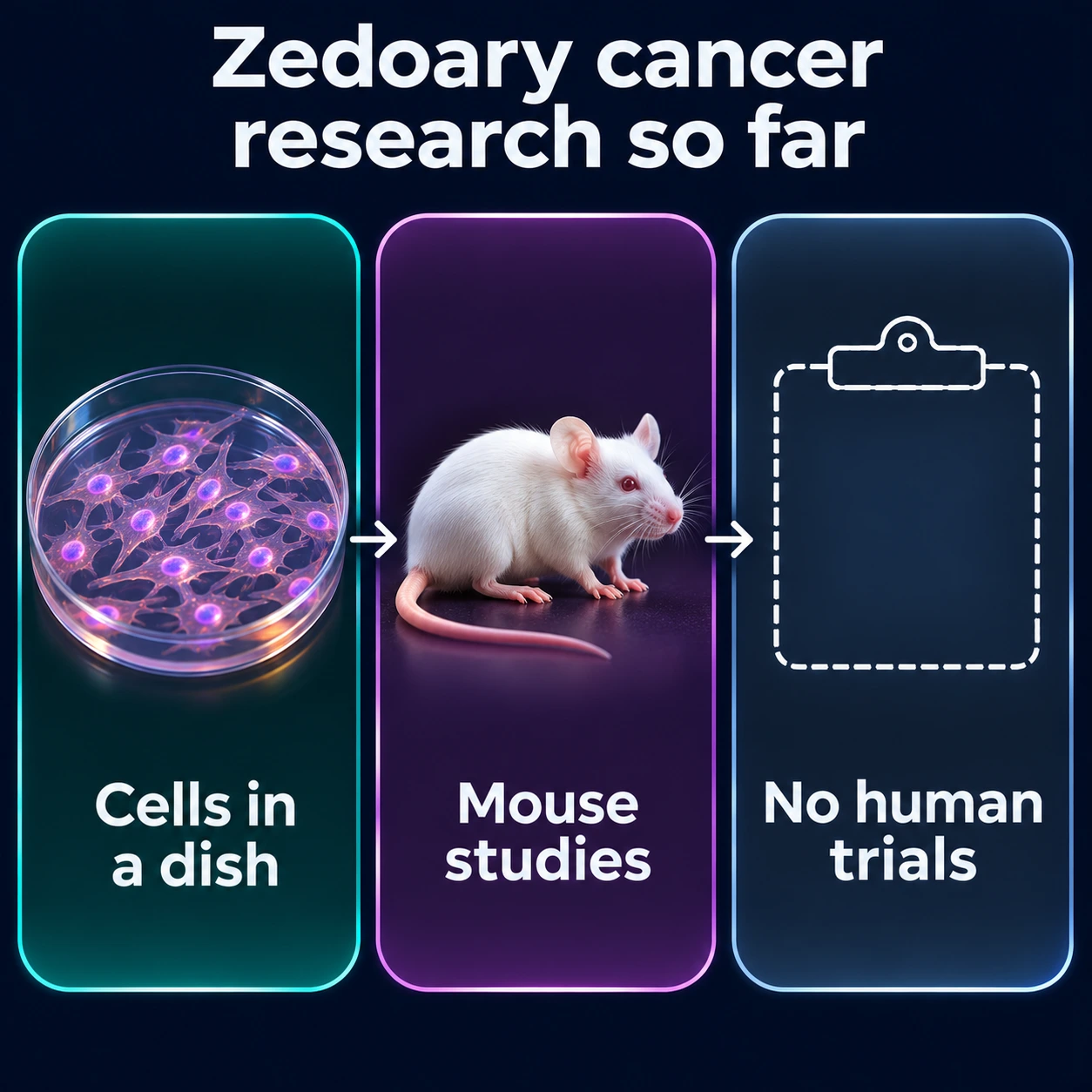
⚠ Evidence warning: Clinical trials or other evidence do not support the claim that zedoary treats cancer: no human trial of the rhizome, powder, tea or extract exists, and the whole-herb data come from cell and mouse studies. This page keeps it as a report of what people, websites or other media say.
Zedoary and Cancer: Preclinical Cytotoxicity, β-Elemene, and the Gap to a Patient
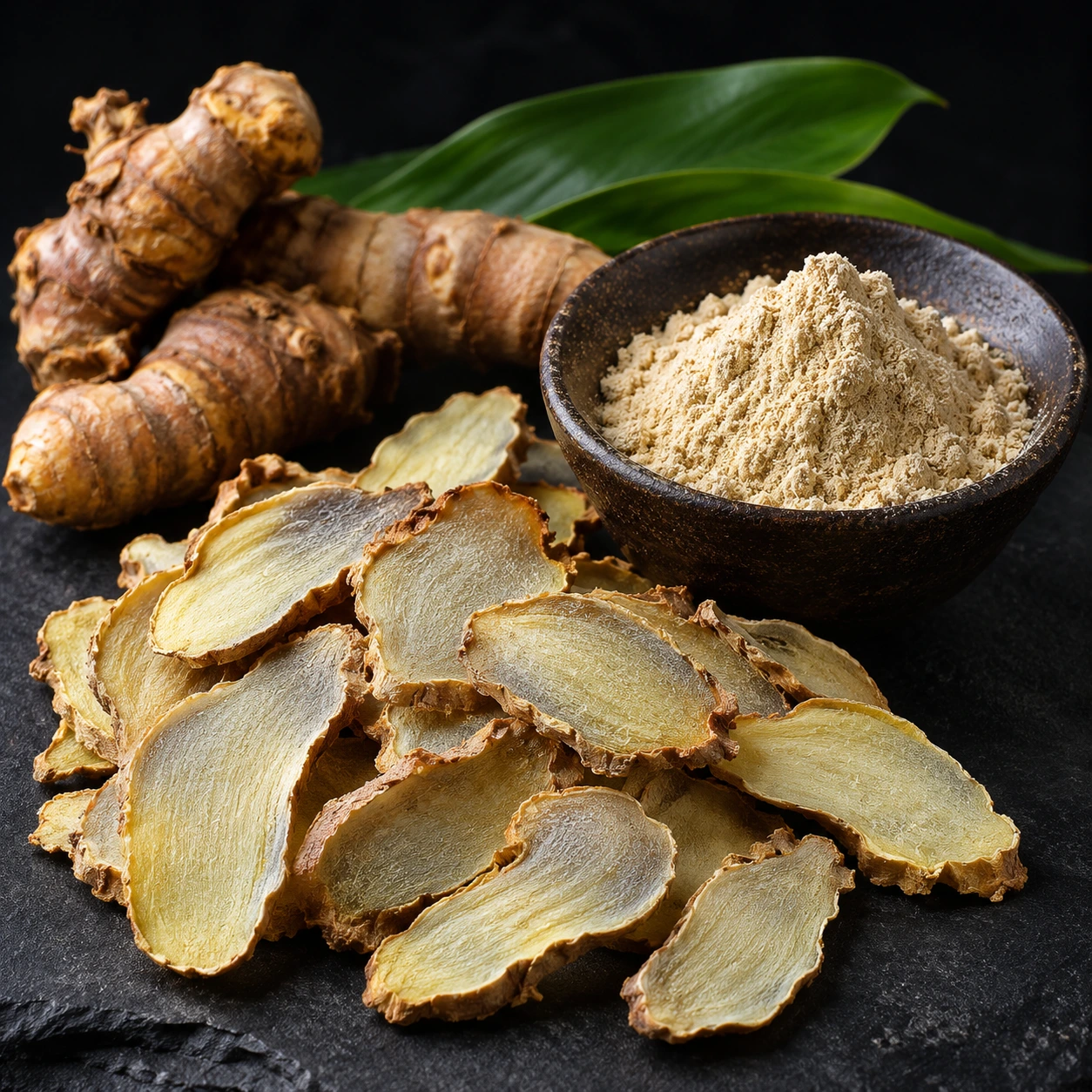
“Zedoary treats cancer” is both this herb’s oldest medicinal reputation — documented across Chinese, Ayurvedic and Southeast Asian traditions — and, as the main Curcuma zedoaria page already explains for β-elemene specifically, its most commonly overstated one. This page goes past that single compound to the full preclinical literature: what has actually been tested, in what model, at what concentration, and what the numbers mean when you do the arithmetic rather than just reading the word “cytotoxic” in an abstract.
Table of Contents
- The Claim, and What Actually Anchors It
- Reading an IC50 Number: the Arithmetic
- The Cell-Line Survey, Cancer by Cancer
- The One Oral, In-Vivo, Treatment-Design Study
- Drug-Resistance Reversal: a Better-Evidenced Sub-Claim
- The β-Elemene Injection, Revisited With the Preclinical Grounding
- Reading Preclinical Design Before the Result
- Human Data for the Whole Herb: None
- Verdict and Evidence Tier
- What Is Not Known
- Practical Cautions
- Key Research Papers
- Connections
- Featured Videos
The Claim, and What Actually Anchors It
Nearly every cell-based cytotoxicity paper on zedoary opens with a version of the same sentence: that Curcuma zedoaria “has been used as a traditional agent against malignant diseases” or “to treat various cancers” in Ayurveda and Chinese medicine. That traditional reputation is real and well documented. What follows on this page is the modern laboratory literature it has generated — a genuinely substantial body of cell-line and animal work, almost entirely preclinical, with one compound (β-elemene) that reached actual clinical use in China by an entirely different route than eating the rhizome.
Reading an IC50 Number: the Arithmetic
Cytotoxicity papers report an IC50 — the concentration that kills half the cells in a dish. The number by itself means little without a sense of scale, so here it is, stated plainly rather than left implicit.
In early-stage drug discovery, a cell-line hit is generally considered worth pursuing when its IC50 sits in the nanomolar to low-micromolar range — roughly the potency territory of paclitaxel or cisplatin against sensitive lines. Two of the cleanest, most specific zedoaria cytotoxicity papers report:
- 212–392 µM for three sesquiterpenes (including curcumenol) against human gastric cancer AGS cells.
- 125 µM for curcuzedoalide, the most potent of five compounds tested, against the same AGS cell line.
Those figures are two to three orders of magnitude higher than a “promising” drug-discovery hit — hundreds of micromolar rather than tens of nanomolar. That does not mean the effect is fake; it means it is weak by the standards that would make a chemist take a compound forward, and it means a person eating zedoary rhizome is nowhere near delivering hundreds of micromolar of a single sesquiterpene to a tumour. These figures were measured with purified single compounds, separated from the rhizome’s methanol extract by column chromatography and high-performance liquid chromatography (HPLC) — not with the whole rhizome. The crude methanol extract itself, in the curcuzedoalide study, had an IC50 of 96.60 µg/mL against the same AGS cells. For contrast, curdione’s COX-2/PGE2 IC50 in the inflammation literature (discussed on the inflammation and arthritis page) was 1.1 µM — a genuinely potent number in the same rhizome’s chemistry, which shows that “zedoary compounds are weak” is not a blanket truth; potency varies enormously by compound and by target, and the cancer-cell-line numbers specifically are on the weak end.
The Cell-Line Survey, Cancer by Cancer
The literature spans a wide range of cancer types, in cell culture and in mouse tumour models, with extracts, the essential oil or isolated compounds from the rhizome:
- Gastric cancer (AGS cells). The curcumenol/sesquiterpene and curcuzedoalide papers above; curcuzedoalide’s mechanism traced to activation of caspase-8, caspase-9, caspase-3 and poly(ADP-ribose) polymerase (PARP) — the standard apoptosis-execution pathway.
- Breast cancer (MCF-7). Curdione suppressed tumour growth in a xenograft nude-mouse model in a dose-dependent manner, and induced apoptosis in vitro via decreased mitochondrial membrane potential, increased cleaved caspase-3/9 and Bax, and decreased Bcl-2.
- Triple-negative breast cancer (MDA-MB-231). A petroleum-ether extract of the rhizome inhibited proliferation and, combined with docetaxel, reversed docetaxel resistance in both a resistant cell line and a xenograft mouse model — discussed further below.
- Ovarian cancer (SKOV3). Zedoary essential oil combined with paclitaxel synergistically enhanced apoptosis and suppressed proliferation compared with either agent alone, via increased caspase-3 and PARP.
- Esophageal cancer (TE-8). Discussed in detail in the next section — the one study using oral administration in a living animal.
- Non-small-cell lung cancer (H1299). Zedoary essential oil induced apoptosis via caspase-3/8/9 activation, altered Bcl-2/Bax ratio, and release of cytochrome c, apoptosis-inducing factor (AIF) and endonuclease G; intraperitoneal administration of the oil significantly suppressed tumour growth in vivo.
- Renal cell carcinoma (786-O, Caki-1). A 2026 study on germacrone found it suppressed proliferation, migration and invasion, promoted apoptosis and cell-cycle arrest, and significantly inhibited tumour growth in a xenograft mouse model — via a novel mechanism (the c-Fos/SREBP1 axis) disrupting the cancer cells’ own fatty-acid and cholesterol synthesis, “without detectable systemic toxicity” in the treated mice.
- Ovarian cancer, a second line. A separate 2013 study tested a single purified compound from the rhizome, α-curcumene — not a zedoary extract — on SiHa cells, which the authors describe as human ovarian cancer cells. It cut cell viability by more than 73% over 48 hours, with release of mitochondrial cytochrome c and caspase-3 activation, the signs of apoptosis.
Five of these eight lines of work also used a mouse tumour model — the curdione breast-cancer, triple-negative breast-cancer, esophageal, lung and renal studies; the gastric (AGS), SKOV3 ovarian and α-curcumene studies are cell-culture-only. Where an in-vivo tumour model was used, it is worth noting the route explicitly, because it matters for what the finding does and does not support: the lung-cancer study used intraperitoneal injection of the essential oil directly into the animal’s abdominal cavity — a parenteral route, not oral, for the same reasons of poor oral bioavailability that make the β-elemene injection an injection in the first place.
The One Oral, In-Vivo, Treatment-Design Study
One study in this literature stands apart on design, and it is worth flagging as the strongest single piece of evidence in this set precisely because of what it avoided. Hadisaputri and colleagues (2015) treated human esophageal carcinoma (TE-8) cells with a rhizome extract and separately gave the same extract orally to tumour-bearing mice. Tumour formation was significantly suppressed by the oral extract. This is the one anticancer study in the entire zedoaria literature that used both a whole-rhizome extract (not an isolated purified compound) and the oral route (not injection) in a living animal with an established tumour (not a prophylaxis design). Every one of those three features answers a standing objection this doctrine raises elsewhere on this site — route substitution, compound substitution, and pretreatment-versus-treatment design — which is exactly why it is highlighted rather than buried in the list above. It is also, notably, a single study from a single laboratory, unreplicated, and still several steps short of a human trial.
Drug-Resistance Reversal: a Better-Evidenced Sub-Claim
A distinct and mechanistically coherent group of studies looks not at whether zedoary compounds kill cancer cells outright, but at whether they can restore a chemotherapy drug’s effectiveness against cells that have become resistant to it. This sub-claim has its own, separate evidence base:
- Two related papers (2014) found β-elemene reversed cisplatin resistance in A549/DDP lung adenocarcinoma cells — a cell line deliberately selected for resistance to the chemotherapy drug cisplatin (DDP) — via decreased mitochondrial membrane potential, increased reactive oxygen species, decreased P-glycoprotein (the drug-efflux pump most responsible for multidrug resistance), and activation of the mitochondrial apoptosis pathway (cytochrome c release, caspase-3 activation, altered Bcl-2/Bad ratio).
- A 2021 study found a petroleum-ether zedoary extract reversed docetaxel resistance in triple-negative breast cancer cells, both in vitro and in a xenograft mouse model, by suppressing the pregnane X receptor (PXR) and the downstream drug-resistance machinery it controls (multidrug resistance 1 (MDR1), breast cancer resistance protein (BCRP) and cytochrome P450 3A4 (CYP3A4)).
Drug-resistance reversal is mechanistically more plausible as a real phenomenon than de-novo cytotoxicity at the concentrations discussed above, because P-glycoprotein and PXR inhibition are well-characterised, druggable mechanisms independent of zedoary — this is the same reason grapefruit-juice-type interactions are taken seriously elsewhere in pharmacology. It is still cell-line and xenograft work, not a clinical trial of zedoary as a chemotherapy adjunct in patients, and P-glycoprotein/PXR inhibition is exactly the kind of drug-interaction mechanism that cuts both ways: something that can restore a resistant tumour’s drug sensitivity can just as easily alter the levels of other, unrelated drugs a patient is taking. See Practical Cautions.
The β-Elemene Injection, Revisited With the Preclinical Grounding
The main Curcuma zedoaria page already covers the essential facts: β-elemene, isolated and purified from this rhizome, is formulated as an emulsion injection, and also as an oral emulsion, and approved in China as an adjunct to chemotherapy or radiotherapy, not a stand-alone cure, and not approved by the U.S. Food and Drug Administration (FDA), European Medicines Agency (EMA) or UK Medicines and Healthcare products Regulatory Agency (MHRA). The drug-resistance-reversal mechanism above is directly relevant to why it is used as an adjunct rather than a first-line agent: its most plausible clinical role, on the mechanistic evidence, is restoring sensitivity to a chemotherapy drug that has stopped working well on its own, not replacing that drug. This is a case where the doctrine of asking “where has this mechanism’s ceiling already been established” applies cleanly — the ceiling is visible in the approval itself: a licensed, injected, purified compound derived from this plant is approved only as an add-on, which tells you the honest best case for the whole herb, taken by mouth, is considerably below even that.
Two meta-analyses of the purified compound in people, both searching Chinese as well as English-language databases, put numbers on that add-on role. They are trials of elemene, not of the herb:
- With chemotherapy (2023). A systematic review that searched English and Chinese databases for trials of elemene injection and oral emulsion found that adding elemene to chemotherapy was linked to a higher response rate (risk ratio 1.48), better disease control (risk ratio 1.20), better 1-year (risk ratio 1.34) and 2-year (risk ratio 1.57) survival, and fewer cases of severe low white-blood-cell counts (grade III–IV leukopenia, risk ratio 0.46). Elemene also raised the rate of vein inflammation at the drip site (phlebitis) more than threefold (risk ratio 3.41). The benefit grew smaller as treatment time and the number of cycles increased.
- With chemoembolization for liver cancer (2019). A meta-analysis of 10 studies with 543 people with liver cancer that could not be removed by surgery (unresectable hepatocellular carcinoma) found that elemene injection added to transcatheter arterial chemoembolization (TACE) improved the tumour response rate (odds ratio 2.72) and 1-year survival (odds ratio 2.79) compared with chemoembolization alone, with no significant difference in stomach and bowel upset, fever or bone-marrow suppression.
Reading Preclinical Design Before the Result
Three recurring design features are worth checking in any zedoary cancer paper, because they change what the result means:
- Cell line versus living tumour. Much of the zedoary cancer literature, including three of the eight studies above, is cell-culture only. A compound that kills cancer cells in a dish at 100–400 µM has not been shown to reach a tumour at any comparable concentration in a living body, let alone by mouth.
- Injected versus oral route, where an animal model was used at all. The lung-cancer in-vivo work used intraperitoneal injection of the oil. The docetaxel-resistance work used the extract systemically in a xenograft but does not specify oral dosing throughout. Only the esophageal-cancer study above is clearly both oral and in a living tumour-bearing animal.
- Xenograft models use immunodeficient mice. Human tumour cells are grown in mice bred to lack a functioning immune system specifically so the graft is not rejected. That is necessary for the experiment to work at all, and it also means these models cannot show anything about how a compound interacts with a patient’s own immune response to a tumour — increasingly understood to be central to how many real cancer therapies work.
Human Data for the Whole Herb: None
No clinical trial of zedoary rhizome, powder, tea or extract — as opposed to the isolated, purified β-elemene compound — for any cancer, in any population, was located in this review. The traditional reputation is centuries old; the modern clinical translation belongs entirely to one isolated, purified molecule, elemene, given as an injection or as an oral emulsion — a purified drug, not the rhizome or any traditional preparation of it.
Verdict and Evidence Tier
- Tier: preclinical, with one clinical exception that does not transfer. A genuinely large cell-culture and rodent literature across many cancer types; one licensed adjunct drug made from an isolated, purified compound given by injection or as an oral emulsion.
- Verdict on whole-herb human efficacy: absent. No trial exists.
- Verdict on cell-line cytotoxicity: real but weak, at concentrations two to three orders of magnitude above a promising drug-discovery threshold for the cleanest-reported compounds.
- Verdict on drug-resistance reversal: the most mechanistically coherent sub-claim, resting on well-characterised pharmacology (P-glycoprotein, PXR), still confined to cell lines and xenografts.
- Verdict on β-elemene: the strongest real-world translation, and explicitly not evidence for the rhizome — different compound (a purified isolate), different preparation (an injection or an oral emulsion), different dose, approved only as an adjunct.
What Is Not Known
- No human trial of whole zedoary rhizome, powder or extract for any cancer.
- No oral bioavailability data for any of the named cytotoxic sesquiterpenes in humans, so no way to estimate what fraction of the effective in-vitro concentration an oral dose could plausibly deliver.
- No data on whether the drug-resistance-reversal mechanism, if real in a person, would meaningfully affect the levels of other prescribed medications — a question that matters more, not less, for anyone already on chemotherapy.
- No comparison of raw rhizome, standard extract and essential oil against each other in any single cancer model, so it is not established which preparation (if any) carries the most of whatever activity exists.
- No replication of the one oral in-vivo esophageal-cancer study by an independent laboratory.
Practical Cautions
No human trial has tested zedoary rhizome as a cancer treatment, and the rhizome is not the same thing as the purified β-elemene drug described above. The concern that matters most for people on chemotherapy, targeted therapy or immunotherapy is an interaction, for a specific mechanistic reason: the drug-resistance-reversal literature above shows zedoary compounds interacting directly with P-glycoprotein and the pregnane X receptor, the same transport and metabolism machinery that governs blood levels of many chemotherapy drugs and a great many other prescription medications besides. A mechanism documented for restoring a drug’s effect on a resistant tumour is the same mechanism that could unpredictably raise or lower the level of an unrelated drug taken at the same time. That risk exists whether or not the anticancer effect itself is real.
Key Research Papers
- Hadisaputri YE, Miyazaki T, Suzuki S, et al. Molecular characterization of antitumor effects of the rhizome extract from Curcuma zedoaria on human esophageal carcinoma cells. International Journal of Oncology. 2015;47(6):2255-63. PubMed PMID: 26498695. The one oral, in-vivo, treatment-design study.
- Lee TK, Lee D, Lee SR, et al. Sesquiterpenes from Curcuma zedoaria rhizomes and their cytotoxicity against human gastric cancer AGS cells. Bioorganic Chemistry. 2019;87:117-122. PubMed PMID: 30884305. The 212–392 µM IC50 figures.
- Jung EB, Trinh TA, Lee TK, et al. Curcuzedoalide contributes to the cytotoxicity of Curcuma zedoaria rhizomes against human gastric cancer AGS cells through induction of apoptosis. Journal of Ethnopharmacology. 2018;213:48-55. PubMed PMID: 29102767.
- Li J, Bian WH, Wan J, et al. Curdione inhibits proliferation of MCF-7 cells by inducing apoptosis. Asian Pacific Journal of Cancer Prevention. 2014;15(22):9997-10001. PubMed PMID: 25520141. Xenograft plus in-vitro apoptosis data.
- Zhou Y, Shen J, Xia L, Wang Y. Curcuma zedoaria (Berg.) Rosc. essential oil and paclitaxel synergistically enhance the apoptosis of SKOV3 cells. Molecular Medicine Reports. 2015;12(1):1253-7. PubMed PMID: 25777341.
- Wang B, Zhang R, Wu M, et al. Germacrone suppresses renal cancer growth by regulating c-Fos-mediated lipid metabolism. Lipids in Health and Disease. 2026;25(1):116. PubMed PMID: 41832498. Xenograft tumour suppression “without detectable systemic toxicity.”
- Yao C, Jiang J, Tu Y, et al. β-elemene reverses the drug resistance of A549/DDP lung cancer cells by activating intracellular redox system, decreasing mitochondrial membrane potential and P-glycoprotein expression, and inducing apoptosis. Thoracic Cancer. 2014;5(4):304-12. PubMed PMID: 26767017.
- Yao CC, Tu YR, Jiang J, et al. β-elemene reverses the drug resistance of lung cancer A549/DDP cells via the mitochondrial apoptosis pathway. Oncology Reports. 2014;31(5):2131-8. PubMed PMID: 24627125. Companion study to the above from the same research group.
- Ahmed Hamdi OA, Syed Abdul Rahman SN, Awang K, et al. Cytotoxic constituents from the rhizomes of Curcuma zedoaria. The Scientific World Journal. 2014;2014:321943. PubMed PMID: 25126594.
- Syu WJ, Shen CC, Don MJ, et al. Cytotoxicity of curcuminoids and some novel compounds from Curcuma zedoaria. Journal of Natural Products. 1998;61(12):1531-4. PubMed PMID: 9868158.
- Qiao EQ, Yang HJ, Yu XF, et al. Curcuma zedoaria petroleum ether extract reverses the resistance of triple-negative breast cancer to docetaxel via pregnane X receptor. Annals of Translational Medicine. 2021;9(17):1389. PubMed PMID: 34733941.
- Chen CC, Chen Y, Hsi YT, et al. Chemical constituents and anticancer activity of Curcuma zedoaria Roscoe essential oil against non-small cell lung carcinoma cells in vitro and in vivo. Journal of Agricultural and Food Chemistry. 2013;61(47):11418-27. PubMed PMID: 24199734. Intraperitoneal, not oral, in-vivo dosing.
- Shin Y, Lee Y. Cytotoxic activity from Curcuma zedoaria through mitochondrial activation on ovarian cancer cells. Toxicological Research. 2013;29(4):257-61. PubMed PMID: 24578796. Tested the isolated compound α-curcumene.
- Pan Y, Wan P, Zhang L, Wang C, Wang Y. Clinical benefit and risk of elemene in cancer patients undergoing chemotherapy: a systematic review and meta-analysis. Frontiers in Pharmacology. 2023;14:1185987. PubMed PMID: 37601061. Elemene injection and oral emulsion with chemotherapy; phlebitis risk.
- Yao Y, Chen J, Jiao D, Li Y, Zhou X, Han X. Elemene injection combined with transcatheter arterial chemoembolization for unresectable hepatocellular carcinoma: a meta-analysis. Medicine (Baltimore). 2019;98(44):e17813. PubMed PMID: 31689867.
Connections
- All Herbs
- Zedoary (Curcuma zedoaria) — the main article, including the full β-elemene and Chinese-injectable account.
- Zedoary Benefits Deep Dive — the hub.
- Zedoary for Inflammation and Arthritis — the same sesquiterpene chemistry, a different endpoint, and curdione’s much more potent 1.1 µM figure for comparison.
- Zedoary and the Liver — including the cytochrome P450 3A4 (CYP3A4) drug-interaction literature, directly relevant to the resistance-reversal mechanism on this page.
- Zedoary for Wound Healing and Topical Use.
- Turmeric (Curcuma longa) — the curcumin anticancer literature this page’s findings are routinely, incorrectly borrowed from.
- Oncology — the disease-category landing page.
- Cancer — the overview page, including where drug-interaction risk from a supplement matters most.