Stevia and Blood Pressure
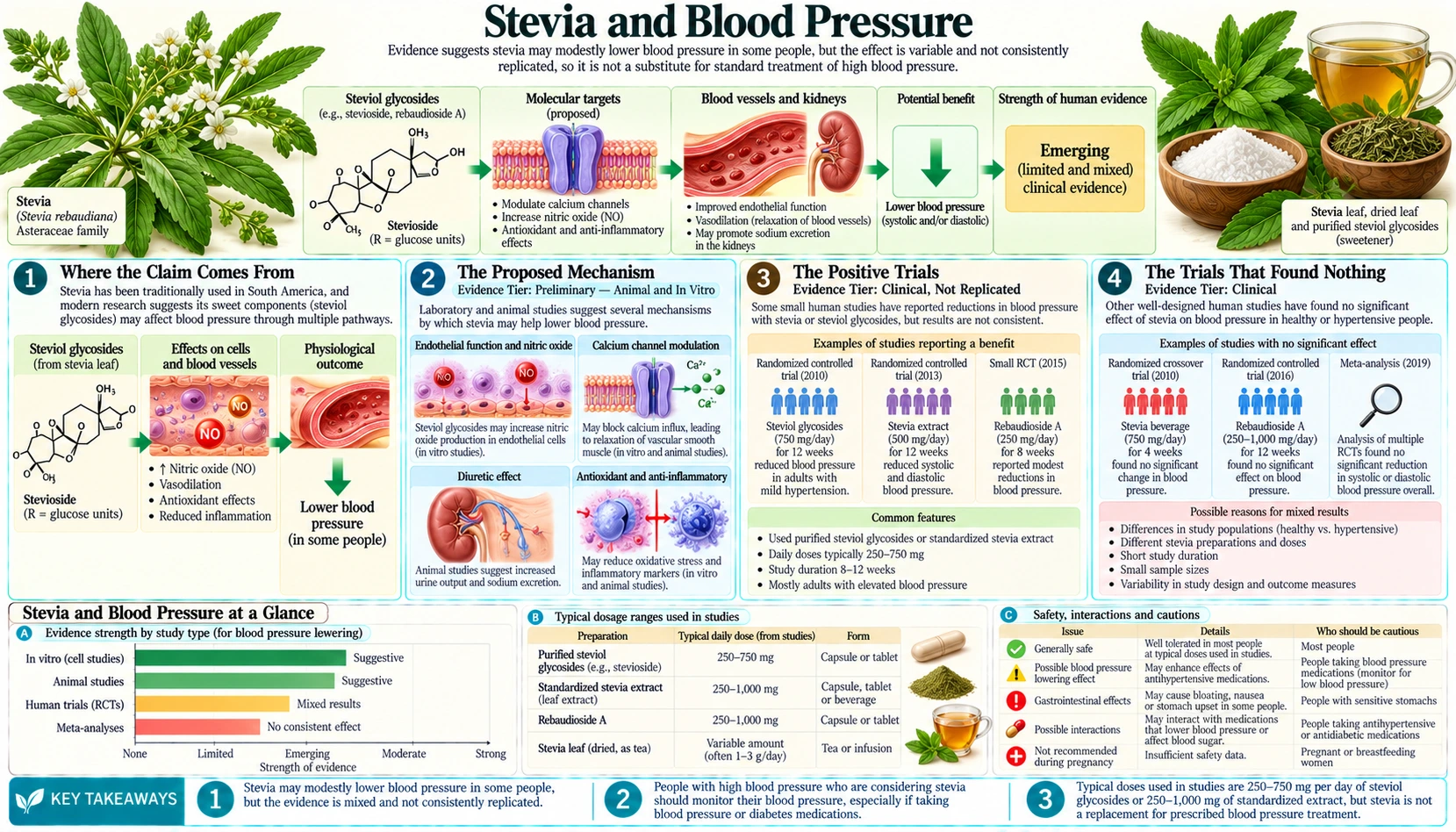
This is the weakest of stevia's four commonly cited benefits, and this page says so at the top rather than at the bottom. The blood-pressure claim rests on a small number of long trials conducted by a small number of related research groups, using stevioside at doses many times higher than anyone consumes as a sweetener, and it was not reproduced when independent groups elsewhere tried. Later trials designed to detect a blood-pressure effect found none.
That does not make the original results fraudulent or uninteresting. It makes them unreplicated, which in clinical research is a specific and important status. This page lays out what was found, by whom, at what dose, and what happened when others looked.
Table of Contents
- Where the Claim Comes From
- The Proposed Mechanism
- The Positive Trials
- The Trials That Found Nothing
- The Dose Gap
- Reading an Unreplicated Literature
- What the Systematic Reviews Concluded
- The Indirect Route That Does Work
- Which "Stevia" Was Even Tested
- What Actually Lowers Blood Pressure
- Key Research Papers
- Safety Note and Disclaimer
- Connections
- Featured Videos
1. Where the Claim Comes From
Between 2000 and 2003, two clinical trials from one Taiwan-based research group, with overlapping authors, reported that oral stevioside lowered blood pressure substantially in Chinese people with hypertension, over trial durations of one and two years respectively. Those two papers are the origin of essentially every "stevia lowers blood pressure" claim in circulation today, twenty-odd years later.
Long randomized trials in hypertension are rare and expensive, so a one-year and a two-year trial carry real weight on paper. The problem is what happened next, or rather what did not.
2. The Proposed Mechanism (Evidence Tier: Preliminary — Animal and In Vitro)
The mechanistic story is coherent, which is part of why the claim persists. Work in isolated vessels and in animals has reported that stevioside and its aglycone steviol reduce calcium influx through voltage-gated calcium channels in vascular smooth muscle, producing vasodilation. That is broadly the mechanism of the dihydropyridine calcium channel blocker drug class — amlodipine and its relatives.
Additional preclinical reports have proposed effects on nitric-oxide-mediated vasorelaxation, on renin-angiotensin signalling, and on renal handling of sodium. Some spontaneously hypertensive rat studies show blood-pressure reduction with stevioside.
Every one of those findings is preclinical. A compound that relaxes an isolated aortic ring at a bath concentration says nothing about whether the same compound reaches a comparable concentration at the same tissue in a living person consuming milligrams of it in coffee. In stevia's case there is a specific reason to doubt that it does: steviol glycosides are not absorbed intact, and what reaches the circulation is steviol glucuronide, a conjugate on its way to the kidney — not the parent glycoside used in the vessel-bath experiments.
3. The Positive Trials (Evidence Tier: Clinical, Not Replicated)
- Chan and colleagues (2000), A double-blind placebo-controlled study of the effectiveness and tolerability of oral stevioside in human hypertension, British Journal of Clinical Pharmacology. 106 Chinese adults with hypertension (diastolic pressure between 95 and 110 mmHg) received 250 mg of stevioside three times daily — 750 mg/day — or placebo for one year. After 3 months, blood pressure in the stevioside group had fallen significantly (systolic from 166.0 to 152.6 mmHg, diastolic from 104.7 to 90.3 mmHg), and the effect persisted during the whole year. Tolerability was reported as good.
- Hsieh and colleagues (2003), Efficacy and tolerability of oral stevioside in patients with mild essential hypertension: a two-year, randomized, placebo-controlled study, Clinical Therapeutics. A larger and longer trial — 500 mg of stevioside three times daily, 1,500 mg/day, for two years — in Chinese people with mild essential hypertension. Of 174 patients enrolled, 168 completed the trial. It again reported significant falls in systolic and diastolic blood pressure versus placebo: after 2 years, systolic pressure in the stevioside group went from 150 to 140 mmHg and diastolic from 95 to 89 mmHg. Going by the patients' own home readings, the effect began about 1 week after the start of treatment. After 2 years, 6 of 52 patients (11.5%) in the stevioside group had left ventricular hypertrophy (a thickened heart wall), against 17 of 50 (34.0%) on placebo. It also reported improvements in quality-of-life measures and no significant adverse effects.
Both are properly randomized, placebo-controlled and double-blind. Neither is a small pilot. On their own terms they are decent trials.
4. The Trials That Found Nothing (Evidence Tier: Clinical)
Independent groups elsewhere tried and did not reproduce the finding.
- Ferri and colleagues (2006), Investigation of the antihypertensive effect of oral crude stevioside in patients with mild essential hypertension, Phytotherapy Research. Conducted in Brazil, in previously untreated people with mild essential hypertension — the same kind of patients the earlier trials targeted. Crude stevioside was stepped up from 3.75 to 7.5 and then 15.0 mg/kg/day over 24 weeks. Blood pressure fell during treatment, but it fell similarly in the placebo group, so no antihypertensive effect was found.
- Barriocanal and colleagues (2008), Apparent lack of pharmacological effect of steviol glycosides used as sweeteners in humans, Regulatory Toxicology and Pharmacology. A pilot study conducted in Paraguay: three months of stevioside at 250 mg three times daily (750 mg/day — the same daily dose as Chan 2000) or placebo, in people with type 1 diabetes, people with type 2 diabetes, and people without diabetes whose blood pressure was normal or low-normal. Blood pressure was a pre-specified measurement. No effect was found. The paper's title states its conclusion.
- Maki and colleagues (2008), The hemodynamic effects of rebaudioside A in healthy adults with normal and low-normal blood pressure, Food and Chemical Toxicology. A trial designed specifically around the hypotension question, giving 1,000 mg/day of rebaudioside A or placebo for 4 weeks to 100 adults whose starting blood pressure averaged about 110/70 mmHg. No clinically important change in clinic blood pressure, 24-hour ambulatory blood pressure or heart rate. The companion trial in adults with type 2 diabetes, published in the same journal and year, found the same.
Note the shape of this. Only Ferri 2006 repeated the test in people with high blood pressure. Barriocanal 2008 was a pilot study in people with diabetes or with normal or low-normal blood pressure, and Maki 2008 enrolled people with normal and low-normal blood pressure. All three measured blood pressure as a planned outcome; Barriocanal 2008 used the same daily dose as Chan 2000, and Maki 2008 gave 1,000 mg/day of rebaudioside A.
5. The Dose Gap — Why This Is Not About Sweetener Use At All
Even taking the positive trials entirely at face value, they do not describe sweetener consumption. They describe drug administration.
- Chan 2000 used 750 mg/day of stevioside. Hsieh 2003 used 1,500 mg/day.
- The Acceptable Daily Intake (ADI) set by the Joint Food and Agriculture Organization/World Health Organization Expert Committee on Food Additives (JECFA) is 4 mg/kg body weight/day as steviol equivalents. For a 70 kg adult that is 280 mg/day of steviol equivalents, which for stevioside (conversion factor about 0.40) corresponds to roughly 700 mg of stevioside.
- So the Hsieh dose sits at roughly twice the ADI, taken daily for two years. The Chan dose sits at approximately the ADI.
- Actual tabletop consumption is nowhere near either. A packet contains a few milligrams of glycoside. Intake surveys in Europe and North America generally find even high consumers well below the ADI.
The practical translation is blunt: if the blood-pressure effect were real, you would not obtain it by sweetening your coffee. You would obtain it by taking purified stevioside capsules three times a day at a dose at or above the internationally agreed intake limit, indefinitely. That is not a sweetener strategy; it is unsupervised self-medication with an unapproved drug.
6. How to Read a Literature That Did Not Replicate
Two features of this evidence base deserve stating plainly, because they are the reason systematic reviewers have been unenthusiastic:
- Geographic and group clustering. The positive results came from a small number of related investigators working in one region. The negative results came from independent groups in Brazil, Paraguay and the United States. When a finding survives only within its originating group, the most common explanations are population differences, methodological differences, or publication and analytical choices — not necessarily any of them, but the clustering itself is the signal.
- Failure to replicate is more informative than the original positive. This is uncomfortable but standard. A positive result establishes a hypothesis; a well-powered negative replication at the same or higher dose substantially weakens it. Here there are three negative trials, but only one of them (Ferri 2006) was a replication in people with high blood pressure; the other two were a pilot study and a 4-week trial in people with normal or low-normal blood pressure.
There are legitimate counter-arguments. Trial durations differed — one and two years versus three to four months — and it is conceivable that a slow vascular effect needs longer than a season to appear. Baseline blood pressure differed between populations, and antihypertensive effects are generally larger in people with higher starting pressure. Crude stevioside preparations differ from purified rebaudioside A in composition. None of these rescue the claim; they only explain why it has not been definitively closed.
7. What the Systematic Reviews Concluded
Onakpoya and Heneghan (2015), Effect of the natural sweetener, steviol glycoside, on cardiovascular risk factors: a systematic review and meta-analysis of randomised clinical trials, European Journal of Preventive Cardiology, pooled nine randomized trials with 756 participants on steviol glycosides and cardiovascular risk factors including blood pressure. The difference in systolic blood pressure between steviol glycoside and placebo was not significant (mean difference −2.98 mmHg, −6.23 to 0.27), but significant reductions in diastolic blood pressure and fasting blood glucose were observed. The authors concluded that stevioside may generate reductions in blood pressure and fasting blood glucose, that the sizes of the effects are small, and that the substantial heterogeneity between trials limits the robustness of any conclusions; rebaudioside A did not appear to have any significant effect on blood pressure. They called for further clinical trials.
Bundgaard Anker and colleagues (2019), Effect of Steviol Glycosides on Human Health with Emphasis on Type 2 Diabetic Biomarkers: A Systematic Review and Meta-Analysis of Randomized Controlled Trials, Nutrients, pooled nine randomized trials from seven studies with 462 participants. It reported an overall significant reduction in systolic blood pressure in favour of steviol glycosides compared with placebo (mean difference −6.32 mmHg). The reductions in diastolic blood pressure, fasting blood glucose and total cholesterol were not significant, and the trials differed significantly from one another (heterogeneity) in several analyses. The authors called for more studies.
Toews and colleagues (2019), Association between intake of non-sugar sweeteners and health outcomes: systematic review and meta-analyses of randomised and non-randomised controlled trials and observational studies, BMJ, examined non-sugar sweeteners as a group, in generally healthy adults and children, across a wide range of endpoints including blood pressure. Most health outcomes did not seem to differ between people who used non-sugar sweeteners and people who did not, and the authors noted that most studies were small and short, so confidence in the results is limited.
Taken together, the reviews report mixed results: small blood-pressure effects, seen mainly with stevioside rather than rebaudioside A, with large differences between trials.
PubMed: steviol glycosides and cardiovascular risk factors, systematic review
8. The Indirect Route That Does Work
There is a real, evidence-backed way stevia can end up associated with better blood pressure, and it has nothing to do with vascular smooth muscle.
High intake of sugar-sweetened beverages is associated with higher blood pressure and with weight gain, and weight loss is one of the most reliable non-drug blood-pressure interventions there is — roughly 1 mmHg of systolic reduction per kilogram lost, in the trial literature. Replacing sugary drinks with stevia-sweetened ones reduces calorie intake modestly, as covered on the Weight and Calorie Control page. McGlynn and colleagues (2022) in JAMA Network Open found that substituting low- and no-calorie sweetened beverages for sugar-sweetened ones improved body weight and several cardiometabolic markers.
That is a genuine benefit obtained by an entirely ordinary mechanism: less sugar, less weight, lower pressure. It is worth having. It is also not what the supplement copy is claiming.
9. Which "Stevia" Was Even Tested
The three products sold under the name behave differently here as everywhere else:
- Whole stevia leaf — traditional Guaraní use, not approved as a sweetener in the US or EU. No blood-pressure trial has used whole leaf. The traditional record does not include an antihypertensive indication either.
- Purified steviol glycosides (E 960) — what the trials used, in capsule form at pharmacological doses. Chan and Hsieh used crude or purified stevioside; Maki used rebaudioside A. These are different compounds sharing one core, and it is at least possible they behave differently, though nothing establishes that they do.
- Retail tabletop products — mostly erythritol or dextrose with a trace of rebaudioside. Nothing in any trial says anything about these. The Microbiome and Safety page covers the separate 2023 cardiovascular signal attached to erythritol, which is a bulking-agent question and not a stevia question — a distinction almost universally lost in news coverage.
10. What Actually Lowers Blood Pressure
The measures with trial evidence for lowering blood pressure are:
- Sodium reduction — the Dietary Approaches to Stop Hypertension (DASH)-Sodium trials remain among the clearest dietary evidence in cardiology.
- Weight loss — approximately 1 mmHg systolic per kilogram in trial data.
- Aerobic exercise — see Exercise.
- Dietary potassium from vegetables and fruit.
- Alcohol reduction.
- The DASH and Mediterranean dietary patterns — see Mediterranean Diet.
- Prescribed antihypertensive medication where indicated. See Hypertension.
Key Research Papers
Each entry links to its PubMed record.
- Chan P et al. A double-blind placebo-controlled study of the effectiveness and tolerability of oral stevioside in human hypertension. British Journal of Clinical Pharmacology, 2000. — PubMed PMID: 10971305
- Hsieh MH et al. Efficacy and tolerability of oral stevioside in patients with mild essential hypertension: a two-year, randomized, placebo-controlled study. Clinical Therapeutics, 2003. — PubMed PMID: 14693305
- Ferri LA et al. Investigation of the antihypertensive effect of oral crude stevioside in patients with mild essential hypertension. Phytotherapy Research, 2006. — PubMed PMID: 16775813
- Barriocanal LA et al. Apparent lack of pharmacological effect of steviol glycosides used as sweeteners in humans. Regulatory Toxicology and Pharmacology, 2008. — PubMed PMID: 18397817
- Maki KC et al. The hemodynamic effects of rebaudioside A in healthy adults with normal and low-normal blood pressure. Food and Chemical Toxicology, 2008. — PubMed PMID: 18555574
- Maki KC et al. Chronic consumption of rebaudioside A, a steviol glycoside, in men and women with type 2 diabetes mellitus. Food and Chemical Toxicology, 2008. — PubMed PMID: 18555575
- Onakpoya IJ, Heneghan CJ. Effect of the natural sweetener, steviol glycoside, on cardiovascular risk factors: a systematic review and meta-analysis of randomised clinical trials. European Journal of Preventive Cardiology, 2015. — PubMed PMID: 25412840
- Bundgaard Anker CC, Rafiq S, Jeppesen PB. Effect of Steviol Glycosides on Human Health with Emphasis on Type 2 Diabetic Biomarkers: A Systematic Review and Meta-Analysis of Randomized Controlled Trials. Nutrients, 2019. — PubMed PMID: 31438580
- Toews I et al. Association between intake of non-sugar sweeteners and health outcomes: systematic review and meta-analyses of randomised and non-randomised controlled trials and observational studies. BMJ, 2019. — PubMed PMID: 30602577
- McGlynn ND et al. Association of low- and no-calorie sweetened beverages as a replacement for sugar-sweetened beverages with body weight and cardiometabolic risk. JAMA Network Open, 2022. — PubMed PMID: 35285920
- Geuns JM. Stevioside. Phytochemistry, 2003. — PubMed PMID: 14561506
- Ashwell M. Stevia, nature's zero-calorie sustainable sweetener: a new player in the fight against obesity. Nutrition Today, 2015. — PubMed PMID: 27471327
- Samuel P et al. Stevia leaf to stevia sweetener: exploring its science, benefits, and future potential. The Journal of Nutrition, 2018. — PubMed PMID: 29982648
12. Safety Note and Disclaimer
The trials above do not show that stevia reliably lowers blood pressure, and stopping or reducing blood-pressure medication leaves high blood pressure untreated. Untreated hypertension causes stroke, heart failure, kidney disease and vision loss, usually without symptoms until damage is done.
Purified steviol glycosides are considered safe within the ADI by JECFA, the U.S. Food and Drug Administration (FDA) and European Food Safety Authority (EFSA) at sweetener-level intakes. The capsule doses used in the trials above are a different matter: taking 750 to 1,500 mg of stevioside daily for years is unsupervised use of a compound at or above its intake limit, and no regulator has evaluated that pattern of use for chronic safety. For people taking blood-pressure medication who also consume stevia at high doses, the concern is theoretical: the medication and stevioside lowering blood pressure together (additive hypotension).
Nothing on this page is medical advice, a diagnosis, or a recommendation to alter prescribed treatment. This site is an educational resource, not a treatment service.
Connections
- All Herbs
- Stevia (Stevia rebaudiana) — main topic page
- Stevia — Benefits Deep Dive
- Stevia for Blood Sugar and Diabetes
- Stevia for Weight and Calorie Control
- Stevia, the Gut Microbiome and Safety
- Hypertension
- Cardiovascular Disease
- Atherosclerosis
- Cardiology
- Metabolic Syndrome
- Obesity
- Magnesium
- Mediterranean Diet
- Exercise
- Licorice — the herb that raises blood pressure
- Artificial Sweeteners