⚠ Evidence warning: Clinical trials or other evidence do not support the claim that stevia eases a lasting move away from sugar and intense sweetness. This page keeps it as a report of what people, websites or other media say.
Stevia for Weight and Calorie Control
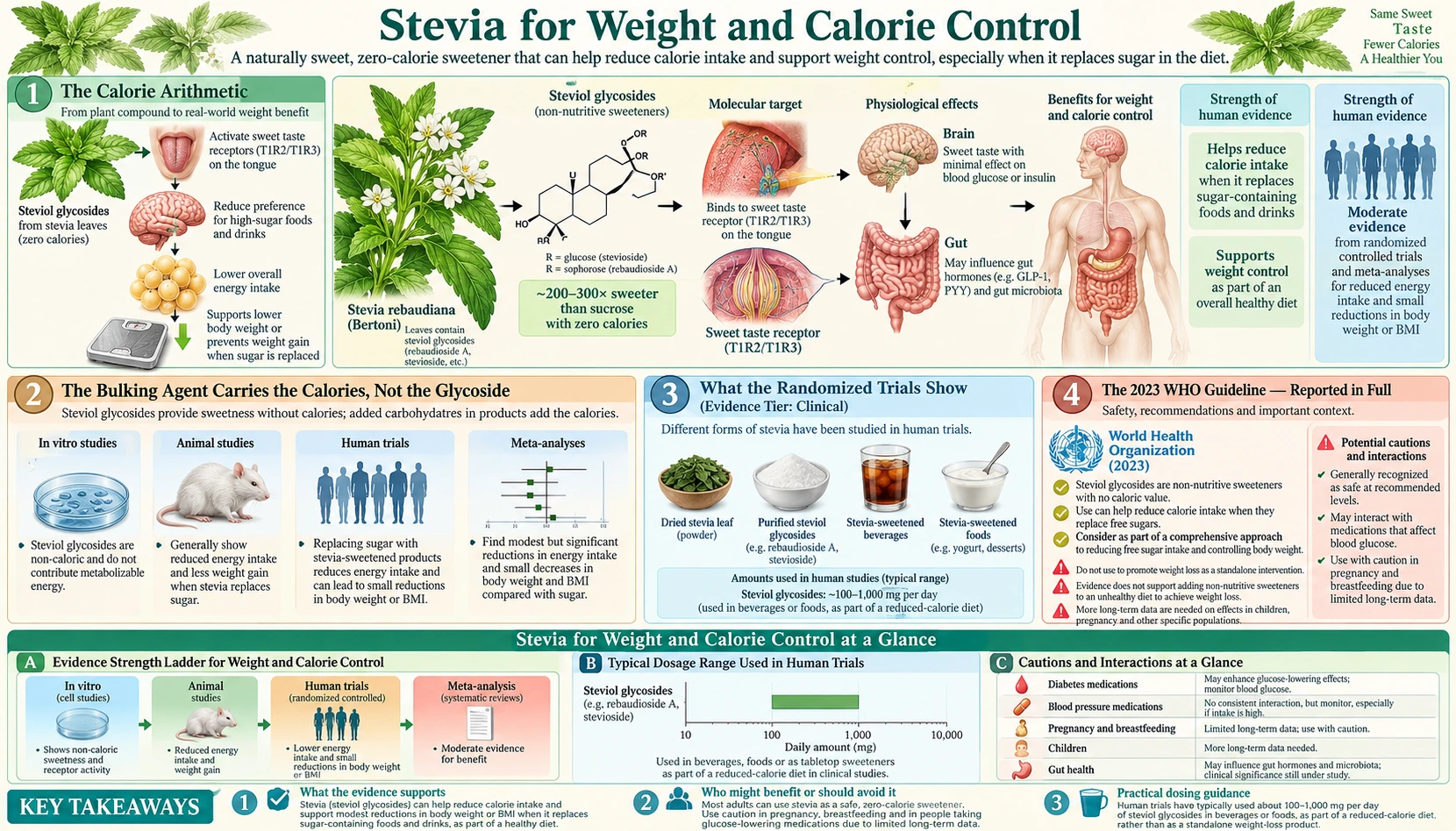
This is the most contested claim about stevia, and it is contested for an unusual reason: the randomized trials and the world's leading health authority currently point in different directions, and both are defensible. In 2023 the World Health Organization issued a guideline advising against the use of non-sugar sweeteners for weight control. That guideline covers stevia by name. This page reports it in full rather than skipping past it, then explains where it came from and where the disagreement actually lies.
The short version: substituting stevia for sugar produces a small, real reduction in calorie intake and body weight in controlled trials. It does not produce the transformation the packaging suggests, and the World Health Organization's objection is about long-term population outcomes rather than about short-term calorie arithmetic.
Table of Contents
- The Calorie Arithmetic
- The Bulking Agent Carries the Calories
- What the Randomized Trials Show
- The 2023 World Health Organization Guideline — Reported in Full
- Why the Trials and the Cohorts Disagree
- Appetite, Sweet Taste and Compensation
- Where Stevia Genuinely Helps: Drinks
- Where It Does Not Help
- How the Findings Apply in Practice
- Key Research Papers
- Safety Note and Disclaimer
- Connections
- Featured Videos
1. The Calorie Arithmetic
Purified steviol glycosides contribute no meaningful energy. They are not absorbed intact; the sugar units are cleaved off by colonic bacteria in milligram quantities, and the released steviol is conjugated in the liver and excreted in urine. Because a rebaudioside is 200 to 400 times sweeter than sucrose, the mass consumed is trivial to begin with.
So the arithmetic of pure substitution is straightforward. Sugar supplies 4 kcal per gram. A 350 ml can of regular soft drink carries roughly 35 grams of sugar, about 140 kcal. Swapping it for a stevia-sweetened version removes essentially all of that.
What the arithmetic cannot tell you is whether the person eats those calories somewhere else. That question — compensation — is the entire scientific debate, and it is why sections 5 and 6 exist.
2. The Bulking Agent Carries the Calories, Not the Glycoside
Three different products are sold as "stevia" and only one of them is reliably calorie-free.
- Whole stevia leaf — the traditional Guaraní form. Not an approved sweetener in the United States or the European Union; sold in the US only as a supplement or herbal tea. Negligible calories as consumed, but no weight-control trial evidence whatsoever.
- Purified steviol glycosides (E 960) — rebaudioside A, stevioside, and increasingly rebaudiosides D and M. The approved sweetener, acceptable daily intake (ADI) 4 mg/kg body weight/day as steviol equivalents. Effectively zero calories.
- Retail tabletop "stevia" — packets and spoonable tubs. Mostly bulking agent by weight, carrying a trace of rebaudioside. The bulk is where any calories live.
Bulking agents in common use:
- Erythritol — about 0.2 to 0.24 kcal/g, absorbed in the small intestine and excreted largely unchanged in urine. Genuinely near-zero. It has a separate cardiovascular question attached to it, discussed on the Microbiome and Safety page — and note carefully that the question belongs to erythritol, not to stevia.
- Dextrose — 4 kcal/g, and it is glucose. A packet is around 1 gram.
- Maltodextrin — 4 kcal/g, with a glycaemic index higher than table sugar.
US labelling rules permit "zero calorie" on servings under 5 kcal. A dextrose-bulked packet qualifies while still delivering about 4 kcal of glucose. One packet is noise. Eight packets a day for a year is not.
3. What the Randomized Trials Show (Evidence Tier: Clinical)
Restricting attention to randomized controlled trials of substitution — the design that can actually establish causation — the picture is consistent and modest.
- Miller and Perez (2014), Low-calorie sweeteners and body weight and composition: a meta-analysis of randomized controlled trials and prospective cohort studies, American Journal of Clinical Nutrition. In the randomized trials, substituting low-calorie sweeteners for sugar produced modest reductions in body weight, body mass index (BMI), fat mass and waist circumference. In the prospective cohorts, the same exposure was not associated with body weight or fat mass, but was associated with a slightly higher body mass index (correlation 0.03; 95% confidence interval 0.01 to 0.06). That split — trials say down, cohorts show at most a very small rise in body mass index — is the single most important fact on this page.
- Rogers and colleagues (2016), Does low-energy sweetener consumption affect energy intake and body weight? A systematic review, including meta-analyses, of the evidence from human and animal studies, International Journal of Obesity. Concluded that substituting low-energy sweeteners for sugar reduces energy intake and body weight, and that the animal evidence for compensation did not translate to humans.
- Higgins and Mattes (2019), A randomized controlled trial contrasting the effects of 4 low-calorie sweeteners and sucrose on body weight in adults with overweight or obesity, American Journal of Clinical Nutrition. A 12-week trial in 154 adults with overweight or obesity that separated the sweeteners rather than lumping them together. Sucrose and saccharin both led to weight gain (+1.85 kg and +1.18 kg) and did not differ from each other; aspartame, rebaudioside A and sucralose showed no significant change from baseline. The stevia result is the rebaudioside A arm: 28 people were assigned 1.25 to 1.75 litres a day of rebaudioside A-sweetened drinks for 12 weeks, with no significant weight change.
- Laviada-Molina and colleagues (2020), Effects of nonnutritive sweeteners on body weight and body mass index in diverse clinical contexts: systematic review and meta-analysis, Obesity Reviews. Twenty randomized trials with 2,914 participants. Small but statistically significant reductions in body weight and body mass index versus sugar comparators and on unrestricted diets; no effect against placebo or no intervention, against water, or within weight-reduction diets.
- McGlynn and colleagues (2022), Association of low- and no-calorie sweetened beverages as a replacement for sugar-sweetened beverages with body weight and cardiometabolic risk, JAMA Network Open. Substituting for sugar-sweetened beverages improved body weight and several cardiometabolic markers, and was broadly comparable to substituting water.
The magnitude matters. Pooled effects in these analyses fall at roughly one kilogram: 0.80 kg less in Miller and Perez, 1.06 kg less in McGlynn and 1.35 kg less in Rogers, whose longer trials ran from 4 weeks to 40 months. That is a real effect and a small one. It is not a weight-loss intervention; it is a way of removing a specific source of calories.
PubMed: low-calorie sweeteners and body weight, randomized trials
4. The 2023 World Health Organization Guideline — Reported in Full
In May 2023 the World Health Organization published Use of non-sugar sweeteners: World Health Organization (WHO) guideline. Its recommendation, quoted in substance:
World Health Organization suggests that non-sugar sweeteners not be used as a means of achieving weight control or reducing the risk of noncommunicable diseases.
The guideline names steviol glycosides explicitly among the sweeteners covered, alongside acesulfame K, aspartame, advantame, cyclamates, neotame, saccharin and sucralose. It applies to everyone except people with pre-existing diabetes. It does not cover sugar alcohols such as erythritol, xylitol or sorbitol — which is a significant carve-out given how much of a retail stevia packet is erythritol.
Three qualifications belong in the same breath, and they are the World Health Organization's own, not a defence invented afterwards:
- The recommendation is conditional, not strong. In World Health Organization's grading vocabulary that is an explicit statement that the evidence base does not support a firm directive and that policy-makers will need to weigh local context.
- The certainty of evidence was graded low to very low for the long-term outcomes driving the recommendation.
- The long-term harm signals — higher risk of type 2 diabetes, cardiovascular disease and all-cause mortality — came from observational cohort studies. The randomized trials in the same underlying review, Health effects of the use of non-sugar sweeteners: a systematic review and meta-analysis by Rios-Leyvraz and Montez (World Health Organization, 2022), showed the small short-term weight reduction described in section 3.
So the World Health Organization did not find that the trials were wrong. It found that a small short-term benefit, graded against low-certainty long-term observational harm signals, was not a sufficient basis to recommend sweeteners as a weight-control strategy. That is a defensible public-health judgement, and it is a different claim from "stevia makes you fat."
The World Health Organization systematic review underlying the guideline
5. Why the Trials and the Cohorts Disagree
Both cannot be simply true. The candidate explanations, in rough order of how much weight the evidence gives them:
- Reverse causation. People switch to diet drinks because they have gained weight, developed prediabetes, or been told to. The cohort then records diet-drink users as heavier and at higher metabolic risk, with the causal arrow pointing backwards. This is the leading explanation, and it is very hard to remove statistically because the switch typically happens before the study's baseline measurement.
- Residual confounding. Non-sugar sweetener intake in observational data tracks with the rest of an ultra-processed diet. Statistical adjustment for diet quality is never complete.
- Behavioural compensation. The "I had a diet soda, so I'll have the cake" effect. Real in some individuals; section 6 covers what controlled feeding studies actually found.
- A genuine long-term biological effect — via the microbiome, sweet-taste receptors in the gut, or cephalic-phase responses. Plausible, actively researched, and not established for steviol glycosides specifically. Suez and colleagues (2022) in Cell found that stevia altered gut microbiome composition but, unlike saccharin and sucralose, did not impair glycaemic responses.
- The trials are too short. A 12-week trial cannot detect a 10-year effect. This cuts against the trial evidence and is a legitimate criticism. A 52-week trial answers it only partly: 493 adults in a group weight-management programme were randomized to water or non-nutritive sweetened drinks, and kept off 6.1 kg and 7.5 kg respectively. The authors call the 1.4 kg gap statistically greater but not clinically significant. It was not specific to stevia, and a beverage industry association funded it.
An honest reader ends up somewhere like this: the short-term calorie reduction is real; the long-term population signal is real as a signal but weakly supported as a causal claim; and neither justifies treating stevia as either a weight-loss tool or a hazard.
6. Appetite, Sweet Taste and Compensation (Evidence Tier: Clinical, Small Studies)
The compensation hypothesis says that sweetness without calories confuses appetite regulation, so the calories return later. Controlled studies have looked directly:
- Anton and colleagues (2010), Effects of stevia, aspartame, and sucrose on food intake, satiety, and postprandial glucose and insulin levels, Appetite. In 31 people (19 lean, 12 with obesity), preloads of 290 kcal with stevia or 493 kcal with sucrose came before lunch and dinner. Participants given a stevia preload before a meal did not eat more at subsequent meals to make up the deficit (day-long intake about 301 kcal lower than with sucrose), and had lower post-meal glucose and insulin than after sucrose.
- Stamataki and colleagues (2020), Stevia beverage consumption prior to lunch reduces appetite and total energy intake without affecting glycemia or attentional bias to food cues, The Journal of Nutrition. In 20 healthy adults, total energy intake (drink plus lunch) was 727 kcal after the stevia drink and 832 kcal after water; there was no evidence of increased attention to food cues, which is the mechanism the "sweetness primes craving" hypothesis predicts.
- Tey and colleagues (2017), International Journal of Obesity, compared aspartame-, monk fruit-, stevia- and sucrose-sweetened beverages in 30 healthy men and reported the opposite: they ate more at lunch after the no-calorie drinks than after the sucrose drink, the energy “saved” was fully compensated for at later meals, and total daily energy intake did not differ between the four drinks (P=0.831).
These studies disagree: none of the removed calories came back in Anton, all of them in Tey. Pooled across 129 short-term comparisons, Rogers and colleagues found total intake about 94 kcal lower than with sugar-sweetened food or drink (95% confidence interval −122 to −66) and no difference against water. That fits the modest trial effect of roughly one kilogram.
The rodent literature that popularised the compensation idea is not a reliable guide to humans here: rodents metabolise steviol differently (excreting it largely unconjugated in bile and faeces, where humans excrete steviol glucuronide in urine), and the systematic review by Rogers and colleagues found the animal-to-human translation did not hold.
7. Where Stevia Genuinely Helps: Drinks
Most of the evidence above comes from beverages, and there is a structural reason. Liquid calories are poorly registered by appetite regulation — a person who drinks 140 kcal of soft drink reduces subsequent food intake far less than someone who eats 140 kcal of solid food. So sugary drinks are unusually easy to remove without triggering hunger, and they are the highest-yield target.
The McGlynn 2022 analysis in JAMA Network Open is the cleanest evidence for exactly this substitution, and it covers low- and no-calorie drinks as a group, not stevia alone: 17 trials with 1,733 adults with overweight or obesity who were at risk for or had diabetes. Replacing sugary drinks with low- or no-calorie drinks was associated with 1.06 kg lower body weight (95% confidence interval −1.71 to −0.41), while replacing sugary drinks with water, in the 3 trials that tested it, was not associated with any outcome. The authors describe a similar direction of benefit for the two swaps. Whether water is the better replacement depends on whether people stick to it, and a stevia-sweetened drink that displaces a sugary one removes calories that a glass of water left undrunk does not.
8. Where It Does Not Help
- Baked goods. Sugar provides bulk, browning, moisture and structure. Replacing 200 grams of it with 60 milligrams of rebaudioside removes almost all the physical substance, so commercial "stevia-sweetened" baked goods are rebuilt with bulking agents, starches and fats. The calorie saving is often far smaller than the front label implies, and occasionally there is none. The nutrition panel shows the actual figure.
- Halo eating. The largest real-world failure mode is not biological. A product being sweetened with stevia says nothing about its total calories, its fat, or its processing.
- Adding sweetness that was not there before. Stevia only helps by displacement. Sweetening things that used to be unsweetened adds nothing except a habit.
- Anything other than calories. There is no credible human evidence that steviol glycosides raise metabolic rate, mobilise fat, or affect body composition independently of energy intake.
9. How the Findings Apply in Practice
- Drinks come first in the evidence. That is where the evidence is and where the calories are least noticed.
- The bulking agent sets the calories. Erythritol-bulked and pure liquid glycoside products carry fewer calories than dextrose or maltodextrin blends.
- Stevia is described as a bridge, not a destination. The most durable outcome described is reduced preference for intense sweetness overall. Stevia can make the transition off sugar tolerable; it does not have to be permanent.
- A sweetener can seem to license the rest of the meal. This is the failure mode that shows up in the observational data.
- Whole-food patterns still do the heavy lifting. Other pages cover the Mediterranean Diet, Exercise and Fasting — interventions with far more evidence behind them than any sweetener swap.
Key Research Papers
- World Health Organization. Use of non-sugar sweeteners: WHO guideline. 2023. — Read the guideline at WHO
- Rios-Leyvraz M, Montez J. Health effects of the use of non-sugar sweeteners: a systematic review and meta-analysis. WHO, 2022. — Read the review at WHO
- Miller PE, Perez V. Low-calorie sweeteners and body weight and composition: a meta-analysis of randomized controlled trials and prospective cohort studies. American Journal of Clinical Nutrition, 2014. — PubMed PMID: 24944060
- Rogers PJ et al. Does low-energy sweetener consumption affect energy intake and body weight? A systematic review, including meta-analyses, of the evidence from human and animal studies. International Journal of Obesity, 2016. — PubMed PMID: 26365102
- Higgins KA, Mattes RD. A randomized controlled trial contrasting the effects of 4 low-calorie sweeteners and sucrose on body weight in adults with overweight or obesity. American Journal of Clinical Nutrition, 2019. — PubMed PMID: 30997499
- Laviada-Molina H et al. Effects of nonnutritive sweeteners on body weight and BMI in diverse clinical contexts: systematic review and meta-analysis. Obesity Reviews, 2020. — PubMed PMID: 32216045
- McGlynn ND et al. Association of low- and no-calorie sweetened beverages as a replacement for sugar-sweetened beverages with body weight and cardiometabolic risk. JAMA Network Open, 2022. — PubMed PMID: 35285920
- Anton SD et al. Effects of stevia, aspartame, and sucrose on food intake, satiety, and postprandial glucose and insulin levels. Appetite, 2010. — PubMed PMID: 20303371
- Stamataki NS et al. Stevia beverage consumption prior to lunch reduces appetite and total energy intake without affecting glycemia or attentional bias to food cues. The Journal of Nutrition, 2020. — PubMed PMID: 32125421
- Tey SL et al. Effects of aspartame-, monk fruit-, stevia- and sucrose-sweetened beverages on postprandial glucose, insulin and energy intake. International Journal of Obesity, 2017. — PubMed PMID: 27956737
- Toews I et al. Association between intake of non-sugar sweeteners and health outcomes: systematic review and meta-analyses of randomised and non-randomised controlled trials and observational studies. BMJ, 2019. — PubMed PMID: 30602577
- Suez J et al. Personalized microbiome-driven effects of non-nutritive sweeteners on human glucose tolerance. Cell, 2022. — PubMed PMID: 35987213
- Harrold JA et al. Non-nutritive sweetened beverages versus water after a 52-week weight management programme: a randomised controlled trial. International Journal of Obesity, 2024. — PubMed PMID: 37794246
10. Safety Note and Disclaimer
Purified steviol glycosides are considered safe within the acceptable daily intake of 4 mg/kg body weight/day as steviol equivalents by the Joint Food and Agriculture Organization/World Health Organization Expert Committee on Food Additives (JECFA), the U.S. Food and Drug Administration (FDA) and European Food Safety Authority (EFSA). That safety statement applies to the purified glycoside and not to whole leaf, which has no equivalent dossier, nor to whatever bulking agent makes up the bulk of a retail packet.
The World Health Organization guideline described in section 4 is a public-health recommendation about strategy, not a safety warning about toxicity. Its message is about not relying on sweeteners to lose weight; it is not a statement that sweeteners are dangerous.
The guideline excludes people with pre-existing diabetes, and the long-term signals it weighed were type 2 diabetes, cardiovascular disease and all-cause mortality, from observational studies graded low to very low certainty. Nothing on this page is medical advice, a diagnosis, or a substitute for professional care. This site is an educational resource.
Connections
- All Herbs
- Stevia (Stevia rebaudiana) — main topic page
- Stevia — Benefits Deep Dive
- Stevia for Blood Sugar and Diabetes
- Stevia and Blood Pressure
- Stevia, the Gut Microbiome and Safety
- Obesity
- Metabolic Syndrome
- Insulin Resistance
- Prediabetes
- Type 2 Diabetes
- Mediterranean Diet
- Ketogenic Diet
- Fasting
- Exercise
- Glucagon-Like Peptide-1 Receptor Agonists
- Artificial Sweeteners
- Food Additives
- Honey
- Gymnema
- Licorice
- Hemoglobin A1c Test
- Fasting Insulin