Galangal — Benefits Deep Dive
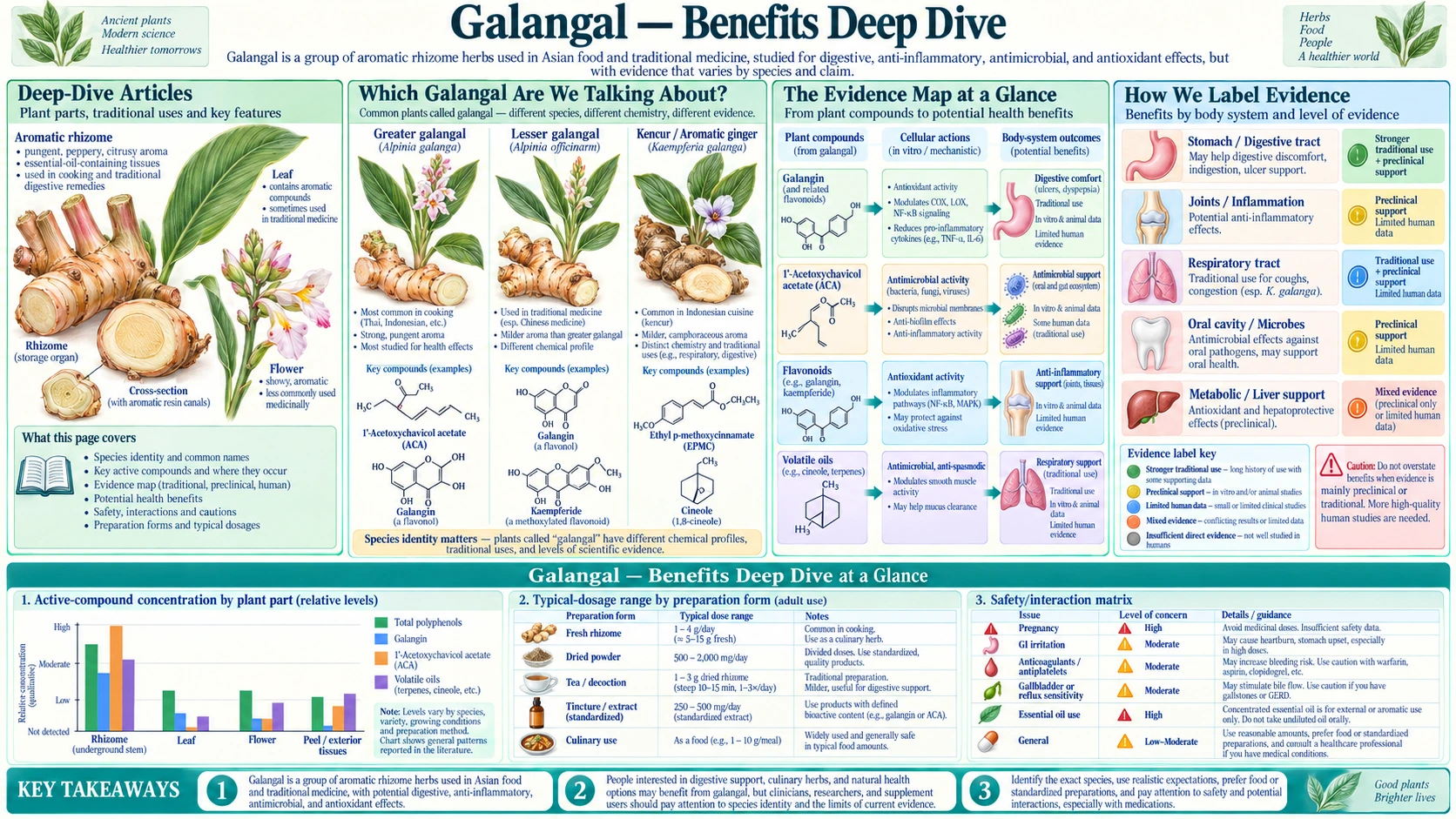
Galangal is one of the most heavily studied culinary rhizomes in the laboratory and one of the least studied in the clinic. That gap is the single most important fact about it, and it shapes every page in this section. Cell-culture chemists have spent nearly thirty years characterising a molecule called 1'-acetoxychavicol acetate (ACA), isolated from the Thai and Indonesian cooking rhizome Alpinia galanga, and it does remarkable things to inflammatory signalling in a dish. Almost none of that work has ever been carried forward into a randomised trial in people.
These four deep-dive articles take the four claims most often made for galangal — that it settles the stomach, that it calms inflammation and eases joint pain, that it kills bacteria and fungi, and that it helps male fertility and blood sugar — and separate what has been demonstrated in humans from what has only been demonstrated in a test tube. In most cases the honest answer is that the human demonstration has not happened yet. Where a real clinical trial exists, we say so and describe its size. Where the evidence is a rat, a petri dish, or four centuries of custom, we say that too, in those words.
The other recurring theme is identity. "Galangal" is not one plant. It is a market name covering at least three species that are chemically different from one another, and a great deal of confusion in the popular literature comes from treating a study of one as evidence for another. Every claim on these pages names the species it belongs to.
Table of Contents
- Deep-Dive Articles
- Which Galangal Is Meant: Three Plants, One Name
- The Evidence Map at a Glance
- How We Label Evidence
- Key Research: The Human Trials
- Key Research: Inflammation and ACA
- Key Research: Antimicrobial and Antifungal Work
- Key Research: Fertility, Metabolism, and Blood Sugar
- Key Research: Chemistry, Identity, and Reviews
- External Resources
- Connections
- Featured Videos
Deep-Dive Articles
Four articles, each covering one cluster of claims in detail, each with its own research section and its own honest verdict.
Galangal for Digestive Health and Nausea
The oldest and best-attested traditional use, running from Thai kha to Chinese gao liang jiang: bloating, poor appetite, cold-type stomach pain, queasiness. What the animal ulcer studies actually showed, why the anti-nausea reputation is largely borrowed from ginger rather than earned, and what a warming rhizome can and cannot do for a difficult stomach.
Read the deep dive →Galangal for Inflammation and Joint Pain
1'-Acetoxychavicol acetate is one of the better-replicated nuclear factor kappa B (NF-κB) inhibitors in natural-product chemistry, reproduced across laboratories since 1998. It has never been tested against arthritis in a person. This article explains the mechanism properly, covers the Thai herbal compress, and is blunt about the missing trial.
Read the deep dive →Galangal's Antimicrobial and Antifungal Effects
Galangal extract inhibits a long list of bacteria and fungi in laboratory assays, including dermatophytes, Candida, and drug-resistant organisms — and one strand of research suggests it interferes with the plasmids that carry resistance genes. Why none of that means you can treat an infection with a spice.
Read the deep dive →Galangal for Fertility and Metabolic Health
The sperm-motility trial that supplement marketing leans on tested a combination of galangal and pomegranate in a small group of men, so the effect cannot be attributed to galangal at all. Plus the blood-sugar and lipid work, which is entirely rodent and in vitro, and what "supports metabolism" honestly amounts to here.
Read the deep dive →Which Galangal Is Meant: Three Plants, One Name
Three plants share the English name, and mixing them up invalidates the evidence.
- Greater galangal — Alpinia galanga. The thick, pale, pine-scented culinary rhizome of Thailand, Indonesia, Malaysia, and Vietnam. Thai kha, Indonesian lengkuas, Vietnamese riềng. This is the species behind 1'-acetoxychavicol acetate, behind both human alertness trials, and behind the combination fertility trial. When these pages say "galangal" without qualification, they mean this one.
- Lesser galangal — Alpinia officinarum. A slimmer, redder, hotter rhizome from southern China. In Traditional Chinese Medicine it is 高良姜 gao liang jiang, a warming remedy for cold-pattern stomach pain. It is the richer source of the flavonol galangin, and it — not A. galanga — is the species used in most of the rodent gastric-protection work.
- Kaempferia galanga. A different genus entirely, sold as kencur, aromatic ginger, or sand ginger, and confusingly also as a kind of "galangal". Its dominant compound is ethyl p-methoxycinnamate, not ACA. Research on it is not research on galangal in the culinary sense. See our separate page on kencur.
The practical rule: a claim about galangal is unverifiable until you know the binomial. A supplement label reading only "galangal root extract 500 mg" identifies nothing. A bottle that does not print a Latin binomial holds, in effect, unidentified plant material — and any research cited on that bottle is unattached to the product inside it.
The Evidence Map at a Glance
Before reading further, it helps to know where the ground is firm and where it is not.
- Randomised human trial evidence exists for only a few things, most of them not benefits people usually buy galangal for. The first is mental alertness and sustained attention, tested in two small placebo-controlled studies of a single proprietary standardised A. galanga extract, conducted with industry involvement and not independently replicated. The second is sperm motility, tested in one small randomised trial of a combination product in which galangal was one of two active ingredients — so it does not establish anything about galangal alone. The third is erectile problems caused by selective serotonin reuptake inhibitor (SSRI) antidepressants: in a 2023 randomized triple-blind trial in Iran, 60 men taking SSRIs received either 500 mg of A. galanga extract or placebo, and after 4 weeks the International Index of Erectile Function score rose from 11.2 to 17.4 with galangal and from 10.6 to 13.7 with placebo (p < 0.001) (PubMed PMID: 37143784). It is one small 4-week study and has not been repeated. A 2024 long COVID trial tested a five-plant mixture in which galangal was one ingredient, so it says nothing about galangal alone.
- Animal evidence exists for gastric-mucosa protection (mostly A. officinarum), for anti-inflammatory activity in standard rodent oedema models, and for blood-glucose lowering in diabetic-rodent models. Animal work is a reason to run a human trial. It is not a substitute for one.
- In-vitro evidence is abundant and genuinely interesting — NF-κB suppression, cyclooxygenase-2 (COX-2) and inducible nitric oxide synthase (iNOS) inhibition, broad antibacterial and antifungal activity, antiplasmid activity, and an enormous anticancer cell-culture literature. Almost every compound ever tested does something in a dish at some concentration. Most fail in a body.
- Traditional use is broad, ancient, and cross-cultural — Thai, Malay, Indonesian, Chinese, Ayurvedic, Unani, and medieval European. It tells you what people believed and what worked well enough to keep using. It is not clinical evidence, and this section never treats it as such.
- There is no established therapeutic dose of galangal for anything. Culinary quantities are safe and delicious; extract quantities are unstudied outside the few trials described on this page.
How We Label Evidence
Every substantive claim in these four articles carries one of four tags, used consistently:
- Randomised clinical trial — tested in humans against a placebo or comparator with random allocation. On this topic, rare.
- Preliminary human — observed in people, but without randomisation, blinding, or a control group; or in a combination product where the contribution of galangal cannot be separated out.
- Preliminary (animal or in vitro) — demonstrated in rodents, isolated tissue, or cell culture only. The great majority of galangal research sits here.
- Traditional use only — documented in one or more traditional systems with no supporting modern study.
These pages report an honest small answer rather than an impressive large one: where galangal has been oversold, they say it has been oversold, and they point to the herb that actually has the trial — usually ginger.
Key Research: The Human Trials
The randomised human trials of galangal are few and small — five are listed below, two of them of combination products, plus one trial of a molecule found in galangal oil. The first three are described in detail on the relevant deep-dive pages; each entry links its PubMed record.
- Srivastava, Mennemeier and Pimple, "Effect of Alpinia galanga on mental alertness and sustained attention with or without caffeine: a randomized placebo-controlled study," Journal of the American College of Nutrition, 2017. A crossover trial of a standardised extract in 59 adults with moderate caffeine intake: the alertness score rose by about 12.5 milliseconds from baseline at 3 hours (p = 0.042), and the extract taken with caffeine was reported to maintain sustained attention without the post-caffeine drop-off. PubMed PMID: 28910196.
- Srivastava and colleagues, "A randomized placebo controlled clinical trial demonstrating safety and efficacy of EnXtra in healthy adults," Journal of the American College of Nutrition, 2021. Same proprietary extract, same research group. Over 12 weeks, the extract with or without caffeine caused no significant change in the electrocardiogram (ECG, including the QT interval), blood pressure or heart rate compared with baseline, and alertness and calmness scores rose compared with placebo. PubMed PMID: 32412358.
- Fedder and colleagues, "An extract of pomegranate fruit and galangal rhizome increases the numbers of motile sperm: a prospective, randomised, controlled, double-blinded trial," PLoS One, 2014. A genuine randomised trial — of a two-ingredient product, in fewer than a hundred men: 70 enrolled and 66 completed three months; the average total number of motile sperm rose by 62% (from 23.4 to 37.8 million) with the tablets and by 20% with placebo (p = 0.026). Two of the authors were commercialising the product. PubMed PMID: 25275520.
- Juergens and colleagues, "Anti-inflammatory activity of 1.8-cineol (eucalyptol) in bronchial asthma: a double-blind placebo-controlled trial," Respiratory Medicine, 2003. Not a galangal trial, but the best human evidence for a molecule galangal's essential oil happens to be rich in. PubMed PMID: 12645832.
- Akbarzadeh and colleagues, "Assessing the effect of Alpinia galanga extract on the treatment of SSRI-induced erectile dysfunction: a randomized triple-blind clinical trial," Frontiers in Psychiatry, 2023. 60 men taking SSRI antidepressants received 500 mg of A. galanga extract or placebo; after 4 weeks the erectile-function score rose from 11.2 to 17.4 with galangal and from 10.6 to 13.7 with placebo. One small 4-week study, not yet repeated. PubMed PMID: 37143784.
- Lukkunaprasit and colleagues, "Impact of combined plant extracts on long COVID: an exploratory randomized controlled trial," Complementary Therapies in Medicine, 2024. 66 people with long COVID in Thailand took a five-plant extract — lime (Citrus aurantifolia), Tiliacora triandra, cannabis, galangal and black pepper, 4,500 mg a day — or placebo for 7 days. The total symptom score fell more than with placebo, but C-reactive protein, a blood marker of inflammation, did not change. Being a five-plant mix, it says nothing about galangal alone. PubMed PMID: 39488240.
Key Research: Inflammation and ACA
- Ohata and colleagues, "Inhibition by 1'-acetoxychavicol acetate of lipopolysaccharide- and interferon-gamma-induced nitric oxide production through suppression of inducible nitric oxide synthase gene expression in RAW264 cells," Carcinogenesis, 1998 — the paper that opened the field. Find on PubMed.
- Murakami and colleagues, "Zingiberaceous and citrus constituents, 1'-acetoxychavicol acetate, zerumbone, auraptene, and nobiletin, suppress lipopolysaccharide-induced cyclooxygenase-2 expression in RAW264.7 murine macrophages through different modes of action," Journal of Nutrition, 2005. Find on PubMed.
- Kojima-Yuasa and Matsui-Yuasa, "Pharmacological effects of 1'-acetoxychavicol acetate, a major constituent in the rhizomes of Alpinia galanga and Alpinia conchigera," Journal of Medicinal Food, 2020 — the best single review of ACA. Find on PubMed.
- Rampogu and colleagues, "A comprehensive review on chemotherapeutic potential of galangin," Biomedicine & Pharmacotherapy, 2021 — the flavonol named after this plant, reviewed across its in-vitro literature. Find on PubMed.
Key Research: Antimicrobial and Antifungal Work
- Latha and colleagues, "Antiplasmid activity of 1'-acetoxychavicol acetate from Alpinia galanga against multi-drug resistant bacteria," Journal of Ethnopharmacology, 2009 — the most mechanistically interesting antimicrobial finding on this plant. Find on PubMed.
- Weerakkody and colleagues, "Synergistic antimicrobial activity of galangal (Alpinia galanga), rosemary (Rosmarinus officinalis) and lemon iron bark (Eucalyptus staigerana) extracts," Journal of the Science of Food and Agriculture, 2011. Find on PubMed.
- Bhamarapravati, Pendland and Mahady, "Extracts of spice and food plants from Thai traditional medicine inhibit the growth of the human carcinogen Helicobacter pylori," In Vivo, 2003 — a Thai screening study in which galangal was among the plants tested. Find on PubMed.
- Live search: Alpinia galanga and antifungal or dermatophyte activity — the laboratory basis for the traditional Malay use of sliced lengkuas on ringworm.
Key Research: Fertility, Metabolism, and Blood Sugar
- Fedder and colleagues, PLoS One, 2014, described above — the combination sperm-motility trial. The deep-dive explains the limits of what it shows. PubMed PMID: 25275520.
- Live search: Alpinia galanga, antidiabetic activity and blood glucose — a body of rodent and in-vitro work with no human counterpart.
- Live search: Alpinia species and alpha-glucosidase inhibition — the proposed mechanism behind the blood-sugar claims, demonstrated only in enzyme assays.
- Live search: Galangin, lipid metabolism, and adipocytes — cell-culture work often cited in weight-loss marketing.
Key Research: Chemistry, Identity, and Reviews
- Abubakar and colleagues, "A review on the ethnomedicinal uses, phytochemistry and pharmacology of Alpinia officinarum Hance," Journal of Ethnopharmacology, 2018 — the reference work for lesser galangal, cataloguing a compound profile distinctly different from A. galanga. Find on PubMed.
- Gong and colleagues, "Effects and possible mechanisms of Alpinia officinarum ethanol extract on indomethacin-induced gastric injury in rats," Pharmaceutical Biology, 2018. Find on PubMed.
- Pradubyat and colleagues, "1'-Acetoxychavicol acetate from Alpinia galanga represses proliferation and invasion, and induces apoptosis via HER2-signaling in endocrine-resistant breast cancer cells," Planta Medica, 2022 — representative of the cell-culture cancer literature, and of its limits. Find on PubMed.
- Live search: Alpinia galanga essential oil composition — useful for understanding why two studies of "galangal oil" may be studying materially different mixtures.
- Live search: Zingiberaceae rhizome authentication and adulteration — the identity problem, as the analytical chemists see it.
External Resources
- U.S. National Center for Complementary and Integrative Health (NCCIH) — Herbs at a Glance. The US National Center for Complementary and Integrative Health's plain-language evidence summaries. Galangal does not have its own entry, which is itself informative about the state of the evidence.
- Plants of the World Online (Kew). Authoritative botanical records for Alpinia galanga, Alpinia officinarum, and Kaempferia galanga — the place to settle a naming argument.
- USDA GRIN Taxonomy. Accepted names, synonyms, and common-name cross-references, including the ones that cause the galangal confusion.
- PubChem. Structures and property data for 1'-acetoxychavicol acetate, galangin, and 1,8-cineole.
- Memorial Sloan Kettering — About Herbs. Clinician-facing herb monographs with an unusually sober take on interaction risk during cancer treatment.
- PubMed — all Alpinia galanga research. The whole literature, unfiltered. Note how few entries carry the word "randomized".
A Note on Safety
Galangal eaten as food — coins simmered in a soup, rhizome pounded into a curry paste — is safe, well tolerated, and consumed daily by hundreds of millions of people. Concentrated extracts and essential oils are a different proposition and have barely been studied. Concentrated galangal preparations have no safety data in pregnancy or breastfeeding. Supplements are commonly stopped about two weeks before planned surgery. With anticoagulants or antiplatelet drugs the concern is an added bleeding effect; with insulin or a sulfonylurea, an added blood-sugar-lowering effect; and with narrow-therapeutic-index medicines cleared by cytochrome P450 enzymes, a possible change in the medicine's blood levels. Nothing on these pages is medical advice, and none of the galangal research covers a symptom that is severe, persistent, or worsening.
Connections
- All Herbs
- Galangal (Alpinia galanga) — the main hub page: botany, names, culinary use, forms, dosage, and cautions.
- Ginger (Zingiber officinale) — the cousin galangal is confused with, and the one with a genuine clinical record.
- Ginger for Nausea Relief — where the anti-nausea evidence actually lives.
- Turmeric (Curcuma longa) — the third great Zingiberaceae rhizome and a cautionary tale about laboratory promise.
- Turmeric for Inflammation and Joint Health — a useful contrast in how much human data a comparable compound has accumulated.
- Cardamom (Elettaria cardamomum) — another aromatic Zingiberaceae spice with overlapping terpene chemistry.
- Kencur (Kaempferia galanga) — the "other galangal", and the substitution most likely to wreck a curry paste.
- Fingerroot (Boesenbergia rotunda) — Chinese keys, the fourth rhizome in the same market basket.
- Boswellia — a botanical anti-inflammatory that did get taken into human osteoarthritis trials.