⚠ Evidence warning: Clinical trials or other evidence do not support the claims that wood betony relieves tension headache, calms nervous tension and works as a wound wash or gargle. This page keeps it as a report of what people, websites or other media say.
Wood Betony — Benefits Deep Dive
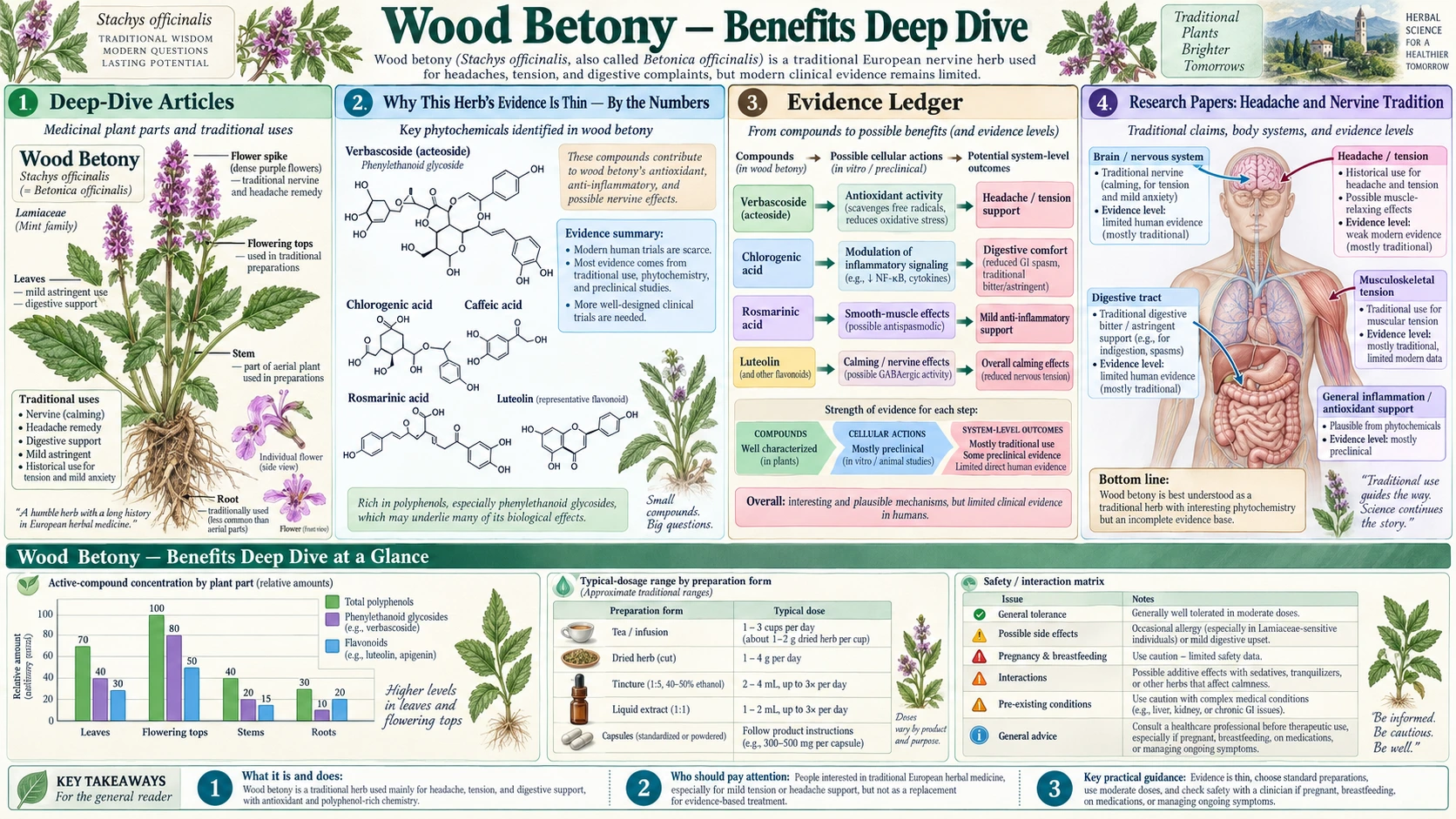
An old Latin proverb held that betony had so many virtues you should sell your coat to afford it. A treatise attributed to Antonius Musa, physician to the emperor Augustus, is said to have listed forty-seven complaints it could treat. That reputation is the largest single fact about this plant — larger, by a wide margin, than anything the modern research literature has to say about it. This Benefits section takes betony’s specific traditional claims one at a time, checks each against a species-locked search of the primary biomedical literature rather than a secondary summary, and reports exactly what comes back: a near-total absence of direct human evidence, a genuinely useful phytochemistry literature, one real safety study worth reading carefully, and — the most concrete finding across all four pages — two different, unrelated Stachys species whose real modern research keeps getting close enough to wood betony’s name to risk being mistaken for it.
Deep-Dive Articles
Headache and the Nervine Tradition
Betony’s oldest and most specific claim — the herb Culpeper assigned to head-governing Aries. A species-locked search returns zero headache studies of any kind. What the chemistry plausibly explains, what a real trial would require, and how feverfew and butterbur — herbs that do have migraine trials — compare, including a hazard betony does not share with either.
Read the deep dive →Anxiety and Nervous Tension
The broader “grounding” nervine claim, checked the same way — and a genuine case of mistaken identity: Stachys lavandulifolia, Persia’s “Mountain Tea,” has a real human randomized trial for occupational stress. It is a different plant. This page explains exactly how the two get confused and why it matters.
Read the deep dive →Astringency, Antimicrobial Activity, and Safety
The traditional gargle and wound-wash uses, the real essential-oil chemistry and antimicrobial lab data behind them, why an essential oil is not a cup of tea, a 2023 Candida-fluconazole synergy screen, and the one dedicated genotoxicity study on this plant — reported with its actual mixed result rather than flattened to “safe.”
Read the deep dive →Antioxidant and Phenolic Chemistry
The best-supported chapter of betony’s story: the named betonyosides, a polyphenol and tannin content that measures high even against its own Stachys relatives, and antioxidant assays that rank the plant differently depending on the method — plus why a strong test-tube result is not the same thing as a proven benefit, a lesson two large human trials already paid for.
Read the deep dive →Table of Contents
- Deep-Dive Articles
- Why This Herb’s Evidence Is Thin — By the Numbers
- Evidence Ledger
- Research Papers: Headache and Nervine Tradition
- Research Papers: Anxiety and Nervous Tension
- Research Papers: Astringency, Antimicrobial Activity, and Safety
- Research Papers: Antioxidant and Phenolic Chemistry
- Research Papers: Species Identity — What Is (and Is Not) Wood Betony
- External Authoritative Resources
- Connections
- Featured Videos
Why This Herb’s Evidence Is Thin — By the Numbers
Rather than assert that research on wood betony is limited, every page in this section ran the same check and reports the actual count. A title/abstract-scoped, phrase-locked PubMed search for "Stachys officinalis"[tiab] OR "Betonica officinalis"[tiab] — deliberately avoiding PubMed’s default behavior of silently expanding a bare species name across its taxonomy tree, which is how evidence for the wrong plant quietly attaches itself to this one — returns 19 records. Because a phrase search misses papers that abbreviate the name to “S. officinalis”, the plant’s full indexed biomedical record is at least that large. Reading rather than merely counting those 19 changes the picture further: roughly half are field ecology, plant genetics, and one plant-pathology case report — researchers studying the living wildflower, not the herb in anyone’s teacup. Narrowing to specific claims:
- Headache, migraine, or cephalalgia: zero records.
- Any clinical trial, in any human, for any purpose: zero records (one match was an unrelated antifungal screening paper that happened to use the word “patients” in passing).
- Anxiety, sedative, or central nervous system (CNS) activity: two records, neither a study of any outcome — a government drug-and-lactation monograph describing the tradition, and a veterinary ethnobotany survey.
- Wound healing: zero records.
- Antioxidant or phenolic chemistry: three records — the strongest single category, and genuine, replicated, on-species chemistry.
- Antimicrobial activity: two records, both real in-vitro findings. A third sits outside the phrase search because it abbreviates the name: a 2021 study of three Stachys species from Romania found the highest total polyphenol content in the S. officinalis extract (232 ± 43 mg GAE/g) and the highest antioxidant activity (602 ± 75 mM Trolox/g), and antimicrobial capacity in all three extracts, especially on Gram-positive bacteria (laboratory tests).
- Genotoxicity / safety testing: one record — the only dedicated toxicology study this plant has.
This is the honest shape of the evidence: essentially nothing behind the two most famous traditional claims (head and nerves), a small but real body of phytochemistry, and a single safety study. It is not zero evidence across the board, and treating it as uniformly “unstudied” would be as inaccurate as treating it as validated.
Evidence Ledger
Different claims about this plant sit in genuinely different evidentiary positions, and collapsing them into one verdict would misrepresent all of them. This table separates traditional efficacy claims (untested), laboratory phytochemistry (real, but preclinical), and safety data (real, and mixed) rather than assigning a single rating to “wood betony” as a whole.
| Claim | Evidentiary Status | Basis |
|---|---|---|
| Relieves tension headache | Absent — never adequately tested | Zero species-locked headache/migraine records; tradition and plausibility only |
| Calms anxiety / “grounding” nervine effect | Absent — never adequately tested | Zero trials of the herb; compound-level pharmacology (verbascoside, stachydrine) studied mostly from other sources |
| Effective gargle / wound wash | Absent — never adequately tested | Tannin chemistry is real; no clinical trial of the traditional application exists |
| Antimicrobial (essential oil, in vitro) | Real, preclinical only | Direct MIC data against Aspergillus niger and Candida albicans; not tested as a tea or gargle |
| Antioxidant / polyphenol-rich chemistry | Real, established chemistry | Multiple independent assays and research groups; not a tested clinical outcome |
| Genotoxicity / DNA safety | Real, but mixed | The extracts were not mutagenic in the Ames test (S. typhimurium strains TA98 and TA100) and did not induce chromosome aberrations; all extracts induced DNA damage on the comet assay, and the B. officinalis extract caused a slight increase in sister chromatid exchange (SCE), another DNA-damage test. These were tests on human white blood cells (lymphocytes) in a dish, not in people. |
| Galactogogue (increases milk supply) | Absent, and explicitly stated as such | U.S. National Institutes of Health (NIH) LactMed: “no scientifically valid clinical trials support this use” |
Research Papers: Headache and Nervine Tradition
- Betony. In: Drugs and Lactation Database (LactMed). National Institute of Child Health and Human Development; 2006–. Revised 2024. — PubMed
- Miyase T, Yamamoto R, Ueno A. Phenylethanoid glycosides from Stachys officinalis. Phytochemistry. 1996;43(2):475–479. — PubMed PMID: 8862039
- Ernst E, Pittler MH. The efficacy and safety of feverfew (Tanacetum parthenium L.): an update of a systematic review. Public Health Nutrition. 2000;3(4A):509–514. — PubMed PMID: 11276299
- Lipton RB, et al. Petasites hybridus root (butterbur) is an effective preventive treatment for migraine. Neurology. 2004;63(12):2240–2244. — PubMed PMID: 15623680
- Full detail and five further citations on the Headache and Nervine Tradition page.
Research Papers: Anxiety and Nervous Tension
- Cheng F, et al. A review of pharmacological and pharmacokinetic properties of stachydrine. Pharmacological Research. 2020;155:104755. — PubMed PMID: 32173585
- Jadidi A, et al. Effect of Stachys lavandulifolia on occupational stress in emergency medical technicians. Explore. 2023;19(6):803–805. A different species — see the sub-article. — PubMed PMID: 37061348
- Ghazizadeh J, Sadigh-Eteghad S, Marx W, et al. The effects of lemon balm (Melissa officinalis L.) on depression and anxiety in clinical trials: a systematic review and meta-analysis. Phytotherapy Research. 2021;35(12):6690–6705. — PubMed PMID: 34449930
- Brock C, et al. American Skullcap (Scutellaria lateriflora): a randomised, double-blind placebo-controlled crossover study of its effects on mood in healthy volunteers. Phytotherapy Research. 2014;28(5):692–698. — PubMed PMID: 23878109
- Full detail and eight further citations on the Anxiety and Nervous Tension page.
Research Papers: Astringency, Antimicrobial Activity, and Safety
- Lazarević JS, et al. Chemical composition and antimicrobial activity of the essential oil of Stachys officinalis (L.) Trevis. (Lamiaceae). Chemistry & Biodiversity. 2013;10(7):1335–1349. — PubMed PMID: 23847079
- Ohiienko T, et al. Screening of medicinal and aromatic plants extracts for the synergism with fluconazole against Candida albicans and Candida tropicalis fungi associated with denture stomatitis. Wiadomosci Lekarskie. 2023;76(7):1615–1620. — PubMed PMID: 37622505
- Slapšytė G, et al. Genotoxic properties of Betonica officinalis, Gratiola officinalis, Vincetoxicum luteum and Vincetoxicum hirundinaria extracts. Food and Chemical Toxicology. 2019;134:110815. — PubMed PMID: 31520668
- Givol O, Kornhaber R, Visentin D, Cleary M, Haik J, Harats M. A systematic review of Calendula officinalis extract for wound healing. Wound Repair and Regeneration. 2019;27(5):548–561. — PubMed PMID: 31145533
- Stegăruș DI, Lengyel E, Apostolescu GF, Botoran OR, Tanase C. Phytochemical analysis and biological activity of three Stachys species (Lamiaceae) from Romania. Plants (Basel). 2021;10(12):2710. Abbreviates the name to “S. officinalis”, so the phrase search misses it. — PubMed PMID: 34961181
- Full detail and seven further citations on the Astringency, Antimicrobial Activity, and Safety page.
Research Papers: Antioxidant and Phenolic Chemistry
- Apostolescu GF, et al. Chemical and antioxidant profile of hydroalcoholic extracts of Stachys officinalis L., Stachys palustris L., Stachys sylvatica L. from Romania. Acta Chimica Slovenica. 2023;70(2):231–239. — PubMed PMID: 40836517
- Matkowski A, Piotrowska M. Antioxidant and free radical scavenging activities of some medicinal plants from the Lamiaceae. Fitoterapia. 2006;77(5):346–353. — PubMed PMID: 16713687
- Alipieva K, Korkina L, Orhan IE, Georgiev MI. Verbascoside—a review of its occurrence, (bio)synthesis and pharmacological significance. Biotechnology Advances. 2014;32(6):1065–1076. — PubMed PMID: 25048704
- ATBC and CARET: isolated beta-carotene supplementation trials in smokers, both null or harmful for cancer prevention. — PubMed
- Full detail and eight further citations on the Antioxidant and Phenolic Chemistry page.
Research Papers: Species Identity — What Is (and Is Not) Wood Betony
The single most concrete, actionable finding across this whole Benefits section is not about wood betony’s own effects — it is about which plant a citation actually refers to. Two other Stachys species have real, recent, English-language research programs of their own, and both are easy to mistake for this one.
- Rabbani M, Sajjadi SE, Zarei HR. Anxiolytic effects of Stachys lavandulifolia Vahl on the elevated plus-maze model of anxiety in mice. Journal of Ethnopharmacology. 2003;89(2–3):271–276. Persian “Mountain Tea” a different species with real anxiolytic evidence. — PubMed PMID: 14611891
- Jadidi A, et al. Effect of Stachys lavandulifolia on occupational stress in emergency medical technicians. Explore. 2023;19(6):803–805. A real human randomized trial — of a different species. — PubMed PMID: 37061348
- Jalilian N, Modarresi M, Rezaie M, Ghaderi L, Bozorgmanesh M. Phytotherapeutic management of polycystic ovary syndrome: role of aerial parts of wood betony (Stachys lavandulifolia). Phytotherapy Research. 2013;27(11):1708–1713. The name mix-up reaches journal titles: this randomized trial tested Mountain Tea, not Stachys officinalis. In 66 women aged 15–45 with abnormal uterine bleeding from polycystic ovary syndrome, 5 g of the herb three times a day for three months was compared with the hormone drug medroxyprogesterone acetate; the fall in bleeding was similar in both groups (P = 0.248), and side effects were more common on the herb (45.5%) than on the drug (24.2%). — PubMed PMID: 23307315
- Yilmaz S, Fidan H. Pharmacological and toxicological profile of the Stachys lavandulifolia Vahl: a comprehensive review. Zeitschrift für Naturforschung C. 2025;80(9–10):481–491. The review notes that “potential toxicity issues about abortion and renal toxicity” (kidney toxicity) were also reported — relevant to anyone who buys “betony” and receives Mountain Tea instead. — PubMed PMID: 40899416
- Lima JADS, et al. Stachys byzantina K. Koch in the treatment of skin inflammation: a comprehensive evaluation of its therapeutic properties. ACS Omega. 2024;9(50):49899–49912. Lamb’s ear — ornamental, and a different species again. — PubMed PMID: 39713701
- Tomou EM, Barda C, Skaltsa H. Genus Stachys: a review of traditional uses, phytochemistry and bioactivity. Medicines. 2020;7(10):63. The genus-wide context for how easily this happens. — PubMed PMID: 33003416
Full discussion of both species-confusion cases is on the Anxiety and Nervous Tension page (Stachys lavandulifolia, including a side-by-side comparison table) and the Astringency, Antimicrobial Activity, and Safety page (Stachys byzantina).
External Authoritative Resources
- PubMed — live search: Stachys officinalis OR Betonica officinalis (the exact species-locked search this section’s claims were checked against)
- U.S. National Institutes of Health LactMed — Betony (Drugs and Lactation Database, National Institute of Child Health and Human Development)
- Wikipedia — Betonica officinalis (Stachys officinalis) (botanical identity, synonymy, and distribution)
Connections
- All Herbs
- Wood Betony (Main Page)
- Wood Betony for Headache and the Nervine Tradition
- Wood Betony for Anxiety and Nervous Tension
- Wood Betony: Astringency, Antimicrobial Activity, and Safety
- Wood Betony’s Antioxidant and Phenolic Chemistry
- Skullcap
- Feverfew
- Lemon Balm
- Motherwort
- Valerian
- Calendula
- Migraine