Red Clover — Benefits Deep Dive
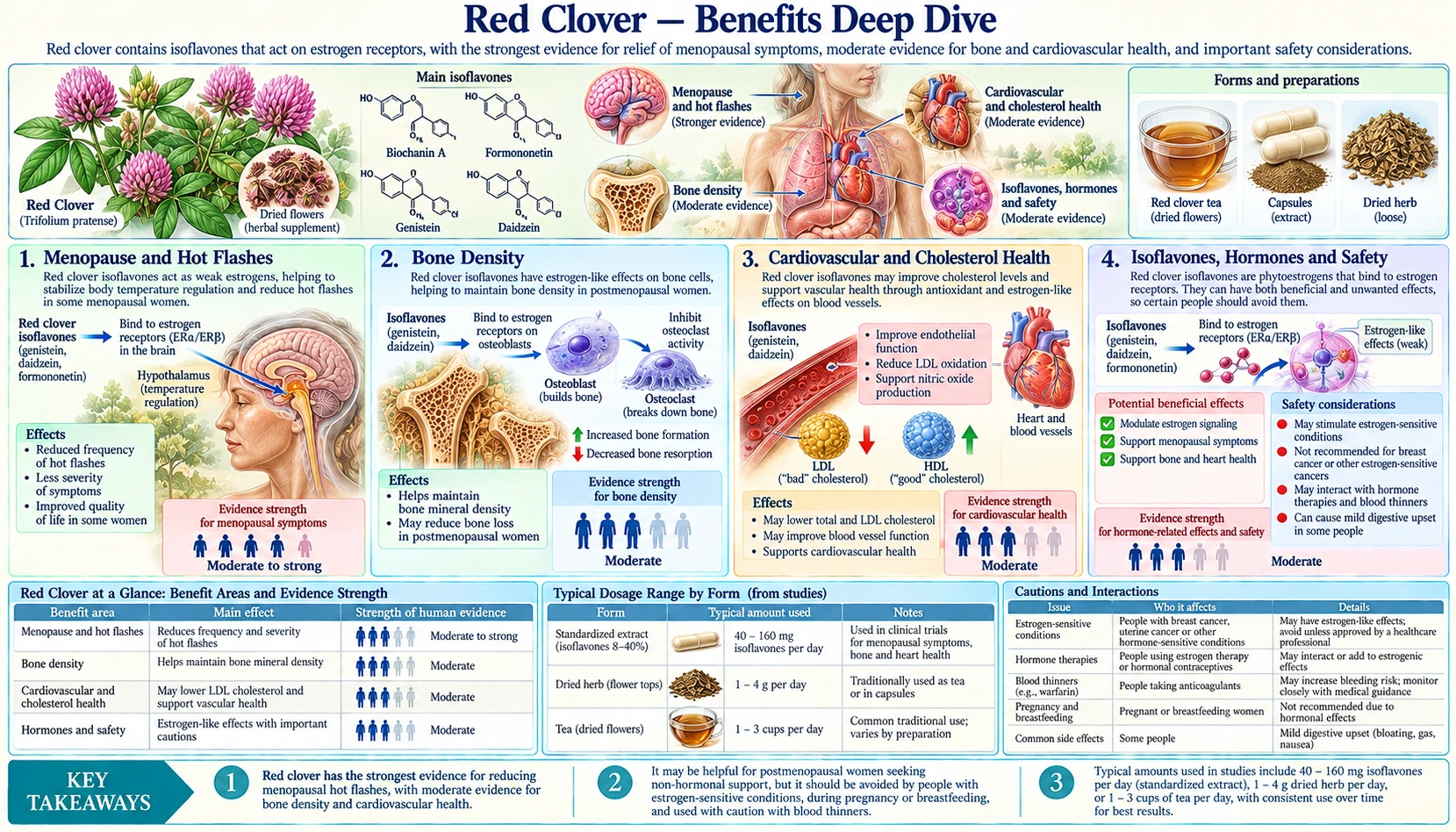
Red clover (Trifolium pratense) is unusual among the herbs on this site: it has been put through a genuinely large number of randomized, placebo-controlled human trials, and those trials have failed to agree with one another. That disagreement is the honest headline of this deep dive. Anyone browsing supplement marketing will find red clover described as a proven, natural answer to hot flashes. Anyone reading the actual clinical literature will find a body of evidence in which several well-run trials found no benefit at all over a dummy pill, a handful of trials found a modest benefit, and the most independent pooled reviews land on "not conclusively better than placebo."
These four pages exist to lay that record out fairly rather than to sell the herb. The menopause page walks through the positive trials and the null trials side by side, then asks why they conflict — dose, extract type, placebo response, and the intriguing possibility that a reader's own gut bacteria decide whether the herb does anything. The bone density page separates three very different endpoints that marketing routinely blurs together: bone turnover markers, measured bone mineral density, and actual fractures. The cardiovascular page covers the lipid trials and the more interesting arterial-stiffness findings, while being blunt that no red clover study has ever measured a heart attack or a stroke. The isoflavones and safety page sets out the safety findings: red clover is a phytoestrogen, and that single fact shapes which groups of people the research raises concerns for.
A word about what red clover is, chemically, because everything else follows from it. Its activity comes from four isoflavones — biochanin A, formononetin, genistein and daidzein. The first two are the most abundant in the dried flowering tops; during digestion the body strips a methyl group from each, converting biochanin A into genistein and formononetin into daidzein. Those two products are the more receptor-active pair, and they are weak estrogens: shaped enough like estradiol to occupy an estrogen receptor, but far too feeble to substitute for hormone therapy. That weakness is simultaneously the reason red clover is relatively well tolerated and the reason its benefits, where they exist at all, are small.
Throughout these pages every claim carries an evidence label — randomized clinical trial, preliminary (laboratory or animal work), or traditional use only — and where trials contradict each other, that is stated rather than smoothed over. Every citation links to its PubMed record, with the paper's real title, journal and year given in the prose, so you can confirm each one yourself.
Deep-Dive Articles
Red Clover for Menopause and Hot Flashes
The flagship use and the most contested. The trials that found a benefit, the trials that found nothing, what Cochrane concluded, and why a 30–50% placebo response makes hot flashes one of the hardest symptoms in medicine to study.
Read the deep dive →Red Clover and Bone Density
Why estrogen protects bone, what isoflavones do to bone cells in the laboratory, and what a one-year randomized trial measuring actual bone mineral density found: less bone loss at the spine, no effect at the hip. Turnover markers are not fractures.
Read the deep dive →Red Clover for Cardiovascular and Cholesterol Health
Modest and inconsistent lipid changes, a more interesting signal on arterial compliance, and the hard limit of the field: not one trial has measured a cardiovascular event.
Read the deep dive →Red Clover Isoflavones, Hormones and Safety
The chemistry, the equol divide, and the safety cases that matter most: hormone-sensitive cancers, endometriosis, fibroids, tamoxifen, aromatase inhibitors, anticoagulants, surgery and pregnancy.
Read the deep dive →Table of Contents
Key Research: Menopause & Vasomotor Symptoms
This is the largest body of red clover research and the least settled. Read the positive and negative entries together — taking either group on its own gives a false picture. Evidence tier: randomized clinical trials and meta-analyses, in genuine disagreement.
- Phytoestrogens for menopausal vasomotor symptoms — Cochrane Database of Systematic Reviews, 2013. The independent gold-standard review. After pooling the randomized evidence for red clover and other phytoestrogens it found no conclusive evidence that they relieve hot flashes better than placebo. PubMed PMID: 24323914
- The effectiveness of red clover on hot-flash in menopausal women: a GRADE-assessed systematic review and meta-analysis — European Journal of Obstetrics, Gynecology, and Reproductive Biology, 2026. Pooled nine randomized placebo-controlled trials in women aged 40–65 taking 37.1–160 mg of isoflavones daily for 12 weeks to 12 months, and found a statistically significant reduction in hot-flash frequency with red clover (standardized mean difference -0.446; 95% confidence interval -0.807 to -0.084; p = 0.016), which the authors describe as a small-to-moderate effect; most trials had a low risk of bias. This newer pooled result is more positive than the 2013 Cochrane review. PubMed PMID: 42269521
- Phytoestrogen supplements for the treatment of hot flashes: the Isoflavone Clover Extract (ICE) Study — a randomized controlled trial — JAMA, 2003. A rigorous American trial of two different red clover products against placebo in 252 women for 12 weeks. Mean daily hot-flash counts fell by similar amounts with the two red clover extracts (5.1 and 5.4) and with placebo (5.0); one extract reduced hot flashes more rapidly than placebo, but the authors concluded that “neither supplement had a clinically important effect on hot flashes or other symptoms of menopause.” PubMed PMID: 12851275
- Isoflavones from red clover (Promensil) significantly reduce menopausal hot flush symptoms compared with placebo — Maturitas, 2002. The best-known positive trial, using 80 mg/day of standardized isoflavones. PubMed PMID: 12161042
- Trifolium pratense isoflavones in the treatment of menopausal hot flushes: a systematic review and meta-analysis — Phytomedicine, 2007. Pooled the available trials and found at most a small reduction. PubMed PMID: 17239573
- Effects of a standardised extract of Trifolium pratense (Promensil) at a dosage of 80 mg in the treatment of menopausal hot flushes: a systematic review and meta-analysis — Phytomedicine, 2017. Restricted to one specific standardized extract at 80 mg/day: five studies met the inclusion criteria and three were pooled, showing a reduction in hot-flush frequency against placebo (weighted mean difference 3.63 hot flushes per day; 95% confidence interval 2.70–4.56), which the authors called statistically and clinically significant. The preparation was safe over the short (3-month) duration of the studies. PubMed PMID: 28160855
- Safety and efficacy of black cohosh and red clover for the management of vasomotor symptoms: a randomized controlled trial — Menopause, 2009. A head-to-head-plus-placebo design in which neither botanical outperformed placebo. PubMed PMID: 19609225
- Combined Red Clover isoflavones and probiotics potently reduce menopausal vasomotor symptoms — PLoS ONE, 2017. A fermented-extract trial reporting a substantially larger effect than the classic extracts — a promising but single, small result. PubMed PMID: 28591133
- Clinical studies of red clover (Trifolium pratense) dietary supplements in menopause: a literature review — Menopause, 2006. A careful early inventory of the trial landscape and its methodological weaknesses. PubMed PMID: 16645539
- Effect of phytoestrogens on sexual function in menopausal women: a systematic review and meta-analysis — Climacteric, 2018. Red clover showed no significant effect on sexual function (standardized mean difference -0.087; 95% confidence interval -0.936 to 0.763; two trials) or on sexual satisfaction. PubMed PMID: 30156931
Key Research: Bone
Bone is where the gap between marketing and evidence is widest, because supplement claims lean on short-term biochemical markers while the one large density trial found less bone loss at the lumbar spine and no effect at the hip. Evidence tier: one substantial randomized trial (spine benefit, no hip effect), several small trials, plus preliminary animal work.
- The effects of phytoestrogen isoflavones on bone density in women: a double-blind, randomized, placebo-controlled trial — The American Journal of Clinical Nutrition, 2004. A one-year trial of a red clover isoflavone supplement in 205 women aged 49–65. Loss of lumbar-spine bone mineral density was significantly lower with the supplement than with placebo (P = 0.03; bone mineral content P = 0.04), with no significant effect on hip bone mineral density, bone-resorption markers or body composition; bone-formation markers rose in postmenopausal women. The authors concluded that isoflavones have “a potentially protective effect on the lumbar spine.” PubMed PMID: 14749241
- The effect of isoflavones extracted from red clover (Rimostil) on lipid and bone metabolism — Menopause, 2001. An early, small study reporting favorable movement in some bone and lipid measures. PubMed PMID: 11449083
- Combined bioavailable isoflavones and probiotics improve bone status and estrogen metabolism in postmenopausal osteopenic women: a randomized controlled trial — The American Journal of Clinical Nutrition, 2017. The strongest positive bone result, using a fermented red clover extract. PubMed PMID: 28768651
- Intake of Novel Red Clover Supplementation for 12 Weeks Improves Bone Status in Healthy Menopausal Women — Evidence-Based Complementary and Alternative Medicine, 2015. A short trial reporting improvement in bone measures; twelve weeks is too brief to speak to fracture risk. PubMed PMID: 26265926
- A systematic review and meta-analysis of the effects of isoflavone formulations against estrogen-deficient bone resorption in peri- and postmenopausal women — The American Journal of Clinical Nutrition, 2017. Pooled isoflavone bone data across formulations, with formulation and bioavailability as the key variables. PubMed PMID: 28768649
- Effects of phytoestrogenic isoflavones from red clover (Trifolium pratense L.) on experimental osteoporosis — Phytotherapy Research, 2007. Preliminary animal work in ovariectomized rats. PubMed PMID: 17117453
Key Research: Cardiovascular & Lipids
A field of surrogate markers. Small, inconsistent lipid effects; a more reproducible signal on arterial compliance; and no hard-outcome data whatsoever. Evidence tier: randomized trials of surrogate endpoints only.
- Effects of red clover (Trifolium pratense) isoflavones on the lipid profile of perimenopausal and postmenopausal women — a systematic review and meta-analysis — Maturitas, 2020. Pooled ten studies (twelve comparisons) with 910 peri- and postmenopausal women: total cholesterol fell by 0.29 mmol/L (-11.21 mg/dL; p = 0.0136), while the changes in low-density lipoprotein (LDL) cholesterol, triglycerides and high-density lipoprotein (HDL) cholesterol were not significant, and heterogeneity between studies was very high (I² 87.95%–98.30%). PubMed PMID: 31883666
- Isoflavones from red clover improve systemic arterial compliance but not plasma lipids in menopausal women — The Journal of Clinical Endocrinology and Metabolism, 1999. The title states the dissociation precisely: vessels moved, cholesterol did not. PubMed PMID: 10084567
- Isoflavones reduce arterial stiffness: a placebo-controlled study in men and postmenopausal women — Arteriosclerosis, Thrombosis, and Vascular Biology, 2003. Supports the arterial-compliance signal in both sexes. PubMed PMID: 12714433
- The effects of dietary supplementation with isoflavones from red clover on the lipoprotein profiles of post menopausal women with mild to moderate hypercholesterolaemia — Atherosclerosis, 2000. An early lipoprotein trial in women who actually had raised cholesterol. PubMed PMID: 10996349
- Modest protective effects of isoflavones from a red clover-derived dietary supplement on cardiovascular disease risk factors in perimenopausal women, and evidence of an interaction with ApoE genotype in 49–65 year-old women — The Journal of Nutrition, 2004. Both halves of the title matter: the effects were modest, and genotype appeared to modify them. PubMed PMID: 15226466
- Influence of red clover-derived isoflavones on serum lipid profile in postmenopausal women — The Journal of Obstetrics and Gynaecology Research, 2009. One of the more favorable individual lipid reports. PubMed PMID: 20144173
Key Research: Isoflavone Chemistry & Equol
Why two people can take the same capsule and get different results, and why two bottles of "red clover" can differ in strength. Evidence tier: analytical chemistry and human metabolism studies.
- Phytoestrogens derived from red clover: an alternative to estrogen replacement therapy? — The Journal of Steroid Biochemistry and Molecular Biology, 2005. A detailed review of biochanin A, formononetin, genistein and daidzein and how they engage estrogen receptors. PubMed PMID: 15876415
- Seasonal variation of red clover (Trifolium pratense L., Fabaceae) isoflavones and estrogenic activity — Journal of Agricultural and Food Chemistry, 2006. Documents how much the plant's isoflavone content swings with season and material — the reason standardized extracts exist. PubMed PMID: 16478248
- The chemical and biologic profile of a red clover (Trifolium pratense L.) phase II clinical extract — The Journal of Alternative and Complementary Medicine, 2006. Characterizes what is actually inside a clinical-grade extract. PubMed PMID: 16566672
- Equol: history, chemistry, and formation — The Journal of Nutrition, 2010. The definitive account of the gut-bacterial metabolite that may decide who responds. PubMed PMID: 20519412
- A PubMed topic search on equol producer status and isoflavone response, which collects the work testing whether producers and non-producers respond differently. Run this search
Key Research: Safety & Hormone-Sensitive Tissue
The short-term safety record is reassuring; the long-term record does not exist. Both halves of that sentence are important. Evidence tier: randomized safety trials (short-term) plus preliminary laboratory and animal work on hormone-sensitive tissue.
- Red-clover-derived isoflavones and mammographic breast density: a double-blind, randomized, placebo-controlled trial — Breast Cancer Research, 2004. Reassuring: no increase in mammographic density over the study period. PubMed PMID: 15084240
- Red clover isoflavones are safe and well tolerated in women with a family history of breast cancer — Menopause International, 2008. A short-term safety study in higher-risk women. PubMed PMID: 18380954
- Estrogenic effects of genistein on the growth of estrogen receptor-positive human breast cancer (MCF-7) cells in vitro and in vivo — Cancer Research, 1998. Preliminary laboratory evidence that a red clover metabolite can stimulate hormone-sensitive cells — the mechanistic basis of the caution. PubMed PMID: 9731492
- Dietary genistein negates the inhibitory effect of tamoxifen on growth of estrogen-dependent human breast cancer (MCF-7) cells implanted in athymic mice — Cancer Research, 2002. The animal study behind the tamoxifen caution. PubMed PMID: 11980635
- Potential interactions between alternative therapies and warfarin — The American Journal of Health-System Pharmacy, 2000. Places red clover's coumarin content in the broader herb–anticoagulant picture. PubMed PMID: 10902065
- A PubMed topic search on Trifolium pratense adverse effects and safety, which returns the accumulated tolerability and adverse-event literature. Run this search
External Resources
- U.S. National Center for Complementary and Integrative Health (NCCIH) — Red Clover: the US National Center for Complementary and Integrative Health's plain-language summary, including what the evidence does and does not support.
- LiverTox — Red Clover: the U.S. National Institutes of Health's drug-induced liver injury reference entry for red clover preparations.
- PubMed — all randomized controlled trials of Trifolium pratense: the raw trial record, if you would rather read it yourself than take anyone's summary.
- The Cochrane Library: home of the independent systematic reviews referenced throughout these pages.
- U.S. National Institutes of Health (NIH) Office of Dietary Supplements: background on how supplements are regulated in the United States and why product potency varies.
Connections
- All Herbs
- Red Clover (main page)
- Red Clover for Menopause and Hot Flashes
- Red Clover and Bone Density
- Red Clover for Cardiovascular and Cholesterol Health
- Red Clover Isoflavones, Hormones and Safety
- Menopause
- Menopause & Hormone Replacement Therapy
- Vasomotor Symptoms: Hot Flashes & Night Sweats
- Osteoporosis
- Cholesterol Management
- Black Cohosh
- Black Cohosh for Menopause & Hot Flashes
- Sage for Menopause & Hot Flashes
- Chasteberry
- Dong Quai
- Maca
- Calcium for Bone Health
- Vitamin D3 for Bone Health
- Vitamin K2
- Lipid Panel
This page is educational information, not medical advice. Red clover is a phytoestrogen, and the research raises concerns for people with a history of breast, uterine or ovarian cancer, endometriosis or uterine fibroids, for people taking anticoagulant, antiplatelet or hormone-modifying medication, and for anyone pregnant or breastfeeding. In mice, dietary genistein (one of the isoflavones red clover yields) negated the inhibitory effect of tamoxifen on the growth of estrogen-dependent human breast cancer cells, and a 2000 review lists red clover among herbal products that may increase the risk of bleeding or potentiate the effects of warfarin, noting that nearly all such information comes from laboratory data, animal studies or individual case reports.