⚠ Evidence warning: Clinical trials or other evidence do not support the claims that traditionally prepared noble kava root has an excellent safety record and that poor raw material alone explains the liver injury reports. This page keeps it as a report of what people, websites or other media say.
Kava: History and Traditional Use
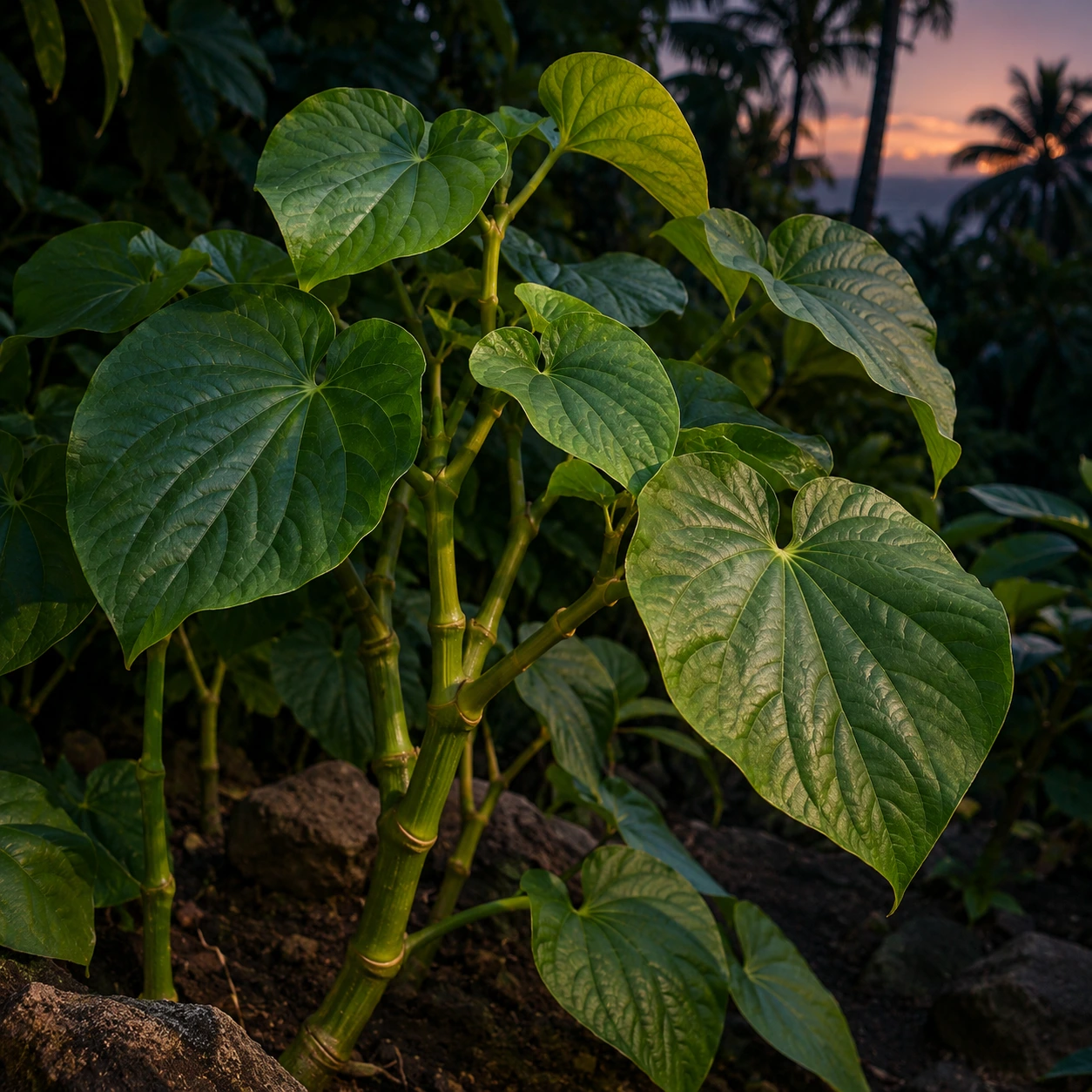
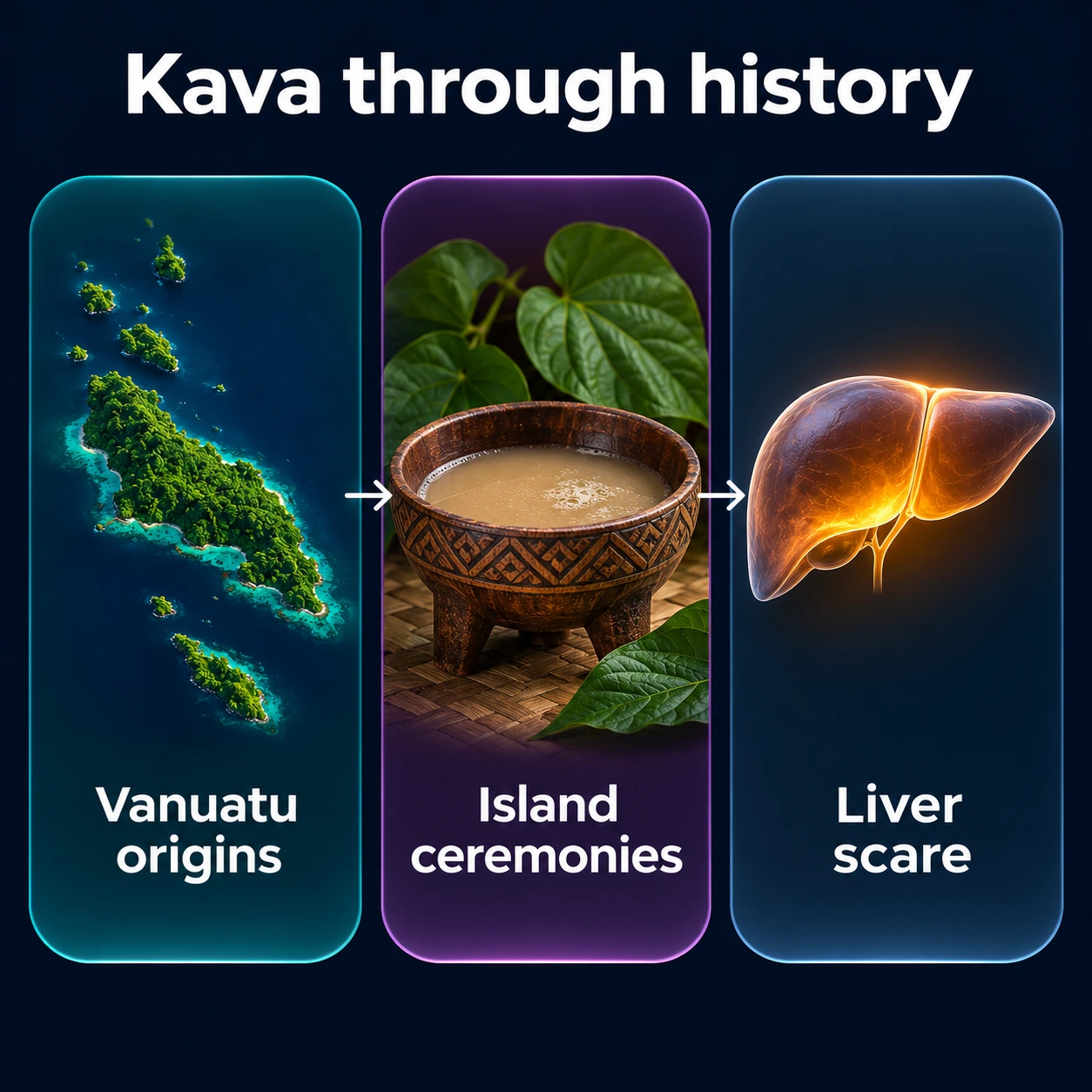
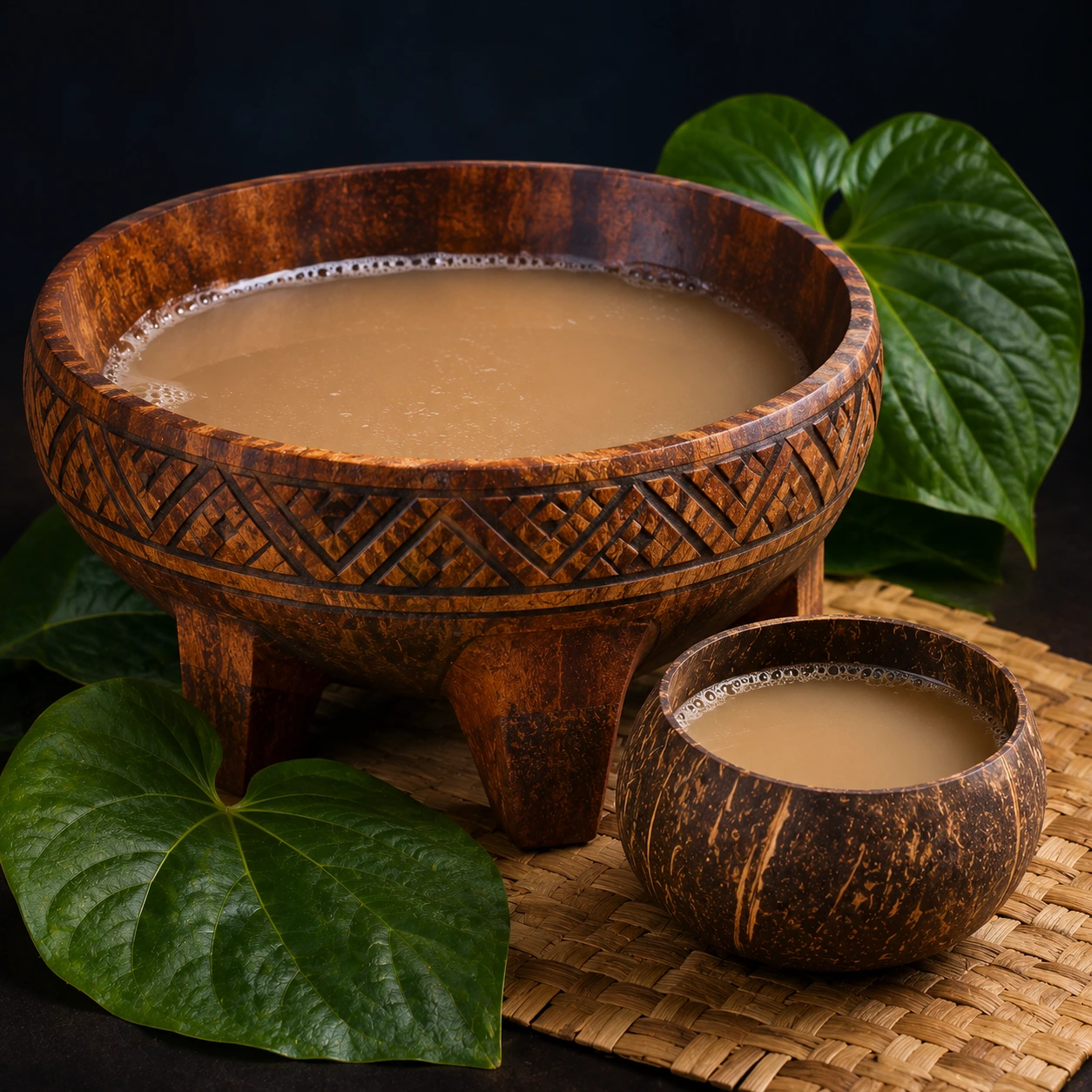
Kava (Piper methysticum) is one of the oldest cultivated plants of the Pacific Islands, drunk for roughly three thousand years as a sacred root that brings calm, eases social tension, and binds communities together. Its story runs from the volcanic islands of Vanuatu, across the open ocean with the great Austronesian voyagers, into Fijian, Tongan, Samoan, and Hawaiian ceremony, and — far more recently — into European pharmacies, a tangle of regulatory bans, and a worldwide revival of kava bars. This is a history grounded in what scholars, botanists, and the islanders themselves have documented; where the record is folklore or oral tradition, it is named as such.
Table of Contents
- The Name and What It Means
- Origins in Vanuatu and the Wild Ancestor
- Carried Across the Pacific
- Kava in Ceremony: Fiji, Tonga, Samoa, Hawaii
- Folklore and Origin Legends
- European Contact and the Naming of the Plant
- Kava Reaches Western Medicine
- The Liver Scare and the German Ban
- Revival: Nakamals, Kava Bars, and Renewed Science
- Heavy Use Beyond the Pacific Islands: Arnhem Land, Australia
- Key Research Papers
- Connections
- Featured Videos
The Name and What It Means
The word kava comes from Pacific languages. Popular accounts gloss it as "bitter" or "potent root", a fair description of a drink that is earthy, peppery, and slightly numbing on the tongue. The linguist John Lynch (2002) traced it to a Proto-Oceanic term, *kawaRi, for a root with special psychoactive or ritual properties, probably a species of ginger, which shifted to kava when the plant was first domesticated. The word survives in many island languages, which is itself a clue to how far and how early the plant travelled: the Hawaiian 'awa, the Samoan and Tahitian 'ava, and the Tongan kava are close relatives. Other island names look quite different, among them the Pohnpeian sakau, the Fijian yaqona and the northern Vanuatu maloku; Lynch notes the dissimilarity of the last two and investigates later word changes in Vanuatu and Fiji. When you order kava today, you are using a word that Pacific peoples have spoken for thousands of years.
The plant's scientific name, Piper methysticum, was assigned by a European naturalist in the eighteenth century (his story comes later on this page) and literally means "intoxicating pepper." Kava genuinely is a pepper — a close botanical cousin of the black pepper (Piper nigrum) on your kitchen table. The "intoxicating" half of the name has aged less well: kava's calm is quite unlike alcohol's drunkenness, and modern researchers often note that the label was misleading. Still, the name stuck, and it is the one botanists and pharmacists use worldwide.
Origins in Vanuatu and the Wild Ancestor
Most scholars agree that kava was first domesticated in the islands of northern Vanuatu, in the western Pacific, around three thousand years ago. The evidence is layered and mutually reinforcing. Genetically, Vanuatu holds by far the greatest diversity of kava — on the order of dozens of distinct local varieties, compared with only a handful in Fiji, Tonga, or Samoa — which is the classic fingerprint of a plant's place of origin. Linguistic and botanical studies point the same way. The foundational phytochemical survey by Vincent Lebot and Joel Levesque, which sampled cultivars across dozens of islands, concluded that the named kava varieties descend from a single wild ancestor and that the pattern of domestication begins in Vanuatu.
That wild ancestor is Piper wichmannii, a fertile, seed-bearing pepper still found growing wild in Melanesia. Over many generations, island farmers selected and re-planted the most pleasant and potent individuals, and the result — Piper methysticum — is a true cultigen: a plant that exists only because people made it. Kava is functionally sterile. It sets little or no viable seed and is propagated entirely by hand, from stem cuttings, exactly as it has been for millennia. Every kava plant alive today is, in effect, a clone passed down an unbroken human chain reaching back thousands of years — one of the clearest living illustrations anywhere of how ancient peoples shaped a wild plant into a cultivated one.
Carried Across the Pacific
Kava did not stay in Vanuatu. It spread across the Pacific in the canoes of the Austronesian voyagers — the seafaring peoples whose Lapita culture pushed eastward from Melanesia into the wider Pacific. Because kava cannot grow from seed, it could only have travelled as living cuttings, deliberately carried and replanted by people who valued it enough to give it space in a canoe alongside food crops, pigs, and the other "canoe plants" that made island settlement possible. Its spread is therefore a record of human movement, though not of the whole Austronesian expansion: the 2016 FAO/WHO technical report describes kava drinking in Polynesian, Melanesian and Micronesian cultures "with the exception of New Zealand, New Caledonia and most of the Solomon Islands."
This is why kava is, as botanists put it, endemic to Oceania — native to the Pacific island world and essentially nowhere else among the broader Austronesian regions. It reached Fiji and then much of Polynesia and Micronesia, taking on a new name in each language while keeping the same ceremonial heart. The plant's journey is a quiet testament to how central it was: of all the things the first settlers could have loaded into their canoes, a mildly bitter root with no food value earned passage across thousands of miles of open ocean, purely for the calm and the community it brought.
Kava in Ceremony: Fiji, Tonga, Samoa, Hawaii
Across the Pacific, kava became far more than a drink. It is the centrepiece of ceremony, diplomacy, and hospitality, and the protocols around it are taken seriously. In Fiji, where kava is called yaqona, the sevusevu is a formal presentation in which a visitor offers a bundle of dried kava root to a village chief as a gift and a sign of respect; the root is then prepared and shared, and the visitor is welcomed. A formal yaqona ceremony commonly accompanies important social, political, and religious occasions, and the bundled roots themselves are the offering at its heart.
In Tonga, the royal taumafa kava is among the most solemn ceremonies in the kingdom, historically bound up with the installation and honouring of chiefs and kings; participants are seated in a precise circle and served in a strict order of rank. Samoa has its own 'ava ceremony with comparable formality, marking the conferral of chiefly titles and other significant events. Throughout these cultures the ordering of who is served, and when, encodes the social hierarchy itself — the highest-ranking person is acknowledged first, and the act of sharing the bowl knits the gathering together.
In Hawaii, kava is called 'awa, and Hawaiians traditionally cultivated many distinct varieties, used by healers (kahuna) and across society for medicinal, social, and religious purposes. The recurring theme everywhere is the same: kava is a tool of peace. It is drunk to open negotiations, to settle disputes, to welcome strangers, to mark births, marriages, and funerals, and to sit together at the end of the day. That a single plant came to occupy this role across so many separate island cultures is one of the most striking facts in its history.
Folklore and Origin Legends
Like any plant this important, kava gathered a body of legend — and these stories are best read as folklore and oral tradition rather than literal history. The best-known is the Tongan legend of Kava'onau. As the story is traditionally told, a couple on a small island had only their daughter, Kava'onau, who was gravely ill, when a high chief arrived and they had nothing worthy to offer him; in their grief and sense of duty they sacrificed her. From her burial place, the tale holds, two new plants grew — kava and sugarcane — and the kava's calming power was revealed when an animal that nibbled it grew sleepy. The plants were brought to the chief, and from this the kava ceremony is said to have been born. Tongans preserved this account through oral history, and the name of the plant is popularly linked to the girl's name. It is a story about sacrifice, honour, and the bond of care between a people and their leaders — the very values the kava ceremony enacts.
Other Pacific cultures carry their own traditions in which kava is a gift of the gods or a plant that opens communication between the human and spirit worlds. Such myths vary from island to island and are not historical records of how the plant actually arose — that question is answered by the botanical and genetic evidence pointing to Vanuatu. But the legends matter in their own right: they show that kava was woven into the sacred imagination of these cultures, treated not as an ordinary crop but as something given, earned, and revered. Folklore holds the meaning; science holds the origin.
European Contact and the Naming of the Plant
Europeans first documented kava during the great Pacific voyages of the eighteenth century. The naturalist Georg Forster, who sailed with Captain James Cook on Cook's second voyage (1772–1775), gave one of the first detailed scientific descriptions of the plant in his 1777 voyage narrative; he later formally named it Piper methysticum — "intoxicating pepper" in his 1786 botanical work, which is why its botanical authority is written "G. Forst." Forster and his contemporaries watched kava being prepared and shared in Pacific communities and recorded the ceremony with the mixture of curiosity and misunderstanding typical of the period. As later researchers have pointed out, the "intoxicating" in the name reflects a European assumption that kava acted like alcohol, which it does not.
European missionaries and colonial administrators frequently disapproved of kava. Some viewed the communal preparation as unhygienic, and many objected to its place in indigenous religious and ceremonial life; as a result, kava drinking was discouraged or even banned in places during the eighteenth and nineteenth centuries. One lasting consequence was practical: scholars note that the preparation of kava from dried root (rather than fresh) spread partly in response to missionary pressure on the traditional methods. Despite these efforts, kava endured. It was too deeply rooted in Pacific social and spiritual life to be suppressed, and it survived colonialism to remain central to island culture today.
Kava Reaches Western Medicine
By the nineteenth and twentieth centuries, kava had crossed from ethnographic curiosity into the Western pharmacy. European — especially German — researchers studied the root's chemistry and isolated its active compounds, the kavalactones, and standardized kava extracts came to be sold as remedies for anxiety, nervous tension, and restlessness. Importantly, the European medicinal tradition generally followed the Pacific one in using the peeled rhizome and root — the parts islanders had always used — and over many decades this was well tolerated. As Teschke and colleagues summarized in their review, before liver injury was recognized "European countries traditionally adhered to the use of peeled kava rhizomes, which were well tolerated and failed to cause toxicity." The same review notes that aerial plant parts and the peelings of roots and stems were "sometimes used by European manufacturers."
This period gave kava a second life as a documented, studied botanical medicine, and it set the stage for the modern clinical-trial era in which kava's anti-anxiety effects have been formally tested. It also, however, introduced something the traditional method never had: solvent extraction. Where islanders steep ground root in cold water, some commercial manufacturers used alcohol or acetone to pull more compounds out of the plant. That seemingly technical difference — water versus solvent, root versus whole plant, noble cultivar versus any cultivar — would turn out to matter enormously when questions about kava's safety arose at the turn of the twenty-first century.
The Liver Scare and the German Ban
Around 1999–2000, a cluster of case reports in Europe linked certain commercial kava products to liver injury, some of it serious. Acting on these reports, Germany's medicines regulator (the BfArM) moved against kava, and in 2002 kava medicines were effectively pulled from the German market. Some accounts also describe a temporary European Union import restriction that year, though no EU legal text confirming it was found; Kuchta and colleagues write more generally of "a ban of kava products in Europe," and Teschke and colleagues list bans in countries including the United Kingdom, Germany, Switzerland, France and Canada. For a plant with thousands of years of communal use behind it, this was a dramatic reversal, and it cast a long shadow over kava's reputation that lingers in safety warnings today.
The scientific re-examination that followed was pointed. Researchers asked an obvious question: if Pacific Islanders had safely drunk large quantities of water-prepared noble kava for millennia, why were rare liver injuries surfacing only in Western products? Investigators — including Kuchta, Schmidt, and Nahrstedt in their detailed review of the affair — argued that the problem lay not with properly prepared noble kava root but with poor-quality raw material: the use of non-noble ("tudei") cultivars, of stems and leaves rather than the root, and of solvent extracts that concentrate compounds the traditional water method leaves behind. They framed the episode as a case of ill-defined herbal identity, lax quality control, and, in their view, misguided regulation. That is one side of the dispute.
The numbers behind the scare come from the World Health Organization's review. Of the 93 case reports it first identified, 8 were rated as having a "probable" link with kava: 6 with organic solvent extracts and 2 with kava beverage. Its report concluded that the ratings "provide a significant concern of a cause-and-effect relationship between kava products and hepatotoxicity." Teschke and Wolff (2009) criticized the method WHO used to assign causality. A later analysis of 31 case reports, using a different causality scale, rated kava, with or without other drugs and supplements, as a highly probable, probable or possible cause of liver disease in 14 patients, and in 5 of those 14 the product was an aqueous extract. Weighing the long history of use and the more recent research, the 2016 FAO/WHO technical report on kava beverage stated: "it is possible for kava beverage to be consumed with an acceptably low level of health risk; however, further studies are needed to define the parameters necessary to ensure safe use of kava beverage."
Vanuatu answered the quality question with law. Its Kava Act of 2002, in effect from 2008, prohibits the sale and export of non-noble and non-medicinal varieties, namely two-day kava and wichmannii (wild) kava, though the FAO/WHO report notes anecdotal reports that the rules are not strictly followed.
The legal tide eventually turned. A German administrative court overturned the ban in 2014, finding the prohibition disproportionate, and a higher court confirmed that decision in 2015, restoring kava's status as a regulated medicine in Germany. The takeaway kava's defenders draw from this whole history: sourcing and preparation are everything, and traditionally prepared noble kava root has an excellent long-term safety record. Kava can still affect the liver. Teschke and colleagues report that "liver injury occurred with ethanolic, acetonic and aqueous kava extracts," and a 2025 systematic review found that kava's role in liver toxicity "remains unclear." The risk factors WHO listed for liver reactions are organic solvent extracts, heavy alcohol intake, pre-existing liver disease, inherited variants of cytochrome P450 liver enzymes, and excessive doses, and it noted that taking kava with other drugs harmful to the liver or with interacting drugs, particularly anti-anxiety drugs, antipsychotics and antithrombotic (anti-clotting) drugs, might lead to harm. The detailed, current safety guidance lives in the companion Kava Benefits articles and on the main Kava page.
Revival: Nakamals, Kava Bars, and Renewed Science
Today kava is in the middle of a global revival. In the Pacific it never left: in Vanuatu, nakamals — the traditional kava-drinking houses — remain everyday gathering places, and kava is a major cultural and economic mainstay across the islands. What is new is kava's spread beyond Oceania. Kava bars have opened across North America, Europe, and Australia, offering the root as a sociable, alcohol-free alternative for people seeking relaxation and conversation without a hangover — a modern echo of the very role kava has played in the Pacific for three thousand years.
Alongside the cultural revival has come a scientific one. Modern laboratories have mapped how the plant builds its calming kavalactones: the 2019 study by Pluskal and colleagues in Nature Plants reconstructed the biosynthetic pathway, identifying the chain of enzymes the plant evolved to make these compounds. Clinical researchers continue to test kava's effects on anxiety, and quality advocates push for standards that guarantee only noble root reaches consumers. In a 2020 trial, 171 people with diagnosed generalised anxiety disorder took an aqueous root extract (120 mg kavalactones twice a day) or placebo for 16 weeks: anxiety reduction did not differ significantly, and 17.4% on kava against 23.8% on placebo were in remission. Poorer memory, tremor and liver test abnormalities were more frequent on kava, though no participant met criteria for herb-induced liver injury. The authors wrote that this extract was not effective for diagnosed generalised anxiety disorder, while earlier research has generally supported kava in non-clinical groups, potentially for situational anxiety. The thread running through kava's entire history — from a Vanuatu garden three millennia ago, across the open Pacific, into ceremony, into the pharmacy, through controversy, and now into bars and laboratories around the world — is remarkably consistent: a humble bitter root, valued above almost any other plant for its power to calm the body and bring people together in peace.
The US market has brought new problems of its own. Reports to US poison centers fell sharply after a 2002 Food and Drug Administration advisory on severe liver injury, but have risen steadily since 2011, reaching 203 in 2025. In that year 30% of reports involved kava combined with kratom, a psychoactive plant with opioid-like effects, and serious outcomes were reported in 32% of reports, compared with 12% in 2000 (Towers 2026).
Heavy Use Beyond the Pacific Islands: Arnhem Land, Australia
Heavy use outside the Pacific islands brought a different picture from village ceremony. A 1988 pilot survey in a coastal Aboriginal community in Arnhem Land, Australia, compared 39 kava users with 34 non-users. Very heavy users averaged 440 g of kava a week. They were 20% underweight and had greatly raised levels of gamma-glutamyl transferase, a liver enzyme. Kava users more often complained of poor health and a "puffy" face and more often had a typical scaly rash. The researchers also recorded other ill health in the community that was unrelated to kava, and called for less kava use and better nutrition among users.
The 2016 FAO/WHO report describes the same rash, "kava dermopathy," as a result of sustained heavy drinking (more than 435 g of kava powder a week), and says it reverses after drinking stops.
Key Research Papers
The references below are the key peer-reviewed and scholarly sources behind this history, followed by curated PubMed topic-search links into the ethnobotanical and clinical literature. Author names, titles, and journals are given as plain text; only stable DOI, PMID, and PubMed links are hyperlinked, and each opens in a new tab.
- Singh YN. Kava: an overview. Journal of Ethnopharmacology. 1992;37(1):13-45. — PubMed PMID: 1453702 · doi:10.1016/0378-8741(92)90003-A
- Lebot V, Merlin M, Lindstrom L. Kava: The Pacific Elixir — The Definitive Guide to Its Ethnobotany, History, and Chemistry. Yale University Press; 1992 (Healing Arts Press reprint, 1997). ISBN 978-0892817269. (Standard scholarly reference on kava's origins, ethnobotany, and cultural history; named here as a book.)
- Lebot V, Levesque J. The origin and distribution of kava (Piper methysticum Forst. f., Piperaceae): a phytochemical approach. Allertonia. 1989;5(2):223-281. (Foundational phytochemical survey of kava cultivars and chemotypes; named here as a journal monograph — not PubMed-indexed.)
- Teschke R, Sarris J, Glass X, Schulze J. Kava, the anxiolytic herb: back to basics to prevent liver injury? British Journal of Clinical Pharmacology. 2011;71(3):445-448. — PubMed PMID: 21284704 · doi:10.1111/j.1365-2125.2010.03775.x
- Kuchta K, Schmidt M, Nahrstedt A. German Kava Ban Lifted by Court: The Alleged Hepatotoxicity of Kava (Piper methysticum) as a Case of Ill-Defined Herbal Drug Identity, Lacking Quality Control, and Misguided Regulatory Politics. Planta Medica. 2015;81(18):1647-1653. — PubMed PMID: 26695707 · doi:10.1055/s-0035-1558295
- Pluskal T, Torrens-Spence MP, Fallon TR, De Abreu A, Shi CH, Weng JK. The biosynthetic origin of psychoactive kavalactones in kava. Nature Plants. 2019;5(8):867-878. — PubMed PMID: 31332312 · doi:10.1038/s41477-019-0474-0
- Lynch J. Potent Roots and the Origin of kava. Oceanic Linguistics. 2002;41(2):493-513. — doi:10.1353/ol.2002.0010
- Food and Agriculture Organization of the United Nations, World Health Organization. Kava: a review of the safety of traditional and recreational beverage consumption. Technical Report. Rome; 2016. — FAO/WHO report (PDF)
- Sarris J, Byrne GJ, Bousman CA, et al. Kava for generalised anxiety disorder: A 16-week double-blind, randomised, placebo-controlled study. Australian & New Zealand Journal of Psychiatry. 2020;54(3):288-297. — PubMed PMID: 31813230 · doi:10.1177/0004867419891246
- Mathews JD, Riley MD, Fejo L, et al. Effects of the heavy usage of kava on physical health: summary of a pilot survey in an aboriginal community. Medical Journal of Australia. 1988;148(11):548-555. — PubMed PMID: 3374423 · doi:10.5694/j.1326-5377.1988.tb93809.x
- Towers EB, Williams IL, Holstege CP, Farah R. Increase in Poison Center Reports Linked to Kratom-Containing Kava Products - National Poison Data System, United States, 2000-2025. MMWR Morbidity and Mortality Weekly Report. 2026;75(12):157-163. — PubMed PMID: 41926333 · doi:10.15585/mmwr.mm7512a1
- Economidis G, Lynch M, Taylor S, Asare-Doku W, Macpherson G, Degenhardt L, Farrell M, Santo T Jr. Global Perspectives on Kava: A Narrative Systematic Review of the Health Effects, Economic and Social Impacts and Policy Considerations. Drug and Alcohol Review. 2025;44(6):1601-1640. — PubMed PMID: 40560778 · doi:10.1111/dar.14080
- Kava ethnobotany and traditional Pacific use PubMed: Piper methysticum kava ethnobotany traditional use
- Kava origin, domestication, and chemotypes PubMed: Piper methysticum kava origin and domestication