⚠ Evidence warning: Clinical trials or other evidence do not support the claim that kava lifts mood and treats depression, or that it causes no impairment of memory or attention. This page keeps it as a report of what people, websites or other media say.
Kava for Mood and Cognitive Effects
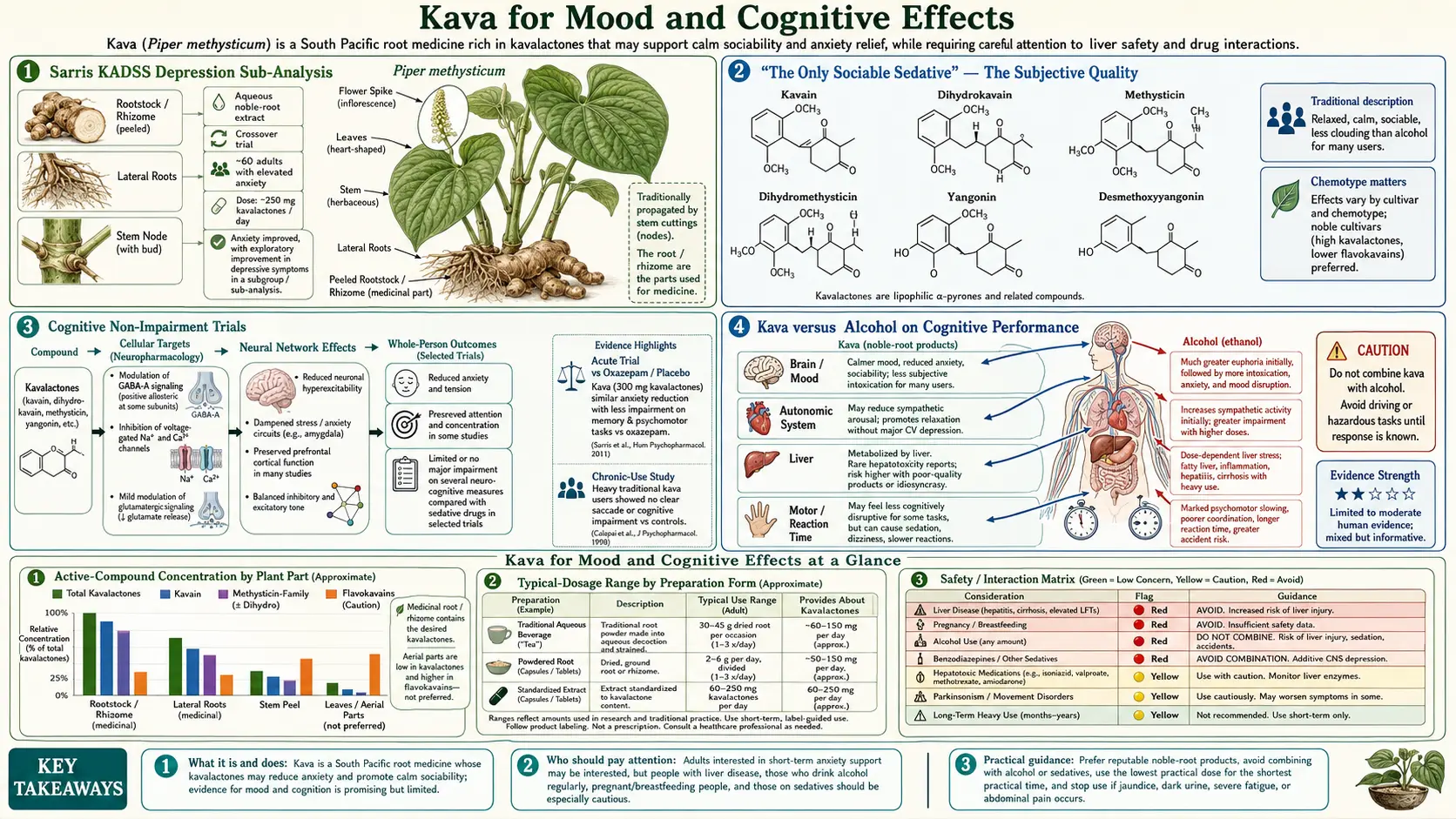
One of the most striking and counterintuitive findings in the modern kava literature is that the kavalactones, despite producing measurable anxiolysis and physical relaxation, showed no replicated significant negative effects on cognition in a 2011 systematic review of ten trials — in contrast to alcohol, benzodiazepines, and most other GABAergic anxiolytics. The picture is not uniform: one chronic study in that review found that kava impaired visual attention during high-cognitive demand, and the larger 16-week 2020 Sarris trial reported poorer memory more often on kava than on placebo. The 2009 Kava Anxiety Depression Spectrum Study (KADSS), a 3-week crossover trial in people with elevated anxiety, reported significant reductions in depression scores alongside the anxiety result. The mechanistic hypotheses for a mood effect rest on test-tube and animal work: reversible inhibition of monoamine oxidase B (MAO-B) by kava pyrones, most potently desmethoxyyangonin and methysticin, in human platelets, and changes in dopamine levels in the brains of rats. This deep-dive walks through the depression evidence, the cognitive studies, the MAO-B and dopamine hypotheses, and the practical implications for "the only sociable sedative."
Table of Contents
- Sarris Trials and Depression Scores
- "The Only Sociable Sedative" — The Subjective Quality
- Cognitive Performance Trials
- Kava versus Alcohol on Cognitive Performance
- Kava versus Benzodiazepines on Cognitive Performance
- The MAO-B Inhibition Hypothesis
- The Dopamine Hypothesis
- Mood Elevation Without Stimulant Character
- Kava and Major Depressive Disorder Evidence
- Cautions for the Mood Use Case
- Key Research Papers
- Connections
- Featured Videos
Sarris Trials and Depression Scores
The Kava Anxiety Depression Spectrum Study (KADSS), published by Sarris and colleagues in 2009 and discussed in the Anxiety Relief deep-dive, was described by its authors as the first documented human clinical trial assessing the anxiolytic and antidepressant efficacy of an aqueous extract of kava. It was a 3-week placebo-controlled, double-blind crossover trial in 60 adults with 1 month or more of elevated generalized anxiety, who took five kava tablets a day containing 250 mg of kavalactones.
The results, as the trial's abstract reports them:
- Anxiety — Hamilton Anxiety Scale scores fell by 9.9 points on kava versus 0.8 points on placebo in the first controlled phase, and by 10.3 points on kava versus a rise of 3.3 points on placebo in the second; the pooled effect across phases was highly significant (p < 0.0001)
- Depression — pooled analyses revealed highly significant relative reductions in Montgomery-Åsberg Depression Rating Scale (MADRS) scores, as well as in Beck Anxiety Inventory scores
- Safety — no serious adverse effects and no clinical hepatotoxicity at the dose and duration studied
The authors concluded that kava “appears equally effective in cases where anxiety is accompanied by depression.” The KADSS was not a depression trial: participants were enrolled for anxiety, each controlled phase lasted 3 weeks, and depression scores were a secondary measure.
The later 2013 Sarris trial (75 people enrolled, 58 in the intention-to-treat analysis, 6 weeks, 120 or 240 mg of kavalactones a day depending on response) enrolled people with generalized anxiety disorder and no comorbid mood disorder. It found a significant reduction in anxiety compared with placebo (Cohen d = 0.62), with 26% of the kava group in remission versus 6% of the placebo group; its abstract reports no depression result.
"The Only Sociable Sedative" — The Subjective Quality
Long-time observers of kava use across both traditional Pacific contexts and modern recreational/medicinal use commonly describe the kava experience with a phrase that captures something genuinely unusual in psychopharmacology: kava is the only "sociable sedative." Unlike alcohol, it does not disinhibit. Unlike benzodiazepines, it does not blunt. Unlike opioids, it does not produce euphoria. Unlike stimulants, it does not energize. What it produces is best described as relaxed sociability with mental clarity — a state in which conversation flows more easily, interpersonal warmth increases, social anxiety drops, but the participant remains fully present, alert, and able to make complex judgments.
This subjective quality is essentially incompatible with the conventional gamma-aminobutyric acid-A pharmacology of sedatives. Most gamma-aminobutyric acid-A modulators (alcohol, benzodiazepines, barbiturates) produce sedation precisely because they reduce cortical activity globally, including the cortical activity needed for cognitive performance and emotional regulation. Kava's ability to produce anxiolysis without this global cortical depression is one of the more interesting unsolved questions in psychopharmacology.
The leading hypotheses for why kava is sociable while other GABAergic agents are not:
- Gamma-aminobutyric acid-A subunit selectivity — kavalactones may act preferentially at α2/α3-containing gamma-aminobutyric acid-A receptors (mediating anxiolysis) rather than α1-containing receptors (mediating global sedation). This pattern would produce anxiolysis without sedation.
- Concurrent dopaminergic effect — in rats, a higher dose of kava extract (120 mg/kg) increased dopamine levels in the nucleus accumbens, a brain reward area (Baum 1998); if a similar effect occurs in people, it could counterbalance any gamma-aminobutyric acid-mediated sedation, maintaining alertness and reward-system activity that supports sociable interaction
- Concurrent MAO-B inhibition — the MAO-B inhibition seen in test-tube studies, most potent with desmethoxyyangonin and methysticin, could prolong dopamine and phenethylamine availability, supporting alertness and mood
- Multi-receptor multi-mechanism convergence — the simultaneous action across four mechanisms produces a clinical signature no single-target drug reproduces
Whatever the mechanism, the practical implication is that kava occupies a clinical niche that no pharmaceutical anxiolytic occupies: an agent that reduces social anxiety enough to enable comfortable social engagement, without the cognitive blunting that would interfere with that engagement, without the disinhibition that creates problems with alcohol, and without the abuse liability that complicates benzodiazepine use in this context.
Cognitive Performance Trials
A 2011 systematic review by LaPorte and colleagues found ten human clinical trials of kava and cognition (seven acute, three chronic) and concluded that the majority of evidence suggests kava has no replicated significant negative effects on cognition. Within those trials, one acute study found that kava significantly improved visual attention and working memory processes, another found that kava increased body sway, and one chronic study found that kava significantly impaired visual attention during high-cognitive demand.
Reaction Time and Information Processing
Heinze et al. (1994) recorded event-related potentials (ERPs, brain-wave responses) during a visual search task in young, healthy men given a standardized kava extract or oxazepam (a benzodiazepine) in a double-blind design. Oxazepam had significant effects on a number of psychometric tests and on search time and quality, and reduced the amplitude of several components, including the occipital P3 (part of the P300 family of responses that index information processing). The kava extract was associated with a greater posterior N1, posterior contralateral N2 and occipital P3.
Later studies give a mixed picture. Prescott and colleagues (1993) found that kava increased body sway compared with juice alone, with no other statistically significant differences, although the kava group's mean cognitive performance was generally poorer. Foo and Lemon (1997) found that kava alone had little effect on reported condition and cognitive performance but produced a decrement in performance on Digit Symbol Coding. In a 2012 crossover study of 22 moderately anxious adults, a single 180 mg kavalactone dose was found to have no negative effect on cognition, whereas oxazepam reduced alertness.
Working Memory and Attention
In a word-recognition memory task, Münte and colleagues (1993, 12 healthy volunteers) found that oxazepam was associated with a significantly worse recognition rate, while kava showed a slightly increased recognition rate. Longer use is less clear: in the 16-week 2020 Sarris trial of an aqueous kava root extract (171 people with generalised anxiety disorder, 120 mg of kavalactones twice a day), poorer memory was reported more often in the kava group than in the placebo group (Kava = 36 vs placebo = 23; p = 0.044), as was tremor/shakiness.
Driving Simulator Performance
Driving simulator studies are particularly important practically because they capture integrated psychomotor performance under simulated real-world demands. In a 2013 randomized, placebo-controlled crossover study, 22 adults used a driving simulator after a medicinal dose of kava (180 mg of kavalactones), oxazepam (30 mg) or placebo, one week apart. No impairing effects on driving outcomes were found after kava compared with placebo, while oxazepam significantly slowed braking reaction time; the authors called for research on larger recreational doses. Real-world data on recreational kava drinking point the other way: in a population-based case-control study of serious-injury crashes in Fiji, 23% of drivers in crashes and 4% of control drivers reported drinking kava in the 12 hours before, and driving following kava use was associated with a four-fold increase in the odds of crash involvement (odds ratio 4.70; 95% CI 1.90–11.63).
Real-World Cognitive Performance
Several studies have measured complex real-world cognitive performance — arithmetic tasks, reading comprehension, problem-solving — on kava versus placebo and versus benzodiazepines. The consistent finding is that kava preserves complex cognitive performance to a degree that benzodiazepines, antihistamines, and other conventional anxiolytics do not.
Kava versus Alcohol on Cognitive Performance
The cognitive contrast between kava and alcohol is particularly stark and well-documented. Both are widely used as social lubricants. Both produce subjective relaxation and reduced social anxiety. Both engage gamma-aminobutyric acid-A receptors. But they differ profoundly in their cognitive consequences.
Alcohol Cognitive Profile
- Measurable impairment of reaction time and motor coordination at blood alcohol concentrations as low as 0.02%
- Substantial impairment of complex psychomotor tasks (driving) at 0.05% and above
- Impairment of working memory, problem-solving, and decision-making
- Disinhibition leading to socially inappropriate behavior
- Anterograde amnesia at higher doses ("blackouts")
- Severe withdrawal syndrome on cessation after chronic heavy use (delirium tremens, seizures)
- Hepatotoxicity from chronic use
- Substantial neurotoxicity from chronic use (cerebellar atrophy, Wernicke-Korsakoff syndrome)
Kava Cognitive Profile
- No measurable impairment of reaction time at clinical doses
- Driving simulator performance not impaired by a 180 mg kavalactone dose in a 2013 study; driving after recreational kava use was linked to higher crash odds in a Fiji case-control study
- Working memory: mixed results — one chronic study found impaired visual attention during high-cognitive demand, and the 16-week 2020 trial reported poorer memory more often on kava than on placebo
- No disinhibition; if anything, social judgment may be improved (consistent with the traditional ceremonial use for dispute resolution and political negotiation)
- No amnesia at clinical doses; very high traditional ceremonial doses produce subjective "fuzziness" but not blackout
- No significant withdrawal syndrome on cessation
- Hepatotoxicity concern with poor-quality preparations (covered in detail on the Benefits hub page); in the largest trial of an aqueous root extract (16 weeks, 171 people), liver function test abnormalities were significantly more frequent on kava than on placebo, although no participant met criteria for herb-induced hepatic injury
- No evidence of central nervous system neurotoxicity from chronic use
Traditional drinking sessions deliver far larger amounts than tablet trials. A 2022 study (Aporosa and colleagues) tested 20 kava drinkers before, during and after a traditionally influenced kava session, which lasts on average 6 hours with about 3.6 litres of beverage kava per person, and compared them with 19 controls. No statistically significant impairment was found in five of six measured cognitive abilities, but temporal order judgement (a timing skill linked to decision-making and information processing) was significantly worse at the final testing point, which the authors say may impair driver safety.
For the use case alcohol has traditionally occupied in many cultures — social lubrication, end-of-day relaxation, mild anxiolysis — the studies above found much less cognitive impairment from kava than alcohol is known to cause, with the exceptions noted. The hepatotoxicity comparison is more nuanced: alcohol is unambiguously hepatotoxic, kava's liver problems have been linked to product quality, and the 2020 trial of an aqueous root extract also found more liver test abnormalities on kava than on placebo.
The growing kava bar phenomenon in the United States and elsewhere is partly a response to this comparison: a venue where adults can engage in social relaxation without the cognitive and behavioral costs of alcohol.
Kava versus Benzodiazepines on Cognitive Performance
The cognitive contrast with benzodiazepines is similarly stark in the head-to-head studies. Oxazepam (a benzodiazepine) affected psychometric tests and visual search time and quality (Heinze 1994), worsened recognition memory (Münte 1993), reduced alertness (Sarris 2012) and slowed braking reaction time in a driving simulator (Sarris 2013); kava did not show these effects in the same studies. The 2011 LaPorte systematic review of ten kava trials, a review rather than a meta-analysis, concluded that kava has no replicated significant negative effects on cognition.
The mechanism difference matters. Benzodiazepines act non-selectively at α1, α2, α3, and α5-containing gamma-aminobutyric acid-A receptors. The α1 subtype mediates sedation. The α2/α3 subtypes mediate anxiolysis. The α5 subtype, enriched in the hippocampus, mediates the amnestic effect that is one of the hallmark side effects of benzodiazepines.
Kavalactones appear to act preferentially at non-α1, non-α5 sites, producing anxiolysis through α2/α3 modulation without the α1-mediated sedation or α5-mediated amnesia. This subunit selectivity is the leading explanation for the cognitive non-impairment.
The pharmaceutical industry has actively pursued α2/α3-selective benzodiazepine receptor modulators for decades, motivated by exactly this profile (anxiolysis without sedation or amnesia). Compounds such as bretazenil produced benzodiazepine-like side effects (sedation, dizziness) in Phase I studies, and bretazenil, developed in the 1980s, was never marketed as a medicine. Alpidem was briefly marketed for the treatment of anxiety but was withdrawn because of liver toxicity. No widely available pharmaceutical reproduces the selective α2/α3 profile proposed for the kavalactones.
The MAO-B Inhibition Hypothesis
The leading mechanistic hypothesis for kava's mood-elevating effect is reversible inhibition of monoamine oxidase B (MAO-B) by the kava pyrones (kavalactones), most potently desmethoxyyangonin and methysticin. MAO-B is the mitochondrial enzyme principally responsible for catabolism of dopamine and trace amines (phenethylamine, benzylamine) in the central nervous system. MAO-A (the parallel isoform) is more important for serotonin and norepinephrine catabolism.
The key study (Uebelhack et al. 1998) was done in the test tube, on MAO-B from human blood platelets. Kava extract was a reversible inhibitor of MAO-B in intact platelets (IC50 24 µM) and in disrupted platelet homogenates (IC50 1.2 µM). The order of potency of the pure kava pyrones was desmethoxyyangonin > methysticin > yangonin > dihydromethysticin > dihydrokavain > kavain, and the two most potent, desmethoxyyangonin and methysticin, showed mean Ki values of 0.28 µM and 1.14 µM. The study did not measure MAO-B inhibition in the brains of people taking kava. The proposed functional implication is that endogenous dopamine and phenethylamine would have somewhat longer half-life in the synapse during kava exposure, producing a mild mood-elevating effect mechanistically similar (but much weaker) to that of pharmaceutical MAO-B inhibitors like selegiline.
Why MAO-B inhibition would produce mood improvement: MAO-B inhibitors like selegiline are U.S. Food and Drug Administration-approved for major depression at sufficient dose, and have been used adjunctively in Parkinson's disease for both motor and mood effects for decades. The mechanism is presumed to be increased synaptic dopamine availability in mesolimbic and prefrontal pathways relevant to motivation, hedonic tone, and reward.
Clinical caveats:
- The in vitro MAO-B inhibition is reversible; this is different from irreversible inhibitors like classical monoamine oxidase inhibitor (MAOI) antidepressants (phenelzine, tranylcypromine) that produce dietary tyramine restrictions
- The clinical magnitude of MAO-B inhibition in vivo at typical kava doses is unknown but likely modest
- Combining monoamine oxidase inhibitor antidepressants with kava carries a risk of clinical serotonin syndrome or hypertensive crisis that is theoretical rather than well-documented
- For concurrent selective serotonin reuptake inhibitor (SSRI) use the theoretical concern is smaller, because the MAO-B effect of kava is small compared to that of pharmaceutical monoamine oxidase inhibitors (MAOIs) that absolutely contraindicate selective serotonin reuptake inhibitor co-administration
The Dopamine Hypothesis
A complementary mechanistic hypothesis for kava's mood effect involves dopamine. The animal study usually cited (Baum and colleagues, 1998) measured dopamine levels by microdialysis in the nucleus accumbens of rats, part of the brain's reward system; it did not test the dopamine transporter. A small dose of kava extract (20 mg/kg) changed dopamine concentrations and a higher dose (120 mg/kg) increased them. Among the single compounds, D,L-kawain lowered dopamine at low doses and either raised it or left it unchanged at higher doses; yangonin lowered dopamine below the detection limit; desmethoxyyangonin raised it; and dihydrokawain, methysticin and dihydromethysticin produced no significant change. The authors suggested that kava's relaxing and slightly euphoric actions may be caused by activation of the mesolimbic dopamine neurones.
A 2011 systematic review attributed kava's possible cognitive benefit to a different transmitter: inhibition of noradrenaline re-uptake in the prefrontal cortex.
The behavioral signature is consistent with weak dopaminergic enhancement. Long-time kava users do not experience the stimulant rush of amphetamines or the euphoric peak of cocaine; they experience modestly elevated mood, slightly enhanced motivation for social engagement, and a sense of well-being. The absence of strong reinforcement explains the absence of abuse liability — kava is not subject to compulsive use patterns characteristic of dopamine-elevating drugs of abuse.
The hypothesis combines weak MAO-B inhibition (less breakdown of dopamine) with the dopamine increases seen in rats, proposing a mild mood-elevating effect without stimulation. The evidence for both parts comes from test-tube and rat studies.
For broader context on dopamine and mood see our Depression page.
Mood Elevation Without Stimulant Character
The distinctive feature of kava's mood effect is that it is mood-elevating without being stimulating. This is unusual. Most mood-elevating agents fall into one of three classes:
- Stimulants — amphetamines, methylphenidate, caffeine; produce both mood elevation and energizing arousal
- Euphoriants — opioids, MDMA, alcohol; produce mood elevation with disinhibition and impairment
- Antidepressants — selective serotonin reuptake inhibitors (SSRIs), serotonin-norepinephrine reuptake inhibitors (SNRIs), monoamine oxidase inhibitors, tricyclics, atypicals; produce mood normalization over weeks of treatment, with neutral or sedating acute effects
Kava is in none of these categories. Its acute effect is mood-elevating without arousal (unlike stimulants), without disinhibition or impairment (unlike alcohol or opioids), and without the multi-week delay of antidepressants. The closest pharmaceutical analog is selegiline (the MAO-B inhibitor) at low doses, which produces mild mood elevation without the cognitive or behavioral effects of typical antidepressants — consistent with the MAO-B mechanism being substantially responsible for kava's mood profile.
Kava's proponents describe it as occupying a niche distinct from any pharmaceutical class: mild mood elevation and reduced social anxiety without stimulation, without intoxication, without impairment, and without the multi-week onset of conventional antidepressants. The trial evidence for the mood part of that description is the short KADSS result described above.
Kava and Major Depressive Disorder Evidence
The KADSS depression result (described above) comes from a 3-week crossover trial in people enrolled for anxiety. In people diagnosed with major depressive disorder, a small 2009 pilot trial by Sarris and colleagues tested kava only in combination with St. John's wort: 28 adults with major depressive disorder and co-occurring anxiety took part in a double-blind crossover trial with two 4-week controlled phases. The combination gave a significantly greater reduction in self-reported depression (Beck Depression Inventory) than placebo in the first controlled phase, but the effect was not replicated in the crossover phase, and there were no significant effects on anxiety or quality of life.
The largest kava trial so far found no benefit for anxiety. In the 2020 Sarris trial, 171 people with diagnosed generalised anxiety disorder took an aqueous extract of dried kava root (120 mg of kavalactones twice a day) or placebo for 16 weeks. The difference in anxiety reduction was not significant (a relative reduction favouring placebo of 1.37 points; p = 0.25), and 17.4% of the kava group were in remission versus 23.8% of the placebo group. Poorer memory and tremor/shakiness were reported more often on kava, and liver function test abnormalities were significantly more frequent on kava, although no participant met criteria for herb-induced hepatic injury. The authors concluded that this particular extract was not effective for diagnosed generalised anxiety disorder.
Cautions for the Mood Use Case
- Monoamine oxidase inhibitor antidepressants — a theoretical (though not well-documented in case reports) risk of hypertensive crisis or serotonin syndrome from the additive MAO inhibition
- Selective serotonin reuptake inhibitor antidepressants — a smaller theoretical concern, from kava's weak MAO-B effect described above
- Bupropion — any dopaminergic effect of kava would add to bupropion's; theoretical risk of seizure threshold lowering
- Parkinson's disease — complex interaction with levodopa and other dopaminergic agents; case reports of worsened parkinsonian symptoms with chronic high-dose kava use
- Pre-existing mood disorder — for bipolar disorder there is a theoretical risk of mood destabilization from any agent affecting dopamine or MAO
- Substance use disorder — kava's subjective qualities, while not producing classical reinforcement or addiction, can become a focus of compulsive use in some individuals predisposed to behavioral addiction patterns, a concern for people with a history of alcohol use disorder or other substance use disorder.
- Concurrent benzodiazepines, z-drugs, opioids, or alcohol — additive central nervous system depression and (for alcohol) additive hepatic stress; in a laboratory study kava appeared to potentiate both perceived and measured impairment when combined with alcohol (Foo and Lemon 1997).
- Hepatotoxicity from poor-quality extracts — the central caution, covered comprehensively on the Benefits hub page
- Pregnancy and breastfeeding — there is insufficient safety data
Key Research Papers
- Sarris J, Stough C, Bousman CA, Wahid ZT, Murray G, Teschke R, Savage KM, Dowell A, Ng C, Schweitzer I (2013). Kava in the treatment of generalized anxiety disorder: a double-blind, randomized, placebo-controlled study. Journal of Clinical Psychopharmacology. 33(5):643-8. — PubMed PMID: 23635869
- Sarris J, Kavanagh DJ, Byrne G, Bone KM, Adams J, Deed G (2009). The Kava Anxiety Depression Spectrum Study (KADSS): a randomized, placebo-controlled crossover trial using an aqueous extract of Piper methysticum. Psychopharmacology (Berl). 205(3):399-407. — PubMed PMID: 19430766
- Sarris J, Byrne GJ, Bousman CA, Cribb L, Savage KM, Holmes O, Murphy J, Macdonald P, Short A, Nazareth S, Jennings E, Thomas SR, Ogden E, Chamoli S, Scholey A, Stough C (2020). Kava for generalised anxiety disorder: A 16-week double-blind, randomised, placebo-controlled study. Australian and New Zealand Journal of Psychiatry. 54(3):288-297. — PubMed PMID: 31813230
- Sarris J, Kavanagh DJ, Deed G, Bone KM (2009). St. John's wort and Kava in treating major depressive disorder with comorbid anxiety: a randomised double-blind placebo-controlled pilot trial. Human Psychopharmacology. 24(1):41-8. — PubMed PMID: 19090505
- Uebelhack R et al. (1998). Inhibition of platelet MAO-B by kava pyrone-enriched extract from Piper methysticum Forster. Pharmacopsychiatry. — PubMed PMID: 9832350
- Baum SS, Hill R, Rommelspacher H (1998). Effect of kava extract and individual kavapyrones on neurotransmitter levels in the nucleus accumbens of rats. Progress in Neuro-Psychopharmacology and Biological Psychiatry. 22(7):1105-20. — PubMed PMID: 9829291
- Heinze HJ, Münthe TF, Steitz J, Matzke M (1994). Pharmacopsychological effects of oxazepam and kava-extract in a visual search paradigm assessed with event-related potentials. Pharmacopsychiatry. 27(6):224-30. — PubMed PMID: 7870743
- Münte TF et al. (1993). Effects of oxazepam and an extract of kava roots (Piper methysticum) on event-related potentials in a word recognition task. Neuropsychobiology. — PubMed PMID: 8515824
- Russell PN, Barker D, Singh NN (1987). The effects of kava on alerting and speed of access of information from long-term memory. Bulletin of the Psychonomic Society. 25(4):236-237. — doi:10.3758/bf03330341
- Foo H, Lemon J (1997). Acute effects of kava, alone or in combination with alcohol, on subjective measures of impairment and intoxication and on cognitive performance. Drug and Alcohol Review. — PubMed PMID: 16203421
- Prescott J, Jamieson D, Emdur N, Duffield P (1993). Acute effects of kava on measures of cognitive performance, physiological function and mood. Drug and Alcohol Review. 12(1):49-57. — PubMed PMID: 16818312
- LaPorte E et al. (2011). Neurocognitive effects of kava (Piper methysticum): a systematic review. Human Psychopharmacology. — PubMed PMID: 21437989
- Sarris J, Murphy J, Mischoulon D, Papakostas GI, Fava M, Berk M, Ng CH (2016). Adjunctive Nutraceuticals for Depression: A Systematic Review and Meta-Analyses. American Journal of Psychiatry. 173(6):575-87. — PubMed PMID: 27113121
- Smith K, Leiras C (2018). The effectiveness and safety of Kava Kava for treating anxiety symptoms: A systematic review and analysis of randomized clinical trials. Complementary Therapies in Clinical Practice. 33:107-117. — PubMed PMID: 30396607
- Sarris J, Scholey A, Schweitzer I, Bousman C, Laporte E, Ng C, Murray G, Stough C (2012). The acute effects of kava and oxazepam on anxiety, mood, neurocognition; and genetic correlates: a randomized, placebo-controlled, double-blind study. Human Psychopharmacology. 27(3):262-9. — PubMed PMID: 22311378
- Sarris J, Laporte E, Scholey A, King R, Pipingas A, Schweitzer I, Stough C (2013). Does a medicinal dose of kava impair driving? A randomized, placebo-controlled, double-blind study. Traffic Injury Prevention. 14(1):13-7. — PubMed PMID: 23259514
- Wainiqolo I, Kafoa B, Kool B, Robinson E, Herman J, McCaig E, Ameratunga S (2016). Driving following Kava Use and Road Traffic Injuries: A Population-Based Case-Control Study in Fiji (TRIP 14). PLoS One. 11(3):e0149719. — PubMed PMID: 26930404
- Aporosa S', Ballard H, Pandey R, McCarthy MJ (2022). The impact of traditional kava (Piper methysticum) use on cognition: Implications for driver fitness. Journal of Ethnopharmacology. 291:115080. — PubMed PMID: 35151837
- Skolnick P (2012). Anxioselective anxiolytics: on a quest for the Holy Grail. Trends in Pharmacological Sciences. 33(11):611-20. — PubMed PMID: 22981367
- Gameli PS, Kutzler J, Huppertz LM, Berardinelli D, Tronconi L, Basile G, Carlier J, Busardò FP, Auwärter V (2026). In vivo and in vitro metabolism of the designer benzodiazepine, bretazenil: a comparison of pooled human hepatocytes and liver microsomes with postmortem urine and blood samples. Archives of Toxicology. 100(1):259-273. — PubMed PMID: 41034680