Bitter Melon: History and Traditional Use
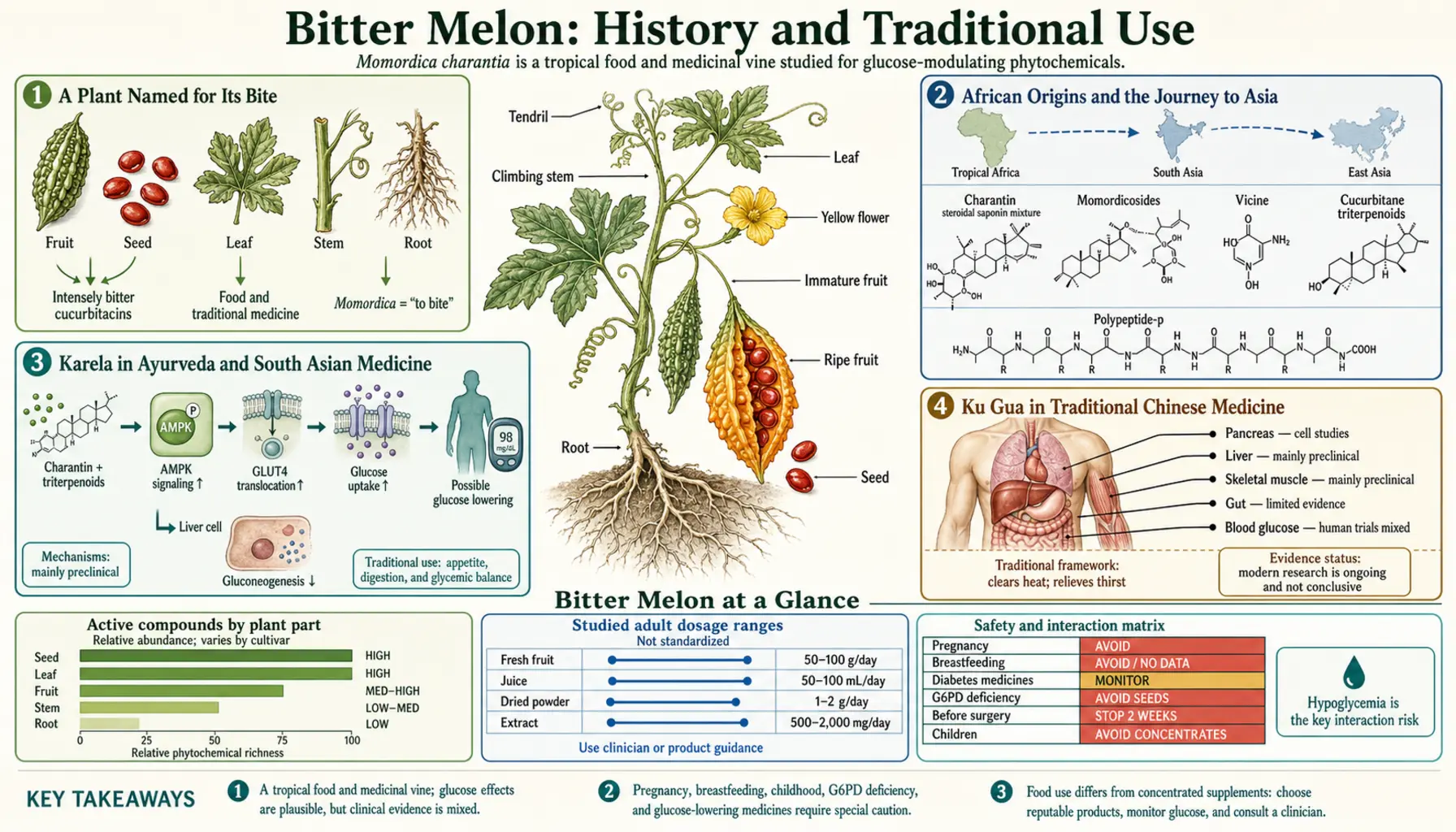
Few foods are as honest about themselves as bitter melon. Its name is its warning, and yet across Africa, South and Southeast Asia, China, and the Caribbean, people have eaten this warty, intensely bitter gourd on purpose for centuries — not only as food but as medicine, especially for what we now call diabetes. This page traces what is actually documented about that long history: where the plant came from, how it travelled, how the great traditional medical systems classified it, and the genuine twentieth-century laboratory milestones that began to test the old reputation. Where the record is firm we say so plainly; where something is tradition or folklore, we name it as tradition.
Table of Contents
- A Plant Named for Its Bite
- African Origins and the Journey to Asia
- Karela in Ayurveda and South Asian Medicine
- Ku Gua in Traditional Chinese Medicine
- Caribbean Cerasee and Other Folk Traditions
- Bitter as a Virtue: A Food Culture
- From Folk Remedy to Laboratory: The Diabetes Milestones
- What the History Does and Does Not Promise
- Research Papers and References
- Connections
- Featured Videos
A Plant Named for Its Bite
Bitter melon is the common English name for Momordica charantia, a climbing annual vine of the cucumber and gourd family (Cucurbitaceae) that bears a distinctive warty, oblong fruit ranging from pale green to deep emerald. It is also widely called bitter gourd, balsam pear, karela (Hindi and Urdu), ku gua (Mandarin, written 苦瓜 and meaning literally "bitter melon"), goya (Okinawan), ampalaya (Filipino), and cerasee or carilla in the Caribbean. The sheer number of established local names is itself a clue to how widely and how long the plant has been cultivated and used.
The Swedish naturalist Carl Linnaeus formally described and named the species Momordica charantia in his foundational Species Plantarum of 1753, the work that anchors modern botanical naming. The genus name Momordica is usually traced to the Latin mordere, "to bite" — a reference not to the fruit's taste but to the seeds, whose jagged, sculptured margins look as though they have been bitten or gnawed. It is a fitting label for a plant whose whole identity, in the kitchen and in the clinic alike, turns on bitterness.
That bitterness is not incidental. In the traditional medical systems that adopted bitter melon, an intensely bitter flavour was not a defect to be masked but a therapeutic signal — bitter plants were thought to cool, cleanse, and stimulate digestion. Understanding that point is the key to the entire history that follows: the very quality that makes the fruit a hard sell at the dinner table is exactly what made it valued as a medicine.
African Origins and the Journey to Asia
For a long time the geographic origin of bitter melon was uncertain, but modern genetic and biogeographic research has clarified the picture, and the answer is somewhat surprising: the plant's wild ancestor is African. Genus-level studies place the natural dispersal of Momordica from tropical Africa to Asia in the deep evolutionary past, on the order of millions of years ago — long before any human use. What matters for human history is what happened far more recently, once people began to cultivate the wild vine.
A 2020 genomic study published in the Proceedings of the National Academy of Sciences (Matsumura and colleagues), together with an accompanying commentary by the botanist Susanne Renner, resequenced bitter gourd populations and concluded that the wild plant's African lineage gave rise to cultivated forms in Asia. Their analysis dated the divergence of the South Asian cultivated lineage from the wild plant to roughly 6,000 years ago, with a further separation of distinct Southeast Asian cultivars only about 800 years ago. In plain terms: bitter melon is an African plant that was domesticated — turned into the cultivated vegetable we know — in Asia, and refined into regional varieties over several thousand years.
The plant's long association with the Indian subcontinent is reflected in its deep roots in South Asian food and medicine, and it spread eastward across the region over many centuries. It is commonly reported that bitter melon reached China comparatively late — sources place its introduction there around the fourteenth century — though precise dates for these ancient movements are inevitably approximate. What is not in doubt is the outcome: by the early modern period, bitter melon was a firmly established food and medicinal plant across a vast belt of the tropical and subtropical Old World, and it would later travel with people to the Caribbean, the Americas, and beyond.
Karela in Ayurveda and South Asian Medicine
In the Ayurvedic tradition of the Indian subcontinent, bitter melon — karela — has a long and well-documented standing as a medicinal food. Ayurvedic theory classifies tastes (rasa) as therapeutic properties, and bitter melon is the bitter (tikta) plant par excellence. Bitter taste in this framework is considered cooling and is held to pacify pitta and kapha, to kindle digestion, to scrape away excess tissue and dampness, and to cleanse the liver and blood. On that logic the fruit, leaves, and juice were traditionally employed for a wide range of complaints.
Modern ethnobotanical reviews of Momordica charantia compile a strikingly long list of these traditional South Asian and broader folk uses, including its reputation as an aid for diabetes, as a digestive and laxative, as an anthelmintic (a remedy for intestinal worms), and as a treatment applied to skin diseases, fevers, jaundice, and a host of other conditions. The widely cited 2004 review by Grover and Yadav in the Journal of Ethnopharmacology catalogues traditional indications ranging across diabetes, dysmenorrhoea, eczema, gout, jaundice, leprosy, piles, pneumonia, psoriasis, rheumatism, and fever, among others — a reminder that, as with most heritage botanicals, the historical claims were broad and that only a few have since been put to rigorous scientific test.
The thread that runs most strongly through the South Asian record, and that connects it to the global picture, is the use of bitter melon for what we would now recognise as diabetes and high blood sugar. That single indication — the bitter fruit taken to manage the "sweet" disease — is the one the modern laboratory would later seize upon, and it is the reason bitter melon became one of the most-studied of all traditional antidiabetic plants.
Ku Gua in Traditional Chinese Medicine
In China the same plant, known as ku gua (苦瓜, "bitter melon"), was absorbed into Traditional Chinese Medicine along entirely parallel lines, despite the two systems developing independently. Chinese medical thinking, like Ayurveda, reads bitterness and "cooling" nature as therapeutic. Bitter melon was classified as a cooling food used to clear "summer heat," to drain heat and toxicity, to brighten the eyes, and to settle the digestive tract — hence its traditional use for fevers, for inflamed or irritated skin, and for gastrointestinal complaints such as dysentery.
As in South Asia, a recurring traditional Chinese application was for the cluster of symptoms — excessive thirst, frequent urination, and wasting — that classical medicine grouped together and that overlaps with what we now call diabetes. Contemporary pharmacology reviews of Momordica charantia consistently note this long-standing East Asian use of the fruit for high blood sugar, and it is one of the reasons bitter melon is sold today across East and Southeast Asia not only as a vegetable but as a health tonic.
That two of the world's oldest and most elaborate medical traditions — Ayurveda and Chinese medicine — independently reached the same core conclusions about a single bitter gourd (cooling, cleansing, good for the digestion, helpful for the "sweet" disease) is a genuinely notable instance of convergent traditional knowledge. It does not, by itself, prove the remedy works; but it is exactly the kind of cross-cultural agreement that prompts scientists to take a folk claim seriously and test it, which is precisely what happened with bitter melon and diabetes.
Caribbean Cerasee and Other Folk Traditions
As people, plants, and the upheavals of trade and empire moved bitter melon out of its Asian heartland, the vine naturalised readily in warm climates around the world and was folded into new local medical traditions. The most vivid example is the Caribbean, where bitter melon — usually the smaller, wilder-growing form — is known as cerasee (also spelled cerassee or kerala). Across Jamaica and the wider West Indies the leaves and vine are dried and brewed into a famously bitter cerasee tea, traditionally drunk to "cleanse" or "wash" the blood, to settle the stomach, to bring down fevers, for colds, and as a general spring tonic. The same blood-sugar association seen in Asia recurs in Caribbean folk practice as well.
Comparable traditional uses are documented across the tropics — in parts of South and Central America, in East Africa where the wild plant grows, and throughout Southeast Asia — with the recurring themes being diabetes, digestion, intestinal parasites, skin conditions, fevers, and malaria. Ethnobotanical surveys repeatedly record bitter melon among the plant remedies used by indigenous and rural communities in these regions, which is a major reason the species attracted such sustained scientific attention.
One traditional use deserves a specific and serious caution rather than a romantic retelling. In a number of folk traditions, bitter melon — particularly the seeds and the fruit in quantity — was used as an abortifacient and to affect fertility, and the published pharmacological literature treats this reputation as credible enough to warn that the plant should be avoided in pregnancy. This is the clearest reminder that "traditional" and "gentle" are not synonyms: a plant can be both a cherished food and genuinely hazardous in particular circumstances. The detailed safety guidance lives on the main Bitter Melon page and its Benefits articles.
Bitter as a Virtue: A Food Culture
Unlike many medicinal herbs, bitter melon never lived only in the apothecary — it has always been, first and foremost, a vegetable, and its history is inseparable from the kitchen. Across its range, generations of cooks developed techniques to tame (without fully removing) the bitterness: slicing the fruit thin, scooping out the spongy seed core, and salting or blanching the slices to draw off some of the bitter juice before cooking. The bitterness was managed, never entirely banished, because in these food cultures a clean, vegetal bitterness is itself prized.
The dishes are as varied as the regions. In Cantonese cooking the gourd is stir-fried with egg, garlic, and fermented black beans, or simmered in soups. In the Philippines, where it is called ampalaya, it appears in pinakbet and is stuffed or scrambled with egg. Across India karela is stir-fried with spices, stuffed (bharwa karela), or sun-dried into chips. In Okinawa, goya champuru — bitter melon stir-fried with tofu, egg, and pork — is an emblem of the islands' celebrated traditional diet. In the Caribbean the plant turns up both on the plate and, more often, in the teapot as cerasee.
This deep culinary embedding is historically important for two reasons. First, it explains how a medicinal reputation could persist unbroken for so long across so many cultures: people were eating the "medicine" routinely, season after season, as ordinary food. Second, it is the practical foundation of the modern view of bitter melon — a food-grade plant, generally safe to eat in normal culinary amounts for most people, whose possible metabolic benefits can be woven into an everyday diet rather than confined to a supplement bottle.
From Folk Remedy to Laboratory: The Diabetes Milestones
The modern scientific story of bitter melon is essentially the story of researchers asking whether the centuries-old claim — that the bitter gourd lowers blood sugar — could be confirmed in the laboratory and, if so, why. Unlike the diffuse folklore, this part of the history has named investigators and datable milestones, and a few of them are worth setting down accurately.
An early and frequently cited milestone is the work of the Indian researchers M. M. Lotlikar and M. R. Rajarama Rao, who in the 1960s isolated from bitter-melon fruit a substance they associated with its blood-sugar-lowering action and which came to be known as charantin. Their findings appeared in Indian scientific journals of the period (a short note in the Journal of the University of Bombay in 1962, and a fuller pharmacological report in the Indian Journal of Pharmacy in 1966). These are old regional papers without modern digital identifiers, so they are named here as historical primary sources rather than linked. Charantin was later characterised chemically as a mixture of two steroidal saponins (sitosteryl glucoside and stigmasteryl glucoside) — one of several constituents now studied for the plant's metabolic effects.
A second landmark came in 1981, when P. Khanna and colleagues, publishing in the Journal of Natural Products, reported the isolation from bitter melon of an insulin-like protein they called polypeptide-p (sometimes nicknamed "plant insulin" or p-insulin), which they described as lowering blood glucose when given by subcutaneous injection to gerbils, langurs, and human subjects. The discovery of an insulin-resembling compound in a food plant was a striking result and helped cement bitter melon's status as a serious subject for diabetes research; that paper remains one of the most-cited references in the field and is linked in the references below.
From these foundations the literature grew into hundreds of phytochemical and pharmacological studies identifying additional candidate compounds — among them the glycoalkaloid vicine and a family of triterpenoids (momordicosides) — and probing how they might act on glucose uptake, insulin signalling, and metabolism. The detailed chemistry and the mechanism-by-mechanism evidence are covered in the Benefits deep-dive articles; what belongs to the historical record is simply that, beginning in the 1960s, the old folk claim about the bitter gourd was taken into the laboratory and given chemical names and testable mechanisms.
What the History Does and Does Not Promise
It would be easy to read this history as a tidy story in which ancient wisdom was simply proven right. The honest picture is more interesting and more useful than that. Tradition raised a clear, specific, and unusually consistent question — does this bitter gourd help with high blood sugar? — and modern science has spent decades trying to answer it. The answer so far is genuinely mixed, and a good health page should say so.
Some clinical trials and laboratory studies have reported modest reductions in blood glucose with bitter melon, which is why interest persists; but the most rigorous syntheses are cautious. A widely cited 2014 systematic review and meta-analysis in Nutrition & Diabetes (Yin and colleagues) pooled the better controlled human trials and found no statistically significant improvement in HbA1c or fasting glucose versus comparison groups, while noting that the available studies were small and short. An earlier safety-and-efficacy review concluded that the evidence was not yet sufficient to recommend bitter melon as a treatment without medical supervision. In other words, the traditional reputation is plausible and partly supported by mechanism studies, but it has not been confirmed as a reliable, clinically meaningful treatment for diabetes.
That measured conclusion is not a reason to dismiss bitter melon — it is a reason to place it correctly. As a food, bitter melon is a legitimate, low-calorie, traditionally valued vegetable that can sit comfortably in a healthy diet, and exploring its possible metabolic benefits as part of that diet is reasonable for most people. As a medicine, it is best viewed as a possible gentle adjunct, not a substitute for proven diabetes care, and it carries real cautions — especially the firm traditional and pharmacological warning to avoid it in pregnancy, the risk of additive low blood sugar when combined with diabetes drugs, and a specific hazard for people with G6PD deficiency. Anyone managing diabetes should work with their clinician rather than rely on the bitter gourd alone. The thread from an Ayurvedic kitchen and a Chinese herbalist's shelf to a modern clinical trial is real and unbroken; what it offers today is a promising, food-grade companion to good medical care — and the encouragement to keep asking, carefully, the question the tradition first posed.
Research Papers and References
The list below combines key peer-reviewed reviews and primary studies on Momordica charantia with curated PubMed topic-search links into the ethnobotanical, historical, and clinical literature. Historical primary sources that predate modern digital identifiers (the Lotlikar and Rao charantin papers of 1962 and 1966) are named in the article text rather than linked. Author names, titles, and journals below are given as plain text; only stable DOI, PMID, and PubMed links are hyperlinked, and each opens in a new tab.
- Khanna P, Jain SC, Panagariya A, Dixit VP. Hypoglycemic activity of polypeptide-p from a plant source. Journal of Natural Products. 1981;44(6):648-655. — doi:10.1021/np50018a002 · PMID 7334382
- Grover JK, Yadav SP. Pharmacological actions and potential uses of Momordica charantia: a review. Journal of Ethnopharmacology. 2004;93(1):123-132. — doi:10.1016/j.jep.2004.03.035 · PMID 15182917
- Basch E, Gabardi S, Ulbricht C. Bitter melon (Momordica charantia): a review of efficacy and safety. American Journal of Health-System Pharmacy. 2003;60(4):356-359. — doi:10.1093/ajhp/60.4.356 · PMID 12625217
- Yin RV, Lee NC, Hirpara H, Phung OJ. The effect of bitter melon (Momordica charantia) in patients with diabetes mellitus: a systematic review and meta-analysis. Nutrition & Diabetes. 2014;4(12):e145. — doi:10.1038/nutd.2014.42 · PMID 25504465
- Joseph B, Jini D. Antidiabetic effects of Momordica charantia (bitter melon) and its medicinal potency. Asian Pacific Journal of Tropical Disease. 2013;3(2):93-102. — doi:10.1016/S2222-1808(13)60052-3
- Mahwish, Saeed F, Sultan MT, Riaz A, Ahmed S, Bigiu N, Amarowicz R, Manea R. Bitter melon (Momordica charantia L.) fruit bioactives charantin and vicine: potential for diabetes prophylaxis and treatment. Plants (Basel). 2021;10(4):730. — doi:10.3390/plants10040730 · PMID 33918062
- Renner SS. Bitter gourd from Africa expanded to Southeast Asia and was domesticated there: a new insight from parallel studies. Proceedings of the National Academy of Sciences USA. 2020;117(40):24630-24631. — doi:10.1073/pnas.2014454117 · PMID 32994347
- Momordica charantia ethnobotany and traditional use — PubMed: Momordica charantia ethnobotany traditional use
- Momordica charantia history, origin, and domestication — PubMed: Momordica charantia origin and domestication
External Authoritative Resources
- NCCIH — Herbs at a Glance
- LiverTox (NIH) — Bitter Melon
- MedlinePlus — Herbs and Supplements
- PubMed — All research on Momordica charantia
Connections
- All Herbs
- Bitter Melon: Health Benefits & Blood Sugar Control — the modern evidence side of the same plant, filed on the site under Blood Sugar — charantin and polypeptide-p, AMPK activation, the human diabetes trials, preparation, dosing, and precautions.
- Bitter Melon Hub
- Bitter Melon Benefits Deep Dive
- Gymnema
- Fenugreek
- Berberine
- Cinnamon
- Neem