Aloe Vera for Digestive Health
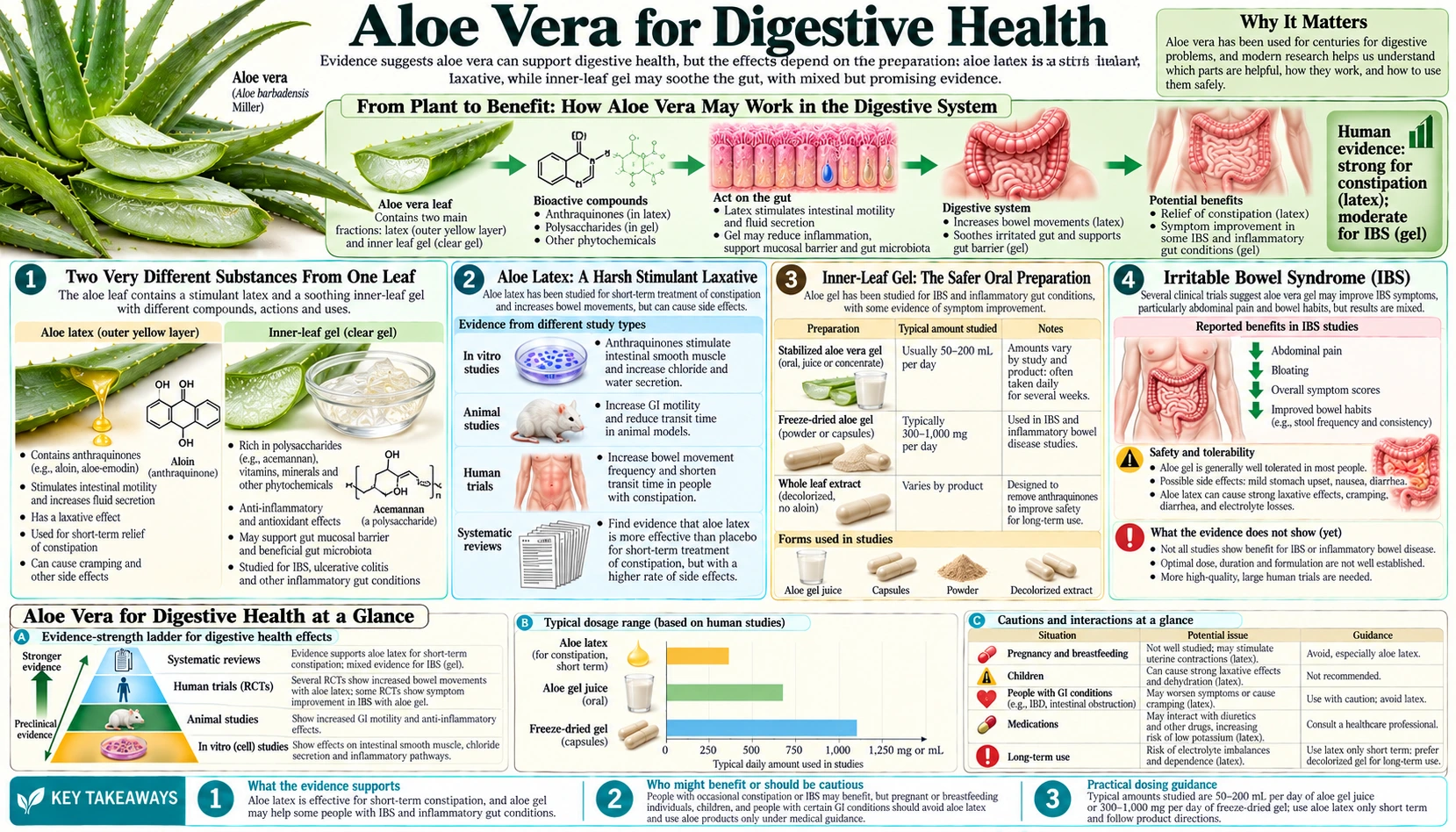
Oral aloe is where the plant's split personality matters most. The clear inner-leaf gel has been tried for irritable bowel syndrome, ulcerative colitis, and acid reflux with cautiously promising results, while the bitter yellow latex is a harsh stimulant laxative that regulators have de-listed, restricted, and flagged as possibly carcinogenic. This page keeps the two firmly separate: it covers what the small gut trials actually show, and it sets out plainly the safety findings behind regulators' actions on aloe latex as a laxative. Nothing here replaces medical care for inflammatory bowel disease or persistent digestive symptoms.
Table of Contents
- Two Very Different Substances From One Leaf
- Aloe Latex: A Harsh Stimulant Laxative
- Inner-Leaf Gel: The Safer Oral Preparation
- Irritable Bowel Syndrome (IBS)
- Ulcerative Colitis and Inflammatory Bowel Disease
- Acid Reflux and Gastroesophageal Reflux Disease
- Constipation: Gel vs Latex
- Choosing a Safe Oral Aloe Product
- Who the Research Raises Concerns For
- Key Research Papers
- Connections
- Featured Videos
Two Very Different Substances From One Leaf
Before any discussion of digestive benefits, the single most important safety point: "aloe vera" by mouth can mean two completely different things.
- Inner-leaf gel (or decolorized juice) — the clear mucilage, mostly water and polysaccharides such as acemannan. Purified versions are relatively well tolerated and are what the irritable bowel syndrome, colitis, and reflux trials used.
- Latex / whole-leaf extract — contains anthraquinone glycosides (aloin, aloe-emodin) that act as a powerful stimulant laxative and carry documented safety concerns.
Many commercial "aloe vera juice" products are made from the inner gel and are low in aloin, but some whole-leaf products contain meaningful latex. The label words that mark inner-gel products are decolorized or purified inner leaf; the words that mark latex-containing products are whole leaf and aloe latex.
Aloe Latex: A Harsh Stimulant Laxative
Aloe latex owes its laxative punch to anthraquinones, chiefly aloin (barbaloin). Gut bacteria convert aloin to aloe-emodin-9-anthrone, which stimulates colonic muscle contraction and increases water and electrolyte secretion into the bowel — producing a purgative effect within 6 to 12 hours. That is effective, but it comes with real problems:
- Cramping, urgency, and watery diarrhea are common, and overuse causes fluid and potassium loss (hypokalemia), which can be dangerous for the heart, especially alongside certain drugs.
- Dependence and a "lazy bowel." Like other stimulant laxatives, chronic use can reduce the colon's own motility and cause melanosis coli, a harmless-looking but telltale darkening of the colon lining.
- Regulatory red flags. The U.S. Food and Drug Administration (FDA) removed aloe from over-the-counter (OTC) laxative "generally recognized as safe and effective" status in 2002. The National Toxicology Program found large-intestine tumors in rats given non-decolorized whole-leaf extract, and International Agency for Research on Cancer (IARC) classifies whole-leaf aloe extract as Group 2B, "possibly carcinogenic to humans." In 2021 the European Union restricted aloe-emodin and related hydroxyanthracene derivatives in food over genotoxicity concerns.
The National Toxicology Program study behind that rat finding was published in 2013 by Boudreau and colleagues. Rats (48 per sex per group) drank water containing 0.5%, 1% or 1.5% aloe whole-leaf extract for two years, and mice drank 1%, 2% or 3%. In male and female rats at 1% and 1.5%, adenomas and carcinomas (benign and cancerous tumours) of the large intestine — the junctions around the cecum and the ascending and transverse colon — were significantly more common than in untreated rats. No large-intestine tumours were seen in mice or in rats at 0.5%. The authors concluded that the extract is "an intestinal irritant" in both rats and mice and "a carcinogen of the large intestine in F344/N rats". These are animal results; no comparable human study exists in the sources read for this page.
The genotoxicity picture is nuanced — some studies of purified aloin or decolorized gel found no genotoxicity, and the tumor signal is tied specifically to the non-decolorized latex-containing whole-leaf material. Taken together, these findings are why aloe latex is no longer recognized as a routine laxative by the FDA. Other stimulant laxatives have been studied far more than aloe latex, and constipation that lasts for months can have an underlying cause of its own.
Inner-Leaf Gel: The Safer Oral Preparation
The oral trials that suggest digestive benefit used purified inner-leaf gel or decolorized juice, not latex. In this form aloe is generally well tolerated for short-term use, with occasional mild cramping or loose stool. Because even inner-gel products can retain some aloin, decolorized products with low aloin content carry the least anthraquinone exposure. In pregnancy and breastfeeding, the concern with oral aloe is the latex risk and a theoretical uterine-stimulant effect.
Irritable Bowel Syndrome (IBS)
Several small randomized trials have tested inner-leaf aloe gel or a standardized aloe extract in irritable bowel syndrome, with mixed but cautiously encouraging results. A 2015 pilot randomized, double-blind, placebo-controlled study by Storsrud and colleagues in 68 adults over four weeks found a trend toward symptom relief (55% responders on aloe vs 31% on placebo, p=0.09; adequate relief 33% vs 14%, p=0.12), but its main outcome was not met, and symptom severity fell on aloe without a difference between the groups; a 2011 crossover trial by Hutchings and colleagues examined quality-of-life effects; and a 2020 randomized, double-blind trial by Ahluwalia and colleagues, in which 160 patients completed four weeks, compared aloe with inulin (a plant fibre) rather than with a placebo. In that trial symptoms fell in both groups with no difference between them (39% responders on aloe vs 45% on inulin), and the authors concluded that aloe "was not superior to control treatment"; fecal microbiota and metabolite profiles differed between people who responded to aloe and those who did not. A 2018 systematic review and meta-analysis by Hong and colleagues pooled three randomized trials with 151 patients and concluded that aloe was effective and safe for short-term treatment of irritable bowel syndrome (symptom-score standardized mean difference 0.41; response rate risk ratio 1.69, 95% confidence interval 1.05–2.73), while listing as limitations that only three trials were included and that one had a high possibility of bias in its design.
Read together: purified aloe gel has been tested in short trials in irritable bowel syndrome with few side effects, and some people do report benefit, but the evidence is not strong enough to call it an established therapy. For the condition itself, see our Irritable Bowel Syndrome page.
Ulcerative Colitis and Inflammatory Bowel Disease
The most-cited gut trial is a 2004 randomized, double-blind, placebo-controlled study by Langmead and colleagues at Barts and The London, Queen Mary School of Medicine and Dentistry, which gave outpatients with mildly to moderately active ulcerative colitis 100 mL of oral aloe vera gel or placebo twice daily for four weeks. Among 44 evaluable patients (30 on aloe, 14 on placebo), clinical response occurred in 47% on aloe vs 14% on placebo (P<0.05), clinical improvement in 37% vs 7% (P=0.06, not statistically significant), and clinical remission in 30% vs 7% (P=0.09, not statistically significant). Disease-activity and histology (tissue) scores fell significantly on aloe but not on placebo, while sigmoidoscopy scores and blood tests showed no difference. The trial was modest in size, and adverse events were minor and similar in both groups.
That single positive-but-inconclusive trial has not been convincingly replicated, so aloe cannot be considered a proven treatment for ulcerative colitis. The evidence does not show that it can replace mesalazine, steroids, biologics, or other standard inflammatory bowel disease (IBD) care; some integrative gastroenterologists describe it as a possible add-on. See our Ulcerative Colitis page and Crohn's Disease page.
Acid Reflux and Gastroesophageal Reflux Disease
A 2015 pilot randomized trial by Panahi and colleagues compared an aloe vera syrup with omeprazole and ranitidine in people with gastro-oesophageal reflux disease and reported that aloe reduced the frequency of several reflux symptoms (heartburn, regurgitation, belching, dysphagia) comparably to the drugs, with fewer side effects. This is a single small pilot, so it is best read as hypothesis-generating rather than practice-changing. Aloe's soothing gel is traditionally used for mild, occasional reflux. Trouble swallowing, weight loss, or bleeding alongside reflux are alarm features that doctors treat as a reason for prompt investigation. See our gastroesophageal reflux disease (GERD) page.
Constipation: Gel vs Latex
This is the clearest illustration of the whole page. Aloe latex will absolutely relieve constipation — it is a potent stimulant laxative — but the safety findings above apply to anything beyond very occasional use. Aloe inner-gel is only mildly laxative and is not a reliable constipation treatment. For ordinary constipation, fiber, fluids, physical activity, and osmotic agents (such as polyethylene glycol) are better studied and carry fewer of these risks. Over-the-counter stimulant laxatives are labelled for short-term use, and the well-characterized ones have far more safety data than aloe latex. See our Constipation page.
Choosing a Safe Oral Aloe Product
- Decolorized / purified inner leaf. Products described this way are the inner-gel type; "whole leaf" and "latex" mark the latex-containing type.
- Low aloin. Low-aloin products are usually described as containing below about 10 parts per million of aloin; an aloe-industry certification program for processing also exists in the U.S.
- Short, defined periods. The trials gave aloe for a set period — four weeks in the Storsrud and Ahluwalia irritable bowel syndrome trials and the Langmead colitis trial — rather than indefinitely.
- Medication overlap. The effects described on this page matter most for people taking medication for diabetes (extra blood-sugar lowering), heart failure, or blood pressure (potassium loss from latex), or with kidney or bowel disease.
Who the Research Raises Concerns For
- Pregnancy and breastfeeding — oral aloe is the concern here (latex risk; theoretical uterine stimulation).
- Children — oral aloe latex is listed as unsuitable for young children.
- Bowel disease or acute abdominal symptoms — aloe latex, like other stimulant laxatives, is contraindicated in intestinal obstruction, appendicitis, an active severe inflammatory bowel disease flare, or undiagnosed abdominal pain.
- Diabetes medication — oral aloe gel can lower blood glucose and may add to the effect of insulin or oral hypoglycemics, so blood glucose can fall further than expected (see our Blood Sugar page).
- Drug interactions. Latex-driven potassium loss can be dangerous with digoxin, diuretics, and corticosteroids; aloe may also reduce absorption of some oral drugs taken at the same time. Rare case reports link oral aloe to acute hepatitis (idiosyncratic), though a controlled study of aloe juice in healthy people found no harm to liver enzymes.
Key Research Papers
- Storsrud S, Ponten I, Simren M (2015). A pilot study of the effect of Aloe barbadensis Mill. extract (AVH200) in patients with irritable bowel syndrome: a randomized, double-blind, placebo-controlled study. J Gastrointestin Liver Dis — PubMed PMID: 26405698
- Hong SW, Chun J, Park S, et al. (2018). Aloe vera is effective and safe in short-term treatment of irritable bowel syndrome: a systematic review and meta-analysis. J Neurogastroenterol Motil — PubMed PMID: 30153721
- Hutchings HA, Wareham K, Baxter JN, et al. (2011). A randomised, cross-over, placebo-controlled study of aloe vera in patients with irritable bowel syndrome: effects on patient quality of life. ISRN Gastroenterol — PubMed PMID: 21991499
- Ahluwalia B, Magnusson MK, Bohn L, et al. (2020). Randomized clinical trial: effects of Aloe barbadensis Mill. extract on symptoms, fecal microbiota and fecal metabolite profiles in patients with irritable bowel syndrome. Neurogastroenterol Motil — PubMed PMID: 32314514
- Langmead L, Feakins RM, Goldthorpe S, et al. (2004). Randomized, double-blind, placebo-controlled trial of oral aloe vera gel for active ulcerative colitis. Aliment Pharmacol Ther — PubMed PMID: 15043514
- Panahi Y, Khedmat H, Valizadegan G, et al. (2015). Efficacy and safety of Aloe vera syrup for the treatment of gastroesophageal reflux disease: a pilot randomized positive-controlled trial. J Tradit Chin Med — PubMed PMID: 26742306
- Muller SO, Eckert I, Lutz WK, Stopper H (1996). Genotoxicity of the laxative drug components emodin, aloe-emodin and danthron in mammalian cells: topoisomerase II mediated?. Mutat Res — PubMed PMID: 9008718
- Galli CL, Cinelli S, Ciliutti P, et al. (2021). Aloe-emodin, a hydroxyanthracene derivative, is not genotoxic in an in vivo comet test. Regul Toxicol Pharmacol — PubMed PMID: 34062205
- Hu J, Lloyd M, Hobbs C, et al. (2021). Absence of genotoxicity of purified Aloe vera whole leaf dry juice as assessed by an in vitro mouse lymphoma tk assay and an in vivo comet assay in male F344 rats. Toxicol Rep — PubMed PMID: 33747796
- Hayes AW, et al. (2022). The absence of genotoxicity of a mixture of aloin A and B and a commercial aloe gel beverage. Toxicol Mech Methods — PubMed PMID: 34979868
- Hoogenboom TCH, et al. (2020). The effect of aloe vera juice on liver enzymes and hepatic structure in a healthy population. Integr Med (Encinitas) — PubMed PMID: 33132775
- Dunnick JK, Nyska A (2013). The toxicity and pathology of selected dietary herbal medicines. Toxicol Pathol — PubMed PMID: 23262639
- Boudreau MD, Mellick PW, Olson GR, et al. (2013). Clear evidence of carcinogenic activity by a whole-leaf extract of Aloe barbadensis miller (aloe vera) in F344/N rats. Toxicol Sci — PubMed PMID: 22968693
PubMed Topic Searches
External Authoritative Resources
- U.S. National Center for Complementary and Integrative Health (NCCIH) — Aloe Vera
- LiverTox (U.S. National Institutes of Health, NIH) — Aloe Vera
- National Toxicology Program — Aloe Vera Whole-Leaf Extract Study (TR-577)
- European Food Safety Authority (EFSA) — Hydroxyanthracene Derivatives (Aloe-emodin) Safety Opinion
- PubMed — Aloe Vera Gastrointestinal Research
Connections
- All Herbs
- Aloe Vera Overview
- Aloe Vera Benefits Hub
- Aloe Vera for Skin & Wound Healing
- Aloe Vera for Blood Sugar
- Irritable Bowel Syndrome
- Ulcerative Colitis
- Crohn's Disease
- Gastroesophageal Reflux Disease (Acid Reflux)
- Peptic Ulcer Disease
- Constipation
- Slippery Elm
- Peppermint
- Ginger
- All Gastroenterology