Agrimony
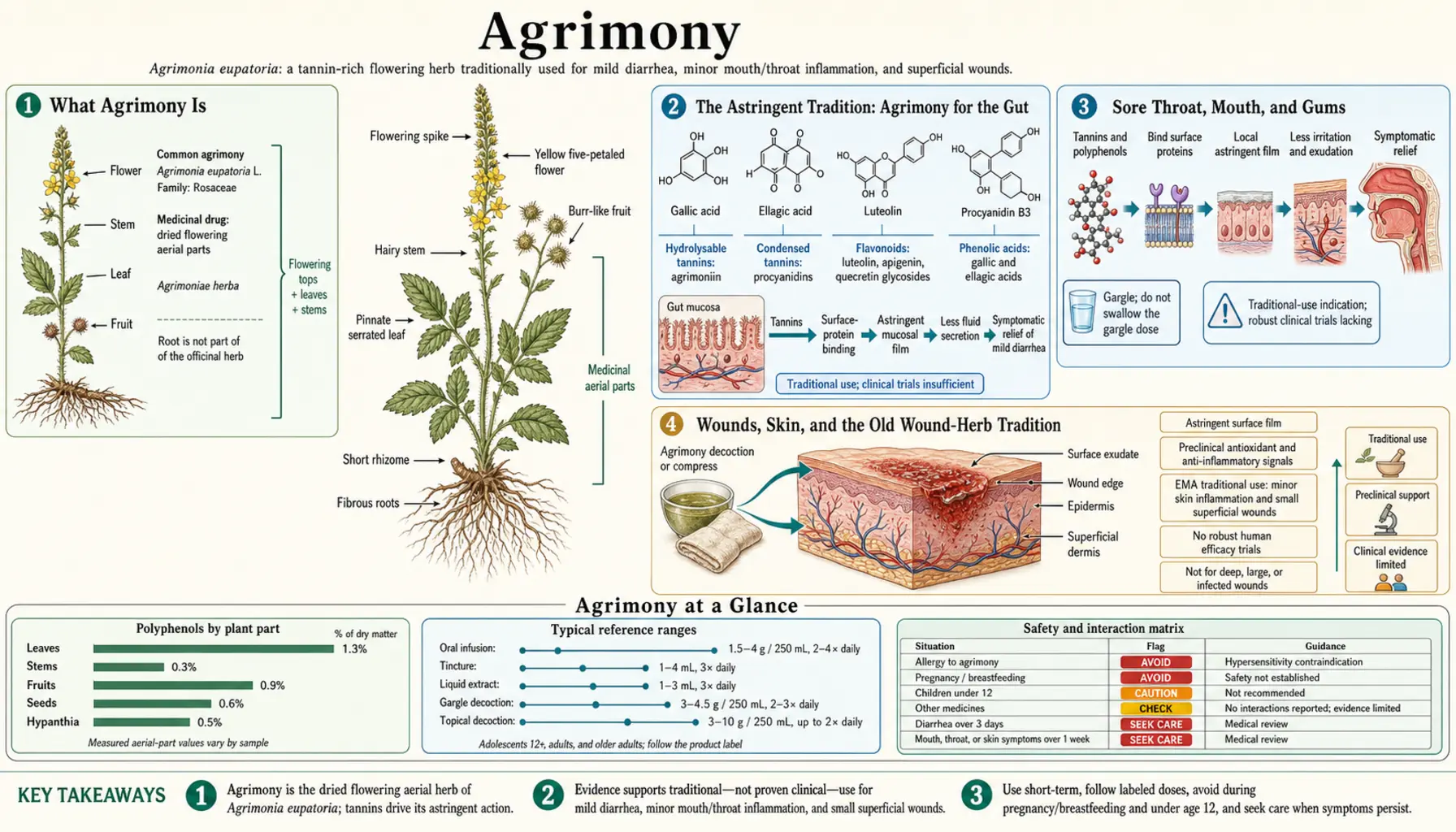
Agrimony (Agrimonia eupatoria) is a tall, slender wayside herb from the rose family, easy to spot in summer by its long spikes of small yellow flowers. Old country names give it away: people called it church steeples for those upright flower spikes, and sticklewort or cocklebur for the little hooked burr-seeds that grab onto clothing and animal fur. For centuries, herbalists across Europe — and, under the name Xian He Cao, practitioners of Traditional Chinese Medicine — have reached for the dried aerial parts (the leafy, flowering tops) as a classic astringent: a plant that tightens and tones tissues. Its most time-honored job is settling the digestive tract, and it doubles as a gargle for sore throats and inflamed gums, a wash for wounds and skin, and a traditional remedy for the liver and urinary tract.
This page explains what agrimony is, how it has been used, what gives it its astringent character (a lot of tannins), and — honestly — what modern laboratory and animal research does and does not yet confirm. Agrimony has a long, respectable track record and a chemistry that makes its traditional uses plausible, but rigorous human clinical trials are still lacking. We will keep that distinction clear throughout, and finish with a practical look at forms, dosing, and safety.
Table of Contents
- What Agrimony Is
- The Astringent Tradition: Agrimony for the Gut
- Sore Throat, Mouth, and Gums
- Wounds, Skin, and the Old Wound-Herb Tradition
- Liver, Gallbladder, and Urinary Uses
- Xian He Cao: Agrimony in Chinese Medicine
- The Active Compounds
- What the Evidence Actually Shows
- Forms and How It Is Used
- Safety and Cautions
- The Honest Bottom Line
- Research Papers
- Connections
- Featured Videos
What Agrimony Is
Agrimony is a perennial herb of the Rosaceae (rose) family. It grows one to three feet tall on roadsides, field edges, hedgerows, and grassy banks across Europe, western Asia, and North Africa, and it has naturalized in parts of North America. The plant sends up a single, often unbranched stem clothed in soft, jagged, feather-like leaves, topped by a long tapering spike of five-petaled yellow flowers that open from the bottom up — the reason for the folk name "church steeples."
After flowering, agrimony forms small grooved fruits ringed with tiny hooked bristles. These burrs latch onto passing animals and trouser legs, which is how the plant spreads and how it earned names like sticklewort. The species most used in herbalism is Agrimonia eupatoria; a close relative, Agrimonia procera (fragrant agrimony), is sometimes used interchangeably and shares much of the same chemistry.
The part used medicinally is the aerial part — the leaves, stems, and flowering tops harvested in summer and dried. The root is used far less often. Dried agrimony has a faintly aromatic, slightly bitter and notably astringent taste; that dry, mouth-puckering quality is the sensory signature of its tannins, and it is central to how the herb has always been used.
The Astringent Tradition: Agrimony for the Gut
Agrimony's flagship traditional use is as a gentle astringent for the digestive tract. "Astringent" simply means it draws tissues together and tightens them. When tannin-rich plant compounds meet the moist lining of the mouth or gut, they bind loosely to surface proteins and form a thin, protective layer — the same puckering effect you feel from strong black tea or an unripe persimmon. On an irritated or leaky gut wall, that tightening can, in traditional thinking, calm oozing and inflammation and firm up loose stools.
Because of this, European herbalists have long used agrimony tea for:
- Mild diarrhea — the classic use, especially the ordinary, self-limiting kind, where the astringent action is meant to slow and firm the bowel.
- Gastroenteritis and general gut upset — to soothe an inflamed, over-active digestive tract.
- Low-grade gut inflammation and "delicate stomachs" — as a mild daily tonic in traditional practice.
This is a sensible, mechanistically plausible use of a tannin-containing plant, and it is echoed in the astringent herbs agrimony is often grouped with. It is important to be clear, though, that these uses rest on tradition and mechanism rather than modern clinical trials. Ordinary diarrhea usually resolves on its own; agrimony tea is a traditional comfort measure, not a treatment for severe, bloody, or prolonged diarrhea, which needs medical attention and, above all, fluids.
Sore Throat, Mouth, and Gums
The same astringency that suits the gut makes agrimony a traditional gargle and mouth rinse. A strong infusion, cooled, has been swished or gargled for:
- Sore throat and hoarseness, including the raw throat of a common cold.
- Inflamed or bleeding gums, mouth ulcers, and general mouth soreness.
- General oral hygiene, as a tightening, freshening rinse.
The logic is straightforward: tannins tighten and lightly protect the delicate mucous membranes of the throat and mouth, which can ease the feeling of rawness. Agrimony gargles appear again and again in traditional European herbals for exactly this purpose, and the herb's demonstrated antimicrobial activity in the laboratory (see below) offers a plausible supporting mechanism. As with the gut uses, this remains a traditional and preclinically supported practice rather than one proven in controlled human trials.
Wounds, Skin, and the Old Wound-Herb Tradition
Agrimony has an old reputation as a wound herb (vulnerary). Applied externally as a cooled infusion, poultice, or wash, it was used to bathe cuts, grazes, sores, and inflamed or weepy skin. Its place in this tradition is genuinely ancient: agrimony appears among the plants named in Anglo-Saxon wound-healing recipes, and modern researchers who tested those old formulations found real antibacterial activity in the plants involved — a nice example of traditional knowledge lining up with laboratory testing.
Once again the astringent, tissue-tightening action is the traditional rationale: on broken or irritated skin, tannins can help draw the surface together and discourage oozing, while the plant's antimicrobial compounds may help keep a wound clean. This is a reasonable topical folk use for minor, superficial skin problems. Deep, dirty, or non-healing wounds are a matter for proper medical care, not an herbal wash.
Liver, Gallbladder, and Urinary Uses
Beyond the gut and skin, traditional herbalism gave agrimony a role as a mild liver and gallbladder herb — a gentle "spring tonic" thought to support bile flow and digestion of fats. The old genus name eupatoria even nods to Mithridates Eupator, a king of antiquity associated with medicinal plants and liver remedies. It was also used as a mild urinary herb, taken as a tea for a sluggish or irritated urinary tract.
These uses are softer and less central than the astringent digestive tradition, and the evidence behind them is correspondingly thinner — largely traditional, with some supporting antioxidant and anti-inflammatory findings from laboratory work. They are best understood as part of agrimony's historical "all-rounder" reputation as a gentle tonic rather than as targeted, proven therapies.
Xian He Cao: Agrimony in Chinese Medicine
Agrimony also holds a firm place in Traditional Chinese Medicine, where Agrimonia pilosa (a close Asian relative) is known as Xian He Cao (仙鹤草). Its signature TCM role is different in emphasis from the European tradition: it is classed among the hemostatic, or "stop bleeding," herbs. It has been used traditionally to help check various kinds of bleeding — such as in the stool, urine, or from the lungs — and, in keeping with the wider astringent theme, for chronic diarrhea and dysentery.
This "stop bleeding" reputation is interesting because it points in the same direction as the herb's astringency: compounds that tighten tissues and interact with proteins can plausibly reduce oozing from small vessels. Some laboratory work has explored effects of agrimony extracts on clotting and hemostasis, which loosely parallels the traditional use. Still, this is preclinical and traditional evidence — not a reason to use agrimony to treat any active bleeding, which is always a medical emergency.
The Active Compounds
Agrimony's chemistry explains almost everything about how it has been used. The dominant constituents are tannins — large polyphenol molecules, present in high amounts, that bind to proteins. Tannins are the direct chemical basis of the herb's astringency: the dry, puckering sensation and the tissue-tightening action on the gut, throat, and skin. Among agrimony's tannins is agrimoniin, a well-studied ellagitannin that is something of a chemical signature for the plant.
Alongside the tannins, agrimony is rich in other polyphenols, including a range of flavonoids (such as quercetin, luteolin, apigenin, and kaempferol derivatives) and phenolic acids. Detailed chemical profiling using modern methods has catalogued and quantified these polyphenols in the herb. These compounds are potent antioxidants — molecules that neutralize reactive free radicals — and they underlie much of the antioxidant and anti-inflammatory activity seen in laboratory studies. The plant also contains small amounts of aromatic volatile oil, some bitter principles, silica, and traces of vitamins and minerals, but it is the tannin-and-flavonoid polyphenol package that defines agrimony pharmacologically.
What the Evidence Actually Shows
Here is the honest picture. Agrimony's core traditional uses — the astringent digestive and throat/mouth applications — are plausible and mechanistically reasonable. Tannins genuinely tighten and lightly protect mucous membranes, and a lot of what tradition claims follows sensibly from that. But most of the modern research is laboratory (test-tube) and animal work, not human clinical trials.
What that preclinical research has found is consistent and encouraging:
- Antioxidant activity: Agrimony extracts and infusions are strong free-radical scavengers in multiple independent studies — unsurprising given the polyphenol content.
- Anti-inflammatory and analgesic activity: Agrimony infusion has shown anti-inflammatory and pain-reducing effects in animal models.
- Antimicrobial activity: Extracts inhibit a range of bacteria (and even show antibiofilm effects), and specific work has tested activity against gut pathogens such as Helicobacter pylori and Campylobacter — a plausible mechanism behind the wound-wash and gargle traditions.
- Antidiabetic (blood-sugar) effects: In diabetic mice, agrimony reduced high blood sugar and affected glucose metabolism and insulin release — among the better-studied pharmacological actions, though still in animals.
- Blood-pressure and blood-clotting effects: Preclinical work points to hypotensive (blood-pressure-lowering) and anticoagulant/hemostatic-adjacent activity, loosely echoing traditional uses.
The gap is clear and worth stating plainly: robust, well-designed human clinical trials are lacking. That does not make agrimony useless — a centuries-old astringent with sensible chemistry and consistent preclinical signals is a reasonable traditional remedy for minor complaints. It does mean we should describe its benefits as traditional and preclinical, not clinically proven, and avoid overselling it.
Forms and How It Is Used
Agrimony is almost always used from the dried aerial parts, in a few simple forms:
- Tea / infusion: The most common form. The dried herb is steeped in hot water and drunk for digestive complaints, or used internally as a mild tonic. A typical traditional amount is roughly a teaspoon or two of dried herb per cup, steeped several minutes; a longer steep pulls out more astringent tannin.
- Gargle / mouth rinse: A stronger, cooled infusion swished or gargled for sore throat, mouth ulcers, and inflamed gums, then spat out.
- Tincture: An alcohol extract, taken in small measured drops in water — a concentrated, shelf-stable option used by herbalists.
- Topical wash or poultice: A cooled infusion applied to minor cuts, grazes, and irritated skin, or the softened herb applied directly.
There is no established standardized medical dose, and products vary. If you use agrimony, follow the directions on a reputable product or the guidance of a qualified herbal practitioner, start low, and treat it as a remedy for minor, short-term complaints.
Safety and Cautions
Agrimony has a long history of use and is generally considered safe in ordinary tea amounts for most healthy adults. Its cautions flow mainly from its high tannin content and from its preclinical pharmacology:
- Tannins and the gut: In large amounts, tannin-rich herbs can cause stomach upset, nausea, or — because they are so astringent — constipation. More is not better; strong, prolonged use is the opposite of gentle.
- Reduced absorption of iron and medicines: Tannins bind minerals and some drug molecules, so agrimony can lower the absorption of dietary iron and certain medications if taken at the same time. Space agrimony a couple of hours apart from iron supplements, iron-rich meals, and prescription medicines.
- Blood sugar: Given its blood-sugar-lowering activity in animals, people with diabetes or on glucose-lowering medication should be cautious and monitor, as effects could theoretically add up.
- Blood pressure: Because of possible hypotensive effects, use care if you are on blood-pressure medication.
- Blood clotting: Given traditional hemostatic use and preclinical effects on clotting, use caution alongside anticoagulant or antiplatelet drugs (such as warfarin), and stop well before surgery.
- Photosensitivity: Increased sensitivity of the skin to sunlight has been noted with agrimony; be mindful of sun exposure if using it regularly.
- Pregnancy and breastfeeding: Traditional sources advise against large medicinal doses in pregnancy, and safety in pregnancy and breastfeeding has not been established. Avoid medicinal amounts.
None of this makes a cup of agrimony tea alarming, but it is a reminder that "natural" is not the same as "inert." If you take regular medication, are pregnant, or have a chronic condition, check with a knowledgeable clinician or herbalist before using agrimony medicinally.
The Honest Bottom Line
Agrimony is a time-honored astringent gut-and-throat herb: a tall, cheerful roadside plant whose tannin-rich tops have been used for centuries to firm up mild diarrhea, soothe an inflamed gut, and gargle away a sore throat or sore gums, with older roles as a wound wash, a gentle liver and urinary tonic, and — as Xian He Cao — a "stop bleeding" herb in Chinese medicine. Its chemistry backs the story: high tannins (including agrimoniin) plus antioxidant flavonoids and polyphenols explain the astringency, and laboratory and animal studies show real antioxidant, anti-inflammatory, antimicrobial, antidiabetic, hypotensive, and hemostatic-adjacent activity.
The honest caveat is that these benefits rest on tradition, tannin pharmacology, and preclinical data — not on robust human trials. Used sensibly, as a tea, gargle, or wash for minor, short-term complaints, agrimony is a reasonable and gentle traditional remedy. Just respect the tannin cautions — space it away from iron and medications, do not overdo it, and avoid medicinal doses in pregnancy — and do not lean on it in place of medical care for anything serious.
Research Papers
- Paluch Z, Biriczová L, Pallag G, Carvalheiro Marques E, et al. The therapeutic effects of Agrimonia eupatoria L. Physiological Research. 2020;69(Suppl 4):S555-S571. doi:10.33549/physiolres.934641 — a modern review pulling together agrimony's traditional uses, phytochemistry, and reported pharmacological effects.
- Granica S, Krupa K, Kłębowska A, Kiss AK. Development and validation of an HPLC-DAD-CAD-MS3 method for qualitative and quantitative standardization of polyphenols in Agrimoniae eupatoriae herba. Journal of Pharmaceutical and Biomedical Analysis. 2013;86:112-122. doi:10.1016/j.jpba.2013.08.006 — identifies and quantifies agrimony's tannins (including agrimoniin) and flavonoids.
- Correia HS, González-Paramás A, Amaral MT, Santos-Buelga C, Batista MT. Polyphenolic profile characterization of Agrimonia eupatoria L. by HPLC with different detection devices. Biomedical Chromatography. 2006;20(1):88-94. doi:10.1002/bmc.533 — maps the flavonoid and phenolic composition behind the herb's activity.
- Correia H, Batista MT, Dinis TC. The activity of an extract and fraction of Agrimonia eupatoria L. against reactive species. BioFactors. 2007;29(2-3):91-104. doi:10.1002/biof.552029209 — shows agrimony extracts scavenge reactive oxygen and nitrogen species.
- Ivanova D, Gerova D, Chervenkov T, Yankova T. Polyphenols and antioxidant capacity of Bulgarian medicinal plants. Journal of Ethnopharmacology. 2005;96(1-2):145-150. doi:10.1016/j.jep.2004.08.033 — ranks agrimony among high-polyphenol, high-antioxidant traditional herbs.
- Venskutonis PR, Škėmaitė M, Ragažinskienė O. Radical scavenging capacity of Agrimonia eupatoria and Agrimonia procera. Fitoterapia. 2007;78(2):166-168. doi:10.1016/j.fitote.2006.10.002 — confirms strong free-radical scavenging in both agrimony species.
- Copland A, Nahar L, Tomlinson CTM, Hamilton V, et al. Antibacterial and free radical scavenging activity of the seeds of Agrimonia eupatoria. Fitoterapia. 2003;74(1-2):133-135. doi:10.1016/s0367-326x(02)00317-9 — reports both antibacterial and antioxidant activity from agrimony seed extracts.
- Muruzović MŽ, Mladenović KG, Stefanović OD, Vasić SM, Čomić LR. Extracts of Agrimonia eupatoria L. as sources of biologically active compounds and evaluation of their antioxidant, antimicrobial, and antibiofilm activity. Journal of Food and Drug Analysis. 2016;24(3):539-547. doi:10.1016/j.jfda.2016.02.007 — documents antioxidant, antimicrobial, and antibiofilm effects.
- Watkins F, Pendry B, Sanchez-Medina A, Corcoran O. Antimicrobial assays of three native British plants used in Anglo-Saxon medicine for wound healing formulations in 10th century England. Journal of Ethnopharmacology. 2012;144(2):408-415. doi:10.1016/j.jep.2012.09.031 — finds real antibacterial activity in agrimony and companion wound-herbs, echoing traditional wound use.
- Cwikla C, Schmidt K, Matthias A, Bone KM, Lehmann R, Tiralongo E. Investigations into the antibacterial activities of phytotherapeutics against Helicobacter pylori and Campylobacter jejuni. Phytotherapy Research. 2010;24(5):649-656. doi:10.1002/ptr.2933 — tests agrimony among herbs active against common gut pathogens.
- Gray AM, Flatt PR. Actions of the traditional anti-diabetic plant, Agrimony eupatoria (agrimony): effects on hyperglycaemia, cellular glucose metabolism and insulin secretion. British Journal of Nutrition. 1998;80(1):109-114. doi:10.1017/s0007114598001834 — demonstrates blood-sugar-lowering and insulin-related actions of agrimony.
- Swanston-Flatt SK, Day C, Bailey CJ, Flatt PR. Traditional plant treatments for diabetes. Studies in normal and streptozotocin diabetic mice. Diabetologia. 1990;33(8):462-464. doi:10.1007/BF00405106 — early study finding agrimony reduced hyperglycemia in diabetic mice.
PubMed: browse more research on Agrimonia eupatoria
Connections
- All Herbs
- Yarrow — astringent, wound, and "stop bleeding" herb
- Marshmallow Root — soothing demulcent for gut and throat
- Slippery Elm — mucilage for the digestive tract and throat
- Sage — astringent gargle for sore throat and gums
- Meadowsweet — gentle astringent for the stomach
- Chamomile — calming herb for digestive upset
- Peppermint — classic herb for the digestive tract
- Uva Ursi — tannin-rich traditional urinary herb
- Calendula — traditional wound and skin herb
- Gastroenterology — digestive-tract conditions
- Conditions on this site that reference this page: Iron-Deficiency Anemia · Sore Throat