⚠ Evidence warning: Clinical trials or other evidence do not support the claims that Rhodiola relieves burnout, depression and fatigue and sharpens the mind. This page keeps it as a report of what people, websites or other media say.
Rhodiola Rosea — Benefits Deep Dive
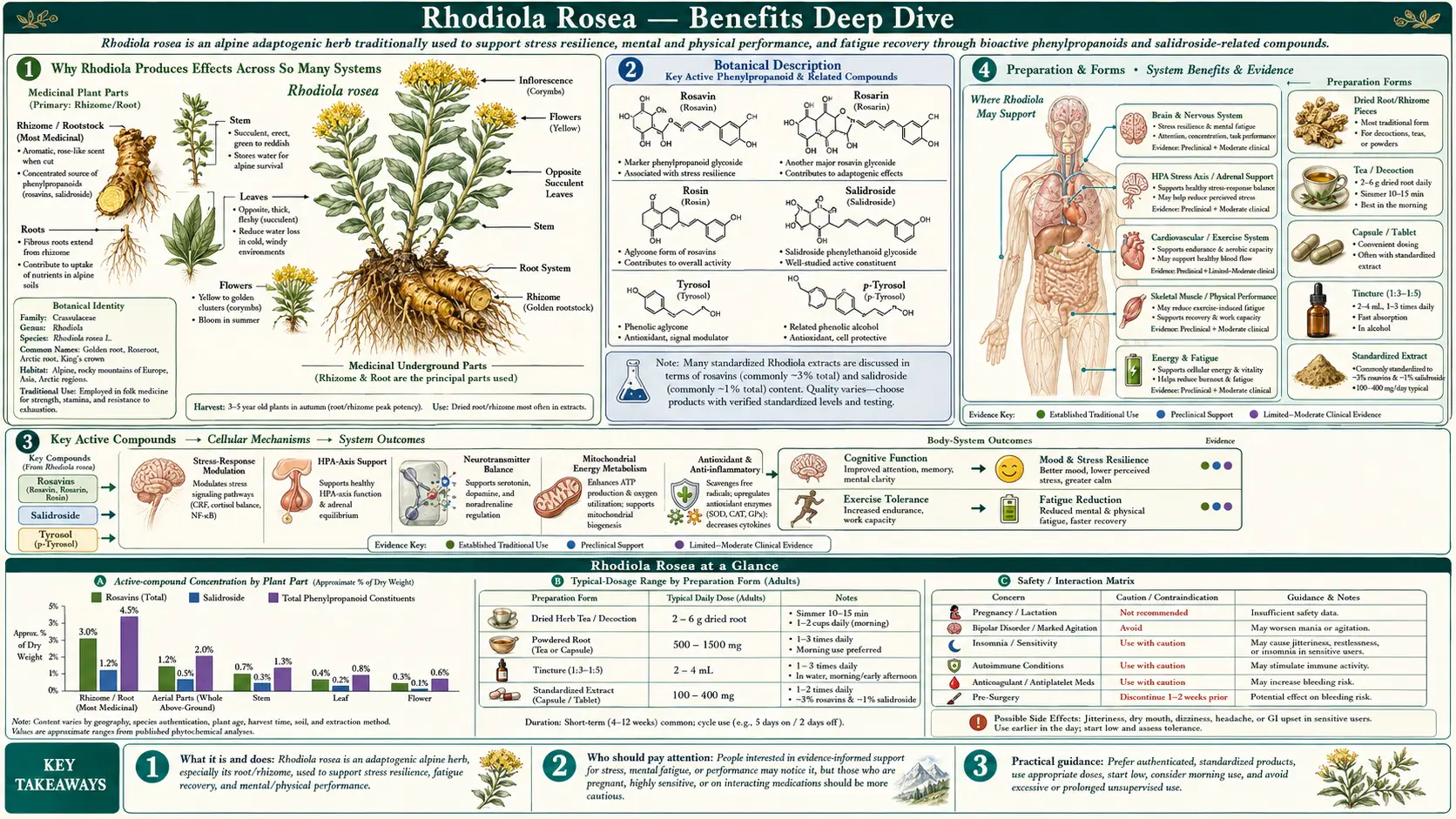
Rhodiola rosea is the Arctic adaptogen the Vikings reportedly brewed as a fortifying tea before long sea voyages and battle, the «golden root» (zolotoy koren) of Siberian folk medicine, and the single most-studied herb in the Soviet Union's fifty-year state-sponsored program to identify natural performance enhancers for soldiers, cosmonauts, and Olympic athletes. The two signature actives — the phenylpropanoid rosavins (rosavin, rosarin, rosin) and the phenylethanoid glycoside salidroside — are standardized to the naturally occurring 3:1 ratio (3% rosavins / 1% salidroside) in pharmaceutical-grade extracts such as the Swedish SHR-5. Four benefit pages below explore the conditions where Rhodiola produces the largest clinical effect: stress-related burnout and fatigue (the indication covered by the European Medicines Agency herbal monograph adopted in March 2012 and revised in March 2024, as a traditional use "exclusively based upon long-standing use"), cognitive performance under sleep deprivation, mild-to-moderate depression (where the Mao 2015 Phase II trial in 57 people found no significant difference in depression scores between Rhodiola, sertraline and placebo, with fewer side effects on Rhodiola than on sertraline), and endurance athletic performance dosed 60 minutes pre-exercise.
Deep-Dive Articles
Stress & Fatigue
The Olsson 2009 Nordic randomized trial of SHR-5 in stress-related fatigue, the Soviet space program research history dating to the 1960s, salidroside and rosavin as paired adaptogens, hypothalamic-pituitary-adrenal (HPA) axis modulation, cortisol normalization without abolishing the acute stress response, and the standardized 200-600 mg/day SHR-5 dosing range that became the European pharmaceutical reference (the European Medicines Agency monograph gives 144-400 mg/day).
Read the deep dive →Cognitive Performance
The Spasov 2000 examination-stress trial in foreign students (20 days; the authors judged the dose probably suboptimal), the Darbinyan 2000 night-shift crossover trial in 56 physicians (improvement reported during the first two-week period), the Olsson 2009 trial (60 people, 576 mg/day, 28 days; both groups improved, the extract more on a burnout scale and several attention measures), Krasik's 1970s Soviet military performance research, and the reported finding that Rhodiola preserves attention, short-term memory, calculation speed, and audiovisual processing under sleep deprivation and sustained cognitive load.
Read the deep dive →Depression
The Mao 2015 Phase II proof-of-concept trial of Rhodiola, sertraline and placebo (57 people, 12 weeks: no significant difference between groups on the Hamilton Depression Rating scale, with drops of 5.1, 8.2 and 4.6 points; adverse events in 30.0%, 63.2% and 16.7%; the authors concluded Rhodiola was less effective than sertraline but may have a better risk-to-benefit ratio), the Darbinyan 2007 trial in mild-to-moderate depression, monoamine oxidase A and B inhibition, and the proposed role of Rhodiola as an alternative to selective serotonin reuptake inhibitors (SSRIs) for patients with intolerable serotonergic side effects.
Read the deep dive →Athletic Performance
The De Bock 2004 endurance trial in 24 young healthy volunteers (time to exhaustion 16.8 to 17.2 minutes one hour after a 200 mg dose), the claimed lactate threshold improvement and reduction in rating of perceived exertion (RPE), which are not among that trial's reported results, military fatigue prophylaxis research (Spasov), and the 60-minutes-before-exercise dosing protocol that distinguishes Rhodiola's acute ergogenic effect from chronic adaptation seen with other adaptogens.
Read the deep dive →Table of Contents
Why Rhodiola Produces Effects Across So Many Systems
Most herbs hit one principal target. Rhodiola rosea is unusual because it is a true adaptogen in the original Lazarev-Brekhman sense — a substance that increases nonspecific resistance to a wide spectrum of stressors by acting on the master control circuits of the stress response itself, rather than on any one downstream organ. The same molecular events therefore translate into protective effects across stress, fatigue, cognition, mood, endurance, and immunity. Four convergent mechanisms explain the breadth of clinical effect:
- Hypothalamic-pituitary-adrenal-axis modulation at the hypothalamus — salidroside reduces c-Fos expression in the paraventricular nucleus (PVN) of the hypothalamus, dampening corticotropin-releasing hormone (CRH) secretion at the very top of the stress cascade. The downstream adrenocorticotropic hormone (ACTH) and cortisol responses are not abolished (which would be dangerous), but they are proportionalized to the actual threat. This is the defining adaptogen signature: chronically elevated cortisol falls back to normal, but the acute fight-or-flight response is preserved. This mechanism underlies the stress-related fatigue and burnout effects documented in the Olsson 2009 SHR-5 trials.
- Monoamine oxidase inhibition (MAO-A and MAO-B) — in a laboratory plate assay, Rhodiola root extracts inhibited MAO-A by 84.3-92.5% and MAO-B by 81.8-88.9% at 100 micrograms/mL, and the most active compound isolated was rosiridin (over 80% of MAO-B at 10-5 M). Salidroside and rosavin are often credited with the effect as well, although that study's abstract does not name them. MAO-A and MAO-B are the two enzymes that degrade serotonin, dopamine, norepinephrine, and other monoamine neurotransmitters in the synaptic cleft. This is the same enzymatic target hit by the older monoamine oxidase inhibitor (MAOI) antidepressant class (phenelzine, tranylcypromine), but with binding described as far weaker and reversible, said to avoid the hypertensive-crisis tyramine risk (no study is cited here for that point). This pharmacology is proposed to drive the antidepressant effects studied in the Darbinyan 2007 and Mao 2015 trials and is proposed as the most likely mechanism behind the cognitive enhancement under fatigue.
- Heat shock protein 70 (Hsp70) induction — Rhodiola extracts upregulate Hsp70 expression in stressed cells, including cardiomyocytes, neurons, and skeletal muscle. Hsp70 is the cell's master chaperone that refolds damaged proteins and prevents apoptosis during stress (heat, hypoxia, oxidative damage, ischemia). The Panossian rabbit immobilization-stress study, which measured blood stress markers rather than Hsp70, showed that Rhodiola-treated animals maintained near-baseline levels of phosphorylated stress-activated protein kinase (p-SAPK/p-JNK), nitric oxide, and cortisol after stress, while placebo animals showed 200-300% elevations. Hsp70 induction is proposed as part of why Rhodiola produces muscle-fatigue protection during endurance exercise and cardioprotection during ischemic stress.
- Adrenal preservation and catecholamine moderation — Rhodiola reduces adrenal catecholamine release during stress and lowers myocardial cyclic AMP (cAMP) and tissue catecholamine concentrations in the heart. The metabolic translation is reduced lactate accumulation, improved fatty acid mobilization, enhanced adenosine triphosphate (ATP) resynthesis through AMP-activated protein kinase (AMPK) modulation, and better mitochondrial function during exhaustive exercise. This mechanism is proposed as the molecular basis for a reduction in perceived exertion. The De Bock 2004 endurance trial itself reported a longer time to exhaustion and higher peak oxygen uptake (VO2peak) one hour after a 200 mg dose, with all other measures unchanged, and four weeks of daily intake did not alter any of the measures.
The therapeutic complication that distinguishes Rhodiola from short-acting stimulants like caffeine is its biphasic dose-response. At standard doses (200-600 mg/day of SHR-5 standardized to 3% rosavins / 1% salidroside), Rhodiola produces clean adaptogenic effects without sedation or stimulation. At excessive doses (reported as above approximately 900 mg/day), some patients are said to experience paradoxical agitation, insomnia, and irritability — the same overstimulation patients describe with selective serotonin reuptake inhibitor (SSRI) overdose. The pattern is described as reversible by dose reduction, and the reading offered is that more Rhodiola is not better, with most benefit at the low end of the dose range. No published trial is cited for the 900 mg/day figure or for the biphasic pattern, so both remain unconfirmed. The doses actually tested include 576 mg/day (Olsson 2009), 340 and 680 mg/day (Darbinyan 2007) and a single 200 mg dose (De Bock 2004), and a 2025 meta-analysis saw larger gains in maximal oxygen uptake (VO2max) above 600 mg/day. The European Medicines Agency (EMA) monograph gives a single dose of 144-200 mg and a daily dose of 144-400 mg.
The depression trial in numbers. Darbinyan 2007 ran for 6 weeks: 31 patients took 340 mg/day of extract, 29 took 680 mg/day and 29 took placebo. Overall depression, insomnia, emotional instability and somatization (physical symptoms) improved on both doses, self-esteem did not, the placebo group showed no such improvements, and no serious side effects were reported.
Two recent meta-analyses disagree on endurance. A 2025 analysis of 26 trials in 668 healthy people found improved VO2max (effect size 0.32), time to exhaustion (0.38) and lower lactate (-0.87), and its authors noted that differences between the studies call for cautious interpretation. A 2026 analysis of 9 trials in 424 people found no significant effect on VO2max (P = 0.30) and no prevention of acute mountain sickness (odds ratio 1.02).
Side effects and drug interactions. The U.S. National Center for Complementary and Integrative Health (NCCIH, updated April 2025) describes rhodiola as possibly safe for up to 12 weeks, lists dizziness, headache, insomnia and either dry mouth or excessive saliva as possible side effects, and reports interactions with the blood-pressure drug losartan. A case report describes restlessness and trembling in a 68-year-old woman after she added Rhodiola to the antidepressant paroxetine, which its authors read as possibly serotonergic. In laboratory tests, six commercial products inhibited the drug-processing enzymes CYP3A4, CYP2D6 and CYP1A2. The EMA monograph states that no clinically relevant interactions have been observed, and that use under age 18 and in pregnancy and breastfeeding is not recommended because the data are lacking.
What Is Actually in the Bottle
When six commercial Rhodiola rosea products were tested in the laboratory, one contained no rosavin, rosarin or rosin, and the researchers judged it not to be a Rhodiola rosea product at all. The strength with which the products blocked drug-processing enzymes also varied widely, with a tincture the strongest, and the measured amounts of the plant's compounds did not predict that strength.
Key Research Papers
- Olsson EM, von Scheele B, Panossian AG (2009). A randomised, double-blind, placebo-controlled, parallel-group study of the standardised extract SHR-5 of the roots of Rhodiola rosea in the treatment of subjects with stress-related fatigue. Planta Medica, 75(2), 105-112. — PubMed PMID: 19016404
- Mao JJ, Xie SX, Zee J, Soeller I, Li QS, Rockwell K, Amsterdam JD (2015). Rhodiola rosea versus sertraline for major depressive disorder: a randomized placebo-controlled trial. Phytomedicine, 22(3), 394-399. — PubMed PMID: 25837277
- Darbinyan V, Kteyan A, Panossian A, Gabrielian E, Wikman G, Wagner H (2000). Rhodiola rosea in stress-induced fatigue — a double blind cross-over study of a standardised extract SHR-5 with a repeated low-dose regimen on the mental performance of healthy physicians during night duty. Phytomedicine, 7(5), 365-371. — PubMed PMID: 11081987
- Spasov AA, Wikman GK, Mandrikov VB, Mironova IA, Neumoin VV (2000). A double-blind, placebo-controlled pilot study of the stimulating and adaptogenic effect of Rhodiola rosea SHR-5 extract on the fatigue of students caused by stress during an examination period with a repeated low-dose regimen. Phytomedicine, 7(2), 85-89. — PubMed PMID: 10839209
- De Bock K, Eijnde BO, Ramaekers M, Hespel P (2004). Acute Rhodiola rosea intake can improve endurance exercise performance. International Journal of Sport Nutrition and Exercise Metabolism, 14(3), 298-307. — PubMed PMID: 15256690
- Darbinyan V, Aslanyan G, Amroyan E, Gabrielyan E, Malmström C, Panossian A (2007). Clinical trial of Rhodiola rosea L. extract SHR-5 in the treatment of mild to moderate depression. Nordic Journal of Psychiatry, 61(5), 343-348. — PubMed PMID: 17990195
- Panossian A, Hambardzumyan M, Hovhanissyan A, Wikman G (2007). The adaptogens rhodiola and schizandra modify the response to immobilization stress in rabbits by suppressing the increase of phosphorylated stress-activated protein kinase, nitric oxide and cortisol. Drug Target Insights, 2, 39-54. — PubMed PMID: 21901061
- van Diermen D, Marston A, Bravo J, Reist M, Carrupt PA, Hostettmann K (2009). Monoamine oxidase inhibition by Rhodiola rosea L. roots. Journal of Ethnopharmacology, 122(2), 397-401. — PubMed PMID: 19168123
- Maniscalco I, Toffol E, Giupponi G, Conca A (2015). The interaction of Rhodiola rosea and antidepressants. A case report. Neuropsychiatrie, 29(1), 36-38. — PubMed PMID: 25413939
- Thu OK, Nilsen OG, Hellum B (2016). In vitro inhibition of cytochrome P-450 activities and quantification of constituents in a selection of commercial Rhodiola rosea products. Pharmaceutical Biology, 54(12), 3249-3256. — PubMed PMID: 27572116
- Wang X, Yang X, Gao Z, Zeng J, Liu Y (2025). The effect of Rhodiola rosea supplementation on endurance performance and related biomarkers: a systematic review and meta-analysis. Frontiers in Nutrition, 12, 1645346. — PubMed PMID: 41080184
- Mou J, Yin J, Fan L, Zhang W, He J, Sun H (2026). Antioxidant but not ergogenic or altitude-protective: a meta-analysis of Rhodiola species in healthy adults. Frontiers in Physiology, 17, 1908897. — PubMed PMID: 42908635
External Authoritative Resources
- European Medicines Agency — Rhodiola rosea L., rhizoma et radix (HMPC Community Herbal Monograph) — the EU herbal monograph on traditional use for the relief of symptoms of stress, adopted March 2012, revised March 2024
- U.S. National Center for Complementary and Integrative Health (NCCIH) — Rhodiola
- Drugs.com — Rhodiola Professional Monograph
- PubMed — All research on Rhodiola rosea
Connections
- All Herbs
- Rhodiola Rosea (Main Page)
- Rhodiola for Stress & Fatigue
- Rhodiola for Cognitive Performance
- Rhodiola for Depression
- Rhodiola for Athletic Performance
- Ashwagandha
- Holy Basil
- Ginseng
- Schisandra
- Bacopa Monnieri
- Ginkgo Biloba
- Depression
- Anxiety
- Burnout
- Fatigue
- Stress Management
- Cortisol Test
- History