Rhodiola Rosea for Depression
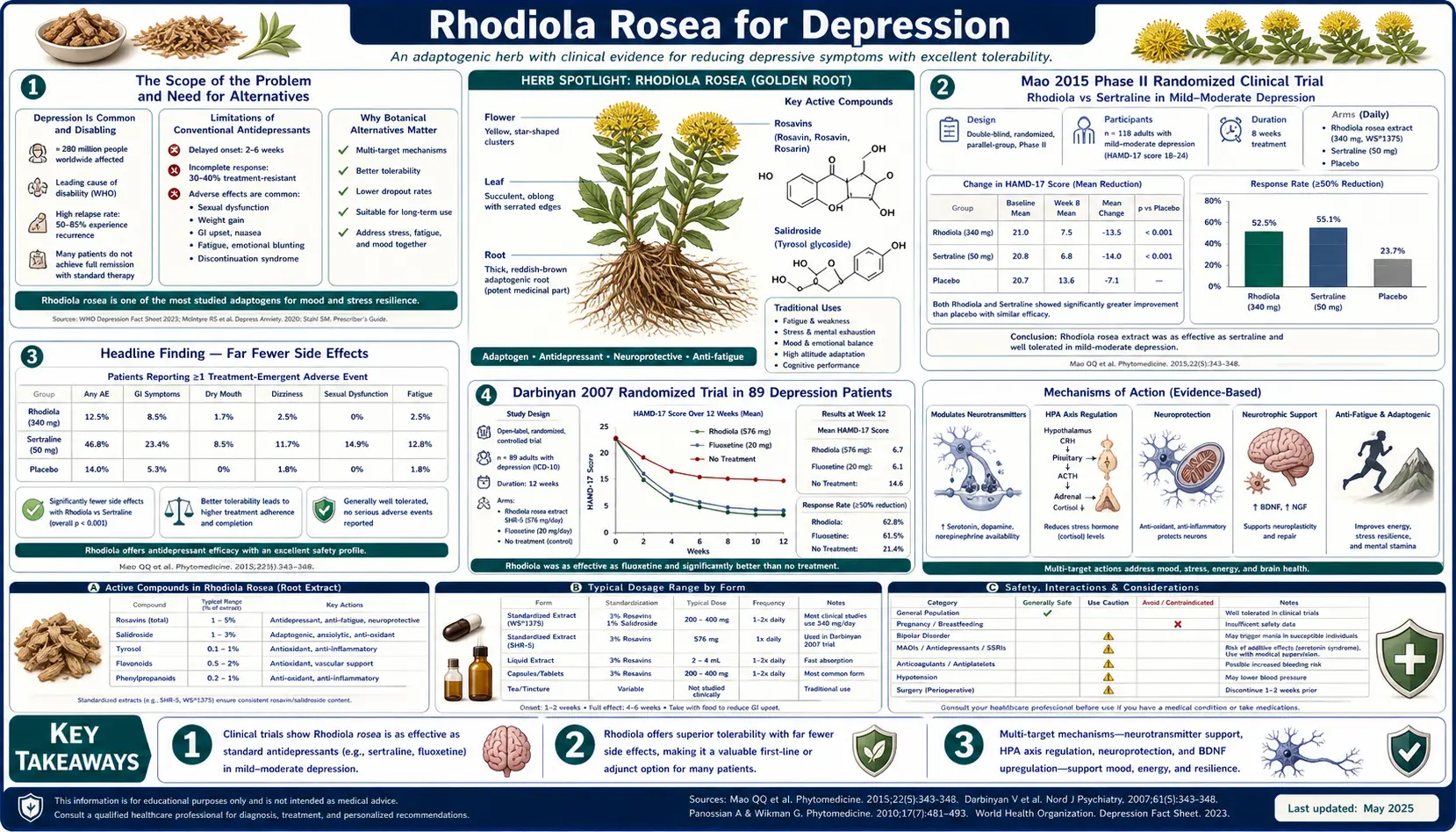
The Phase II Mao 2015 randomized clinical trial published in Phytomedicine compared Rhodiola rosea head-to-head against the selective serotonin reuptake inhibitor (SSRI) sertraline and placebo in 57 people with mild to moderate major depressive disorder. Over 12 weeks, Hamilton Depression Rating Scale (HAM-D) scores fell by 8.2 points on sertraline, 5.1 points on Rhodiola and 4.6 points on placebo, with no statistically significant difference between the groups (p = 0.79) — but Rhodiola produced far fewer adverse events than sertraline: 30.0% of people in the Rhodiola arm reported one, versus 63.2% in the sertraline arm and 16.7% on placebo. The authors concluded that Rhodiola, «although less effective than sertraline, may possess a more favorable risk to benefit ratio» for mild to moderate depression — a finding that matters most for people who cannot tolerate the selective serotonin reuptake inhibitor side-effect profile (sexual dysfunction, weight gain, emotional blunting, gastrointestinal (GI) upset, sleep disruption, the difficult withdrawal syndrome). The Darbinyan 2007 randomized trial in 89 depression patients reported significant improvement versus placebo with a standardized Rhodiola rosea extract. This deep-dive walks through the Mao trial in detail, the monoamine oxidase A and B inhibition found in laboratory tests that resembles the older monoamine oxidase inhibitor (MAOI) antidepressant class, the comparison with selective serotonin reuptake inhibitors (SSRIs) for the mild-to-moderate severity range, and the serotonin syndrome concern when Rhodiola is combined with pharmaceutical antidepressants.
Table of Contents
- The Scope of the Problem and the Need for Alternatives
- The Mao 2015 Phase II Rhodiola vs Sertraline Trial
- The Headline Finding — Far Fewer Side Effects
- The Darbinyan 2007 Randomized Trial in 89 Depression Patients
- Monoamine Oxidase A and B Inhibition Mechanism
- Rhodiola in the Mild-to-Moderate Depression Range
- Versus Selective Serotonin Reuptake Inhibitors — Honest Side-by-Side Comparison
- Adjunctive Use with Selective Serotonin Reuptake Inhibitors (Specialist-Supervised)
- Dosing Protocol for Depression
- Cautions, Drug Interactions, and Safety Findings
- Key Research Papers
- Connections
- Featured Videos
The Scope of the Problem and the Need for Alternatives
Major depressive disorder affects more than 280 million people worldwide and is the leading cause of disability globally. The mainstay of pharmacological treatment for the past three decades has been the selective serotonin reuptake inhibitor class — sertraline, fluoxetine, escitalopram, paroxetine, and citalopram — supplemented by serotonin-norepinephrine reuptake inhibitors (SNRIs, venlafaxine and duloxetine) and a smaller share of atypical antidepressants (bupropion, mirtazapine).
The clinical reality of selective serotonin reuptake inhibitor therapy is that approximately one-third of patients respond robustly, one-third have a partial response, and one-third either do not respond or cannot tolerate the side effects. The adverse-event profile of selective serotonin reuptake inhibitors is the often-overlooked clinical problem: sexual dysfunction (affecting 40-70% of patients on long-term selective serotonin reuptake inhibitor therapy by detailed inquiry), weight gain, emotional blunting (the «flat affect» that many patients describe as worse than the depression itself), gastrointestinal symptoms, sleep architecture disruption, and a discontinuation syndrome on withdrawal that can be severe and prolonged.
For the substantial population of patients with mild-to-moderate depression who either cannot tolerate selective serotonin reuptake inhibitors, refuse to take them, or have inadequate response, the alternatives are limited: cognitive behavioral therapy (effective but expensive, time-limited access in many health systems), exercise (effective but requires sustained behavioral activation that is itself difficult in depression), St. John's Wort (well-evidenced but with substantial drug-interaction profile via cytochrome P450 induction), Saffron (some evidence, limited supply), and Rhodiola rosea. The Mao 2015 trial was designed to test the hypothesis that Rhodiola would have effects similar to sertraline's with fewer adverse events in mild to moderate major depressive disorder.
The Mao 2015 Phase II Rhodiola vs Sertraline Trial
Mao JJ, Xie SX, Zee J, Soeller I, Li QS, Rockwell K, Amsterdam JD (2015) at the University of Pennsylvania published a randomized, double-blind, placebo-controlled Phase II trial directly comparing standardized Rhodiola rosea extract against sertraline (the most widely prescribed selective serotonin reuptake inhibitor) in patients with major depressive disorder. The trial was published in Phytomedicine and remains the highest-quality head-to-head comparison in the literature.
Trial design:
- Population: 57 adults aged 18 or older meeting DSM-IV criteria for major depressive disorder, with a baseline HAM-D score of 10 or more and a Clinical Global Impression Severity rating of 3 («mild») or 4 («moderate»); people with severe major depression, bipolar disorder, psychosis, active suicidality or current antidepressant treatment were excluded
- Randomization: three arms — Rhodiola (n=20), sertraline (n=19), placebo (n=18)
- Dosing: identical-looking capsules of a standardized Rhodiola rosea extract (340 mg per capsule, standardized to rosavin 3.07% and rhodioloside 1.95%), sertraline (50 mg per capsule), or placebo; everyone started on one capsule a day, and people whose HAM-D score had not fallen by more than 50% were moved up one capsule every 2 weeks, to a maximum of 4 capsules a day
- Duration: 12 weeks of treatment
- Outcomes: change in the 17-item HAM-D (Hamilton Depression Rating Scale) as the primary outcome; BDI (Beck Depression Inventory) and CGI/C (Clinical Global Impression of Change) as secondary outcomes; and adverse-event monitoring
The efficacy results (decline in HAM-D score over the 12 weeks):
- Sertraline: −8.2 points (95% confidence interval −12.7 to −3.6)
- Rhodiola: −5.1 points (95% confidence interval −8.8 to −1.3)
- Placebo: −4.6 points (95% confidence interval −8.6 to −0.6) — the large placebo response typical of depression trials
The reductions were modest and showed no statistically significant difference between the groups for HAM-D, BDI or CGI/C (p = 0.79, p = 0.28 and p = 0.17). Compared with placebo, the odds of improving were 1.90 (95% confidence interval 0.44 to 8.20) on sertraline and 1.39 (0.38 to 5.04) on Rhodiola. In the full paper the authors wrote that «overall efficacy did not differ from that of placebo», that the study was not powered to detect small differences between groups, and that the sertraline group started with slightly higher HAM-D scores, which may have contributed to sertraline's larger effect.
The Headline Finding — Far Fewer Side Effects
The actual headline of the Mao 2015 trial — the finding that has the largest implications for clinical practice — is the adverse-event comparison. The trial measured the proportion of patients reporting any adverse event during the 12-week treatment period:
- Sertraline arm: 63.2% (12 of 19) reported one or more adverse events — 52 adverse events in total
- Rhodiola arm: 30.0% (6 of 20) reported one or more adverse events — 12 adverse events in total
- Placebo arm: 16.7% (3 of 18) reported one or more adverse events — 14 adverse events in total
The difference in the share of people reporting adverse events across the three groups was statistically significant (p = 0.012): Rhodiola's rate sat between placebo's and sertraline's. The trial's adverse-event table, which lists only events reported by more than one person, shows the classic selective serotonin reuptake inhibitor profile on sertraline: nausea (10), sexual dysfunction (7), appetite change (4), insomnia (4), palpitations (3), gastrointestinal disturbance (3), yawning (3), dry mouth (2), fatigue (2), headache (2) and nervousness (2). On Rhodiola the listed events were nervousness (2) and dizziness (2); on placebo, nervousness (2). There were no treatment-related serious adverse events. The only two people who stopped treatment because of side effects were both on sertraline (one for palpitations; one for headache, insomnia and sexual dysfunction); no one stopped Rhodiola or placebo early.
What is not known: the trial was small (57 people) and, in the authors' words, «not specifically powered to detect small statistically significant differences between treatment groups», so it cannot settle whether Rhodiola's benefit truly differs from sertraline's or from placebo's.
How these findings line up with depression severity:
- Severe major depression (HAM-D > 25, suicidal ideation, psychotic features, melancholic features): selective serotonin reuptake inhibitor or serotonin-norepinephrine reuptake inhibitor (SNRI) therapy carries the full evidence base; Rhodiola has not been tested here — the Mao 2015 trial excluded severe major depression, psychosis and people who were actively suicidal
- Mild-to-moderate depression in people who tolerate selective serotonin reuptake inhibitor side effects: sertraline and the other selective serotonin reuptake inhibitors have the largest evidence base
- Mild-to-moderate depression in people who stopped selective serotonin reuptake inhibitors because of side effects, or who decline them: this is the group the Mao 2015 conclusion speaks to — a smaller effect on depression scores than sertraline, but far fewer side effects. The authors noted that side effects shape both whether people start a treatment and whether they stay on it long enough to benefit.
The case made for Rhodiola in depression therefore rests on tolerability rather than strength: in this trial its effect on depression scores was smaller than sertraline's and not statistically different from placebo's, while it caused fewer side effects than sertraline.
The Darbinyan 2007 Randomized Trial in 89 Depression Patients
The earlier Darbinyan V, Aslanyan G, Amroyan E, Gabrielyan E, Malmstrom C, Panossian A (2007) randomized trial published in Nordic Journal of Psychiatry studied 89 adults aged 18-70 with mild-to-moderate depression (DSM-IV criteria, HAM-D between 21 and 31). Participants were randomized to one of three arms:
- Standardized Rhodiola rosea extract 340 mg/day (31 patients)
- Standardized Rhodiola rosea extract 680 mg/day (29 patients)
- Matching placebo (29 patients)
Treatment lasted 6 weeks. Depression severity at entry was measured with the Beck Depression Inventory and the Hamilton Rating Scale for Depression, and the effect was assessed on days 0 and 42 from total and subgroup HAM-D scores. In both Rhodiola dose groups the following improved significantly, while the placebo group did not show such improvements:
- Overall depression (total HAM-D score)
- Insomnia subscale (a recurring problem in depression with broader sleep architecture issues)
- Emotional instability subscale
- Somatization subscale
Self-esteem was the one subscale that did not improve significantly.
Importantly, the higher dose (680 mg/day) did not produce significantly better outcomes than the lower dose (340 mg/day) — consistent with the broader Rhodiola pattern of a plateau in dose-response above approximately 400 mg/day. This is the dose-finding evidence supporting the 300-600 mg/day range cited in subsequent guidelines and consistent with the Mao 2015 trial's starting dose of 340 mg/day.
Adverse-event reporting in Darbinyan 2007 was favorable — mild and uncommon, with no serious adverse events and no dropouts attributable to Rhodiola tolerability. This report of good tolerability in a depression population is in line with the Mao 2015 finding of fewer adverse events on Rhodiola than on sertraline.
Monoamine Oxidase A and B Inhibition Mechanism
The pharmacological mechanism underlying Rhodiola's antidepressant effect centers on inhibition of the two monoamine oxidase isoforms, MAO-A and MAO-B. These are mitochondrial flavoprotein enzymes that catalyze the oxidative deamination of monoamine neurotransmitters — serotonin, dopamine, norepinephrine, and epinephrine — in the synaptic cleft. The selectivity differs slightly: MAO-A preferentially metabolizes serotonin and norepinephrine, while MAO-B preferentially metabolizes dopamine and phenethylamine. Inhibiting either or both isoforms increases the synaptic concentration of the corresponding neurotransmitter.
In a 2009 laboratory (test-tube) study, methanol and water extracts of Rhodiola rosea root inhibited MAO-A by 92.5% and 84.3% and MAO-B by 81.8% and 88.9% at a concentration of 100 µg/mL; the most active compound isolated was rosiridin, which inhibited MAO-B by more than 80% at 10−5 M. The inhibition is:
- Reversible, unlike the older irreversible pharmaceutical monoamine oxidase inhibitors (phenelzine, tranylcypromine) that permanently inactivate the enzyme until new enzyme is synthesized over 1-2 weeks
- Mild to moderate in potency, producing partial rather than complete enzyme inhibition
- Non-selective for the A/B subtypes, affecting both isoforms (in contrast to selective MAO-B inhibitors used in Parkinson's disease like selegiline and rasagiline)
The reversibility and mildness are why Rhodiola does not carry the dietary-tyramine restrictions associated with pharmaceutical monoamine oxidase inhibitors (MAOIs). The classic «cheese reaction» (hypertensive crisis triggered by tyramine-containing aged cheeses, cured meats, and fermented foods when MAO-A is irreversibly inhibited) does not appear to occur with normal therapeutic doses of Rhodiola. However, the additive risk with concurrent pharmaceutical monoamine oxidase inhibitors, selective serotonin reuptake inhibitors, serotonin-norepinephrine reuptake inhibitors, or other monoamine modulators is a real concern — see the Cautions section below.
Beyond MAO inhibition, Rhodiola components also inhibit catechol-O-methyltransferase (COMT) at moderate concentrations. COMT is the enzyme that degrades dopamine, norepinephrine, and epinephrine through methylation rather than oxidative deamination. The combined MAO + COMT inhibition produces a broader monoamine-availability effect than either inhibition alone, which may explain why Rhodiola targets the multi-neurotransmitter pathophysiology of depression (which involves all three of serotonin, dopamine, and norepinephrine) rather than only the serotonergic component targeted by selective serotonin reuptake inhibitors.
Additional mechanisms contributing to the antidepressant effect include:
- Hypothalamic-pituitary-adrenal-axis modulation and cortisol normalization (depression is highly comorbid with hypothalamic-pituitary-adrenal (HPA) dysfunction)
- Beta-endorphin and opioid neuropeptide elevation, which may contribute to mood elevation
- brain-derived neurotrophic factor (BDNF) upregulation in the hippocampus
- Anti-inflammatory effects through NF-kB and Nrf2/HO-1 modulation (inflammation is now recognized as a contributor to a subset of depression)
Rhodiola in the Mild-to-Moderate Depression Range
The Rhodiola depression trials enrolled people in the mild-to-moderate severity range — people who have functional impairment from their depression but are not in a severe or melancholic phase. The Mao 2015 trial took people with a HAM-D score of 10 or more rated «mild» or «moderate»; the Darbinyan 2007 trial took HAM-D scores between 21 and 31.
Rhodiola has not been tested in severe depression: the Mao 2015 trial excluded severe major depression, psychosis and people who were actively suicidal, and its effect on depression scores was smaller than sertraline's. Severe depression carries a suicide risk, and psychotic features, prominent vegetative symptoms (severe anorexia, insomnia, psychomotor retardation) and active suicidality are where conventional antidepressant treatment with psychiatric care has its evidence base; Rhodiola has none there.
A 2022 international guideline on nutrient and plant-based treatments in psychiatry, from the World Federation of Societies of Biological Psychiatry (WFSBP) and the Canadian Network for Mood and Anxiety Treatments (CANMAT), was written by a taskforce of 31 academics and clinicians from 15 countries. It graded only strong evidence (meta-analyses or two or more randomized trials) and concluded that «rhodiola use was not supported for use in mood disorders», while St John's wort, saffron, curcumin and lavender had supporting evidence for unipolar depression. The taskforce did not assess single trials and noted that «an absence of data does not imply lack of efficacy».
Within the mild-to-moderate range, groups for whom Rhodiola is discussed as an option:
- Patients with prior selective serotonin reuptake inhibitor failure due to intolerance — sexual dysfunction, gastrointestinal side effects, weight gain, emotional blunting, sleep disruption that led to discontinuation
- Patients who categorically refuse selective serotonin reuptake inhibitor therapy for personal or philosophical reasons but are willing to accept botanical intervention
- Depression in the context of burnout, stress-related fatigue, or chronic illness — where the underlying stress component makes the adaptogen mechanism particularly fitting
- Mild seasonal affective disorder — though formal trials in SAD are limited, the mechanism (hypothalamic-pituitary-adrenal modulation, monoamine availability, the broader photic and circadian disruption of winter depression) is theoretically well-matched
- Postpartum subclinical depression — the lower side-effect profile draws interest from breastfeeding mothers concerned about pharmaceutical exposure, though formal safety data in breastfeeding are lacking (see Cautions)
- Depression in elderly patients with polypharmacy concerns — the reduced drug-interaction burden compared to selective serotonin reuptake inhibitors is the reason Rhodiola is discussed for older people on multiple medications
Versus Selective Serotonin Reuptake Inhibitors — Honest Side-by-Side Comparison
An honest side-by-side comparison of Rhodiola versus selective serotonin reuptake inhibitors for mild-to-moderate depression:
Where selective serotonin reuptake inhibitors win:
- Larger effect size on HAM-D and BDI in most published trials
- Much larger evidence base (thousands of trials vs dozens for Rhodiola)
- Strong evidence for severe and recurrent depression where Rhodiola is unproven
- Insurance coverage in most health systems (Rhodiola is typically out-of-pocket)
- Established prescribing guidelines and physician familiarity
Where Rhodiola wins:
- Dramatically better tolerability — the Mao 2015 30% vs 63% adverse-event difference
- No sexual dysfunction in any meaningful frequency
- No weight gain
- No emotional blunting
- Faster apparent onset — effects often described within 1-2 weeks vs 4-6 weeks for selective serotonin reuptake inhibitors
- No selective serotonin reuptake inhibitor discontinuation syndrome on stopping
- Adjunctive support for the energy and cognitive components of depression (the selective serotonin reuptake inhibitor-treated patient often reports persistent fatigue and brain fog even when mood improves)
- Concurrent benefit for the stress and burnout components that often coexist with mild depression
Where it's a wash:
- Cost — selective serotonin reuptake inhibitors are very cheap as generics; Rhodiola is moderately priced but typically out-of-pocket
- Convenience — both are oral and taken daily; Rhodiola is usually taken in the morning, selective serotonin reuptake inhibitors are typically once daily but can be evening-dosed if preferred
The trade-off the Mao 2015 trial describes is a somewhat larger effect on depression scores with sertraline against far better tolerability with Rhodiola; it matters most for people who have already stopped a selective serotonin reuptake inhibitor because of side effects.
Adjunctive Use with Selective Serotonin Reuptake Inhibitors (Specialist-Supervised)
A separate clinical scenario is the use of Rhodiola as an adjunct to ongoing selective serotonin reuptake inhibitor therapy — either to augment a partial selective serotonin reuptake inhibitor response or to allow selective serotonin reuptake inhibitor dose reduction in patients who are responding but cannot tolerate the side effects. The Mao 2015 trial did not test this: it had three separate arms (Rhodiola, sertraline, placebo). The combination was tested in Gao 2020, a randomized double-blind placebo-controlled trial in which 100 patients with mild to moderate major depressive disorder took sertraline for 12 weeks plus either placebo (33 patients), a Rhodiola capsule at 0.6 g/day (33 patients) or a Rhodiola capsule at 0.3 g/day (34 patients):
- HAM-D, BDI and CGI scores fell in all groups, and the decline was greatest with sertraline plus 0.6 g/day of Rhodiola
- The authors concluded that the Rhodiola capsule «can improve the quality of life and clinical symptoms» and that the higher dose worked better than the lower one
- The published abstract does not report on drug interactions, serotonin syndrome or hypertensive crisis
In the Gao 2020 combination trial, Rhodiola was added to sertraline within a hospital psychiatry department's clinical trial, not self-managed. The risk of additive serotonergic effects is real even if rare: a 2015 case report describes serotonergic symptoms after Rhodiola was added to paroxetine (see Cautions). Supervision in these settings allows monitoring for early signs of overstimulation and dose adjustment.
Scenarios in which adjunctive Rhodiola is discussed:
- Partial selective serotonin reuptake inhibitor response with persistent fatigue, anhedonia, or cognitive fog — Rhodiola may add to the dopaminergic/noradrenergic component the selective serotonin reuptake inhibitor misses
- Selective serotonin reuptake inhibitor tolerability limited by sexual dysfunction or other side effects — Rhodiola adjunct may allow selective serotonin reuptake inhibitor dose reduction while maintaining mood benefit
- Concurrent stress-related burnout in a depressed patient — Rhodiola addresses the stress/hypothalamic-pituitary-adrenal component while selective serotonin reuptake inhibitor addresses the core mood disorder
Dosing Protocol for Depression
The doses used in the depression trials sit at the higher end of the general adaptogenic range:
- Darbinyan 2007: 340 mg/day or 680 mg/day of a standardized Rhodiola rosea extract for 6 weeks
- Mao 2015: one 340 mg capsule a day for the first 2 weeks, raised by one capsule every 2 weeks in people whose HAM-D score had not fallen by more than 50%, up to 4 capsules a day for weeks 6 to 12
- Gao 2020: a Rhodiola capsule at 0.3 g/day or 0.6 g/day added to sertraline for 12 weeks
A practitioner-style protocol for depression, not itself tested in a trial, describes:
- Starting dose: 200 mg standardized extract (3% rosavins / 1% salidroside) once daily in the morning on an empty stomach
- Titration: after one week, if tolerated, 200 mg twice daily (morning and early afternoon, second dose before 3pm)
- Target dose: 300-600 mg/day in divided doses
- Onset of benefit: 1-2 weeks for early signs, 4-6 weeks for substantial mood improvement, similar to the selective serotonin reuptake inhibitor timeline
- Trial period: 8-12 weeks at the target dose before judging response, with HAM-D or BDI scores rechecked at 4 and 12 weeks
- If responding: 6-12 months of continued use with periodic reassessment, and a gradual taper considered after at least 6 months of sustained remission
- If not responding at 12 weeks at 600 mg/day: the protocol calls for re-evaluating depression severity and considering a pharmaceutical antidepressant, and stops at 600 mg/day on the view that higher doses can produce paradoxical agitation (the Mao 2015 trial itself went up to four 340 mg capsules a day)
Depression treatment of any kind usually works slowly: improvement comes gradually over 4-12 weeks rather than as a dramatic immediate change, and stopping in the first 2-4 weeks, before an effect has had time to develop, is described as the most common reason treatment fails.
Cautions, Drug Interactions, and Safety Findings
- Selective serotonin reuptake inhibitor, serotonin-norepinephrine reuptake inhibitor and monoamine oxidase inhibitor antidepressants — combining them with Rhodiola raises a concern for serotonin syndrome (an excess of serotonin activity), a risk that is real even if rare. A 2015 case report describes a 68-year-old woman with recurrent moderate depression, taking the antidepressant paroxetine, who developed restlessness, trembling and autonomic («vegetative») symptoms after she began taking Rhodiola rosea; her doctors interpreted the symptoms as a serotonergic syndrome. The Mao 2015 trial did not combine Rhodiola with sertraline; the Gao 2020 combination trial gave it under medical supervision and its abstract does not report on interactions.
- St. John's Wort, 5-HTP, tryptophan supplements, or S-adenosylmethionine (SAMe) — these also raise serotonin activity, so combining them with Rhodiola carries the same serotonin syndrome concern, with no clear added benefit shown.
- Bipolar disorder — the activation profile can precipitate hypomania or mania, the same risk noted with all antidepressant monotherapy in bipolar disease; the Mao 2015 trial excluded people with bipolar disorder.
- Severe depression with suicidal ideation — Rhodiola has not been studied here: the Mao 2015 trial excluded severe major depression and people who were actively suicidal. Suicidal thoughts are a sign that emergency psychiatric services treat as urgent, and Rhodiola is not a substitute for crisis care.
- Pregnancy and lactation — insufficient safety data. The European Medicines Agency monograph specifically advises against use during pregnancy and breastfeeding due to lack of data, not because of a positive teratogenicity signal.
- Pediatric depression — pediatric safety and efficacy data are insufficient; the depression trials enrolled adults aged 18 and over only.
- Elderly patients — lower starting doses (100 mg/day) with slow increases are described for older people; the reduced drug-interaction burden vs selective serotonin reuptake inhibitors draws interest, but tolerability is more variable in older populations.
- Tramadol and other serotonergic analgesics — theoretical combined serotonergic risk.
- Triptans for migraine — combination caution due to serotonergic additivity.
- Antiparkinsonian therapy (selegiline, rasagiline) — these are pharmaceutical MAO-B inhibitors, and Rhodiola root extracts inhibited MAO-B in laboratory tests, so the effects could add up.
- Linezolid antibiotic — this antibiotic has MAO-inhibitor properties, which raises the same additive concern with Rhodiola.
For the broader depression context, see our Depression page, the St. John's Wort page for the most evidenced botanical antidepressant alternative, the Anxiety page for the commonly comorbid condition, and the Burnout page for stress-related depression context.
Key Research Papers
- Mao JJ, Xie SX, Zee J, Soeller I, Li QS, Rockwell K, Amsterdam JD (2015). Rhodiola rosea versus sertraline for major depressive disorder: a randomized placebo-controlled trial. Phytomedicine, 22(3), 394-399. — PubMed PMID: 25837277
- Darbinyan V, Aslanyan G, Amroyan E, Gabrielyan E, Malmström C, Panossian A (2007). Clinical trial of Rhodiola rosea L. extract SHR-5 in the treatment of mild to moderate depression. Nordic Journal of Psychiatry, 61(5), 343-348. — PubMed PMID: 17990195
- Amsterdam JD, Panossian AG (2016). Rhodiola rosea L. as a putative botanical antidepressant. Phytomedicine, 23(7), 770-783. — PubMed PMID: 27013349
- van Diermen D, Marston A, Bravo J, Reist M, Carrupt PA, Hostettmann K (2009). Monoamine oxidase inhibition by Rhodiola rosea L. roots. Journal of Ethnopharmacology, 122(2), 397-401. — PubMed PMID: 19168123
- Mannucci C, Navarra M, Calzavara E, Caputi AP, Calapai G (2012). Serotonin involvement in Rhodiola rosea attenuation of nicotine withdrawal signs in rats. Phytomedicine, 19(12), 1117-1124. — PubMed PMID: 22921986
- Perfumi M, Mattioli L (2007). Adaptogenic and central nervous system effects of single doses of 3% rosavin and 1% salidroside Rhodiola rosea L. extract in mice. Phytotherapy Research, 21(1), 37-43. — PubMed PMID: 17072830
- Iovieno N, Dalton ED, Fava M, Mischoulon D (2011). Second-tier natural antidepressants: review and critique. Journal of Affective Disorders, 130(3), 343-357. — PubMed PMID: 20579741
- Sarris J, Panossian A, Schweitzer I, Stough C, Scholey A (2011). Herbal medicine for depression, anxiety and insomnia: a review of psychopharmacology and clinical evidence. European Neuropsychopharmacology, 21(12), 841-860. — PubMed PMID: 21601431
- Bystritsky A, Kerwin L, Feusner JD (2008). A pilot study of Rhodiola rosea (Rhodax) for generalized anxiety disorder (GAD). Journal of Alternative and Complementary Medicine, 14(2), 175-180. — PubMed PMID: 18307390
- Gao L, Wu C, Liao Y, Wang J (2020). Antidepressants effects of Rhodiola capsule combined with sertraline for major depressive disorder: a randomized double-blind placebo-controlled clinical trial. Journal of Affective Disorders, 265, 99-103. — PubMed PMID: 32090788
- Concerto C, Boo H, Hu C, Sandilya P, Krish A, Chusid E, Coira D, Aguglia E, Battaglia F (2018). Hypericum perforatum extract modulates cortical plasticity in humans. Psychopharmacology, 235(1), 145-153. (St. John's Wort comparison context) — PubMed PMID: 29018896
- Panossian A, Wikman G, Sarris J (2010). Rosenroot (Rhodiola rosea): traditional use, chemical composition, pharmacology and clinical efficacy. Phytomedicine, 17(7), 481-493. — PubMed PMID: 20378318
- Sarris J, Ravindran A, Yatham LN, Marx W, Rucklidge JJ, McIntyre RS, Akhondzadeh S, Benedetti F, Caneo C, Cramer H, Cribb L, de Manincor M, Dean O, Deslandes AC, Freeman MP, Gangadhar B, Harvey BH, Kasper S, Lake J, Lopresti A, Lu L, Metri NJ, Mischoulon D, Ng CH, Nishi D, Rahimi R, Seedat S, Sinclair J, Su KP, Zhang ZJ, Berk M (2022). Clinician guidelines for the treatment of psychiatric disorders with nutraceuticals and phytoceuticals: the World Federation of Societies of Biological Psychiatry (WFSBP) and Canadian Network for Mood and Anxiety Treatments (CANMAT) Taskforce. World Journal of Biological Psychiatry, 23(6), 424-455. — PubMed PMID: 35311615
- Maniscalco I, Toffol E, Giupponi G, Conca A (2015). [The interaction of Rhodiola rosea and antidepressants. A case report]. Neuropsychiatrie, 29(1), 36-38. (Article in German.) — PubMed PMID: 25413939
PubMed Topic Searches
Connections
- All Herbs
- Rhodiola Rosea Overview
- Rhodiola Benefits Hub
- Rhodiola for Stress & Fatigue
- Rhodiola for Cognitive Performance
- Rhodiola for Athletic Performance
- Depression
- Anxiety
- Burnout
- Fatigue
- St. John's Wort (Botanical Antidepressant)
- Saffron (Botanical Antidepressant)
- Ashwagandha (Adaptogen)
- Stress Management
- Cortisol Test
- History