Maca — Benefits Deep Dive
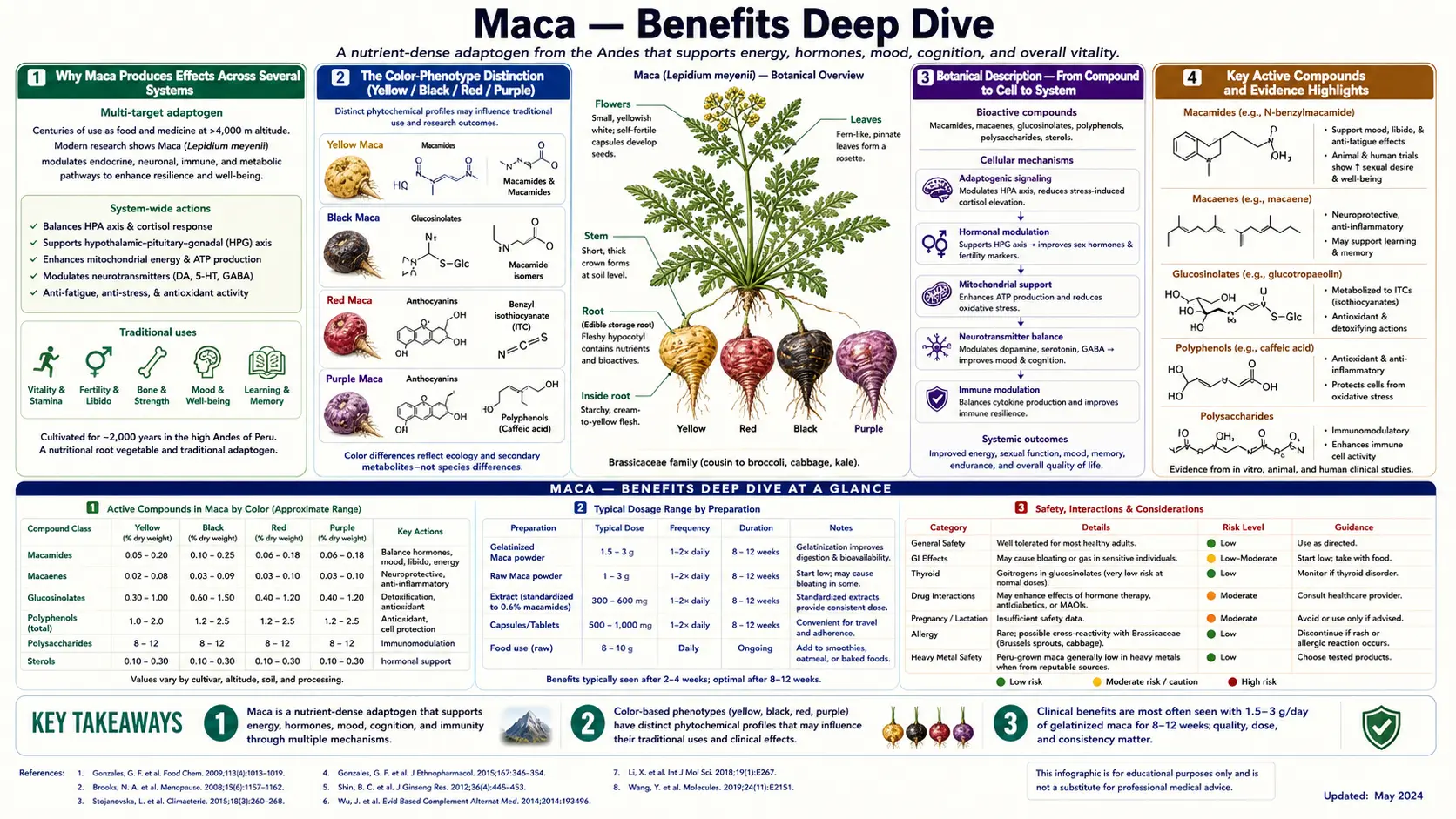
Maca (Lepidium meyenii) is a Peruvian Andean cruciferous root cultivated for at least two thousand years on the harsh Junin Plateau at altitudes above 13,000 feet — one of the very few food crops that thrives in that extreme ultraviolet (UV), freezing nights, and thin-oxygen environment. Botanically a relative of radish and turnip, Maca produces a unique class of polar lipid amides (macamides and macaenes) found in no other known plant, plus glucosinolates, sterols, and unusually high mineral density. Crucially, Maca appears in four distinct color phenotypes — yellow, black, red, and purple — that share the species name but differ measurably in alkaloid and macamide profile, so the color is a treatment-relevant variable: black is the phenotype most often linked with sperm parameters (mostly in rat studies), red with prostate and bone effects in rodents, yellow is the general-purpose tonic. Four benefit pages below explore the conditions where Maca produces the largest documented clinical effect — libido and sexual function, peri- and postmenopausal hormonal balance, energy and physical endurance, and mood and cognition.
Deep-Dive Articles
Libido & Sexual Function
The Gonzales 2002 men's trial (1.5–3 g/day raised subjective libido by week 8 without changing testosterone), the Gonzales 2010 women's trial, the Shin 2010 BMC Complementary Medicine systematic review, the macamides + macaenes hypothesis as putative active class, the contrast with conventional hormonal supplements (in the trials Maca did not change testosterone levels), and the 1.5–3 g/day doses used in the trials.
Read the deep dive →Hormonal Balance & Menopause
The Meissner 2006 and 2008 trials on postmenopausal symptom relief, the open safety question of estrogen-like activity (a yeast-cell test found none, while a breast-cancer cell study found weak estrogenic activity, and Maca has not been tested in people with hormone-sensitive cancers), secondary thyroid effects in some trials, and the HPA / HPO axis modulation hypothesis as the working mechanism.
Read the deep dive →Energy & Endurance
Traditional Peruvian use as an altitude-tolerance staple at 13,000+ ft, the Stone 2009 cycling time-trial study, the iron and B-vitamin nutritional contribution to baseline energy, mitochondrial-mechanism speculation, and the practical distinction between dose-range for endurance (typically 1.5–3 g/day chronic) versus strength / acute performance contexts.
Read the deep dive →Mood & Cognitive Function
The Brooks 2008 postmenopausal anxiety and depression trial, the brain-derived neurotrophic factor (BDNF) and serotonin working hypotheses, the memory data in rodent models (Rubio scopolamine reversal), and the appropriate clinical framing as an adjunct to selective serotonin reuptake inhibitors (SSRIs) and other first-line antidepressants — not a replacement for them. Maca's mood effect is real but modest in magnitude.
Read the deep dive →Table of Contents
Why Maca Produces Effects Across Several Systems
Most herbal "adaptogens" with broad system effects act through a single dominant mechanism — ginseng through ginsenoside steroid analogs, ashwagandha through withanolide cortisol modulation, rhodiola through the rosavin / salidroside catecholamine pathway. Maca is unusual because its dominant mechanism is almost certainly not hormonal mimicry. In the laboratory the results are mixed: a yeast-cell hormone test found no physiologically significant estrogenic or androgenic activity with up to 4 mg/mL of Maca extract (Brooks 2008), while Maca extracts showed estrogenic activity comparable to silymarin in a human breast-cancer cell line (MCF-7) at 100–200 µg/mL (Valentóvá 2006), and red Maca raised androgen-receptor and prostate-specific antigen (PSA) gene activity in a human prostate-cancer cell line (LNCaP) at 20–40 µg/mL without harming the cells (Díaz 2016). Yet clinical trials reproducibly show libido, energy, mood, and menopausal-symptom benefit.
The working mechanistic hypothesis — and it remains a hypothesis — is that Maca acts upstream of the endocrine axes, at the level of the hypothalamus and pituitary, modulating the regulatory tone of the hypothalamic-pituitary-adrenal (HPA) and HPG (hypothalamic-pituitary-gonadal) axes without directly mimicking any downstream hormone. The proposed mediators are:
- Macamides — a class of polar lipid amides (N-benzylpalmitamide, N-benzyloleamide, N-benzyllinoleamide, and related structures) found in no other known plant. Macamides are structural cousins of the endocannabinoid anandamide, and several macamides have been shown in vitro to inhibit fatty acid amide hydrolase (FAAH), the enzyme that degrades anandamide. The implication is that Maca may potentiate endogenous endocannabinoid tone, which in turn modulates hypothalamic-pituitary-adrenal stress response, mood, and sexual function.
- Macaenes — a closely related class of unsaturated fatty acids unique to Maca, often discussed alongside macamides as the "M+M" markers in commercial extract standardization.
- Glucosinolates — the cruciferous-family sulfur-containing compounds (Maca is a member of Brassicaceae, related to broccoli and radish) hydrolyzed to isothiocyanates by myrosinase. Maca's glucosinolate profile (benzyl glucosinolate is dominant) is distinctive among cruciferae but shares the broad anti-inflammatory and detoxification-supporting properties of the class.
- Sterols — beta-sitosterol, campesterol, ergosterol, and ergostadienol are present, and although these do not bind human sex hormone receptors with meaningful affinity, they may modulate cholesterol metabolism upstream of endogenous steroid synthesis.
- Mineral and B-vitamin density — Maca root contains unusually high concentrations of iron, calcium, magnesium, zinc, copper, and B vitamins for a tuberous food. Part of the chronic "energy" benefit may be straightforward micronutrient repletion in deficient individuals, separate from any pharmacologic effect.
This is fundamentally different from soy, black cohosh, DHEA, or pregnenolone — all of which contain compounds that bind sex hormone receptors directly. For people with hormone-sensitive conditions — for example, hormone-receptor-positive breast cancer, endometriosis, or estrogen-sensitive fibroids — the safety question is open: Maca has not been tested in people with hormone-sensitive cancers, and the cell studies disagree on whether it has estrogen-like activity (estrogenic activity in breast-cancer cells, Valentóvá 2006; increased androgen signalling in prostate-cancer cells, Díaz 2016). See the Hormonal Balance and Menopause deep-dive for more on this question.
The complication is that this mechanistic flexibility means Maca's effect size in any individual is hard to predict from biomarkers. Unlike testosterone replacement, where you can measure serum testosterone, dose to target, and observe the symptom response, Maca's endpoints are entirely symptomatic. The clinical trial literature reflects this — most positive trials use self-report scales (sexual function, menopausal symptom scores, mood inventories), and a smaller body of trials measuring actual hormone levels typically finds no change in testosterone, estrogen, or progesterone.
The Brooks 2008 trial shows the pattern in numbers. Fourteen postmenopausal women took 3.5 g/day of Maca powder for 6 weeks and a matching placebo for 6 weeks, in random order (a crossover design). Scores for anxiety, depression and sexual problems on a menopause symptom scale fell compared with both the starting point and placebo (P < 0.05). Blood levels of estradiol, follicle-stimulating hormone (FSH), luteinizing hormone (LH) and sex hormone-binding globulin (SHBG) did not change.
Two newer studies add to this picture. A 2023 Korean randomized, double-blind, placebo-controlled trial (Shin 2023) gave gelatinized Maca or placebo for 12 weeks to 80 men who had symptoms of late-onset hypogonadism (age-related low-testosterone symptoms) but normal testosterone levels (41 Maca, 39 placebo). Scores on the Aging Males' Symptoms scale, the International Index of Erectile Function (IIEF) and the International Prostate Symptom Score (IPSS) improved more with Maca than with placebo (p < 0.05). A 2024 review of Maca and physical performance (Huerta Ojeda 2024) included 21 studies, 16 of them pooled, and reported large effects on forced-swimming, rota-rod and grip-strength tests and lower lactic acid, with bigger effects at higher doses; these tests are laboratory-animal tests, so the results are mainly from animals.
The Color-Phenotype Distinction (Yellow / Black / Red / Purple)
Maca root color is a treatment-relevant variable that most Western marketing has obscured. Traditional Andean farmers have always distinguished the phenotypes, planting and selling them separately for different indications. Modern phytochemical analysis confirms that the colors differ measurably in macamide concentration, glucosinolate profile, and sterol content — even when grown side by side in the same field, meaning the differences are heritable (genetic) rather than environmental.
- Yellow Maca — the most common phenotype, ~60–70% of any unsorted harvest. The "general purpose" tonic. Used for routine energy and endurance support. Most commercial Maca powder sold as unspecified is predominantly yellow. Yellow is the colour usually sold for general fatigue, low motivation, or other non-specific tonic uses.
- Black Maca — the phenotype most often linked with libido and sperm parameters, mostly in rat studies. A small 2001 Gonzales study gave 9 men Maca tablets (1,500 or 3,000 mg/day; the abstract names no colour) for 4 months, with no placebo group, and found increased seminal volume, sperm count and sperm motility, with no change in hormone levels. The 2006 Gonzales et al. study was in rats: black Maca given by mouth raised sperm counts within 1 to 7 days of starting. Black contains the highest measured macamide concentration of the four colors. Discussion of libido, fertility and male sexual function most often centres on black Maca.
- Red Maca — the phenotype associated with prostate and bone effects. The 2005 Gonzales rat study compared yellow, red, and black Maca in normal rats and found that only red reduced prostate size; red, the only colour then tested in the enlarged-prostate model, also prevented the prostate weight gain caused by testosterone enanthate. A 2006 follow-up extended this finding. Red Maca has also been studied (less robustly) for bone density in ovariectomized rodents. Discussion of benign prostatic hyperplasia (BPH), prostate health, and postmenopausal bone support therefore centres on red Maca, though this evidence comes from rats and ovariectomized rodents only.
- Purple Maca — the rarest phenotype, often overlapping in chemistry with red. Less studied. Sometimes marketed as a separate fourth color but in practice frequently sold mixed with red.
In the rat studies above the colour made a difference: red, but not yellow or black, shrank the prostate. "Maca powder" sold without a colour is predominantly yellow, while the black (sperm) and red (prostate) findings come mainly from animal studies. Product labels differ in whether they state the color, the origin (Junin Plateau vs. lowland cultivation, which dramatically affects active compound concentration), and the macamide content.
The human libido trial (Gonzales 2002) was a 12-week double-blind, placebo-controlled trial in men aged 21–56 using gelatinized Maca at 1,500 or 3,000 mg/day; its abstract names no colour. Sexual desire improved from week 8, and serum testosterone and oestradiol did not differ from placebo. A 2022 review pooled the randomized trials of Maca and semen quality (Lee 2022, five trials): Maca did not significantly raise sperm concentration compared with placebo (difference 2.22, 95% confidence interval −2.94 to 7.37, p = 0.4). The authors called the effects on semen quality unclear and said the trials were too few and too small for firm conclusions.
One additional preparation variable: gelatinized Maca has been gently heated to break down starches, which improves digestibility and tolerance for people who experience bloating with raw Maca. Gelatinization does not destroy macamides or glucosinolates at the temperatures used. Most clinical trials have used either raw or gelatinized preparations interchangeably without clear differences in outcome, but tolerance is typically better with gelatinized.
Key Research Papers
- Gonzales GF et al. (2002). Effect of Lepidium meyenii (MACA) on sexual desire and its absent relationship with serum testosterone levels in adult healthy men. Andrologia, 34(6):367-372. — PubMed PMID: 12472620
- Shin BC, Lee MS, Yang EJ, Lim HS, Ernst E (2010). Maca (L. meyenii) for improving sexual function: a systematic review. BMC Complementary and Alternative Medicine, 10:44. — PubMed PMID: 20691074
- Meissner HO et al. (2006). Hormone-balancing effect of pre-gelatinized organic Maca: (I) Biochemical and pharmacodynamic study on Maca using clinical laboratory model on ovariectomized rats. International Journal of Biomedical Science, 2(3):260-272. — PubMed PMID: 23674989
- Brooks NA et al. (2008). Beneficial effects of Lepidium meyenii (Maca) on psychological symptoms and measures of sexual dysfunction in postmenopausal women are not related to estrogen or androgen content. Menopause, 15(6):1157-1162. — PubMed PMID: 18784609
- Stone M et al. (2009). A pilot investigation into the effect of maca supplementation on physical activity and sexual desire in sportsmen. Journal of Ethnopharmacology, 126(3):574-576. — PubMed PMID: 19781622
- Gonzales GF, Cordova A, Gonzales C, Chung A, Vega K, Villena A (2001). Lepidium meyenii (Maca) improved semen parameters in adult men. Asian Journal of Andrology, 3(4):301-303. — PubMed PMID: 11753476
- Gonzales GF, Miranda S, Nieto J, Fernández G, Yucra S, Rubio J, Yi P, Gasco M (2005). Red maca (Lepidium meyenii) reduced prostate size in rats. Reproductive Biology and Endocrinology, 3:5. — PubMed PMID: 15661081
- Gonzales GF, Nieto J, Rubio J, Gasco M (2006). Effect of Black maca (Lepidium meyenii) on one spermatogenic cycle in rats. Andrologia, 38(5):166-172. — PubMed PMID: 16961569
- Valentóvá K, Buckiová D, Kren V, Peknicová J, Ulrichová J, Simánek V (2006). The in vitro biological activity of Lepidium meyenii extracts. Cell Biology and Toxicology, 22(2):91-99. — PubMed PMID: 16528448
- Díaz P, Cardenas H, Orihuela PA (2016). Red Maca (Lepidium meyenii) did not affect cell viability despite increased androgen receptor and prostate-specific antigen gene expression in the human prostate cancer cell line LNCaP. Andrologia, 48(8):922-926. — PubMed PMID: 27681649
- Lee HW, Lee MS, Qu F, Lee JW, Kim E (2022). Maca (Lepidium meyenii Walp.) on semen quality parameters: A systematic review and meta-analysis. Frontiers in Pharmacology, 13:934740. — PubMed PMID: 36110519
- Shin D, Jeon SH, Piao J, Park HJ, Tian WJ, Moon DG, Ahn ST, Jeon KH, Zhu GQ, Park I, Park HJ, Bae WJ, Cho HJ, Hong SH, Kim SW (2023). Efficacy and Safety of Maca (Lepidium meyenii) in Patients with Symptoms of Late-Onset Hypogonadism: A Randomized, Double-Blind, Placebo-Controlled Clinical Trial. World Journal of Men's Health, 41(3):692-700. — PubMed PMID: 36593713
- Huerta Ojeda Á, Rodríguez Rojas J, Cancino-López J, Barahona-Fuentes G, Pavez L, Yeomans-Cabrera MM, Jorquera-Aguilera C (2024). Effects of Maca (Lepidium meyenii Walp.) on Physical Performance in Animals and Humans: A Systematic Review and Meta-Analysis. Nutrients, 17(1):107. — PubMed PMID: 39796542
External Authoritative Resources
- PMC — Maca: An Andean Crop with Multi-Pharmacological Functions (Wang 2007 review) — the most-cited Western-literature overview of Maca phytochemistry and pharmacology
- PMC — Ethnobiology and Ethnopharmacology of Lepidium meyenii (Gonzales 2012) — comprehensive review of the traditional use, color-phenotype distinctions, and clinical evidence
- MedlinePlus — Maca (Natural Medicines monograph)
- PubMed — All Maca / Lepidium meyenii research (~600+ papers)
- U.S. Department of Agriculture (USDA) FoodData Central — Maca root nutritional composition (search "maca")
Connections
- All Herbs
- Maca (Main Page)
- Maca for Libido and Sexual Function
- Maca for Hormonal Balance & Menopause
- Maca for Energy and Endurance
- Maca for Mood and Cognitive Function
- Ashwagandha
- Ginseng
- Rhodiola Rosea
- Holy Basil
- Black Cohosh
- Hormone Panel
- Testosterone Test
- Fatigue
- Stress Management
- Iron
- Zinc
- Calcium
- History