Kale
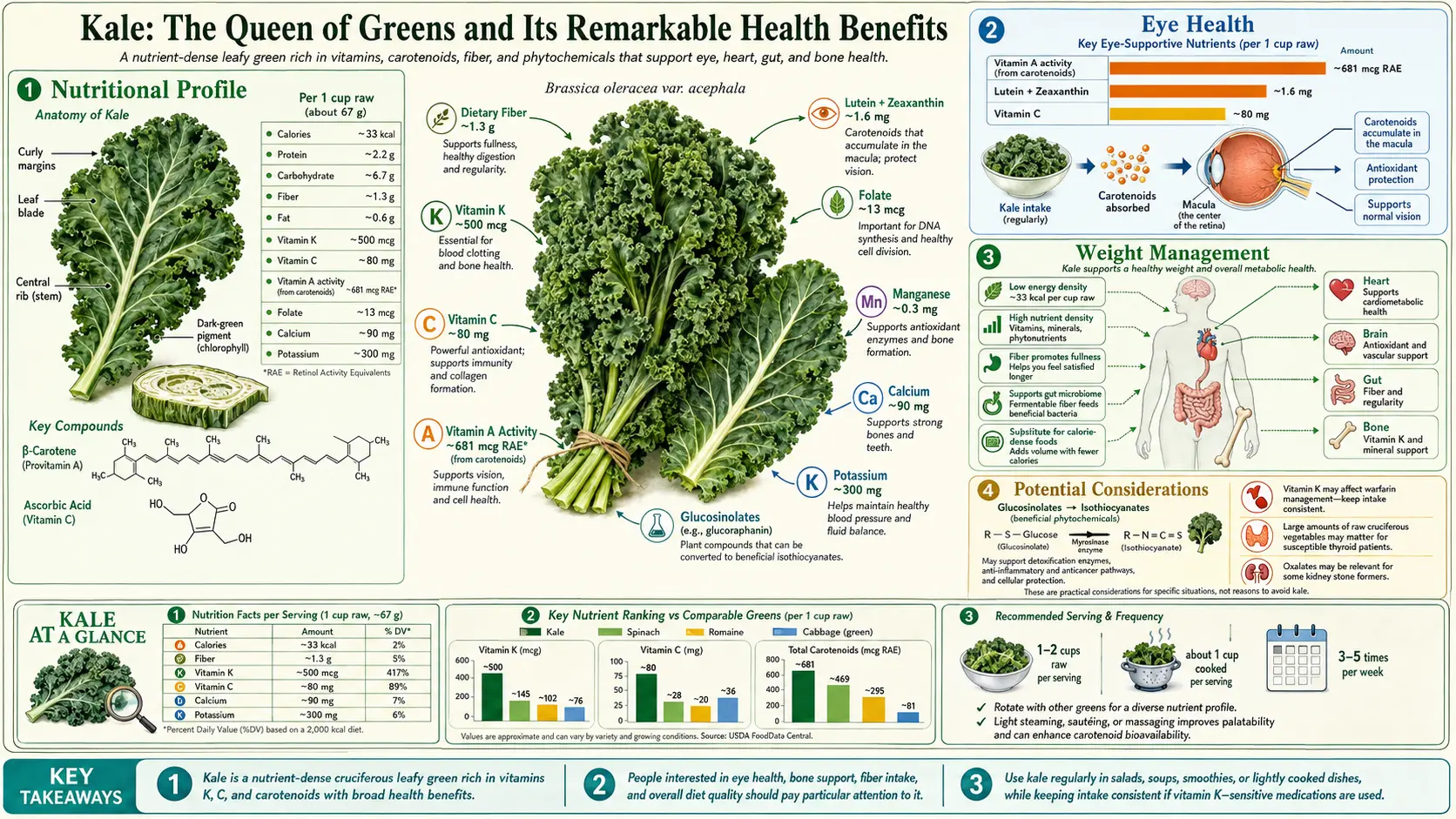
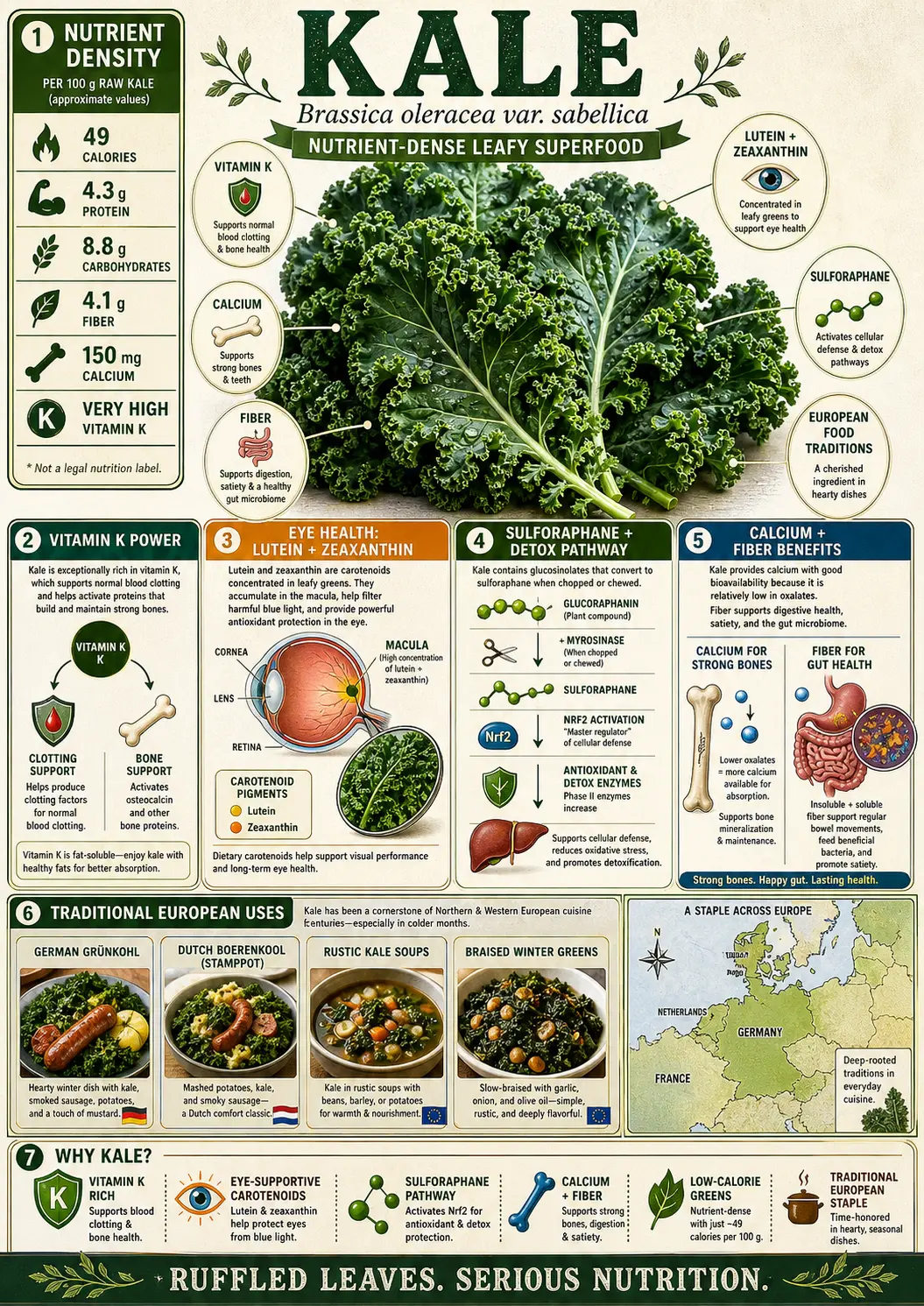
Table of Contents
- Nutritional Profile
- Nutrient Density
- Cancer Research
- Heart Health
- Inflammation
- Eye Health
- Bone Health
- Detoxification Enzymes
- Immune System
- Blood Sugar
- Skin Health
- Weight Management
- Brain Health
- Kale Varieties
- Raw vs. Cooked
- Smoothies and Juicing
- Potential Considerations
- Key Research Papers
- Connections
- Featured Videos
Kale is a leafy green of the cabbage family; the USDA SR Legacy database lists it as Brassica oleracea (Acephala Group), and curly kale is classified as Brassica oleracea convar. acephala var. sabellica (Olsen 2009). Like broccoli, cabbage and Brussels sprouts it is a cruciferous vegetable: it contains glucosinolates, sulfur compounds that the plant enzyme myrosinase converts into isothiocyanates, an enzyme that heat inactivates (Conaway 2000). The history of kale as a crop is covered on the Kale History page, and the full nutrient table on the Kale Nutrients page.
This page summarises what food-composition data and published studies report about kale and about the compound groups it contains. Most of the human evidence for leafy and cruciferous vegetables comes from observational studies, which show associations rather than cause and effect; several of the studies below tested other cruciferous vegetables (broccoli, Brussels sprouts) or purified compounds rather than kale itself, and each is described as such. Four deep-dive pages are collected on the Kale Benefits hub.
1. Nutritional Profile
The USDA SR Legacy database lists the following per 100 grams of raw kale: 35 kcal, 89.6 g water, 2.92 g protein, 1.49 g fat, 4.42 g carbohydrate and 4.1 g dietary fiber; 389.6 micrograms of Vitamin K (phylloquinone, K1), 93.4 mg of Vitamin C, 241 micrograms RAE of Vitamin A (2,873 micrograms of beta-carotene), 6.26 mg of lutein plus zeaxanthin, 62 micrograms of folate, 0.147 mg of Vitamin B6, 254 mg of calcium, 348 mg of potassium, 33 mg of magnesium, 1.6 mg of iron, 0.92 mg of manganese and 0.053 mg of copper. The USDA's household measure for raw kale is 1 cup = 21 grams.
The percent Daily Value (%DV) on a US food label is the amount in the food divided by the Daily Value set in 21 CFR 101.9. Those Daily Values are 120 micrograms for Vitamin K, 90 mg for Vitamin C and 900 micrograms RAE for Vitamin A. So 100 grams of raw kale supplies about 325% of the Daily Value for Vitamin K (389.6 ÷ 120), about 104% for Vitamin C (93.4 ÷ 90) and about 27% for Vitamin A (241 ÷ 900).
Calcium from kale is well absorbed. In 11 women given intrinsically labelled kale and labelled milk, fractional calcium absorption averaged 0.409 from kale and 0.321 from milk (Heaney & Weaver 1990); the authors attribute the difference from spinach, whose calcium is poorly absorbed, to kale's low oxalate content.
For flavonoids, an analysis of curly kale tentatively identified 32 phenolic compounds, including glycosides of quercetin and kaempferol; after acid hydrolysis the totals were 58 mg of kaempferol and 44 mg of quercetin per 100 grams of fresh kale (Olsen 2009). The same database entry lists 0.378 g of 18:3 polyunsaturated fatty acids per 100 grams of raw kale.
2. Nutrient Density
Nutrient density compares the nutrients in a food with its energy. Raw kale supplies 35 kcal per 100 grams in the USDA SR Legacy data, alongside the vitamin amounts listed above. Kale is not the top leafy green on every measure: per 100 grams raw, the same database lists 389.6 micrograms of Vitamin K for kale, 482.9 for spinach and 437.1 for collards; 6.26 mg of lutein plus zeaxanthin for kale, 12.2 mg for spinach and 4.32 mg for collards; and 93.4 mg of Vitamin C for kale, 28.1 mg for spinach and 35.3 mg for collards. Per-calorie rankings depend on the scoring system used, and none is cited here.
3. Cancer Research
The cancer research on kale is mostly research on cruciferous vegetables as a group, and on two glucosinolate products: sulforaphane and indole-3-carbinol. In 1992, sulforaphane was isolated from broccoli as a potent inducer of Phase II detoxication enzymes (quinone reductase and glutathione transferases) in cultured mouse liver-cancer cells and mouse tissues; it induced these enzymes without inducing the aryl-hydrocarbon-receptor-dependent cytochrome P450 (Phase I) enzymes (Zhang 1992). These are cell and animal results.
Indole-3-carbinol (I3C) comes from indole glucosinolates. Taken as a supplement at 6–7 mg/kg a day (7 men for one week, 10 women for two months), it increased urinary excretion of 2-hydroxylated estrogens and lowered most other estrogen metabolites, including 16-alpha-hydroxyestrone; the authors note that the long-term effects of higher catechol-estrogen levels in women need further study (Michnovicz 1997). A 1997 paper on broccoli sprouts noted that indole glucosinolates, which predominate in the mature vegetable, may give rise to degradation products such as indole-3-carbinol that can enhance tumour formation (Fahey 1997).
Human findings are observational and mixed:
- In a network of Italian and Swiss case-control studies, eating cruciferous vegetables at least once a week, compared with no or occasional consumption, was associated with lower odds of cancers of the oral cavity and pharynx (OR 0.83), esophagus (0.72), colorectum (0.83), breast (0.83) and kidney (0.68); the odds ratios for stomach, liver, pancreatic, laryngeal, endometrial, ovarian and prostate cancer were below 1 but not significant (Bosetti 2012).
- A summary of the EPIC cohort (more than 500,000 participants in 10 European countries) reported that colorectal cancer risk was inversely associated with total fruit and vegetable intake, while upper gastrointestinal and lung cancer risk were not associated with vegetable intake (Bradbury 2014).
- For prostate cancer, a Seattle-area case-control study of men under 65 found an odds ratio of 0.59 (95% CI 0.39–0.90) for three or more servings of cruciferous vegetables a week against fewer than one (Cohen 2000). In the Health Professionals Follow-Up Study (47,365 men, 2,969 cases), there was no appreciable association overall (RR 0.93; 95% CI 0.82–1.05 for five or more against one or fewer servings a week), with a stronger inverse association in men under 65 (Giovannucci 2003). A meta-analysis found RR 0.90 overall but no significant association in the cohort studies alone (RR 0.95; 95% CI 0.88–1.02) (Liu 2012).
- Meta-analyses of high against low intake reported RR 0.85 for breast cancer (13 studies, 11 of them case-control; Liu & Lv 2013) and OR 0.84 for colon cancer (Tse & Eslick 2014).
The topic is covered in more detail on the Glucosinolates and Cancer page.
4. Heart Health
Bile acid binding. In a laboratory (in vitro) digestion model, bile acid binding on a dry-matter basis was 13% of that of cholestyramine (a bile-acid-binding cholesterol drug) for steamed collard greens, kale and mustard greens, 10% for broccoli and 5% for cabbage; steam cooking significantly improved bile acid binding compared with the authors' earlier values for the raw vegetables (Kahlon 2008). Bile acid binding is a laboratory marker of cholesterol-lowering potential, not a measured change in human cholesterol.
Kale juice. In a Korean study, 32 men with hypercholesterolemia drank 150 mL of kale juice a day for 12 weeks. HDL cholesterol rose by 27% and the HDL-to-LDL ratio by 52%, and LDL cholesterol fell by 10%, compared with baseline; glutathione peroxidase activity and serum selenium also rose (Kim 2008). The abstract describes no control group.
Potassium and Vitamin K. Raw kale contains 348 mg of potassium per 100 grams in the USDA SR Legacy data (the Daily Value for potassium in 21 CFR 101.9 is 4,700 mg). Vitamin K's role in activating Matrix Gla protein is covered on the Vitamin K and Bone page.
5. Inflammation
Evidence for an anti-inflammatory effect of cruciferous vegetables in people is limited; the authors of one study note that most of it comes from animal studies. In that cross-sectional analysis of 1,005 middle-aged Chinese women, circulating TNF-alpha, IL-1beta and IL-6 were lower among women with higher cruciferous-vegetable intake: the differences between the highest and lowest quintiles were 12.66% for TNF-alpha, 18.18% for IL-1beta and 24.68% for IL-6. Urinary oxidative-stress markers (F2-isoprostanes) were not associated with intake (Jiang 2014). A cross-sectional study cannot show cause and effect.
At the cell level, sulforaphane and other Phase 2 inducers react with cysteine thiol groups on the protein Keap1. This releases the transcription factor Nrf2, which moves to the nucleus and activates the antioxidant response element of Phase 2 genes; the experiments used purified mouse Keap1 (Dinkova-Kostova 2002).
6. Eye Health
USDA SR Legacy lists 6.26 mg of lutein plus zeaxanthin per 100 grams of raw kale and 4.98 mg per 100 grams of boiled kale. Raw spinach is higher, at 12.2 mg per 100 grams, so kale is not the richest leafy source.
Lutein and zeaxanthin, together with meso-zeaxanthin, make up the macular pigment of the retina. By absorbing blue light, the macular pigment protects the underlying photoreceptor layer from light damage. Macular pigment can be raised by eating foods rich in lutein and zeaxanthin, such as dark-green leafy vegetables, or by supplements; a review notes that a causal protective relationship against age-related macular degeneration (AMD) had not been shown experimentally (Krinsky 2003). A 2014 meta-analysis projected that 196 million people would have AMD in 2020, rising to 288 million in 2040 (Wong 2014).
- AREDS2 trial (4,203 participants). Adding 10 mg of lutein and 2 mg of zeaxanthin to the AREDS supplement formula did not further reduce progression to advanced AMD in the primary analysis (HR 0.90; 98.7% CI 0.76–1.07). More lung cancers occurred in the beta-carotene groups, mostly in former smokers, and the investigators concluded that lutein plus zeaxanthin could be an appropriate substitute for beta-carotene in the formula (AREDS2 2013).
- Diet and AMD. A meta-analysis of six cohort studies found no significant association between dietary lutein and zeaxanthin and early AMD (RR 0.96). Highest against lowest intake was associated with lower risk of late AMD (RR 0.74; 95% CI 0.57–0.97) and of neovascular AMD (RR 0.68) (Ma 2012).
- Cataract in women. In the Nurses' Health Study, women in the highest quintile of lutein and zeaxanthin intake had a lower risk of cataract extraction than those in the lowest (RR 0.78; 95% CI 0.63–0.95), and more frequent intake of spinach and kale was associated with a moderate decrease in risk (Chasan-Taber 1999).
- Cataract in men. A separate paper on the Health Professionals Follow-up Study reported RR 0.81 (95% CI 0.65–1.01) for the highest against the lowest fifth of intake; in that cohort, broccoli and spinach were the foods most consistently associated with lower risk (Brown 1999).
Lutein and zeaxanthin are fat-soluble. In a study of 7 people eating salads of spinach, romaine lettuce, cherry tomatoes and carrots, almost no carotenoids were absorbed with a fat-free dressing. More were absorbed with a dressing containing 6 g of canola oil, and more again with one containing 28 g (Brown 2004). The salads in that study did not contain kale.
7. Bone Health
Vitamin K mediates the gamma-carboxylation of several bone proteins, notably osteocalcin (Feskanich 1999). The bone studies below measured total dietary Vitamin K, not kale.
- Nurses' Health Study (72,327 women, 270 hip fractures over 10 years). Women in quintiles 2–5 of Vitamin K intake had a lower age-adjusted relative risk of hip fracture than women in the lowest quintile, below 109 micrograms a day (RR 0.70; 95% CI 0.53–0.93). Risk did not fall further between quintiles 2 and 5. Lettuce, the largest contributor to intake, eaten one or more times a day was associated with RR 0.55 (Feskanich 1999).
- Framingham Heart Study (335 men and 553 women, average age 75). The highest quartile of intake (median 254 micrograms a day) had a fully adjusted relative risk of hip fracture of 0.35 (95% CI 0.13–0.94) against the lowest quartile (median 56 micrograms a day). There was no association between Vitamin K intake and bone mineral density (Booth 2000).
- ECKO trial (440 postmenopausal women with osteopenia). 5 mg a day of Vitamin K1 for 2 to 4 years did not change bone mineral density. Fewer women in the Vitamin K group had clinical fractures (9 versus 20), but the trial was not powered for fractures (Cheung 2008).
These cohort findings are associations. Calcium absorption from kale is described under Nutritional Profile above (Heaney & Weaver 1990). The Vitamin K and Bone page covers this research in detail.
8. Detoxification Enzymes
"Detoxification" in this research means the induction of Phase II (conjugating) enzymes, such as glutathione S-transferases, quinone reductase and glucuronosyltransferases. Isothiocyanates such as sulforaphane are potent inducers of these enzymes in cells and animal tissues (Zhang 1992; Fahey 1997), through the Keap1–Nrf2 mechanism described under Inflammation (Dinkova-Kostova 2002).
In people, the evidence is small. In 10 healthy non-smoking men, the 5 who ate 300 g of cooked Brussels sprouts a day for 3 weeks had alpha-class glutathione S-transferase levels in blood plasma 1.4 times higher than before, while levels in the 5 controls did not change (Bogaards 1994). That study tested Brussels sprouts, not kale.
The amount of glucosinolate in a vegetable varies a great deal. A food-composition review found a median 5.8-fold difference between the lowest and highest values reported for the same vegetable, and average losses of about 36% during cooking (McNaughton 2003).
9. Immune System
Raw kale contains 93.4 mg of Vitamin C per 100 grams in the USDA SR Legacy data, and boiled kale 17.8 mg per 100 grams. A review describes Vitamin C as accumulating in phagocytic cells such as neutrophils, where it can enhance chemotaxis, phagocytosis, generation of reactive oxygen species and microbial killing; Vitamin C deficiency results in impaired immunity and higher susceptibility to infection; and infections lower Vitamin C levels (Carr & Maggini 2017). The same review states that prevention of infection requires intakes that give at least adequate, if not saturating, plasma levels (100–200 mg a day). These findings concern Vitamin C in general; no kale-specific immune study is cited here.
10. Blood Sugar
Raw kale contains 4.42 g of carbohydrate and 4.1 g of dietary fiber per 100 grams in the USDA SR Legacy data. In a meta-analysis of six prospective cohort studies, four of which reported green leafy vegetables separately, greater intake of green leafy vegetables was associated with a 14% lower risk of type 2 diabetes (HR 0.86; 95% CI 0.77–0.97). The summary estimates showed no significant benefit for vegetables, fruit, or fruit and vegetables combined (Carter 2010). These cohorts measured green leafy vegetables as a group, not kale.
11. Skin Health
A review of Vitamin C and the skin describes normal skin as containing high concentrations of Vitamin C, which stimulates collagen synthesis and assists in antioxidant protection against UV-induced photodamage; the review also notes areas where a lack of evidence limits what is known about the benefits (Pullar 2017).
For beta-carotene (2,873 micrograms per 100 grams of raw kale in the USDA SR Legacy data), a meta-analysis of seven supplementation studies found that beta-carotene supplements protected against sunburn, that protection required at least 10 weeks of supplementation, and that the effect grew with each additional month (Köpcke & Krutmann 2008). Those studies used supplements, not food.
12. Weight Management
Raw kale has a low energy density: in the USDA SR Legacy data, 100 grams supply 35 kcal, 89.6 g of water and 4.1 g of fiber, and boiled kale 36 kcal per 100 grams. None of the studies cited on this page tested kale for weight loss.
13. Brain Health
Vitamin K was identified some 40 years before a 2012 review as essential for the synthesis of sphingolipids, which are present in high concentrations in brain cell membranes. The vitamin K-dependent protein Gas6 is also active in neurons and glial cells (Ferland 2012). Menaquinone-4 (MK-4) is present in extrahepatic tissues, with particularly high concentrations in the brain, kidney and pancreas, and phylloquinone (the form in kale) is converted to MK-4 in the body; the human enzyme UBIAD1 carries out this conversion (Nakagawa 2010).
- Vitamin K status. In a cross-sectional analysis of 320 cognitively healthy adults aged 70 to 85, higher serum phylloquinone was associated with better verbal episodic memory. It was not associated with non-verbal memory, executive function or processing speed (Presse 2013).
- Green leafy vegetables. In the Memory and Aging Project (960 participants aged 58–99, followed for a mean of 4.7 years), people in the highest quintile of green leafy vegetable intake (median 1.3 servings a day) had a slower rate of cognitive decline, equivalent to being 11 years younger. Higher intakes of phylloquinone, lutein, folate, alpha-tocopherol, nitrate and kaempferol were each associated with slower decline; beta-carotene was not significant (Morris 2018).
Both are observational studies.
14. Kale Varieties
Kale is sold as several types, including curly kale, lacinato kale (also sold as Tuscan kale or cavolo nero), red or Russian kale, and baby kale (young leaves). Most composition data are reported for kale in general: the USDA SR Legacy entry does not name a variety, and the flavonoid analysis above used curly kale (Olsen 2009).
Varieties differ botanically in one way that matters for the thyroid research. A 2016 review reported that kale belonging to Brassica oleracea contains less than 10 micromoles of goitrin per 100-gram serving and can be considered of minimal risk, whereas some Russian kale is Brassica napus and, like collards and Brussels sprouts, contains enough goitrin to potentially decrease iodine uptake by the thyroid (Felker 2016).
15. Raw vs. Cooked
The USDA SR Legacy data list these values per 100 grams of raw kale and of boiled, drained kale:
- Vitamin C: 93.4 mg raw, 17.8 mg boiled.
- Vitamin K: 389.6 micrograms raw, 418.5 micrograms boiled.
- Lutein plus zeaxanthin: 6.26 mg raw, 4.98 mg boiled.
- Calcium: 254 mg raw, 150 mg boiled.
Studies of cooking report:
- Myrosinase. Heat inactivates the enzyme myrosinase. In 12 men who ate 200 g of fresh or steamed broccoli, urinary isothiocyanate excretion was 32.3% of the amount eaten after fresh broccoli and 10.2% after steamed broccoli, about three times greater bioavailability from fresh (Conaway 2000). That study used broccoli.
- Glucosinolates. Average glucosinolate losses during cooking were about 36% across the published data (McNaughton 2003).
- Oxalate. In nine vegetables tested, boiling reduced soluble oxalate by 30–87% and steaming by 5–53%, and the lost oxalate was recovered in the cooking water (Chai & Liebman 2005).
- Bile acid binding. Steaming improved in vitro bile acid binding of kale compared with earlier values for raw kale (Kahlon 2008).
- Dietary fat. Carotenoid absorption from salad vegetables rose with the amount of fat in the dressing (Brown 2004).
16. Smoothies and Juicing
The one human study of a kale drink cited here is the Korean before-and-after study: 32 men with hypercholesterolemia drank 150 mL of kale juice a day for 12 weeks. HDL cholesterol rose by 27% and LDL cholesterol fell by 10%; the abstract describes no control group (Kim 2008). In a separate absorption study, 7 volunteers ate a single 400 g serving of carbon-13-labelled kale with 30 g of vegetable oil, and the modelled bioavailability of its phylloquinone averaged 4.7% (Novotny 2010). Vitamin K intake is relevant for people taking warfarin; see Potential Considerations below.
17. Potential Considerations
Thyroid and goitrogens. According to a 2016 review, some glucosinolates break down to goitrin and to thiocyanate, which may decrease thyroid hormone production. Radioiodine uptake by the thyroid was inhibited by 194 micromoles of goitrin but not by 77 micromoles. Kale belonging to Brassica oleracea contains less than 10 micromoles of goitrin per 100-gram serving and can be considered of minimal risk, while collards, Brussels sprouts and some Russian kale (Brassica napus) contain enough goitrin to potentially decrease iodine uptake. Thiocyanate from indole glucosinolates can be assumed to carry minimal risk (Felker 2016).
Warfarin and other vitamin K antagonists. These anticoagulants work against Vitamin K, and patients have long been discouraged from eating Vitamin K-rich foods such as green leafy vegetables. A 2016 systematic review (2 dietary intervention trials and 9 observational studies) found conflicting evidence. An effect on coagulation may be detectable only above about 150 micrograms a day of dietary Vitamin K. The review concluded that the evidence does not support advice to change dietary habits when starting these drugs, that restricting dietary Vitamin K does not seem a valid way to improve anticoagulation, and that keeping intake stable, without wide changes, may be more relevant (Violi 2016). Raw kale contains 389.6 micrograms of Vitamin K per 100 grams in the USDA SR Legacy data. Decisions about anticoagulants and diet belong with the prescribing clinician.
Oxalate and kidney stones. Kale is low in oxalate. In one absorption study, 150 grams of kale contained 0.01 g of oxalic acid against 1.27 g in 150 grams of spinach (genannt Bonsmann 2008); in another, 300 grams of kale contained 0.1 mmol of oxalate against 6.6 mmol in 300 grams of spinach, and magnesium absorption was lower from the spinach meal (Bohn 2004). About 75% of kidney stones are composed mainly of calcium oxalate, and boiling lowers the soluble oxalate in vegetables (Chai & Liebman 2005). The Oxalates and Cooking page covers these questions.
Thallium. Thallium is a toxic metal. Brassica crops can take it up from contaminated soil:
- In a dosing experiment with 25 Brassica cultivars, some cultivars reached up to 8,300 micrograms of thallium per gram, and kale had the highest root-to-shoot translocation factor (167) (Corzo-Remigio 2024).
- In Czech pot experiments on soils with naturally high thallium, uptake by vegetables could be high enough to seriously endanger the food chain. Most countries, including the Czech Republic, had no threshold limits for thallium in soils or foods (Pavlíčková 2006).
- In 2025, California public-health investigators described a household (a mother and three young children) with elevated urine thallium. They linked it to a commercially available kale-chip product, measured at 1.98 and 2.15 mg/kg of thallium. They noted that thallium is not regulated in food, that surveillance data are limited, and that dehydration during manufacturing can affect concentrations (Choudhury 2025).
These studies do not report how common thallium contamination is in kale sold in shops.
Key Research Papers
- Heaney RP, Weaver CM. "Calcium absorption from kale" American Journal of Clinical Nutrition, 1990. — PubMed PMID: 2321572 (Fractional calcium absorption from intrinsically labelled kale averaged 0.409, compared with 0.321 from milk, in the same 11 women.)
- Bosetti C et al. "Cruciferous vegetables and cancer risk in a network of case-control studies" Annals of Oncology, 2012. — PubMed PMID: 22328735 (Italian and Swiss case-control network: eating cruciferous vegetables at least once a week was associated with significantly lower odds of cancers of the oral cavity and pharynx, esophagus, colorectum, breast and kidney.)
- Bradbury KE et al. "Fruit, vegetable, and fiber intake in relation to cancer risk: findings from the European Prospective Investigation into Cancer and Nutrition (EPIC)" American Journal of Clinical Nutrition, 2014. — PubMed PMID: 24920034 (Summary of EPIC findings (more than 500,000 participants in 10 countries): colorectal cancer risk was inversely associated with total fruit and vegetable intake; upper gastrointestinal and lung cancer risk were not associated with vegetable intake. Earlier versions of this entry named the wrong authors.)
- Giovannucci E et al. "A prospective study of cruciferous vegetables and prostate cancer" Cancer Epidemiology, Biomarkers & Prevention, 2003. — PubMed PMID: 14693729 (Health Professionals Follow-Up Study, 47,365 men: no appreciable overall association between cruciferous vegetable intake and prostate cancer (RR 0.93; 95% CI 0.82–1.05). Earlier versions of this entry misattributed it to a 2000 paper and to that paper's 41% figure.)
- Kahlon TS et al. "Steam cooking significantly improves in vitro bile acid binding of collard greens, kale, mustard greens, broccoli, green bell pepper, and cabbage" Nutrition Research, 2008. — PubMed PMID: 19083431 (In vitro bile acid binding of steamed collard greens, kale and mustard greens was 13% of that of cholestyramine on a dry-matter basis; steaming improved binding compared with the raw vegetables.)
- Kim SY et al. "Kale juice improves coronary artery disease risk factors in hypercholesterolemic men" Biomedical and Environmental Sciences, 2008. — PubMed PMID: 18548846 (32 hypercholesterolemic men, 150 mL of kale juice a day for 12 weeks: HDL cholesterol +27%, HDL-to-LDL ratio +52%, LDL cholesterol −10% from baseline; no control group described.)
- Age-Related Eye Disease Study 2 Research Group. "Lutein + zeaxanthin and omega-3 fatty acids for age-related macular degeneration: the Age-Related Eye Disease Study 2 (AREDS2) randomized clinical trial" JAMA, 2013. — PubMed PMID: 23644932 (Adding lutein and zeaxanthin to the AREDS formula did not further reduce progression to advanced AMD in the primary analysis (HR 0.90; 98.7% CI 0.76–1.07); proposed as a substitute for beta-carotene.)
- Ma L et al. "Lutein and zeaxanthin intake and the risk of age-related macular degeneration: a systematic review and meta-analysis" British Journal of Nutrition, 2012. — PubMed PMID: 21899805 (Six cohort studies: no significant association with early AMD (RR 0.96); highest against lowest intake associated with lower risk of late AMD (RR 0.74).)
- Chasan-Taber L et al. "A prospective study of carotenoid and vitamin A intakes and risk of cataract extraction in US women" American Journal of Clinical Nutrition, 1999. — PubMed PMID: 10500020 (Nurses' Health Study women: highest against lowest quintile of lutein and zeaxanthin intake, RR 0.78 for cataract extraction.)
- Brown L et al. "A prospective study of carotenoid intake and risk of cataract extraction in US men" American Journal of Clinical Nutrition, 1999. — PubMed PMID: 10500021 (Health Professionals Follow-up Study men: highest against lowest fifth of lutein and zeaxanthin intake, RR 0.81 (95% CI 0.65–1.01) for cataract extraction.)
- Booth SL et al. "Dietary vitamin K intakes are associated with hip fracture but not with bone mineral density in elderly men and women" American Journal of Clinical Nutrition, 2000. — PubMed PMID: 10799384 (Framingham Heart Study: highest against lowest quartile of Vitamin K intake, fully adjusted RR 0.35 (95% CI 0.13–0.94) for hip fracture; no association with bone mineral density.)
- Feskanich D et al. "Vitamin K intake and hip fractures in women: a prospective study" American Journal of Clinical Nutrition, 1999. — PubMed PMID: 9925126 (Nurses' Health Study, 72,327 women: quintiles 2–5 of Vitamin K intake against the lowest quintile (below 109 micrograms a day), age-adjusted RR 0.70 for hip fracture; lettuce one or more times a day, RR 0.55.)
- Bogaards JJ et al. "Consumption of Brussels sprouts results in elevated alpha-class glutathione S-transferase levels in human blood plasma" Carcinogenesis, 1994. — PubMed PMID: 8200071 (10 men; the 5 eating 300 g of cooked Brussels sprouts a day for 3 weeks had plasma alpha-class GST levels raised by a factor of 1.4.)
- Carter P et al. "Fruit and vegetable intake and incidence of type 2 diabetes mellitus: systematic review and meta-analysis" BMJ, 2010. — PubMed PMID: 20724400 (Six cohort studies: greater intake of green leafy vegetables associated with a 14% lower risk of type 2 diabetes (HR 0.86); no significant association for vegetables, fruit, or both combined.)
- Presse N et al. "Vitamin K status and cognitive function in healthy older adults" Neurobiology of Aging, 2013. — PubMed PMID: 23850343 (Cross-sectional, 320 adults aged 70 to 85: higher serum phylloquinone associated with better verbal episodic memory.)
- Cheung AM et al. "Vitamin K supplementation in postmenopausal women with osteopenia (ECKO trial): a randomized controlled trial" PLoS Medicine, 2008. — PubMed PMID: 18922041 (440 postmenopausal women with osteopenia, 5 mg a day of Vitamin K1 for 2 to 4 years: no effect on bone mineral density; fewer clinical fractures (9 versus 20), not powered for fractures.)
- genannt Bonsmann SS et al. "Oxalic acid does not influence nonhaem iron absorption in humans: a comparison of kale and spinach meals" European Journal of Clinical Nutrition, 2008. — PubMed PMID: 17440529 (150 g of kale contained 0.01 g of oxalic acid, against 1.27 g in 150 g of spinach.)
- Bohn T et al. "Fractional magnesium absorption is significantly lower in human subjects from a meal served with an oxalate-rich vegetable, spinach, as compared with a meal served with kale, a vegetable with a low oxalate content" British Journal of Nutrition, 2004. — PubMed PMID: 15035687 (300 g of kale contained 0.1 mmol of oxalate, against 6.6 mmol in 300 g of spinach; magnesium absorption was lower from the spinach meal.)
- Chai W, Liebman M. "Effect of different cooking methods on vegetable oxalate content" Journal of Agricultural and Food Chemistry, 2005. — PubMed PMID: 15826055 (Nine vegetables: boiling reduced soluble oxalate by 30–87% and steaming by 5–53%.)
- Felker P et al. "Concentrations of thiocyanate and goitrin in human plasma, their precursor concentrations in brassica vegetables, and associated potential risk for hypothyroidism" Nutrition Reviews, 2016. — PubMed PMID: 26946249 (Brassica oleracea kale contains less than 10 micromoles of goitrin per 100-g serving (minimal risk); some Russian kale (Brassica napus), collards and Brussels sprouts contain enough to potentially decrease thyroid iodine uptake.)
- Violi F et al. "Interaction Between Dietary Vitamin K Intake and Anticoagulation by Vitamin K Antagonists: Is It Really True?: A Systematic Review" Medicine (Baltimore), 2016. — PubMed PMID: 26962786 (Systematic review, 2 intervention trials and 9 observational studies: conflicting evidence; restricting dietary Vitamin K does not seem a valid strategy; stable intake may be more relevant.)
- Cohen JH et al. "Fruit and vegetable intakes and prostate cancer risk" Journal of the National Cancer Institute, 2000. — PubMed PMID: 10620635 (Seattle-area case-control study, men under 65: three or more servings of cruciferous vegetables a week against fewer than one, OR 0.59 (95% CI 0.39–0.90) for prostate cancer.)
- Liu B et al. "Cruciferous vegetables intake and risk of prostate cancer: a meta-analysis" International Journal of Urology, 2012. — PubMed PMID: 22121852 (Meta-analysis: RR 0.90 overall; not significant in cohort studies alone (RR 0.95; 95% CI 0.88–1.02).)
- Liu X, Lv K. "Cruciferous vegetables intake is inversely associated with risk of breast cancer: a meta-analysis" Breast, 2013. — PubMed PMID: 22877795 (Meta-analysis of 13 studies (11 case-control): RR 0.85 for breast cancer, high against low intake.)
- Tse G, Eslick GD. "Cruciferous vegetables and risk of colorectal neoplasms: a systematic review and meta-analysis" Nutrition and Cancer, 2014. — PubMed PMID: 24341734 (Meta-analysis: OR 0.84 for colon cancer, highest against lowest intake.)
- Zhang Y et al. "A major inducer of anticarcinogenic protective enzymes from broccoli: isolation and elucidation of structure" Proceedings of the National Academy of Sciences of the USA, 1992. — PubMed PMID: 1549603 (Sulforaphane isolated from broccoli as a potent Phase II enzyme inducer in cultured mouse cells and mouse tissues.)
- Fahey JW et al. "Broccoli sprouts: an exceptionally rich source of inducers of enzymes that protect against chemical carcinogens" Proceedings of the National Academy of Sciences of the USA, 1997. — PubMed PMID: 9294217 (Three-day-old broccoli and cauliflower sprouts contained 10 to 100 times more glucoraphanin than mature plants; notes that indole glucosinolate products may enhance tumour formation.)
- Michnovicz JJ et al. "Changes in levels of urinary estrogen metabolites after oral indole-3-carbinol treatment in humans" Journal of the National Cancer Institute, 1997. — PubMed PMID: 9168187 (Indole-3-carbinol supplements (6–7 mg/kg a day) increased urinary 2-hydroxylated estrogens and lowered most other estrogen metabolites in 7 men and 10 women.)
- Dinkova-Kostova AT et al. "Direct evidence that sulfhydryl groups of Keap1 are the sensors regulating induction of phase 2 enzymes that protect against carcinogens and oxidants" Proceedings of the National Academy of Sciences of the USA, 2002. — PubMed PMID: 12193649 (Inducers such as sulforaphane react with cysteine thiols of Keap1, releasing Nrf2; experiments with purified mouse Keap1.)
- Olsen H et al. "Characterization and quantification of flavonoids and hydroxycinnamic acids in curly kale (Brassica oleracea L. Convar. acephala Var. sabellica) by HPLC-DAD-ESI-MSn" Journal of Agricultural and Food Chemistry, 2009. — PubMed PMID: 19253943 (Curly kale: 32 phenolic compounds tentatively identified; after hydrolysis, 58 mg of kaempferol and 44 mg of quercetin per 100 g fresh weight.)
- Jiang Y et al. "Cruciferous vegetable intake is inversely correlated with circulating levels of proinflammatory markers in women" Journal of the Academy of Nutrition and Dietetics, 2014. — PubMed PMID: 24630682 (Cross-sectional, 1,005 Chinese women: higher cruciferous intake associated with lower TNF-alpha, IL-1beta and IL-6.)
- McNaughton SA, Marks GC. "Development of a food composition database for the estimation of dietary intakes of glucosinolates, the biologically active constituents of cruciferous vegetables" British Journal of Nutrition, 2003. — PubMed PMID: 13129476 (Glucosinolate values for the same vegetable varied a median 5.8-fold between studies; cooking losses averaged about 36%.)
- Conaway CC et al. "Disposition of glucosinolates and sulforaphane in humans after ingestion of steamed and fresh broccoli" Nutrition and Cancer, 2000. — PubMed PMID: 11525594 (12 men: isothiocyanate bioavailability about three times greater from fresh than from steamed broccoli.)
- Krinsky NI et al. "Biologic mechanisms of the protective role of lutein and zeaxanthin in the eye" Annual Review of Nutrition, 2003. — PubMed PMID: 12626691 (Review: macular pigment absorbs blue light; a causal protective relationship against AMD not yet demonstrated experimentally.)
- Wong WL et al. "Global prevalence of age-related macular degeneration and disease burden projection for 2020 and 2040: a systematic review and meta-analysis" Lancet Global Health, 2014. — PubMed PMID: 25104651 (Projected 196 million people with AMD in 2020 and 288 million in 2040.)
- Brown MJ et al. "Carotenoid bioavailability is higher from salads ingested with full-fat than with fat-reduced salad dressings as measured with electrochemical detection" American Journal of Clinical Nutrition, 2004. — PubMed PMID: 15277161 (7 participants: carotenoid absorption from salad vegetables was negligible with fat-free dressing and highest with full-fat dressing.)
- Carr AC, Maggini S. "Vitamin C and Immune Function" Nutrients, 2017. — PubMed PMID: 29099763 (Review of Vitamin C and immune function.)
- Pullar JM et al. "The Roles of Vitamin C in Skin Health" Nutrients, 2017. — PubMed PMID: 28805671 (Review of Vitamin C and the skin.)
- Köpcke W, Krutmann J. "Protection from sunburn with beta-Carotene--a meta-analysis" Photochemistry and Photobiology, 2008. — PubMed PMID: 18086246 (Meta-analysis of seven beta-carotene supplementation studies: protection against sunburn after at least 10 weeks.)
- Morris MC et al. "Nutrients and bioactives in green leafy vegetables and cognitive decline: Prospective study" Neurology, 2018. — PubMed PMID: 29263222 (960 participants, mean 4.7 years: highest quintile of green leafy vegetable intake associated with slower cognitive decline, equivalent to being 11 years younger.)
- Ferland G. "Vitamin K and the nervous system: an overview of its actions" Advances in Nutrition, 2012. — PubMed PMID: 22516728 (Review of Vitamin K in sphingolipid synthesis and the nervous system.)
- Nakagawa K et al. "Identification of UBIAD1 as a novel human menaquinone-4 biosynthetic enzyme" Nature, 2010. — PubMed PMID: 20953171 (UBIAD1 identified as the human enzyme that makes menaquinone-4, including from phylloquinone.)
- Novotny JA et al. "Vitamin K absorption and kinetics in human subjects after consumption of 13C-labelled phylloquinone from kale" British Journal of Nutrition, 2010. — PubMed PMID: 20420753 (7 volunteers, 400 g of carbon-13-labelled kale with 30 g of oil: mean phylloquinone bioavailability 4.7%.)
- Corzo-Remigio A et al. "Mechanisms of Uptake and Translocation of Thallium in Brassica Vegetables: An X-ray Fluorescence Microspectroscopic Investigation" Environmental Science & Technology, 2024. — PubMed PMID: 38271998 (Dosing experiment, 25 Brassica cultivars: kale had the highest thallium translocation factor (167).)
- Pavlícková J et al. "Uptake of thallium from naturally-contaminated soils into vegetables" Food Additives and Contaminants, 2006. — PubMed PMID: 16644596 (Czech pot experiments: thallium uptake from naturally high-thallium soils could seriously endanger the food chain.)
- Choudhury A et al. "Thallium Exposure Secondary to Commercial Kale Chip Consumption: California Case Highlights Opportunities for Improved Surveillance and Toxicological Understanding" International Journal of Environmental Research and Public Health, 2025. — PubMed PMID: 40869821 (California household with elevated urine thallium linked to a commercial kale-chip product (1.98 and 2.15 mg/kg thallium).)
PubMed Topic Searches
The following curated PubMed topic searches lead to the peer-reviewed primary literature and systematic reviews that underpin the health claims discussed on this page. Each link opens PubMed in a new tab.
- PubMed: Kale glucosinolates and cancer chemoprevention
- PubMed: Kale lutein zeaxanthin and macular health
- PubMed: Kale vitamin K content and blood coagulation
- PubMed: Kale polyphenols and antioxidant capacity
- PubMed: Kale and LDL cholesterol: randomized trial
- PubMed: Cruciferous vegetables and cardiovascular disease
- PubMed: Sulforaphane and Nrf2 pathway
- PubMed: Kale and oxidative stress biomarkers
- PubMed: Kale calcium bioavailability
- PubMed: Cruciferous vegetables and colorectal cancer
Browse all PubMed citations for “Kale”
This content is provided for informational purposes only and does not constitute medical advice. Decisions about diet, supplements and medicines belong with a qualified clinician.