Beets — Benefits Deep Dive
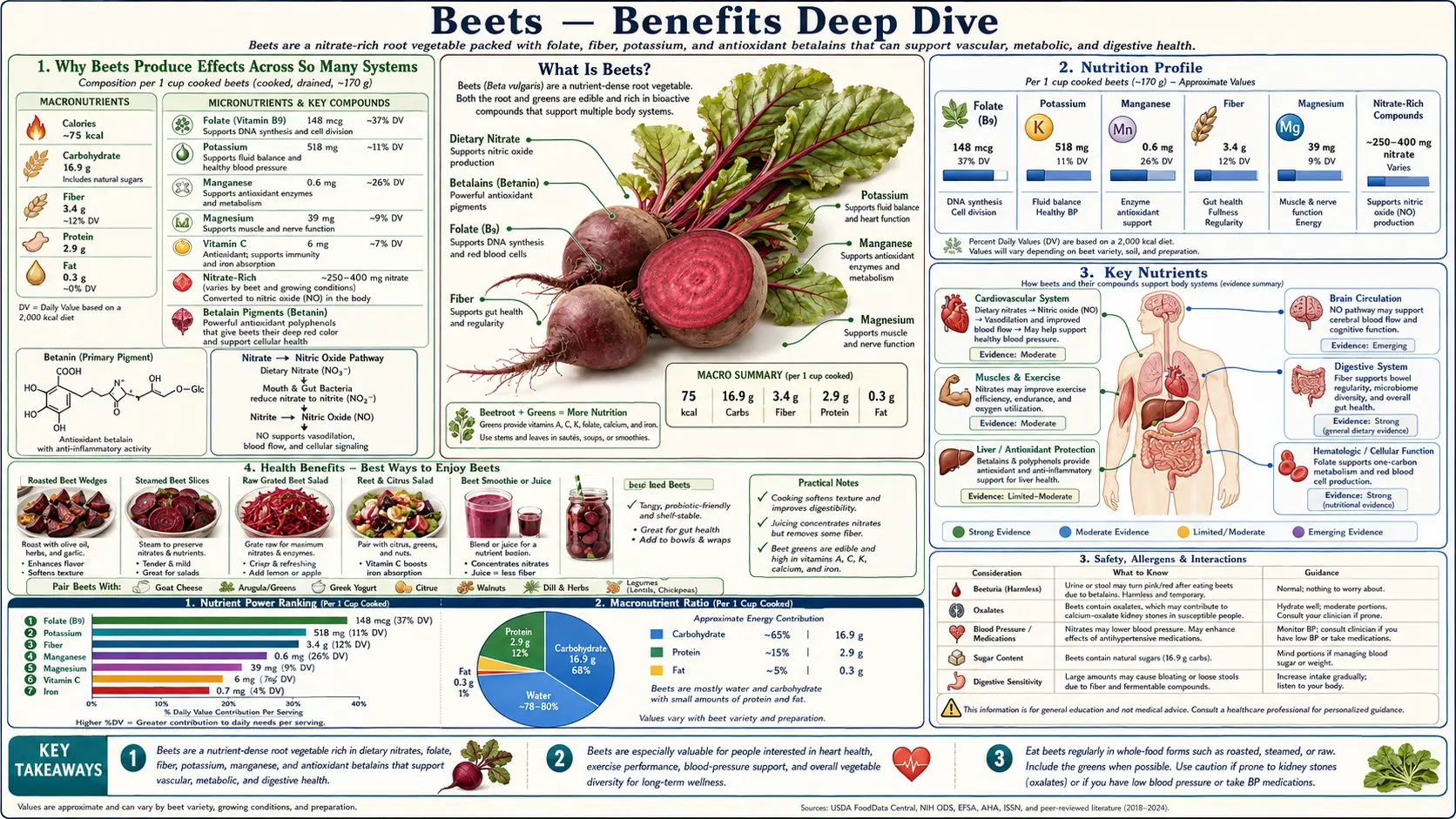
Beets (Beta vulgaris) are among the most concentrated dietary sources of inorganic nitrate (NO3−), which the human enterosalivary circulation converts to bioactive nitric oxide. They also contain a unique class of nitrogen-containing red-violet pigments — the betalains (betacyanins and betaxanthins) — that function as direct radical scavengers and induce phase 2 detoxification enzymes. Beets are uncommon among red-pigmented foods in that they contain no anthocyanins; the distinctive deep magenta color comes entirely from betanin. Four benefit pages below explore four well-studied areas, some resting on human trials and some mainly on cell and animal work: cardiovascular and blood-pressure lowering via the nitrate-nitrite-nitric-oxide pathway, hepatic phase 2 detoxification via betalain-driven Nrf2 activation, athletic endurance via mitochondrial efficiency gains from nitrate, and the betalain pigment chemistry that underlies the antioxidant and anti-inflammatory effects.
Deep-Dive Articles
Nitrates & Blood Pressure
The enterosalivary nitrate-nitrite-nitric-oxide pathway: dietary NO3− is concentrated by the salivary glands, reduced to NO2− by oral commensal bacteria, and reduced again to NO in the acidic stomach and hypoxic tissues. A 2013 meta-analysis of 16 crossover trials lasting 2 hours to 15 days found about 4.4 mm Hg lower systolic blood pressure at varying doses. A single 500 mL beetroot juice dose lowered blood pressure by up to 10.4/8 mm Hg about 3 hours later in healthy volunteers, and a 4-week trial found sustained benefit in people with hypertension. In that single-dose study, interrupting the saliva route that converts nitrate to nitrite blocked the blood-pressure drop — a demonstration that the body depends on mouth bacteria to activate the nutrient. Studies of antibacterial mouthwash itself are split.
Read the deep dive →Liver Phase 2 Support
Betalain pigments activate the Nrf2/Keap1 antioxidant response pathway, inducing transcription of phase 2 detoxification enzymes including glutathione S-transferase (GST), NAD(P)H quinone dehydrogenase 1 (NQO1), heme oxygenase-1 (HO-1), and the glutamate-cysteine ligase subunits that drive glutathione synthesis. Beet feeding raises hepatic glutathione and reduces markers of oxidative liver damage in animal models. Betaine (trimethylglycine) provides an additional methyl-donor pathway for homocysteine remethylation and protection against fatty liver.
Read the deep dive →Athletic Endurance
Beetroot juice has become one of the most-studied legal ergogenic aids in endurance sports. The mechanism is twofold: dietary nitrate lowers the oxygen cost of submaximal exercise (greater work per unit O2 consumed; a 2011 study found a better mitochondrial P/O ratio and reduced expression of ATP/ADP translocase, a protein involved in proton conductance) and increases blood flow to working muscle through NO-mediated vasodilation. Single trials report time-trial gains, such as 2.7–2.8% over 4 km and 16.1 km in nine club cyclists, but two meta-analyses found no significant pooled time-trial effect; time to exhaustion is where the pooled effect is significant. Effects are blunted in already-trained elite athletes whose baseline NO bioavailability is high.
Read the deep dive →Pigments & Antioxidants
The betalain pigments are nitrogen-containing alkaloid pigments (not phenolics), built around the chromophore betalamic acid. Betanin (the dominant betacyanin) has measured oxygen radical absorbance capacity (ORAC) values rivaling anthocyanins and donates electrons to neutralize peroxyl, hydroxyl, and peroxynitrite radicals. Betalains also inhibit lipid peroxidation and the NF-kB inflammatory cascade. The pigments are surprisingly bioavailable — intact betanin is detectable in human urine within 2 hours of beet ingestion, and beeturia (pink or red urine) is said to occur in about 10–14% of people. A 1993 study of 100 people did not find a clear split into two groups, and it reports that beeturia is more common with iron deficiency and malabsorption.
Read the deep dive →Table of Contents
- Deep-Dive Articles
- Why Beets Produce Effects Across So Many Systems
- Research Papers: Nitrate & Blood Pressure
- Research Papers: Liver Phase 2 & Detoxification
- Research Papers: Athletic Endurance
- Research Papers: Betalain Pigments & Antioxidants
- Research Papers: Cross-Cutting (Microbiome, Bioavailability, Safety)
- External Authoritative Resources
- Connections
- Featured Videos
Why Beets Produce Effects Across So Many Systems
Most foods produce their health effects through a single dominant phytochemical class. Beets are unusual in that they combine three distinct bioactive systems, each operating through a different mechanism. Human trials support the nitrate arm, while the betalain liver and pigment arm rests mainly on cell and rat work.
- Inorganic nitrate (NO3−) and the enterosalivary nitric-oxide pathway — beets are among the densest dietary sources of nitrate (typically 150–300 mg per 100 g fresh root, comparable to leafy greens like arugula and spinach). Dietary nitrate is the substrate for an entirely separate NO-generating pathway that runs parallel to the classical L-arginine / endothelial NO synthase route. It depends on oral commensal bacteria (chiefly Veillonella and Actinomyces species) to reduce nitrate to nitrite, after which mammalian enzymes including xanthine oxidoreductase, deoxyhemoglobin, and myoglobin further reduce nitrite to bioactive NO under hypoxic and acidic conditions. This drives the blood-pressure-lowering and vasodilatory effects and the mitochondrial-efficiency gains in endurance exercise.
- Betalain pigments (betacyanins and betaxanthins) — the deep magenta-violet color of red beets comes from betanin (a glucoside of betanidin), with smaller amounts of isobetanin, prebetanin, and the yellow-orange betaxanthins. Betalains are nitrogen-containing alkaloids built around the chromophore betalamic acid. They are a botanically unusual pigment class restricted to the order Caryophyllales (beets, chard, amaranth, prickly pear) and never co-occur with anthocyanins in the same plant. Betalains are direct radical scavengers and indirect Nrf2 activators, driving the antioxidant and anti-inflammatory effects and the induction of hepatic phase 2 detoxification enzymes.
- Betaine (trimethylglycine) and folate — beets are among the densest dietary sources of betaine (114–297 mg per 100 g), a methyl donor that supports the betaine-homocysteine methyltransferase (BHMT) pathway for converting homocysteine back to methionine. This provides a redundant remethylation pathway parallel to the folate / B12 / methionine synthase cycle and contributes to protection against fatty liver and cardiovascular risk from elevated homocysteine.
The therapeutic complication is that nitrate-to-NO conversion depends on the oral microbiome. In a 2015 trial of 15 treated hypertensive adults, 3 days of antibacterial mouthwash reduced mouth nitrate-to-nitrite conversion and raised systolic blood pressure by 2.3 mm Hg, with diastolic pressure unchanged and no beets given; the authors call this a small elevation. The question is unsettled: a 2026 scoping review of 9 studies found raised blood pressure in 5 and no significant link in 4, blamed differences in study design and methods, and stated that no firm conclusions can be drawn. Stomach acid may matter too: in a 15-person trial, the proton pump inhibitor esomeprazole blunted the blood-pressure drop from oral sodium nitrite, and the authors concluded that the effect requires an acidic stomach. That trial used nitrite rather than beets or H2 blockers, and the authors say future studies are needed on the nitrate pathway. Finally, oxalate is the concern for people with calcium-oxalate kidney stones, because oxalic acid promotes stone formation — beet greens are extremely high in oxalate (610 mg per 100 g), and a 2020 review gives 94.6–141.6 mg per 100 g for raw root and 300–525 mg per liter for juice.
What the human studies measured:
- Long-term blood pressure — 68 people with high blood pressure, half already on treatment, drank 250 mL of beet juice daily for 4 weeks. Clinic pressure fell 7.7/2.4 mm Hg compared with nitrate-free juice, with no sign of the effect fading.
- Artery function — in a 6-week trial of 69 people with untreated high cholesterol, flow-mediated dilation (a measure of how well arteries widen) rose 1.1%, about 24% from baseline, on nitrate-rich beet juice and worsened by 0.3% on placebo.
- Endurance — pooled time to exhaustion improved (effect size 0.33, 95% confidence interval 0.15–0.50, in a 2017 meta-analysis; 0.79, 0.23–1.35, in a 2013 one). Pooled time trials did not reach significance (0.11 and −0.10). The 2013 review saw benefits more often in inactive to recreationally active people and with several days of loading.
- Red urine — people who get red urine after beets do so more often with iron deficiency or poor absorption, and the 1993 study suggests stomach acid and emptying speed largely determine what happens to the pigment.
Research Papers: Nitrate & Blood Pressure
- Webb AJ et al. (2008). Acute blood pressure lowering, vasoprotective, and antiplatelet properties of dietary nitrate via bioconversion to nitrite. Hypertension — PubMed PMID: 18250365
- Kapil V et al. (2015). Dietary nitrate provides sustained blood pressure lowering in hypertensive patients: a randomized, phase 2, double-blind, placebo-controlled study. Hypertension — PubMed PMID: 25421976
- Siervo M et al. (2013). Inorganic nitrate and beetroot juice supplementation reduces blood pressure in adults: a systematic review and meta-analysis. Journal of Nutrition — PubMed PMID: 23596162
- Bondonno CP et al. (2015). Antibacterial mouthwash blunts oral nitrate reduction and increases blood pressure in treated hypertensive men and women. American Journal of Hypertension — PubMed PMID: 25359409
- Singh B, North P, Rushetsky ZM, Brito RC, Jenney FE (2026). The effect of antibacterial mouthwash on blood pressure in humans: a scoping review. BMC Cardiovascular Disorders — PubMed PMID: 42754848
- Montenegro MF, Sundqvist ML, Larsen FJ, et al. (2017). Blood Pressure-Lowering Effect of Orally Ingested Nitrite Is Abolished by a Proton Pump Inhibitor. Hypertension — PubMed PMID: 27802417
- Lundberg JO, Weitzberg E, Gladwin MT (2008). The nitrate-nitrite-nitric oxide pathway in physiology and therapeutics. Nature Reviews Drug Discovery — PubMed PMID: 18167491
- Hobbs DA et al. (2013). Acute ingestion of beetroot bread increases endothelium-independent vasodilation and lowers diastolic blood pressure in healthy men: a randomized controlled trial. Journal of Nutrition — PubMed PMID: 23884387
- Coles LT, Clifton PM (2012). Effect of beetroot juice on lowering blood pressure in free-living, disease-free adults: a randomized, placebo-controlled trial. Nutrition Journal — Search PubMed
- Velmurugan S et al. (2016). Dietary nitrate improves vascular function in patients with hypercholesterolemia. American Journal of Clinical Nutrition — PubMed PMID: 26607938
- Larsen FJ et al. (2006). Effects of dietary nitrate on blood pressure in healthy volunteers. New England Journal of Medicine — Search PubMed
Research Papers: Liver Phase 2 & Detoxification
- Krajka-Kuzniak V et al. (2013). Betanin, a beetroot component, induces nuclear factor erythroid-2-related factor 2-mediated expression of detoxifying/antioxidant enzymes in human liver cell lines. British Journal of Nutrition — PubMed PMID: 23769299
- Kathirvel E, Morgan K, Nandgiri G, et al. (2010). Betaine improves nonalcoholic fatty liver and associated hepatic insulin resistance: a potential mechanism for hepatoprotection by betaine. American Journal of Physiology — Gastrointestinal & Liver Physiology — PubMed PMID: 20724529
- Olumese FE, Oboh HA (2018). Hepatoprotective effect of beetroot juice on liver injury in male Sprague-Dawley rats. Annals of Tropical Pathology — doi:10.4103/atp.atp_34_17
- Esatbeyoglu T et al. (2015). Betanin — a food colorant with biological activity. Molecular Nutrition & Food Research — Search PubMed
- Lechner JF et al. (2010). Drinking water with red beetroot food color antagonizes esophageal carcinogenesis in N-nitrosomethylbenzylamine-treated rats. Journal of Medicinal Food — PubMed PMID: 20438319
Research Papers: Athletic Endurance
- Bailey SJ et al. (2009). Dietary nitrate supplementation reduces the O2 cost of low-intensity exercise and enhances tolerance to high-intensity exercise in humans. Journal of Applied Physiology. — PubMed PMID: 19661447
- Larsen FJ et al. (2011). Dietary inorganic nitrate improves mitochondrial efficiency in humans. Cell Metabolism. — PubMed PMID: 21284982
- Lansley KE et al. (2011). Acute dietary nitrate supplementation improves cycling time trial performance. Medicine & Science in Sports & Exercise. — PubMed PMID: 21471821
- Domínguez R et al. (2017). Effects of beetroot juice supplementation on cardiorespiratory endurance in athletes: a systematic review. Nutrients. — PubMed PMID: 28067808
- Jones AM (2014). Dietary nitrate supplementation and exercise performance. Sports Medicine. — PubMed PMID: 24791915
- Wylie LJ et al. (2013). Beetroot juice and exercise: pharmacodynamic and dose-response relationships. Journal of Applied Physiology. — Search PubMed
- Cermak NM, Gibala MJ, van Loon LJ (2012). Nitrate supplementation's improvement of 10-km time-trial performance in trained cyclists. International Journal of Sport Nutrition and Exercise Metabolism. — PubMed PMID: 22248502
- Hoon MW et al. (2013). The effect of nitrate supplementation on exercise performance in healthy individuals: a systematic review and meta-analysis. International Journal of Sport Nutrition and Exercise Metabolism. — PubMed PMID: 23580439
- McMahon NF, Leveritt MD, Pavey TG (2017). The effect of dietary nitrate supplementation on endurance exercise performance in healthy adults: a systematic review and meta-analysis. Sports Medicine. — PubMed PMID: 27600147
- Boorsma RK et al. (2014). Beetroot juice supplementation does not improve performance of elite 1500-m runners. Medicine & Science in Sports & Exercise. — Search PubMed
Research Papers: Betalain Pigments & Antioxidants
- Strack D, Vogt T, Schliemann W (2003). Recent advances in betalain research. Phytochemistry. — Search PubMed
- Kanner J, Harel S, Granit R (2001). Betalains — a new class of dietary cationized antioxidants. Journal of Agricultural and Food Chemistry. — Search PubMed
- Clifford T et al. (2015). The potential benefits of red beetroot supplementation in health and disease. Nutrients. — PubMed PMID: 25875121
- Tesoriere L, Allegra M, Butera D, Livrea MA (2004). Absorption, excretion, and distribution of dietary antioxidant betalains in LDLs: potential health effects of betalains in humans. American Journal of Clinical Nutrition. — PubMed PMID: 15447903
- Reddy MK, Alexander-Lindo RL, Nair MG (2005). Relative inhibition of lipid peroxidation, cyclooxygenase enzymes, and human tumor cell proliferation by natural food colors. Journal of Agricultural and Food Chemistry. — Search PubMed
- Allegra M, Furtmüller PG, Jantschko W, et al. (2005). Mechanism of interaction of betanin and indicaxanthin with human myeloperoxidase and hypochlorous acid. Biochemical & Biophysical Research Communications. — PubMed PMID: 15913556
- Vidal PJ, López-Nicolás JM, Gandía-Herrero F, García-Carmona F (2014). Inactivation of lipoxygenase and cyclooxygenase by natural betalains and semi-synthetic analogues. Food Chemistry. — PubMed PMID: 24518339
- Gandia-Herrero F, Escribano J, Garcia-Carmona F (2016). Biological activities of plant pigments betalains. Critical Reviews in Food Science and Nutrition. — Search PubMed
- Pavokovic D, Krsnik-Rasol M (2011). Complex biochemistry and biotechnological production of betalains. Food Technology and Biotechnology. PubMed: Pavokovic betalain biotechnology
- Khan MI (2016). Plant betalains: safety, antioxidant activity, clinical efficacy, and bioavailability. Comprehensive Reviews in Food Science and Food Safety. — Search PubMed
Research Papers: Cross-Cutting (Microbiome, Bioavailability, Safety)
- Hyde ER et al. (2014). Metagenomic analysis of nitrate-reducing bacteria in the oral cavity: implications for nitric oxide homeostasis. PLoS ONE. — Search PubMed
- Mitchell SC (2001). Food idiosyncrasies: beetroot and asparagus. Drug Metabolism and Disposition. — Search PubMed
- Hord NG, Tang Y, Bryan NS (2009). Food sources of nitrates and nitrites: the physiologic context for potential health benefits. American Journal of Clinical Nutrition. — PubMed PMID: 19439460
- Watts AR et al. (1993). Beeturia and the biological fate of beetroot pigments. Pharmacogenetics. — PubMed PMID: 8148871
- Massey LK, Roman-Smith H, Sutton RA (1993). Effect of dietary oxalate and calcium on urinary oxalate and risk of formation of calcium oxalate kidney stones. Journal of the American Dietetic Association. — Search PubMed
- Holscher HD (2017). Dietary fiber and prebiotics and the gastrointestinal microbiota. Gut Microbes. — PubMed PMID: 28165863
- Mirmiran P et al. (2020). Functional properties of beetroot (Beta vulgaris) in management of cardio-metabolic diseases. Nutrition & Metabolism. — PubMed PMID: 31921325
External Authoritative Resources
- Linus Pauling Institute — Carotenoids
- U.S. National Institutes of Health (NIH) Office of Dietary Supplements — Choline / Betaine Fact Sheet
- U.S. Department of Agriculture (USDA) FoodData Central — Beets, raw
- PubMed — Beetroot juice blood pressure research
- PubMed — Dietary nitrate and exercise performance