Yogurt — Bone Density and Calcium
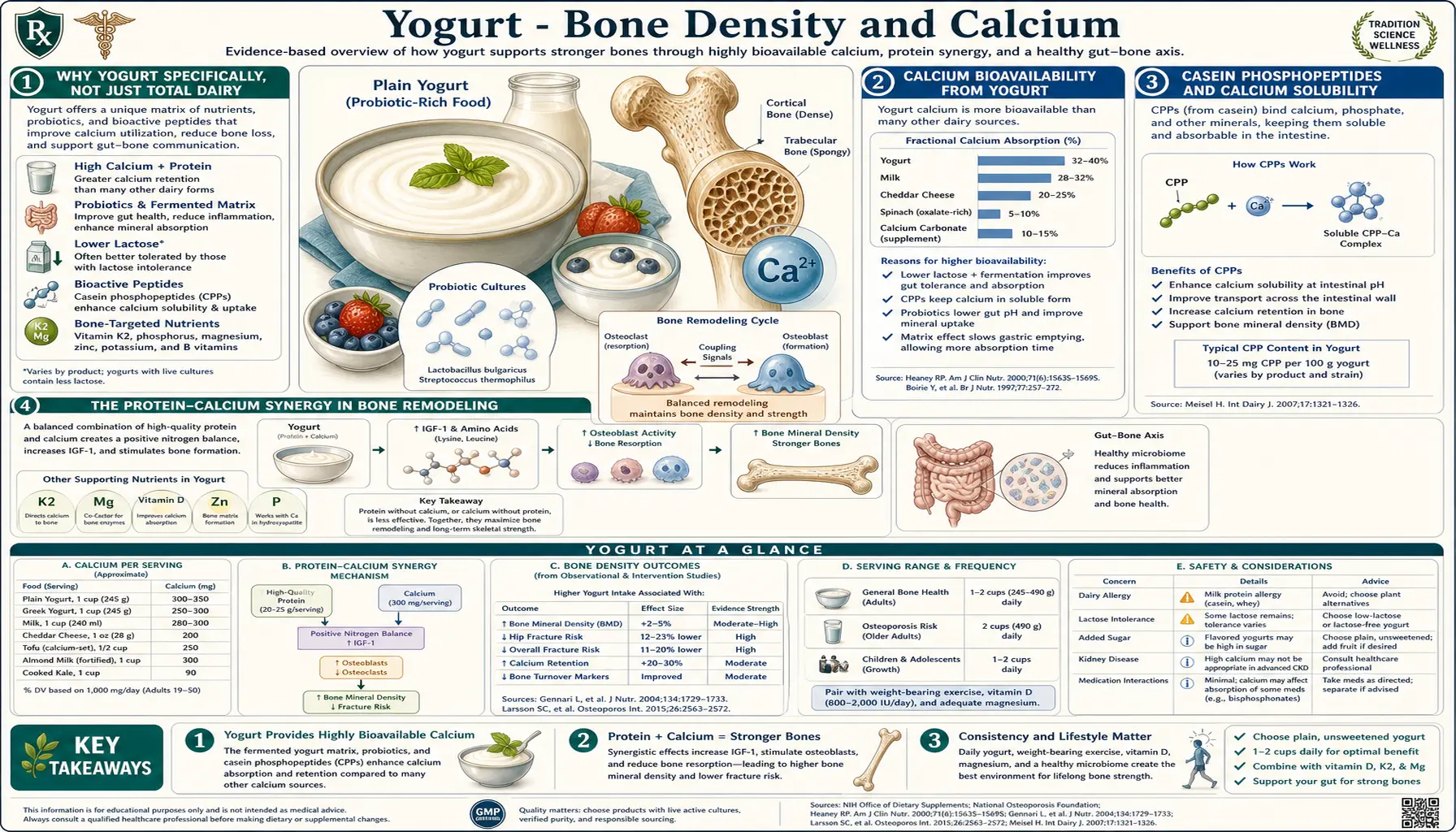
Yogurt supplies calcium and protein and, as a fermented food, vitamin K2 (menaquinones) made by bacteria. In the USDA FoodData Central SR Legacy data, 100 g of plain whole-milk yogurt contains 121 mg calcium and 3.47 g protein, and 100 g of plain whole-milk Greek yogurt contains 100 mg calcium and 9 g protein. In the Framingham Offspring Study, yogurt intake was associated with bone mineral density at the trochanter of the hip, and showed a weak protective trend for hip fracture that was not statistically significant, with 43 hip fractures in the cohort (Sahni 2013). A 2018 meta-analysis of cohort studies found a lower hip-fracture risk at the highest compared with the lowest intake of yogurt and of cheese, and no association for total dairy (Bian 2018). A 2021 cluster randomised trial in Australian aged-care residents found fewer fractures and falls when milk, yogurt and cheese were added to the menu (Iuliano 2021). This deep dive sets out the research on calcium, casein phosphopeptides, protein, vitamin K2 and vitamin D, and what the cohort studies and the trial report.
Table of Contents
- Yogurt Compared With Other Dairy Foods
- Calcium in Yogurt
- Casein Phosphopeptides and Calcium
- Dietary Protein, Calcium and Bone
- Bacterial Vitamin K2 (Menaquinones) in Fermented Dairy
- Vitamin D and Fortification
- The Framingham Hip-Fracture Data and Later Studies
- Adolescent Peak Bone Mass
- Research in Older Adults and Postmenopausal Women
- Cautions and Open Questions
- Key Research Papers
- Connections
- Featured Videos
Yogurt Compared With Other Dairy Foods
Studies of dairy foods and hip fracture have reported inconsistent findings (Bian 2018; Feskanich 2018). When individual dairy foods are analysed separately, the results differ from cohort to cohort:
- Framingham Offspring Study — in 3,212 participants (mean baseline age 55) followed for 12 years, milk and fluid dairy intake were associated with hip but not spine bone mineral density (BMD), and yogurt intake was associated with trochanter BMD alone. Cheese and cream were not associated with BMD, and cream tended to be negatively associated with femoral-neck BMD. No dairy group showed a statistically significant association with hip fracture (Sahni 2013).
- Framingham Original Cohort — in 830 adults with a mean age of 77, medium or high milk intake tended to be associated with a lower hip-fracture risk, an association that did not reach statistical significance; no significant associations were seen for yogurt, cheese or cream (Sahni 2014).
- 2018 meta-analysis — pooling 10 cohort and 8 case-control studies, the summary relative risks for hip fracture at the highest compared with the lowest intake in the cohort studies were 0.91 (95% CI 0.74-1.12) for milk, 0.75 (0.66-0.86) for yogurt, 0.68 (0.61-0.77) for cheese and 1.02 (0.93-1.12) for total dairy products (Bian 2018).
- Two US cohorts — in 80,600 postmenopausal women and 43,306 men over 50 followed for up to 32 years, each daily serving of milk was associated with an 8% lower hip-fracture risk (RR 0.92, 0.87-0.97) and each daily serving of total dairy with a 6% lower risk (RR 0.94, 0.90-0.98). Yogurt consumption was low and was not associated with risk; cheese showed a suggestive inverse association in women only (Feskanich 2018).
Fermented dairy also contains menaquinones made by fermentation cultures (Manoury 2013; Fu 2017) and casein phosphopeptides released during fermentation and digestion (Liu 2024); both are covered below. The cohort studies on this page did not test whether these explain the differences between dairy foods. The cohort findings are associations; the Framingham Offspring authors described their fracture results for milk and yogurt as suggestive and in need of further confirmation (Sahni 2013). The broader research on bone loss is covered on the Osteoporosis page.
Calcium in Yogurt
In the USDA FoodData Central SR Legacy data, 100 g of plain whole-milk yogurt (FDC 171284) contains 121 mg calcium, 3.47 g protein and 12 mg magnesium, and 100 g of plain whole-milk Greek yogurt (FDC 171304) contains 100 mg calcium, 9 g protein and 11 mg magnesium. In these entries the strained (Greek) yogurt has more protein but less calcium; the Greek vs Regular page sets out the full comparison. Under the US standard of identity, yogurt contains not less than 3.25% milkfat and has a pH of 4.6 or lower, measured on the finished product within 24 hours after filling (21 CFR 131.200).
How much calcium is retained depends on more than the amount eaten. A 1999 review lists salt, protein and caffeine among dietary constituents that decrease calcium retention. It also notes that some plants provide absorbable calcium, but that the quantity of vegetables required makes an exclusively plant-based diet impractical for reaching sufficient calcium for most people unless fortified foods or supplements are included (Weaver 1999). Protein is a special case: in a controlled feeding study, a high-protein diet raised intestinal calcium absorption as well as urinary calcium (Kerstetter 2005), as described in the protein section below.
Casein Phosphopeptides and Calcium
Casein phosphopeptides (CPP) are phosphoseryl-containing fragments of casein. They are released by enzymatic hydrolysis or by fermentation during the manufacture of milk products, and during intestinal digestion. A 2024 review collected 249 reported CPP derived from the four types of bovine casein (αs1, αs2, β and κ), described them as able to facilitate and enhance the bioavailability of calcium, and reviewed their structure-activity relationships and the in vitro and in vivo research on how they act in intestinal calcium absorption (Liu 2024).
A complex of casein phosphopeptide and amorphous calcium phosphate (CPP-ACP) is used in some dental products. A 2019 systematic review and meta-analysis of clinical and in vitro studies found significant remineralization effects on white spot lesions of tooth enamel with CPP-ACP compared with control or baseline (Ma 2019).
Dietary Protein, Calcium and Bone
High-protein diets increase urinary calcium. One long-standing hypothesis held that the acid load of a high-protein diet is partly buffered by bone, increasing skeletal resorption (Kerstetter 2005). The studies below tested protein and bone directly:
- Calcium kinetics — 13 healthy women ate a moderate-protein (1.0 g/kg) and a high-protein (2.1 g/kg) diet for 10 days each, in random order. Intestinal calcium absorption, measured with dual stable calcium isotopes, was 26.2% on the high-protein diet and 18.5% on the moderate-protein diet, and urinary calcium also rose. The fraction of urinary calcium of bone origin fell, and there was no effect on net bone balance; the authors concluded that, at least in the short term, high-protein diets are not detrimental to bone (Kerstetter 2005).
- Framingham Osteoporosis Study — in 391 women and 224 men with a mean age of 75, lower protein intake was associated with greater four-year bone loss at the femur and spine, and higher animal-protein intake did not appear to affect the skeleton adversely (Hannan 2000).
- Iowa women — in a cohort of women aged 55-69 with 44 incident hip fractures, hip-fracture risk was negatively associated with total protein intake, mainly animal protein; the relative risk in the highest compared with the lowest quartile of animal-protein intake was 0.31 (95% CI 0.10-0.93). Calcium and vitamin D intake were not related to risk in this cohort (Munger 1999).
- After hip fracture — in a randomised, double-blind trial in 82 patients (mean age 80.7), all of whom received 550 mg/day calcium and one 200,000 IU dose of vitamin D, 20 g/day of protein supplement for six months raised serum insulin-like growth factor-I more than placebo and reduced the loss of proximal femur BMD at 12 months (-2.29% compared with -4.71%); rehabilitation stays were shorter (Schürch 1998).
- 2018 expert consensus — summarising systematic reviews and meta-analyses, the authors reported that in older people with osteoporosis, protein intakes of at least 0.8 g/kg/day (above the current RDA) are associated with higher BMD, a slower rate of bone loss and a reduced risk of hip fracture, provided dietary calcium intakes are adequate. Protein supplements attenuated age-related BMD decrease, with a rise in IGF-I and a fall in parathyroid hormone. They found no evidence that diet-derived acid load is deleterious for bone, judged insufficient protein a possibly more severe problem than excess in the elderly, and called for long-term randomised trials on fracture risk (Rizzoli 2018).
Greek and regular yogurt differ on both nutrients. In the USDA whole-milk entries, Greek yogurt has 9 g protein and 100 mg calcium per 100 g, and plain yogurt has 3.47 g protein and 121 mg calcium (FDC 171304, 171284), so Greek yogurt supplies more protein but less calcium for the same weight. Leucine and muscle protein are covered on the Leucine page.
Bacterial Vitamin K2 (Menaquinones) in Fermented Dairy
Vitamin K is a cofactor in the production of blood coagulation factors in the liver, osteocalcin in bone, and matrix Gla protein in cartilage and the vessel wall (Schurgers 2007). Phylloquinone (vitamin K1) is the plant-based form; menaquinones (vitamin K2) are a class of vitamin K compounds that differ from phylloquinone in the length and saturation of their side chain, and are numbered MK-4 to MK-13 (Fu 2017). What the food measurements show:
- Fermented dairy products — in 62 samples, vitamin K2 contents ranged from undetectable to 1,100 ng/g of product, with a remarkable diversity of menaquinone forms. The major form was MK-9; MK-9 and MK-8 contents were correlated, MK-9 being around four times MK-8. No obvious link was found between MK-9 content and the fat content or pH of the products (Manoury 2013).
- US dairy foods — full-fat products contained appreciable menaquinones, primarily MK-9, MK-10 and MK-11, with modest amounts of phylloquinone, MK-4, MK-8 and MK-12, and little MK-5 to MK-7 or MK-13 in most products. Total vitamin K averaged 506 µg/100 g in soft cheese, 440 in blue cheese, 289 in semi-soft cheese and 282 in hard cheese, compared with 98 in processed cheese. Reduced-fat or fat-free products contained about 5-22% of the vitamin K of their full-fat equivalents: 38.1 µg/100 g in full-fat (4%) milk against 7.7 in nonfat milk (Fu 2017).
- MK-7 supplements — MK-7 is the form derived from natto. In healthy volunteers, natto-derived MK-7 and synthetic K1 were both absorbed well; MK-7 had a very long half-life, accumulated to 7- to 8-fold higher levels during prolonged intake, and induced more complete carboxylation of osteocalcin. The authors noted that preparations supplying 50 µg/day or more of MK-7 may interfere with oral anticoagulant treatment in a clinically relevant way (Schurgers 2007).
The large menaquinone cohorts measured heart outcomes, not bone outcomes. In the Rotterdam Study (4,807 adults), the middle and upper thirds of menaquinone intake had relative risks of coronary heart disease mortality of 0.73 (0.45-1.17) and 0.43 (0.24-0.77) compared with the lowest third, and menaquinone intake was also inversely related to all-cause mortality and severe aortic calcification; phylloquinone intake was not related to any outcome (Geleijnse 2004). In the Prospect-EPIC cohort of 16,057 Dutch women aged 49-70, followed for a mean of 8.1 years, the hazard ratio for incident coronary heart disease was 0.91 (0.85-1.00) per 10 µg/day of vitamin K2, mainly from MK-7, MK-8 and MK-9; vitamin K1 intake was not significantly related (Gast 2009). Vitamin K is covered on the Vitamin K2 page.
Vitamin D and Fortification
The Institute of Medicine committee that set the 2011 Dietary Reference Intakes concluded that a causal role of calcium and vitamin D in skeletal health provided the basis for its requirements. Assuming minimal sun exposure, it set the vitamin D RDA at 600 IU/day for ages 1-70 and 800 IU/day from 71, corresponding to serum 25-hydroxyvitamin D levels of 20 ng/mL (50 nmol/L) or more. Higher serum levels were not consistently associated with greater benefit, and for some outcomes U-shaped associations were observed, with risks at both low and high levels. The Tolerable Upper Intake Level for vitamin D ranges from 1,000 to 4,000 IU/day (Ross 2011).
Vitamin D is an optional ingredient in US yogurt. If it is added, the food must contain not less than 10% of the Daily Value per reference amount customarily consumed, and the label must state “vitamin D” or “vitamin D added” (21 CFR 131.200).
Vitamin D intake and serum 25-hydroxyvitamin D testing are covered on the Vitamin D3 and Vitamin D Test pages.
The Framingham Hip-Fracture Data and Later Studies
The Framingham Offspring analysis (Sahni 2013) included 3,212 participants who completed a food frequency questionnaire in 1991-1995 or 1995-1998 and were followed for hip fracture until 2007, a 12-year follow-up; 2,506 of them had DXA bone density measured in 1996-2001. Mean baseline age was 55 (range 26-85). Dairy foods were entered into the final models together, each adjusted for the others. The findings:
- Yogurt intake was associated with trochanter BMD alone, and remained positively associated with it in the final models.
- Yogurt intake showed a weak protective trend for hip fracture that was not statistically significant: hazard ratio 0.46 (95% CI 0.21-1.03) for up to four servings a week and 0.43 (0.06-3.27) for more than four servings a week.
- No other dairy group showed a significant association with hip fracture (hazard ratios 0.53-1.47). With 43 hip fractures in the cohort, statistical power was limited.
- Milk and fluid dairy intake were associated with hip but not spine BMD; cheese and cream were not associated with BMD.
- The authors concluded that the suggestive fracture results for milk and yogurt need further confirmation.
The Framingham Original Cohort analysis (Sahni 2014) followed 830 men and women with a mean baseline age of 77; 97 hip fractures occurred over a mean of 11.6 years. Mean yogurt intake was 0.4 servings a week. Medium or high milk intake was associated with a 40% lower hip-fracture risk compared with low intake, a result that did not reach statistical significance (p = 0.061), with a similar threshold for milk plus yogurt (p = 0.104). No significant associations were seen for other dairy foods, and the hypothesis was formulated after the data were collected.
Later research is mixed. The 2018 meta-analysis found lower hip-fracture risk with the highest yogurt and cheese intakes in cohort studies, but not with total dairy, and judged the evidence on milk insufficient (Bian 2018). In two large US cohorts, milk and total dairy were associated with lower hip-fracture risk, while yogurt intake was low and not associated with risk (Feskanich 2018). The one randomised trial on this page is the 2021 Australian aged-care trial: in 7,195 residents (mean age 86) of 60 facilities, who were replete in vitamin D, menus with additional milk, yogurt and cheese supplied an extra 562 mg/day calcium and 12 g/day protein, for totals of 1,142 mg calcium and 69 g protein (1.1 g/kg), compared with 700 mg and 58 g in the control facilities. Over two years the intervention was associated with risk reductions of 33% for all fractures (hazard ratio 0.67, 0.48-0.93), 46% for hip fractures (0.54, 0.35-0.83) and 11% for falls (0.89, 0.78-0.98); mortality was unchanged (Iuliano 2021). The trial tested the three dairy foods together, not yogurt alone.
Adolescent Peak Bone Mass
The National Osteoporosis Foundation's 2016 position statement, a systematic review of the literature since 2000, states that lifestyle choices influence 20-40% of adult peak bone mass. It graded the evidence as best (grade A) for positive effects of calcium intake and physical activity, especially during late childhood and the peripubertal years, which it describes as a critical period for bone accretion, and found good evidence for a role of vitamin D and dairy consumption (Weaver 2016). The 2011 Institute of Medicine RDAs for calcium range from 700 to 1,300 mg/day across life-stage groups aged 1 year and older, and the Tolerable Upper Intake Level from 1,000 to 3,000 mg/day (Ross 2011).
A 2008 meta-analysis of dairy and calcium supplementation in children pooled 21 randomised controlled trials and found a non-significant 2 g increase in total-body bone mineral content overall. Among children with normal or near-normal baseline intakes, supplemental dairy or calcium showed little impact; pooling three reports in children with low baseline intakes gave a significant summary increase of 49 g. The authors concluded that increased dietary calcium or dairy products significantly increase total-body and lumbar-spine bone mineral content in children with low baseline intakes (Huncharek 2008).
In four nationally representative USDA surveys of 12,498 US adolescents aged 11-18, total milk consumption fell by 36% between 1965 and 1996, while soft-drink and non-citrus juice consumption rose, and calcium intakes remained below recommendations for girls (Cavadini 2000).
In a 21-day study, 17 African-American girls aged 11-15, 14 of whom had lactose maldigestion, ate a dairy-based diet averaging 1,200 mg calcium and 33 g lactose a day. Breath hydrogen fell significantly between the start and the end of the study and gastrointestinal symptoms were negligible; the authors concluded that lactose maldigestion did not result in lactose intolerance in this population on a dairy-rich diet (Pribila 2000).
Research in Older Adults and Postmenopausal Women
The sources on this page report the following for older adults:
- Dairy foods in aged care — adding milk, yogurt and cheese to residential aged-care menus was associated with fewer fractures, hip fractures and falls over two years (Iuliano 2021).
- Calcium intervention studies — a 2000 review of 139 papers found that all but two of 52 investigator-controlled calcium intervention studies showed better bone balance at high intakes, greater bone gain during growth, reduced bone loss in the elderly or reduced fracture risk. Six of them used dairy sources of calcium, and all six were positive. All studies that evaluated the question reported that high calcium intakes augmented the osteoprotective effect of estrogen (Heaney 2000).
- Protein — higher protein intakes (at least 0.8 g/kg/day) are associated with higher BMD, slower bone loss and lower hip-fracture risk in older people, provided calcium intake is adequate (Rizzoli 2018); the aged-care trial raised protein intake to 1.1 g/kg/day (Iuliano 2021).
- Vitamin D — the 2011 RDA is 800 IU/day from age 71 (Ross 2011); residents in the aged-care trial were replete in vitamin D (Iuliano 2021).
- Vitamin K2 supplements — MK-7 preparations supplying 50 µg/day or more may interfere with oral anticoagulant treatment (Schurgers 2007).
Questions about combining calcium-rich foods or supplements with osteoporosis medicines, including the timing of oral bisphosphonates, belong with a clinician or pharmacist. The broader research is covered on the Osteoporosis page.
Cautions and Open Questions
- Protein and calcium retention — a 1999 review lists protein, with salt and caffeine, among dietary constituents that decrease calcium retention (Weaver 1999). The 2018 consensus found no evidence that diet-derived acid load is deleterious for bone, and the benefits it describes for higher protein intakes apply provided calcium intakes are adequate (Rizzoli 2018).
- Calcium supplements compared with food calcium — a 2010 meta-analysis of placebo-controlled trials found that calcium supplements given without vitamin D were associated with an increased risk of myocardial infarction (hazard ratio 1.31, 95% CI 1.02-1.67, in the patient-level data; pooled relative risk 1.27, 1.01-1.59, in the trial-level data) (Bolland 2010). A 2014 review describes calcium supplementation as linked to both increased and decreased cardiovascular risk, with conclusions hampered by poor compliance and study-design flaws, and states that the RDAs still appear to be a good target, with potential risks if intakes fall too short or greatly exceed them (Weaver 2014).
- Sweetened yogurt — a US yogurt with an added nutritive carbohydrate sweetener and no characterizing flavor must carry the word “sweetened” with its name (21 CFR 131.200). The USDA figures on this page are for plain whole-milk yogurt.
- Milkfat — the US standard sets yogurt at not less than 3.25% milkfat; a yogurt with 2.44% to under 3.25% milkfat must state its milkfat content, and below 2.44% the product is treated as a modified food (21 CFR 131.200). In US dairy foods, reduced-fat or fat-free products contained about 5-22% of the vitamin K of their full-fat equivalents (Fu 2017).
- Acid whey — straining Greek yogurt leaves acid whey, a by-product described as an environmental challenge. A 2022 study cites a report of 2-3 kg of acid whey for every 1 kg of Greek strained yogurt; in its own experiment the quantity ranged from 1.8 to 2.75 kg per kg, and straining 24 hours after incubation rather than immediately produced about 11% less acid whey (Karastamatis 2022).
- Lactose intolerance — lactose digestion and yogurt are covered on the Lactose Tolerance page; in the adolescent feeding study above, a dairy-rich diet was well tolerated by girls with lactose maldigestion (Pribila 2000).
- Cow's milk protein allergy — a different condition from lactose intolerance. Yogurt is made from dairy ingredients (21 CFR 131.200), and its proteins include casein (Liu 2024). Decisions about dairy foods in a milk allergy belong with a clinician.
Key Research Papers
- Sahni S, Tucker KL, Kiel DP, Quach L, Casey VA, Hannan MT (2013). Milk and yogurt consumption are linked with higher bone mineral density but not with hip fracture: the Framingham Offspring Study. Archives of Osteoporosis 8:119 — PubMed PMID: 23371478
- Sahni S, Mangano KM, Tucker KL, Kiel DP, Casey VA, Hannan MT (2014). Protective association of milk intake on the risk of hip fracture: results from the Framingham Original Cohort. Journal of Bone and Mineral Research 29(8):1756-62 — PubMed PMID: 24760749
- Kerstetter JE, O'Brien KO, Caseria DM, Wall DE, Insogna KL (2005). The impact of dietary protein on calcium absorption and kinetic measures of bone turnover in women. Journal of Clinical Endocrinology & Metabolism 90(1):26-31 — PubMed PMID: 15546911
- Heaney RP (2000). Calcium, dairy products and osteoporosis. Journal of the American College of Nutrition 19(2 Suppl):83S-99S — PubMed PMID: 10759135
- Weaver CM (2014). Calcium supplementation: is protecting against osteoporosis counter to protecting against cardiovascular disease? Current Osteoporosis Reports 12(2):211-8 — PubMed PMID: 24671370
- Gast GC, de Roos NM, Sluijs I, et al. (2009). A high menaquinone intake reduces the incidence of coronary heart disease. Nutrition, Metabolism & Cardiovascular Diseases 19(7):504-10 — PubMed PMID: 19179058
- Cavadini C, Siega-Riz AM, Popkin BM (2000). US adolescent food intake trends from 1965 to 1996. Archives of Disease in Childhood 83(1):18-24 — PubMed PMID: 10868993
- Schürch MA, Rizzoli R, Slosman D, Vadas L, Vergnaud P, Bonjour JP (1998). Protein supplements increase serum insulin-like growth factor-I levels and attenuate proximal femur bone loss in patients with recent hip fracture. A randomized, double-blind, placebo-controlled trial. Annals of Internal Medicine 128(10):801-9 — PubMed PMID: 9599191
- Pribila BA, Hertzler SR, Martin BR, Weaver CM, Savaiano DA (2000). Improved lactose digestion and intolerance among African-American adolescent girls fed a dairy-rich diet. Journal of the American Dietetic Association 100(5):524-8 — PubMed PMID: 10812376
- Rizzoli R, Biver E, Bonjour JP, et al. (2018). Benefits and safety of dietary protein for bone health — an expert consensus paper endorsed by the European Society for Clinical and Economical Aspects of Osteopororosis, Osteoarthritis, and Musculoskeletal Diseases and by the International Osteoporosis Foundation. Osteoporosis International 29(9):1933-1948 — PubMed PMID: 29740667
- Iuliano S, Poon S, Robbins J, et al. (2021). Effect of dietary sources of calcium and protein on hip fractures and falls in older adults in residential care: cluster randomised controlled trial. BMJ 375:n2364 — PubMed PMID: 34670754
- FitzGerald RJ, Murray BA, Walsh DJ (2004). Hypotensive peptides from milk proteins. Journal of Nutrition 134(4):980S-8S — PubMed PMID: 15051858
- Bian S, Hu J, Zhang K, Wang Y, Yu M, Ma J (2018). Dairy product consumption and risk of hip fracture: a systematic review and meta-analysis. BMC Public Health 18(1):165 — PubMed PMID: 29357845
- Feskanich D, Meyer HE, Fung TT, Bischoff-Ferrari HA, Willett WC (2018). Milk and other dairy foods and risk of hip fracture in men and women. Osteoporosis International 29(2):385-396 — PubMed PMID: 29075804
- Hannan MT, Tucker KL, Dawson-Hughes B, Cupples LA, Felson DT, Kiel DP (2000). Effect of dietary protein on bone loss in elderly men and women: the Framingham Osteoporosis Study. Journal of Bone and Mineral Research 15(12):2504-12 — PubMed PMID: 11127216
- Munger RG, Cerhan JR, Chiu BC (1999). Prospective study of dietary protein intake and risk of hip fracture in postmenopausal women. American Journal of Clinical Nutrition 69(1):147-52 — PubMed PMID: 9925137
- Schurgers LJ, Teunissen KJ, Hamulyák K, Knapen MH, Vik H, Vermeer C (2007). Vitamin K-containing dietary supplements: comparison of synthetic vitamin K1 and natto-derived menaquinone-7. Blood 109(8):3279-83 — PubMed PMID: 17158229
- Geleijnse JM, Vermeer C, Grobbee DE, et al. (2004). Dietary intake of menaquinone is associated with a reduced risk of coronary heart disease: the Rotterdam Study. Journal of Nutrition 134(11):3100-5 — PubMed PMID: 15514282
- Manoury E, Jourdon K, Boyaval P, Fourcassié P (2013). Quantitative measurement of vitamin K2 (menaquinones) in various fermented dairy products using a reliable high-performance liquid chromatography method. Journal of Dairy Science 96(3):1335-46 — PubMed PMID: 23332840
- Fu X, Harshman SG, Shen X, Haytowitz DB, Karl JP, Wolfe BE, Booth SL (2017). Multiple vitamin K forms exist in dairy foods. Current Developments in Nutrition 1(6):e000638 — PubMed PMID: 29955705
- Weaver CM, Gordon CM, Janz KF, et al. (2016). The National Osteoporosis Foundation's position statement on peak bone mass development and lifestyle factors: a systematic review and implementation recommendations. Osteoporosis International 27(4):1281-1386 — PubMed PMID: 26856587
- Huncharek M, Muscat J, Kupelnick B (2008). Impact of dairy products and dietary calcium on bone-mineral content in children: results of a meta-analysis. Bone 43(2):312-321 — PubMed PMID: 18539555
- Liu G, Guo B, Luo M, et al. (2024). A comprehensive review on preparation, structure-activities relationship, and calcium bioavailability of casein phosphopeptides. Critical Reviews in Food Science and Nutrition 64(4):996-1014 — PubMed PMID: 36052610
- Ma X, Lin X, Zhong T, Xie F (2019). Evaluation of the efficacy of casein phosphopeptide-amorphous calcium phosphate on remineralization of white spot lesions in vitro and clinical research: a systematic review and meta-analysis. BMC Oral Health 19(1):295 — PubMed PMID: 31888600
- Ross AC, Manson JE, Abrams SA, et al. (2011). The 2011 Dietary Reference Intakes for Calcium and Vitamin D: what dietetics practitioners need to know. Journal of the American Dietetic Association 111(4):524-7 — PubMed PMID: 21443983
- Bolland MJ, Avenell A, Baron JA, Grey A, MacLennan GS, Gamble GD, Reid IR (2010). Effect of calcium supplements on risk of myocardial infarction and cardiovascular events: meta-analysis. BMJ 341:c3691 — PubMed PMID: 20671013
- Weaver CM, Proulx WR, Heaney R (1999). Choices for achieving adequate dietary calcium with a vegetarian diet. American Journal of Clinical Nutrition 70(3 Suppl):543S-548S — PubMed PMID: 10479229
- Karastamatis S, Zoidou E, Moatsou G, Moschopoulou E (2022). Effect of modified manufacturing conditions on the composition of Greek strained yogurt and the quantity and composition of generated acid whey. Foods 11(24):3953 — PubMed PMID: 36553693
- U.S. Food and Drug Administration. 21 CFR 131.200 — Yogurt (standard of identity) — eCFR: 21 CFR 131.200
- U.S. Department of Agriculture, Agricultural Research Service. FoodData Central, SR Legacy: Yogurt, plain, whole milk (FDC 171284); Yogurt, Greek, plain, whole milk (FDC 171304) — FoodData Central: FDC 171284, FDC 171304
PubMed Topic Searches
- PubMed: Yogurt and BMD/fracture
- PubMed: CPPs and calcium absorption
- PubMed: K2 in fermented dairy
- PubMed: Kerstetter protein/calcium
- PubMed: Adolescent peak bone mass
Editorial note (2026-10-14): this page was checked against the abstracts of the papers above. Earlier versions of entries 3 and 10 gave the years 2003 and 2014 (the papers are 2005 and 2018), and entry 7 (Cavadini 2000), a study of adolescent food-intake trends, had been cited for a bone-gain figure it does not report; it is now cited for its milk-consumption finding. Calcium-absorption percentages for yogurt, vegetables and supplement salts, and dosing figures, that could not be traced to a source were removed.