Yogurt — Greek vs Regular
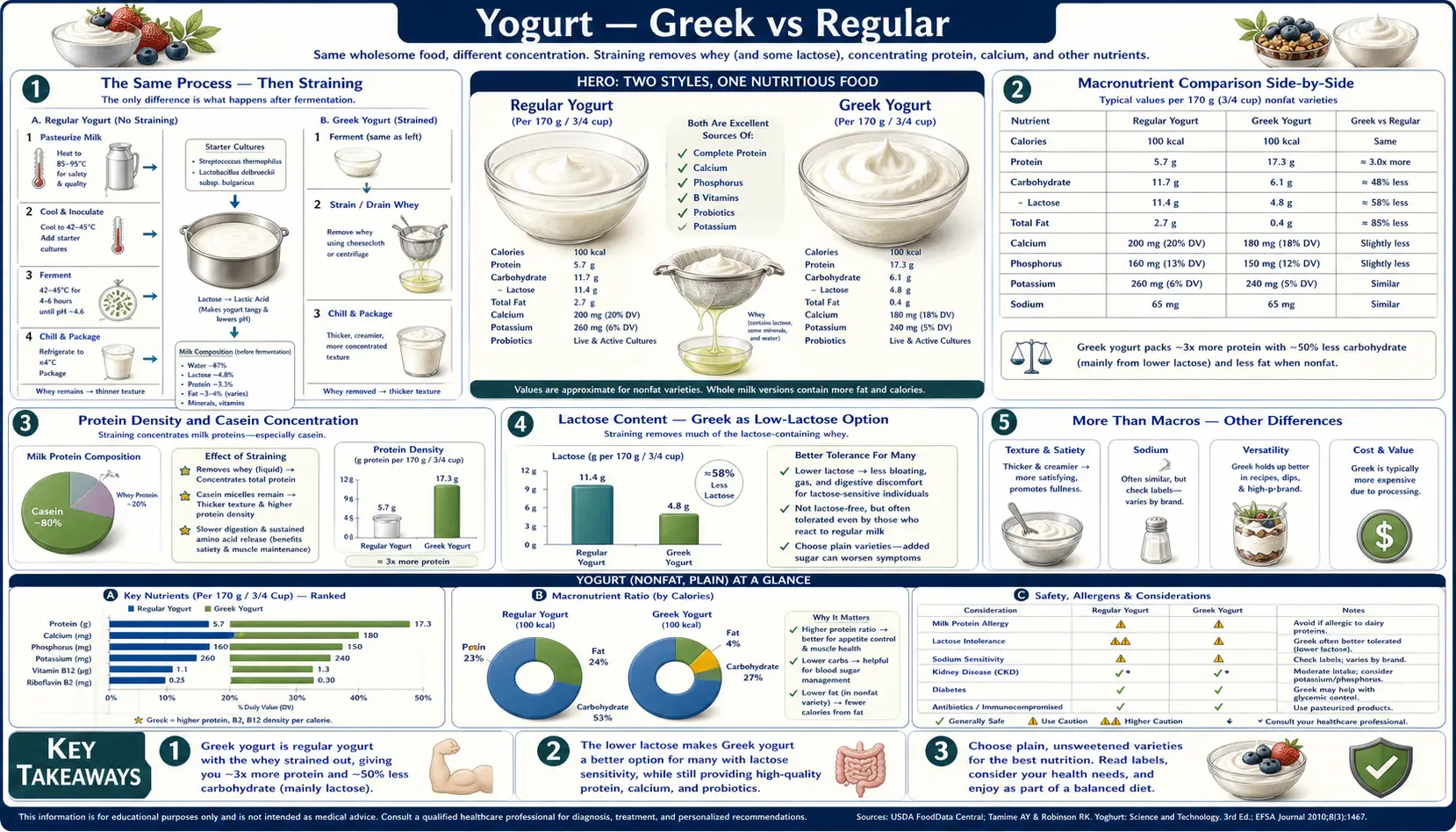
Greek yogurt, also called strained yogurt, is yogurt from which part of the liquid whey has been drained; as a result it has higher total solids and lower lactose than regular yogurt (Gyawali 2022). Some products sold as Greek yogurt are instead made by adding dried dairy ingredients (Desai 2013). This deep dive sets out how the two styles are made, what the USDA food composition data show for plain whole-milk and Greek yogurt, what is known about casein digestion, what the satiety trials of yogurt snacks tested and found, the acid whey left behind by straining, and how US rules treat milkfat and live cultures.
Table of Contents
- The Same Process — Then Straining
- The Nutrient Comparison per 100 g (USDA)
- Protein Density and Casein Digestion
- Lactose Content
- Calcium and Minerals in Straining
- Satiety Trials and the Protein Leverage Hypothesis
- Related Styles — Skyr and Fortified Greek-Style Yogurt
- Acid Whey
- Milkfat: What the US Standard Says
- Summary of the Findings
- Key Research Papers
- Connections
- Featured Videos
The Same Process — Then Straining
Under the US standard of identity (21 CFR 131.200), yogurt is made by culturing milk ingredients with a characterizing bacterial culture containing Lactobacillus delbrueckii subsp. bulgaricus and Streptococcus thermophilus. The dairy ingredients must be pasteurized or ultra-pasteurized before the culture is added, and the finished yogurt must have a pH of 4.6 or lower within 24 hours after filling.
Heating the milk denatures part of its whey proteins, which raises the water-holding capacity of the yogurt gel and so affects how much whey is later expelled (Karastamatis 2022). In a 2022 laboratory study of Greek strained yogurt, milk heated at 90 °C for 5 minutes was treated as the typical industrial condition, and incubation lasted about 4 hours (Karastamatis 2022).
Greek yogurt is then strained. Straining can be done by centrifugation, by filtration through membranes, or by filtration through a cloth bag, which is the traditional method (Karastamatis 2022). The liquid removed is acid whey. In the same study, acid whey from Greek strained yogurt is described as having a pH of 3.5–4.5 and containing 5–7% total solids, 0.03–0.38% fat, 3.37–4.99% lactose, 0.17–0.66% protein, 0.5–0.7% ash (minerals) and 0.6–1.40% lactic acid; the authors also measured calcium, potassium, magnesium and sodium in it, and the whey proteins alpha-lactalbumin and beta-lactoglobulin (Karastamatis 2022).
Draining the whey gives Greek yogurt higher total solids and lower lactose than regular yogurt (Gyawali 2022). Greek legislation requires the strained yogurt sold in Greece to contain at least 5.6% protein when made from cow's or goat's milk and 8% when made from sheep's milk (Karastamatis 2022). A 2013 study noted that no US standard of identity existed for Greek yogurt (Desai 2013).
Live cultures are discussed in the Probiotic Strains and Lactose Tolerance deep-dives. Under 21 CFR 131.200, any yogurt, strained or not, may state that it “contains live and active cultures” if it has at least 107 colony-forming units per gram at the time of manufacture, with a reasonable expectation of 106 CFU/g through its assigned shelf life.
The Nutrient Comparison per 100 g (USDA)
Values per 100 g from the USDA FoodData Central SR Legacy database. The whole-milk entries are the main comparison; the database's nonfat entries are listed after them because only the nonfat Greek entry reports lactose separately. USDA lists one 6-ounce container of plain whole-milk yogurt as 170 g.
- Yogurt, plain, whole milk (FDC 171284) — 61 kcal, 3.47 g protein, 3.25 g fat (2.096 g saturated), 4.66 g carbohydrate, 4.66 g total sugars, 121 mg calcium, 95 mg phosphorus, 155 mg potassium, 46 mg sodium, 0.142 mg riboflavin, 0.37 µg vitamin B12.
- Yogurt, Greek, plain, whole milk (FDC 171304) — 97 kcal, 9 g protein, 5 g fat (2.395 g saturated), 3.98 g carbohydrate, 4 g total sugars, 100 mg calcium, 135 mg phosphorus, 141 mg potassium, 35 mg sodium, 0.278 mg riboflavin, 0.75 µg vitamin B12.
- Yogurt, plain, skim milk (FDC 170887) — 56 kcal, 5.73 g protein, 0.18 g fat, 7.68 g carbohydrate, 7.68 g total sugars, 199 mg calcium, 255 mg potassium, 77 mg sodium.
- Yogurt, Greek, plain, nonfat (FDC 170894) — 59 kcal, 10.19 g protein, 0.39 g fat, 3.6 g carbohydrate, 3.24 g total sugars (2.54 g lactose, 0.7 g galactose), 110 mg calcium, 141 mg potassium, 36 mg sodium.
The patterns in these entries:
- Protein is higher in the Greek entries in both the whole-milk and the nonfat pair.
- Calcium, potassium and sodium are lower in the Greek entries in both pairs.
- Sugars differ little between the two whole-milk entries (4.66 g vs 4 g), and more between the two nonfat entries (7.68 g vs 3.24 g).
- Energy and fat are higher in the whole-milk Greek entry than in plain whole-milk yogurt (97 vs 61 kcal; 5 g vs 3.25 g fat).
The SR Legacy entries are averages; individual products differ, and flavored or sweetened yogurts carry added sugars that these plain entries do not.
Protein Density and Casein Digestion
Milk protein is made up of caseins and whey proteins. Caseins form coagula in the stomach, which makes their gastric emptying, and the rise in blood amino acids that follows a meal, notably slower than that of whey proteins; processing, including heat treatment in the presence of whey proteins and conversion to stirred yoghurt, affects how caseins coagulate in the stomach (Horstman 2023).
- Slow and fast proteins — when healthy adults ate a single meal of either casein or whey protein, whey produced a dramatic but short rise in plasma amino acids, while casein produced a prolonged plateau of moderate rise, probably because of slow gastric emptying. Whole-body protein breakdown was inhibited by 34% after casein but not after whey; protein synthesis was stimulated by 68% with whey and by 31% with casein, and net leucine balance over 7 hours was more positive with casein (Boirie 1997).
- Protein before sleep — in 16 healthy young men who did evening resistance exercise, a drink with 40 g of casein taken 30 minutes before sleep was digested and absorbed during the night, increased whole-body protein synthesis and improved net protein balance compared with a placebo drink; mixed muscle protein synthesis was about 22% higher, which reached borderline significance (P = 0.05) (Res 2012). The trial used a purified casein drink, not yogurt.
For more on protein quality and amino acid composition, see the Leucine page and the broader Amino Acids hub.
Lactose Content
Lactose is one of the main solids in acid whey (3.37–4.99%, Karastamatis 2022), and draining the whey gives Greek yogurt lower lactose than regular yogurt (Gyawali 2022). In the USDA SR Legacy data, the plain nonfat Greek entry reports 2.54 g lactose per 100 g; the whole-milk entries report total sugars only (4.66 g for plain whole-milk yogurt, 4 g for whole-milk Greek yogurt).
Yogurt with live cultures also carries its own lactase. In a 1984 breath-hydrogen study of nine lactase-deficient people, yogurt enhanced lactose digestion, and pasteurizing the yogurt eliminated that effect, reducing its lactase activity 10-fold and its cell counts 100-fold. Even so, all subjects fed pasteurized yogurt were free of symptoms, whereas eight of nine had gastrointestinal distress after cultured milk (buttermilk), although the amount of lactose malabsorbed was similar (Savaiano 1984). The Lactose Tolerance deep-dive covers the mechanism.
US rules allow yogurt to be treated after culturing to inactivate its microorganisms; such a product keeps the name “yogurt” but must carry the phrase “does not contain live and active cultures” (21 CFR 131.200).
Calcium and Minerals in Straining
Acid whey carries minerals out of the yogurt: it contains 0.5–0.7% ash, and calcium, potassium, magnesium and sodium were each measured in it; acid whey from yogurt strained 24 hours after incubation had less calcium than acid whey strained immediately (Karastamatis 2022).
In the USDA SR Legacy entries, calcium per 100 g is 121 mg in plain whole-milk yogurt and 100 mg in whole-milk Greek yogurt, and 199 mg in plain skim-milk yogurt and 110 mg in nonfat Greek yogurt. Potassium and sodium are also lower in both Greek entries, while phosphorus, riboflavin and vitamin B12 are higher in the whole-milk Greek entry than in plain whole-milk yogurt.
Products made as “fortified Greek” yogurt, by adding dried dairy ingredients rather than straining (Desai 2013), do not lose whey in this way; their composition depends on the ingredients added. See Bone Density and Calcium for yogurt and skeletal health.
Satiety Trials and the Protein Leverage Hypothesis
A group at the University of Missouri ran three small randomized crossover trials of 160-kcal afternoon yogurt snacks in healthy women, measuring hunger and fullness, the time until dinner was voluntarily requested, and how much was eaten at an ad libitum dinner:
- Douglas 2013 — 15 women (age 26 ± 2 years) ate yogurt snacks with 5, 14 or 24 g protein, or no snack, for 3 days. Snacking, whatever the protein content, reduced hunger and increased fullness compared with no snack. The 24 g protein snack, a Greek yogurt, led to lower hunger and higher fullness than the 5 g snack and to the latest dinner request (178 ± 7 min after the snack, against 152 ± 7 min for the 5 g snack and 158 ± 7 min for the 14 g snack). Dinner intake was lower after the yogurt snacks than after no snack, but the 160 kcal of the snacks was not fully compensated for at that meal.
- Ortinau 2013 — 32 women (age 27 ± 2 years) ate a 160-kcal Greek-style yogurt with 14 g protein or one with 5 g protein. There were no differences in hunger, fullness, the time to dinner request, or dinner intake (686 ± 33 vs 709 ± 34 kcal; p = 0.324). The authors concluded that the additional 9 g of protein was insufficient to improve markers of energy-intake regulation.
- Ortinau 2014 — 20 women (age 27 ± 2 years) compared a high-protein yogurt (14 g protein, 25 g carbohydrate, 0 g fat) with high-fat crackers and high-fat chocolate, each 160 kcal. The yogurt led to greater reductions in afternoon hunger than chocolate, with no differences in fullness; it delayed eating by about 30 minutes compared with chocolate (p < 0.01) and about 20 minutes compared with crackers (p = 0.07), and was followed by about 100 fewer kcal at dinner than chocolate (p < 0.05) and crackers (p = 0.08).
In a French study of 18 healthy young men, a liquid yogurt and chocolate bars matched for energy and weight were eaten as an afternoon snack. The yogurt produced lower hunger, appetite and desire to eat and higher fullness in the hour before dinner, but the time until dinner was requested was similar (165 and 174 minutes) and intake at dinner was not reduced (Chapelot 2010).
These trials measured single afternoons and the next meal. None of them measured total daily energy intake or body weight.
The protein leverage hypothesis, set out by Simpson and Raubenheimer in 2005, proposes that because protein makes up only about 15% of dietary energy and protein intake has stayed nearly constant across populations, the drive to reach a protein target could lead people to overeat total energy when their diet is diluted in protein, and perhaps to eat less when it is not; the authors presented some supporting epidemiological, experimental and animal data and predictions for future testing (Simpson 2005). A 2014 review of higher-protein diets for weight loss in athletes states that protein may have advantages with respect to satiety during energy balance (Phillips 2014).
In observational data from three US cohorts (120,877 women and men followed in 4-year periods), weight change was inversely associated with the intake of yogurt (−0.82 lb per 4-year period), as it was with vegetables, whole grains, fruits and nuts; the analysis did not distinguish Greek from regular yogurt (Mozaffarian 2011). In a cross-sectional study of 6,526 Framingham adults, yogurt consumers had better diet quality, lower circulating triglycerides and glucose, and lower systolic blood pressure and insulin resistance than non-consumers (Wang 2013).
Related Styles — Skyr and Fortified Greek-Style Yogurt
- Skyr — a high-protein dairy product containing mainly caseins; a 2023 laboratory digestion study compared a skyr with a whey-based fermented dairy product, both at 10% protein, under conditions modelled on young and older adults (Lavoisier 2023).
- Fortified Greek-style yogurt — in a 2013 sensory study of 24 commercial Greek yogurts, products made by adding dried dairy ingredients (“fortified Greek”) generally had more surface shine and jiggle and less denseness than traditional strained Greek yogurts, and some had a burnt or beefy flavor. Consumers knew Greek yogurts had more protein but were generally unaware of the difference between strained and fortified products, and both kinds received the highest overall liking scores in blinded testing (Desai 2013).
A 2022 review describes how ingredients, starter cultures and processing techniques affect the quality and sensory properties of Greek yogurt (Gyawali 2022).
Acid Whey
Acid whey production has increased with the growing demand for Greek yogurt and acid-coagulated cheeses, and it is a by-product for which the dairy industry has long struggled to find a sustainable use (Rocha-Mendoza 2021). It has been reported that 2–3 kg of acid whey is left behind for every 1 kg of Greek strained yogurt produced, which creates environmental challenges (Karastamatis 2022). A 2021 study described acid whey as having little commercial value because of its low protein content, and as environmentally harmful when disposed of as waste (Allen 2021). A 2025 review attributes its environmental and economic challenges to its high organic load and to disposal restrictions (Mutaliyeva 2025).
Uses described in the reviews:
- On-site ultrafiltration and biodigesters, which reduce transport costs and provide energy for the plant (Rocha-Mendoza 2021)
- A starting material for fermented beverages, a growth medium for lactic acid bacteria, and a source of lactose and minerals (Rocha-Mendoza 2021)
- Animal feed and bioenergy, alongside food and beverage products (Mutaliyeva 2025)
Production methods also affect the amount generated. In the 2022 laboratory study, straining 24 hours after incubation rather than immediately gave an 8% higher yield of strained yogurt and about 11% less acid whey, without significantly changing the yogurt's sensory properties (Karastamatis 2022). Unstrained yogurt does not produce acid whey.
Milkfat: What the US Standard Says
Under 21 CFR 131.200, yogurt contains not less than 3.25% milkfat and not less than 8.25% milk solids not fat. A yogurt with at least 2.44% but less than 3.25% milkfat must state its milkfat percentage next to the word “yogurt”; below 2.44% milkfat, the product is treated as a modified food under a separate section (21 CFR 130.10). Vitamin A and vitamin D are optional added ingredients; if added, each must reach at least 10% of the Daily Value per reference amount.
A 2013 study noted that the Dietary Guidelines for Americans then recommended increasing the intake of fat-free or low-fat milk and milk products (Wang 2013). The PURE investigators wrote that dietary guidelines recommend minimising whole-fat dairy as a source of saturated fat, and that evidence for this contention is sparse. In PURE, a cohort of 136,384 people aged 35–70 in 21 countries, eating more than one serving of yogurt a day, compared with none, was associated with a lower risk of the composite of death or major cardiovascular events (HR 0.86, 95% CI 0.75–0.99), and total dairy intake above two servings a day was associated with lower mortality and major cardiovascular disease (Dehghan 2018). These are observational associations.
In the 2013 sensory study, full-fat Greek yogurts were characterized by firmness and denseness, which the low- and non-fat yogurts lacked (Desai 2013).
For the related topic of saturated fat in dairy and cardiometabolic risk, see the Atherosclerosis page.
Summary of the Findings
- Composition — in the USDA whole-milk entries, Greek yogurt has more protein, energy and fat per 100 g, and less calcium, potassium and sodium, than plain yogurt; total sugars differ little between the two whole-milk entries.
- Lactose — straining removes lactose with the whey (Gyawali 2022); yogurt's own live-culture lactase improved lactose digestion in lactase-deficient people, and pasteurization removed that effect (Savaiano 1984).
- Satiety — in small single-day trials in healthy women, a 24 g protein Greek yogurt delayed the next meal more than lower-protein yogurts (Douglas 2013), a 14 g snack did not differ from a 5 g one (Ortinau 2013), and a high-protein yogurt was followed by about 100 fewer kcal at dinner than chocolate (Ortinau 2014). No trial cited here measured total daily intake or weight.
- Casein — casein is digested more slowly than whey (Boirie 1997; Horstman 2023); a casein drink before sleep increased overnight whole-body protein synthesis in young men (Res 2012).
- Live cultures — straining and live cultures are separate questions; the label statement “contains live and active cultures” has a set minimum count, and heat-treated yogurt must say it does not contain them (21 CFR 131.200).
- By-product — straining leaves acid whey, reported at 2–3 kg per kg of Greek yogurt (Karastamatis 2022).
Decisions about diet in a medical condition belong with a clinician.
Key Research Papers
- Desai NT, Shepard L, Drake MA (2013). Sensory properties and drivers of liking for Greek yogurts. Journal of Dairy Science 96(12):7454-66 — PubMed PMID: 24404579
- Ortinau LC, Hoertel HA, Douglas SM, Leidy HJ (2014). Effects of high-protein vs. high-fat snacks on appetite control, satiety, and eating initiation in healthy women. Nutrition Journal 13:97 — PubMed PMID: 25266206
- Boirie Y, Dangin M, Gachon P, Vasson MP, Maubois JL, Beaufrère B (1997). Slow and fast dietary proteins differently modulate postprandial protein accretion. PNAS 94(26):14930-5 — PubMed PMID: 9405716 (casein vs whey digestion kinetics)
- Res PT, Groen B, Pennings B, Beelen M, Wallis GA, Gijsen AP, Senden JM, van Loon LJ (2012). Protein ingestion before sleep improves postexercise overnight recovery. Medicine & Science in Sports & Exercise 44(8):1560-9 — PubMed PMID: 22330017
- Phillips SM (2014). A brief review of higher dietary protein diets in weight loss: a focus on athletes. Sports Medicine 44 Suppl 2:S149-53 — PubMed PMID: 25355188
- Mozaffarian D, Hao T, Rimm EB, Willett WC, Hu FB (2011). Changes in diet and lifestyle and long-term weight gain in women and men. NEJM 364(25):2392-404 — PubMed PMID: 21696306 (yogurt and weight gain)
- Dehghan M et al. (2018). Association of dairy intake with cardiovascular disease and mortality in 21 countries from five continents (PURE): a prospective cohort study. The Lancet 392(10161):2288-2297 — PubMed PMID: 30217460
- Stoyanova LG, Ustyugova EA, Netrusov AI (2012). Antibacterial metabolites of lactic acid bacteria: their diversity and properties. Prikladnaia Biokhimiia i Mikrobiologiia 48:259-75 (in Russian; English translation in Applied Biochemistry and Microbiology) — PubMed PMID: 22834296
- Wang H, Livingston KA, Fox CS, Meigs JB, Jacques PF (2013). Yogurt consumption is associated with better diet quality and metabolic profile in American men and women. Nutrition Research 33(1):18-26 — PubMed PMID: 23351406
- Douglas SM, Ortinau LC, Hoertel HA, Leidy HJ (2013). Low, moderate, or high protein yogurt snacks on appetite control and subsequent eating in healthy women. Appetite 60(1):117-122 — PubMed PMID: 23022602
- Ortinau LC, Culp JM, Hoertel HA, Douglas SM, Leidy HJ (2013). The effects of increased dietary protein yogurt snack in the afternoon on appetite control and eating initiation in healthy women. Nutrition Journal 12:71 — PubMed PMID: 23742659
- Chapelot D, Payen F (2010). Comparison of the effects of a liquid yogurt and chocolate bars on satiety: a multidimensional approach. British Journal of Nutrition 103(5):760-7 — PubMed PMID: 19874632
- Simpson SJ, Raubenheimer D (2005). Obesity: the protein leverage hypothesis. Obesity Reviews 6(2):133-42 — PubMed PMID: 15836464
- Horstman AMH, Huppertz T (2023). Milk proteins: Processing, gastric coagulation, amino acid availability and muscle protein synthesis. Critical Reviews in Food Science and Nutrition 63(30):10267-10282 — PubMed PMID: 35611879
- Savaiano DA, AbouElAnouar A, Smith DE, Levitt MD (1984). Lactose malabsorption from yogurt, pasteurized yogurt, sweet acidophilus milk, and cultured milk in lactase-deficient individuals. American Journal of Clinical Nutrition 40(6):1219-23 — PubMed PMID: 6439026
- Gyawali R, Feng X, Chen YP, Lorenzo JM, Ibrahim SA (2022). A review of factors influencing the quality and sensory evaluation techniques applied to Greek yogurt. Journal of Dairy Research 1-7 — PubMed PMID: 35466900
- Karastamatis S, Zoidou E, Moatsou G, Moschopoulou E (2022). Effect of modified manufacturing conditions on the composition of Greek strained yogurt and the quantity and composition of generated acid whey. Foods 11(24):3953 — PubMed PMID: 36553693
- Rocha-Mendoza D, Kosmerl E, Krentz A, Zhang L, Badiger S, Miyagusuku-Cruzado G, Mayta-Apaza A, Giusti M, Jiménez-Flores R, García-Cano I (2021). Invited review: Acid whey trends and health benefits. Journal of Dairy Science 104(2):1262-1275 — PubMed PMID: 33358165
- Allen MM, Pike OA, Kenealey JD, Dunn ML (2021). Metabolomics of acid whey derived from Greek yogurt. Journal of Dairy Science 104(11):11401-11412 — PubMed PMID: 34454763
- Mutaliyeva B, Turkeyeva E, Madybekova G, Živković L, Talluri VP, Issayeva A, Vinceković M (2025). Acid whey valorization: novel approaches for probiotic and functional products development. Frontiers in Nutrition 12:1630925 — PubMed PMID: 41049378
- Lavoisier A, Morzel M, Chevalier S, Henry G, Jardin J, Harel-Oger M, Garric G, Dupont D (2023). In vitro digestion of two protein-rich dairy products in the ageing gastrointestinal tract. Food & Function 14(20):9377-9390 — PubMed PMID: 37789767
- U.S. Food and Drug Administration. 21 CFR 131.200 — Yogurt (standard of identity) — eCFR: 21 CFR 131.200
- U.S. Department of Agriculture, Agricultural Research Service. FoodData Central, SR Legacy (April 2018): Yogurt, plain, whole milk (FDC 171284); Yogurt, Greek, plain, whole milk (FDC 171304); Yogurt, plain, skim milk (FDC 170887); Yogurt, Greek, plain, nonfat (FDC 170894) — FoodData Central: FDC 171284, FDC 171304, FDC 170887, FDC 170894
PubMed Topic Searches
- PubMed: Greek yogurt and satiety
- PubMed: Casein phosphopeptides and calcium
- PubMed: Icelandic Skyr
- PubMed: Protein leverage hypothesis
- PubMed: Full-fat dairy and CVD
- PubMed: Greek yogurt and diet patterns
- PubMed: Greek yogurt and weight management
- PubMed: Acid whey disposal
Editorial note (2026-10-14): three entries previously in this list could not be found in PubMed or Crossref — “Wang H et al. (2014), Greek yogurt consumption and dietary patterns of US adults”, “Erdman JK (2017), Greek yogurt and its impact on weight management: a systematic review” and “Erdmann CD et al. (2014), Acid whey: dispelling the myths”. They have been removed as citations; their PubMed search links are kept above.