⚠ Evidence warning: Clinical trials or other evidence do not support the claim that pork eaters in selenium-rich soil regions (US Great Plains, parts of Canada) have lower thyroid autoimmune rates. This page keeps it as a report of what people, websites or other media say.
Pork — Benefits Deep Dive
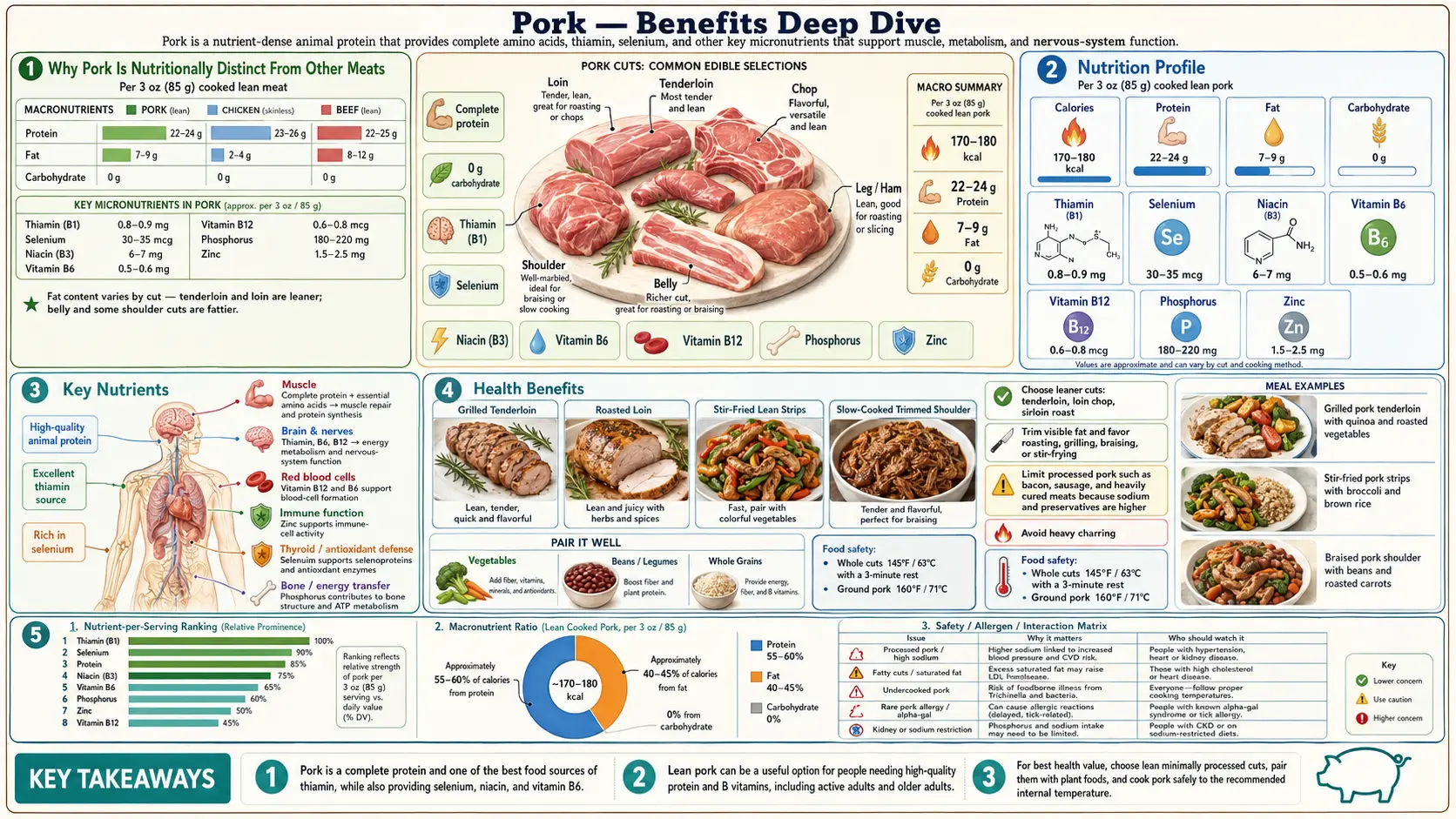
Pork is the most consumed meat on Earth, accounting for roughly 36% of global meat consumption. Beyond calories and protein, it is the richest source of thiamine (vitamin B1) among meats, a top-tier source of selenium, and — when sourced from pastured heritage breeds — a meaningful contributor of monounsaturated fat and the rendered cooking fat lard. The four deep-dive pages below examine the nutrient density that makes pork unique (thiamine, selenium, iodine), the production system that determines fat-soluble vitamin content (heritage vs. confinement), and the traditional rendering of leaf-lard back into a stable, vitamin-D-bearing cooking fat that the industrial era largely abandoned.
Deep-Dive Articles
Thiamine (B1) Density
Pork is the standout dietary source of thiamine, providing roughly 8× the thiamine per gram of beef or chicken. A 3-oz serving of pork loin delivers ~0.7 mg thiamine (~60% of the Recommended Dietary Allowance, RDA). The mechanism is rooted in the pig's skeletal muscle biochemistry, which depends heavily on thiamine-pyrophosphate-driven pyruvate dehydrogenase activity. Coverage of beriberi history, alcoholic neuropathy, and why polished-rice cultures pair pork dishes with rice for biochemical balance.
Read the deep dive →Selenium and Iodine
Pork delivers 30-50 mcg selenium per 3-oz serving (60-90% Recommended Dietary Allowance), incorporated as selenomethionine and selenocysteine into selenoproteins that drive thyroid hormone conversion (deiodinases) and glutathione peroxidase antioxidant activity. Iodine content depends on the soil iodine and feed iodine of the production region. Coverage of Keshan disease, Hashimoto's thyroiditis, and why pork eaters in selenium-rich soil regions (US Great Plains, parts of Canada) have lower thyroid autoimmune rates.
Read the deep dive →Heritage Breeds
Heritage breeds (Berkshire, Mangalitsa, Tamworth, Gloucestershire Old Spots, Red Wattle, Ossabaw) raised on pasture and forage produce fundamentally different meat than confinement-raised commodity pork. Higher monounsaturated fat (Mangalitsa lard is closer to olive oil than to commodity lard), measurable vitamin D content from sunlight exposure, higher omega-3, lower omega-6, deeper red color (myoglobin), and intramuscular fat marbling that the commodity industry bred out.
Read the deep dive →Lard Rendering
Rendered pork fat (lard) was the dominant cooking fat in the United States until the 1911 introduction of vegetable shortening and the subsequent demonization of saturated fat. Leaf lard (the kidney fat) is the highest grade, with a neutral flavor and high smoke point (~190 degrees C / 374 degrees F). U.S. Department of Agriculture (USDA) FoodData Central lists 2.5 micrograms (102 international units, IU) of vitamin D per 100 g of lard, and a US study found more vitamin D in the loin meat of pigs kept in sunlight than in pigs raised indoors. Step-by-step home rendering, wet vs. dry method, storage, and why lard makes the flakiest pie crust.
Read the deep dive →Table of Contents
- Deep-Dive Articles
- Why Pork Is Nutritionally Distinct From Other Meats
- Key Research Papers
- Research Papers: Thiamine and B-Vitamin Density
- Research Papers: Selenium, Iodine, and Trace Minerals
- Research Papers: Heritage Breeds and Production System
- Research Papers: Lard, Cooking Fats, and Vitamin D
- Research Papers: Safety, Trichinosis, and Modern Pork
- External Authoritative Resources
- Connections
- Featured Videos
Why Pork Is Nutritionally Distinct From Other Meats
Most discussions of red and white meat lump pork in with beef ("red meat") or with chicken ("the other white meat" — the National Pork Board's 1987 pork-industry checkoff advertising campaign). Both framings obscure what makes pork biochemically distinct from either category.
- Thiamine concentration is an order of magnitude higher than any other meat. A 3-oz serving of pork loin contains ~0.7 mg thiamine. The same serving of beef, chicken, or lamb contains 0.05-0.10 mg. USDA FoodData Central lists 1.02 mg thiamine per 100 g of roasted lean pork loin and 0.659 mg per 100 g of braised lean pork loin, so the cooking method changes the amount; it lists 0.08 mg per 100 g for broiled lean beef top sirloin and 0.07 mg per 100 g for roasted chicken breast. Pork is the richest thiamine source among meats but not among all foods: USDA lists 1.48 mg per 100 g for dried sunflower seed kernels. One proposed explanation, offered here without a published source and not an established finding, is metabolic: pig skeletal muscle relies more heavily on glycolytic metabolism than the muscle of grazing ruminants, and thiamine-pyrophosphate is the essential cofactor for pyruvate dehydrogenase at the pyruvate-to-acetyl-CoA junction. The pig stores thiamine in muscle tissue at concentrations no other commonly eaten land animal matches. This single fact explains why pork-rich cuisines (Cantonese, much of Eastern Europe) historically had lower beriberi rates than polished-rice cultures that ate primarily chicken or fish.
- Selenium content scales with soil selenium — and pigs concentrate it efficiently. Pigs raised on selenium-replete grain (Great Plains corn and soy) deliver 30-50 mcg selenium per 3-oz serving as bioavailable selenomethionine. Pigs raised in selenium-deficient soil regions (much of China, parts of New Zealand, Finland before national selenium fertilization) deliver dramatically less. This regional variation is a major driver of population selenium intake worldwide.
- The fat profile depends entirely on what the pig ate. Pigs are true omnivores with the most plastic fat composition of any livestock species. A confinement pig fed corn and soy produces lard that is approximately 40% saturated, 45% monounsaturated (mostly oleic), 12% polyunsaturated (mostly linoleic); USDA FoodData Central's entry for lard lists 39.2 g saturated, 45.1 g monounsaturated and 11.2 g polyunsaturated fat per 100 g. A Mangalitsa pig finished on acorns produces lard that is 55-60% monounsaturated, biochemically closer to olive oil than to commodity lard. The pig becomes what it eats more directly than any ruminant.
- Vitamin D in pork fat depends on sunlight exposure. Pigs produce vitamin D3 in their skin from ultraviolet B (UVB) light, just like humans, and store it in their fat. A pastured pig in summer sun produces lard with measurable vitamin D3; USDA FoodData Central lists 2.5 micrograms (102 international units) of vitamin D per 100 g of lard. A confinement pig that never sees sunlight produces lard with essentially zero vitamin D unless the feed is fortified. In a US study, finishing pigs kept in sunlight had more vitamin D in the loin meat than pigs raised indoors (0.997 vs 0.348 micrograms per 100 g, counting vitamin D3 plus its stored form, 25-hydroxyvitamin D); sunlight did not raise the vitamin D3 in the fat under the skin, though it did raise the stored form there (Larson-Meyer 2017). In a Danish study of minipigs with two animals per group, daily ultraviolet light equal to 10-20 minutes of midday sun raised vitamin D3 in fat tissue to 150-260 ng/g, more than in minipigs fed up to 60 micrograms of vitamin D3 a day (90-150 ng/g) (Burild 2015).
The implication is that the food-system question "what kind of pork should I eat" is more consequential than for any other meat. Beef quality varies meaningfully across grass-fed and grain-fed but the variation is modest. Pork quality variation across heritage-breed pasture-raised and commodity-confinement is enormous, spanning multiple nutritional dimensions simultaneously.
Key Research Papers
- Larson-Meyer DE, Ingold BC, Fensterseifer SR, Austin KJ, Wechsler PJ, Hollis BW, Makowski AJ, Alexander BM (2017). Sun exposure in pigs increases the vitamin D nutritional quality of pork. PLoS One 12(11):e0187877 — PubMed PMID: 29136033
- Burild A, Frandsen HL, Poulsen M, Jakobsen J (2015). Tissue content of vitamin D3 and 25-hydroxy vitamin D3 in minipigs after cutaneous synthesis, supplementation and deprivation of vitamin D3. Steroids 98:72-9 — PubMed PMID: 25725256
Research Papers: Thiamine and B-Vitamin Density
- Thiamine in pork muscle (topic search) — PubMed: Pork thiamine muscle
- Thiamine content and nutrient composition of pork (topic search) — PubMed: Pork thiamine composition
- Beriberi epidemiology and rice-polishing thiamine deficiency (historical) — PubMed: Beriberi epidemiology
- Wernicke encephalopathy and thiamine deficiency in alcoholism — PubMed: Wernicke encephalopathy
- Pyruvate dehydrogenase complex and thiamine pyrophosphate cofactor — PubMed: PDH and TPP
- Pork as a top dietary source of B vitamins (thiamine, niacin, B6, B12) — PubMed: Pork B vitamins
- Thiamine requirements and recommended dietary allowance (RDA) — PubMed: Thiamine RDA
- Diabetes and thiamine status — PubMed: Diabetes and thiamine
- Thiamine cooking losses in pork (boiling, frying, roasting) — PubMed: Cooking losses
- Thiamine and heart failure (Shoshin beriberi) — PubMed: Shoshin beriberi
Research Papers: Selenium, Iodine, and Trace Minerals
- Selenium content of pork and bioavailability (selenomethionine) — PubMed: Pork selenium
- Keshan disease and selenium deficiency in Chinese provinces — PubMed: Keshan disease
- Glutathione peroxidase and selenoproteins in human nutrition — PubMed: Selenoproteins
- Selenium and thyroid hormone conversion (T4 to T3 via deiodinases) — PubMed: Selenium deiodinase
- Selenium supplementation and Hashimoto's thyroiditis — PubMed: Selenium and Hashimoto's
- Iodine in pork products and feed iodine influence — PubMed: Iodine in pork
- Zinc bioavailability from pork and heme-iron content — PubMed: Zinc heme iron
- Selenium and prostate cancer (SELECT trial) — PubMed: SELECT trial
- Geographic variation in soil selenium and food selenium worldwide — PubMed: Soil selenium geography
- Selenium toxicity (selenosis) at chronic high intake — PubMed: Selenosis
Research Papers: Heritage Breeds and Production System
- Mangalitsa pig fat composition and monounsaturated fatty acid content — PubMed: Mangalitsa fat profile
- Iberico (acorn-finished) pork fat composition — PubMed: Iberico pork
- Pastured vs. confinement pork fatty acid profile comparison — PubMed: Pastured vs. confinement
- Heritage breed pork sensory evaluation (Berkshire, Tamworth, Duroc) — PubMed: Heritage breed sensory
- Outdoor-reared pig vitamin D content from UVB exposure — PubMed: Pig vitamin D UVB
- Conjugated linoleic acid (CLA) in pastured pork — PubMed: CLA in pastured pork
- Acorn-finishing and oleic acid in pork — PubMed: Acorn finishing
- Slow-growing pig breeds and intramuscular fat marbling — PubMed: Slow-growing breeds
- Pasture rotation pig farming and soil health — PubMed: Silvopasture pigs
- Welfare comparison of conventional and heritage pork production — PubMed: Welfare comparison
Research Papers: Lard, Cooking Fats, and Vitamin D
- Lard fatty acid composition (saturated, monounsaturated, polyunsaturated breakdown) — PubMed: Lard fatty acid profile
- Cooking fat smoke points and thermal stability comparison — PubMed: Smoke point comparison
- Hydrogenated vegetable shortening and trans fat (topic search) — PubMed: Shortening trans fat
- Vitamin D3 content in animal fat (pasture-raised) — PubMed: Vitamin D3 in animal fat
- Leaf lard vs. back fat composition — PubMed: Leaf vs. back fat
- Rendering methods (wet vs. dry) and fat oxidation — PubMed: Rendering methods
- Saturated fat and cardiovascular disease meta-analyses (topic search) — PubMed: Saturated fat reassessment
- Industrial seed oil linoleic acid and inflammation — PubMed: Seed oil linoleic
- Pie crust shortening and lard sensory evaluation — PubMed: Lard pastry
- Lard oxidative stability vs. polyunsaturated oils — PubMed: Lard oxidative stability
Research Papers: Safety, Trichinosis, and Modern Pork
- Trichinella spiralis epidemiology and US pork industry decline — PubMed: Trichinella decline
- USDA reduced pork cooking temperature recommendation (145 vs 160 degrees F) — PubMed: USDA cooking temp
- Hepatitis E virus in pork (zoonotic risk in raw/undercooked) — PubMed: Hepatitis E in pork
- Yersinia enterocolitica and pork — PubMed: Yersinia in pork
- Salmonella in pork production — PubMed: Salmonella in pork
- Ractopamine feed additive controversy and international bans — PubMed: Ractopamine
- Antibiotic use in pork production and resistance — PubMed: Pork antibiotic resistance
- Nitrate and nitrite in cured pork (bacon, ham) and N-nitrosamines — PubMed: Nitrites in cured pork
- Processed meat and colorectal cancer (IARC classification) — PubMed: IARC processed meat
- Religious dietary law and pork avoidance (Judaism, Islam) — PubMed: Pork religious dietary law
External Authoritative Resources
- U.S. Department of Agriculture FoodData Central — complete nutrient composition for every pork cut
- National Pork Board — the US pork-industry checkoff board; cut nomenclature and cooking guidelines
- Livestock Conservancy — Heritage Breeds — conservation status of heritage pig breeds
- U.S. Centers for Disease Control and Prevention (CDC) Trichinellosis page — epidemiology of modern trichinella risk in US pork
- PubMed — All research on pork nutrition