Lentils — Benefits Deep Dive
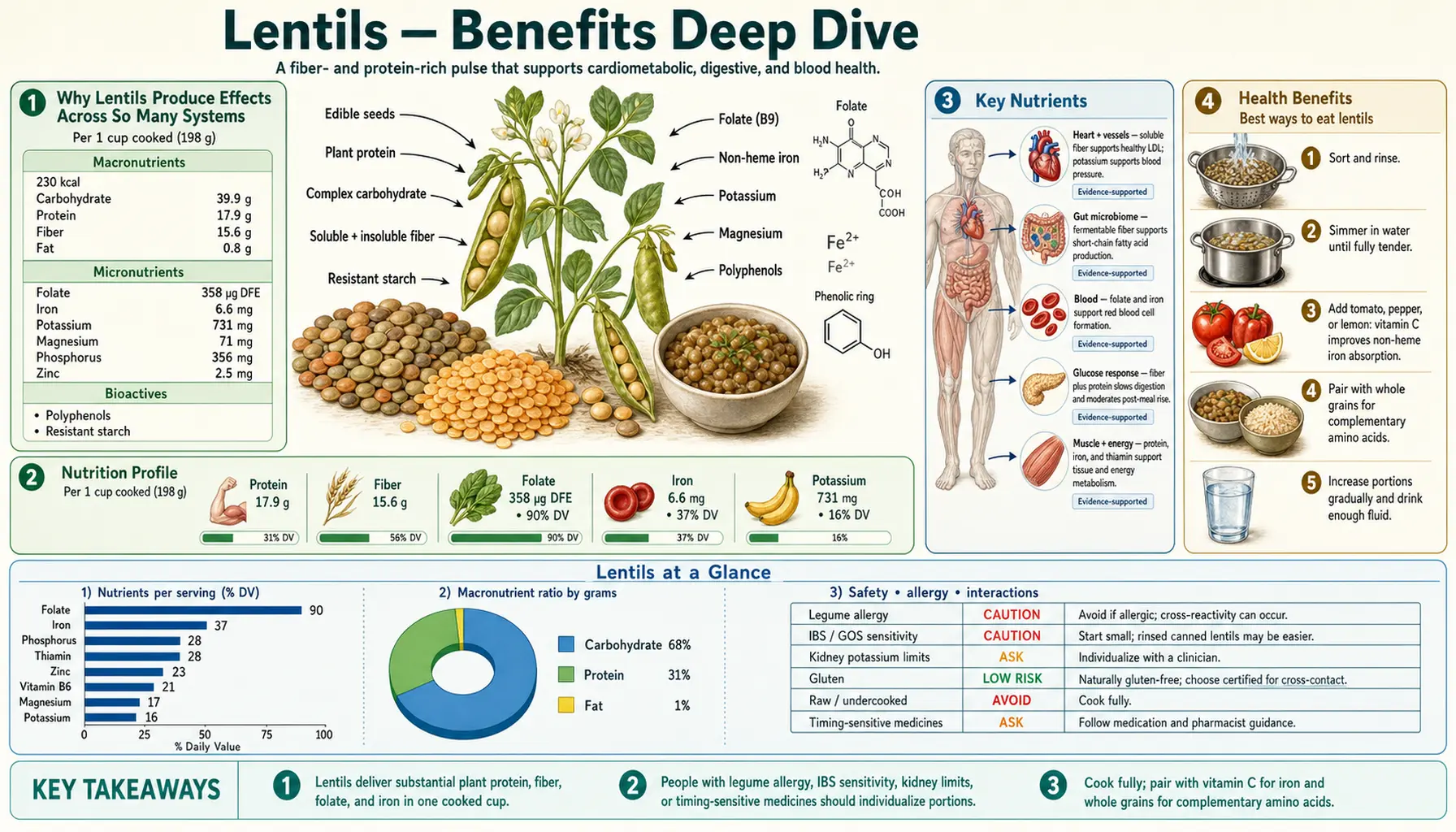
Lentils (Lens culinaris) are among the oldest cultivated foods on Earth — archaeobotanical evidence places them in the human diet since approximately 11,000 BCE in the Fertile Crescent. They are also among the most nutritionally dense legumes available, providing 18 grams of plant protein per cooked cup, 16 grams of total dietary fiber, 90% of the Recommended Dietary Allowance (RDA) for folate, and meaningful quantities of non-heme iron, magnesium, potassium, manganese, and several B vitamins — all for roughly 230 calories and zero saturated fat. Four benefit pages below explore the conditions where lentils produce the largest clinical effect: plant protein and iron absorption for vegetarians and vegan-adjacent eaters, soluble fiber for low-density lipoprotein (LDL) cholesterol reduction, folate for pregnancy and neural tube defect prevention, and the soaking-and-sprouting techniques that neutralize phytic acid antinutrients to maximize mineral bioavailability.
Deep-Dive Articles
Plant Protein & Iron
18 grams of complete-enough plant protein per cooked cup paired with 6.6 mg of non-heme iron (USDA: 3.33 mg per 100 g, 198 g per cup) — about 82% of the 8 mg Recommended Dietary Allowance for men and about 37% of the 18 mg Recommended Dietary Allowance for women aged 19-50. Why lentils-plus-rice is biochemically a complete protein, the lysine-methionine complementation rule, vitamin C as the factor reported to triple non-heme iron absorption, how calcium and polyphenols eaten in the same meal lower it, and how traditional vegetarian meals combine these foods.
Read the deep dive →Soluble Fiber & Cholesterol
A 1984 metabolic-ward trial by Anderson and colleagues (20 men with high cholesterol, 21 days) found that bean-supplemented diets lowered low-density lipoprotein cholesterol by 24%, and a 2014 pooled analysis of 26 randomized trials found that about one serving of pulses a day (median 130 g) lowered low-density lipoprotein cholesterol by 0.17 mmol/L. The proposed mechanisms are bile-acid sequestration by viscous fiber and short-chain fatty acid feedback inhibition of hepatic cholesterol synthesis. Comparison with the JUPITER and HOPE-3 statin trials, how the Portfolio Diet combines lentils with nuts and plant sterols, and the pulse amounts used in trials.
Read the deep dive →Folate & Pregnancy
Lentils as one of the densest natural food sources of folate (358 mcg DFE per cooked cup: about 60% of the 600 mcg DFE Recommended Dietary Allowance in pregnancy, and about 90% of the 400 mcg DFE adult Recommended Dietary Allowance, in a single serving), the MRC Vitamin Study that established preconceptional folic acid for neural tube defect prevention, the methylfolate / methylenetetrahydrofolate reductase (MTHFR) C677T story for women who cannot convert synthetic folic acid efficiently, and why combining lentils with leafy greens and citrus produces folate intake patterns superior to fortified processed foods.
Read the deep dive →Soaking & Phytates
The single most important food-preparation knowledge for any legume-heavy diet. Phytic acid (inositol hexaphosphate) binds zinc, iron, calcium, and magnesium in the gut and reduces their absorption by 30-50% when consumed at typical dietary loads. Overnight soaking degrades roughly 30% of phytates, germination/sprouting degrades 60-80%, and traditional sourdough-style fermentation degrades over 90%. The science of phytase enzyme activation, the contrasting "phytic acid as antioxidant" literature, and a practical kitchen protocol.
Read the deep dive →Table of Contents
- Deep-Dive Articles
- Why Lentils Produce Effects Across So Many Systems
- A 2026 Update Finds Similar Cholesterol Effects Across Pulse Types
- Research Papers: Plant Protein & Iron
- Research Papers: Soluble Fiber & Cholesterol
- Research Papers: Folate & Pregnancy
- Research Papers: Phytates, Soaking, and Bioavailability
- Research Papers: Cross-Cutting (Glycemic, Mortality, Microbiome)
- External Authoritative Resources
- Connections
- Featured Videos
Why Lentils Produce Effects Across So Many Systems
Most single foods influence one or two clinical endpoints. Lentils influence at least six because the legume packages, in a single 230-calorie cup, the substrate inputs for multiple distinct physiologic pathways. Each maps to a different category of measurable benefit in the clinical literature.
- Protein-amino-acid substrate — 18 g per cup is comparable on a per-calorie basis to lean ground beef. Lysine is abundant (about 7% of total protein: USDA lists 0.63 g of lysine in the 9.02 g of protein in 100 g of cooked lentils), while methionine and tryptophan are the limiting amino acids; pairing with grains (which are lysine-poor but methionine-rich) yields a complete amino acid profile. This is the mechanism behind the global rice-and-lentil dish patterns — Indian dal-chawal, Middle Eastern mujadara, Ethiopian misir wat over injera — that have sustained vegetarian populations for millennia. See Plant Protein and Iron for the lysine-methionine complementation chemistry and the non-heme iron absorption story that runs in parallel.
- Soluble fiber substrate — roughly 8 g of the 16 g total fiber per cup is soluble (viscous, gel-forming). Soluble fiber binds bile acids in the small intestine, forcing the liver to draw cholesterol out of low-density lipoprotein particles to synthesize replacement bile acids, the mechanism proposed for the low-density lipoprotein reductions documented in legume trials. In plain numbers: a 2014 pooled analysis of 26 randomized trials (1,037 people) found that diets with about one serving of pulses a day (median 130 g) lowered low-density lipoprotein cholesterol by 0.17 mmol/L compared with diets without pulses; the authors noted that longer, higher-quality trials are still needed (Ha 2014). See Soluble Fiber and Cholesterol.
- Insoluble fiber substrate — the other ~8 g acts as the bulk-forming, transit-accelerating fiber familiar from wheat bran. It increases stool weight, reduces transit time, and provides the substrate for colonic bacterial fermentation that produces short-chain fatty acids (butyrate, propionate, acetate). Butyrate is the dominant energy substrate for the colonocyte and the molecular signal that maintains tight junctions in the colonic epithelium.
- Folate (vitamin B9) substrate — 358 mcg DFE per cup, one of the densest natural sources outside organ meats. Folate is the methyl donor for one-carbon metabolism, DNA synthesis, and neural tube closure in early embryonic development. See Folate and Pregnancy.
- Slowly digested starch — lentils have a glycemic index of approximately 30, among the lowest of any starch-bearing food, because their amylose content is high and the starch granules are tightly packaged inside intact cellular walls that resist amylase. The result is a slow, sustained glucose release with minimal insulin spike, the mechanism proposed for the hemoglobin A1c (HbA1c) results in legume trials. The trials differ: in a 3-month trial of 121 people with type 2 diabetes, a low-glycemic-index diet with at least 1 cup of legumes a day lowered HbA1c by 0.5%, against 0.3% on a high wheat-fiber diet (Jenkins 2012), while a 1-year trial of 162 people with diet-managed type 2 diabetes found that a low-glycemic-index diet did not change HbA1c (Canadian Trial of Carbohydrates in Diabetes, Wolever 2008).
- Phytochemical content — polyphenols (especially in the seed coat of brown and black lentils), saponins, and resistant starch all contribute to the anti-inflammatory and gut-microbiome-modulating effects documented in observational and intervention studies.
The complication is that the same package also contains antinutrients — phytic acid, lectins, tannins, and oligosaccharides (raffinose, stachyose, the gas-producing carbohydrates that earn legumes their colloquial reputation). All can be substantially reduced by traditional preparation methods (soaking, sprouting, fermenting, pressure cooking), which is the focus of the fourth deep-dive page: Soaking and Phytates. How much the soaking and sprouting steps change things, compared with eating lentils "as-is", depends largely on whether the diet is genuinely legume-heavy (in which case the antinutrient load is larger and traditional preparation removes more of it) or occasional (in which case the antinutrient load is below the threshold for significant mineral depletion).
A 2026 Update Finds Similar Cholesterol Effects Across Pulse Types
A 2026 updated review in the Journal of the American Heart Association pooled 38 randomized trials (52 trial comparisons, 2,095 people) that lasted a median of 6 weeks and used a median of about 130 g of cooked pulses a day (about half to two-thirds of a cup). Whole pulses lowered low-density lipoprotein (LDL) cholesterol by 0.14 mmol/L, non-high-density lipoprotein (non-HDL) cholesterol by 0.22 mmol/L and apolipoprotein B by 0.08 g/L, and lowered HDL cholesterol slightly (by 0.03 mmol/L), with no effect on other blood fats. Results were similar across pulse types. For beans, the fall in LDL cholesterol grew with the amount eaten, up to 1 cup a day. The authors rated the certainty of the evidence moderate to high for every outcome except apolipoprotein B (very low), and wrote that more studies of chickpeas, dried peas and lentils specifically are still needed (Back 2026).
Research Papers: Plant Protein & Iron
- Young VR, Pellett PL (1994). Plant proteins in relation to human protein and amino acid nutrition. American Journal of Clinical Nutrition. — PubMed
- Hurrell R, Egli I (2010). Iron bioavailability and dietary reference values. American Journal of Clinical Nutrition. — PubMed
- Cook JD, Reddy MB (2001). Effect of ascorbic acid intake on nonheme-iron absorption from a complete diet. American Journal of Clinical Nutrition. — PubMed
- Petry N et al. (2010). Polyphenols and phytic acid contribute to the low iron bioavailability from common beans in young women. Journal of Nutrition. — PubMed
- Pawlak R, Lester SE, Babatunde T (2014). The prevalence of cobalamin deficiency among vegetarians assessed by serum vitamin B12. European Journal of Clinical Nutrition. — PubMed
- Sandberg AS (2002). Bioavailability of minerals in legumes. British Journal of Nutrition. — PubMed
- Haider LM et al. (2018). The effect of vegetarian diets on iron status in adults: A systematic review and meta-analysis. Critical Reviews in Food Science and Nutrition. — PubMed
- FAO/WHO/UNU Expert Consultation (2007). Protein and amino acid requirements in human nutrition. — PubMed
- Boye J, Wijesinha-Bettoni R, Burlingame B (2012). Protein quality evaluation twenty years after the introduction of the protein digestibility corrected amino acid score method. British Journal of Nutrition. — PubMed
- Mariotti F (2019). Animal and plant protein sources and cardiometabolic health. Advances in Nutrition. — PubMed
Research Papers: Soluble Fiber & Cholesterol
- Anderson JW, Story L, Sieling B, Chen WJ, Petro MS, Story J (1984). Hypocholesterolemic effects of oat-bran or bean intake for hypercholesterolemic men. American Journal of Clinical Nutrition. — PubMed PMID: 6095635
- Bazzano LA et al. (2011). Non-soy legume consumption lowers cholesterol levels: a meta-analysis of randomized controlled trials. Nutrition, Metabolism & Cardiovascular Diseases. — PubMed
- Ha V et al. (2014). Effect of dietary pulse intake on established therapeutic lipid targets for cardiovascular risk reduction: a systematic review and meta-analysis of randomized controlled trials. CMAJ. — PubMed PMID: 24710915
- Back S, Yang S, Rossi A, et al. (2026). Effect of different types of whole dietary pulses on established therapeutic lipid targets for cardiovascular risk reduction: an updated systematic review and dose-response meta-analysis of randomized controlled trials. Journal of the American Heart Association. — PubMed PMID: 42132198
- Jenkins DJ et al. (2011). Effect of a dietary portfolio of cholesterol-lowering foods given at 2 levels of intensity of dietary advice on serum lipids in hyperlipidemia. JAMA. — PubMed
- Brown L et al. (1999). Cholesterol-lowering effects of dietary fiber: a meta-analysis. American Journal of Clinical Nutrition. — PubMed
- Wolever TM et al. (2008). The Canadian Trial of Carbohydrates in Diabetes (CCD), a 1-y controlled trial of low-glycemic-index dietary carbohydrate in type 2 diabetes: no effect on glycated hemoglobin but reduction in C-reactive protein. American Journal of Clinical Nutrition. — PubMed PMID: 18175744
- Sievenpiper JL et al. (2009). Effect of non-oil-seed pulses on glycaemic control: a systematic review and meta-analysis. Diabetologia. — PubMed
- Mollard RC et al. (2012). Regular consumption of pulses for 8 weeks reduces metabolic syndrome risk factors in overweight and obese adults. Applied Physiology, Nutrition, and Metabolism. — PubMed
- Threapleton DE et al. (2013). Dietary fibre intake and risk of cardiovascular disease: systematic review and meta-analysis. BMJ. — PubMed
- Reynolds A et al. (2019). Carbohydrate quality and human health: a series of systematic reviews and meta-analyses. Lancet. — PubMed
Research Papers: Folate & Pregnancy
- MRC Vitamin Study Research Group (1991). Prevention of neural tube defects: results of the Medical Research Council Vitamin Study. Lancet. — PubMed
- Czeizel AE, Dudas I (1992). Prevention of the first occurrence of neural-tube defects by periconceptional vitamin supplementation. NEJM. — PubMed
- Frosst P et al. (1995). A candidate genetic risk factor for vascular disease: a common mutation in methylenetetrahydrofolate reductase. Nature Genetics. — PubMed
- Pietrzik K, Bailey L, Shane B (2010). Folic acid and L-5-methyltetrahydrofolate: comparison of clinical pharmacokinetics and pharmacodynamics. Clinical Pharmacokinetics. — PubMed
- Crider KS et al. (2012). Folate and DNA methylation: a review of molecular mechanisms and the evidence for folate's role. Advances in Nutrition. — PubMed
- Lassi ZS et al. (2013). Folic acid supplementation during pregnancy for maternal health and pregnancy outcomes. Cochrane Database. — PubMed
- Smith AD, Refsum H (2016). Homocysteine, B vitamins, and cognitive impairment. Annual Review of Nutrition. — PubMed
- Williams J et al. (2015). Updated estimates of neural tube defects prevented by mandatory folic acid fortification. MMWR. — PubMed
- Tinker SC et al. (2015). U.S. women of childbearing age who are at possible increased risk of a neural tube defect-affected pregnancy due to suboptimal red blood cell folate concentrations. Birth Defects Research. — PubMed
- Bailey LB et al. (2015). Biomarkers of nutrition for development — folate review. Journal of Nutrition. — PubMed
Research Papers: Phytates, Soaking, and Bioavailability
- Reddy NR (2002). Occurrence, distribution, content, and dietary intake of phytate. Food Phytates (CRC Press). — PubMed
- Gibson RS, Bailey KB, Gibbs M, Ferguson EL (2010). A review of phytate, iron, zinc, and calcium concentrations in plant-based complementary foods used in low-income countries and implications for bioavailability. Food and Nutrition Bulletin. — PubMed
- Egli I et al. (2002). The influence of soaking and germination on the phytase activity and phytic acid content of grains and seeds potentially useful for complementary feeding. Journal of Food Science. — PubMed
- Lopez HW, Leenhardt F, Coudray C, Remesy C (2002). Minerals and phytic acid interactions: is it a real problem for human nutrition? International Journal of Food Science and Technology. — PubMed
- Schlemmer U, Frolich W, Prieto RM, Grases F (2009). Phytate in foods and significance for humans: food sources, intake, processing, bioavailability, protective role and analysis. Molecular Nutrition & Food Research. — PubMed
- Hurrell RF (2003). Influence of vegetable protein sources on trace element and mineral bioavailability. Journal of Nutrition. — PubMed
- Greiner R, Konietzny U (2006). Phytase for food application. Food Technology and Biotechnology. — PubMed
- Kumar V et al. (2010). Dietary roles of phytate and phytase in human nutrition: A review. Food Chemistry. — PubMed
- Graf E, Empson KL, Eaton JW (1987). Phytic acid: a natural antioxidant. Journal of Biological Chemistry. — PubMed
- Sandberg AS, Andlid T (2002). Phytogenic and microbial phytases in human nutrition. International Journal of Food Science and Technology. — PubMed
Research Papers: Cross-Cutting (Glycemic, Mortality, Microbiome)
- Jenkins DJ et al. (2012). Effect of legumes as part of a low glycemic index diet on glycemic control and cardiovascular risk factors in type 2 diabetes mellitus: a randomized controlled trial. Archives of Internal Medicine. — PubMed PMID: 23089999
- Marventano S et al. (2017). Legume consumption and CVD risk: a systematic review and meta-analysis. Public Health Nutrition. — PubMed PMID: 28077199
- Darmadi-Blackberry I et al. (2004). Legumes: the most important dietary predictor of survival in older people of different ethnicities. Asia Pacific Journal of Clinical Nutrition. — PubMed
- Bouchenak M, Lamri-Senhadji M (2013). Nutritional quality of legumes, and their role in cardiometabolic risk prevention: a review. Journal of Medicinal Food. — PubMed
- Ganesan K, Xu B (2017). Polyphenol-rich lentils and their health promoting effects. International Journal of Molecular Sciences. — PubMed PMID: 29125587
- Roy F, Boye JI, Simpson BK (2010). Bioactive proteins and peptides in pulse crops: pea, chickpea and lentil. Food Research International. — PubMed
- Polak R, Phillips EM, Campbell A (2015). Legumes: health benefits and culinary approaches to increase intake. Clinical Diabetes. — PubMed
- Mudryj AN, Yu N, Aukema HM (2014). Nutritional and health benefits of pulses. Applied Physiology, Nutrition, and Metabolism. — PubMed
External Authoritative Resources
- U.S. Department of Agriculture (USDA) FoodData Central — Lentils, mature seeds, cooked, boiled, without salt — the authoritative micronutrient profile per 100 g
- Harvard T.H. Chan School of Public Health — Nutrition Source: Lentils
- Linus Pauling Institute — Folate Micronutrient Information Center
- U.S. National Institutes of Health (NIH) Office of Dietary Supplements — Iron Fact Sheet (Health Professionals)
- FAO International Year of Pulses 2016 — technical documents on lentils, beans, peas, chickpeas
- PubMed — All research on Lens culinaris nutrition
Connections
- All Food
- Lentils (Main Page)
- Lentils for Plant Protein and Iron
- Lentils for Soluble Fiber and Cholesterol
- Lentils for Folate and Pregnancy
- Soaking and Phytates
- Folate (Vitamin B9)
- Iron
- Magnesium
- Zinc
- Potassium
- Iron Deficiency Anemia
- Hypercholesterolemia
- Type 2 Diabetes
- Beans
- Chickpeas
- Oats
- History
- Nutrients