Beans for Heart Health and Cholesterol
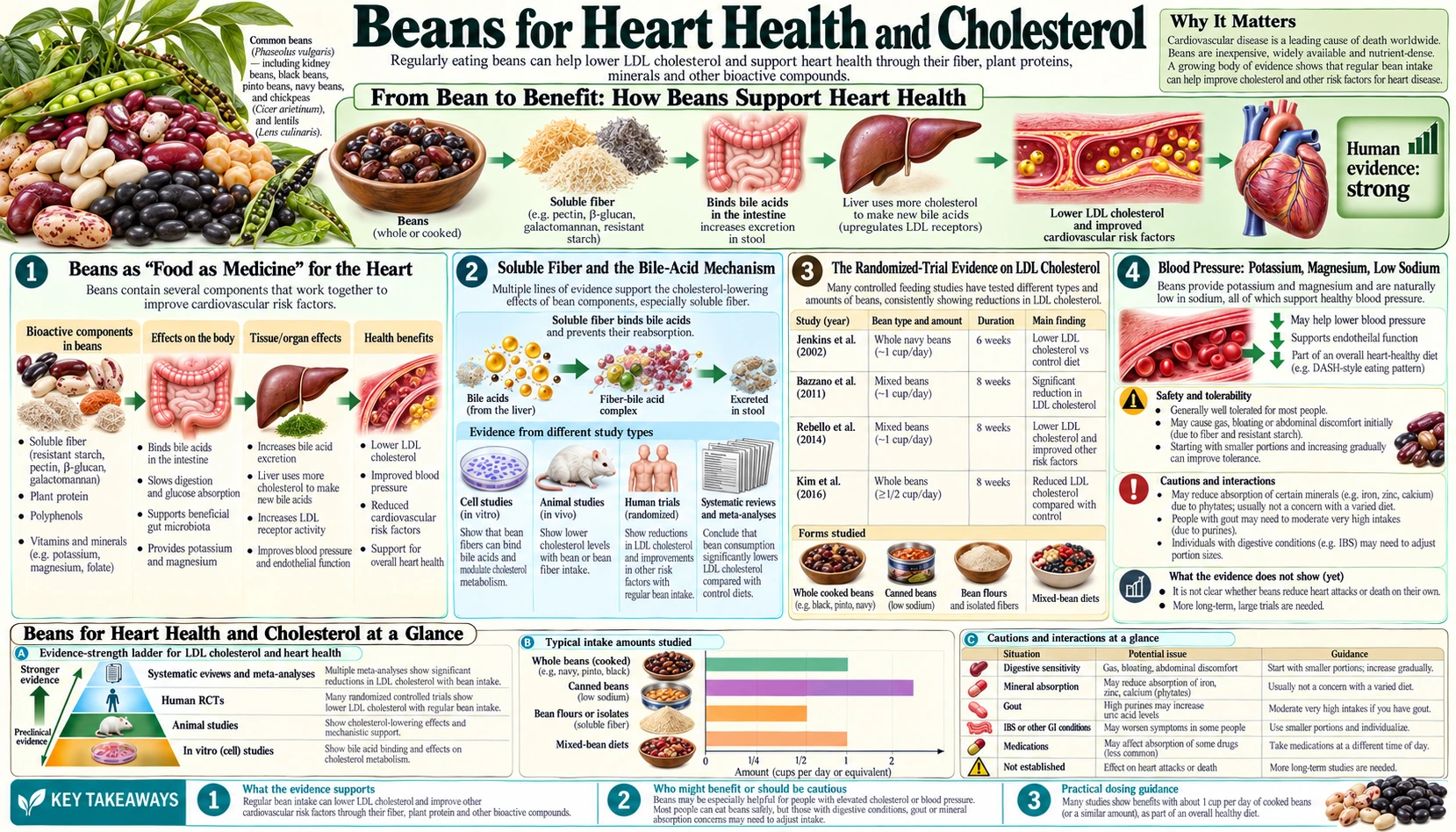
Beans are one of the very few everyday foods whose heart benefits have been tested the same way medicines are — in randomized controlled trials, not just by watching what healthy people happen to eat. The headline result is modest but real: eating about one serving of beans, lentils, or chickpeas a day lowers "bad" low-density lipoprotein (LDL) cholesterol by roughly 5 percent. That sounds small, but spread across a population and sustained over years it translates into meaningfully fewer heart attacks and strokes. Beans also nudge blood pressure down through their potassium and magnesium, help with weight and triglycerides by being filling and fiber-rich, and quietly displace the red and processed meat that does the heart the most harm. This page walks through how beans actually work on the heart, what the trials really showed, and what the trial amounts look like on a plate — without overpromising. Beans are a powerful complement to good cardiac care; they are not a replacement for a statin your doctor has prescribed.
Table of Contents
- Beans as "Food as Medicine" for the Heart
- Soluble Fiber and the Bile-Acid Mechanism
- The Randomized-Trial Evidence on Low-Density Lipoprotein Cholesterol
- Blood Pressure: Potassium, Magnesium, Low Sodium
- Real-World Heart Outcomes
- Triglycerides, Metabolic Syndrome, and Weight
- Why the Whole Package Beats Any Single Nutrient
- How to Eat Beans for Your Heart
- Honest Caveats and Safety
- Key Research Papers
- Connections
- Featured Videos
Beans as "Food as Medicine" for the Heart
Most nutrition advice rests on observational studies — researchers track what large groups of people eat and see who stays healthy. That kind of evidence is useful but always carries a doubt: maybe the people who eat more beans also exercise more, smoke less, or are simply more health-conscious in a dozen ways the study can't fully untangle. Beans are unusual because their effect on cholesterol has also been tested in randomized controlled trials (RCTs) — the same design used to test drugs, where people are randomly assigned to eat beans or not, so the groups are otherwise comparable. When a result survives that test, it is far more believable.
Beans (botanically Phaseolus vulgaris — the species that includes black, kidney, pinto, navy, and cannellini beans) belong to the broader family of pulses, the dried edible seeds of legumes, alongside lentils and chickpeas. Across this family, the trial evidence points the same direction: regular pulse intake lowers low-density lipoprotein cholesterol, and the broader dietary pattern that features beans is associated with lower blood pressure, lower triglycerides, and fewer cardiovascular events. Major dietary guidelines worldwide recommend legumes as a cornerstone of a heart-protective diet for exactly this reason.
The honest framing is that beans are not a miracle and not a megadose of any one magic compound. They are a whole food that does several useful things at once, each one modest, that add up. The rest of this page explains those mechanisms and shows what the actual numbers from the trials look like.
Soluble Fiber and the Bile-Acid Mechanism
The best-understood way beans lower cholesterol runs through their soluble fiber and the body's recycling of bile acids. It is worth understanding because it makes the effect concrete rather than mysterious.
Your liver makes bile acids from cholesterol and releases them into the gut to help digest fat. Normally the body is thrifty: most of those bile acids are reabsorbed in the lower small intestine and sent back to the liver to be used again. Soluble fiber — and beans are rich in it — forms a thick gel in the gut that traps bile acids and carries them out in the stool before they can be reabsorbed. This is called bile-acid sequestration.
Here is the key step. When bile acids are lost rather than recycled, the liver has to make a fresh batch — and the raw material for new bile acids is cholesterol. To get that cholesterol, the liver increases the number of low-density lipoprotein receptors on its surface, which are the "hooks" that pull low-density lipoprotein-cholesterol particles out of the bloodstream. More low-density lipoprotein pulled out of the blood means a lower blood low-density lipoprotein level. Strikingly, this is the very same pathway that the prescription cholesterol drugs called bile-acid sequestrants (such as cholestyramine) use deliberately. Soluble fiber in foods such as oat bran achieves a gentler version of the same thing.
Beans help the heart in a few other fiber-related ways too: the same gel slows the absorption of dietary fat and cholesterol, and when the fiber and resistant starch in beans are fermented by gut bacteria in the colon, they produce short-chain fatty acids that appear to modestly dampen the liver's own cholesterol production. The bile-acid mechanism is well established for oat bran and other gel-forming fibers, but for beans themselves it is not proven. In the classic 1984 trial by Anderson and colleagues, bean diets lowered low-density lipoprotein by 24% yet did not increase the bile acids lost in the stool: oat bran raised bile-acid excretion, while beans had the opposite effect. So for beans, other parts of the package — the fermentation of their fiber, their plant protein, and the meat they replace — may matter as much, and which part does most of the work is not known.
The Randomized-Trial Evidence on Low-Density Lipoprotein Cholesterol
So how much does it actually move the number? The strongest single piece of evidence is a 2014 meta-analysis published in CMAJ (the Canadian Medical Association Journal) by Ha, Sievenpiper, and colleagues. They pooled 26 randomized controlled trials testing dietary pulses against control diets. The finding: eating about one serving of pulses a day — roughly three-quarters of a cup — lowered low-density lipoprotein cholesterol by about 5 percent (on the order of 0.17 mmol/L, or about 6–7 mg/dL) compared with the control diets. The same analysis found no change in two other markers of heart risk it measured, apolipoprotein B and non-high-density lipoprotein cholesterol.
An earlier 2011 meta-analysis by Bazzano and colleagues, published in Nutrition, Metabolism & Cardiovascular Diseases, looked specifically at non-soy legumes (beans, lentils, chickpeas — setting soy aside, since soy has its own literature). Pooling 10 of those randomized controlled trials with 268 participants, it likewise found that legume intake significantly lowered total and low-density lipoprotein cholesterol: on average, total cholesterol fell by 11.8 mg/dL and low-density lipoprotein cholesterol by 8.0 mg/dL more than on the control diets. Two independent meta-analyses, using different study sets and reaching the same conclusion, is exactly the kind of convergence that makes a finding trustworthy.
A few honest points of context:
- A 5 percent low-density lipoprotein drop is modest next to a statin, which can lower low-density lipoprotein by 30–50 percent. Beans are not in that league. But for cholesterol, even small, sustained reductions matter at the population level, and they stack with other diet changes (oats, nuts, viscous fibers, less saturated fat).
- The effect is most visible in people who started with higher cholesterol. One of the early classic trials — Anderson and colleagues in 1984 — fed beans (or oat bran) to 20 men with high cholesterol for 21 days on a hospital metabolic ward; the bean diets cut blood cholesterol by 19% and low-density lipoprotein by 24%, helping establish beans as a cholesterol-lowering food in the first place.
- Much of the benefit comes not just from what beans add but from what they replace. A plate of beans usually stands in for something higher in saturated fat — ground beef, sausage, cheese — so the low-density lipoprotein benefit reflects both the bean fiber and the saturated fat you didn't eat.
The bottom line from the trials: a daily serving of beans or other pulses is a legitimate, evidence-based way to lower low-density lipoprotein cholesterol by a small but real amount, as part of an overall heart-healthy diet.
Blood Pressure: Potassium, Magnesium, Low Sodium
Cholesterol is only half the story. High blood pressure is one of the biggest drivers of heart attack, stroke, heart failure, and kidney disease, and beans have close to an ideal mineral profile for keeping it in check. They are naturally high in potassium and magnesium and naturally low in sodium — the exact ratio the heart wants.
Potassium lowers blood pressure in two ways: it helps the kidneys excrete excess sodium, and it relaxes the walls of blood vessels so blood flows under less pressure. Most people eating a modern diet get far too much sodium and far too little potassium; beans help correct both sides of that imbalance at once. A single cooked cup of many beans supplies several hundred milligrams to over a thousand milligrams of potassium. Magnesium supports the same blood-vessel relaxation and is involved in hundreds of processes that keep the cardiovascular system steady.
This is precisely the logic of the DASH diet (Dietary Approaches to Stop Hypertension), the eating pattern proven in trials to lower blood pressure. DASH is built on foods rich in potassium, magnesium, calcium, and fiber and low in sodium — and it explicitly counts legumes among its core foods. Beans are, in effect, a DASH food. See Hypertension for more.
There is one practical catch worth flagging here and revisiting below: canned beans can be high in added sodium, which works against the blood-pressure benefit. Draining and rinsing canned beans removes roughly 40 percent of the sodium — a simple habit that keeps the convenience of canned beans without undoing their cardiovascular advantage. Choosing "no-salt-added" cans or cooking dried beans avoids the issue entirely.
Real-World Heart Outcomes
Lowering low-density lipoprotein and blood pressure is valuable because of where it leads — fewer actual heart attacks and strokes. Several large studies that followed people over many years connect bean and legume intake to those hard outcomes, not just to lab numbers.
The most cited is the NHANES I Epidemiologic Follow-up Study (Bazzano and colleagues, 2001, Archives of Internal Medicine). Following a large group of US adults, it found that people who ate legumes four or more times a week had a notably lower risk of coronary heart disease — roughly a fifth lower — than those who ate them less than once a week. This was one of the first large American studies to tie ordinary beans to fewer heart events.
Later pooled analyses broadened the picture:
- A 2014 meta-analysis by Afshin and colleagues in the American Journal of Clinical Nutrition pooled cohort studies on nuts and legumes and found that higher legume intake was associated with a lower risk of coronary heart disease.
- A 2017 meta-analysis by Marventano and colleagues in Public Health Nutrition, focused specifically on legumes and cardiovascular disease, likewise reported that greater legume consumption was linked to lower risk of cardiovascular and coronary disease.
- Broader fiber research points the same way: a 2013 meta-analysis by Threapleton and colleagues in the BMJ found that higher total and soluble dietary fiber intake was associated with significantly lower cardiovascular and coronary disease risk — and beans are among the densest sources of exactly that fiber.
- A 2023 dose-response meta-analysis by Mendes and colleagues in Nutrition, Metabolism & Cardiovascular Diseases pooled 26 observational studies. People eating the most legumes had a lower risk of cardiovascular disease (relative risk 0.94, about 6% lower) and of coronary heart disease (relative risk 0.90, about 10% lower) than those eating the least, but no difference in stroke. The lower coronary risk grew with intake up to about 400 g of legumes a week and then appeared to level off.
It is fair to note these outcome studies are observational, so they show association rather than proof of cause. But they line up neatly with the randomized trials on cholesterol and blood pressure: the mechanisms predict fewer heart events, and the population data show fewer heart events. When the laboratory evidence and the real-world evidence agree, the conclusion is on solid ground.
Triglycerides, Metabolic Syndrome, and Weight
Beyond low-density lipoprotein and blood pressure, beans help several other measures that together make up metabolic syndrome — the dangerous cluster of high triglycerides, low high-density lipoprotein (HDL) ("good") cholesterol, high blood pressure, high blood sugar, and excess belly fat that sharply raises heart-disease risk.
Triglycerides are a blood fat strongly tied to refined carbohydrates, sugar, and excess calories. Because beans have a very low glycemic impact and are slowly digested, they cause a gentle rather than spiking blood-sugar and insulin response, which tends to keep triglycerides lower — especially when beans replace white bread, white rice, sugary foods, and other fast carbohydrates. Some pulse trials have shown improvements in triglycerides alongside the low-density lipoprotein effect.
Weight is the other big lever. Beans are remarkably filling for their calories: the combination of fiber and plant protein slows digestion and signals fullness, so people tend to eat less overall without trying. Trials of bean- and pulse-rich diets have generally shown neutral-to-favorable effects on body weight and waist size despite people not being told to cut calories. Carrying less excess weight, particularly around the middle, eases nearly every cardiovascular risk factor at once.
Two displacements amplify all of this. Every bean-based meal is usually one that isn't built on refined carbohydrates (helping triglycerides and blood sugar) and one that isn't built on red or processed meat (helping low-density lipoprotein and overall heart risk). For blood sugar specifically, see our companion page on Blood Sugar and Diabetes.
Why the Whole Package Beats Any Single Nutrient
A recurring temptation in nutrition is to crown a single "active ingredient" the one fiber, the one mineral, the one antioxidant that supposedly does the work — and then sell it in a pill. Beans are a good argument for why that reductive view often fails. Their heart benefit comes from many modest effects working together, and the combination is what matters.
Consider what a serving of beans delivers at the same time:
- Soluble fiber that lowers low-density lipoprotein through bile-acid sequestration.
- Plant protein that replaces some animal protein and the saturated fat that comes with it.
- Low saturated fat in the food itself — beans are nearly fat-free, and what fat they have is unsaturated.
- Potassium and magnesium with very little sodium, supporting healthy blood pressure.
- Resistant starch and fermentable fiber that feed gut bacteria producing helpful short-chain fatty acids.
- Polyphenols — including the anthocyanin pigments that color black and red beans — which have antioxidant and anti-inflammatory activity in lab studies.
- Folate and other B vitamins involved in normal cardiovascular metabolism.
No supplement reproduces this combination, and isolating one piece usually disappoints. Fiber supplements alone, for instance, don't carry the protein, minerals, and polyphenols, and they don't replace meat on your plate. This is also why eating different beans over time is sensible — black, kidney, pinto, navy, cannellini, plus lentils and chickpeas — since each brings a slightly different mix of fiber, minerals, and pigments. The lesson the trials keep teaching is that the food, eaten whole and regularly, outperforms the sum of its isolated parts. See also Oats and Resistant Starches for foods that complement beans through related mechanisms.
How to Eat Beans for Your Heart
The dose that mattered in the trials is reassuringly ordinary: roughly three-quarters of a cup to one cup of cooked beans on most days. You do not need to overhaul your whole diet to capture the benefit. What that looks like in practice:
- About a cup most days. That is close to the "one serving a day" that lowered low-density lipoprotein in the meta-analyses. Consistency matters more than any single big serving.
- Beans in place of some red and processed meat. This is where much of the cardiovascular payoff lives. Common swaps are beans in chili instead of (or alongside less) ground beef, lentils in a Bolognese, or a bean-and-vegetable taco. The low-density lipoprotein benefit comes from both the bean fiber and the saturated fat you skip.
- Dried or rinsed canned — both work. Cooking dried beans is cheapest and lets you control sodium completely. Canned beans are perfectly healthy and convenient; draining and rinsing them cuts sodium by about 40 percent, and "no-salt-added" cans are also sold.
- Beans with vegetables. A bean-and-vegetable meal layers fiber, potassium, and polyphenols and is the kind of plate the DASH and Mediterranean patterns are built on.
- A gradual start. People not used to beans commonly start with smaller portions and build up over a couple of weeks, which gives the gut time to adapt and keeps gas down (more on this just below).
- Variety is a feature. Black, kidney, pinto, navy, and cannellini beans rotate easily with lentils and chickpeas. See Lentils and the main Beans page.
You do not have to choose a single "best" bean. They are far more alike than different for the heart, so the right bean is the one you enjoy and will actually eat week after week.
Honest Caveats and Safety
Beans are safe and beneficial for the great majority of people, but a few honest caveats keep the advice accurate.
Sodium in canned beans. As noted above, salt-packed canned beans can carry enough sodium to blunt the blood-pressure benefit. Draining and rinsing removes roughly 40 percent of it; no-salt-added cans or home-cooked dried beans avoid it altogether.
Gas and bloating. Beans contain oligosaccharides (notably raffinose-family sugars) that the human gut can't fully digest, so gut bacteria ferment them — producing the gas beans are famous for. This is not harmful, and in fact that same fermentation is part of beans' benefit to the gut. It usually eases as the gut adapts, which is why people commonly introduce beans gradually. Soaking dried beans and discarding the soak water, rinsing canned beans, cooking them thoroughly, and using small amounts at first all help. For more on the gut side, see Gut Health and Longevity.
The red kidney bean cooking rule — this one is genuinely important. Raw and undercooked dried red kidney beans contain high levels of a natural toxin called phytohaemagglutinin (a lectin) that can cause severe nausea, vomiting, and diarrhea within hours. As few as four or five raw beans can make someone ill, and — counterintuitively — slow-cooking at a low temperature can actually increase the toxin if the beans never get hot enough. The US Food and Drug Administration's Bad Bug Book reports that boiling the beans for 10 minutes at 100 °C completely destroyed the toxin in one study, but its guidance for consumers, based on British studies, is soaking dried kidney beans in water for at least 5 hours, pouring the water away, and boiling them in fresh water for at least 30 minutes, so the beans get hot enough for long enough. Slow cookers often reach only 75 °C or less inside the food, which does not destroy the toxin. Canned kidney beans are already fully cooked and completely safe to eat straight from the can. The toxin is most concentrated in red kidney beans; the same FDA chapter reports that white kidney beans carry about one-third as much and broad beans 5% to 10% as much.
Kidney disease. Beans are high in potassium and phosphorus. For people with healthy kidneys this is a benefit, but in advanced kidney disease the kidneys can no longer clear them reliably and they build up in the blood: high blood potassium can cause dangerous heart-rhythm problems, and high phosphorus pulls calcium from bone into blood vessels. That is why beans are often restricted in advanced kidney disease, with the amount set from blood tests. Our companion page covers this in detail: Beans for Kidney Health.
Beans are not a statin replacement. This deserves to be stated plainly. Beans lower low-density lipoprotein by a modest amount — very roughly 5 percent — whereas cholesterol-lowering medications can lower it by 30–50 percent. If your doctor has prescribed a statin or other heart medication, beans are an excellent addition to that treatment, not a substitute for it. The bean trials tested beans as part of a diet, not as a replacement for a prescribed medicine. The right model is a partnership: a heart-healthy, bean-rich diet doing its steady work alongside the therapy your clinician has chosen. See Cholesterol Management.
Key Research Papers
- Ha V, Sievenpiper JL, de Souza RJ, et al. (2014). Effect of dietary pulse intake on established therapeutic lipid targets for cardiovascular risk reduction: a systematic review and meta-analysis of randomized controlled trials. CMAJ. — PubMed PMID: 24710915
- Bazzano LA, Thompson AM, Tees MT, Nguyen CH, Winham DM (2011). Non-soy legume consumption lowers cholesterol levels: a meta-analysis of randomized controlled trials. Nutrition, Metabolism & Cardiovascular Diseases. — PubMed PMID: 19939654
- Bazzano LA, He J, Ogden LG, et al. (2001). Legume consumption and risk of coronary heart disease in US men and women: NHANES I Epidemiologic Follow-up Study. Archives of Internal Medicine. — PubMed PMID: 11718588
- Anderson JW, Story L, Sieling B, Chen WJ, Petro MS, Story J (1984). Hypocholesterolemic effects of oat-bran or bean intake for hypercholesterolemic men. American Journal of Clinical Nutrition. — PubMed PMID: 6095635
- Threapleton DE, Greenwood DC, Evans CE, et al. (2013). Dietary fibre intake and risk of cardiovascular disease: systematic review and meta-analysis. BMJ. — PubMed PMID: 24355537
- Afshin A, Micha R, Khatibzadeh S, Mozaffarian D (2014). Consumption of nuts and legumes and risk of incident ischemic heart disease, stroke, and diabetes: a systematic review and meta-analysis. American Journal of Clinical Nutrition. — PubMed PMID: 24898241
- Marventano S, Izquierdo Pulido M, Sánchez-González C, et al. (2017). Legume consumption and CVD risk: a systematic review and meta-analysis. Public Health Nutrition. — PubMed PMID: 28077199
- Bouchenak M, Lamri-Senhadji M (2013). Nutritional quality of legumes, and their role in cardiometabolic risk prevention: a review. Journal of Medicinal Food. — PubMed PMID: 23398387
- Mendes V, Niforou A, Kasdagli MI, Ververis E, Naska A (2023). Intake of legumes and cardiovascular disease: A systematic review and dose-response meta-analysis. Nutrition, Metabolism & Cardiovascular Diseases. — PubMed PMID: 36411221
- US Food and Drug Administration (2012). Bad Bug Book: Handbook of Foodborne Pathogenic Microorganisms and Natural Toxins, 2nd edition — Phytohaemagglutinin chapter. — FDA Bad Bug Book (PDF)