Pears
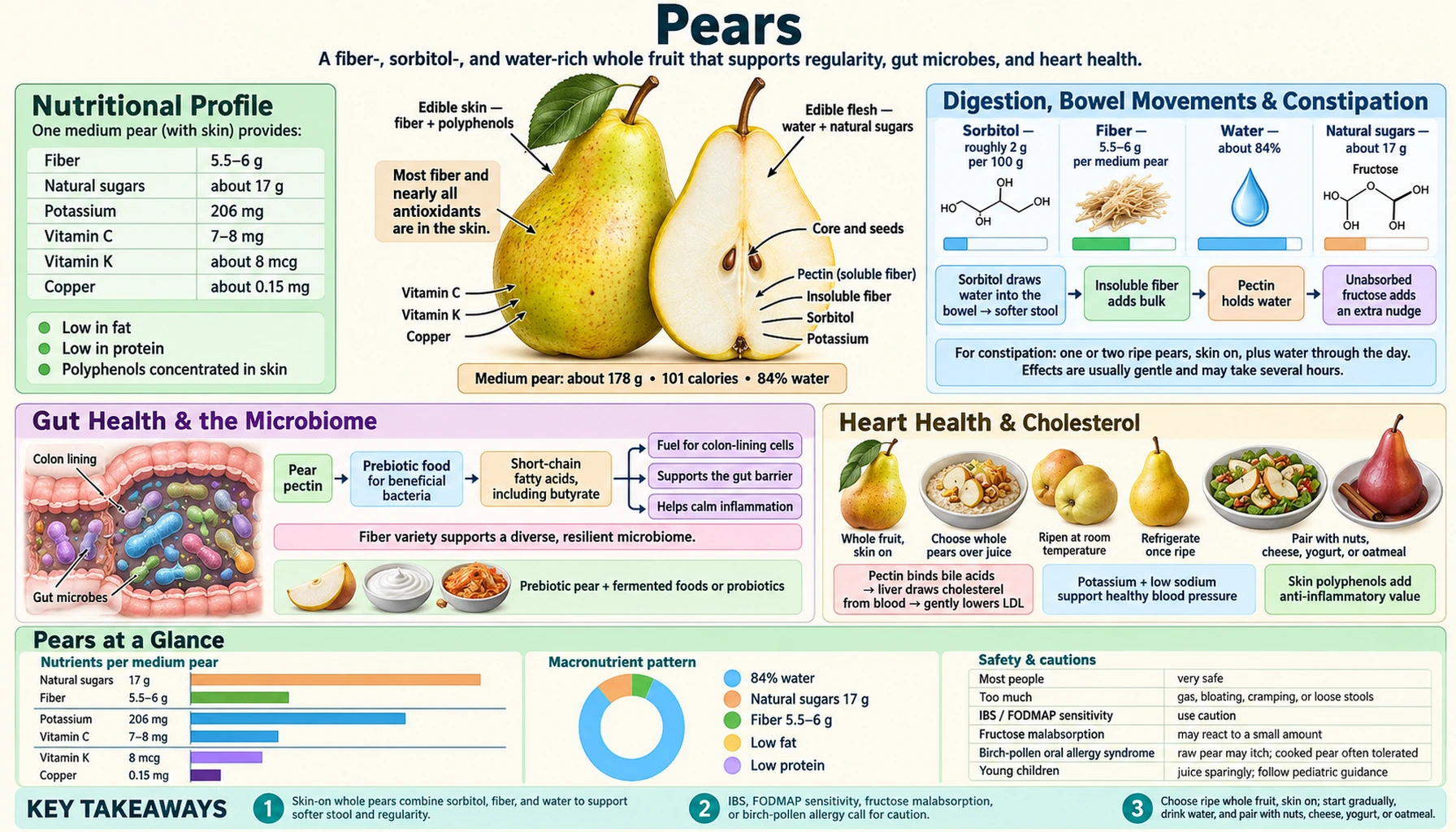
Pears (Pyrus communis) have a long-standing reputation for easing constipation and supporting regular bowel movements. A 2015 systematic review of pears and health concluded that their high dietary fiber and fructose content probably explain the fruit’s laxative properties; pears also contain sorbitol, a poorly absorbed sugar alcohol that draws water into the gut, and they are mostly water. Studies on pears and the heart, blood sugar and body weight are mostly observational, with apples and pears counted together; one randomized trial fed whole pears to adults with metabolic syndrome. Lab analyses find the polyphenols far more concentrated in the peel than in the flesh.
Deep-Dive Articles
Digestion, Bowel Movements & Constipation Relief
The flagship guide. How sorbitol, fiber, fructose and water each relate to the laxative reputation of pears, what the sorbitol and fiber trials found, and the gas/bloating and FODMAP flip side.
Read the deep dive →Gut Health & the Microbiome
Pectin and the other fermentable fibers in pears reach the colon, where gut bacteria ferment them into short-chain fatty acids such as butyrate — what that research describes, and how pears relate to fermented foods.
Read the deep dive →Heart Health & Cholesterol
What soluble-fiber trials found for LDL cholesterol, the potassium and polyphenol content of pears, the 12-week pear trial in metabolic syndrome, and the observational white-fruit-and-vegetable link to lower stroke risk.
Read the deep dive →Blood Sugar & Weight Management
What the large US cohorts found for whole fruit versus fruit juice and type 2 diabetes, what they found for apples, pears and weight change, and the vitamin C, vitamin K, copper and skin polyphenols in pears.
Read the deep dive →Table of Contents
Nutritional Profile
The figures below are per 100 grams of raw pear, from USDA FoodData Central record 169118 (“Pears, raw”); the same record lists a medium pear as 178 grams. Pears are about 84% water (84.0 g per 100 g) and supply 57 kcal per 100 g, with little fat (0.14 g) or protein (0.36 g).
- Dietary fiber — 3.1 grams per 100 grams; a 2015 systematic review of pears and health describes about 6 grams per serving. The fiber is a mix of soluble fiber (including pectin) and insoluble fiber.
- Sorbitol — a sugar alcohol that the body absorbs poorly. The Monash University FODMAP team lists pears among fruits that contain both fructose and sorbitol. The USDA record does not report a sorbitol value, and none is given here.
- Natural sugars — 9.75 grams of total sugars per 100 grams, mostly fructose (6.42 g) with glucose (2.6 g) and sucrose (0.71 g). Monash University researchers measured fructose in excess of glucose in pear, the pattern that makes part of the fructose poorly absorbed in some people.
- Potassium — 116 mg per 100 grams, with 1 mg of sodium.
- Vitamin C — 4.3 mg per 100 grams, a modest amount.
- Vitamin K and copper — 4.4 mcg of vitamin K (phylloquinone) and 0.082 mg of copper per 100 grams.
- Polyphenols and triterpenes — a 2014 analysis of ten pear varieties found arbutin, chlorogenic acid, epicatechin and rutin (a quercetin glycoside) among the dominant phenolic compounds, along with the triterpenes oleanolic and ursolic acid. The 2015 review reports 27–41 mg of phenolics per 100 grams of pear.
In that 2014 analysis, every measured class of compound (total phenolics, flavonoids and triterpenes) was roughly 6–20 times more concentrated in the peel than in the flesh. That is a concentration comparison; the share of a whole pear’s fiber held in the peel was not reported in the sources checked for this page.
Digestion, Bowel Movements & Constipation
Pears have a long-standing reputation for relieving constipation and supporting regular bowel movements. The 2015 systematic review found no human feeding studies of pears at that time, and attributed the laxative properties mainly to the fruit’s fiber and fructose. Four components are usually discussed:
- Sorbitol. Sorbitol is a sugar alcohol that the small intestine absorbs slowly and incompletely. The unabsorbed portion acts as an osmotic laxative: it draws water into the bowel and softens the stool. Concentrated sorbitol is itself used as a laxative — in a randomized double-blind crossover trial in 30 men aged 65 to 86 with chronic constipation, a 70% sorbitol solution and the prescription laxative lactulose showed no clinically significant difference in laxative effect, and nausea was more common with lactulose. Apples also contain both fructose and sorbitol, according to the Monash FODMAP team. Prunes (dried plums) have their own trial evidence: in a systematic review, 100 g of prunes a day for 3 weeks improved stool frequency and consistency compared with psyllium in people with constipation.
- Fiber. A meta-analysis of five randomized trials found that dietary fiber increased stool frequency in people with constipation, but did not clearly improve stool consistency, treatment success, laxative use or painful defecation. Insoluble fiber adds bulk; soluble fiber (pectin) holds water.
- Fructose. Pears contain fructose in excess of glucose, and fructose that is not fully absorbed draws additional water into the gut.
- Water. About 84% of a raw pear is water (USDA FDC 169118).
What has not been tested. No trial of whole pears for constipation was found among the sources checked for this page; the sorbitol and fiber trials used a sorbitol solution and fiber preparations, and the 2015 review notes that pear feeding studies were lacking.
The flip side. The same sorbitol, fructose, and fiber can cause gas, bloating, cramping, or loose stools, particularly in larger amounts. The Monash University FODMAP team lists pears as a high-FODMAP fruit because of their excess fructose and sorbitol; FODMAPs are a recognized trigger of symptoms in irritable bowel syndrome, and people with fructose malabsorption may react to pears. The full story is in the deep-dive: Pears for Digestion, Bowel Movements, and Constipation Relief. For the underlying condition, see Constipation.
Gut Health & the Microbiome
Fermentable fibers, pectin among them, resist digestion in the small intestine and reach the colon, where gut bacteria ferment them. A 2016 review describes the resulting short-chain fatty acids (such as butyrate) as energy substrates that also activate cell receptors and inhibit histone deacetylases, affecting several physiological processes; a 2013 fiber review lists the established prebiotics as mainly oligosaccharides such as inulin, and pear pectin itself has not been tested as a prebiotic in the sources checked for this page. More in Pears for Gut Health and the Microbiome; related pages cover fermented foods and probiotics.
Heart Health & Cholesterol
In a meta-analysis of 67 controlled trials, 2–10 grams a day of soluble fiber (pectin, oat, psyllium) produced small but significant decreases in total and LDL cholesterol, and the authors described the effect as small within the practical range of intake. In a 12-week randomized crossover trial in 40 adults aged 45–65 with metabolic syndrome, two medium fresh pears a day were compared with a calorie-matched drink: systolic blood pressure tended to fall (not statistically significant, P = 0.07), pulse pressure fell significantly, and waist circumference and waist-to-hip ratio were modestly reduced; the authors described the improvements as modest. In a Dutch cohort of 20,069 adults followed for 10 years, a higher intake of white fruits and vegetables was associated with a lower risk of stroke (highest versus lowest quarter, hazard ratio 0.48); apples and pears made up 55% of that group. That is an observational association, not proof of cause. Details in Pears for Heart Health and Cholesterol.
Blood Sugar & Weight
In three large US cohorts (Nurses’ Health Study, Nurses’ Health Study II and Health Professionals Follow-up Study), every three servings a week of apples and pears (counted together) was associated with a lower risk of type 2 diabetes (hazard ratio 0.93), while the same increase in fruit juice was associated with a higher risk (hazard ratio 1.08). In the same cohorts, each additional daily serving of apples/pears was associated with a 1.24 lb lower weight change over each four-year period. Both are observational associations. More in Pears for Blood Sugar and Weight Management.
Antioxidants, Vitamins & Minerals
Pears supply modest amounts of vitamin C, vitamin K, the trace mineral copper and potassium (figures above), and a mix of polyphenols — arbutin, chlorogenic acid, epicatechin and rutin — plus triterpenes. In the 2014 ten-variety analysis, peel and flesh extracts showed antioxidant and anti-inflammatory activity in laboratory assays, with the peel far richer in these compounds than the flesh; laboratory activity is not the same as an effect in people.
Whole Fruit, Peel & Juice
- Peel. Phenolics, flavonoids and triterpenes were about 6–20 times more concentrated in pear peel than in flesh in a 2014 analysis of ten varieties.
- Whole fruit and juice. In the US cohorts above, whole apples and pears were associated with lower type 2 diabetes risk and fruit juice with higher risk. A 2017 American Academy of Pediatrics statement notes that juice was sometimes recommended for children with constipation, and describes its high sugar content and lack of fiber and protein as potential drawbacks.
- Whole-food trial. A 2019 randomized trial of whole pears in adults with metabolic syndrome used two medium fresh pears a day for 12 weeks (see Heart Health above).
Considerations
What the research reports on tolerance and allergy:
- Gas, bloating, and loose stools. The sorbitol, fructose, and fiber in pears can cause gas or bloating, particularly in larger amounts.
- IBS and FODMAP sensitivity. The Monash FODMAP team lists pears as high in FODMAPs (excess fructose plus sorbitol), a group of carbohydrates that can trigger symptoms in people with irritable bowel syndrome or fructose malabsorption.
- Fruit juice and young children. The 2017 American Academy of Pediatrics statement on fruit juice notes it was sometimes recommended for children with constipation, and lists high sugar content (calories and dental caries) and the lack of protein and fiber as potential detrimental effects. Decisions about children’s diets belong with a pediatric clinician.
- Oral allergy syndrome. Pear is a known trigger of oral allergy syndrome, which affects a high percentage of people allergic to birch pollen. The major pear allergen, Pyr c 1, belongs to the same protein family as the birch-pollen allergen Bet v 1, and birch Bet v 1 strongly inhibited IgE binding to it in laboratory tests.
Key Research Papers
- Reiland H, Slavin J. Systematic Review of Pears and Health. Nutrition Today. 2015. — Systematic review of pears and health outcomes (PubMed and Agricola, 1970 onward); reports about 6 g fiber per serving and 27–41 mg phenolics per 100 g, attributes the laxative properties mainly to fiber and fructose, and found no human pear-feeding studies at the time. — doi:10.1097/NT.0000000000000112
- Lederle FA, et al. Cost-effective treatment of constipation in the elderly: a randomized double-blind comparison of sorbitol and lactulose. The American Journal of Medicine. 1990. — Randomized double-blind crossover trial in 30 men aged 65–86: 70% sorbitol and lactulose showed no clinically significant difference in laxative effect; nausea was more common with lactulose. — doi:10.1016/0002-9343(90)90177-f
- Yang J, et al. Effect of dietary fiber on constipation: a meta analysis. World Journal of Gastroenterology. 2012. — Five randomized trials: fiber increased stool frequency but did not clearly improve stool consistency, treatment success, laxative use or painful defecation. — doi:10.3748/wjg.v18.i48.7378
- Lever E, et al. Systematic review: the effect of prunes on gastrointestinal function. Alimentary Pharmacology & Therapeutics. 2014. — Four trials; in constipation, prunes (100 g/day for 3 weeks) improved stool frequency and consistency compared with psyllium. Prunes, not pears, were studied. — doi:10.1111/apt.12913
- Oude Griep LM, et al. Colors of fruit and vegetables and 10-year incidence of stroke. Stroke. 2011. — Dutch cohort of 20,069 adults: higher intake of white fruits and vegetables (55% apples and pears) was associated with lower 10-year stroke incidence (observational). — doi:10.1161/STROKEAHA.110.611152
- Muraki I, et al. Fruit consumption and risk of type 2 diabetes: results from three prospective longitudinal cohort studies. BMJ. 2013. — Three US cohorts: apples and pears (counted together) were associated with lower type 2 diabetes risk; fruit juice with higher risk (observational). — doi:10.1136/bmj.f5001
- Bertoia ML, et al. Changes in intake of fruits and vegetables and weight change in United States men and women followed for up to 24 years: analysis from three prospective cohort studies. PLOS Medicine. 2015. — Each added daily serving of apples/pears was associated with a −1.24 lb weight change per 4-year period (observational). — doi:10.1371/journal.pmed.1001878
- Slavin J. Fiber and prebiotics: mechanisms and health benefits. Nutrients. 2013. — Review of dietary fiber and prebiotics; the best-established prebiotics are oligosaccharides such as inulin; pear pectin is not studied specifically. — doi:10.3390/nu5041417
- Navaei N, Pourafshar S, Akhavan NS, Litwin NS, Foley EM, George KS, Hartley SC, Elam ML, Rao S, Arjmandi BH, Johnson SA. Influence of daily fresh pear consumption on biomarkers of cardiometabolic health in middle-aged/older adults with metabolic syndrome: a randomized controlled trial. Food & Function. 2019;10(2):1062-1072. — 40 adults, two medium pears a day vs a calorie-matched drink for 12 weeks; pulse pressure and waist measures modestly reduced, systolic pressure a non-significant trend. — PubMed PMID: 30720034
- Li X, Wang T, Zhou B, Gao W, Cao J, Huang L. Chemical composition and antioxidant and anti-inflammatory potential of peels and flesh from 10 different pear varieties (Pyrus spp.). Food Chemistry. 2014;152:531-8. — Peel compounds about 6–20 times higher than flesh; laboratory assays. — PubMed PMID: 24444971
- Muir JG, Rose R, Rosella O, Liels K, Barrett JS, Shepherd SJ, Gibson PR. Measurement of short-chain carbohydrates in common Australian vegetables and fruits by high-performance liquid chromatography (HPLC). Journal of Agricultural and Food Chemistry. 2009;57(2):554-65. — Monash University FODMAP measurements; pear contained fructose in excess of glucose. — PubMed PMID: 19123815
- Brown L, Rosner B, Willett WW, Sacks FM. Cholesterol-lowering effects of dietary fiber: a meta-analysis. American Journal of Clinical Nutrition. 1999;69(1):30-42. — 67 controlled trials; small but significant LDL reductions with 2–10 g/day soluble fiber. — PubMed PMID: 9925120
- Koh A, De Vadder F, Kovatcheva-Datchary P, Bäckhed F. From Dietary Fiber to Host Physiology: Short-Chain Fatty Acids as Key Bacterial Metabolites. Cell. 2016;165(6):1332-1345. — Review of short-chain fatty acids from fiber fermentation. — PubMed PMID: 27259147
- Karamloo F, Scheurer S, Wangorsch A, May S, Haustein D, Vieths S. Pyr c 1, the major allergen from pear (Pyrus communis), is a new member of the Bet v 1 allergen family. Journal of Chromatography B. 2001;756(1-2):281-93. — Pear oral allergy syndrome and its link to birch-pollen allergy. — PubMed PMID: 11419719
- Heyman MB, Abrams SA; Section on Gastroenterology, Hepatology, and Nutrition; Committee on Nutrition. Fruit Juice in Infants, Children, and Adolescents: Current Recommendations. Pediatrics. 2017;139(6):e20170967. — American Academy of Pediatrics statement on fruit juice. — PubMed PMID: 28562300
PubMed Topic Searches
Connections
- All Food
- Pears History
- Pears Nutrients
- Pears Benefits Hub
- Pears for Digestion & Constipation
- Pears for Gut Health & the Microbiome
- Pears for Heart Health & Cholesterol
- Pears for Blood Sugar & Weight
- Natural Constipation Relief (Foods Ranked)
- Constipation
- Irritable Bowel Syndrome (IBS)
- Prunes
- Apples
- Bananas
- Fermented Foods
- Probiotics