Cucumber
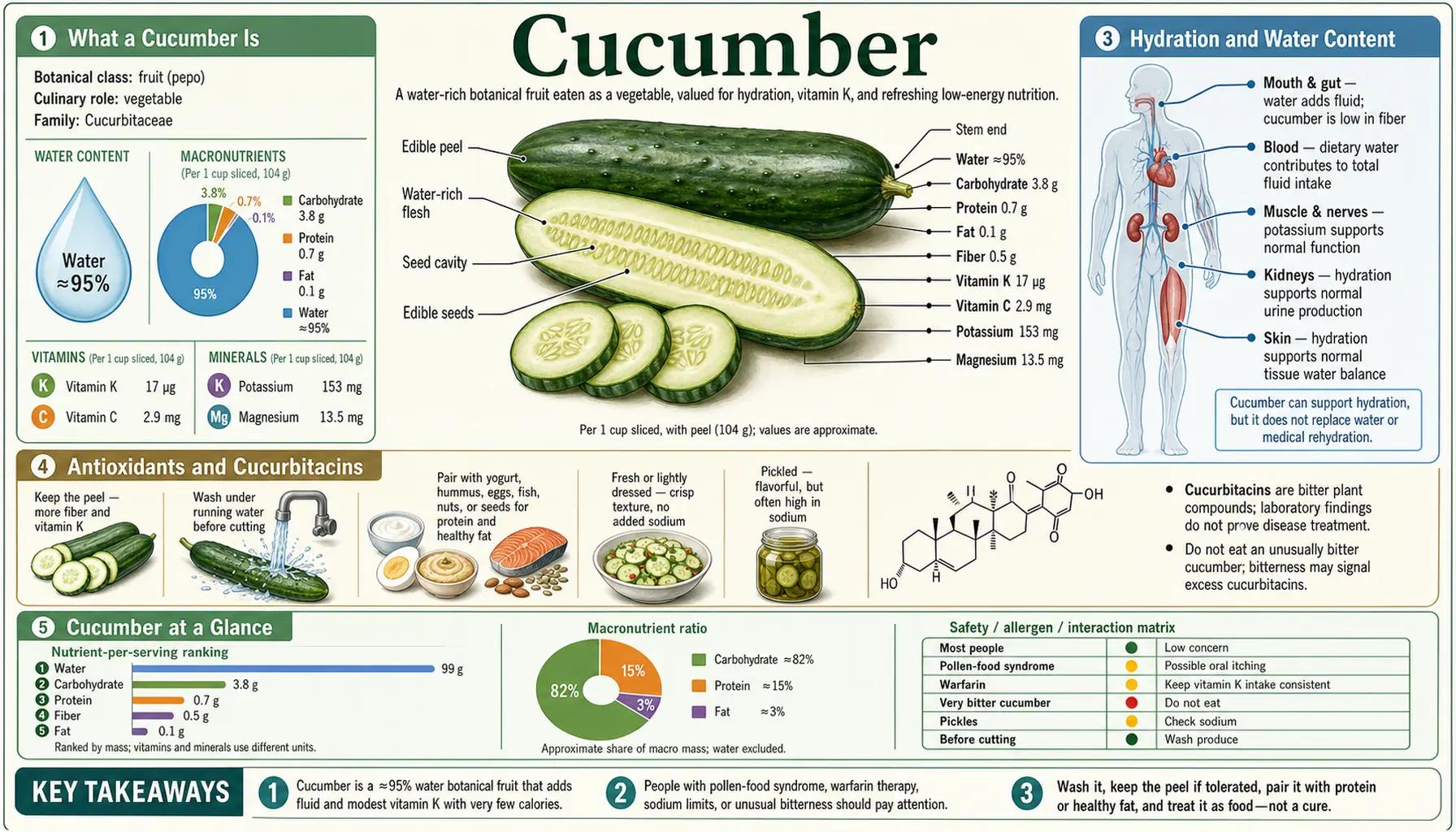
The cucumber (Cucumis sativus) is one of the most watery, refreshing, and low-key foods on the table. It is a member of the gourd family — the same botanical clan as melons, squash, and pumpkins — and although we treat it like a vegetable in salads and sandwiches, it is technically a fruit, since it grows from the flower and carries the seeds. Cucumbers are roughly ninety-five percent water, which makes them light, cooling, and famously low in calories. That same wateriness is why they show up in so much folk wisdom about hydration, cool skin, and calm digestion. This page walks through what a cucumber actually is (and the difference between the slicing, pickling, and long "English" types), what nutrition it does and does not provide, and an honest look at the popular claims: hydration, the antioxidants and bitter cucurbitacins, the classic "cucumber slices on the eyes" habit, blood sugar, and pickling. Where the evidence is thin or comes only from lab and animal studies, this page says so plainly. Cucumber is a genuinely healthy, hydrating food to enjoy freely — it just is not a miracle cure, and it does not need to be one.
Table of Contents
- What a Cucumber Is
- Nutritional Profile
- Hydration and Water Content
- Antioxidants and Cucurbitacins
- Skin and the "Cucumber on the Eyes" Tradition
- Blood Sugar and Fiber
- Pickled Cucumbers and Fermentation
- How to Select and Store Cucumbers
- Safety and Who Should Take Care
- Research Papers
- Connections
- Featured Videos
What a Cucumber Is
Cucumbers are the fruit of a trailing vine, Cucumis sativus, first domesticated in the foothills of the Himalayas thousands of years ago and now grown almost everywhere. Botanists call the fruit a pepo — a berry with a firm outer rind — the same structural type as a melon or a squash. In the kitchen we treat cucumber as a vegetable because it is mild, crunchy, and savory rather than sweet, but by the plant's own definition it is a fruit that carries seeds.
You will mainly meet three kinds at the market:
- Slicing cucumbers — the common thick, dark-green cucumbers sold for salads and sandwiches. They often have a waxed skin (see the storage section) and moderate-sized seeds.
- Pickling cucumbers — shorter, bumpier, thinner-skinned types (such as Kirby) bred to soak up brine well and stay crisp when pickled.
- Seedless or "English" (hothouse) cucumbers — long, thin-skinned, nearly seedless varieties usually sold shrink-wrapped instead of waxed. They are also marketed as "burpless" because they tend to be lower in the bitter compounds that some people find hard to digest.
Genetically, cucumber has a relatively small, well-mapped genome, which has helped plant breeders develop the milder, less-bitter, seedless varieties most of us buy today. None of this changes the basic point for eaters: whichever type you pick, you are getting a crisp, water-dense food with a very gentle nutritional footprint.
Nutritional Profile
The single most important fact about cucumber nutrition is water. A raw cucumber with its skin is about ninety-five percent water, which is why a whole cup of sliced cucumber delivers only around fifteen to sixteen calories. That makes it one of the lightest foods you can eat by volume — you can fill a plate with it for almost no energy cost, which is genuinely useful if you are trying to eat more volume and fewer calories.
Beyond water, a serving of cucumber (skin on) contributes small but real amounts of several nutrients:
- Vitamin K — cucumber is a modest source of vitamin K, the fat-soluble vitamin involved in blood clotting and bone metabolism. Most of it sits in the skin.
- Vitamin C — a small amount of this antioxidant vitamin, more when the cucumber is very fresh.
- Potassium — a little of this blood-pressure-friendly mineral, part of why cucumbers are viewed as a light, hydrating food.
- Magnesium and manganese — trace amounts that add up as part of a varied diet.
- Silica (silicon) — cucumber, especially the skin, is often listed among the better dietary sources of silicon, a mineral of interest for connective tissue. The human evidence here is still developing.
- Fiber — a modest amount, again concentrated in the skin and seeds.
The recurring theme is that the skin and seeds hold most of what little nutrition a cucumber carries. Peeling a cucumber removes much of its fiber, vitamin K, and antioxidant content along with the skin, so leaving the peel on (well washed) keeps the most nutrients. Cucumber is not a nutrient powerhouse and does not pretend to be — its value is being a hydrating, crunchy, essentially guilt-free way to add vegetables, water, and a little fiber to a meal.
Hydration and Water Content
Because cucumbers are around ninety-five percent water, they are often called a "hydrating" food, and that framing is fair. We get a meaningful share of our daily fluids not just from drinking but from what we eat, and water-rich produce like cucumber, watermelon, lettuce, and tomatoes all contribute. Eating cucumber alongside a glass of water is a pleasant, low-calorie way to top up fluids, and the small amount of potassium and other minerals it carries come along for free.
It is worth keeping the claim honest, though. Reviews of water and health make clear that adequate hydration supports normal functioning of the body and even cognition, but there is no evidence that cucumber specifically hydrates "better" than plain water or than any other water-rich food. Research on how different beverages and foods affect hydration status shows that what matters is the total water, plus a little sodium and other nutrients that help the body hold onto that water — not any magic in the cucumber itself. So enjoy cucumber as one tasty contributor to your fluid intake, not as a substitute for drinking water when you are thirsty or exercising.
Antioxidants and Cucurbitacins
Cucumbers contain a light mix of plant antioxidants — vitamin C, beta-carotene (mostly in the darker skin), and flavonoids and lignans such as those studied across many fruits and vegetables. In the laboratory, cucumber extracts show measurable free-radical-scavenging and anti-inflammatory activity, and dietary patterns rich in colorful plants are consistently linked with lower oxidative stress. That is a reason to eat cucumber as part of a varied plant-forward diet, but the antioxidant amounts in a normal serving are modest compared with more deeply colored produce like berries or leafy greens.
The more distinctive cucumber compounds are the cucurbitacins — bitter, defensive chemicals the plant makes, most concentrated near the stem end and in the skin. They are the reason an occasional cucumber tastes sharply bitter. Cucurbitacins are genuinely interesting to scientists: in cell and animal studies they show anti-inflammatory and anti-cancer activity, and researchers describe them as promising "medicinal leads" worth investigating. But it is important to be honest about where that research stands. Almost all of it is preclinical — done in test tubes and rodents using concentrated, isolated cucurbitacins, not in people eating cucumbers. At the concentrations found in ordinary edible cucumbers, cucurbitacins are present in tiny amounts, and modern breeding has deliberately lowered them to make cucumbers milder. So the takeaway is nuanced: the cucurbitacins in cucumber are a fascinating research topic and a plausible future drug source, but eating cucumber is not a cucurbitacin therapy, and you should not seek out very bitter cucumbers hoping for a health boost. In fact, unusually bitter wild or garden cucumbers can carry enough cucurbitacin to cause stomach upset, so bitterness is a signal to discard, not to eat.
Skin and the "Cucumber on the Eyes" Tradition
Few food images are more familiar than cucumber slices resting on someone's eyes at a spa. The tradition has a sensible core and a lot of exaggeration around it. The sensible core: cucumber is cold, wet, and gentle, and laying cool slices on tired or puffy eyes feels genuinely soothing. The coolness constricts small blood vessels and reduces the feeling of puffiness, and the moisture is mildly hydrating to the skin surface — the same reasons a cold spoon or a chilled damp cloth also helps. Much of the benefit is simply cool, calm, and moisture, not something unique to cucumber.
There is also a thread of laboratory interest in cucumber and skin chemistry. Studies of cucumber fruit extract have found antioxidant activity and the ability to inhibit enzymes such as hyaluronidase and elastase, which break down the skin's supporting structures — a reason cucumber shows up in cosmetics. That is legitimate as far as it goes, but it comes from test-tube work on concentrated extracts, not from proof that slices of cucumber reverse wrinkles or "detoxify" skin. So the fair summary is: cucumber on the eyes or skin is pleasant, cooling, and harmless, and it can briefly reduce the look of puffiness; it is not a medical treatment, and it will not replace sleep, sun protection, or a good moisturizer. Enjoy it as a nice ritual, not a cure.
Blood Sugar and Fiber
Cucumber is a friendly food for blood sugar, mainly by what it lacks. It is very low in carbohydrate and calories, so it barely moves blood glucose, and its crunchy bulk and light fiber can help a meal feel more filling without adding sugar or starch. Swapping chips for cucumber sticks, or adding cucumber to bulk out a salad, is a small, sensible move for anyone watching their weight or blood sugar.
You will also find bolder claims that cucumber "lowers blood sugar" or helps diabetes. Here the evidence is thin and mostly preclinical. Animal studies — for example, work feeding cucumber peel to diabetic mice — have reported modest improvements in blood sugar and antioxidant markers, which is why the peel in particular gets attention. But these are rodent experiments using concentrated peel, not clinical trials in people, and there is no good human evidence that eating cucumber meaningfully treats or prevents diabetes. The honest position: cucumber is an excellent low-sugar, high-water food to include if you are managing blood sugar, and it fits easily into a diabetes-friendly plate — but treat any "cucumber lowers blood sugar" headline as a preliminary lab finding, not a proven therapy, and keep it alongside (not instead of) your regular care.
Pickled Cucumbers and Fermentation
Most cucumbers we eat pickled fall into two very different camps, and the distinction matters for health.
- Quick (vinegar) pickles — cucumbers soaked in hot vinegar, salt, and spices. These are tangy and shelf-stable but are not fermented; the vinegar does the preserving, so they contain no live cultures.
- Lacto-fermented (brined) pickles — cucumbers submerged in a saltwater brine and left to ferment, so naturally present Lactobacillus bacteria convert sugars into lactic acid. This is the same natural souring process that makes sauerkraut and other traditional ferments, and the finished pickles (usually sold refrigerated, not on the shelf) can carry live cultures.
Fermented vegetables are an area of real and growing scientific interest: reviews of fermented foods describe potential benefits for the gut microbiome and beyond, though the evidence for any single fermented food is still emerging. If you enjoy that tradition, naturally fermented cucumber pickles are a pleasant way to take part — look for "naturally fermented," refrigerated, with live cultures on the label, since heat-processed jarred pickles have had any cultures killed off.
The one clear caution with all pickles is sodium. Pickling brines are salty, and a single large dill pickle can carry a substantial share of a day's sodium. For most people an occasional pickle is fine, but if you are watching blood pressure or fluid retention, treat pickles as a salty condiment rather than a free vegetable, and balance them with fresh, unsalted cucumber the rest of the time.
How to Select and Store Cucumbers
Good cucumbers are simple to pick. Choose ones that are firm from end to end, with taut, deep-green skin and no soft spots, wrinkling, or yellowing — yellowing usually means the cucumber is overripe and will taste bitter and seedy. A cucumber that feels heavy for its size is well hydrated inside.
Many slicing cucumbers are sold with a thin edible wax coating that helps them retain moisture and last longer in shipping. The wax is food-grade and not harmful, but it is worth a good rinse and scrub under running water before eating, both to clean the surface and to remove any residues. English (seedless) cucumbers are usually shrink-wrapped instead of waxed, so they need only a rinse. If you dislike the wax or the skin, you can peel — just remember that peeling removes much of the fiber and vitamin K along with it.
Store whole cucumbers in the refrigerator, ideally in the warmer part or a crisper drawer, and use them within about a week; they are sensitive to cold and can develop soft, pitted spots if kept too cold for too long. Keep them away from ethylene-producing fruits like ripe tomatoes, bananas, and melons, which speed up softening. Once cut, wrap the cucumber and use it within a day or two, since the exposed flesh dries out and loses crispness quickly.
Safety and Who Should Take Care
Cucumber is one of the safest foods there is. It is not a common allergen, it is very gentle on digestion, and it is low in the fermentable carbohydrates (FODMAPs) that trigger symptoms in people with irritable bowel syndrome — so cucumber is generally well tolerated even on a low-FODMAP diet. A few practical notes round out the picture:
- Wash before eating. As with all fresh produce, rinse and scrub cucumbers to reduce surface dirt, wax, and any residues, especially if you eat the skin.
- Bitterness is a signal to stop. An occasional very bitter cucumber has higher cucurbitacin levels; a bite or two is harmless, but a strongly bitter cucumber can cause stomach upset, so it is best discarded rather than eaten.
- "Burping" and indigestion. Some people find ordinary cucumbers repeat on them or cause mild gassiness. Seedless "burpless" or English varieties, and removing the seeds and peel, usually solve this.
- Pickles mean salt. The cucumber itself is fine, but pickled cucumbers are high in sodium — a consideration for anyone managing blood pressure or heart conditions.
- Vitamin K and blood thinners. Cucumber's vitamin K content is modest, but people taking warfarin are advised to keep their vitamin K intake consistent rather than swinging up and down; steady, ordinary cucumber portions are not a problem, and any big diet change should be discussed with the clinician managing the medication.
For the overwhelming majority of people, cucumber is simply a wholesome, hydrating food to eat as often as you like.
Research Papers
- Mukherjee PK, Nema NK, Maity N, Sarkar BK. Phytochemical and therapeutic potential of cucumber. Fitoterapia. 2013;84:227–236. doi:10.1016/j.fitote.2012.10.003 — a comprehensive review of cucumber's chemistry and reported activities, noting most therapeutic claims rest on preclinical work.
- Huang S, Li R, Zhang Z, Li L, et al. The genome of the cucumber, Cucumis sativus L. Nature Genetics. 2009;41(12):1275–1281. doi:10.1038/ng.475 — the reference cucumber genome that has guided breeding of milder, less-bitter, seedless varieties.
- Kaushik U, Aeri V, Mir SR. Cucurbitacins — an insight into medicinal leads from nature. Pharmacognosy Reviews. 2015;9(17):12–18. doi:10.4103/0973-7847.156314 — reviews the bitter cucurbitacins as promising but still preclinical medicinal leads.
- Nema NK, Maity N, Sarkar B, Mukherjee PK. Cucumis sativus fruit — potential antioxidant, anti-hyaluronidase, and anti-elastase agent. Archives of Dermatological Research. 2011;303(4):247–252. doi:10.1007/s00403-010-1103-y — laboratory evidence behind cucumber's use in skin care, from extract not whole slices.
- Dixit Y, Kar A. Protective role of three vegetable peels in alloxan induced diabetes mellitus in male mice. Plant Foods for Human Nutrition. 2010;65(3):284–289. doi:10.1007/s11130-010-0175-3 — a rodent study reporting blood-sugar and antioxidant effects of cucumber peel; preclinical, not human evidence.
- Popkin BM, D'Anci KE, Rosenberg IH. Water, hydration, and health. Nutrition Reviews. 2010;68(8):439–458. doi:10.1111/j.1753-4887.2010.00304.x — context for why water-rich foods like cucumber contribute usefully to daily fluid intake.
- Maughan RJ, Watson P, Cordery PA, Walsh NP, et al. A randomized trial to assess the potential of different beverages to affect hydration status: development of a beverage hydration index. The American Journal of Clinical Nutrition. 2016;103(3):717–723. doi:10.3945/ajcn.115.114769 — shows what actually governs how well a food or drink hydrates (water plus a little sodium), not any single food's magic.
- Lieberman HR. Hydration and cognition: a critical review and recommendations for future research. Journal of the American College of Nutrition. 2007;26(sup5):555S–561S. doi:10.1080/07315724.2007.10719658 — supports the general value of staying hydrated without overstating any one food's role.
- Marco ML, Heeney D, Binda S, Cifelli CJ, et al. Health benefits of fermented foods: microbiota and beyond. Current Opinion in Biotechnology. 2017;44:94–102. doi:10.1016/j.copbio.2016.11.010 — background on lacto-fermented vegetables such as brined pickles and their potential gut benefits.
- Jiang S, Liu H, Li C. Dietary regulation of oxidative stress in chronic metabolic diseases. Foods. 2021;10(8):1854. doi:10.3390/foods10081854 — places cucumber's modest antioxidants within the broader value of a plant-rich diet.
- PubMed topic search — dietary silicon (silica) and bone / connective-tissue health, relevant to cucumber as a silicon source: pubmed.ncbi.nlm.nih.gov/?term=dietary+silicon+bone+connective+tissue
- PubMed topic search — cucurbitacin anticancer and anti-inflammatory (preclinical) activity: pubmed.ncbi.nlm.nih.gov/?term=cucurbitacin+anticancer+anti-inflammatory
- PubMed topic search — Cucumis sativus pharmacology and human studies: pubmed.ncbi.nlm.nih.gov/?term=Cucumis+sativus+cucumber+health
Connections
- All Food
- Celery
- Tomatoes
- Watermelon
- Bell Peppers
- Sauerkraut
- Kimchi
- Cabbage
- Vitamin K
- Vitamin C
- Potassium
- Silicon