Adaptogens for Stress Management
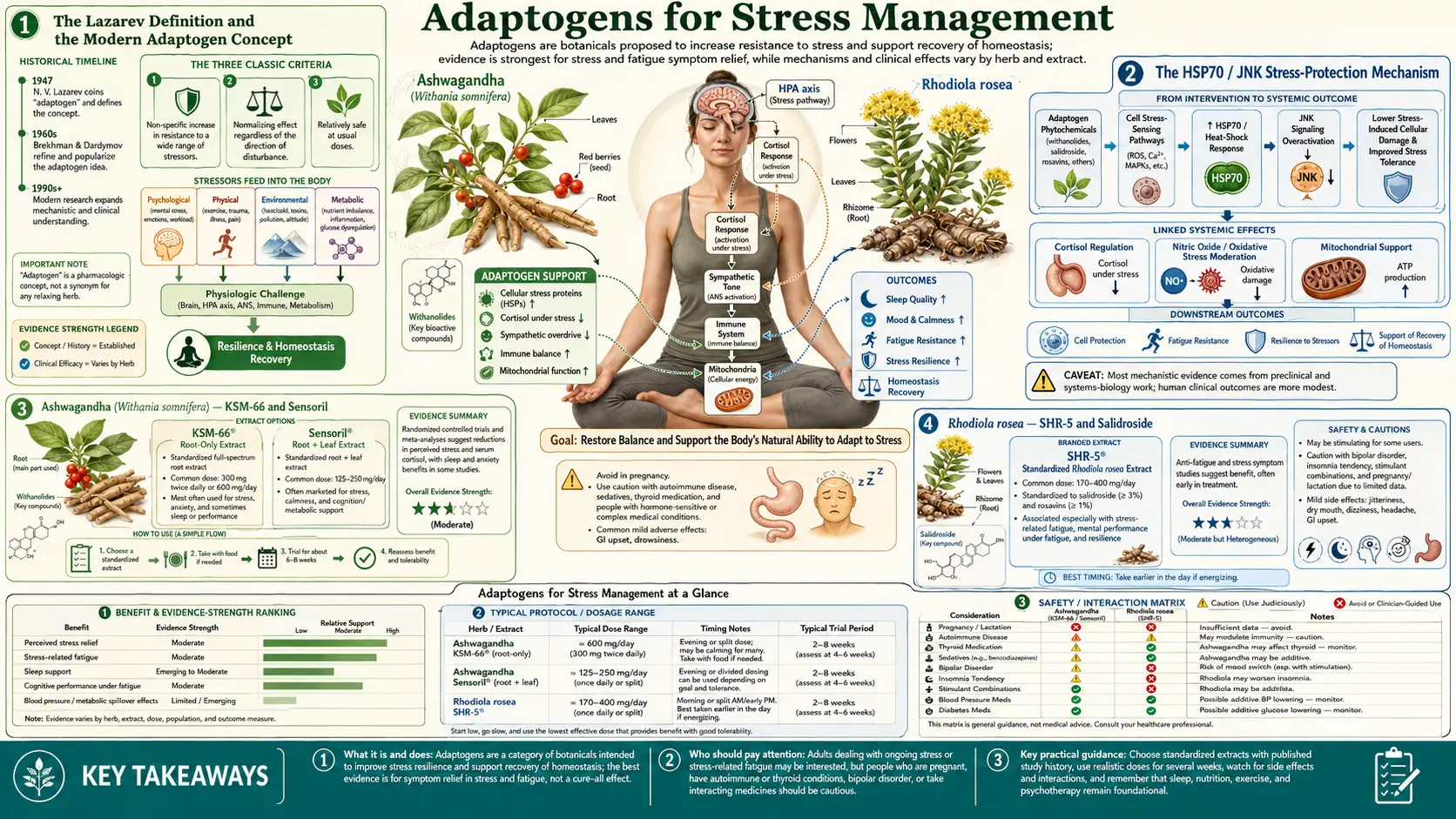
"Adaptogen" is a specific pharmacological category defined in 1957 by the Soviet toxicologist Nikolai Lazarev: a substance must (1) be relatively non-toxic at normal doses, (2) produce a non-specific increase in resistance to a broad range of physical, chemical, and biological stressors, and (3) exert a normalizing influence on the body regardless of the direction of the stress-induced abnormality. Of the thirty or so plants traditionally claimed to meet this definition, four have accumulated the largest body of high-quality randomized clinical-trial evidence in the modern literature: Ashwagandha (Withania somnifera), Rhodiola rosea, Holy Basil (Ocimum sanctum/tenuiflorum), and Schisandra chinensis. The molecular mechanism that ties them together appears to be upregulation of the heat-shock protein HSP70 and regulation of the stress-sensor kinase JNK, plus modulation of the hypothalamic-pituitary-adrenal (HPA) axis and the sympathetic nervous system at multiple levels. This deep-dive walks through each of the four, the standardized extracts with clinical-trial support, dosing protocols, time-to-effect, and the safety profile under chronic use.
Table of Contents
- The Lazarev Definition and the Modern Adaptogen Concept
- The HSP70 / JNK Stress-Protection Mechanism
- Ashwagandha (Withania somnifera) and Its Standardized Extracts
- Rhodiola rosea, Its Standardized Root Extract and Salidroside
- Holy Basil (Tulsi, Ocimum sanctum)
- Schisandra chinensis
- Adaptogen Combinations and Cycling
- Dosing, Time-to-Effect, and Quality Sourcing
- Cautions and Drug Interactions
- Key Research Papers
- Connections
- Featured Videos
The Lazarev Definition and the Modern Adaptogen Concept
Nikolai Lazarev, a Soviet toxicologist working at the All-Union Scientific Research Institute of Pharmaceutical Chemistry, coined the term adaptogen in 1957 to describe a category of substance he believed could produce a state of "non-specific increased resistance" to stress. His student Israel Brekhman extended the work through the 1960s and 1970s, primarily studying Eleutherococcus senticosus (Siberian "ginseng," not a true Panax ginseng). The Soviet military and space programs funded the research as a search for compounds that could keep pilots, soldiers, and cosmonauts performing under sustained operational stress without the side-effect profile of stimulants like amphetamines.
The modern formalized criteria, articulated by Alexander Panossian, the leading contemporary adaptogen researcher, are:
- Decreases stress-induced damage and increases stress resistance — measured in animal models by survival time under cold, hypoxia, exhaustion, or chemical toxicity.
- Produces a normalizing effect — restores function regardless of whether the stress-induced abnormality is high or low. In this concept, an adaptogen given to a hypertensive patient would lower blood pressure, and the same adaptogen given to a hypotensive patient would raise it.
- Is harmless and does not disturb body functions more than necessary — broad therapeutic index, no significant withdrawal syndrome, no chronic toxicity at normal doses.
In a 2008 reflection paper, the herbal medicines committee of the European Medicines Agency (EMA) named Eleutherococcus, Panax ginseng, Schisandra and Rhodiola as examples of herbs called adaptogens, but concluded that the principle of adaptogenic action "needs further clarification and studies in the pre-clinical and clinical area" and that the term "is not accepted in pharmacological and clinical terminology that is commonly used in the EU". It judged the term "not appropriate for a marketing authorisation", while stating that the concept is sufficient to be considered in the assessment of traditional herbal medicinal products (EMA reflection paper on the adaptogenic concept, 2008). The U.S. Food and Drug Administration (FDA) does not recognize the category either and regulates adaptogens as dietary supplements under DSHEA. European pharmacopoeial-grade extracts have stricter standardization requirements than U.S. supplements.
The HSP70 / JNK Stress-Protection Mechanism
Panossian and colleagues, working at the Swedish Herbal Institute and later at the Armenian Drug and Medical Technology Agency, characterized the molecular mechanism that unifies the major adaptogens. Their 2009 Phytomedicine paper was a study in mice given a fixed combination of Eleutherococcus, Schisandra and Rhodiola extracts for seven days: the combination raised the mice's basal blood level of Hsp72, a member of the heat-shock protein 70 (HSP70) family, from 0.8-1.5 to 5.5-6.3 pg/ml, and increased their swimming time to exhaustion about sevenfold (from 3.0 to 21.1 minutes). That animal study tested the three-herb combination, not each herb separately, and did not measure JNK. The authors' 2010 review (Panossian and Wikman, Pharmaceuticals) lists regulation of HSP70 and of the c-Jun N-terminal kinase (JNK) stress-sensor pathway among the mechanisms associated with the stress-protective activity of adaptogens.
HSP70 is a molecular chaperone that protects proteins from misfolding and aggregation under stress. Cells preconditioned by sub-lethal stress (mild heat, mild hypoxia, mild oxidative challenge) upregulate HSP70 and become substantially more resistant to subsequent lethal stress. The phenomenon is called preconditioning or hormesis. Adaptogens appear to chemically mimic the preconditioning signal — the body responds as if it had been mildly stressed and upregulates HSP70 in anticipation of larger stress that may follow.
The JNK pathway is one of three major stress-activated MAP kinase cascades. JNK responds to oxidative stress, DNA damage, inflammatory cytokines, and physical insult; its activation drives apoptosis when stress exceeds the cell's repair capacity. Adaptogens appear to modulate JNK in a context-dependent way, suppressing pathological over-activation while preserving the appropriate physiological response.
Additional documented mechanisms include direct effects on the hypothalamic-pituitary-adrenal axis (blunting of CRH-stimulated adrenocorticotropic hormone (ACTH) release), modulation of monoamine neurotransmitters (Rhodiola is a mild monoamine oxidase inhibitor), and effects on the cortisol-binding protein and on gamma-aminobutyric acid-A receptor signaling (Ashwagandha withanolides bind gamma-aminobutyric acid-A in vitro).
Ashwagandha (Withania somnifera) and Its Standardized Extracts
Ashwagandha is the most extensively studied modern adaptogen, with over forty randomized controlled trials in the indexed literature. The active constituents are the withanolides — a class of steroidal lactones — with withanolide A, withaferin A, and withanoside IV being the most pharmacologically significant.
Two standardized extracts dominate the clinical trial literature:
- A root-only extract — a full-spectrum root-only extract standardized to 5% withanolides. The 2012 Chandrasekhar trial (Indian J Psychol Med) tested 300 mg twice daily for 60 days in 64 adults with chronic stress; the active group showed a 27.9% reduction in morning serum cortisol vs 7.9% in placebo (p<0.001), and substantial improvements on the Perceived Stress Scale, Depression Anxiety Stress Scale, and General Health Questionnaire.
- A root-and-leaf extract — a root-and-leaf extract standardized to 10% withanolide glycosides, 32% oligosaccharides, and <0.5% withaferin A. Auddy and colleagues (J Am Nutraceutical Assoc 2008) tested 125-500 mg/day for 60 days and found dose-dependent reductions in cortisol and improvements in fasting blood glucose, blood pressure, and self-reported well-being scores.
The Lopresti and colleagues 2019 trial (Medicine) tested 240 mg/day of a different standardized extract for 60 days in 60 adults with high self-reported stress. Compared with placebo, it found significant reductions in Hamilton Anxiety Rating Scale (HAM-A) scores (P = .040), morning cortisol (P < .001) and DHEA-S (P = .004); the reduction on the Depression, Anxiety and Stress Scale (DASS-21) was not statistically significant (P = .096). Salve and colleagues (Cureus 2019) gave 250 mg/day or 600 mg/day of a root extract, or placebo, for eight weeks to 60 stressed adults (58 completed). They reported significant reductions in Perceived Stress Scale scores and serum cortisol at both doses, and better sleep quality than with placebo; anxiety was measured with the HAM-A.
A 2022 meta-analysis (Akhgarjand and colleagues, Phytother Res) pooled 12 randomized trials with 1,002 adults. Compared with placebo, ashwagandha reduced anxiety (standardized mean difference −1.55) and stress (standardized mean difference −1.75), with the stress effect seen at 300-600 mg/day. The authors rated the certainty of the evidence as low for both outcomes, and results varied widely between trials (I² 93.8% for anxiety, 83.1% for stress).
Typical clinical dosing is 300-600 mg/day in two divided doses, taken with meals. Time to noticeable effect is 2-4 weeks; full effect by 8-12 weeks. Ashwagandha is well-tolerated; the most common side effect is mild gastrointestinal upset. Liver injury has been described in several case series — usually resolving after the herb is stopped, but fatal in some people with existing liver disease (see Cautions) — and the herb is contraindicated in pregnancy (potential abortifacient activity) and in hyperthyroidism (Ashwagandha can raise thyroid hormone levels; see Cautions).
Rhodiola rosea, Its Standardized Root Extract and Salidroside
Rhodiola rosea is a high-altitude plant native to the mountainous regions of Europe, Asia, and North America. The principal active constituents are the rosavins (rosavin, rosin, rosarin — unique to R. rosea and used as authentication markers) and salidroside (also called rhodioloside). The most thoroughly studied standardized extract is a root extract standardized to 3% rosavins and 1% salidroside.
Rhodiola produces effects that are notably different from Ashwagandha. Where Ashwagandha is calming and lowers cortisol, Rhodiola is mildly stimulating and improves mental performance under fatigue. The 2009 Olsson trial (Planta Medica) tested 576 mg/day of this root extract for 28 days in 60 adults with stress-related fatigue. Both groups improved on several measures, including depression scores on the Montgomery-Åsberg Depression Rating Scale (MADRS) — a placebo effect; compared with placebo, the extract group improved more on the Pines Burnout Scale, on tests of attention, and in the cortisol response to waking. A 2012 open-label study by Edwards and colleagues (Phytother Res) gave 200 mg of a Rhodiola extract twice daily for 4 weeks to 101 people with life-stress symptoms; it had a single group and no placebo, and reported improvements in stress symptoms, disability and overall therapeutic effect, seen even after 3 days.
Two trials worth highlighting:
- Darbinyan 2007 (Nord J Psychiatry) — a 6-week trial of 340-680 mg/day of the standardized root extract in 89 patients with mild-to-moderate depression found significant improvement on the Hamilton Depression Rating Scale and Beck Depression Inventory at both doses, with no significant difference between the dose groups.
- Mao 2015 (Phytomedicine) — the first randomized comparison of Rhodiola to sertraline for depression: 57 adults with mild to moderate major depression took Rhodiola, sertraline or placebo for 12 weeks. Scores fell modestly in all three groups with no significant difference between groups, so neither Rhodiola nor sertraline separated significantly from placebo. Rhodiola produced smaller absolute improvement than sertraline (Hamilton Depression Rating Scale −5.1 vs −8.2; placebo −4.6) but substantially fewer adverse events (30.0% vs 63.2%; placebo 16.7%), and the authors concluded Rhodiola may have a more favorable risk-to-benefit ratio.
Typical clinical dosing is 200-600 mg/day taken in the morning or early afternoon (Rhodiola can cause insomnia if taken in the evening). Time to effect is unusually fast for an adaptogen — many patients report noticeable improvement within 3-7 days. Rhodiola is generally well-tolerated; the principal adverse effects are insomnia (the reason for the morning timing above), restlessness (which practitioners manage by lowering the dose), and rarely, increased blood pressure in susceptible individuals.
Holy Basil (Tulsi, Ocimum sanctum)
Holy Basil (Sanskrit tulsi, scientific Ocimum sanctum or the synonym Ocimum tenuiflorum) is one of the most revered plants in Ayurvedic tradition and is grown in households across the Indian subcontinent for daily consumption as a tea or chewed leaf. The active constituents include eugenol, rosmarinic acid, ursolic acid, and ocimumosides A and B.
Holy Basil is the most thoroughly multi-system adaptogen. Marc Cohen's 2014 J Ayurveda Integr Med review (a narrative review, without pooled figures) summarized the research: effects on blood glucose, blood pressure, lipid profile, anxiety scores, cognitive function, and immune markers. A later systematic review by Jamshidi and Cohen (Evid Based Complement Alternat Med 2017) identified 24 human studies and reported that all of them described favourable clinical outcomes, with none reporting significant adverse events.
The most-cited stress trial is Bhattacharyya and colleagues (2008 Nepal Med Coll J), which gave 500 mg of Holy Basil leaf extract twice daily for 60 days to 35 adults with generalized anxiety disorder. All 35 took the extract (the abstract describes no comparison group); anxiety, and the stress and depression that went with it, fell significantly (p<0.001) over the 60 days. The Saxena 2012 trial (Evid Based Complement Alternat Med), a placebo-controlled study in 150 adults with general stress symptoms (71 on 1,200 mg/day of extract, 79 on placebo), found significant improvements at 6 weeks, with overall improvement 39% greater than with placebo.
Typical dosing is 300-600 mg of standardized extract twice daily, or 2-3 cups of Tulsi tea daily. Holy Basil is generally regarded as one of the safest adaptogens; the principal cautions are mild antiplatelet activity (relevant to people taking anticoagulants), potential low blood sugar (hypoglycemia) in people with diabetes taking insulin or sulfonylureas, and theoretical reduction of fertility at very high doses based on animal studies.
Schisandra chinensis
Schisandra chinensis is a climbing vine native to northeastern China and the Russian Far East. The fruit is called wu wei zi (five-flavor berry) in traditional Chinese medicine, named for the fact that the dried berry contains all five classical flavors (sour, sweet, bitter, pungent, salty). The active constituents are the schisandra lignans — schisandrin A and B (also called gomisin A and B), schisandrol, and schisantherin — concentrated primarily in the seed.
Schisandra has the most distinctive multi-organ profile of the four major adaptogens. Beyond central nervous system (CNS) effects, schisandra lignans are documented hepatoprotective agents — they upregulate hepatic phase I and phase II detoxification enzymes and protect hepatocytes from chemical injury. Practitioners therefore often favor Schisandra for people with chronic stress combined with hepatic insufficiency, chemical exposure, or alcohol-related liver dysfunction.
The clinical trial database is smaller than for Ashwagandha or Rhodiola but consistent. The 1999 Panossian Phytother Res trial showed 270 mg/day of standardized schisandra extract significantly reduced fatigue and improved mental performance under stress. Aslanyan and colleagues (Phytomedicine 2010) gave a single 270 mg tablet of a fixed Rhodiola-Schisandra-Eleutherococcus combination, or placebo, to 40 women who had felt stressed over a long period; two hours later the combination group scored significantly better on a test of attention, speed, and accuracy.
Typical dosing is 500-1,000 mg of dried fruit extract (or 100-300 mg of a standardized lignan extract) twice daily. Schisandra is well-tolerated; the principal adverse effects are mild gastrointestinal (GI) upset and occasional sleep disturbance if taken late in the day. It is contraindicated in epilepsy (theoretical reduction of seizure threshold), and an added effect with sedatives is a concern.
Adaptogen Combinations and Cycling
Most modern adaptogen products combine two or more herbs to address complementary aspects of the stress response. The empirical experience is that combinations often produce a more balanced effect than single-herb monotherapy, though direct head-to-head trial evidence is limited.
- Ashwagandha + Rhodiola — the most common combination, pairing Ashwagandha's calming/cortisol-lowering effect with Rhodiola's mild stimulation and anti-fatigue effect. Practitioners use it for people who have both anxiety and fatigue. In a 2020 case series of five people with ashwagandha-linked liver injury, Rhodiola was named as a possible co-cause in one case where both had been taken.
- Rhodiola + Schisandra + Eleutherococcus — a fixed combination of Rhodiola, Schisandra, and Eleutherococcus extract studied in multiple Russian and Scandinavian trials for stress, fatigue, and immune function.
- Ayurvedic stress formulas — often combine Ashwagandha + Holy Basil + Brahmi (Bacopa monnieri) + Shankhpushpi.
- Traditional Chinese formulas — combine Schisandra with Reishi, Goji, and Astragalus for the "Eight Treasures" or similar formulations.
The question of cycling — on/off rotation rather than continuous use — is unsettled. Continuous-use trials of 8-12 weeks consistently show maintained effect without tolerance, and the longest-duration trials (up to a year for Ashwagandha) have not shown loss of effect. Traditional Ayurvedic and Chinese practice often involves cycling, but the rationale is closer to seasonal energetics than to receptor-tolerance pharmacology. A common practitioner approach is daily use for the duration of the stressor, with a 1-2 week break every 3-6 months to judge whether it is still needed.
Dosing, Time-to-Effect, and Quality Sourcing
Adaptogen dosing depends entirely on the standardization of the extract. Standardized extracts (such as the ashwagandha and Rhodiola root extracts described above) are dosed lower than the equivalent crude herb because the active constituents are concentrated. Reference clinical-trial dosing:
- Ashwagandha — 300-600 mg/day of standardized extract (5% withanolides), in two divided doses with food. Time to effect: 2-4 weeks.
- Rhodiola rosea — 200-600 mg/day of standardized extract (3% rosavins, 1% salidroside), taken in morning or early afternoon. Time to effect: 3-14 days.
- Holy Basil — 300-600 mg of standardized extract twice daily, or 2-3 cups of Tulsi tea daily. Time to effect: 2-6 weeks.
- Schisandra chinensis — 500-1,000 mg of dried fruit extract twice daily. Time to effect: 2-4 weeks.
Sourcing matters more for adaptogens than for most herbs because (a) adulteration is common — cheaper plants are routinely substituted for true Rhodiola rosea, Holy Basil, and Schisandra chinensis — and (b) the active constituents are highly variable in unstandardized material. Third-party testing programs (such as USP, NSF, and ConsumerLab) check products independently of the seller.
Cautions and Drug Interactions
Adaptogens are among the safest herbal categories but each has specific cautions:
- Pregnancy — Ashwagandha is contraindicated due to potential abortifacient activity. Rhodiola and Schisandra have insufficient safety data in pregnancy and are generally not used. Holy Basil has been used traditionally in pregnancy but at much lower doses than therapeutic supplementation.
- Hyperthyroidism — Ashwagandha can raise thyroid hormone levels and is contraindicated in Graves' disease and uncontrolled thyrotoxicosis. In a 2018 trial in 50 adults with subclinical hypothyroidism (an underactive thyroid without obvious symptoms), 600 mg/day of root extract for 8 weeks improved serum thyroid-stimulating hormone (TSH), T3 and T4 levels significantly compared with placebo, moving them toward normal (PubMed PMID: 28829155); the trial measured total serum T3 and T4, not free hormones.
- Autoimmune disease — theoretical concern that adaptogens with immune-stimulating effects (Eleutherococcus more than the four covered here) could worsen autoimmune disease. The clinical experience with Ashwagandha and Holy Basil in autoimmune patients is mixed; practitioners describe cautious use with monitoring.
- Sedatives and antidepressants — Rhodiola has mild MAO-inhibiting activity in vitro; theoretical interaction with selective serotonin reuptake inhibitors (SSRIs), serotonin-norepinephrine reuptake inhibitors (SNRIs), and traditional monoamine oxidase inhibitors (MAOIs). Ashwagandha may potentiate benzodiazepines and gamma-aminobutyric acid-A-active drugs. In two studies of 12 healthy men each, an extract of a related species, Schisandra sphenanthera, raised the blood levels of drugs cleared by the liver enzyme cytochrome P450 3A4 (CYP3A4): tacrolimus by 164% and midazolam by 119% (PubMed PMID: 17506780; PubMed PMID: 19552749); calcium channel blockers and many statins are also cleared by that enzyme.
- Anticoagulants — Holy Basil has mild antiplatelet activity, which is relevant to people taking aspirin, clopidogrel, or warfarin.
- Diabetes medications — both Ashwagandha and Holy Basil can lower blood glucose; together with insulin or sulfonylureas the combined effect can push blood sugar too low, which is why glucose is commonly monitored when starting.
- Surgery — adaptogens are commonly stopped 1-2 weeks before scheduled surgery because of potential effects on bleeding, glucose, and anesthetic metabolism.
- Liver injury (Ashwagandha) — In a 2020 case series from Iceland and the US Drug-Induced Liver Injury Network, five people developed jaundice, with nausea, tiredness, itching and abdominal discomfort, 2-12 weeks after starting ashwagandha-containing supplements. The injury was cholestatic (blocked bile flow) or mixed; itching and jaundice lasted 5-20 weeks; no one developed liver failure, and liver tests returned to normal within 1-5 months in four of them (one was lost to follow-up). In one of the five, Rhodiola was named as a possible co-cause (PubMed PMID: 31991029). An Indian case series (2019-2022) reported 8 people injured by single-ingredient ashwagandha products, with no adulteration found; 5 had existing chronic liver disease, 3 of them developed acute-on-chronic liver failure, and all 3 died (PubMed PMID: 37756041). A 2026 scoping review counted 25 patients in 13 publications: most recovered over weeks to months after stopping, one had acute liver failure requiring a liver transplant, and three people with existing cirrhosis died (PubMed PMID: 42367407). Jaundice (yellow skin or eyes) and itching are signs of liver injury that hospitals treat as urgent.
Key Research Papers
- Panossian A, Wikman G, Effects of adaptogens on the central nervous system (Pharmaceuticals 2010) — PubMed PMID: 27713248
- Panossian A, Wikman G, Sarris J, Rosenroot (Rhodiola rosea): traditional use, chemical composition, pharmacology and clinical efficacy (Phytomedicine 2010) — PubMed PMID: 20378318
- Chandrasekhar K, Kapoor J, Anishetty S, A prospective randomized double-blind, placebo-controlled study of safety and efficacy of high-concentration full-spectrum extract of Ashwagandha root (KSM-66) in reducing stress and anxiety. — PubMed PMID: 23439798
- Lopresti AL et al., An investigation into the stress-relieving and pharmacological actions of an Ashwagandha (Withania somnifera) extract (Medicine 2019) — PubMed PMID: 31517876
- Salve J et al., Adaptogenic and anxiolytic effects of Ashwagandha root extract in healthy adults (Cureus 2019) — PubMed PMID: 32021735
- Olsson EM, von Schéele B, Panossian AG, A randomised, double-blind, placebo-controlled, parallel-group study of the standardised extract SHR-5 of the roots of Rhodiola rosea in the treatment of subjects with stress-related fatigue (Planta Med 2009) — PubMed PMID: 19016404
- Darbinyan V et al., Clinical trial of Rhodiola rosea extract SHR-5 in the treatment of mild to moderate depression (Nord J Psychiatry 2007) — PubMed PMID: 17990195
- Mao JJ et al., Rhodiola rosea versus sertraline for major depressive disorder: a randomized placebo-controlled trial (Phytomedicine 2015) — PubMed PMID: 25837277
- Cohen MM, Tulsi — Ocimum sanctum: a herb for all reasons (J Ayurveda Integr Med 2014) — PubMed PMID: 25624701
- Saxena RC, Singh R, Kumar P, Negi MP, Saxena VS, Geetharani P, Allan JJ, Venkateshwarlu K, Efficacy of an Extract of Ocimum tenuiflorum (OciBest) in the Management of General Stress: A Double-Blind, Placebo-Controlled Study (Evid Based Complement Alternat Med 2012) — PubMed PMID: 21977056
- Panossian A, Wagner H, Stimulating effect of adaptogens: an overview with particular reference to their efficacy following single dose administration. — PubMed PMID: 16261511
- Aslanyan G, Amroyan E, Gabrielyan E, Nylander M, Wikman G, Panossian A, Double-blind, placebo-controlled, randomised study of single dose effects of ADAPT-232 on cognitive functions (Phytomedicine 2010) — PubMed PMID: 20374974
- Panossian A, Wikman G, Kaur P, Asea A, Adaptogens exert a stress-protective effect by modulation of expression of molecular chaperones (Phytomedicine 2009) — PubMed PMID: 19188053
- Edwards D, Heufelder A, Zimmermann A, Therapeutic effects and safety of Rhodiola rosea extract WS® 1375 in subjects with life-stress symptoms--results of an open-label study (Phytother Res 2012) — PubMed PMID: 22228617
- Bhattacharyya D, Sur TK, Jana U, Debnath PK, Controlled programmed trial of Ocimum sanctum leaf on generalized anxiety disorders (Nepal Med Coll J 2008) — PubMed PMID: 19253862
- Jamshidi N, Cohen MM, The Clinical Efficacy and Safety of Tulsi in Humans: A Systematic Review of the Literature (Evid Based Complement Alternat Med 2017) — PubMed PMID: 28400848
- Akhgarjand C, Asoudeh F, Bagheri A, Kalantar Z, Vahabi Z, Shab-Bidar S, Rezvani H, Djafarian K, Does Ashwagandha supplementation have a beneficial effect on the management of anxiety and stress? A systematic review and meta-analysis of randomized controlled trials (Phytother Res 2022) — PubMed PMID: 36017529
- Sharma AK, Basu I, Singh S, Efficacy and Safety of Ashwagandha Root Extract in Subclinical Hypothyroid Patients: A Double-Blind, Randomized Placebo-Controlled Trial (J Altern Complement Med 2018) — PubMed PMID: 28829155
- Björnsson HK, Björnsson ES, Avula B, Khan IA, Jonasson JG, Ghabril M, Hayashi PH, Navarro V, Ashwagandha-induced liver injury: A case series from Iceland and the US Drug-Induced Liver Injury Network (Liver Int 2020) — PubMed PMID: 31991029
- Philips CA, Valsan A, Theruvath AH, Ravindran R, Oommen TT, Rajesh S, Bishnu S, Augustine P; Liver Research Club India, Ashwagandha-induced liver injury-A case series from India and literature review (Hepatol Commun 2023) — PubMed PMID: 37756041
- McIntyre D, Nguyen P, Kim Y, Meyer B, Salloum M, Ashwagandha (Withania somnifera)-Associated Liver Injury: A Scoping Review of Clinical Characteristics and Safety Considerations (Cureus 2026) — PubMed PMID: 42367407
Connections
- All Remedies
- Stress Management Benefits Hub
- Hypothalamic-Pituitary-Adrenal Axis Regulation
- HRV Training
- Cold and Sauna Exposure
- Stress Management (Main Page)
- Ashwagandha
- Rhodiola
- Holy Basil (Tulsi)
- Schisandra
- Bacopa monnieri (Brahmi)
- Eleuthero (Siberian Ginseng)
- Reishi Mushroom
- Astragalus
- Cortisol Lab Test
- Adrenal Fatigue