Fake Eggs: The Myth, the Real Fraud, and How to Tell Them Apart
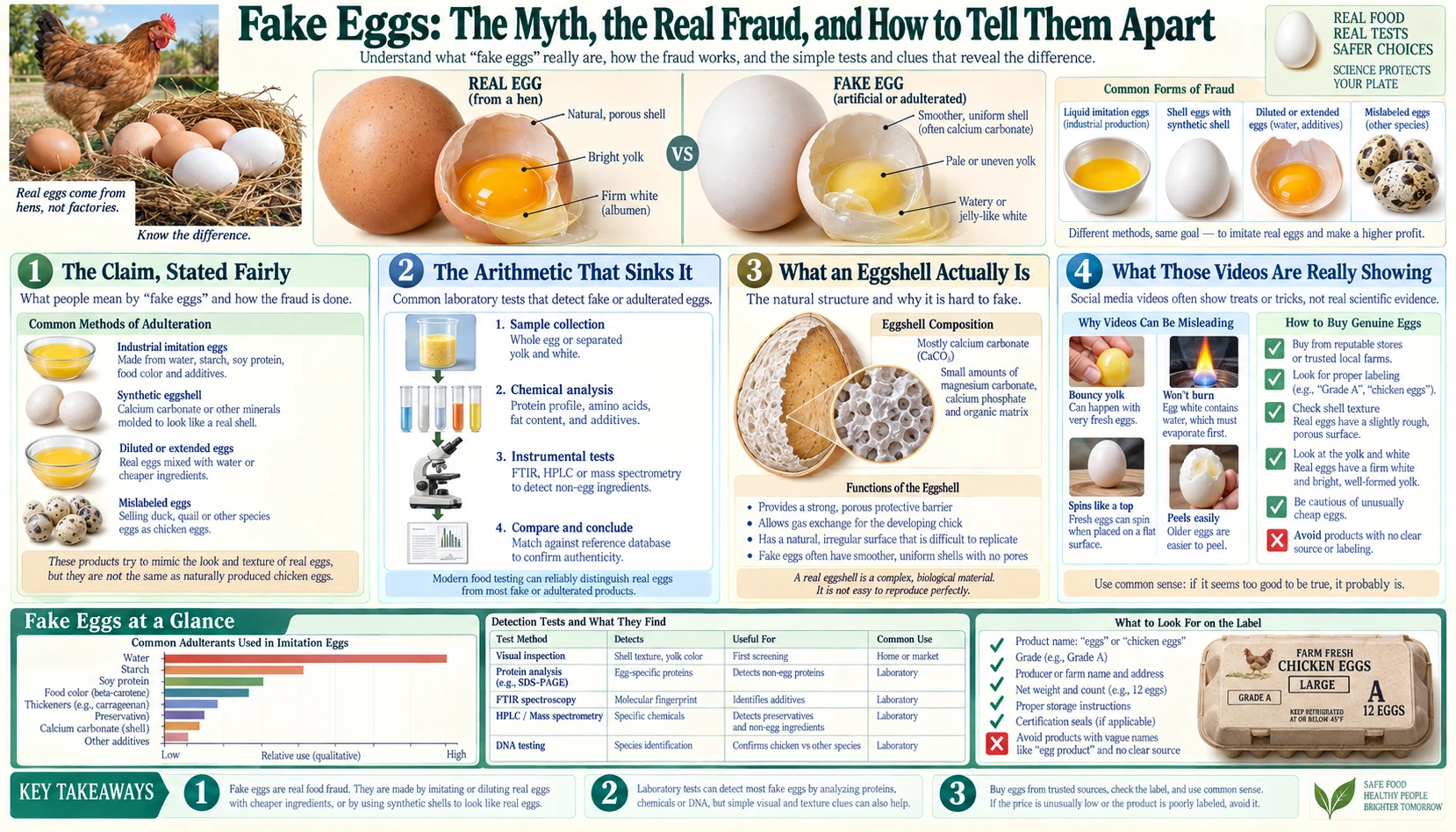
There are two stories about fake eggs. One of them is enormously popular, has been circulating for the better part of two decades, and is essentially false. The other is real, is prosecuted regularly in several countries, costs shoppers a great deal of money every year, and almost nobody talks about it.
The popular story is that eggs are being manufactured from chemicals — a gelled yolk, a synthetic white, a moulded calcium-carbonate shell — and sold in ordinary shops. The real story is far more mundane and far more common: an egg from a caged hen, physically identical to any other egg, sold in a carton that says free-range, pasture-raised or organic, at two or three times the price. Nothing has been faked about the egg. What has been faked is its history.
This page does both jobs. It takes the manufactured-egg claim seriously enough to explain properly why it does not hold up, because dismissing a widely believed thing without showing the working persuades nobody. Then it sets out the documented fraud — what the labels legally mean, what shoppers assume they mean, why the gap between the two is so profitable, and why an egg is one of the hardest foods in the shop to authenticate even in a well-equipped laboratory.
Table of Contents
- The Claim, Stated Fairly
- The Arithmetic That Sinks It
- What an Eggshell Actually Is
- What Those Videos Are Really Showing
- The Argument From the Research Literature
- The Real Fraud: Selling the Wrong Production System
- What the Labels Legally Mean
- The Stamp on Every European Egg
- Why an Egg Is So Hard to Authenticate
- Yolk Colour Is a Diet Signal, and It Is Managed
- Does the System Change the Egg? Honestly.
- Liquid and Powdered Egg: Where Adulteration Is Real
- When the Feed Is the Problem
- Freshness, Dates and the Float Test
- What a Shopper Can Actually Do
- The Bottom Line
- Key Research Papers
- Connections
- Featured Videos
The Claim, Stated Fairly
The manufactured-egg story is specific, which is part of why it is convincing. In its usual form it goes like this. A yolk is made by dropping a mixture of sodium alginate, water, gelatin and a yellow colouring into a calcium chloride bath, where the alginate gels on contact into a sphere with a skin. A white is made from the same alginate chemistry without the colour. The two are assembled inside a two-part mould, and a shell is built up from calcium carbonate, paraffin wax and gypsum. The finished object is said to be indistinguishable from a real egg until you crack it, at which point the yolk bounces, the white is slippery, and the whole thing smells faintly of chemicals when fried.
Every step of that description is chemically real. Spherification with alginate and a calcium bath is genuine food science, used deliberately in modern cooking to make gelled spheres that look like yolks or caviar. That is exactly why the story travels: nothing in it is impossible, and anybody who has seen a cookery demonstration knows the technique works.
The story nevertheless does not describe anything that is happening in your supermarket, for reasons that have nothing to do with chemistry and everything to do with cost. Let us do the arithmetic, because it is the whole argument.
The Arithmetic That Sinks It
Food fraud is a business. It happens where a cheap thing can be made to pass as an expensive thing, and the size of the gap between the two is what pays for the deception. That is why the classic frauds are in saffron, in high-grade olive oil, in premium fish, in aged spirits and in infant formula — all products where the genuine article costs many times the substitute.
An egg is the opposite of that in every respect.
The real thing is one of the cheapest protein foods on earth
A hen converts feed into a complete, sterile, individually packaged, self-preserving protein serving, and does it roughly 300 times a year with no labour beyond collection. At the farm gate, an ordinary egg is worth a few cents. There is no meaningful margin to steal, because there is barely any margin in the object at all.
The counterfeit is a precision manufacturing job
Now price the fake. To fool anybody past the first second you would need: a mineralised shell of the right thickness, curvature, porosity, surface texture and acoustic response; two shell membranes underneath it; an air cell at the blunt end; a thin outer albumen and a structurally different thick albumen surrounding the yolk; two chalazae anchoring the yolk in position; a yolk with an intact vitelline membrane, a germinal disc, and the concentric light-and-dark layering that a hen deposits over the days the yolk develops; and the correct weight distribution so it does not feel wrong in the hand or behave wrongly when spun.
Each of those is a separate process step with its own materials, moulds, tolerances and reject rate. And the whole assembly has to be produced for less than a few cents to be worth doing, in a clandestine facility, with no economies of scale, using food-grade inputs that individually cost more per kilogram than eggs do.
The conclusion
It is not that a convincing counterfeit egg is impossible. It is that it would be a luxury item. Anyone with the equipment and skill to mass-produce one has far more profitable things to counterfeit, starting with almost every other product in the shop. Fraud follows margin, and there is no margin here.
This is the same reasoning that tells you nobody is counterfeiting bags of flour or bottles of tap water, and it is a reliable first filter for any food-fraud claim you encounter: who is making money, and how much? If the answer is “nobody, and none,” the claim needs extraordinary evidence.
What an Eggshell Actually Is
The shell deserves its own section, because the manufactured-egg story treats it as the easy part — just calcium carbonate in a mould — and it is in fact the hardest part.
An eggshell is about 95% calcium carbonate, but the phrase “calcium carbonate” does most of the deceiving in that sentence. It is not chalk poured into a shape. It is a protein-templated biomineral composite: an organic matrix of specialised proteins, secreted in a precise sequence in the hen's uterus, controls where crystals nucleate, which crystal faces grow, how the columns of calcite orient themselves, and where the several thousand gas-exchange pores are left open. Modern work on the avian eggshell has catalogued that protein toolkit in detail and shown how tightly the mineral phase is controlled by it (Gautron 2021). More striking still, the calcium is delivered not as dissolved ions precipitating on a surface but in vesicles carrying amorphous calcium carbonate that is subsequently converted to crystalline calcite in place — a mineralisation route that had not previously been described in vertebrates (Stapane 2020).
The practical consequence is what matters here. The shell's strength comes from that microstructure, not from its bulk composition. A shell moulded from calcium carbonate powder and a binder would have the right chemistry and the wrong everything else: it would ring wrong when tapped, break wrong under pressure, feel wrong under a fingernail, and either seal the egg completely or leak, because the pores are not something you can approximate. Shell thickness, breaking force, shell deformation and cuticle thickness are all routinely measured in the egg industry to a precision that a moulded imitation would not survive for a moment.
None of this proves a counterfeit is impossible. It explains why the counterfeit would have to be expensive, which is the argument in the previous section, reached from a different direction.
What Those Videos Are Really Showing
If the manufactured egg is a myth, the videos still need explaining — people are genuinely finding eggs that behave oddly. Almost all of it is ordinary egg physics, and most of it is documented in the food-science literature.
The bouncing, rubbery yolk: freezing
This is the single commonest cause. Egg yolk that has been frozen and thawed undergoes irreversible gelation: the low-density lipoprotein structure aggregates as ice crystals concentrate the salts around it, and the yolk sets into a rubbery, sliceable mass that does not return to liquid. It will bounce. It will peel. It will not mix properly into a batter. This is a well-characterised phenomenon that the food industry manages routinely by adding salt or sugar to yolk before freezing it precisely to prevent it (PubMed: freeze-induced yolk gelation). An egg that spent a night against the back wall of a cold refrigerator, or a winter night in an unheated van, is a frozen egg.
The watery white: age and warmth
A fresh egg has two visibly different whites — a stiff, cloudy thick albumen that stands up around the yolk, and a thin runny layer outside it. With time and warmth, the thick albumen breaks down and spreads out. The egg goes flat in the pan and the white runs. This is measured formally as the Haugh unit, computed from albumen height and egg weight, and it falls steadily with storage. A comprehensive study of egg quality across short and long storage at different temperatures documents exactly how fast, and how much temperature dominates the outcome (Bermudez-Aguirre 2026). A parallel study across two breeds found the same temperature dependence and showed that the bird's genetics also shift the baseline (Rizzi 2026).
The tough yolk membrane that peels: also age
The vitelline membrane around the yolk weakens with storage as water migrates into the yolk from the white, which is why an old yolk breaks when you try to separate it. But a yolk from an egg stored cold for a long time can go the other way and become noticeably tougher and more rubbery to handle. Either way, the yolk you can pick up and roll between your fingers is an old yolk, not a synthetic one.
The smell and the chalky look: pH drift and moisture loss
An eggshell is porous by design. Over time carbon dioxide diffuses out and the albumen becomes markedly alkaline — a fresh white sits near pH 7.6 and an old one can approach pH 9. Water evaporates outward at the same time, enlarging the air cell. Assessments of retail table eggs routinely record this pH drift alongside the physical quality decline (Hemeda 2025). Alkaline egg white tastes and smells different, and cooks differently. Coating an egg to slow that gas exchange measurably preserves quality, which is the mirror-image demonstration that the gas exchange is what is driving the change (Akarca 2021).
The shell that peels or looks odd
Eggs are sometimes coated with a thin food-grade mineral oil or wax after washing, to replace the natural cuticle that washing removes. That coating can be peeled off in a sheet by a determined person with a fingernail, and it looks exactly like the “plastic film” in the videos. It is doing a real job: an unwashed egg keeps its cuticle and a washed one needs a substitute.
The Argument From the Research Literature
There is one more line of evidence, and it is quietly the strongest.
Food authenticity is an active, well-funded research field. When a fraud is real, a detection literature grows around it — that is what happened with melamine in milk within months of 2008, and it is what has happened with olive oil grade fraud, honey syrup addition, fish species substitution and meat speciation. The literature is a reasonably faithful map of what regulators and industry are actually worried about, because that is who funds it.
Search that literature for eggs and you find a substantial, growing body of work on exactly one problem: verifying an egg's production system and origin. Nuclear magnetic resonance profiling of yolk to classify housing systems. Non-targeted lipidomics to separate organic from conventional. Near-infrared spectroscopy for provenance. Stable isotope analysis to check feed and region. Machine learning on physical quality traits. All of it aimed at the question “did this egg come from where the box says?”
What you do not find is a detection literature for synthetic shell eggs. No validated methods, no proficiency schemes, no survey studies, no recovered samples characterised in a journal. If counterfeit eggs were reaching retail in any country in any quantity, that literature would exist, because building it would be straightforward and somebody's funding would depend on it.
An absence of evidence is not by itself proof of absence — but for a claim this old, this widely repeated and this easy to test, the silence of the analytical literature is close to decisive. Meanwhile the production-system fraud that is real has generated a decade of published method development, which is the next half of this page.
The Real Fraud: Selling the Wrong Production System
Here is the fraud that actually happens, stated in one sentence: an egg laid by a caged hen is put into a carton labelled free-range, pasture-raised or organic, and sold for two to four times what it is worth.
Every structural condition for a successful fraud is present at once, which is why this one persists where the manufactured-egg story never got started.
- The price gap is large and permanent. Producing an egg outdoors or organically costs genuinely more — more land, more feed, more labour, more disease risk, more birds lost. The retail premium reflects that. So the gap between the cheap product and the expensive one is wide, stable and known in advance.
- The two products are physically the same object. Unlike a diluted oil or a substituted fish, there is no foreign material to find and no missing component to measure. Both items are entirely genuine hen eggs.
- The claim is about history, not composition. “Free-range” describes something that happened to a bird months ago, in a place the shopper will never see. History leaves only faint traces in the product.
- Substitution needs no processing at all. The fraud is a decision about which pallet goes into which box. There is no factory step to detect, no residue, no equipment.
- Verification is documentary. Enforcement mostly consists of checking whether the number of premium eggs leaving a packing centre could plausibly have come from the number of premium hens declared. It is an audit of paperwork against flock records, and paperwork can be written.
The research community states the motive without any hedging. A Belgian study of egg authentication opens by noting that eggs from outdoor housing systems sell at a higher price than conventional eggs and that this price difference creates an incentive for potential fraud, which is why cost-effective authentication methods are needed (Van Nerom 2026). A German study makes the same point about organic eggs specifically: the legal requirements for organic husbandry make production more expensive, and that increases the risk of food fraud (Lösel 2023).
What the Labels Legally Mean
Most of the value in this page is in this section, because the gap between what these words are defined to mean and what shoppers hear them mean is where the money is. The terms differ considerably between jurisdictions.
In the United States
Cage-free. The hens are not in cages. They are typically in a large barn, at high density, and they may never go outside. The term says nothing about space per bird, outdoor access, or flock size. It is a real and meaningful change in one respect — the birds can walk, perch and stretch their wings — and it is not what most shoppers picture.
Free-range. Uncaged, with some access to the outdoors. Within the federal shell-egg grading programme, which is voluntary, this is a label claim a producer can ask to have verified. What the federal claim does not fix is how much outdoor space, for how long, of what kind, or how many birds share the door. A barn with a small covered porch that the birds rarely use can satisfy it.
Pasture-raised. This is the important one: there is no federal definition of “pasture-raised” for eggs at all. The words are worth what the certifying scheme behind them is worth. The major third-party welfare certifications do define it, typically specifying a substantial minimum outdoor area per bird — commonly on the order of a hundred square feet each, with rotation requirements — and those schemes audit against their standards. But an unaccompanied “pasture-raised” claim on a carton, with no certifier's mark, is a marketing phrase and nothing more. This is precisely the term that commands the highest premium.
Organic. The one term on this list that is legally defined and federally enforced, under the National Organic Program. It requires certified organic feed, no antibiotics, no hormones, and outdoor access. Note what it is and is not: organic certification is primarily about inputs, and the outdoor-access requirement has been the subject of long-running argument over how it is interpreted in practice. Organic is a real claim with real auditing behind it; it is not a synonym for pasture.
Farm fresh, natural, hen-happy, and similar. Undefined. They mean nothing and carry no obligation.
No hormones added. Technically true and completely uninformative. Hormones are not permitted in poultry production in the United States, so this is true of every egg on the shelf. A label that boasts about complying with a universal prohibition is telling you about its marketing department.
Omega-3 enriched. A genuine feed-based claim — adding flaxseed or algal sources to the ration does raise yolk omega-3 content. The amount varies widely between products and is worth reading rather than assuming.
In the European Union
The definitions are tighter, mandatory rather than voluntary, and attached to numbers. Under the marketing standards for eggs, “free-range” requires continuous daytime access to open-air runs that are mainly covered with vegetation, with an outdoor stocking density not exceeding one hen per four square metres. Indoor density in non-cage systems is capped at nine hens per square metre of usable area. Barren battery cages have been prohibited since 2012; the enriched cages that replaced them must provide a nest, litter, perches and a claw-shortening device along with a defined minimum area per bird.
Whether those numbers describe a life you would want for a hen is a separate question, and a fair one. The point here is narrower: they are numbers, they are mandatory, and they can be audited, which makes the corresponding fraud a matter of provable fact rather than of interpretation.
The Stamp on Every European Egg
The European Union does one thing here that no other major market does, and it is worth knowing about even if you shop elsewhere, because it is the clearest example of what real traceability looks like on a consumer product.
Every egg sold in the EU is individually stamped with a code, and the code is not decorative. The first digit is the production system:
- 0 — organic
- 1 — free-range
- 2 — barn (indoors, uncaged)
- 3 — cage
After it come a two-letter country code and then the registered identifier of the individual production establishment. So a stamp reads as a sentence: this system, this country, this farm. The registration scheme behind the establishment codes exists specifically so that every laying-hen holding in the Union is enumerated and tied to a declared production method.
Three things make this powerful. It is on the egg itself, not on the box, so re-boxing an egg does not change what it says. It is mandatory, not a voluntary claim. And it makes the fraud arithmetically checkable: an establishment registered for a given number of hens in a given system can only produce so many eggs bearing that code, and a packing centre shipping more of them than its suppliers could have laid has a problem it cannot explain away.
That is not a claim that EU egg fraud does not happen — it does, and the code is what makes the cases provable. It is a claim that stamping the product itself is a genuinely better design than certifying the carton, and the contrast with a voluntary carton-level claim is instructive.
Why an Egg Is So Hard to Authenticate
Suppose you are handed an egg with no packaging and asked which system it came from. This turns out to be genuinely difficult, and the published attempts are worth walking through, because their failures are more informative than their successes.
Physical measurements: mostly a dead end
The most direct approach is to measure the egg. A Belgian team did this at unusual scale: 33,216 eggs from 76 commercial farms, measured for weight, shell breaking force, shell deformation, shell thickness, cuticle thickness, albumen height, Haugh unit and yolk colour, then classified indoor against outdoor with machine learning. The best model reached 76.6% accuracy. A model using yolk colour alone reached 74.1% — almost all of the signal came from one variable. The authors' own conclusion is the honest one and deserves quoting in substance: accuracy was moderate, the best predictor was yolk colour, its value as a screening tool “has to be nuanced” because yolk colour is driven by diet and may simply be correlated with management practice, and egg quality parameters appear robust and little affected by the housing system (Van Nerom 2026).
Read that again, because it is the crux of this page. The physical egg barely knows which system it came from. That is exactly what makes the fraud attractive, and it is why the answer had to come from somewhere other than a set of calipers.
Molecular profiling: much better, with a warning attached
Going deeper works. A non-targeted lipidomic method using liquid chromatography with ion-mobility mass spectrometry, built on 270 egg samples, classified organic against conventional eggs with 96.3% accuracy; the variables that carried the signal turned out to be carotenoids and specific lipids — that is, the chemical shadow of what the hen ate. A far cheaper infrared screening method on the same samples reached 80% (Lösel 2023). That two-tier structure — cheap screening, expensive confirmation — is how authenticity testing works everywhere.
A German group took the largest sample set yet published for this problem: 4,188 egg yolks from four breeds across colony cage, barn, free-range and organic systems, profiled by proton NMR and classified with several machine-learning methods (Bischof 2024). Their models worked on the reference set. Then they tested them on eggs bought from ordinary shops, and at most 62.8% of those were classified into the system printed on the box.
That number is arresting and it is very easy to misuse, so here is the careful reading. It is not an estimate that a third of shop eggs are mislabelled. The authors do not claim that, and they explicitly conclude the opposite kind of thing — that more authentic reference samples are needed to account for breed, feeding and changes of housing. A model trained on four breeds under known conditions is being asked about eggs from unknown breeds on unknown diets; the disagreements are far more likely to be the model's limits than the labels' honesty. What the result genuinely shows is that this problem is not solved, and that a laboratory cannot yet look at an arbitrary supermarket egg and tell you where it came from. Reporting it as a fraud rate would be exactly the sort of confident misreading this page exists to argue against.
Stable isotopes: the method with the firmest footing
The most robust approach does not look at the egg's structure at all but at the isotopic signature the hen's diet left in it. Ratios of heavy to light carbon, nitrogen, oxygen and sulphur vary with feed crop, fertiliser regime and geography, and they pass into the egg. Multi-isotope work on regional and organic animal products has shown this can support identification of both origin and production system (Gatzert 2023). Nitrogen isotope ratios are particularly useful against organic claims, because synthetic and manure-derived nitrogen carry different signatures and organic rules govern precisely that. Near-infrared spectroscopy with chemometrics has been applied to the provenance question as a rapid screen (Hoffman 2022), and the broader reviews of spectroscopic authentication of animal-origin foods (Chaudhary 2022) and of biomarker approaches across the category (Thomas 2025) set out where the field stands.
What this all adds up to
Egg authentication is a live research problem rather than a solved one. The methods that work well are expensive and are run on samples somebody already suspected. The cheap ones lean on yolk colour, which — as the next section explains — is the one thing a dishonest producer can trivially control.
Yolk Colour Is a Diet Signal, and It Is Managed
Ask anyone how to spot a good egg and they will say: look for a deep orange yolk. It is the most trusted visual cue in the shop, and it is close to worthless as a guide to welfare or nutrition.
Where the colour comes from
Hens cannot synthesise carotenoids. Every molecule of pigment in a yolk was eaten. A hen on maize, alfalfa, grass and marigold-derived pigments lays a deep yellow-orange yolk; a hen on wheat and barley lays a pale one. The colour is therefore a faithful report of one thing only — the carotenoid content of the ration — and only an indirect, breakable proxy for anything else.
And it is a controlled industrial variable
Yolk colour is not left to chance anywhere in commercial production. It is specified, measured against a numbered colour fan, and hit by adjusting the feed, because different markets expect different shades and packers must deliver consistency. The pigments used include natural xanthophylls and approved synthetic carotenoids, of which canthaxanthin is the best known. Canthaxanthin is an authorised feed additive in the European Union with a maximum permitted content, and the safety and efficacy assessment behind that authorisation sets out both the permitted levels and the pigmentation effect (EFSA FEEDAP 2014). Feeding trials show the deposition is orderly and dose-dependent — microencapsulated canthaxanthin raises yolk colour score and yolk canthaxanthin concentration predictably (Wen 2022) — and a meta-analysis across brown-egg layers examined its effects on production more broadly (Umar Faruk 2018).
Nor does it require an additive at all. Simply changing the maize supplies the pigment: hens fed a biofortified orange maize laid eggs with markedly higher yolk xanthophyll density and deeper pigmentation than hens on ordinary maize (Ortiz 2021).
The consequence, stated bluntly
A hen in a cage, fed a pigmented ration, lays a deeper orange yolk than a hen on pasture with poor forage. Yolk colour can be dialled to any value the buyer wants, in any production system, for a trivial cost. It tells you the ration was rich in carotenoids. It does not tell you the bird went outside, and it does not tell you the egg is more nutritious. Consumers reading colour as a quality signal are reading a variable that the producer sets.
The irony is worth stating: the cheapest authentication method in the literature leans mainly on yolk colour, and yolk colour is the single easiest parameter for a dishonest producer to control. The Belgian authors flagged this themselves as the reason their result has to be nuanced.
The illegal version
Where approved pigments are expensive or unavailable, illegal industrial dyes have been used instead — principally the Sudan azo dyes, which are carcinogenic and forbidden in food, and which have turned up in paprika used in animal feeding to deepen yolk colour. The evidence on how much actually reaches the egg is genuinely surprising and worth knowing. A controlled transfer study fed laying hens rations contaminated with Sudan I at three concentrations up to 42 mg/kg; residues appeared in yolk only at the highest dose, at about 0.29 µg/kg — far below what the compound's properties would have predicted (Piątkowska 2018). Two conclusions follow, and they point in opposite directions: the practice is a poor way to colour an egg, and testing eggs for these dyes is a poor way to detect contaminated feed. The control point is the feed, not the egg. More on colourants under Food Dyes.
Does the System Change the Egg? Honestly.
If cage eggs are being sold as free-range, the obvious question is what the buyer lost. The honest answer is: less than the price difference implies, and less than most people assume — though not nothing.
The retail survey
The most directly relevant study sampled United Kingdom retail eggs across four production systems — caged, free-range, organic and extensive organic — and measured fatty acids, carotenoids and vitamins, across seasons (Chatzidimitriou 2024). The findings are precise, and each one is worth stating as the authors found it:
- Production system did not alter vitamin D3, vitamin B2 or vitamin B9 content at all. The widely repeated claim that free-range eggs are a notably better source of vitamin D did not hold in this dataset.
- It did significantly influence fatty acids, carotenoids, and vitamins A and E, with concentrations decreasing as production intensity increased. So there is a real gradient, running in the expected direction.
- But for most of those measures, caged and free-range eggs did not differ significantly from each other. The gradient was mostly between the intensive systems and the extensive organic end, not between the two categories the fraud actually swaps.
- Organic and extensive organic were similar for vitamin E and fatty acids, with carotenoids higher in the extensive organic eggs.
- Season mattered more than expected. Vitamins A, D3 and B2 fluctuated through the year — D3 and B2 higher in July than January — while fatty acids, carotenoids, vitamin E and B9 were steady. The month you buy an egg can matter as much as the system it came from.
The controlled comparison
A direct comparison of enriched cages against free-range in late-lay hens found something the retail survey did not: total lipids and cholesterol were unaffected by system, but free-range yolks had lower monounsaturated and higher polyunsaturated fatty acids, with a more favourable omega-6 to omega-3 ratio (Peng 2024). Earlier work on rearing and feeding systems similarly found differences in the oxidative characteristics of yolk lipids between systems (Pignoli 2009).
Reconciling them
These are not contradictory; they are measuring different things. A controlled trial holds breed, age and everything else constant and isolates the system, so a real effect shows up. A retail survey samples whatever the market actually contains, where feed formulation varies enormously within each system and swamps the between-system difference. Both are true, and together they say something useful: the system sets a possibility, and the ration decides the outcome. A well-fed caged hen can out-produce a poorly fed free-range one on any nutrient you care to name, because the nutrient came from the feed either way.
What was actually stolen
So when a caged egg is sold as free-range, the buyer usually loses very little nutritionally. What they lose is the thing they were actually paying for: a welfare standard and a farming practice. That is a real loss and a real deception. It is simply not a nutritional one, and the case against this fraud does not need to be dressed up as a health scare to be strong. If you buy free-range or organic eggs for animal-welfare reasons, substitution takes away the entire thing you bought. That is the honest indictment.
One genuine health-relevant difference is worth noting separately, and it does not favour either side simply: housing system influences Salmonella risk in laying flocks in complicated, well-reviewed ways, with cage and non-cage systems each carrying distinct infection dynamics rather than one being straightforwardly safer (Van Hoorebeke 2011).
Liquid and Powdered Egg: Where Adulteration Is Real
Everything above concerns shell eggs, where the object's own integrity is a defence. Break the shell and that defence is gone. Liquid whole egg, liquid white, liquid yolk and dried egg powder are commodity ingredients sold by the tonne into baking, food manufacture and catering, and they are adulterated in the ordinary way — because at that point they are just a liquid sold on specification, and everything on the Fake Milk page applies again.
The documented adulterations of liquid egg fall into three groups, and a study that set out to build rapid tests for each is a good map of the territory (Yang 2024):
- Water dilution — the universal fraud, detectable in that work by simple colorimetry in about a minute per sample.
- Manipulating the yolk-to-white ratio in whole egg — yolk is the expensive fraction, so shifting the ratio toward white while selling the product as whole egg is straightforward margin. An electrochemical method resolved this in about six minutes per sample.
- Blending different varieties of egg white or yolk — substituting a cheaper source into a product sold as something more specific, which the authors addressed with an interfacial fingerprinting technique.
The work carries a published correction (erratum, 2025), which is worth citing alongside it rather than quietly ignoring.
Two further points about processed egg. Species substitution — duck or quail egg standing in for hen, or the reverse where one carries a premium — is invisible once the shell is gone and is addressed by the same DNA and peptide methods used for milk speciation. And an ingredient sold as egg but partly replaced by starch, gum or a cheaper protein is an allergen problem as much as an economic one, in both directions: someone avoiding egg may get it, and someone avoiding a substituted ingredient will not know it is there.
When the Feed Is the Problem
An egg is a concentrated report on what a hen ate about a day earlier. That makes feed the control point for both quality and contamination, and it is where several real incidents have originated.
Melamine, again
The same compound that defined milk fraud reappears here, by a different route: melamine added to protein feed ingredients to inflate their apparent protein content passes into the hen and into her eggs. This has been measured directly. Feeding studies established that melamine residues appear in eggs from hens on contaminated feed (Yang 2011), characterised the distribution between eggs, plasma and tissues (Gallo 2012), and examined what a melamine-contaminated diet does to tissue distribution, blood variables and egg quality together (Suchý 2014). The lesson generalises: a fraud committed against a feed buyer becomes a contamination event in a food.
Veterinary and pesticide residues
The largest European egg incident of recent years was not adulteration but the illegal use of an insecticide in poultry-house red-mite treatment, which contaminated eggs across many countries and led to very large-scale withdrawals. It illustrates the same structure from a different angle: an input applied to the hen, not to the egg, and an egg that looks entirely normal (PubMed: insecticide contamination of eggs).
And the honest note about enrichment
The same feed leverage that creates these problems is what makes deliberate enrichment work. Omega-3 eggs, higher-carotenoid eggs and higher-vitamin eggs are all produced by changing the ration, and they do what they claim. That is legitimate product design, clearly labelled, and it is not fake food — it is the same mechanism, used honestly.
Freshness, Dates and the Float Test
Date and freshness relabelling is a documented food fraud across many products, and eggs are an easy target because the object is undated once it leaves the box. It is worth understanding what an egg's age actually does to it, since that is the one thing you genuinely can assess at home.
What ageing is, physically
An egg loses water and carbon dioxide through the shell's pores. Three things follow: the air cell at the blunt end grows; the albumen becomes alkaline; and the thick albumen thins so the egg spreads out in the pan. Storage temperature drives all of it — the difference between refrigerated and ambient storage is much larger than the difference between one week and two (Bermudez-Aguirre 2026).
The float test: real, and widely misunderstood
Place an egg in water. A very fresh one lies flat on the bottom; an older one tilts upward; an old one stands on end; a very old one floats.
This works, and the mechanism is exactly what it appears to be — it is measuring the size of the air cell, which grows as water evaporates out. But be clear about what it is not measuring. It is an age test, not a safety test. A floating egg is old and has usually lost a good deal of eating quality; it is not necessarily spoiled. A sinking egg is young; it is not thereby guaranteed free of contamination, since a hen infected internally lays a contaminated egg that is perfectly fresh. Use the float test to decide whether to poach an egg or hard-boil it — older eggs peel better — not to decide whether it is safe.
Two national systems, and why they differ
In the United States, shell eggs are washed and sanitised, which removes the natural cuticle and leaves the pores exposed, so refrigeration from packing onward is required. In much of Europe, eggs are not washed, the cuticle remains, and eggs are stored and sold at ambient temperature. Both systems are coherent; they simply make opposite trade-offs about the cuticle. The practical implication for a traveller is that the two must not be mixed: a washed egg needs the cold chain it was designed for, and refrigerating an unwashed egg and then leaving it out causes condensation on the shell, which is its own problem.
What a Shopper Can Actually Do
Stop reading yolk colour as quality
It is the most trusted cue and the most easily manipulated variable in the entire product. Deep orange means a carotenoid-rich ration and nothing else. Unlearning this one thing is the single most useful outcome of this page.
Look for the certifier, not the adjective
“Pasture-raised” with an audited third-party certification mark is a claim somebody stands behind. “Pasture-raised” alone, in a nice typeface, is a phrase. The difference between those two cartons is the entire difference between a standard and a suggestion, and they often sit side by side at similar prices.
Read the code on the egg where there is one
Where eggs are individually stamped, the mark is on the object rather than the packaging, and the first digit tells you the production system directly. It is the best consumer-facing traceability in the food supply, and it costs nothing to glance at.
Shorten the chain
Eggs from a named farm, a farmers' market or a producer you can ask are not automatically better eggs, but the claim and the person making it are attached to each other. Every fraud on this page depends on distance between the hen and the buyer.
Treat an impossible price as impossible
Producing eggs outdoors genuinely costs more, everywhere, for reasons that do not vary much. Premium-labelled eggs at close to commodity prices are explained by a promotion, a short date, or a substitution — and it is worth knowing which.
Buy the age you need
Very fresh eggs poach beautifully and peel terribly. Eggs a couple of weeks old peel cleanly. This is genuine, useful, and has nothing to do with fraud — but it is the practical skill that the float test is actually for.
Do not try to run an authenticity test in your kitchen
The production-system fraud is undetectable at home because it is undetectable in a well-equipped laboratory more often than not. No amount of examining the yolk, the shell, the white or the way it fries will tell you whether the hen went outside. Anyone who tells you otherwise is selling something.
The Bottom Line
- The manufactured “plastic egg” is a myth. The chemistry in the story is real, but a convincing counterfeit shell egg would cost far more to make than the egg it imitates. Fraud follows margin, and eggs have none.
- The videos show real eggs behaving badly. Frozen and thawed yolk gels irreversibly and bounces. Old albumen thins and runs. Old whites go alkaline and smell wrong. Oiled or waxed shells peel. All documented, none synthetic.
- The silence of the research literature is the strongest evidence. There is a decade of published method development on verifying an egg's production system and none at all on detecting synthetic eggs. Researchers build detection methods for frauds that exist.
- The real fraud is production-system mislabelling — cage eggs sold as free-range, pasture-raised or organic. Large price gap, physically identical product, a claim about history rather than composition, and no processing step to detect.
- “Pasture-raised” has no federal definition in the United States. It is worth exactly as much as the certifier behind it, and it commands the highest premium of any egg claim.
- The European stamp is the model. A code on the egg itself, mandatory, with the production system as the first digit and the farm identified — which makes the fraud arithmetically checkable rather than a matter of opinion.
- Yolk colour is set by the feed and can be dialled to any value. A caged hen on a pigmented ration lays a deeper orange yolk than a pasture hen on poor forage. It is not a welfare signal and it is not a nutrition signal.
- The nutritional loss from the fraud is small; the loss is real anyway. A retail survey found no effect of system on vitamin D3, B2 or B9, and mostly no significant difference between caged and free-range. What a substituted egg steals is the welfare standard the buyer paid for — which is a sufficient indictment without inventing a health scare.
- Break the shell and ordinary adulteration begins. Liquid and powdered egg are diluted with water, shifted in yolk-to-white ratio, and blended from cheaper sources — with allergen consequences on top of the economic ones.
Key Research Papers
Authenticating an egg's production system and origin
- Van Nerom S, De Grande A, Heim R, Delezie E, Buyse K. Research note: a machine learning approach for authentication of laying hen housing systems based on egg quality parameters. Poultry Science. 2026;105(9):107219. — 33,216 eggs from 76 farms; 76.6% accuracy overall, 74.1% from yolk colour alone, and the authors' own conclusion that egg quality parameters are little affected by housing system. — PubMed PMID: 42302604
- Bischof G, Januschewski E, Juadjur A. Authentication of laying hen housing systems based on egg yolk using 1H NMR spectroscopy and machine learning. Foods. 2024;13(7):1098. — the largest reference set published (4,188 yolks); supermarket samples matched their printed system in at most 62.8% of cases, which the authors read as a limit of the model rather than a fraud rate. — PubMed PMID: 38611402
- Lösel H, Brockelt J, Gärber F, et al. Comparative analysis of LC-ESI-IM-qToF-MS and FT-NIR spectroscopy approaches for the authentication of organic and conventional eggs. Metabolites. 2023;13(8):882. — 96.3% accuracy by non-targeted lipidomics against 80% by infrared screening, with carotenoids and lipids carrying the signal. — PubMed PMID: 37623826
- Hoffman LC, Ni D, Dayananda B, et al. Unscrambling the provenance of eggs by combining chemometrics and near-infrared reflectance spectroscopy. Sensors. 2022;22(13):4988. — a rapid, low-cost screening layer for the provenance question. — PubMed PMID: 35808484
- Gatzert X, Chun KP, Hermanowski R, et al. Application of multiple stable isotopes to aid identification of the origin of regional and organic animal products in Hesse, Germany. Isotopes in Environmental and Health Studies. 2023;59(4–6):490–510. — the isotope approach applied to organic and regional claims. — PubMed PMID: 37981783
- Chaudhary V, Kajla P, Dewan A, et al. Spectroscopic techniques for authentication of animal origin foods. Frontiers in Nutrition. 2022;9:979205. — where the spectroscopic toolkit stands across the category. — PubMed PMID: 36204380
- Thomas R, Sharma D, Thomas R, et al. Exploring potential biomarkers in foods of animal origin. Journal of Food Science and Technology. 2025;62(10):1825–1841. — biomarker strategies for verifying animal-origin food claims. — PubMed PMID: 40917218
- Everstine KD, Chin HB, Lopes FA, Moore JC. Database of food fraud records: summary of data from 1980 to 2022. Journal of Food Protection. 2024;87(3):100227. — four decades of documented incidents, categorised by product and fraud type. — PubMed PMID: 38246523
Does production system change the egg?
- Chatzidimitriou E, Davis H, Baranski M, et al. Variation in nutritional quality in UK retail eggs. Food Chemistry. 2024;454:139783. — system did not alter vitamin D3, B2 or B9; it did influence fatty acids, carotenoids and vitamins A and E, but caged and free-range mostly did not differ significantly from each other. — PubMed PMID: 38795627
- Peng M, Tavaniello S, Banaszak M, et al. Comparison of fatty acid profile in egg yolk from late-age hens housed in enriched cages and in a free range system. Animals. 2024;14(7):1099. — no difference in total lipids or cholesterol; a real difference in the polyunsaturated fraction and the omega-6 to omega-3 ratio. — PubMed PMID: 38612338
- Pignoli G, Rodriguez-Estrada MT, Mandrioli M, et al. Effects of different rearing and feeding systems on lipid oxidation and antioxidant capacity of freeze-dried egg yolks. Journal of Agricultural and Food Chemistry. 2009;57(24):11517–11527. — system and ration both leave a measurable mark on yolk lipid chemistry. — PubMed PMID: 20000852
- Van Hoorebeke S, Van Immerseel F, Haesebrouck F, et al. The influence of the housing system on Salmonella infections in laying hens: a review. Zoonoses and Public Health. 2011;58(5):304–311. — the risk picture is genuinely complicated and does not favour one system simply. — PubMed PMID: 20875073
Yolk colour: pigments, feed additives and illegal dyes
- EFSA Panel on Additives and Products or Substances used in Animal Feed (FEEDAP). Scientific opinion on the safety and efficacy of canthaxanthin as a feed additive for poultry and for ornamental birds and ornamental fish. EFSA Journal. 2014;12(1):3527. — the authorisation and the permitted levels behind managed yolk colour. — PubMed PMID: 42125100
- Wen C, Xu X, Zhou D, et al. The effects of canthaxanthin microencapsulation on yolk color and canthaxanthin deposition in egg yolk of laying hens. Poultry Science. 2022;101(6):101889. — colour as a dose-dependent, controllable output. — PubMed PMID: 35504065
- Umar Faruk M, Roos FF, Cisneros-Gonzalez F. A meta-analysis on the effect of canthaxanthin on egg production in brown egg layers. Poultry Science. 2018;97(1):84–87. — the pigment's wider effects, pooled across trials. — PubMed PMID: 29077922
- Ortiz D, Lawson T, Jarrett R, et al. Biofortified orange corn increases xanthophyll density and yolk pigmentation in egg yolks from laying hens. Poultry Science. 2021;100(7):101117. — deep colour achieved by changing the maize, with no additive at all. — PubMed PMID: 34102484
- Piątkowska M, Jedziniak P, Olejnik M, et al. Absence of evidence or evidence of absence? A transfer and depletion study of Sudan I in eggs. Food Chemistry. 2018;239:598–602. — the illegal dye transfers into yolk far less than expected, so testing eggs is a poor way to police feed. — PubMed PMID: 28873610
Processed egg, feed contamination and freshness
- Yang S, Yang F, Dou W, Chi Y, Chi Y. Testing adulterated liquid-egg: developing rapid detection techniques based on colorimetry, electrochemistry, and interfacial fingerprinting. Food Chemistry. 2024;444:138674. — the three real liquid-egg adulterations and a rapid method for each. — PubMed PMID: 38335687
- Yang S, Yang F, Dou W, Chi Y, Chi Y. Corrigendum to “Testing adulterated liquid-egg…”. Food Chemistry. 2025;469:142694. — the published correction to the paper above. — PubMed PMID: 39765430
- Yang T, Huangfu WG, Wu YL. Melamine residues in eggs of laying hens exposed to melamine-contaminated feed. Poultry Science. 2011;90(3):701–704. — feed fraud becoming food contamination. — PubMed PMID: 21325245
- Gallo A, Bertuzzi T, Battaglia M, Masoero F, et al. Melamine in eggs, plasma and tissues of hens fed contaminated diets. Animal. 2012;6(7):1163–1169. — where the compound goes once the hen has eaten it. — PubMed PMID: 23031478
- Suchý P, Novák P, Zapletal D, Straková E. Effect of melamine-contaminated diet on tissue distribution of melamine and cyanuric acid, blood variables, and egg quality in laying hens. British Poultry Science. 2014;55(3):375–379. — residues and egg quality assessed together. — PubMed PMID: 24730385
- Bermudez-Aguirre D, Carter J, Juneja VK, Niemira BA. A comprehensive study of chicken eggs quality in short- and long-term storage under different temperatures. Foods. 2026;15(16):2850. — how fast an egg ages, and how completely temperature governs it. — PubMed PMID: 42650543
- Rizzi C. A study on the effect of breed and storage temperature on quality of eggs laid by two local Italian hen breeds. Animals. 2026;16(12):1808. — genetics shifts the baseline, temperature drives the decline. — PubMed PMID: 42353419
- Hemeda S, Abdallh M, Ibrahim B, Ali E. Assessment of bacterial contamination, physical quality, and internal pH (albumen and yolk) of table eggs in Khartoum North. Scientific Reports. 2025;15(1):39663. — the pH drift and physical decline measured together in retail eggs. — PubMed PMID: 41224819
- Akarca G, Istek Ö, Tomar O. The effect of resin coating on the quality characteristics of chicken eggs during storage. Journal of Food Science. 2021;86(4):1243–1257. — sealing the pores slows the ageing, which shows what the ageing is. — PubMed PMID: 33761140
How an eggshell is actually made
- Gautron J, Stapane L, Le Roy N, Nys Y, et al. Avian eggshell biomineralization: an update on its structure, mineralogy and protein tool kit. BMC Molecular and Cell Biology. 2021;22(1):11. — the protein machinery that controls where and how the mineral forms. — PubMed PMID: 33579194
- Stapane L, Le Roy N, Ezagal J, et al. Avian eggshell formation reveals a new paradigm for vertebrate mineralization via vesicular amorphous calcium carbonate. Journal of Biological Chemistry. 2020;295(47):15853–15869. — calcium delivered in vesicles as an amorphous phase, then converted in place. — PubMed PMID: 32816992
Standards, regulations and other sources
- Commission Delegated Regulation (EU) 2023/2465 as regards marketing standards for eggs. EUR-Lex — the current EU marketing standards, replacing Regulation (EC) No 589/2008.
- Commission Regulation (EC) No 589/2008 laying down detailed rules for marketing standards for eggs. EUR-Lex — the long-standing text in which the free-range stocking-density conditions were set out.
- Council Directive 1999/74/EC laying down minimum standards for the protection of laying hens. EUR-Lex — the barren-cage prohibition, the enriched-cage requirements and the nine-hens-per-square-metre indoor limit.
- Council Directive 2002/4/EC on the registration of establishments keeping laying hens. EUR-Lex — the establishment-code scheme that makes the stamp on each egg traceable to a farm.
- United States Code of Federal Regulations, 7 CFR Part 56: Voluntary Grading of Shell Eggs. eCFR — note the word “voluntary”: this is the programme under which label claims are verified on request.
- United States Code of Federal Regulations, 7 CFR Part 57: Inspection of Eggs (Egg Products Inspection Act). eCFR — the mandatory side, covering restricted eggs and egg products.
- United States Code of Federal Regulations, 7 CFR Part 205: National Organic Program. eCFR — the one United States egg claim with a legal definition and enforcement behind it.
- United States Code of Federal Regulations, 21 CFR Part 118: Production, Storage and Transportation of Shell Eggs. eCFR — the egg safety rule behind United States washing and refrigeration practice.
- United States Department of Agriculture, Agricultural Marketing Service. Organic Rules and Regulations. AMS organic regulations index — the administering programme for the organic claim.
Connections
- Fake Food — The section hub: adulteration, dilution, mislabelling and grade fraud
- Fake Beef — The same sell-the-wrong-history fraud, in the meat case
- Fake Milk — Melamine, watering and the lesson about testing a proxy
- Fake Olive Oil — Grade fraud, where nothing foreign is added and every purity test passes
- Eggs — Nutrition, physiology and health effects of the genuine article
- Egg Nutrients — What is actually in an egg, nutrient by nutrient
- Egg Benefits — The evidence for what eggs do, in depth
- Pasture vs Cage-Free — The production systems compared on their merits
- Lutein, Zeaxanthin and Eyes — The carotenoids that colour the yolk, and what they do
- The Cholesterol Myth Revisited — Another egg belief that did not survive the evidence
- Choline and the Brain — The nutrient eggs supply better than almost anything else
- Chicken — The same bird, the same production systems, the same label questions
- Vitamin A — One of the vitamins that varied with production system
- Vitamin D — The one the retail survey found unaffected by housing
- Food Dyes — Approved colourants, banned azo dyes, and where the line sits
- Food Additives — What is deliberately added to food and feed, and under what rules
- Pesticides — How an input applied to the animal ends up in the product
- Ultra-Processed Foods — When the processing itself is the problem
- Honey — Another food where the fraud is about origin rather than substance
- Lab Tests — The laboratory methods behind these detections, explained
- Food — The complete food library