Pasture vs Cage-Free Eggs — Decoding the Labels
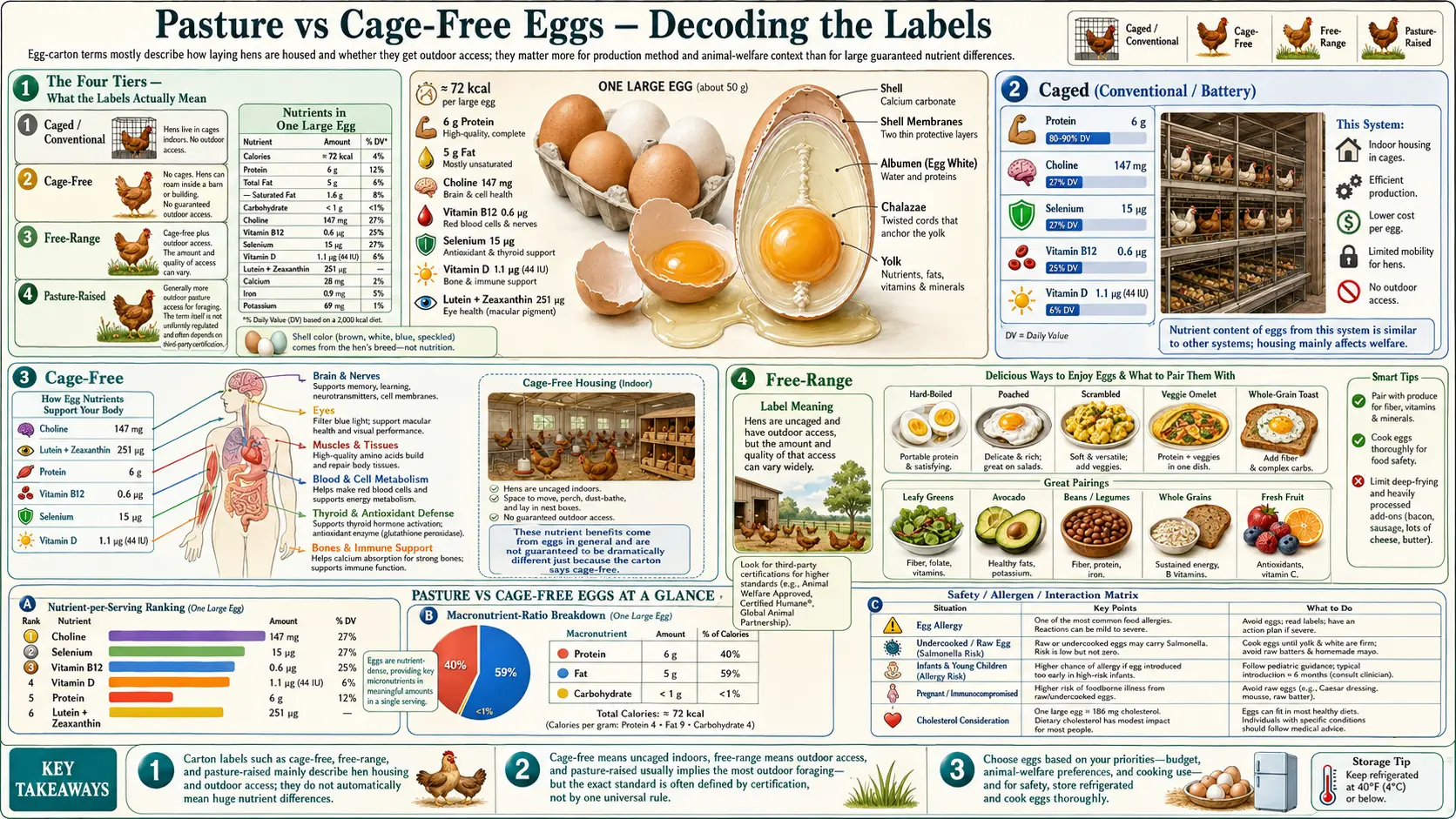
Egg cartons in the US use four common housing terms — caged, cage-free, free-range and pasture-raised. Their meanings come from different places: USDA grading and organic rules, and private animal-welfare certifiers whose standards set their own space requirements. Peer-reviewed comparisons of eggs by housing system are few and differ in design. In a 6-week cross-over trial, eggs of pastured hens had twice the vitamin E and long-chain omega-3 fat and 2.5-fold the total omega-3 of eggs from caged hens fed only commercial mash (Karsten 2010); in a 4-week randomized trial, sunlight-exposed hens laid eggs with three- to fourfold more yolk vitamin D3 than indoor hens (Kühn 2014); and in a range-access study with identical feed, omega-3 rose slightly while cholesterol, vitamin A and vitamin E did not change (Anderson 2011). This page sets out what each label requires under the published standards and what the studies measured.
Table of Contents
- The Four Tiers — What the Labels Actually Mean
- Caged (Conventional / Battery)
- Cage-Free
- Free-Range
- Pasture-Raised
- What "Organic" Requires Outdoors
- A Widely Cited Magazine Survey (Not Peer-Reviewed)
- Peer-Reviewed Evidence (Karsten, Anderson, Kühn, Van Duinen)
- The Omega-6 to Omega-3 Ratio Shift
- The Vitamin D Mystery (UVB Exposure)
- Price, Production and What the Studies Did Not Measure
- Label Claims and the Standards Behind Them
- Key Research Papers
- Connections
- Featured Videos
The Four Tiers — What the Labels Actually Mean
Egg-carton housing terms in the US come from several sources: the USDA Agricultural Marketing Service (AMS), which grades eggs and approves the labels on cartons bearing its grade shield; the USDA organic regulations (7 CFR part 205); the FDA egg safety rule (21 CFR part 118), which covers food safety rather than housing; and private animal-welfare certifiers, whose standards set their own numerical space requirements. The four common housing terms are caged, cage-free, free-range and pasture-raised.
The four tiers as they are usually described:
- Caged (conventional): hens housed in cages. US federal grading rules reviewed for this page set no cage-space figure; the European Union's laying-hen directive (Council Directive 1999/74/EC) set at least 550 cm² of cage area per hen for unenriched cages and prohibited rearing hens in them from 1 January 2012.
- Cage-Free: hens uncaged but housed indoors. AMS offers a "Certified Cage Free" grade-shield design that may appear only on eggs that are both officially graded and certified by USDA as sourced from cage-free flocks. One private certifier's laying-hen standard sets 1.5 sq ft per bird in a single-level barn, 1.2 sq ft with raised slats and 1.0 sq ft in a multi-tier aviary.
- Free-Range: hens with access to an outdoor area. The same certifier's standard defines free range as daily access to an uncovered outdoor area, weather permitting, with at least 2 sq ft of outdoor space per bird.
- Pasture-Raised: hens kept on vegetated pasture. The same certifier's "Pasture Raised" standard requires at least 2.5 acres (1 hectare) per 1,000 birds — listed in its housing appendix as 108 sq ft per bird — with year-round outdoor access, a written rotational grazing plan, housing at night, and no more than 14 consecutive days of continuous indoor confinement.
The peer-reviewed comparisons below suggest that nutrient differences track what the hens eat and whether they are actually outdoors in sunlight, not the label alone. In one trial, free-range eggs bought from supermarkets had relatively low vitamin D, and the authors noted the vitamin D gain depends on farming conditions being attractive enough for hens to range outside (Kühn 2014).
Caged (Conventional / Battery)
In conventional cage systems hens are kept in groups inside wire cages. The EU directive's requirements for the "enriched" cages it still permits show what unenriched cages lacked: each hen must have at least 750 cm² of cage area (600 cm² usable), a nest, litter that allows pecking and scratching, and at least 15 cm of perch.
Caged eggs are the usual comparison group in the studies on this page. In Karsten et al. (2010) the caged comparison hens received only commercial hen mash; in Kühn et al. (2014) the comparison was hens kept indoors without sunlight. The nutrient differences those studies report are covered in the sections below.
Eggs from caged hens still supply protein, choline and B vitamins; the egg's general nutrient profile is covered on the Eggs Nutrients page.
Cage-Free
"Cage-free" means hens are not in cages; it does not by itself mean they go outdoors. Under the private certifier standard described above, cage-free barns provide 1.0–1.5 sq ft per bird depending on the barn design, and the base standard does not require outdoor access.
Studies that change only the housing, with the same feed, find modest differences. A Colombian commercial-farm study (Rodríguez-Hernández et al. 2024) split Hy-Line Brown hens at 16 weeks into conventional-cage and cage-free housing on the same farm, fed both groups the same diet, and analysed 3,960 eggs from 22 to 82 weeks of age. Cage-free eggs had higher yolk pigmentation, Haugh units and albumen height between 38 and 69 weeks; caged eggs had stronger shells from 57 to 82 weeks. Differences in yolk fatty acids were limited to a few individual fatty acids at particular ages; the abstract does not report a difference in omega-3 content.
The welfare differences between housing systems are a separate question from egg composition; the studies on this page measured composition only.
Free-Range
Free-range systems add access to an outdoor area. How much the hens use it, and how much forage is there, varies by farm. Two studies measured free-range or range eggs directly:
- Anderson (2011): 500 Hy-Line Brown hens were hatched together and received the same care and feed, the only difference being access to range. Range eggs had more total, monounsaturated and polyunsaturated fat, and more omega-3 fatty acids (0.17% vs 0.14%). Cholesterol did not differ (163.42 vs 165.38 mg/50 g in caged vs range eggs), and vitamins A and E were not affected by housing. The same egg pool sent to four laboratories gave significantly different results for every nutrient except cholesterol.
- Kühn et al. (2014): hens kept outdoors or with an indoor/outdoor option laid eggs with three- to fourfold more vitamin D3 in the yolk than hens kept indoors; free-range eggs bought from supermarkets had relatively low vitamin D (details in the vitamin D section below).
Pasture-Raised
None of the federal texts reviewed for this page (AMS grading, 7 CFR part 205, 21 CFR part 118) defines "pasture-raised" for eggs. Numerical meaning comes from private certifier standards; the one described above requires 108 sq ft (2.5 acres per 1,000 birds) of pasture that consists mainly of living vegetation, with periodic rotation under a written plan and a maximum walking distance of 400 yards from the pasture fence to the nearest house door.
Pasture access lets hens eat a range of plants and insects, which researchers expect to change egg composition (Van Duinen et al. 2025). Peer-reviewed measurements:
- Karsten et al. (2010): compared with eggs of caged hens fed only commercial mash, eggs of pastured hens (also given 70 g of commercial mash per bird per day) had twice as much vitamin E and long-chain omega-3 fat, 2.5-fold more total omega-3 fatty acids, and less than half the omega-6:omega-3 ratio. Vitamin A concentration was 38% higher, but total vitamin A per egg did not differ.
- Kühn et al. (2014): sunlight-exposed hens' yolks had three- to fourfold more vitamin D3 than indoor hens' yolks.
- Van Duinen et al. (2025): in a pasture-based flock in Southern Ohio sampled monthly from May to December, vitamin A, vitamin E, carotenoids and omega-3 levels all varied by month.
Karsten et al. also reported that at the end of their trial the pastured hens weighed 14% less and averaged 15% lower hen-day egg production than the caged hens.
What "Organic" Requires Outdoors
USDA organic eggs must come from hens managed under 7 CFR part 205. Among its requirements: the total feed ration must be certified organic (§ 205.237(a)); producers may not use animal drugs, including hormones, to promote growth, feed mammalian or poultry slaughter by-products to poultry, or provide feed to which any antibiotic has been added (§ 205.237(b)); products from animals treated with antibiotics may not be sold as organic (§ 205.238(c)(1)); excluded methods (genetic engineering) are prohibited (§ 205.105); and beak trimming after 10 days of age is prohibited (§ 205.238(a)(5)(ii)).
Outdoor access was the contested point. In the 2023 Organic Livestock and Poultry Standards final rule (88 FR 75394), AMS wrote that some operations and certifying agents had interpreted the older general requirement for outdoor access as satisfied by screened, elevated patio structures known as "porches," while other certifiers required outdoor space with soil and vegetation. The rule as now codified in § 205.241:
- requires year-round access to the outdoors, direct sunlight and materials for dust bathing, and prohibits continuous total confinement indoors (temporary confinement is allowed for listed reasons, including air temperatures under 32 °F or above 90 °F);
- counts enclosed porches and lean-to structures as indoor space, not outdoor space;
- requires at least 75% of outdoor space to be soil, with vegetative cover appropriate for the season, climate and geography;
- sets outdoor space for layers at no less than 1 sq ft per 2.25 lb of bird, or alternatively at least 3.0 sq ft per bird;
- sets indoor stocking density by housing type, from at least 1.5 sq ft per bird (mobile and aviary housing) to at least 3.0 sq ft per bird ("other" housing).
Layer operations certified before January 2, 2025 have until January 2, 2029 to comply with the outdoor stocking density and soil-and-vegetation requirements. The organic rule's outdoor minimum (3.0 sq ft per bird) is far smaller than the 108 sq ft in the private pasture-raised standard described above, so "organic" and "pasture-raised" describe different things and can appear together or separately on a carton.
A Widely Cited Magazine Survey (Not Peer-Reviewed)
Many popular articles on pastured eggs quote a set of multiples (for omega-3, vitamin E, beta-carotene, vitamin D, cholesterol and saturated fat) from a 2007 survey run by a US magazine, which sent eggs from pastured flocks for laboratory analysis. The survey was not published in a peer-reviewed journal, and its figures are not repeated on this page.
Anderson (2011) is a reminder of why method matters in egg-composition work: when one egg pool was split and sent to four laboratories, the laboratory had a significant effect on every nutrient measured except cholesterol, with total fat ranging from 6.76% to 8.88%. The peer-reviewed studies in the next section each compared eggs analysed under the same design.
Peer-Reviewed Evidence (Karsten, Anderson, Kühn, Van Duinen)
The peer-reviewed literature comparing eggs by housing system is small, and designs differ.
- Karsten et al. (2010), Renewable Agriculture and Food Systems. Cross-over design: 75 sister hens were rotated, two weeks each, across three pasture types (alfalfa, red and white clover, mixed cool-season grasses), with 70 g of commercial hen mash per bird per day; 50 sister hens were fed only commercial hen mash in cages for the whole 6 weeks. Pastured hens' eggs had twice as much vitamin E and long-chain omega-3 fat, 2.5-fold more total omega-3 fatty acids, and less than half the omega-6:omega-3 ratio of caged hens' eggs. Vitamin A concentration was 38% higher, but total vitamin A per egg did not differ. Hens foraging grasses laid eggs with 23% more vitamin E than hens foraging clover.
- Anderson (2011), Poultry Science. 500 Hy-Line Brown hens with identical care and feed except range access. Range eggs had more total, monounsaturated and polyunsaturated fat and slightly more omega-3 (0.17% vs 0.14%); cholesterol, vitamin A and vitamin E did not differ by housing.
- Kühn et al. (2014), Nutrition. Hens randomly assigned to indoor, outdoor or indoor/outdoor groups (33–34 hens each) for 4 weeks. Yolk vitamin D3 averaged 14.3 µg/100 g dry matter outdoors, 11.3 with the indoor/outdoor option and 3.8 indoors — three- to fourfold higher with sunlight exposure.
- Van Duinen et al. (2025), PLOS One. Monthly sampling of a regenerative pasture-based flock in Southern Ohio from May to December. Vitamin A was highest in late summer; vitamin E rose across the season to 118.1 µg/g fresh yolk in November; total omega-3 was highest in September and October. Eggs from September to November had higher vitamins A and E, more omega-3 and a more favourable omega-6:omega-3 balance than eggs from other months.
- Rodríguez-Hernández et al. (2024), Animals. Conventional cage vs indoor cage-free housing with the same diet; differences in egg quality measures and in a few individual fatty acids (described in the Cage-Free section).
- Lopez-Bote et al. (1998), Animal Feed Science and Technology. An earlier Spanish study of the effect of free-range feeding on n-3 fatty acid and alpha-tocopherol (vitamin E) content and the oxidative stability of eggs; its abstract could not be retrieved for this review, so its results are not summarised here.
Across these studies:
- Vitamin E and omega-3 were higher in pastured eggs in Karsten 2010; in Anderson 2011, range access raised omega-3 slightly and did not change vitamin E.
- Vitamin A concentration was higher in pastured eggs in Karsten 2010 but total vitamin A per egg did not differ; Anderson 2011 found no housing effect.
- Vitamin D3 rose three- to fourfold with sunlight exposure in Kühn 2014.
- Composition of pasture eggs changed by month in Van Duinen 2025.
- Cholesterol did not differ by housing in Anderson 2011.
None of these studies measured health outcomes in people eating the eggs.
The Omega-6 to Omega-3 Ratio Shift
A 2002 review by Simopoulos estimated that humans evolved on a diet with an omega-6:omega-3 ratio of approximately 1, compared with 15/1–16.7/1 in Western diets, and argued that a lower ratio is associated with lower risk of several chronic diseases; the review notes that the optimal ratio may vary with the disease under consideration.
For eggs, Karsten et al. (2010) reported that pastured hens' eggs had less than half the omega-6:omega-3 ratio of caged hens' eggs, and Van Duinen et al. (2025) found the ratio in pasture eggs varied by month. Hens can also be given omega-3-rich feed: in Goldberg et al. (2012), caged hens fed diets with hempseed oil or hempseed for 12 weeks laid eggs with up to 15.3 mg/g of total omega-3 in the yolk (12% hempseed oil diet) vs 2.4 mg/g in controls, with no significant differences in aroma or flavour except sweetness.
The research on omega-3 fatty acids more broadly is covered on the Omega-3 Fatty Acids page.
The Vitamin D Mystery (UVB Exposure)
In people, UVB radiation converts 7-dehydrocholesterol in the skin to previtamin D3, which becomes vitamin D3 (reviewed by Holick 2007). The Kühn et al. (2014) trial attributes the higher vitamin D3 in eggs from outdoor hens to sunlight exposure.
The trial's design and results:
- Laying hens were randomly assigned to three groups of 33 to 34 hens, kept indoors, outdoors, or with an indoor/outdoor option, for 4 weeks.
- Yolk vitamin D3 averaged 14.3 µg/100 g dry matter in the outdoor group, 11.3 µg/100 g in the indoor/outdoor group and 3.8 µg/100 g in the indoor group (P < 0.001).
- Yolk 25-hydroxyvitamin D3 was also affected by sunlight exposure, though less markedly.
- Free-range eggs bought at random from supermarkets had relatively low vitamin D content.
The authors concluded that free-range farming can produce vitamin D-enriched eggs "provided that farming conditions are sufficiently attractive for hens to range outside." The trial reported vitamin D per 100 g of yolk dry matter, not per egg.
The research on vitamin D more broadly is covered on the Vitamin D3 page.
Price, Production and What the Studies Did Not Measure
Housing systems differ in land, labour and feed, and egg prices vary by region and over time; the studies on this page did not report prices, and none is given here.
Points the studies do report that bear on the comparison:
- Production. In Karsten et al. (2010), pastured hens weighed 14% less and averaged 15% lower hen-day egg production than caged hens by the end of the trial; the authors noted pastured hens may have lower body weight and production unless supplemented to meet their energy and protein needs.
- Season. Van Duinen et al. (2025) found that pasture-egg composition changed month by month, so a single measurement does not describe a farm's eggs year-round.
- Laboratory. Anderson (2011) found the laboratory doing the analysis significantly affected the results for every nutrient except cholesterol.
- Outdoor use. Kühn et al. (2014) found supermarket free-range eggs had relatively low vitamin D, and tied the vitamin D gain to hens actually ranging outside.
- Health outcomes. None of the studies measured health outcomes in people eating eggs from different housing systems.
Label Claims and the Standards Behind Them
The housing claims on a carton rest on different kinds of standards:
- USDA grade shield: only eggs officially graded by USDA may bear the grade shield, and every label bearing the shield needs AMS pre-approval. The "Certified Cage Free" shield design may appear only on eggs both officially graded and certified by USDA as sourced from cage-free flocks.
- USDA Organic (7 CFR part 205): organic feed, no antibiotics, no growth-promoting hormones, no excluded methods, year-round outdoor access, at least 3.0 sq ft of outdoor space per bird (or 1 sq ft per 2.25 lb of bird), at least 75% soil outdoors with vegetative cover, and porches counted as indoor space.
- Private animal-welfare certifiers: each publishes its own standard. The one described on this page (its 2023 laying-hen standard) sets cage-free indoor space of 1.0–1.5 sq ft per bird, free range at 2 sq ft of outdoor space per bird with daily access weather permitting, and pasture raised at 108 sq ft (2.5 acres per 1,000 birds) with year-round access and rotation. Other certifiers' figures differ.
- FDA egg safety rule (21 CFR part 118): applies to producers with 3,000 or more laying hens at a farm that do not sell all their eggs directly to consumers, whatever the housing system. It requires a written Salmonella Enteritidis prevention plan (SE-monitored pullets, biosecurity, rodent and fly control, cleaning and disinfection, testing) and holding and transporting eggs at or below 45 °F ambient temperature beginning 36 hours after lay.
The numerical requirements above come from the organic regulations and from the private standards that set them; among the federal texts reviewed for this page, only the organic rule sets numerical outdoor space for laying hens.
Key Research Papers
- Karsten HD, Patterson PH, Stout R, Crews G (2010). Vitamins A, E and fatty acid composition of the eggs of caged hens and pastured hens. Renewable Agriculture and Food Systems. 25(1):45-54. — doi:10.1017/S1742170509990214
- Anderson KE (2011). Comparison of fatty acid, cholesterol, and vitamin A and E composition in eggs from hens housed in conventional cage and range production facilities. Poult Sci. 90(7):1600-8. — PubMed PMID: 21673178
- Van Duinen R, Sergin S, Chavva S, Adams JK, Bitler CA, Fenton JI (2025). Seasonal variation in egg nutrient composition under a pasture-based layer hen system: Implications for sustainable agriculture. PLoS One. 20(9):e0332411. — PubMed PMID: 40997024
- Kühn J, Schutkowski A, Kluge H, Hirche F, Stangl GI (2014). Free-range farming: a natural alternative to produce vitamin D-enriched eggs. Nutrition. 30(4):481-4. — PubMed PMID: 24607306
- Rodríguez-Hernández R, Rondón-Barragán IS, Oviedo-Rondón EO (2024). Egg Quality, Yolk Fatty Acid Profiles from Laying Hens Housed in Conventional Cage and Cage-Free Production Systems in the Andean Tropics. Animals (Basel). 14(1):168. — PubMed PMID: 38200899
- Lopez-Bote CJ, Sanz Arias R, Rey AI, Castano A, Isabel B, Thos J (1998). Effect of free-range feeding on n-3 fatty acid and alpha-tocopherol content and oxidative stability of eggs. Anim Feed Sci Technol. 72(1-2):33-40. — doi:10.1016/S0377-8401(97)00180-6
- Goldberg EM, Gakhar N, Ryland D, Aliani M, Gibson RA, House JD (2012). Fatty acid profile and sensory characteristics of table eggs from laying hens fed hempseed and hempseed oil. J Food Sci. 77(4):S153-60. — PubMed PMID: 22429187
- Sirri F, Iaffaldano N, Minelli G, Meluzzi A, Rosato MP, Franchini A (2007). Comparative pigmentation efficiency of high dietary levels of apo-ester and marigold extract on quality traits of whole liquid egg of two strains of laying hens. J Appl Poult Res. 16(3):429-37. — doi:10.1093/japr/16.3.429
- Simopoulos AP (2002). The importance of the ratio of omega-6/omega-3 essential fatty acids. Biomed Pharmacother. 56(8):365-79. — PubMed PMID: 12442909
- Holick MF (2007). Vitamin D deficiency. N Engl J Med. 357(3):266-81. — PubMed PMID: 17634462
- Hu FB, Bronner L, Willett WC, Stampfer MJ, Rexrode KM et al. (2002). Fish and omega-3 fatty acid intake and risk of coronary heart disease in women. JAMA. 287(14):1815-21. — PubMed PMID: 11939867
- Iannotti LL, Lutter CK, Stewart CP, Gallegos Riofrío CA, Malo C et al. (2017). Eggs in early complementary feeding and child growth: a randomized controlled trial. Pediatrics. 140(1):e20163459. — PubMed PMID: 28588101
Regulations and Standards
- US Code of Federal Regulations, 7 CFR part 205 (National Organic Program), §§ 205.105, 205.237, 205.238, 205.241 — eCFR: 7 CFR part 205
- USDA Agricultural Marketing Service (2023). National Organic Program; Organic Livestock and Poultry Standards. Final rule. 88 FR 75394 (November 2, 2023) — Federal Register 2023-23726
- US Code of Federal Regulations, 21 CFR part 118 (Production, Storage, and Transportation of Shell Eggs), §§ 118.1, 118.4 — eCFR: 21 CFR part 118
- USDA Agricultural Marketing Service. Egg grade shields (Certified Cage Free design) — AMS: grade shields
- Council Directive 1999/74/EC laying down minimum standards for the protection of laying hens, Articles 5–6 — EUR-Lex 31999L0074
- A private animal-welfare certifier's Animal Care Standards for egg-laying hens (2023 edition), Part 4 and Appendix 4 (certifier not named, per site policy).