Interstitial Cystitis / Bladder Pain Syndrome
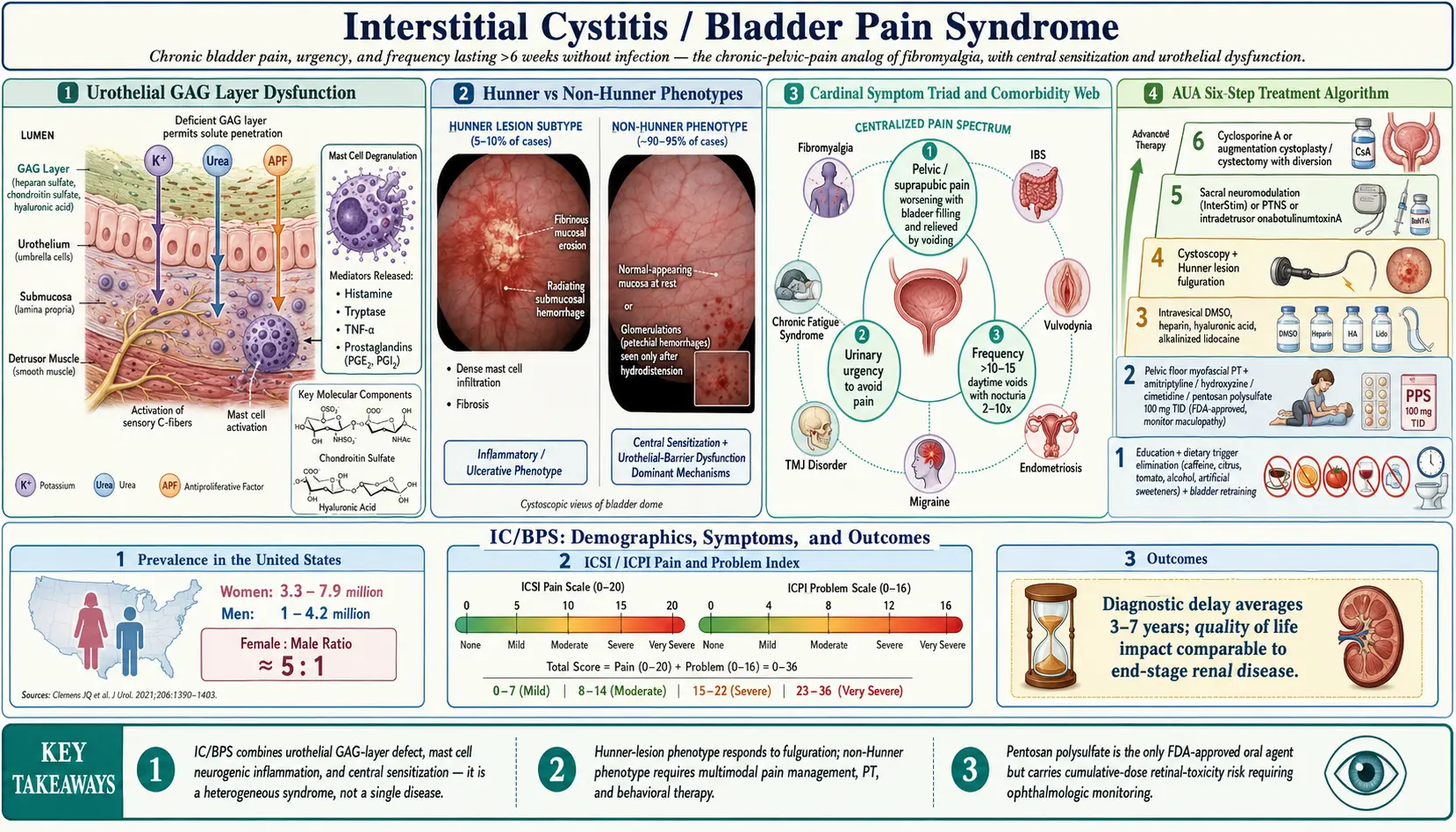
Table of Contents
1. Overview
Interstitial Cystitis / Bladder Pain Syndrome (IC/BPS) is a chronic condition of the urinary bladder marked by pelvic pain, pressure or discomfort together with urinary frequency and urgency, without infection or another identifiable cause. The 2011 American Urological Association (AUA) guideline adopted the definition agreed by the Society for Urodynamics and Female Urology: “An unpleasant sensation (pain, pressure, discomfort) perceived to be related to the urinary bladder, associated with lower urinary tract symptoms of more than six weeks duration, in the absence of infection or other identifiable causes.” The panel chose it because it allows treatment to begin after a relatively short symptomatic period.
IC/BPS is defined by pain. A review of the published evidence by Offiah and colleagues (2013) lists frequency, urgency and pain on bladder filling as the most common symptoms, and the high-specificity case definition used in the RAND Interstitial Cystitis Epidemiology (RICE) study required pain that worsened as the bladder filled. The condition often occurs alongside irritable bowel syndrome, fibromyalgia, chronic fatigue syndrome, migraine, panic attacks and depression (see Epidemiology).
The 2022 AUA guideline describes IC/BPS as a heterogeneous clinical syndrome with subgroups or phenotypes, and it contains separate statements on cystoscopy for patients with Hunner lesions. In a Swedish series of 130 patients with classic (Hunner lesion) disease and 101 with nonulcer disease, the nonulcer patients were younger at diagnosis and at symptom onset, and bladder capacity under general anesthesia differed markedly between the groups; the authors concluded that the two subtypes are separate entities.
2. Epidemiology
The RAND Interstitial Cystitis Epidemiology (RICE) study screened 146,231 United States households by telephone between 2007 and 2009. By its high-sensitivity case definition 6.53% of adult women met symptom criteria, and by its high-specificity definition 2.70% did — 3.3 to 7.9 million women aged 18 or older. Their symptom severity and impact were comparable to those of women with an established diagnosis, yet only 9.7% reported having been given an IC/BPS diagnosis, which the authors read as evidence that the condition may be underdiagnosed.
The RICE male study applied the same approach to men. Weighted prevalence was 4.2% by the high-sensitivity definition and 1.9% by the high-specificity definition, about 2.1 million United States men by the latter; 17% of the men meeting either the high-specificity IC/BPS definition or the chronic prostatitis/chronic pelvic pain syndrome (CP/CPPS) definition met both. The authors concluded that the prevalence of IC/BPS symptoms in men approaches that in women and that the condition may be underdiagnosed in men.
IC/BPS frequently coexists with other conditions. Of 3,397 RICE women who met the IC/BPS case definition, 2,185 reported a physician diagnosis of at least one of irritable bowel syndrome, fibromyalgia, chronic fatigue syndrome, migraine, panic attacks or depression. In a Taiwanese insurance database of 9,269 people with IC/BPS and 46,345 comparison subjects, those with IC/BPS had a higher prevalence of every comorbidity examined except metastatic cancer, with particularly high odds of neurological diseases, rheumatological diseases and mental illnesses.
3. Pathophysiology
The cause of IC/BPS is not known, and several mechanisms have been proposed.
Urothelial Glycosaminoglycan (GAG) Defect Hypothesis
One long-standing hypothesis holds that a defect in the surface glycosaminoglycan (GAG) layer of the bladder lining leaves the urothelium “leaky”, letting urine constituents reach the deeper bladder wall. In a 1991 study by Parsons and colleagues, a concentrated urea solution was placed in the bladder: 31 normal subjects absorbed 4.3% of it in 45 minutes and 56 people with interstitial cystitis absorbed 25%; those with Hunner’s ulcers absorbed 34.5% and those without ulcers 22.8%. The authors described this as the first disease associated with a leaky bladder epithelium. Pentosan polysulfate sodium, the oral drug labeled for IC bladder pain, is a semisynthetic sulfated polysaccharide, and its label describes it as a weak anticoagulant with 1/15 the activity of heparin.
Mast Cells and Inflammation
Inflammatory cells have been studied in bladder tissue for decades, with mixed results. In a 1978 review of 52 patients, Messing and Stamey found submucosal edema and vasodilation to be the characteristic histologic finding at all stages, while the presence of eosinophils and mast cells was variable.
Hunner Lesion Subtype: Local Immune Response
The 2011 AUA guideline states that the only consistent cystoscopic finding that leads to a diagnosis of IC/BPS is one or more inflammatory-appearing lesions or ulcerations, as initially described by Hunner. In bladder biopsies from 15 patients with Hunner lesion disease (ESSIC type 3C), compared with patients with overactive bladder and healthy controls, Gamper and colleagues found high expression of T- and B-cell markers, low expression of urothelial markers, focal lymphoid aggregates in the submucosa and high immunoglobulin concentrations in urine only in the Hunner lesion group, and described it as a local adaptive immune response.
Autoimmune and Systemic Associations
In the Taiwanese population study, people with IC/BPS were more likely than comparison subjects to have rheumatological diseases, including rheumatoid arthritis, systemic lupus erythematosus and ankylosing spondylitis. Messing and Stamey reported in 1978 that immunofluorescent studies and laboratory tests, including the fluorescent antinuclear antibody test, had not helped them diagnose or investigate the condition.
4. Etiology and Risk Factors
- Sex: IC/BPS has long been described as a condition of women. The RICE studies found symptom prevalence of 2.7–6.5% in women and 1.9–4.2% in men, depending on the case definition used.
- Family history: In a pilot survey of members of a patient association, Warren and colleagues estimated that adult female first-degree relatives of people with IC had a prevalence of IC about 17 times that of the general population. With earlier evidence of greater concordance in identical than in non-identical twins, the authors wrote that this suggests, but does not prove, a genetic susceptibility.
- Coexisting pain conditions: In RICE women with both IC/BPS symptoms and other conditions, bladder symptoms did not consistently begin before or after the other conditions; depression tended to begin earlier and fibromyalgia later. In a phenotyping study of 100 women, domains outside the bladder (psychosocial, neurological/systemic and tenderness) were associated with greater symptom impact.
- Autoimmune diseases: Rheumatological diseases were more common in people with IC/BPS in the Taiwanese population study.
- Depression and anxiety: In a population-based RICE sample of 1,469 women, over one third had probable depression and 52% reported recent panic attacks. In a Taiwanese cohort, people newly diagnosed with IC/BPS had about five times the risk of a depressive-disorder diagnosis in the following year compared with matched controls (hazard ratio 5.06).
5. Clinical Presentation
Symptoms often fluctuate. The 2011 AUA guideline describes strategies for managing flare-ups and stress-induced symptom exacerbations, and in a survey of 104 patients, 90.2% reported that certain foods or beverages made their symptoms worse.
Cardinal Symptoms
- Pelvic pain: The defining feature of IC/BPS, described in the guideline definition as pain, pressure or discomfort perceived to be related to the bladder. Pain that worsens as the bladder fills was one of the RICE high-specificity criteria.
- Urinary frequency and urgency: The RICE high-specificity criteria included daytime urinary frequency of 10 or more times, or urgency due to pain, pressure or discomfort rather than fear of wetting. In a Finnish series of 23 patients with refractory disease, the mean number of voids before treatment was 20.8 per 24 hours. The Offiah review reports that all urodynamic volumes are reduced in BPS.
- Nocturia: Night-time voiding is one of the outcomes measured in IC/BPS trials, for example the 2005 randomized trial of cyclosporine A and pentosan polysulfate sodium.
- Sexual dysfunction: Among RICE women with a current sexual partner (75% of the sample), 88% reported at least one general sexual dysfunction symptom and 90% at least one IC/BPS-specific sexual dysfunction symptom in the past four weeks; IC/BPS-specific sexual dysfunction was associated with more severe bladder symptoms, younger age and worse depression symptoms.
Hunner Lesion vs. Non-Hunner IC
In the Swedish series of 231 patients, those with nonulcer disease were younger at diagnosis and at symptom onset than those with classic (Hunner lesion) disease, and bladder capacity under general anesthesia differed markedly between the two groups. In the 1991 urea-absorption study, patients with Hunner’s ulcers absorbed more urea than those without, which the authors read as support for the concept that patients with ulcers have clinically worse disease. The guidelines treat Hunner lesions separately (see Treatment).
Validated Assessment Tools
- O'Leary-Sant Interstitial Cystitis Symptom and Problem Indexes (ICSI/ICPI): The 2011 AUA guideline describes this questionnaire as useful for gathering comprehensive symptom information, and lists 0–10 Likert-style and visual analog scales for pain intensity and pain body maps for patients whose presentation suggests a more global pain syndrome.
- Pelvic Pain and Urgency/Frequency (PUF) symptom scale: Used alongside the ICSI as an outcome measure in phenotyping studies and trials, including the 2009 UPOINT study and a 2020 randomized trial of Hunner lesion surgery.
- UPOINT phenotyping: A system classifying patients across six domains — urinary, psychosocial, organ-specific, infection, neurological/systemic and tenderness. In 100 consecutive women with IC/BPS, all were positive in at least two domains; a greater number of domains was associated with longer symptom duration and worse symptom and pain scores.
- ESSIC classification: In the European Society for the Study of Interstitial Cystitis (ESSIC) classification, Hunner lesion disease corresponds to type 3C, the label used in biopsy studies of this subtype.
6. Diagnosis
IC/BPS is diagnosed by its symptoms once other causes have been excluded. The 2011 AUA guideline calls for a careful history, physical examination and laboratory tests to document the symptoms and signs of IC/BPS and to exclude other disorders in the differential diagnosis.
Urinalysis and Urine Culture
The basic laboratory tests in the guideline are urinalysis and urine culture. It adds that urine cytology may be considered in people who smoke or who have unevaluated microscopic hematuria, given the risk of bladder cancer, and that a urine culture may be indicated even after a negative urinalysis to detect lower levels of bacteria. The RICE case definition likewise required that bladder symptoms had not resolved after antibiotic treatment.
Cystoscopy and Hydrodistension
The guideline describes cystoscopy and/or urodynamics as tests to consider when the diagnosis is in doubt, not as necessary for diagnosis in uncomplicated presentations. It states that there are no agreed cystoscopic findings diagnostic for IC/BPS other than Hunner lesions. Glomerulations (pinpoint petechial hemorrhages) can be consistent with IC/BPS but are commonly seen in other conditions and in people without symptoms: in 20 asymptomatic women having cystoscopy during tubal ligation, scores for these lesions rose after bladder distension to the same degree as in symptomatic patients. In the guideline, cystoscopy under anesthesia with short-duration, low-pressure hydrodistension serves to look for other causes and Hunner lesions, to treat, and to measure anatomic bladder capacity; high-pressure (above 80–100 cm H2O), long-duration (over 10 minutes) hydrodistension is listed among treatments not to be offered, because of serious adverse events such as bladder rupture and sepsis without consistently greater benefit.
Biopsy
Bladder biopsy material has been used in research to characterize Hunner lesion disease (see Pathophysiology).
Potassium Sensitivity Test (PST)
The 2011 AUA guideline states that the potassium sensitivity test has neither the specificity nor the sensitivity to change clinical decision-making and is not recommended.
Urodynamic Studies
The 2011 guideline states that there are no agreed urodynamic diagnostic criteria for IC/BPS and that urodynamic evaluation may give information about coexisting lower urinary tract symptoms. The Offiah review reports that all urodynamic volumes are reduced in patients with BPS.
7. Treatment
Earlier versions of the AUA guideline (2011, amended 2015) ranked treatments from first to sixth line. The 2022 update no longer uses tiers: it groups treatments as behavioral/non-pharmacologic, oral medicines, bladder instillations, procedures and major surgery, to stress that care is individualized. It states that, except for patients with Hunner lesions, initial treatment should typically be nonsurgical, and that concurrent, multimodal therapies may be offered. The 2011 version noted that no single treatment had been found effective for the majority of patients.
Behavioral and Non-Pharmacologic Approaches
The 2011 guideline lists education about bladder function and about what is and is not known about IC/BPS, and self-care and behavioral strategies: changing urine concentration or volume, local heat or cold, staying away from foods known to be common bladder irritants such as coffee or citrus products, an elimination diet to find foods or drinks that contribute to symptoms, stress management and bladder training. It notes that this rests on clinical experience and a limited literature. In the 104-patient survey, the most frequently reported and most bothersome items were coffee, tea, soda, alcoholic beverages, citrus fruits and juices, artificial sweeteners and hot pepper. The 2011 guideline lists manual physical therapy for pelvic, abdominal and hip muscle trigger points where trained clinicians are available, and states that pelvic floor strengthening exercises such as Kegel exercises should be avoided.
Oral Medicines
- Pentosan polysulfate sodium (PPS): A semisynthetic sulfated polysaccharide that a 2022 review describes as the only FDA-approved oral therapy for interstitial cystitis. Its label indicates it for the relief of bladder pain or discomfort associated with IC; the labeled dose is 300 mg/day as one 100 mg capsule three times daily, with reassessment after 3 months; it states that the value and risks of continuing in patients whose pain has not improved by 6 months are not known. In the label’s placebo-controlled trial, 38% of patients on the drug and 18% on placebo had more than 50% improvement in bladder pain over 3 months. In a 121-person pilot trial, response rates were 34% with PPS and 18% without (a nonsignificant trend). The label warns of retinal pigmentary changes (pigmentary maculopathy) with long-term use (see Complications).
- Amitriptyline: In a multicenter placebo-controlled trial of 271 previously untreated patients, all given an education and behavioral program, the dose was raised over 6 weeks from 10 up to 75 mg once daily. At 12 weeks, 55% on amitriptyline and 45% on placebo reported moderate or marked improvement, a difference that was not statistically significant. Among the 207 who reached at least 50 mg, response was 66% versus 47%, a subgroup comparison the authors note was not specified in advance.
- Hydroxyzine: In the 121-person pilot factorial trial, response was 31% in those given hydroxyzine and 20% in those not (not statistically significant), and there were no treatment differences on any secondary end point; the authors concluded that neither hydroxyzine nor PPS provided benefit for the majority of patients.
- Guideline listing: The 2011 guideline listed amitriptyline, cimetidine, hydroxyzine and pentosan polysulfate as second-line oral options, in alphabetical order with no hierarchy, with evidence strength Grade B or C. It states that long-term oral antibiotics should not be offered; in the trial it cites, 20% on sequential antibiotics and 16% on placebo reported 50% or greater improvement, a nonsignificant difference.
Bladder Instillations
- Dimethyl sulfoxide (DMSO): Labeled for the symptomatic relief of interstitial cystitis. The label describes instilling 50 mL into the bladder, left for 15 minutes and then voided, repeated every two weeks until maximum relief is obtained, with longer intervals afterwards.
- Heparin and lidocaine: The 2011 guideline listed dimethyl sulfoxide, heparin or lidocaine as second-line bladder instillations, in alphabetical order with no hierarchy. Bacillus Calmette-Guérin and resiniferatoxin instillations are among the treatments it states should not be offered outside research (BCG) or at all (resiniferatoxin), because trials found no benefit over placebo.
Procedures and Major Surgery
- Treatment of Hunner lesions: The 2011 guideline recommends fulguration (laser or electrocautery) and/or triamcinolone injection when Hunner lesions are present. In a randomized trial of 126 patients, transurethral resection and transurethral coagulation of the lesions gave similar recurrence-free times (12.2 and 11.5 months) and similar symptom improvement, with bladder injury in 7.9% and 3.4% respectively. In a Korean series of 240 patients managed with transurethral fulguration, 168 (70.0%) achieved pain control; repeat procedures were needed for recurrent pain, and 18 (7.5%) went on to cystectomy.
- Cyclosporine A: An immunosuppressant that the 2011 guideline listed as an option for patients whose symptoms other treatments had not controlled (Grade C evidence), adding that it is not FDA-approved for IC/BPS. In a randomized trial of 64 patients over 6 months, 1.5 mg/kg twice daily gave a 75% global response rate versus 19% for pentosan polysulfate 100 mg three times daily, with more adverse events in the cyclosporine arm. In a Finnish series of 23 patients treated for at least a year after other therapies failed, daily voids fell from 20.8 to 10.2, 20 reported no bladder pain on treatment, and symptoms recurred in most cases when the drug was stopped.
- Neuromodulation and botulinum toxin A: Also listed in the 2011 guideline for symptoms other treatments had not controlled, with the note that the evidence is limited by study quality, small samples and short follow-up.
- Major surgery: Substitution cystoplasty or urinary diversion with or without cystectomy was the 2011 guideline’s last option, for carefully selected patients whom all other therapies had failed. The guideline states that diversion relieves frequency and nocturia and sometimes pain, but that relief is not guaranteed and pain can persist even after cystectomy, especially in nonulcer disease. The 2022 update rewrote its text on major surgery.
8. Complications
- Quality-of-life impairment: In the RICE study, women meeting the symptom criteria reported severity and impact comparable to women with established diagnoses, and the authors describe the symptoms as associated with considerable disability.
- Depression and panic attacks: Over one third of a population-based RICE sample of 1,469 women had probable depression and 52% reported recent panic attacks; those with either reported worse functioning, more pain and were less likely to work because of bladder pain. In the RICE temporal-ordering study, depression tended to begin before the bladder symptoms.
- Sexual dysfunction: Reported by most RICE women with a current partner (88% general, 90% IC/BPS-specific symptoms in the past four weeks).
- Pentosan polysulfate maculopathy: The drug’s label warns that retinal pigmentary changes have been identified with long-term use; most cases occurred after 3 years of use or longer, though some after shorter use, and cumulative dose appears to be a risk factor. Reported visual symptoms include difficulty reading, slow adjustment to low light and blurred vision. The label states the changes may be irreversible and that retinal and vision changes may progress even after the drug is stopped. A 2022 review describes a strong dose-dependent association. Two large insurance-claims studies gave mixed results: one of 227,325 commercially insured patients found no association between PPS exposure and later maculopathy diagnoses, while another, of 3,012 users followed for 5 years and 1,604 for 7, found no significant association at 5 years and higher odds of a combined atypical maculopathy or dry age-related macular degeneration diagnosis at 7 years (odds ratio 1.41).
- Small, fibrotic bladder: The 2011 guideline refers to the rare end-stage small, fibrotic bladder, for which major surgery may be considered at any time, and describes hydrodistension as a way to identify patients whose capacity is reduced by fibrosis.
9. Prognosis
IC/BPS is a chronic condition. The 2011 AUA guideline notes that no single treatment has been found effective for the majority of patients and that acceptable symptom control may take trials of several options, including combinations. Long-term outcome figures depend on the subtype and treatment studied: in the Korean fulguration series, 70.0% of 240 patients with Hunner lesions achieved pain control, with repeat procedures for recurrence; in the Finnish cyclosporine series, symptoms recurred in most cases when the drug was stopped.
In the UPOINT phenotyping study, longer symptom duration was associated with a greater number of positive domains, and domains outside the bladder (psychosocial, neurological, tenderness) predicted greater symptom impact; the authors hypothesized that the system could direct multimodal therapy and improve outcomes. The RICE finding that only 9.7% of symptomatic women had been given the diagnosis points to underdiagnosis.
10. Prevention
No intervention has been shown to prevent IC/BPS. Research relevant to the course of the condition includes:
- Recognition: The RICE investigators found that most women with symptoms meeting the case definition had never been given the diagnosis. The authors of the RICE depression and panic study suggested that clinicians be alert to bladder pain in patients seeking treatment for depression or anxiety.
- Coexisting conditions: In the UPOINT study, the psychosocial, neurological/systemic and tenderness domains were associated with greater symptom impact.
- Diet: In the 104-patient survey, 90.2% reported that certain foods or beverages worsened their symptoms; the 2011 guideline lists an elimination diet as a way to identify which foods or fluids contribute to an individual’s symptoms.
11. Recent Research
Pentosan polysulfate maculopathy (Pearce et al., 2018): Pearce, Chen and Jain described a pigmentary maculopathy in six adults who had taken pentosan polysulfate sodium for interstitial cystitis, with a median cumulative exposure of 2,263 g (range 1,314–2,774 g) over a median of 186 months. Most reported difficulty reading as the most bothersome symptom, with generally intact visual acuity; imaging suggested a primary injury to the retinal pigment epithelium. A 2019 multicenter series of 35 patients reported a median 15 years of use and median cumulative exposure of 1.61 kg (range 0.44–4.31 kg). The 2022 AUA update added statements on potential adverse events from pentosan polysulfate, and the current label carries a warning on retinal pigmentary changes, suggests a baseline retinal examination within six months of starting treatment and periodically during it, and advises continued follow-up examinations after stopping.
Lidocaine-releasing intravesical system (LiRIS): An investigational device designed to stay in the bladder and release lidocaine into urine over 2 weeks. In a 2012 study of 16 women given a 200 mg or 650 mg device for 2 weeks, both doses were well tolerated, the overall responder rate was 64% at removal and 64% two weeks later, Hunner’s lesions resolved in five of six subjects who had them at baseline, and extended follow-up suggested the pain reduction lasted several months after removal.
Phenotype-directed treatment: The UPOINT system (urinary, psychosocial, organ-specific, infection, neurological/systemic, tenderness) was proposed to classify patients with urological pelvic pain. In 100 consecutive women with IC/BPS the proportions positive were urinary 100%, psychosocial 34%, organ-specific 96%, infection 38%, neurological/systemic 45% and tenderness 48%; the infection domain was not associated with increased symptoms. The authors’ proposal that UPOINT can direct multimodal therapy was stated as a hypothesis.
Hunner lesion immunology: Gene-expression and immunohistochemistry work on ESSIC type 3C biopsies found a local adaptive immune response with raised urinary immunoglobulin levels, and the authors suggested that urinary immunoglobulin measurement could be explored as a non-invasive test for this subtype.
Key Research Papers
- Parsons CL, Lilly JD, Stein P (1991). Epithelial dysfunction in nonbacterial cystitis (interstitial cystitis). J Urol 145(4):732–735 — PubMed PMID: 2005689
- Hanno PM, Burks DA, Clemens JQ, et al. (2011). AUA guideline for the diagnosis and treatment of interstitial cystitis/bladder pain syndrome. J Urol 185(6):2162–2170 — PubMed PMID: 21497847
- Berry SH, Elliott MN, Suttorp M, et al. (2011). Prevalence of symptoms of bladder pain syndrome/interstitial cystitis among adult females in the United States. J Urol 186(2):540–544 — PubMed PMID: 21683389
- Sant GR, Propert KJ, Hanno PM, et al. (2003). A pilot clinical trial of oral pentosan polysulfate and oral hydroxyzine in patients with interstitial cystitis. J Urol 170(3):810–815 — PubMed PMID: 12913705
- Peeker R, Fall M (2002). Toward a precise definition of interstitial cystitis: further evidence of differences in classic and nonulcer disease. J Urol 167(6):2470–2472 — PubMed PMID: 11992059
- Messing EM, Stamey TA (1978). Interstitial cystitis: early diagnosis, pathology, and treatment. Urology 12(4):381–392 — PubMed PMID: 213864
- Sairanen J, Forsell T, Ruutu M (2004). Long-term outcome of patients with interstitial cystitis treated with low dose cyclosporine A. J Urol 171(6 Pt 1):2138–2141 — PubMed PMID: 15126772
- Nickel JC, Shoskes D, Irvine-Bird K (2009). Clinical phenotyping of women with interstitial cystitis/painful bladder syndrome: a key to classification and potentially improved management. J Urol 182(1):155–160 — PubMed PMID: 19447429
- Pearce WA, Chen R, Jain N (2018). Pigmentary maculopathy associated with chronic exposure to pentosan polysulfate sodium. Ophthalmology 125(11):1793–1802 — PubMed PMID: 29801663
- Keller JJ, Liu SP, Lin HC (2013). Increased risk of depressive disorder following diagnosis with bladder pain syndrome/interstitial cystitis. Neurourol Urodyn 32(5):467–471 — PubMed PMID: 23001581 (replaces an earlier listing of a “case-control study on the association of interstitial cystitis with anxiety disorders and depression”, 2012, that could not be found in PubMed)
- Clemens JQ, Elliott MN, Suttorp M, Berry SH (2012). Temporal ordering of interstitial cystitis/bladder pain syndrome and non-bladder conditions. Urology 80(6):1227–1231 — PubMed PMID: 23206765
- Offiah I, McMahon SB, O'Reilly BA (2013). Interstitial cystitis/bladder pain syndrome: diagnosis and management. Int Urogynecol J 24(8):1243–1256 — PubMed PMID: 23430074 (replaces an earlier listing of a 2015 Offiah and McMahon pathogenesis review that could not be found in PubMed)
- Clemens JQ, Erickson DR, Varela NP, Lai HH (2022). Diagnosis and treatment of interstitial cystitis/bladder pain syndrome. J Urol 208(1):34–42 — PubMed PMID: 35536143
- Suskind AM, Berry SH, Ewing BA, et al. (2013). The prevalence and overlap of interstitial cystitis/bladder pain syndrome and chronic prostatitis/chronic pelvic pain syndrome in men: results of the RAND Interstitial Cystitis Epidemiology male study. J Urol 189(1):141–145 — PubMed PMID: 23164386
- Keller JJ, Chen YK, Lin HC (2012). Comorbidities of bladder pain syndrome/interstitial cystitis: a population-based study. BJU Int 110(11 Pt C):E903–E909 — PubMed PMID: 23020942
- Warren JW, Jackson TL, Langenberg P, et al. (2004). Prevalence of interstitial cystitis in first-degree relatives of patients with interstitial cystitis. Urology 63(1):17–21 — PubMed PMID: 14751339
- Watkins KE, Eberhart N, Hilton L, et al. (2011). Depressive disorders and panic attacks in women with bladder pain syndrome/interstitial cystitis: a population-based sample. Gen Hosp Psychiatry 33(2):143–149 — PubMed PMID: 21596207
- Bogart LM, Suttorp MJ, Elliott MN, et al. (2011). Prevalence and correlates of sexual dysfunction among women with bladder pain syndrome/interstitial cystitis. Urology 77(3):576–580 — PubMed PMID: 21215432
- Shorter B, Lesser M, Moldwin RM, Kushner L (2007). Effect of comestibles on symptoms of interstitial cystitis. J Urol 178(1):145–152 — PubMed PMID: 17499305
- Waxman JA, Sulak PJ, Kuehl TJ (1998). Cystoscopic findings consistent with interstitial cystitis in normal women undergoing tubal ligation. J Urol 160(5):1663–1667 — PubMed PMID: 9783927
- Gamper M, Viereck V, Eberhard J, et al. (2013). Local immune response in bladder pain syndrome/interstitial cystitis ESSIC type 3C. Int Urogynecol J 24(12):2049–2057 — PubMed PMID: 23670165
- Foster HE Jr, Hanno PM, Nickel JC, et al. (2010). Effect of amitriptyline on symptoms in treatment naïve patients with interstitial cystitis/painful bladder syndrome. J Urol 183(5):1853–1858 — PubMed PMID: 20303115
- Sairanen J, Tammela TL, Leppilahti M, et al. (2005). Cyclosporine A and pentosan polysulfate sodium for the treatment of interstitial cystitis: a randomized comparative study. J Urol 174(6):2235–2238 — PubMed PMID: 16280777
- Ko KJ, Cho WJ, Lee YS, et al. (2020). Comparison of the efficacy between transurethral coagulation and transurethral resection of Hunner lesion in interstitial cystitis/bladder pain syndrome patients: a prospective randomized controlled trial. Eur Urol 77(5):644–651 — PubMed PMID: 31959549
- Jeong HJ, Kang YJ, Choo MS, et al. (2025). Transurethral fulguration of Hunner lesion was effective for primary management of pelvic pain in patients with interstitial cystitis: a long-term follow-up study. Neurourol Urodyn 44(5):1047–1053 — PubMed PMID: 40176747
- Hanif AM, Armenti ST, Taylor SC, et al. (2019). Phenotypic spectrum of pentosan polysulfate sodium-associated maculopathy: a multicenter study. JAMA Ophthalmol 137(11):1275–1282 — PubMed PMID: 31486843
- Lindeke-Myers A, Hanif AM, Jain N (2022). Pentosan polysulfate maculopathy. Surv Ophthalmol 67(1):83–96 — PubMed PMID: 34000253
- Ludwig CA, Vail D, Callaway NF, et al. (2020). Pentosan polysulfate sodium exposure and drug-induced maculopathy in commercially insured patients in the United States. Ophthalmology 127(4):535–543 — PubMed PMID: 31899034
- Jain N, Li AL, Yu Y, VanderBeek BL (2020). Association of macular disease with long-term use of pentosan polysulfate sodium: findings from a US cohort. Br J Ophthalmol 104(8):1093–1097 — PubMed PMID: 31694837
- Nickel JC, Jain P, Shore N, et al. (2012). Continuous intravesical lidocaine treatment for interstitial cystitis/bladder pain syndrome: safety and efficacy of a new drug delivery device. Sci Transl Med 4(143):143ra100 — PubMed PMID: 22814850
- Pentosan polysulfate sodium capsules: FDA-approved prescribing information (label version 2024-09-18), National Library of Medicine DailyMed — DailyMed: pentosan polysulfate sodium label
- Dimethyl sulfoxide intravesical solution: FDA-approved prescribing information, National Library of Medicine DailyMed — DailyMed: dimethyl sulfoxide label
Connections
- Urology
- Overactive Bladder
- Urinary Tract Infections
- Urinary Incontinence
- Bladder Cancer
- Kidney Stones
- Irritable Bowel Syndrome
- Fibromyalgia
- Depression
- Anxiety
- Urinalysis
- Systemic Lupus Erythematosus
- Benign Prostatic Hyperplasia
- Herbs covered on this site that discuss this condition: Uva Ursi · Cat’s Whiskers / Java Tea (Orthosiphon aristatus) · Cleavers · Horsetail