Influenza: History and Discovery
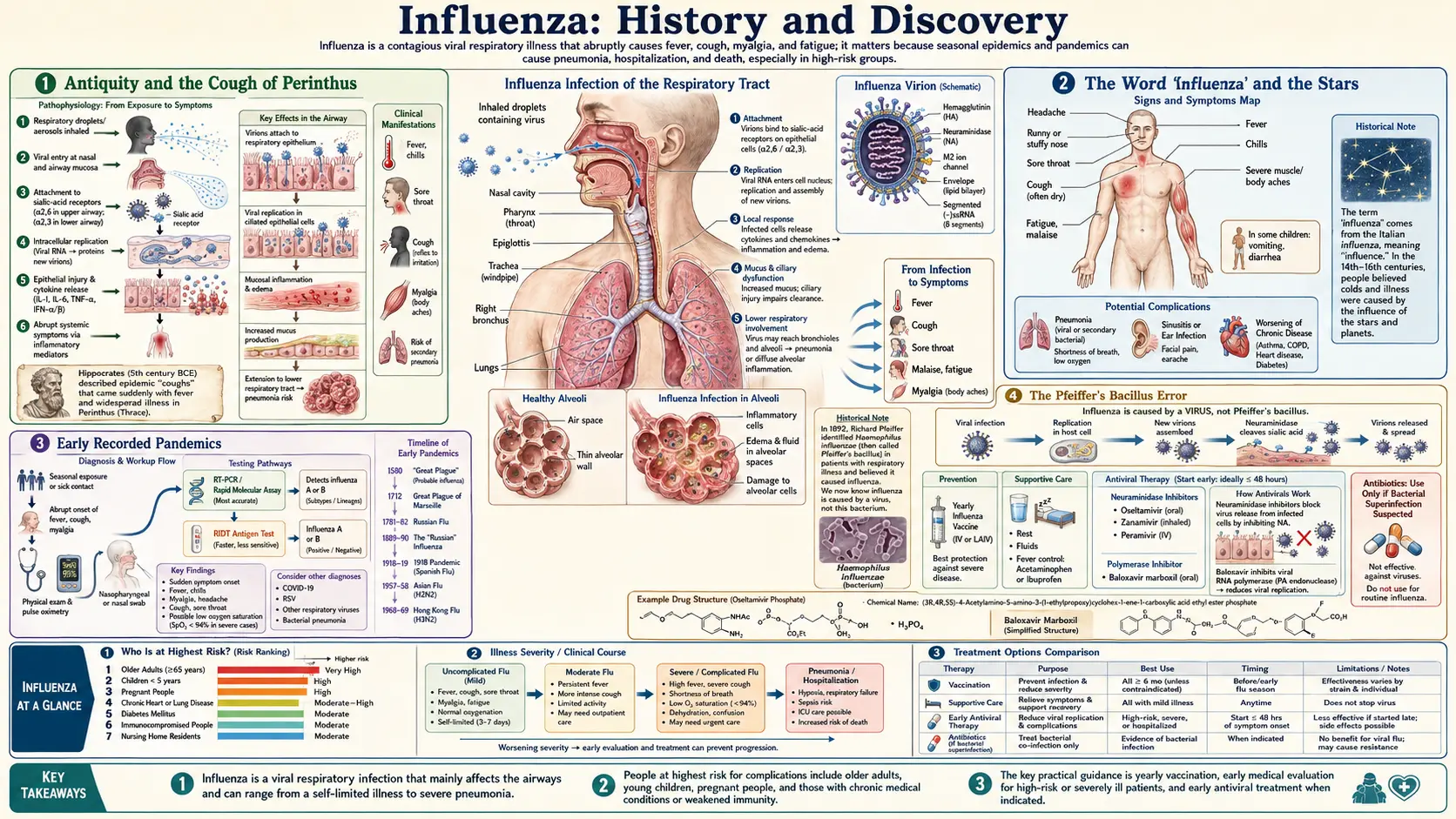
Influenza is one of humanity's oldest epidemic companions, yet for almost all of recorded history nobody knew what caused it. Sudden, sweeping winter fevers were blamed first on the stars — the very word influenza comes from the medieval Italian belief in the astrological "influence" of the heavens on epidemics — and later, wrongly, on a bacterium. The true culprit, a virus too small to see in any microscope of its day, was not caught until 1933, when Wilson Smith, Christopher Andrewes, and Patrick Laidlaw isolated the human influenza A virus in London. This page traces that long arc: from Hippocrates and the word's strange etymology, through the catastrophic 1918–1919 pandemic and the famous error of "Pfeiffer's bacillus," to the discovery of the virus, the typing of its surface proteins, and the first vaccines. Names, dates, and "firsts" here are drawn from the historical and scientific record; where a claim is genuinely disputed by historians, it is flagged as such.
Table of Contents
- Antiquity and the Cough of Perinthus
- The Word "Influenza" and the Stars
- Early Recorded Pandemics
- The Pfeiffer's Bacillus Error
- The 1918–1919 Pandemic
- Richard Shope and the Swine-Flu Clue
- Catching the Virus: 1933
- Influenza B, H/N Typing, and the First Vaccines
- From Discovery to Modern Surveillance
- Key Research Papers
- Connections
- Featured Videos
Antiquity and the Cough of Perinthus
Epidemics that look very much like influenza — sudden, sweeping outbreaks of fever, headache, body aches, and cough that arrive in winter, race through a community, and then vanish — are recorded as far back as the written word allows. The disease's defining signature, an explosive arrival affecting huge numbers of people almost at once, is hard to mistake, and ancient and medieval chroniclers across Europe and Asia repeatedly described seasonal "catarrhal fevers" that fit the pattern. It is reasonable to say that influenza, or something like it, has shadowed human populations for thousands of years.
The most frequently cited ancient candidate comes from Hippocrates. In his Epidemics (around 412 BCE) he described a respiratory outbreak in the northern Greek port of Perinthus — sometimes called the "Cough of Perinthus" or the "fever of Perinthus" marked by cough, sore throat, fevers, and aches peaking near the winter solstice. This is often presented as the first description of influenza. Honesty requires a caveat, however: the diagnosis is genuinely disputed. The outbreak also featured neurological complications (such as paralysis and impaired night vision) and relatively few reports of the post-influenza pneumonia one would expect, and the nineteenth-century scholar Émile Littré and others argued it better fits diphtheria, or perhaps several diseases circulating at once. The Cough of Perinthus is therefore best understood as a possible early influenza description, not a confirmed one.
The key historical point is one of categories. The disease — epidemic respiratory fever — is ancient and was observed for millennia. The cause — a specific virus — is a discovery of the twentieth century. Almost the entire pre-modern history of influenza is a history of describing a recurring affliction without any means of identifying what produced it, which is exactly why explanations reached, for centuries, toward the sky.
The Word "Influenza" and the Stars
The name itself records a vanished theory of disease. "Influenza" is an Italian word, descended from the medieval Latin influentia, literally "a flowing in." In medieval astrology, influentia named an intangible fluid or emanation thought to stream down from the stars and planets and shape events on earth — including outbreaks of illness. An epidemic was, in this view, an influenza: a visitation produced by the occult "influence" of the heavens. Italian writers were applying the term to disease outbreaks by the early sixteenth century, and the related phrase influenza di freddo — "influence of the cold" tied particular epidemics to the season as well as the stars.
The word entered English in 1743, when a major influenza epidemic that had begun in Italy swept across Europe; English speakers adopted the Italian name for it, and "the influenza" quickly became the standard English term. (The clipped, casual form "flu" is a much later nineteenth-century abbreviation.) The etymology is more than a curiosity: it preserves, fossilized in everyday language, the centuries-long conviction that epidemic fevers came from cosmic forces rather than from any living agent. Every time the word is used today, it carries a quiet trace of a pre-germ-theory worldview.
It is worth stressing that the astrological meaning was the original one. The word did not start as a medical label and acquire mystical overtones; it began as a term for celestial influence and was only later attached, by long usage, to the specific seasonal disease we now know it names. The science caught up with the word by almost two hundred years.
Early Recorded Pandemics
Between the medieval period and the twentieth century, Europe and the wider world experienced repeated influenza pandemics, many of them well documented in civic, military, and medical records even though their cause remained unknown. Outbreaks consistent with influenza were chronicled in the sixteenth, seventeenth, and eighteenth centuries; the 1743 epidemic that gave English the word was one of several that crossed the continent in waves. The nineteenth century saw further severe pandemics, most notably the so-called "Russian flu" of 1889–1890, which spread rapidly along the new railway and steamship networks and was tracked, week by week, in the newspapers of the day.
These pre-viral pandemics matter to the history of discovery because they made influenza a recurring object of serious medical study. By the late nineteenth century, with germ theory ascendant after the work of Pasteur and Koch, physicians were no longer content to blame the stars; they were actively hunting for a microbe. The recurring, large-scale nature of influenza made it a natural target for the new bacteriology — and, as it turned out, a trap, because the tools of bacteriology were about to find the wrong organism and hold the field for a generation.
The Pfeiffer's Bacillus Error
During the "Russian flu" pandemic, in 1892, the German bacteriologist Richard Pfeiffer isolated a small rod-shaped bacterium from the noses and airways of influenza patients and concluded that he had found the cause of the disease. He named it Bacillus influenzae — widely known as Pfeiffer's bacillus — and the claim was broadly accepted by the medical community of the era. The organism is real and is still with us today under its modern name, Haemophilus influenzae; its species name is a permanent linguistic souvenir of Pfeiffer's mistaken conclusion.
The error was consequential. Because Pfeiffer's bacillus was so often present in flu patients — it is a common inhabitant of the human airway and a frequent cause of the secondary bacterial pneumonias that follow influenza — it kept turning up in exactly the cases physicians were studying, which seemed to confirm the theory. The catch, only fully appreciated later, is that presence is not causation: the bacterium was riding along with the real (invisible) culprit and complicating its aftermath, not producing the disease. This is one of the most instructive cautionary tales in the history of microbiology, a textbook example of confusing a frequent companion of a disease with its cause.
The consequences became tragically clear in 1918, when much of the world's research effort against the deadliest pandemic in modern history was aimed at the wrong target. The mistake was not finally corrected until the 1930s, when the actual cause of influenza was isolated and shown to be filterable — far smaller than any bacterium. Pfeiffer's bacillus did not cause influenza; it merely accompanied and complicated it, and naming the historical error plainly is part of telling the story accurately.
The 1918–1919 Pandemic
The catastrophe that defines influenza in the modern imagination is the pandemic of 1918–1919, popularly called the "Spanish flu." In a series of waves near the end of the First World War, it infected a large fraction of the world's population and killed an estimated 50 million people — with some scholarly estimates ranging from roughly 25 million up to as high as 100 million. It was extraordinary not only in scale but in its victims: unusually, it killed many healthy young adults, not just the very young and very old, a demographic signature that still draws research attention.
The name "Spanish flu" is itself a historical error worth correcting. Spain was not the origin of the pandemic. Spain was a neutral country during the war and did not censor its press, so Spanish newspapers reported openly on the spreading illness while the warring nations suppressed such news to protect morale. Because the candid coverage came out of Spain, other countries wrongly assumed Spain was the source. The true geographic origin of the 1918 virus remains uncertain and debated; what is clear is that it was not Spanish in any meaningful sense, and the popular name unfairly attached a global disaster to one blameless country.
Crucially, throughout the 1918 pandemic the cause was still unknown. Most scientists were still searching for Pfeiffer's bacillus, developing antisera and experimental vaccines aimed at a bacterium that was not responsible. The pandemic's staggering toll, and the failure of bacteriological approaches against it, helped drive the next fifteen years of research that would finally identify the virus — making 1918 both the greatest tragedy in the disease's history and a turning point in the science of it.
Richard Shope and the Swine-Flu Clue
The breakthrough came, indirectly, from pigs. During and after the 1918 pandemic, veterinarians had noticed a flu-like respiratory illness sweeping through American swine herds, its timing suggestively close to the human pandemic. In the late 1920s and into 1931, the American pathologist Richard E. Shope, working at the Rockefeller Institute (building on the work of his mentor Paul A. Lewis), set out to find the cause of this swine influenza — and his careful experiments quietly overturned the bacterial dogma.
Shope first isolated a bacterium from sick pigs (one resembling Pfeiffer's organism) but found that injecting it into healthy pigs did not reliably reproduce the disease. He then performed the decisive test: he took secretions from infected pigs and passed them through a filter fine enough to hold back all bacteria, and showed that the cell-free, bacteria-free filtrate could still transmit the disease. The infectious agent was therefore filterable — far smaller than any bacterium — the hallmark of a virus. Shope published this swine-influenza work in 1931, providing the first solid experimental evidence that an influenza was caused by a filterable virus rather than a bacterium.
Shope's pig studies were the conceptual bridge to the human discovery. They demonstrated, in an influenza, the experimental approach — filtration plus transmission to a susceptible animal — that would, just two years later, finally catch the human virus. His name belongs at the front of any honest account of how influenza's true cause was found.
Catching the Virus: 1933
The human influenza virus was first isolated in 1933, in London, at the National Institute for Medical Research (NIMR) at Mill Hill. The work is credited to three scientists: Wilson Smith, Christopher Andrewes, and Patrick Laidlaw. Taking filtered throat washings from people sick during a 1933 influenza outbreak, they instilled the bacteria-free material into the noses of ferrets — and the ferrets came down with a clear, transmissible influenza-like illness that could be passed from animal to animal. Like Shope's swine agent, the human agent was filterable: a virus, not a bacterium.
The choice of the ferret as the experimental animal was itself a pivotal stroke, opening influenza to laboratory study for the first time. (A celebrated anecdote of the period even records the chain running in reverse, with a sneezing influenza-infected ferret passing the illness to a researcher — an informal demonstration of the very transmissibility the team was studying.) The team's landmark report, "A virus obtained from influenza patients," appeared in The Lancet in 1933 and is the foundational document of human influenza virology. The agent they recovered is what we now call influenza A virus.
The significance is hard to overstate. After thousands of years of describing the disease and roughly four decades of chasing the wrong bacterium, the actual cause of influenza was finally in hand. The 1933 isolation decisively ended the Pfeiffer's-bacillus era, vindicated the viral hypothesis that Shope's pig work had pointed to, and opened the door to everything that followed — typing the virus, growing it in the laboratory, and ultimately vaccinating against it.
Influenza B, H/N Typing, and the First Vaccines
Once the first virus was caught, the field advanced quickly. The agent of 1933 was designated influenza type A. A second, distinct type was identified soon after: influenza B was isolated in 1940 by the American virologist Thomas Francis Jr., who had also done pioneering work isolating human influenza A virus in the mid-1930s. (Some sources date Francis's influenza B work slightly earlier; the commonly cited year for the type B isolation is 1940.) The existence of two independent types was an early sign of the diversity that would make influenza so hard to pin down — and so hard to vaccinate against permanently.
Researchers learned that influenza A viruses are studded with two key surface proteins: hemagglutinin (H), which lets the virus latch onto and enter cells, and neuraminidase (N), which helps newly made virus particles break free. Different combinations of these proteins define the familiar subtype labels such as H1N1 and H3N2. As more subtypes were characterized, the World Health Organization formalized this H/N nomenclature, issuing a major revised naming system in 1980 (updating an earlier 1971 scheme) so that strains could be described in a single consistent international language. Because these surface proteins drift and occasionally shift, the subtypes in circulation change over time — the fundamental reason a new flu shot is needed each year.
Vaccination followed close on the heels of the typing work. In the early 1940s, a research team at the University of Michigan led by Thomas Francis Jr. — with a young Jonas Salk (later famous for the polio vaccine) among its members — developed the first effective inactivated ("killed") influenza vaccine, grown in chicken eggs and tested with U.S. military support. It was licensed for wider use around 1945. From the 1933 isolation to a usable vaccine took only about a decade, and the egg-based, periodically-updated approach those researchers pioneered remains, in modernized form, a backbone of influenza vaccination to this day.
From Discovery to Modern Surveillance
The discoveries of the 1930s and 1940s converted influenza from a mysterious, sky-blamed scourge into a studied, named, and partly manageable disease. With the virus isolated, its types and subtypes defined, and a vaccine in hand, the second half of the twentieth century became an era of surveillance and response. Because influenza's surface proteins are forever changing, no single vaccine confers lasting immunity, so the world built standing systems to watch the virus evolve — most notably the global laboratory network that tracks circulating strains and recommends, each year, which ones the upcoming season's vaccine should target.
The historical arc also explains influenza's enduring danger. The same protein variability that frustrated the early virologists is what allows new pandemic strains to emerge when influenza viruses reassort — a possibility foreshadowed, fittingly, by Shope's pigs, since swine can host both human and avian influenza viruses. The lessons of 1918 (a virus capable of devastating waves), of Pfeiffer (the peril of mistaking a bystander for a cause), and of 1933 (the power of the right experimental method) all feed directly into how influenza is monitored and confronted today.
Seen whole, the history of influenza is a story of a disease that was experienced for millennia before it was understood for a single day. The word still whispers of the stars; the bacterium still carries the name of a famous mistake; and the modern, evolving framework of types, subtypes, and annual vaccines all descends from a handful of researchers who, in the 1930s and 1940s, finally caught and characterized the thing itself. For the practical clinical picture — symptoms, prevention, and treatment — see the main Influenza page.
Key Research Papers
The references below combine peer-reviewed historical and virological literature with curated PubMed topic-search links and authoritative public-health resources. Historical primary texts (Hippocrates' Epidemics; Pfeiffer's and Shope's original reports; the 1933 Lancet paper by Smith, Andrewes, and Laidlaw) are named in the article as historical sources. PubMed and reference links open in a new tab.
- Smith W, Andrewes CH, Laidlaw PP. A virus obtained from influenza patients. The Lancet. 1933;222(5732):66-68. — PubMed: Smith, Andrewes & Laidlaw 1933
- Shope RE. Swine influenza: III. Filtration experiments and etiology. Journal of Experimental Medicine. 1931;54(3):373-385. — doi:10.1084/jem.54.3.373
- Eyler JM. The state of science, microbiology, and vaccines circa 1918. Public Health Reports. 2010;125(Suppl 3):27-36. — doi:10.1177/00333549101250S306
- Taubenberger JK, Morens DM. 1918 influenza: the mother of all pandemics. Emerging Infectious Diseases. 2006;12(1):15-22. — doi:10.3201/eid1201.050979
- Honigsbaum M. The art of medicine: revisiting the 1957 and 1968 influenza pandemics. The Lancet. 2020;395(10240):1824-1826. — doi:10.1016/S0140-6736(20)31201-0
- WHO. A revision of the system of nomenclature for influenza viruses: a WHO memorandum. Bulletin of the World Health Organization. 1980;58(4):585-591. — PubMed PMID: 6969132
- Etymologia: influenza. Emerging Infectious Diseases. 2006;12(1):179. — PMC: Etymologia — influenza
- Hippocrates and the "Cough of Perinthus" / 412 BCE epidemic — historical diagnosis debate — PubMed: Hippocrates and the history of influenza
- Pfeiffer's bacillus and Haemophilus influenzae — history of the influenza causation error — PubMed: Pfeiffer's bacillus history
- Thomas Francis Jr. and the isolation of influenza B virus — PubMed: Francis and influenza B
- History of influenza vaccine development (Francis, Salk, egg-grown inactivated vaccine) — PubMed: history of the influenza vaccine
- Hemagglutinin and neuraminidase — structure, function, and subtype nomenclature — PubMed: hemagglutinin and neuraminidase subtypes
- Discovery and early virology of influenza A (ferret model; interwar virus research) — PubMed: discovery of influenza A virus
External Authoritative Resources
Connections
- Pulmonology
- Influenza (main page)
- All Conditions
- Pneumonia
- Chronic Obstructive Pulmonary Disease
- Asthma
- Acute Respiratory Distress Syndrome
- Cystic Fibrosis
- Dr. Bryan Ardis: the Latin word virus means venom