Grief: Normal Mourning, Complicated Grief, and Prolonged Grief Disorder
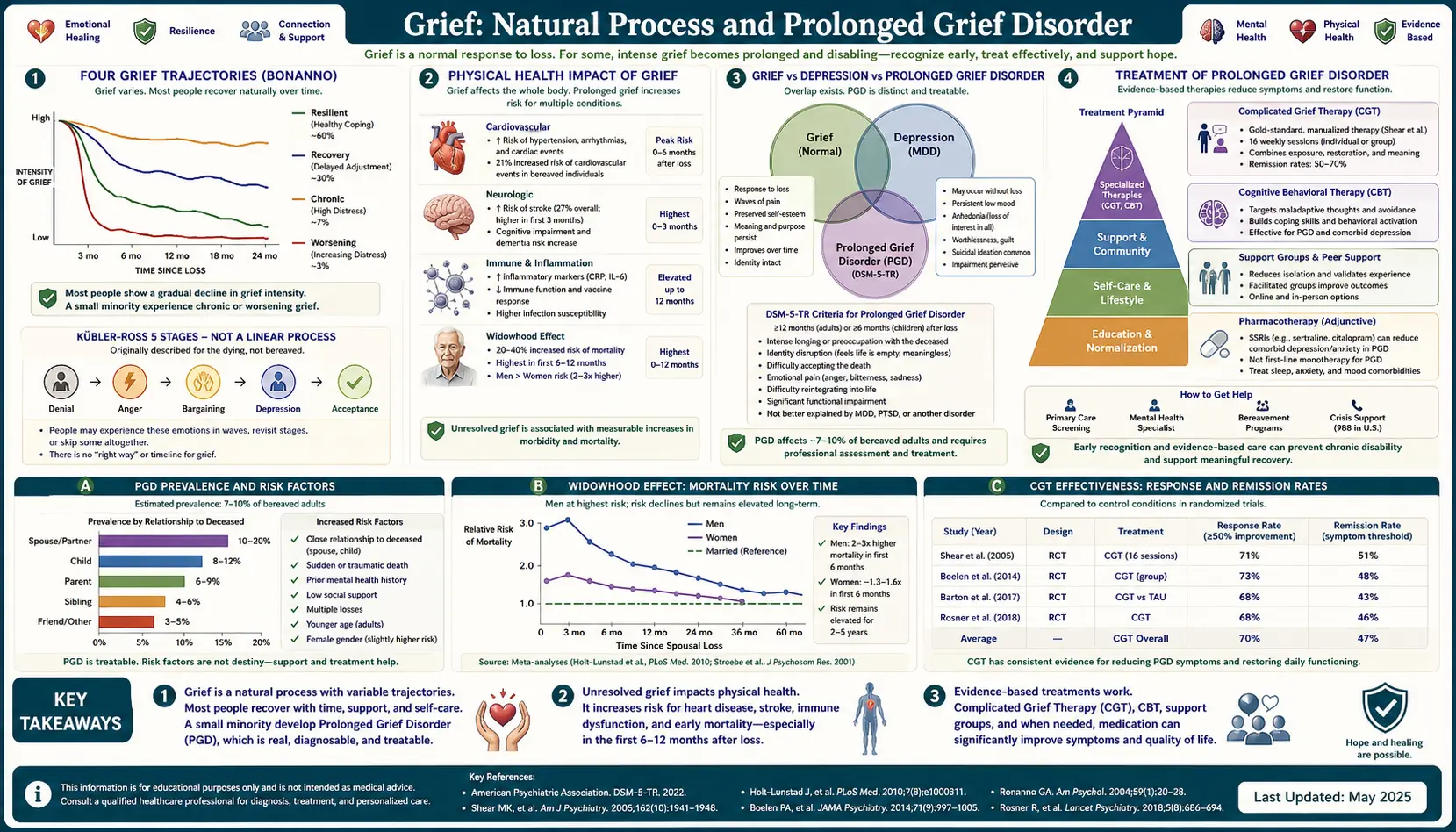
Grief is the universal human response to loss. Most grief is not illness — it is a painful but natural process of integrating the reality of absence into a continuing life. In the DSM-5-TR, a specific diagnosis of prolonged grief disorder (PGD) was added in 2022 to describe grief that persists in severity and functional impact well beyond typical bereavement, affecting roughly 7 to 10 percent of bereaved adults. U.S. Surgeon General advisories in recent years have highlighted grief alongside loneliness as a major under-recognized public-health dimension of modern life.
This article describes normal grief, the distinction from depression and post-traumatic stress disorder (PTSD), the new PGD diagnosis, treatment options that work, and what ordinary support from friends, family, and communities looks like.
Table of Contents
Normal Grief
Most bereaved people experience intense waves of sadness, yearning, preoccupation with the deceased, disturbed sleep, loss of appetite, and functional impairment for weeks to months after the death. These waves gradually become less frequent and less incapacitating, and the grieving person re-engages with work, relationships, and meaning — while continuing to love and remember the person who died. Grief is not resolved so much as integrated. Acute intense phases typically last 6 to 12 months but yearly anniversary reactions are normal and can continue for life.
Beyond the “Five Stages”
Elisabeth Kübler-Ross’s five stages — denial, anger, bargaining, depression, acceptance — were originally observations of dying patients, not the bereaved, and were never intended as a sequential model. Modern grief research (George Bonanno’s work in particular) shows grief is highly variable. Common trajectories include resilient (majority) — significant distress early that attenuates, recovery — longer distress then attenuation, chronic — persistent severe distress, and delayed — relatively intact initially with later emergence of symptoms. No trajectory is wrong or right.
The Physical Health Impact
- Increased all-cause mortality in the first 6 months after spousal loss (“widowhood effect”), particularly in men.
- Elevated cardiovascular events including takotsubo cardiomyopathy (“broken-heart syndrome”).
- Immune dysregulation with increased infection risk.
- Sleep disruption, weight change, fatigue.
- Increased risk of depression and substance-use disorders.
Grief vs Depression
Major depression and grief share many features but differ in important ways:
- Grief waves come and go around the memory of the deceased; depression is pervasive and constant.
- Self-esteem is typically intact in grief; depression often includes worthlessness and self-loathing.
- Positive emotions and moments of humor occur in grief; depression is anhedonic across the board.
- Active suicidal ideation should not be dismissed as “normal grief” and warrants clinical attention.
Prolonged Grief Disorder
DSM-5-TR criteria for prolonged grief disorder require:
- Death of a loved one at least 12 months ago (6 months in children and adolescents).
- Intense yearning or preoccupation with the deceased.
- At least three additional symptoms: identity disruption, disbelief about the death, avoidance of reminders, intense emotional pain, difficulty with reintegration, emotional numbness, meaninglessness, intense loneliness.
- Clinically significant distress or impairment.
- Symptoms exceed expected cultural or contextual norms.
Treatment
- Complicated Grief Therapy (CGT) — a structured 16-session protocol developed by Katherine Shear that has the strongest evidence base for PGD. Benefits exceed both standard psychotherapy and antidepressants alone in trials.
- Cognitive behavioral therapy for grief with exposure-based and cognitive-restructuring components.
- Interpersonal therapy.
- Support groups — shared loss experience, especially condition-specific (widowhood, child loss, suicide loss).
- Medications — selective serotonin reuptake inhibitors (SSRIs) are appropriate for co-occurring depression or anxiety; their effect on grief itself is limited.
- Psychedelic-assisted therapy — emerging research with psilocybin and MDMA in prolonged grief.
What Helps (and Doesn’t) From Others
Evidence-informed and clinically consistent:
- Presence over platitudes. “I’m so sorry” and sitting with the person is often enough. Avoid “they’re in a better place,” “everything happens for a reason,” and “you need to move on.”
- Specific offers. “I’m dropping off dinner Tuesday” beats “let me know if you need anything.”
- Remembering after the first few weeks. Most support arrives immediately and disappears when the bereaved is often most isolated.
- Naming the person who died. Saying their name and sharing memories is typically welcome, not painful.
- Marking anniversaries and birthdays.
- Practical help — meals, errands, child-care, paperwork — often more useful than emotional processing.
- Patience with nonlinear recovery. Grief returns unpredictably for years.
Key Research Papers
- Shear MK (2015). Clinical practice. Complicated grief. The New England Journal of Medicine — PubMed PMID: 25564898
- Prigerson HG, Boelen PA, Xu J, et al. (2021). Validation of the new DSM-5-TR criteria for prolonged grief disorder and the PG-13-Revised (PG-13-R) scale. World Psychiatry — PubMed PMID: 33432758
- Lundorff M, Holmgren H, Zachariae R, et al. (2017). Prevalence of prolonged grief disorder in adult bereavement: A systematic review and meta-analysis. Journal of Affective Disorders — PubMed PMID: 28167398
- Shear K, Frank E, Houck PR, et al. (2005). Treatment of complicated grief: a randomized controlled trial. JAMA — PubMed PMID: 15928281
- Shear MK, Reynolds CF 3rd, Simon NM, et al. (2016). Optimizing Treatment of Complicated Grief: A Randomized Clinical Trial. JAMA Psychiatry — PubMed PMID: 27276373
- Bonanno GA, Wortman CB, Lehman DR, et al. (2002). Resilience to loss and chronic grief: a prospective study from preloss to 18-months postloss. Journal of Personality and Social Psychology — PubMed PMID: 12416919
- Moon JR, Kondo N, Glymour MM, et al. (2011). Widowhood and mortality: a meta-analysis. PloS One — PubMed PMID: 21858130
PubMed Topic Searches
The PubMed topic searches below return up-to-date peer-reviewed literature for the subjects covered on this page.
- PubMed: prolonged grief disorder
- PubMed: complicated grief therapy
- PubMed: grief depression distinction
- PubMed: bereavement mortality
- PubMed: grief cortisol immune
- PubMed: grief cardiovascular
- PubMed: grief cognitive behavioral therapy
- PubMed: grief pharmacotherapy
- PubMed: grief DSM-5
- PubMed: grief sleep disturbance
- PubMed: grief children adolescents
- PubMed: grief meaning reconstruction