Metronidazole and Tinidazole for Trichomoniasis: Dosing, Safety, and Resistance
- How Nitroimidazoles Kill T. vaginalis
- CDC 2021 Regimens
- Tinidazole: The CDC Alternative Regimen
- Metronidazole: The CDC Recommended Regimens
- Side Effects and Tolerability
- The Alcohol Interaction
- Safety in Pregnancy
- Safety During Breastfeeding
- Nitroimidazole Resistance
- Topical and Non-Nitroimidazole Approaches
- Key Research Papers
- Connections
How Nitroimidazoles Kill T. vaginalis
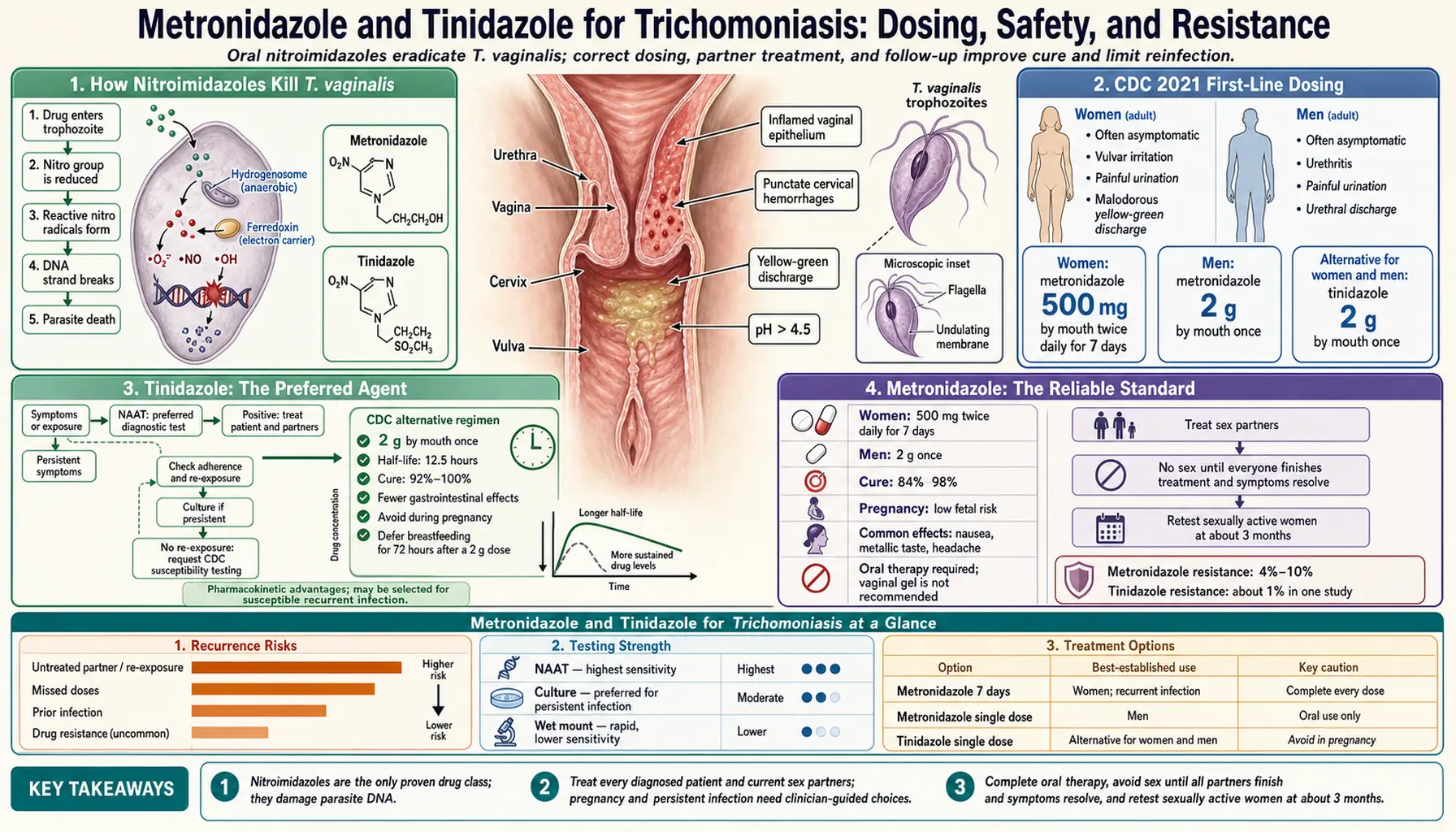
Metronidazole and tinidazole belong to the 5-nitroimidazole class of drugs (PubMed PMID: 32729451). They act only after being metabolically activated inside the parasite. T. vaginalis is an amitochondrial anaerobe: in place of mitochondria it has hydrogenosomes, double-membrane organelles in which the oxidative decarboxylation of pyruvate is coupled to ATP synthesis and linked to ferredoxin-mediated electron transport. A 1999 review describes this pathway as the one responsible for the metabolic activation of 5-nitroimidazole drugs such as metronidazole (Kulda 1999, PubMed PMID: 10221623).
The same review describes a second drug-activating system in T. vaginalis, involving the hydrogenosomal malic enzyme and NAD:ferredoxin oxidoreductase. Because the activating enzymes sit in the parasite's own energy metabolism, loss of those enzymes is also the main route to resistance (see Nitroimidazole Resistance).
CDC 2021 Regimens
The CDC Sexually Transmitted Infections Treatment Guidelines, 2021 (MMWR 2021;70[No. RR-4]) list these regimens (CDC 2021, PubMed PMID: 34292926):
- Women — recommended: metronidazole 500 mg orally twice daily for 7 days
- Men — recommended: metronidazole 2 g orally in a single dose
- Women and men — alternative: tinidazole 2 g orally in a single dose
The guideline lists the same 7-day metronidazole regimen for women with HIV. It states that metronidazole gel does not reach therapeutic levels in the urethra and perivaginal glands and, because it is less efficacious than oral metronidazole, is not recommended. Because of the high rate of reinfection among women, the guideline recommends retesting all sexually active women approximately 3 months after initial treatment, regardless of whether they believe their partners were treated; it states that data are insufficient to support retesting men after treatment (CDC 2021, PubMed PMID: 34292926).
A third 5-nitroimidazole, secnidazole, was tested as a single 2 g oral dose against placebo in a phase 3 double-blind trial that enrolled 147 women at 10 US sites in 2019–2020. In the per-protocol population, microbiological cure was 94.9% with secnidazole versus 1.7% with placebo; cure rates were 100% (4 of 4) in women with HIV and 95.2% (20 of 21) in women with bacterial vaginosis. The most frequent treatment-emergent adverse events were vulvovaginal candidiasis and nausea (each 2.7%) (Muzny 2021, PubMed PMID: 33768237).
Tinidazole: The CDC Alternative Regimen
The 2021 CDC guideline lists tinidazole 2 g as a single oral dose as the alternative regimen for both women and men; the recommended regimen for women is the 7-day metronidazole course (CDC 2021, PubMed PMID: 34292926).
The guideline states that tinidazole reaches higher levels in serum and the genitourinary tract than metronidazole, has a longer half-life (12.5 hours versus 7.3 hours), and has fewer gastrointestinal side effects. The current US tinidazole label gives a plasma half-life of approximately 12–14 hours; the metronidazole label gives an average elimination half-life of eight hours in healthy subjects.
On efficacy, the guideline summarizes the trial evidence this way: randomized controlled trials comparing single 2 g doses of metronidazole and tinidazole indicated that tinidazole is equivalent or superior to metronidazole in achieving parasitologic cure and symptom resolution; recommended metronidazole regimens have produced cure rates of approximately 84%–98%, and the recommended tinidazole regimen approximately 92%–100% (CDC 2021, PubMed PMID: 34292926). In one older double-blind trial, a single 2 g dose of tinidazole given to 137 women produced a primary cure rate of 96.4% at one to two weeks; at about two months, relapse was 5.1% when the woman's partner had also received tinidazole and 23.7% when the partner had received placebo (Lyng 1981, PubMed PMID: 7018164).
The tinidazole label lists the most common adverse reactions to a single 2 g dose (incidence above 1%) as metallic or bitter taste, nausea, weakness, fatigue or malaise, dyspepsia, cramps or epigastric discomfort, vomiting, anorexia, headache, dizziness and constipation. The CDC guideline notes that tinidazole is usually more expensive than metronidazole, and that tinidazole should be avoided for pregnant women (CDC 2021, PubMed PMID: 34292926).
Metronidazole: The CDC Recommended Regimens
Metronidazole is the drug of both recommended regimens in the 2021 CDC guideline: 500 mg twice daily for 7 days for women, and a single 2 g dose for men (CDC 2021, PubMed PMID: 34292926).
The 7-day course for women rests on a multicentre, open-label randomized trial at three US sexual health clinics (Kissinger 2018, PubMed PMID: 30297322). Among 623 HIV-uninfected, non-pregnant women, 11% (34 of 312) in the 7-day group were T. vaginalis positive at the test-of-cure visit 4 weeks after treatment, compared with 19% (58 of 311) after a single 2 g dose (relative risk 0.55). Bacterial vaginosis status did not significantly change the result. Self-reported adherence was 96% in the 7-day group and 99% in the single-dose group. The trial stopped early because of funding limits (planned enrolment had been 1,664 women). The authors concluded that the 7-day dose should be the preferred treatment for women; the CDC guideline describes the trial as halving the proportion of women retesting positive at the 1-month visit (CDC 2021, PubMed PMID: 34292926).
A 2003 Cochrane review of 54 trials concluded that nitroimidazole drugs seem to be effective in achieving short-term parasitological cure, that a single oral dose can achieve it, and that partner treatment can reduce longer-term reinfection (Forna 2003, PubMed PMID: 12804391).
Side Effects and Tolerability
In the Kissinger 2018 trial, side-effects were similar in the single-dose and 7-day groups; the most common was nausea (23%), followed by headache (7%) and vomiting (4%) (PubMed PMID: 30297322).
The US metronidazole label states that the most common adverse reactions are gastrointestinal, particularly nausea, sometimes with headache, anorexia and occasionally vomiting, and that a sharp, unpleasant metallic taste is not unusual. It lists convulsive seizures, encephalopathy, aseptic meningitis and optic and peripheral neuropathy as the most serious reported reactions, and notes that persistent peripheral neuropathy has been reported in some patients receiving prolonged administration. The tinidazole label likewise reports convulsions and peripheral neuropathy.
Drug interactions (as the labels state them): metronidazole has been reported to potentiate the anticoagulant effect of warfarin and other oral coumarin anticoagulants, prolonging prothrombin time, and the tinidazole label states that tinidazole may do the same; in patients stabilized on relatively high doses of lithium, short-term metronidazole has been associated with raised serum lithium and, in a few cases, signs of lithium toxicity; psychotic reactions have been reported in alcoholic patients using metronidazole and disulfiram together.
Allergy: for people with an IgE-mediated hypersensitivity reaction to 5-nitroimidazoles, the CDC guideline describes metronidazole desensitization according to published regimens, in consultation with an allergy specialist (CDC 2021, PubMed PMID: 34292926). In a CDC consultation series of 59 women with suspected metronidazole hypersensitivity (2003–2006), urticaria (47%) was the most common reaction, and the authors concluded that metronidazole desensitization was effective (Helms 2008, PubMed PMID: 18221927).
The Alcohol Interaction
Both US labels carry an alcohol warning. The metronidazole label states that oral metronidazole is associated with a disulfiram-like reaction to alcohol (abdominal cramps, nausea, vomiting, headaches and flushing) and lists stopping alcohol and products containing propylene glycol during and for at least three days after therapy. The tinidazole label lists the same symptoms and the same three-day window.
The research behind the warning is thinner than its prominence suggests. The proposed mechanism is blocking of the liver enzyme aldehyde dehydrogenase, so that acetaldehyde builds up in the blood. A 2000 review of reports published from 1969 to 1982 found no convincing evidence that the reaction exists; it evaluated six case reports involving eight patients, four of them serious including one death, and found that none provided evidence that could justify its conclusions (Williams 2000, PubMed PMID: 10676835). In a double-blind study of 12 healthy men, half took metronidazole for 5 days and half placebo before all drank ethanol (0.4 g/kg); metronidazole did not raise blood acetaldehyde or produce objective or subjective adverse effects, although the authors noted that a reaction might still occur in some subgroups or by other mechanisms (Visapää 2002, PubMed PMID: 12022894). A retrospective emergency-department study compared 18 patients with measurable blood alcohol who received metronidazole with 18 matched controls and found no documented suspected disulfiram-like reaction in the metronidazole group (Feldman 2023, PubMed PMID: 37494646).
A 2020 systematic review concluded that the disulfiram-like reaction, though classically associated with metronidazole, occurs with uncertain frequency and varied severity, and listed tinidazole and secnidazole among antimicrobials that available data support using with concurrent alcohol consumption (Mergenhagen 2020, PubMed PMID: 31871085). The label warnings remain in place.
Safety in Pregnancy
The 2021 CDC guideline states that T. vaginalis infection in pregnancy is associated with adverse pregnancy outcomes, particularly premature rupture of membranes, preterm delivery and delivery of infants who are small for gestational age, and that symptomatic pregnant women, regardless of pregnancy stage, should be tested and treated (CDC 2021, PubMed PMID: 34292926).
Metronidazole in pregnancy: the guideline states that although metronidazole crosses the placenta, data indicate that it poses a low risk to the developing fetus. It also describes one randomized trial in pregnant women with asymptomatic trichomoniasis that reported no substantial difference in preterm birth after two 2 g doses of metronidazole 48 hours apart at 16–23 and 24–29 weeks' gestation, compared with placebo (CDC 2021, PubMed PMID: 34292926). A current US metronidazole tablet label, by contrast, lists metronidazole as contraindicated during the first trimester of pregnancy in patients with trichomoniasis.
Tinidazole in pregnancy: the guideline states that tinidazole should be avoided for pregnant women (CDC 2021, PubMed PMID: 34292926).
Safety During Breastfeeding
The CDC guideline states that metronidazole is secreted in breast milk and that, with maternal oral therapy, breastfed infants receive metronidazole in doses lower than those used to treat infections. It notes that clinicians sometimes advise deferring breastfeeding for 12–24 hours after maternal treatment with metronidazole, and that one study found a maternal regimen of 400 mg three times daily for 7 days produced a lower concentration in breast milk and was considered compatible with breastfeeding over longer periods (CDC 2021, PubMed PMID: 34292926). The metronidazole label states that the drug appears in breast milk in concentrations similar to those in plasma.
For tinidazole, the guideline states that breastfeeding should be deferred for 72 hours after a single 2 g oral dose (CDC 2021, PubMed PMID: 34292926).
Nitroimidazole Resistance
The 2021 CDC guideline states that metronidazole resistance occurs in 4%–10% of cases of vaginal trichomoniasis (CDC 2021, PubMed PMID: 34292926). A 2004 review put the figure at at least 5% of clinical cases (Cudmore 2004, PubMed PMID: 15489348). Among 178 isolates from women in a US partner-notification study, resistance was present in 17 (9.6%) for metronidazole and 1 (0.56%) for tinidazole, and in vitro resistance correlated poorly with clinical response to treatment (Schwebke 2006, PubMed PMID: 17000740).
In laboratory work, prolonged cultivation of trichomonads under sublethal metronidazole produces resistance in steps: aerobic resistance, similar to that seen in isolates from treatment-refractory patients, appears first, and the terminal stage is stable anaerobic resistance with very high minimal lethal concentrations. The process involves a progressive decrease and eventual loss of pyruvate:ferredoxin oxidoreductase, with decreased ferredoxin expression in T. vaginalis (Kulda 1999, PubMed PMID: 10221623). A 2020 systematic review of 58 articles implicated reduced expression of pyruvate:ferredoxin oxidoreductase, ferredoxin, nitroreductase, hydrogenase, thioredoxin reductase and flavin reductase, found resistance higher with metronidazole than with tinidazole, and associated resistance with co-infection by Mycoplasma hominis or T. vaginalis virus and with the type 2 genotype (Graves 2020, PubMed PMID: 32729451).
For persistent infection not attributed to reexposure, the CDC guideline describes clinicians requesting a kit from CDC for drug-resistance testing. Its regimens for this situation are metronidazole or tinidazole 2 g once daily for 7 days; if that fails, high-dose oral tinidazole 2 g daily plus intravaginal tinidazole 500 mg twice daily for 14 days, or high-dose oral tinidazole 1 g three times daily plus intravaginal paromomycin (4 g of 6.25% cream nightly) for 14 days. The guideline states that concurrent treatment of all sex partners is vital for preventing reinfections (CDC 2021, PubMed PMID: 34292926). A 2019 review reports some success with high-dose tinidazole plus intravaginal paromomycin cream, intravaginal boric acid, and intravaginal metronidazole/miconazole (Alessio 2019, PubMed PMID: 31388764).
Topical and Non-Nitroimidazole Approaches
Metronidazole vaginal gel: the 2021 CDC guideline states that metronidazole gel does not reach therapeutic levels in the urethra and perivaginal glands, and that because it is less efficacious than oral metronidazole it is not recommended (CDC 2021, PubMed PMID: 34292926).
Boric acid: in the setting of persistent infection, the guideline states that clinical improvement has been reported with intravaginal boric acid but not with nitazoxanide (CDC 2021, PubMed PMID: 34292926), and a 2019 review describes some success with intravaginal boric acid in resistant cases (PubMed PMID: 31388764). These reports come from resistant or refractory infection, not from first-line comparisons with oral nitroimidazoles.
Other options: two 2004 reviews noted the lack of approved alternatives outside the 5-nitroimidazole class (Cudmore 2004, PubMed PMID: 15489348; Schwebke and Burgess 2004, PubMed PMID: 15489349), and a 2020 systematic review concluded that alternative treatments outside the class are needed (PubMed PMID: 32729451). No trial evidence for household or over-the-counter preparations against T. vaginalis was found in the sources reviewed for this page.
Key Research Papers
- Kissinger P, Muzny CA, Mena LA, et al. Single-dose versus 7-day-dose metronidazole for the treatment of trichomoniasis in women. Lancet Infect Dis. 2018;18(11):1251-1259. — PubMed PMID: 30297322
- Workowski KA, Bachmann LH, Chan PA, et al. Sexually Transmitted Infections Treatment Guidelines, 2021. MMWR Recomm Rep. 2021;70(4):1-187. — PubMed PMID: 34292926
- Schwebke JR, Barrientes FJ. Prevalence of Trichomonas vaginalis isolates with resistance to metronidazole and tinidazole. Antimicrob Agents Chemother. 2006;50(12):4209-4210. — PubMed PMID: 17000740
- Cudmore SL, Delgaty KL, Hayward-McClelland SF, et al. Treatment of infections caused by metronidazole-resistant Trichomonas vaginalis. Clin Microbiol Rev. 2004;17(4):783-793. — PubMed PMID: 15489348
- Wendel KA, Workowski KA. Trichomoniasis: challenges to appropriate management. Clin Infect Dis. 2007;44(Suppl 3):S123-S129. — PubMed PMID: 17342665
- Forna F, Gülmezoglu AM. Interventions for treating trichomoniasis in women. Cochrane Database Syst Rev. 2003;(2):CD000218. — PubMed PMID: 12804391
- Schwebke JR, Burgess D. Trichomoniasis. Clin Microbiol Rev. 2004;17(4):794-803. — PubMed PMID: 15489349
- Kissinger P, Amedee A, Clark RA, et al. Trichomonas vaginalis treatment reduces vaginal HIV-1 shedding. Sex Transm Dis. 2009;36(1):11-16. — PubMed PMID: 19008776
- Helms DJ, Mosure DJ, Secor WE, Workowski KA. Management of Trichomonas vaginalis in women with suspected metronidazole hypersensitivity. Am J Obstet Gynecol. 2008;198(4):370.e1-7. — PubMed PMID: 18221927
- Lyng J, Christensen J. A double-blind study of the value of treatment with a single dose tinidazole of partners to females with trichomoniasis. Acta Obstet Gynecol Scand. 1981;60(2):199-201. — PubMed PMID: 7018164
- Muzny CA, Schwebke JR, Nyirjesy P, et al. Efficacy and safety of single oral dosing of secnidazole for trichomoniasis in women: results of a phase 3, randomized, double-blind, placebo-controlled, delayed-treatment study. Clin Infect Dis. 2021;73(6):e1282-e1289. — PubMed PMID: 33768237
- Visapää JP, Tillonen JS, Kaihovaara PS, Salaspuro MP. Lack of disulfiram-like reaction with metronidazole and ethanol. Ann Pharmacother. 2002;36(6):971-974. — PubMed PMID: 12022894
- Williams CS, Woodcock KR. Do ethanol and metronidazole interact to produce a disulfiram-like reaction? Ann Pharmacother. 2000;34(2):255-257. — PubMed PMID: 10676835
- Mergenhagen KA, Wattengel BA, Skelly MK, Clark CM, Russo TA. Fact versus fiction: a review of the evidence behind alcohol and antibiotic interactions. Antimicrob Agents Chemother. 2020;64(3):e02167-19. — PubMed PMID: 31871085
- Feldman R, Jaszczenski R. Can metronidazole cause a disulfiram-like reaction? A case-control study propensity matched by age, sex, and ethanol concentration. WMJ. 2023;122(3):171-177. — PubMed PMID: 37494646
- Kulda J. Trichomonads, hydrogenosomes and drug resistance. Int J Parasitol. 1999;29(2):199-212. — PubMed PMID: 10221623
- Graves KJ, Novak J, Secor WE, Kissinger PJ, Schwebke JR, Muzny CA. A systematic review of the literature on mechanisms of 5-nitroimidazole resistance in Trichomonas vaginalis. Parasitology. 2020;147(13):1383-1391. — PubMed PMID: 32729451
- Alessio C, Nyirjesy P. Management of resistant trichomoniasis. Curr Infect Dis Rep. 2019;21(9):31. — PubMed PMID: 31388764