Dupuytren's Contracture
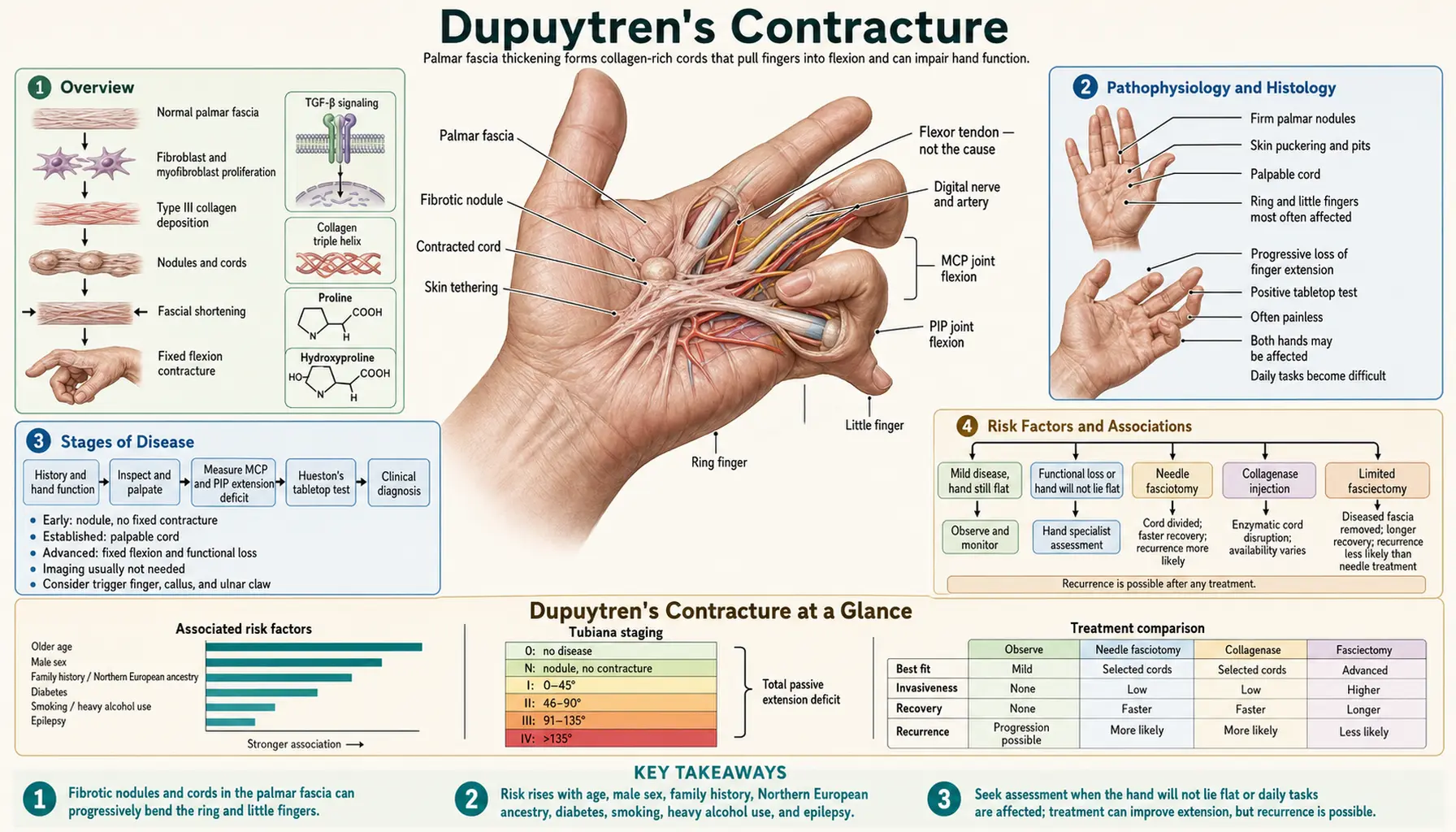
Table of Contents
- Overview
- Pathophysiology and Histology
- Stages of Disease
- Risk Factors and Associations
- Clinical Presentation and Diagnosis
- Non-Surgical Management
- Surgical and Procedural Treatment
- Recurrence and Long-Term Outcomes
- Key Research Papers
- PubMed Research Searches
- Connections
- Featured Videos
Overview
Dupuytren's contracture is a fibroproliferative disease of the palmar fascia that causes the connective tissue beneath the skin of the palm to thicken and scar, progressively pulling one or more fingers into a bent (flexed) position that cannot be straightened. It is not a tendon problem — the tendons themselves are unaffected; the disease involves the tough fascial tissue that overlies them.
The condition is most common in men over age 40 of Northern European descent. The ring finger (4th) and little finger (5th) are most commonly affected, though the middle finger and, rarely, the index finger can also be involved. About 50% of cases are bilateral, though often asymmetric in severity. The condition is typically painless once established, though early nodules may be mildly tender.
A simple bedside assessment is the tabletop test (also called the Hubbard sign): the patient tries to lay their hand completely flat on a table. If the palm and all fingers cannot make full contact with the table surface, the test is positive, indicating clinically significant contracture. Severity is formally graded using the Tubiana scale (grades 0–4) based on the total passive extension deficit measured across the affected finger's joints.
The condition is named after Baron Guillaume Dupuytren, the French surgeon who performed the first documented surgical fasciectomy for the condition in 1831 at the Hôtel-Dieu hospital in Paris — though earlier descriptions exist, including by Henry Cline Sr. and Astley Cooper. Dupuytren's condition is sometimes called morbus Dupuytren, palmar fibromatosis, or palmar fascial contracture.
Pathophysiology and Histology
Myofibroblast proliferation is the central cellular event in Dupuytren's contracture. Normal palmar fascial fibroblasts transform into myofibroblasts — cells that express alpha-smooth muscle actin (α-SMA) and have the contractile properties of smooth muscle while still producing extracellular matrix like fibroblasts. This transformation is driven primarily by TGF-β1 (transforming growth factor beta-1), along with PDGF (platelet-derived growth factor), and local mechanical stress. The result is a self-amplifying cycle: myofibroblasts contract, increasing local tension, which further stimulates TGF-β1 signaling, recruiting more myofibroblasts.
These activated myofibroblasts deposit excess extracellular matrix, particularly an abnormal ratio of type III collagen (fetal-type, more flexible) in early disease that later shifts toward type I collagen (mature, stiff, inextensible) as the disease matures. This collagen deposition within the normal palmar aponeurosis transforms the fascial bands into pathological cords that progressively shorten.
Histological Phases (Luck's Classification, 1959)
- Proliferative phase: Highly cellular lesion dominated by myofibroblasts. Abundant type III collagen. This is the nodule stage. Cells are mitotically active and densely packed, resembling a low-grade sarcoma histologically — but this is entirely benign.
- Involutional phase: Myofibroblasts align along lines of tension within the fascial planes. Cellularity decreases. Collagen fibers become organized into a longitudinally oriented cord structure.
- Residual phase: Few cells remain. The cord is composed primarily of dense type I collagen. Contractile force is now mechanical, not cellular — the cord physically holds the finger in flexion.
Anatomy of the Pathological Cords
The normal palmar aponeurosis has defined band structures; in Dupuytren's disease these become pathological cords. The most clinically important cord types are:
- Pretendinous cord: The most common. Arises from the pretendinous band of the palmar aponeurosis. Causes MCP (metacarpophalangeal) joint contracture. Straight, superficial, and relatively safe surgically.
- Spiral cord: Arises from the pretendinous band, spiral band, lateral digital sheet, and Grayson's ligament. Critically, it wraps around the neurovascular bundle, displacing it medially and superficially — placing the digital nerve and artery in the midline just beneath the skin at the base of the digit. Causes PIP (proximal interphalangeal) joint contracture and is the most dangerous cord surgically.
- Central cord: Lies centrally in the digit, causes PIP contracture, does not displace the neurovascular bundle as dramatically as the spiral cord.
- Natatory cord: Located in the web space between fingers; causes web space contracture and abduction deficit of adjacent fingers.
- Lateral cord: Arises from the lateral digital sheet; contributes to PIP and DIP contracture.
Stages of Disease
Dupuytren's contracture evolves through recognizable clinical stages, though the pace varies enormously between patients. Some individuals progress from nodule to significant contracture within months; others remain at the nodule stage for decades.
Stage 1 — Nodule Formation
The first detectable sign is a painless, firm palmar nodule located in the distal palm, typically in line with the ring or little finger ray. The nodule represents the myofibroblast-rich proliferative phase. It may be mildly tender when first forming but typically becomes asymptomatic. The overlying skin may be puckered or dimpled due to tethering of the skin to the fascia through vertical fascial septa. No contracture is present at this stage.
Stage 2 — Cord Formation
The nodule matures into a fibrotic cord as myofibroblasts align along fascial planes and deposit oriented collagen. The cord becomes palpable as a firm, longitudinal band extending from the palm into the digit. The skin overlying the cord is often tethered. At this stage, the finger may have a very mild tendency toward flexion, but full passive extension is still possible.
Stage 3 — Finger Contracture
As the cord shortens, it pulls the affected finger(s) progressively into flexion. MCP joint contractures develop first. Functionally, MCP contractures up to 60–70° are often well tolerated — the hand can still grip objects reasonably well. PIP joint contractures develop later and are much more functionally disabling. They also respond less well to all forms of treatment, because the PIP joint capsule, volar plate, and flexor tendon sheath undergo secondary contracture once the joint has been held in flexion for an extended period.
Severity is classified using the Tubiana Grading Scale based on the total passive extension deficit (TPED) across the affected ray's joints:
- Grade I: TPED 0–45°
- Grade II: TPED 45–90°
- Grade III: TPED 90–135°
- Grade IV: TPED greater than 135°
Stage 4 — Functional Impairment
With significant contracture, the tabletop test is clearly positive (cannot lay the hand flat). Grip strength is reduced. Patients have difficulty with: wearing gloves, shaking hands, reaching into pockets, gripping large tools or steering wheels, playing a musical instrument, and washing the face. PIP contractures of 30° or more in the ring or little finger are typically sufficient to motivate patients to seek treatment.
Risk Factors and Associations
Demographic and Genetic Factors
- Age and sex: Predominantly affects men over 40 years of age. The male-to-female ratio is approximately 6–10:1 in Northern European populations. Women who develop the disease tend to do so later in life and often have a milder course.
- Ethnicity: Strongly associated with Northern European ancestry — sometimes called the "Viking disease." Highest prevalence in Scandinavia, Scotland, Iceland, and among descendants of Northern European emigrants to Australia, New Zealand, and North America. Rare in Asian, African, and Middle Eastern populations.
- Family history: Inherited as an autosomal dominant trait with variable penetrance. A positive family history is reported in 27–68% of patients depending on the series studied. Genetic studies have identified associations with EPDR1, WNT2, and SULF1 loci, though no single gene accounts for most cases.
Medical and Lifestyle Risk Factors
- Diabetes mellitus: Increases risk 2–3-fold. Associated with bilateral, often mild contracture. The mechanism may involve glycation of palmar collagen and microangiopathy.
- Alcohol use disorder / liver cirrhosis: Historically associated ("hepatic Dupuytren's"). Alcohol use appears to be an independent risk factor, not simply mediated by liver disease.
- Tobacco smoking: Independent risk factor; dose-dependent relationship with prevalence and severity.
- Epilepsy and antiepileptic drugs: Hueston observed an association between epilepsy and Dupuytren's; phenobarbital in particular has been implicated, possibly through its effect on fibroblast proliferation. The association is less prominent in the era of modern antiepileptics.
- HIV infection: Reported association, possibly related to immune dysregulation and altered cytokine profiles.
- Manual labor and vibration exposure: The association is debated. Hand-arm vibration syndrome (HAVS) and vibration white finger have been linked to Dupuytren's in occupational medicine literature, but large epidemiological studies show inconsistent results.
Dupuytren's Diathesis
The Dupuytren's diathesis concept describes a phenotype associated with particularly aggressive disease, early onset, and high recurrence after treatment. Features of Dupuytren's diathesis include:
- Onset before age 40
- Bilateral involvement
- Strong positive family history
- Male sex
- Northern European ancestry
- Ectopic disease — involvement beyond the palm: Ledderhose disease (plantar fibromatosis — nodules/cords on the sole of the foot), Peyronie's disease (penile fibrosis / induratio penis plastica — fibrous plaques in the tunica albuginea of the penis causing penile curvature), and Garrod's pads (dorsal PIP fibrotic knuckle pads, also called "Dupuytren's disease of the knuckles")
Patients with multiple diathesis features have a significantly higher rate of recurrence after all forms of treatment, and this knowledge should inform pre-operative counseling and treatment choice.
Clinical Presentation and Diagnosis
Dupuytren's contracture has a typically insidious onset. Most patients first notice a painless lump in the palm, often incidentally or when a family member points it out. Over months to years, one or more fingers progressively flex and cannot be fully straightened. The onset is rarely acute. Pain at presentation should raise suspicion for an alternative diagnosis.
Physical Examination
The diagnosis is entirely clinical — no laboratory tests, X-rays, or imaging studies are required or diagnostically useful in typical cases. Key examination steps:
- Inspection: Look for skin puckering or dimpling in the palm (tethering of dermis to fascia). In established disease, the affected finger(s) adopt a flexed resting posture.
- Palpation: Identify nodules (firm, round or oval, in the distal palm) and cords (firm, longitudinal, extending from palm into digit). The pretendinous cord is the most commonly palpated structure.
- Range of motion: Measure passive extension deficit at MCP and PIP joints with a goniometer. Calculate the Tubiana grade.
- Tabletop test: Ask the patient to press the entire hand flat against a hard surface. Inability to do so with any joint elevated is a positive test.
- Bilateral assessment: Examine both hands; bilateral involvement is present in approximately half of patients.
- Ectopic disease: Palpate plantar surfaces of the feet for Ledderhose nodules; inspect dorsal PIP joints for Garrod's pads; ask about penile curvature (Peyronie's).
Differential Diagnosis
- Trigger finger (stenosing tenosynovitis): Causes a snapping or locking of the finger, not a fixed contracture. There is no palmar cord; the nodule (if present) is tender and located over the A1 pulley at the base of the finger.
- Flexor tendon contracture / scarring: May follow hand injury or surgery. No palmar fascia cord; separate from Dupuytren's anatomy.
- Camptodactyly: Congenital flexion contracture of the PIP joint of the little finger (and sometimes others), present from childhood. No palmar nodule or cord. Different age and distribution pattern.
- Diabetic cheiroarthropathy: Causes the "Prayer sign" (inability to press palms together) due to waxy thickening of skin and periarticular tissue; not cord-based; multiple digits; associated with long-standing poorly controlled diabetes.
- Palmar fibromatosis of other causes: Rare fibrous tumors of the palm; imaging may be needed if the diagnosis is uncertain.
Non-Surgical Management
No pharmacological agent has been conclusively proven to halt or reverse established Dupuytren's contracture. Management options at the early nodule stage are limited, and the primary role of the physician is accurate diagnosis, patient education, and monitoring.
Observation and Monitoring
Observation alone is appropriate for patients with Tubiana grade 0–I disease without functional impairment. Many patients remain stable at the nodule stage for years or decades. The tabletop test should be performed at each visit as a simple progression monitor. Patients should be counseled on the features of Dupuytren's diathesis that predict faster progression.
Pharmacological Agents (Not Proven Effective)
Multiple agents have been studied for disease modification in Dupuytren's, none with robust evidence:
- Colchicine: Anti-inflammatory; small studies showed no benefit.
- Tamoxifen: Anti-fibrotic via TGF-β antagonism; studied in small trials; not standard care.
- Vitamin E (tocopherol): Historically used; no controlled trial evidence of efficacy.
- Calcium channel blockers (verapamil): Studied topically; some case series suggest softening of nodules but no controlled trial confirmation.
- Corticosteroid injection: Intralesional triamcinolone can soften and reduce early palmar nodules, and may reduce tenderness. It does not reverse established contracture. Some evidence supports its use in the early, tender nodule phase to slow progression. Not curative.
Radiotherapy
External beam radiotherapy (XRT) has the strongest evidence among non-surgical options for early Dupuytren's disease (nodule and early cord stage, Tubiana grade 0–N). The standard protocol is approximately 30 Gy delivered in 5 fractions. Seegenschmiedt and colleagues have published the largest series, demonstrating that radiotherapy significantly slows progression and can soften nodules in early disease. The mechanism is likely suppression of myofibroblast proliferation by ionizing radiation. Radiotherapy is not effective for established contracture (it does not lyse existing cords) and is not widely available. It is best considered for patients with early disease who wish to delay or avoid surgery, particularly younger patients and those with diathesis features.
Physiotherapy and Splinting
No evidence supports physiotherapy or stretching exercises as disease-modifying for Dupuytren's contracture. Night splinting post-operatively is used in some protocols to maintain extension gains from surgery, though its benefit is debated in the literature. Pre-operatively, splinting does not reverse contracture.
Surgical and Procedural Treatment
Treatment is indicated when Dupuytren's contracture causes functional impairment. The general thresholds are: MCP contracture of 30–40° or more, or any PIP contracture (since PIP contractures are harder to correct and the joint undergoes secondary capsular contracture the longer it is held in flexion). Three main procedural options exist, each with a different recurrence-versus-invasiveness trade-off.
1. Needle Aponeurotomy (NA) / Percutaneous Needle Fasciotomy (PNF)
An office-based procedure performed under local anesthesia. A needle (typically a standard hypodermic needle, 16–18 gauge) is used to repeatedly score and perforate the cord under the skin until it ruptures and the finger can be extended. Requires no incision beyond the needle puncture. Recovery is rapid — most patients return to normal activities within days.
- Advantages: Fast, low cost, low risk of serious complications, can be repeated, well tolerated in elderly or anticoagulated patients.
- Disadvantages: Highest recurrence rate — approximately 50% at 5 years in comparative studies (van Rijssen et al.).
- Best suited for: Elderly patients, those with significant comorbidities, MCP contractures (PIP contractures respond less well to NA due to the complexity of cord anatomy), and patients who prioritize minimal downtime over durability.
- Complications: Skin tears (~5–10%), digital nerve injury (risk is higher when treating spiral cords), flexor tendon injury (rare), hematoma.
2. Collagenase Clostridium histolyticum (CCH, Xiaflex)
CCH is a purified enzyme derived from Clostridium histolyticum bacteria that preferentially degrades the collagen within the Dupuytren's cord. It was FDA-approved in 2010 for Dupuytren's contracture following the pivotal CORD I and CORD II trials.
Procedure: The enzyme is injected directly into the cord in an office setting. The patient returns 24–72 hours later (typically the next day) for a gentle manipulation under local anesthesia to rupture the weakened cord and extend the finger. A splint is often worn for 4 months afterward.
- Efficacy (Hurst et al., NEJM 2009): Clinical success (reduction in contracture to within 5° of full extension) was achieved in 64% of MCP contractures and 31% of PIP contractures.
- Recurrence: Intermediate — approximately 35–47% at 3–5 years; lower than NA, higher than fasciectomy in most comparative series.
- Complications: Skin tears (~10% of patients), local edema and bruising (nearly universal), tendon rupture (rare, less than 0.1%), complex regional pain syndrome (CRPS), allergic reactions (repeat injections).
- Limitations: High cost; drug availability has been intermittent in many countries. Not suitable when the cord is not clearly palpable and discretely injectable.
3. Limited (Selective) Fasciectomy
Surgical removal of the diseased fascia while preserving normal palmar and digital structures. Performed under general or regional anesthesia as a day surgery procedure. The standard incision is a zigzag (Bruner) incision over the palm and digit, which provides wide exposure while crossing skin tension lines to minimize scarring. The surgeon excises the diseased cords under direct vision, with careful preservation of the digital neurovascular bundles — particularly important when a spiral cord is present, as the digital nerve and artery are displaced into the surgical danger zone.
- Recurrence: Lower than NA or CCH — approximately 15–25% at 5 years.
- Complications: Hematoma (most common early complication), wound dehiscence (particularly in the flexion creases), digital nerve or artery injury, CRPS (5–10% in some series), infection, stiffness.
- Post-operative care: Supervised hand therapy, scar management, and night splinting are standard. Recovery to full function typically takes 6–12 weeks.
4. Dermofasciectomy
The most radical procedure: excision of the diseased fascia plus the overlying skin, which is replaced with a full-thickness skin graft (typically from the ipsilateral inner arm). The rationale is that diseased skin may harbor fibroblast progenitors capable of re-initiating the fibroproliferative process; removing it reduces recurrence risk.
- Recurrence: Lowest of all approaches — approximately 8% at 5 years.
- Best suited for: Patients with strong Dupuytren's diathesis features, and recurrent disease after prior treatment where normal fascial and skin planes have been disrupted.
- Disadvantages: Most invasive; longer recovery; donor site morbidity; skin graft aesthetics.
Recurrence and Long-Term Outcomes
Recurrence after treatment is one of the defining challenges of Dupuytren's contracture management. Dupuytren's disease recurs — it is not cured by any current intervention; only the affected tissue is removed or disrupted, while the underlying genetic and systemic predisposition remains.
Recurrence Rates by Treatment
- Needle aponeurotomy: ~50% recurrence at 5 years (van Rijssen et al., RCT comparing NA vs. fasciectomy)
- Collagenase CCH: ~35–47% at 3–5 years (CORD trial long-term follow-up data)
- Limited fasciectomy: ~15–25% at 5 years
- Dermofasciectomy: ~8% at 5 years (Nordenskjöld et al.)
PIP Joint Outcomes
PIP joint contractures are consistently harder to correct and less likely to achieve full extension after any treatment compared to MCP contractures. This is because the PIP joint, once held in flexion for extended periods, develops secondary changes: the volar plate and joint capsule shorten, the check-rein ligaments contract, and the accessory collateral ligaments tighten. Even after complete cord removal or disruption, the joint itself may have a fixed component that is not correctable without additional capsular release — a more complex procedure with higher complication risk. This is a key argument for treating PIP contractures earlier rather than waiting until they are severe.
Dupuytren's Diathesis and Recurrence
Patients who present with Dupuytren's diathesis features — early onset, bilateral disease, ectopic fibromatoses (Ledderhose, Peyronie's, Garrod's pads), male sex, family history — have substantially higher recurrence rates and should be counseled accordingly. In high-diathesis patients, dermofasciectomy or repeated procedures over a lifetime are often the realistic expectation.
Adjuvant Therapies After Surgery
Post-operative measures studied for recurrence prevention include: corticosteroid injection into residual nodules, radiotherapy to surgical sites, and 5-fluorouracil. None have robust Level I evidence for routine use. Post-operative hand therapy and splinting are standard for recovery, though their effect on recurrence specifically is debated.
Natural History Without Treatment
Dupuytren's disease generally progresses slowly over many years, though the pace is highly variable. Some patients with early nodules remain stable for decades. Others progress rapidly from nodule to severe contracture within 1–2 years. The presence of Dupuytren's diathesis features is the best predictor of rapid progression. Observational studies confirm that once PIP contracture is established and severe, complete correction even with surgery is unlikely, underscoring the importance of timely intervention.
Key Research Papers
- Peimer CA et al. (CORD I trial) — Collagenase Clostridium histolyticum for Dupuytren's contracture: comparison of two non-surgical treatment approaches. J Hand Surg Am. 2013. — Search PubMed — Randomized controlled trial; CCH non-inferior to fasciectomy in contracture correction at 3 months; higher recurrence with CCH at follow-up.
- Hindocha S et al. — Dupuytren's diathesis revisited: evaluation of prognostic indicators for risk of disease recurrence. J Hand Surg Am. 2012. — Search PubMed — Quantifies diathesis risk factors for post-surgical recurrence; bilateral disease, ectopic fibromatoses, and male sex are the strongest predictors.
- Townley WA et al. — Dupuytren's contracture unfolded. BMJ. 2006. — Search PubMed — Systematic review of epidemiology, pathophysiology, clinical features, and treatment options; widely cited overview.
- Hurst LC et al. — Injectable collagenase Clostridium histolyticum for Dupuytren's contracture. N Engl J Med. 2009. — Search PubMed — FDA pivotal trial; 64% MCP and 31% PIP contracture success; established CCH as the first non-surgical pharmacological treatment.
- van Rijssen AL et al. — Five-year results of a randomized clinical trial on treatment in Dupuytren's disease: needle aponeurotomy versus limited fasciectomy. Plast Reconstr Surg. 2012. — Search PubMed — RCT with 5-year follow-up; recurrence rate 85% (NA) vs 21% (fasciectomy); NA appropriate for selected patients accepting higher recurrence.
- McFarlane RM — Patterns for the diseased fascia in the fingers in Dupuytren's contracture: displacement of the neurovascular bundle. Plast Reconstr Surg. 1974. — Search PubMed — Classic anatomical description of cord types including the spiral cord and neurovascular bundle displacement; foundational for surgical safety.
- Luck JV — Dupuytren's contracture: a new concept of the pathogenesis correlated with surgical management. J Bone Joint Surg Am. 1959. — Search PubMed — Original description of the three histological phases (proliferative, involutional, residual); cornerstone of Dupuytren's pathology understanding.
- Seegenschmiedt MH et al. — Radiotherapy for early-stage Dupuytren's contracture: long-term results after 13 years follow-up. Strahlenther Onkol. 2001. — Search PubMed — Systematic review; radiotherapy slows nodule progression and softens early disease; not effective for established contracture.
- Nordenskjöld J et al. — Long-term outcomes after dermofasciectomy for Dupuytren's contracture. J Hand Surg Eur. 2017. — Search PubMed — Dermofasciectomy achieves lowest recurrence (~8% at 5 yr); recommended for high-diathesis and recurrent cases.
- Werker PM et al. — Consensus on a multidisciplinary treatment guideline for Dupuytren disease: the 2012 European Consensus. Plast Reconstr Surg Glob Open. 2013. — Search PubMed — International Dupuytren Society consensus; treatment decision algorithm based on joint, grade, diathesis, and patient factors.
- Denkler K — Surgical complications associated with fasciectomy for Dupuytren's disease: a 20-year review of the English literature. Eplasty. 2010. — Search PubMed — Comprehensive complication analysis; CRPS, nerve injury, and wound dehiscence rates by procedure type; informs consent discussions.
- Sweet S, Blackmore S — Surgical and therapy update on the management of Dupuytren's disease. J Hand Ther. 2014. — Search PubMed — Practical review of surgical indications, the tabletop test as decision threshold, and post-operative therapy protocols.
PubMed Research Searches
Search PubMed directly for the latest peer-reviewed studies on Dupuytren's contracture:
- Dupuytren's contracture treatment options surgical
- Dupuytren collagenase Xiaflex CCH outcomes
- Dupuytren fasciectomy recurrence rates
- Dupuytren needle aponeurotomy technique
- Dupuytren diathesis risk factors recurrence
- Dupuytren palmar fibromatosis myofibroblast pathophysiology
- Dupuytren radiotherapy early disease
- Dupuytren epidemiology Northern European prevalence
- Peyronie Ledderhose Dupuytren association
- Dupuytren dermofasciectomy outcomes
- Dupuytren TGF-beta collagen fibrosis mechanism
- Dupuytren contracture functional outcomes
Connections
- Orthopedics
- Carpal Tunnel Syndrome — another fibrotic process affecting hand function; median nerve compression at the wrist causing numbness and weakness; distinct pathology from Dupuytren's cord contracture but may coexist
- Rheumatoid Arthritis — inflammatory arthritis causing progressive hand deformity (ulnar deviation, swan-neck, boutonniere deformities); important differential from Dupuytren's contracture when evaluating a flexed finger
- Diabetes — 2–3-fold increased risk of Dupuytren's contracture; bilateral presentation common in long-standing diabetes; glycation of palmar collagen proposed mechanism
- Osteoarthritis — degenerative hand OA and Dupuytren's contracture frequently coexist in older patients; PIP joint OA complicates surgical correction of PIP contracture
- All Conditions — complete disease index across all medical specialties