Macular Degeneration: History and Discovery
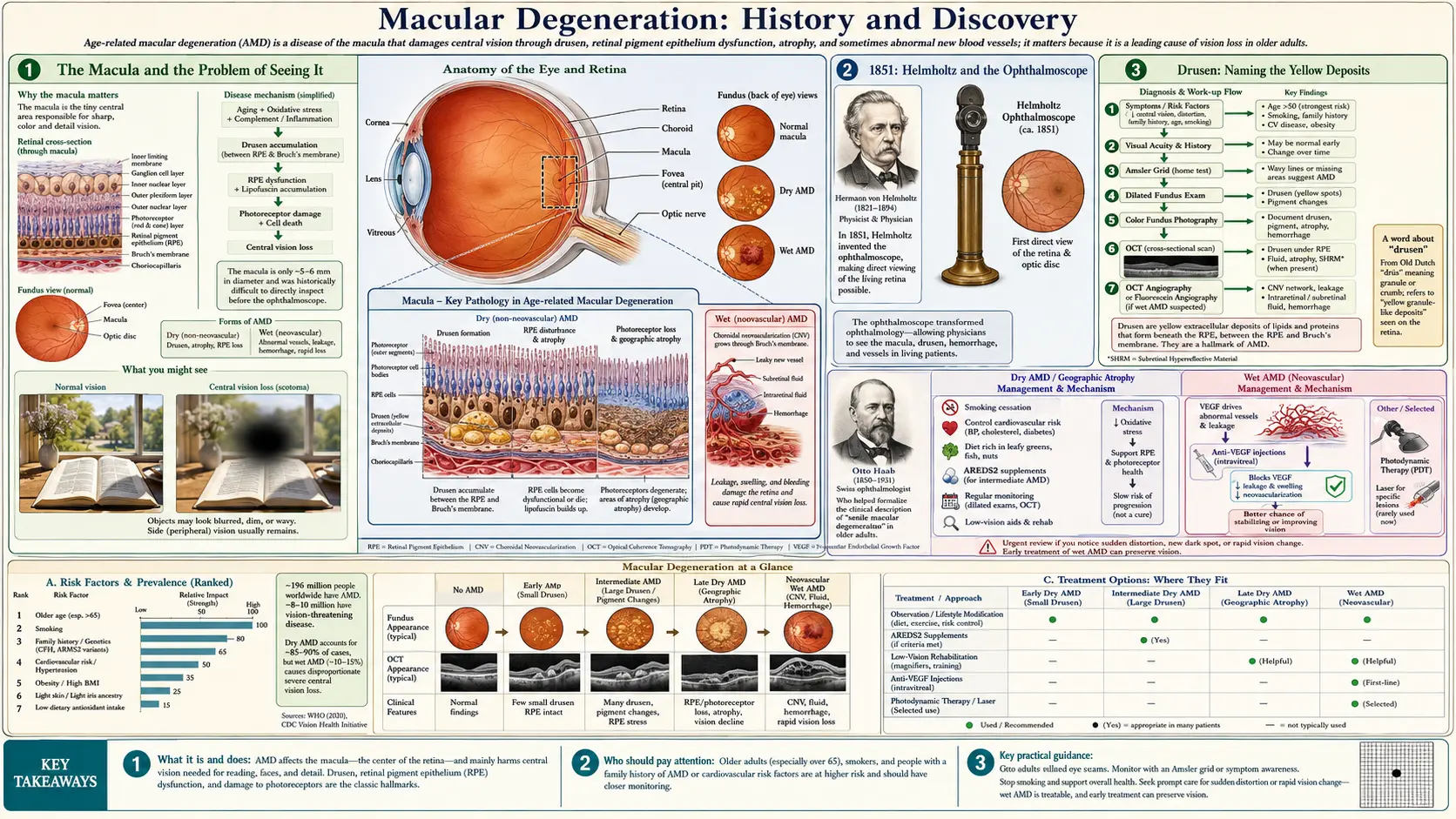
Age-related macular degeneration (AMD) is a disease of the macula, the central part of the retina. A 2005 genetics paper calls it the most frequent cause of irreversible blindness in the elderly in developed countries (Hageman 2005). Doctors could not look at the retina of a living patient until Hermann von Helmholtz described his eye mirror, the ophthalmoscope, in 1851. The deposits now called drusen were first described in 1854 by Carl Wedl, then by Frans Donders in 1855 and Heinrich Müller, who coined the word, in 1856; in 1885 Otto Haab was the first to report “senile macular illness” as a separate disease (de Jong 2016; de Jong 2018). This page follows the story from that first look into the eye, through the division into “dry” and “wet” forms, laser and light treatments, the anti-VEGF injections approved from 2004 onward, the AREDS supplement trials, and the 2005 discovery of the complement factor H gene, to the first two treatments approved for geographic atrophy in 2023.
Table of Contents
- The Macula and the Problem of Seeing It
- 1851: Helmholtz and the Ophthalmoscope
- Drusen: Naming the Yellow Deposits
- Otto Haab and “Senile Macular Degeneration”
- Dry and Wet: Splitting the Disease in Two
- Lasers and Light: The First Treatments
- The VEGF Story and the Anti-VEGF Revolution
- AREDS, Smoking, and the Genetics of Risk
- Key Research Papers
- Connections
- Featured Videos
The Macula and the Problem of Seeing It
AMD affects the macula, the central part of the retina. Its first signs appear in the choriocapillaris, Bruch’s membrane and the retinal pigment epithelium (RPE), the layers that lie beneath the light-sensing photoreceptors (de Jong 2018; Bhutto 2012). In geographic atrophy (GA), the advanced dry form, the result can be significant deficits in reading, night vision and dark adaptation and dense, irreversible blind spots (scotomas), although the first decline in visual acuity may be relatively minor if the fovea, the centre of the macula, is spared. In wet AMD, by contrast, vision loss is typically acute (Holz 2014).
Before the 1850s physicians had no way to see these layers in a living eye. Loss of visual acuity in older people was described under the general label “senile amblyopia”, as the ophthalmologist and historian de Jong notes (de Jong 2016).
The recorded history of AMD therefore begins with an instrument. De Jong dates the earliest descriptions of AMD to around 1850 (de Jong 2016), and in a second review to 1855 and 1868 (de Jong 2018) — shortly after it became possible to look at the back of the eye.
1851: Helmholtz and the Ophthalmoscope
In 1851 Hermann von Helmholtz (1821–1894) published a description of an “eye mirror” (Augen-Spiegel) for examining the retina in the living eye (Helmholtz 1851, as cited by de Jong 2018; dates from Tan 2006). Pearce’s history of the instrument traces its origins to the old observation that the back of the eye appears black. In 1703 Méry reported that a cat’s eye could be seen to glow when the animal was held under water; Prévost later deduced that the glow was incident light being reflected, not light coming out of the eye; and Purkinje and von Brücke used lenses to try to see the fundus and almost succeeded. It was Helmholtz who created the first usable ophthalmoscope (Pearce 2009).
The instrument spread quickly. Two years later, in 1853, Donders’ doctoral student Adrien van Trigt wrote a thesis on ophthalmoscopy containing the first colour images of the fundus, and from 1852 on Donders set out to bridge what he saw with the ophthalmoscope and what he saw under the microscope, collecting post-mortem eyes for histology (de Jong 2018).
That pairing of the ophthalmoscope with the microscope produced the first descriptions of drusen and of the disease itself in the 1850s and 1860s, described in the next section (de Jong 2016; de Jong 2018).
Drusen: Naming the Yellow Deposits
Around 1850 three authors gave drusen different names (de Jong 2016; de Jong 2018). The pathologist Carl Wedl gave the first description in 1854, calling them “colloid bodies of the choroid” (Colloidkörper) and taking them for incompletely developed cells because they had no cell membrane or nucleus. Frans Donders called them “colloid balls” (Colloidkugeln) in 1855, noted their preference for the macular area, described RPE atrophy between groups of drusen and concluded that drusen arise from RPE cell nuclei. After examining 38 apparently healthy post-mortem eyes he asked how far this degeneration could lead to visual disturbances, and he was convinced that the white flecks he had seen with the ophthalmoscope in older people with “senile amblyopia” were not fatty change but colloid degeneration (de Jong 2016; de Jong 2018).
Heinrich Müller coined the word druse in 1856. Druse is the German word for a geode, a rock cavity filled with crystals, and de Jong suggests Müller chose it because of the crystalline core in some large drusen (de Jong 2016; de Jong 2018). Albrecht Nagel was probably the first to publish on AMD using clinical and microscopic findings from the same patient: in 1868 he described a 64-year-old woman with partly confluent white flecks around both maculae who reported marked loss of sight and distorted vision (metamorphopsia) (de Jong 2016; de Jong 2018).
In 1874 Jonathan Hutchinson described a choroid “speckled with minute dots of yellowish white deposits”; his friend Warren Tay made the ophthalmoscopic examination. Hutchinson set out three stages: scattered yellow-white spots; their coalescence into patches with irregular borders; and haemorrhage at the “yellow spot” (the macula) with absorption of the blood. De Jong writes that this already describes the present-day course from drusen to late AMD (de Jong 2018), although in his 2016 review he concludes that Hutchinson’s own patient, given the early age of onset and other cases of visual loss in the family, actually had a different condition, Doyne’s honeycomb retinal dystrophy (de Jong 2016).
What drusen are and where they come from is still not settled: de Jong writes that more than 160 years on, it is still not known exactly where drusen originate (de Jong 2018). In 2005 Hageman and colleagues reported that complement factor H, the major inhibitor of the alternative complement pathway, accumulates within drusen and is made by the RPE (Hageman 2005).
Otto Haab and “Senile Macular Degeneration”
In 1884 Nettleship published on “central guttate choroiditis”, with a plate that clearly showed drusen — what would now be called early AMD — and in the same year on “central senile areolar choroidal atrophy”, probably what is now called dry late AMD (de Jong 2016; de Jong 2018). One year later, in 1885, Otto Haab was the first to report on “senile macular illness” (senile Maculaerkrankung) as a separate entity among the macular diseases. From more than 50,000 patient files he concluded that it was about as frequent as traumatic and myopic macular disease, and that it was often bilateral (de Jong 2016).
Two points qualify the usual story. First, Haab did not see drusen as part of the disease: he explicitly called them “quite innocent changes in old persons” that had nothing to do with senile macular illness, and the connection between drusen and AMD remained obscure for over a century (de Jong 2016). Second, the name changed. According to de Jong, ophthalmologists gradually became aware that “senile” macular degeneration was not a diagnosis patients were eager to hear; “age-determined” was first used in Germany (Straub, 1969) and “age-related” later appeared in the American literature, as terminology shifted after 1965. The terms early and late AMD were coined around 1995 (de Jong 2016; de Jong 2018).
The wet form had its own early literature. De Jong dates the first use of the word “disciform” to an 1896 atlas and calls the monograph by Junius and Kuhnt (1926) on disciform degeneration of the macula the breakthrough description of that form. Around 1965 a standard textbook covered AMD in seven pages under the sub-head “vascular sclerosis”, which de Jong takes as a sign of limited knowledge of or interest in the disease at the time (de Jong 2016). In 1967 Gass published a monograph on the pathogenesis of disciform detachment of the neuroepithelium (Gass 1967).
Dry and Wet: Splitting the Disease in Two
AMD is now divided into a dry (atrophic) form and a wet (neovascular) form. A 2012 review puts atrophic AMD at about 85–90% of cases and neovascular AMD at about 10–15% (Bhutto 2012). In the atrophic form, large confluent drusen and changes in the RPE appear to come first, and loss of the RPE can predict progression to geographic atrophy. In the neovascular form, the same review describes RPE cells made hypoxic by loss of the choriocapillaris producing angiogenic substances such as vascular endothelial growth factor (VEGF), which stimulate new vessels to grow from the choriocapillaris (choroidal neovascularization, CNV); photoreceptors then die from leakage from these vessels and from scarring (Bhutto 2012).
Seeing these vessels required new imaging. In 1961 Novotny and Alvis published a method of photographing fluorescence in the circulating blood of the human retina (Novotny 1961). Fluorescein angiography is among the techniques now used to detect GA (Holz 2014), and the 1999 verteporfin trials used it to decide on retreatment, treating again whenever angiography showed fluorescein leakage (TAP 1999).
Wet AMD often shows itself as distortion of straight lines (metamorphopsia). The Swiss ophthalmologist Marc Amsler (1891–1968) described his grid chart in 1947 (Tripathy 2023). Marmor’s history of macular grids notes that lines or grids for documenting metamorphopsia had appeared in ophthalmology textbooks for more than 100 years, but that testing for macular degeneration did not become routine until Amsler’s grids spread in the middle of the 20th century, in large measure because therapy for macular disease had become possible (Marmor 2000). A 2023 meta-analysis of 10 studies (1,890 eyes) found a sensitivity of 71% and a specificity of 63% for detecting wet AMD when the comparison group had dry AMD; its authors wrote that this sensitivity may be at levels typically not recommended for monitoring, and that at-risk patients typically should be encouraged to have regular eye examinations regardless of grid results (Bjerager 2023).
Lasers and Light: The First Treatments
The first treatment tested in large randomized trials was laser photocoagulation, which seals abnormal vessels with a laser burn. The Macular Photocoagulation Study (MPS) Group reported in 1991 that argon laser treatment of extrafoveal CNV (lesions away from the centre of the fovea) prevented or delayed large losses of visual acuity for at least 5 years. In eyes with AMD, untreated eyes had 1.5 times the risk of treated eyes of losing six or more lines of acuity, but recurrent neovascularization was seen in 54% of treated eyes by 5 years (MPS 1991, five-year results).
Lesions directly under the fovea (subfoveal) were harder to treat. In the MPS subfoveal trial, 20% of laser-treated eyes versus 11% of untreated eyes had lost six or more lines three months after enrolment; by 24 months the comparison had reversed (20% versus 37%). The investigators wrote that treatment of eligible lesions was recommended only if both the patient and the ophthalmologist were prepared for a large decrease in visual acuity immediately after treatment (MPS 1991, subfoveal trial).
Photodynamic therapy (PDT) with verteporfin used a light-activated drug in place of a burn: the drug was infused into a vein, and 15 minutes after the infusion began a 689 nm laser light was applied to the lesion. In the two TAP trials (609 patients with subfoveal CNV), 61% of verteporfin-treated eyes versus 46% of placebo-treated eyes had lost fewer than 15 letters of acuity at 12 months; the benefit was clearest in predominantly classic lesions (67% versus 39%), and no statistically significant difference was found when classic CNV made up less than half of the lesion (TAP 1999). The US Food and Drug Administration (FDA) approved verteporfin on 12 April 2000 (Drugs@FDA, NDA 021119). In the later ANCHOR trial, 64.3% of patients treated with verteporfin lost fewer than 15 letters at 12 months, but their mean visual acuity still fell by 9.5 letters (Brown 2006).
The VEGF Story and the Anti-VEGF Revolution
Blood-vessel growth (angiogenesis) had already been discussed as a treatment target in cancer: in 1971 Judah Folkman published “Tumor angiogenesis: therapeutic implications” (Folkman 1971). In 1989 Ferrara and Henzel purified, from bovine pituitary follicular cells, a growth factor specific for vascular endothelial cells and proposed the name vascular endothelial growth factor (VEGF) (Ferrara 1989). Later that year Leung, Ferrara and colleagues cloned VEGF and reported that it is a secreted protein able to induce angiogenesis in vivo (Leung 1989).
The first anti-VEGF drug for the eye was pegaptanib, approved by the FDA in December 2004 (FDA approval letter, NDA 21-756). In its two trials (1,186 patients), 70% of patients given 0.3 mg lost fewer than 15 letters at 54 weeks, compared with 55% given sham injections, and 33% versus 23% kept or gained acuity (Gragoudas 2004). Ranibizumab, an antibody fragment that neutralizes all active forms of VEGF-A, was approved on 30 June 2006 (Drugs@FDA, BLA 125156). In the MARINA trial (716 patients), 94.6% of patients on 0.5 mg lost fewer than 15 letters at 12 months, compared with 62.2% with sham injections, and 33.8% gained 15 or more letters, compared with 5.0%; mean acuity rose by 7.2 letters, against a fall of 10.4 letters with sham (Rosenfeld 2006). In the ANCHOR trial (423 patients), 96.4% on 0.5 mg lost fewer than 15 letters, compared with 64.3% with verteporfin, and 40.3% gained 15 or more letters, compared with 5.6%; the investigators wrote that treatment improved visual acuity on average at 1 year (Brown 2006).
The CATT investigators wrote in 2011 that clinical trials had established the efficacy of ranibizumab, and that bevacizumab was being used off-label for AMD despite the absence of similar supporting data. Their National Eye Institute–funded trial randomized 1,208 patients: at 1 year, the two drugs had equivalent effects on visual acuity when given on the same schedule (8.0 letters gained with monthly bevacizumab, 8.5 with monthly ranibizumab). Rates of death, heart attack and stroke were similar, but serious systemic adverse events (mainly hospitalizations) were more frequent with bevacizumab (24.1% versus 19.0%), with the excess spread across disease categories not previously identified as areas of concern; the investigators wrote that the differences require further study (CATT 2011).
Aflibercept was approved on 18 November 2011 (Drugs@FDA, BLA 125387). In the VIEW 1 and VIEW 2 trials (2,419 patients), aflibercept 2 mg every 2 months after three monthly doses was non-inferior to monthly ranibizumab in the proportion of patients maintaining vision at week 52 (95.1% and 95.6% in the two trials, versus 94.4% with ranibizumab); the authors wrote that the every-2-month regimen offered the potential to reduce the risk from monthly injections and the burden of monthly monitoring (Heier 2012).
AREDS, Smoking, and the Genetics of Risk
For the dry form, the first large trial was nutritional. The Age-Related Eye Disease Study (AREDS), an 11-centre double-masked trial published in 2001, enrolled 3,640 people aged 55–80 and assigned them to daily antioxidants (vitamin C 500 mg, vitamin E 400 IU and beta-carotene 15 mg), zinc (80 mg as zinc oxide, with copper 2 mg as cupric oxide), antioxidants plus zinc, or placebo; average follow-up was 6.3 years. Compared with placebo, antioxidants plus zinc reduced the odds of developing advanced AMD (odds ratio 0.72; 99% CI 0.52–0.98); the odds ratios for zinc alone (0.75) and antioxidants alone (0.80) were not statistically significant. Participants with only extensive small drusen, non-extensive intermediate drusen or pigment abnormalities had a 1.3% 5-year probability of progression; when these 1,063 participants were excluded, the odds ratio for antioxidants plus zinc was 0.66 (99% CI 0.47–0.91). Antioxidants plus zinc was the only treatment that significantly reduced at least moderate vision loss (odds ratio 0.73), and the investigators listed smoking as a contraindication to the formulation (AREDS 2001).
AREDS2, published in 2013, enrolled 4,203 people aged 50–85 at risk of advanced AMD (bilateral large drusen, or large drusen in one eye and advanced AMD in the other; median follow-up 5 years) and tested adding lutein 10 mg plus zeaxanthin 2 mg, the omega-3 fatty acids DHA 350 mg plus EPA 650 mg, or both, to the AREDS formulation. In the primary analyses none of these additions reduced progression to advanced AMD (hazard ratio 0.90 for lutein plus zeaxanthin, P=.12; 0.97 for DHA plus EPA, P=.70; 0.89 for both, P=.10). Removing beta-carotene or lowering the zinc dose had no apparent effect on progression. More lung cancers occurred with beta-carotene than without it (23 [2.0%] vs 11 [0.9%], nominal P=.04), mostly in former smokers; for that reason the investigators concluded that lutein plus zeaxanthin could be an appropriate carotenoid substitute for beta-carotene in the AREDS formulation (AREDS2 2013).
Both trials studied people who already had signs of AMD: AREDS enrolled people with drusen, pigment abnormalities, non-central geographic atrophy, or advanced AMD in one eye, and its benefit was found in the higher-risk group; AREDS2 enrolled only people with large drusen (AREDS 2001; AREDS2 2013).
Two other threads changed the understanding of who gets AMD. The first is smoking. A 2005 systematic review of 17 studies found that 13 reported a statistically significant association, with a two- to three-fold increased risk in current smokers compared with never-smokers and evidence of a dose–response, a temporal relationship and reversibility of effect; five studies found no association (Thornton 2005).
The second is genetics. In April 2005 three papers in one issue of Science linked a common variant in the complement factor H (CFH) gene to AMD. Klein and colleagues, in a genome-wide screen of 96 cases and 50 controls, found that people homozygous for the risk allele had 7.4 times the likelihood of AMD, and resequencing revealed a tyrosine-to-histidine change at amino acid 402 (Y402H) (Klein 2005). Edwards and colleagues found that at least one histidine at position 402 increased the risk of AMD 2.7-fold and might account for 50% of its attributable risk (Edwards 2005). Haines and colleagues reported odds ratios between 2.45 and 5.57 for Y402H and estimated that it likely explains about 43% of AMD in older adults (Haines 2005). In May 2005 Hageman and colleagues, studying about 900 cases and 400 controls, found one common at-risk CFH haplotype in 50% of cases and 29% of controls; they proposed that variation in this regulator of the alternative complement pathway, combined with a triggering event such as infection, underlies a major proportion of AMD (Hageman 2005).
Complement then became a drug target for geographic atrophy. The FDA approved the complement C3 inhibitor pegcetacoplan (Liao 2020) on 17 February 2023 (Drugs@FDA, NDA 217171); its phase 3 report describes it as the first FDA-approved treatment for GA. In the OAKS and DERBY trials (1,258 patients), monthly pegcetacoplan slowed lesion growth by 21% in OAKS at 12 months, while the 12% reduction in DERBY was not statistically significant; at 24 months the reductions were 22% (OAKS) and 19% (DERBY). There were no differences in the key secondary visual function endpoints at 24 months, and new-onset wet AMD was reported in 11% (OAKS) and 13% (DERBY) of patients on monthly pegcetacoplan, compared with 2% and 4% on sham (Heier 2023). The FDA approved the complement C5 inhibitor avacincaptad pegol (Jaffe 2021) on 4 August 2023 (Drugs@FDA, NDA 217225); in the phase 3 GATHER2 trial (448 patients), monthly 2 mg slowed GA growth by 14% compared with sham over 12 months (Khanani 2023). Drusen, which Haab dismissed as “quite innocent changes in old persons” (de Jong 2016), are now described as the hallmark lesion of AMD (Hageman 2005).
Key Research Papers
Each citation below ends in its verified PubMed or DOI record; FDA records link to the agency’s Drugs@FDA database. Topic searches into the wider literature follow the list. All links open in a new tab.
- de Jong PTVM. A Historical Analysis of the Quest for the Origins of Aging Macula Disorder, the Tissues Involved, and Its Terminology. Ophthalmology and Eye Diseases. 2016;8(Suppl 1):5–14. — doi:10.4137/OED.S40523
- de Jong PTVM. Elusive drusen and changing terminology of AMD. Eye (London). 2018;32(5):904–914. — doi:10.1038/eye.2017.298
- Pearce JM. The ophthalmoscope: Helmholtz’s Augenspiegel. European Neurology. 2009;61(4):244–249. — PubMed PMID: 19182487
- Tan SY, Shigaki D. Hermann von Helmholtz (1821–1894): inventor of the ophthalmoscope. Singapore Medical Journal. 2006;47(5):359–360. — PubMed PMID: 16645682
- Gass JD. Pathogenesis of disciform detachment of the neuroepithelium. American Journal of Ophthalmology. 1967;63(3):Suppl:1–139. — PubMed PMID: 6019308
- Bhutto I, Lutty G. Understanding age-related macular degeneration (AMD): relationships between the photoreceptor/retinal pigment epithelium/Bruch’s membrane/choriocapillaris complex. Molecular Aspects of Medicine. 2012;33(4):295–317. — PubMed PMID: 22542780
- Holz FG, Strauss EC, Schmitz-Valckenberg S, van Lookeren Campagne M. Geographic atrophy: clinical features and potential therapeutic approaches. Ophthalmology. 2014;121(5):1079–1091. — PubMed PMID: 24433969
- Novotny HR, Alvis DL. A method of photographing fluorescence in circulating blood in the human retina. Circulation. 1961;24:82–86. — PubMed PMID: 13729802
- Tripathy K, Salini B. Amsler Grid. In: StatPearls. Treasure Island (FL): StatPearls Publishing; 2023. — PubMed PMID: 30844168
- Marmor MF. A brief history of macular grids: from Thomas Reid to Edvard Munch and Marc Amsler. Survey of Ophthalmology. 2000;44(4):343–353. — PubMed PMID: 10667441
- Bjerager J, Schneider M, Potapenko I, et al. Diagnostic accuracy of the Amsler grid test for detecting neovascular age-related macular degeneration: a systematic review and meta-analysis. JAMA Ophthalmology. 2023;141(4):315–323. — PubMed PMID: 36795396
- Macular Photocoagulation Study Group. Argon laser photocoagulation for neovascular maculopathy: five-year results from randomized clinical trials. Archives of Ophthalmology. 1991;109(8):1109–1114. — PubMed PMID: 1714270
- Macular Photocoagulation Study Group. Laser photocoagulation of subfoveal neovascular lesions in age-related macular degeneration: results of a randomized clinical trial. Archives of Ophthalmology. 1991;109(9):1220–1231. — PubMed PMID: 1718250
- Treatment of Age-Related Macular Degeneration with Photodynamic Therapy (TAP) Study Group. Photodynamic therapy of subfoveal choroidal neovascularization in age-related macular degeneration with verteporfin: one-year results of 2 randomized clinical trials — TAP report. Archives of Ophthalmology. 1999;117(10):1329–1345. — PubMed PMID: 10532441
- Folkman J. Tumor angiogenesis: therapeutic implications. New England Journal of Medicine. 1971;285(21):1182–1186. — PubMed PMID: 4938153
- Ferrara N, Henzel WJ. Pituitary follicular cells secrete a novel heparin-binding growth factor specific for vascular endothelial cells. Biochemical and Biophysical Research Communications. 1989;161(2):851–858. — PubMed PMID: 2735925
- Leung DW, Cachianes G, Kuang WJ, Goeddel DV, Ferrara N. Vascular endothelial growth factor is a secreted angiogenic mitogen. Science. 1989;246(4935):1306–1309. — PubMed PMID: 2479986
- Gragoudas ES, Adamis AP, Cunningham ET Jr, Feinsod M, Guyer DR; VEGF Inhibition Study in Ocular Neovascularization Clinical Trial Group. Pegaptanib for neovascular age-related macular degeneration. New England Journal of Medicine. 2004;351(27):2805–2816. — PubMed PMID: 15625332
- Rosenfeld PJ, Brown DM, Heier JS, et al.; MARINA Study Group. Ranibizumab for neovascular age-related macular degeneration. New England Journal of Medicine. 2006;355(14):1419–1431. — PubMed PMID: 17021318
- Brown DM, Kaiser PK, Michels M, et al.; ANCHOR Study Group. Ranibizumab versus verteporfin for neovascular age-related macular degeneration. New England Journal of Medicine. 2006;355(14):1432–1444. — PubMed PMID: 17021319
- CATT Research Group; Martin DF, Maguire MG, Ying GS, Grunwald JE, Fine SL, Jaffe GJ. Ranibizumab and bevacizumab for neovascular age-related macular degeneration. New England Journal of Medicine. 2011;364(20):1897–1908. — PubMed PMID: 21526923
- Heier JS, Brown DM, Chong V, et al.; VIEW 1 and VIEW 2 Study Groups. Intravitreal aflibercept (VEGF trap-eye) in wet age-related macular degeneration. Ophthalmology. 2012;119(12):2537–2548. — PubMed PMID: 23084240
- Age-Related Eye Disease Study Research Group. A randomized, placebo-controlled, clinical trial of high-dose supplementation with vitamins C and E, beta carotene, and zinc for age-related macular degeneration and vision loss: AREDS report no. 8. Archives of Ophthalmology. 2001;119(10):1417–1436. — PubMed PMID: 11594942
- Age-Related Eye Disease Study 2 (AREDS2) Research Group. Lutein + zeaxanthin and omega-3 fatty acids for age-related macular degeneration: the AREDS2 randomized clinical trial. JAMA. 2013;309(19):2005–2015. — doi:10.1001/jama.2013.4997
- Thornton J, Edwards R, Mitchell P, Harrison RA, Buchan I, Kelly SP. Smoking and age-related macular degeneration: a review of association. Eye (London). 2005;19(9):935–944. — PubMed PMID: 16151432
- Klein RJ, Zeiss C, Chew EY, et al. Complement factor H polymorphism in age-related macular degeneration. Science. 2005;308(5720):385–389. — doi:10.1126/science.1109557
- Edwards AO, Ritter R 3rd, Abel KJ, Manning A, Panhuysen C, Farrer LA. Complement factor H polymorphism and age-related macular degeneration. Science. 2005;308(5720):421–424. — PubMed PMID: 15761121
- Haines JL, Hauser MA, Schmidt S, et al. Complement factor H variant increases the risk of age-related macular degeneration. Science. 2005;308(5720):419–421. — PubMed PMID: 15761120
- Hageman GS, Anderson DH, Johnson LV, et al. A common haplotype in the complement regulatory gene factor H (HF1/CFH) predisposes individuals to age-related macular degeneration. Proceedings of the National Academy of Sciences USA. 2005;102(20):7227–7232. — PubMed PMID: 15870199
- Liao DS, Grossi FV, El Mehdi D, et al. Complement C3 inhibitor pegcetacoplan for geographic atrophy secondary to age-related macular degeneration: a randomized phase 2 trial. Ophthalmology. 2020;127(2):186–195. — PubMed PMID: 31474439
- Heier JS, Lad EM, Holz FG, et al. Pegcetacoplan for the treatment of geographic atrophy secondary to age-related macular degeneration (OAKS and DERBY): two multicentre, randomised, double-masked, sham-controlled, phase 3 trials. Lancet. 2023;402(10411):1434–1448. — PubMed PMID: 37865470
- Jaffe GJ, Westby K, Csaky KG, et al. C5 inhibitor avacincaptad pegol for geographic atrophy due to age-related macular degeneration: a randomized pivotal phase 2/3 trial. Ophthalmology. 2021;128(4):576–586. — PubMed PMID: 32882310
- Khanani AM, Patel SS, Staurenghi G, et al. Efficacy and safety of avacincaptad pegol in patients with geographic atrophy (GATHER2): 12-month results from a randomised, double-masked, phase 3 trial. Lancet. 2023;402(10411):1449–1458. — PubMed PMID: 37696275
- U.S. Food and Drug Administration. Approval letter, NDA 21-756 (pegaptanib sodium injection), signed 17 December 2004. — fda.gov
- U.S. Food and Drug Administration. Drugs@FDA: NDA 021119 (verteporfin, original approval 04/12/2000). — Drugs@FDA
- U.S. Food and Drug Administration. Drugs@FDA: BLA 125156 (ranibizumab, original approval 06/30/2006). — Drugs@FDA
- U.S. Food and Drug Administration. Drugs@FDA: BLA 125387 (aflibercept, original approval 11/18/2011). — Drugs@FDA
- U.S. Food and Drug Administration. Drugs@FDA: NDA 217171 (pegcetacoplan intravitreal injection, original approval 02/17/2023). — Drugs@FDA
- U.S. Food and Drug Administration. Drugs@FDA: NDA 217225 (avacincaptad pegol, original approval 08/04/2023). — Drugs@FDA
PubMed Topic Searches
- Gass and disciform macular degeneration — PubMed: Gass disciform macular degeneration
- History of the ophthalmoscope and Hermann von Helmholtz — PubMed: ophthalmoscope history (Helmholtz)
- Drusen — history, terminology, and pathology in age-related macular degeneration — PubMed: drusen history and terminology
- Ranibizumab pivotal trials for neovascular AMD (MARINA / ANCHOR) — PubMed: ranibizumab MARINA ANCHOR trials
- Bevacizumab versus ranibizumab for AMD — the CATT comparison of anti-VEGF therapies — PubMed: CATT bevacizumab vs ranibizumab
- Discovery of vascular endothelial growth factor (VEGF) and the biology of angiogenesis — PubMed: VEGF discovery (Ferrara)
- Amsler grid and the detection of metamorphopsia in macular disease — PubMed: Amsler grid and metamorphopsia
External Authoritative Resources
- National Eye Institute (NIH) — Age-Related Macular Degeneration
- EyeWiki (American Academy of Ophthalmology) — Age-Related Macular Degeneration
- PubMed — All research on the history of age-related macular degeneration. — Search PubMed
Connections
- Ophthalmology
- Macular Degeneration (main article)
- Cataracts
- Glaucoma
- Glaucoma: History and Discovery
- Diabetes
- Diabetic Retinopathy & Complications
- All Conditions