Vulvar Cancer
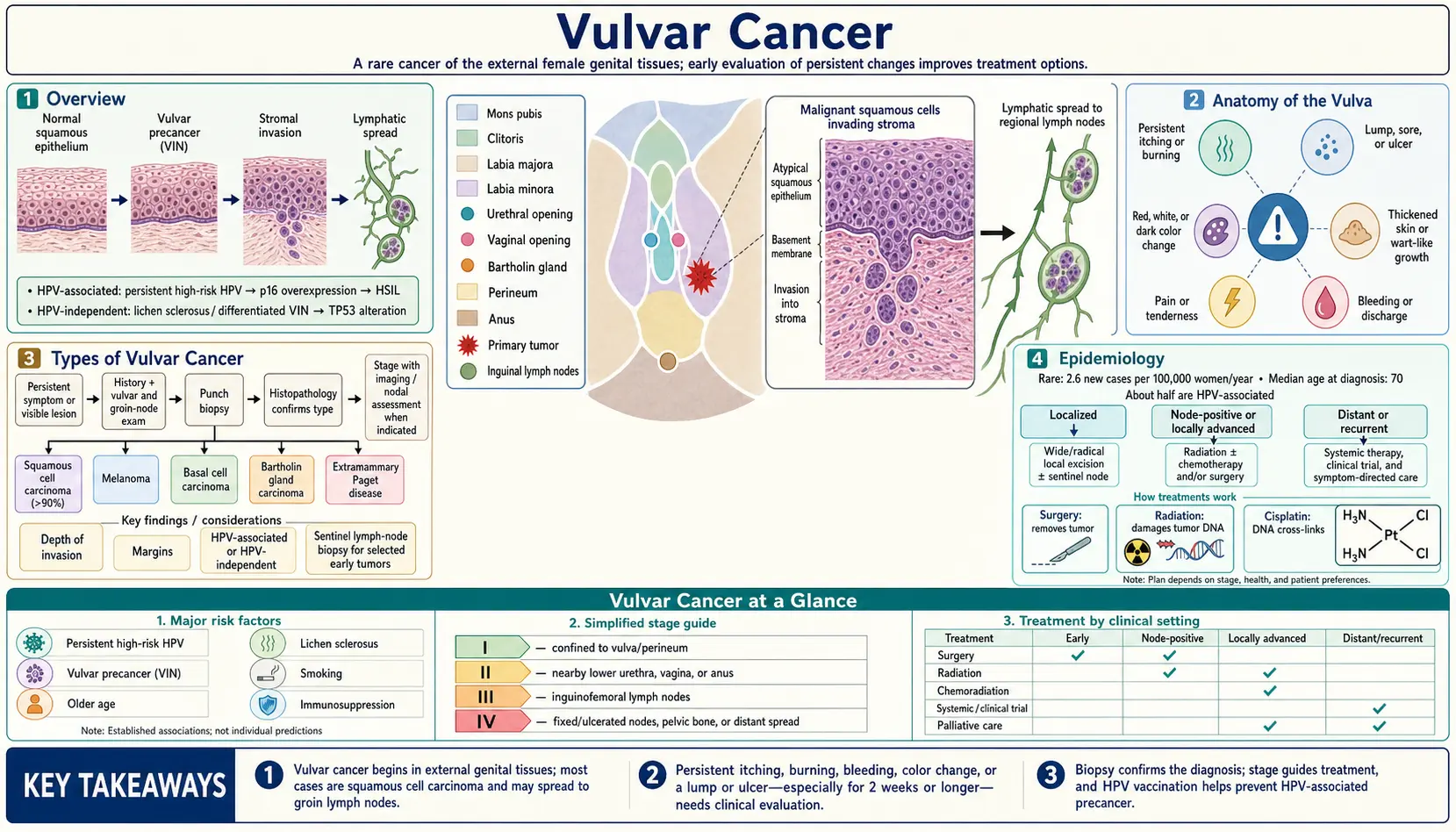
Table of Contents
- Overview
- Anatomy of the Vulva
- Types of Vulvar Cancer
- Epidemiology
- Risk Factors
- Staging
- Diagnosis
- Treatment
- Complications
- Prognosis
- Prevention
- References & Research
- Research Papers
- Connections
- Featured Videos
1. Overview
Vulvar cancer is a malignancy of the external female genitalia — the visible outer structures that make up the vulva. In the United States, roughly 6,000 women are diagnosed each year, and about 1,600 die from it. Compared to cancers of the breast or colon, those numbers are not enormous — but vulvar cancer carries a particularly heavy burden because of where it occurs, what its treatment involves, and how deeply it affects a woman's sense of self, sexuality, and dignity.
About 90% of vulvar cancers are squamous cell carcinomas (SCC) — the same basic cell type that causes most skin cancers. But "squamous cell carcinoma of the vulva" is not one disease: it actually travels two very different biological roads to get there. Understanding which road applies changes almost everything about treatment, prognosis, and who is at risk. Those two paths are explained fully in Section 3.
If you are reading this because you or someone you love has been diagnosed, or because a biopsy is pending, we want to say this directly: vulvar cancer is often curable when caught early, and even when it is not caught early, real treatment options exist. The staging and surgical language can sound alarming. The anatomy is intimate. Some treatments are genuinely hard. This page does not soften that reality — but it also explains it clearly, because understanding what is happening is the best foundation for making good decisions.
2. Anatomy of the Vulva
The term vulva refers to all of the external female genitalia — everything visible from the outside. It is important to distinguish the vulva from the vagina, which is the internal canal leading to the uterus. Vulvar cancer and vaginal cancer are separate primary sites with different staging systems, different treatments, and different outcomes.
The structures that make up the vulva include:
- Labia majora — the outer, larger folds of skin on either side.
- Labia minora — the inner, thinner folds of skin just inside the labia majora.
- Clitoris — the erectile organ at the top of the labia minora, highly sensitive tissue important to sexual function.
- Vaginal vestibule — the space between the labia minora that contains the vaginal opening and the urethral meatus (the opening for urine).
- Bartholin glands — two small glands, one on each side of the vaginal opening (posterior vestibule), that produce lubricating fluid. These can give rise to a rare but distinct type of vulvar cancer.
- Perineum — the area of skin between the vaginal opening and the anus.
Why anatomy matters for staging and surgery. Where a vulvar tumor sits determines a great deal. A tumor on the outer labia, well away from the urethra and anus, can often be removed with a wide local excision that preserves function. A tumor on or near the clitoris, or spanning the midline, has different lymph drainage patterns and more complex surgical implications. The lymphatic drainage of the vulva runs to the superficial inguinal nodes (in the groin), then to the deep inguinal nodes, and on to the external iliac and pelvic nodes. Clitoral and periurethral tumors can sometimes drain directly to deep pelvic nodes, bypassing the usual groin station — a fact with real consequences for lymph node assessment.
3. Types of Vulvar Cancer
Understanding the type matters because it determines who gets this cancer, at what age, and how aggressive it is.
Squamous Cell Carcinoma — Two Distinct Pathways
About 90% of vulvar cancers are squamous cell carcinomas, but they arrive via two biologically separate routes:
HPV-related pathway (~50% of cases): The human papillomavirus — particularly HPV types 16 and 18, the same strains that cause most cervical cancers — infects vulvar tissue and can cause a precancerous change called usual-type vulvar intraepithelial neoplasia (uVIN), also called high-grade squamous intraepithelial lesion (HSIL). Over years to decades, uVIN can progress to a warty or basaloid pattern of SCC. This type tends to occur in younger women (50s to 60s), is more likely to coexist with HPV-related changes in the cervix or vagina (a phenomenon called "field effect"), and often has a somewhat better prognosis.
Non-HPV pathway (~50% of cases): In older women, typically in their 70s and 80s, vulvar cancer often arises through a completely different chain of events. Lichen sclerosus — a chronic inflammatory skin condition of the vulva that causes itching, thinning, and scarring — can, over many years, transform through a precursor called differentiated VIN (dVIN) into a keratinizing (conventional) squamous cell carcinoma. This pathway is HPV-negative. It tends to be diagnosed at an older age, is often more aggressive, and carries a poorer prognosis than its HPV-related counterpart.
The practical implication: a 58-year-old woman who smokes and has had prior HPV-related cervical changes is a very different patient than a 78-year-old with a 20-year history of lichen sclerosus. Both can develop vulvar SCC, but the story behind each — and to some degree the behavior of the tumor — differs substantially.
Other, Less Common Types
- Melanoma (~5%) — the second most common type. Vulvar melanoma behaves like melanoma elsewhere: deeply pigmented or amelanotic lesion, staged by the melanoma system (Breslow thickness), treated with wide excision and, for advanced disease, immunotherapy (checkpoint inhibitors). Prognosis is worse than SCC overall because it is often diagnosed late.
- Bartholin gland carcinoma — a rare cancer arising in the Bartholin glands. Subtypes include SCC, adenocarcinoma, and adenoid cystic carcinoma. Often presents as what appears to be a benign Bartholin cyst in an older woman; persistent or recurrent Bartholin "cysts" in women over 40 should always be biopsied.
- Paget's disease of the vulva — an intraepithelial adenocarcinoma (cancer in the surface lining) that typically presents as a red, eczematous rash of the vulva. It looks like a chronic skin condition and is frequently misdiagnosed for years. In a minority of cases it is associated with an underlying invasive adenocarcinoma or with a separate internal adenocarcinoma (colorectal, bladder) — so a thorough workup is needed when Paget's is found.
- Verrucous carcinoma — a highly differentiated, slow-growing subtype of SCC that resembles a giant condyloma. It is locally destructive but rarely metastasizes. Wide local excision is usually curative.
4. Epidemiology
Vulvar cancer accounts for about 4% of all gynecologic cancers in the United States — behind uterine and cervical cancers but with a meaningful impact given the intimate site and the morbidity of treatment. SEER data put annual US incidence at approximately 6,000 new cases, with around 1,600 deaths per year.
Incidence has risen roughly 20% over the past two decades, driven in part by an increase in HPV-related precancerous lesions (uVIN) in younger women. The HPV vaccine is expected to reduce this burden over coming decades, but that benefit is not yet visible in incidence data — the vaccinated generation is still mostly too young for vulvar cancer to appear.
The median age at diagnosis is approximately 68 years overall, reflecting the predominance of the non-HPV (lichen sclerosus) pathway in older women. But the HPV-related pathway is shifting the distribution younger — cases in women in their 40s and 50s are becoming proportionally more common.
Immunosuppression is a strong amplifier of risk. Women living with HIV, or those on immunosuppressive therapy after solid-organ transplant, have substantially higher rates of HPV-related vulvar cancers — their immune systems cannot suppress HPV the way immunocompetent bodies usually can.
5. Risk Factors
- HPV infection — especially HPV types 16 and 18. HPV is transmitted sexually, and most sexually active adults are exposed at some point; most infections clear on their own. Persistent infection with high-risk types is what drives cancer risk.
- Lichen sclerosus — a chronic inflammatory skin condition of the vulva. Lifetime risk of progression to SCC is approximately 4–6% in women with lichen sclerosus. That number sounds small, but the condition is common and often underdiagnosed or undertreated, so the absolute contribution to vulvar cancer burden is significant.
- Smoking — damages DNA directly and may impair the immune response to HPV, synergizing with viral infection to promote cancer.
- Immunosuppression — HIV infection, immunosuppressive medications after organ transplant, or other conditions that compromise immune surveillance.
- Prior high-grade vulvar, cervical, or vaginal intraepithelial neoplasia — reflects persistent HPV exposure throughout the lower genital tract ("field effect").
- Prior invasive cervical or vaginal cancer — same field-effect reasoning.
- Age — risk rises steadily with age; the non-HPV pathway in particular is a disease of older women.
It is worth being direct about something: most women with one or more of these risk factors will never develop vulvar cancer. And some women who develop it have none of them. Risk factors shift probability — they do not determine fate. If you have lichen sclerosus and are worried, the most important thing you can do is stay in regular follow-up with a dermatologist or gynecologist who can monitor for change.
6. Staging
Vulvar cancer is staged using the FIGO 2021 / AJCC system. Staging determines treatment and gives the best available estimate of prognosis. Here is what each stage means in plain language:
Stage I — Cancer confined to the vulva:
- Stage IA: Tumor any size, confined to the vulva, with stromal invasion of 1 mm or less. This is the one stage where lymph node assessment can safely be skipped — the risk of lymph node spread is less than 1% with such minimal invasion. Surgery alone (wide local excision) is almost always curative.
- Stage IB: Tumor confined to the vulva but with invasion deeper than 1 mm, or tumor larger than 2 cm. Lymph node assessment is needed because the risk of spread to groin nodes is meaningful.
Stage II: Tumor of any size that has grown to involve adjacent structures — the lower third of the vagina, the lower third of the urethra, or the anus — but without spread to lymph nodes. Still potentially curable with surgery.
Stage III — Spread to the inguinofemoral (groin) lymph nodes: This is where the picture becomes significantly more serious, and the details matter:
- Stage IIIA: 1–2 lymph node metastases smaller than 5 mm, or 1 node metastasis 5 mm or larger.
- Stage IIIB: 2 or more lymph node metastases 5 mm or larger, or 3 or more metastases smaller than 5 mm.
- Stage IIIC: Lymph node involvement with extracapsular spread (cancer has broken through the wall of the lymph node into surrounding tissue).
Stage IVA — Locally very advanced: The tumor has spread to the upper two-thirds of the urethra or vagina, the bladder lining, the rectal lining, or the pelvic bone — or there are fixed or ulcerated lymph nodes in the groin (meaning they are stuck to surrounding tissue and cannot move freely).
Stage IVB — Distant metastases: Cancer has spread beyond the pelvis to other organs (lungs, liver, bones, distant lymph nodes).
The most important single prognostic factor in vulvar cancer is whether cancer has spread to the lymph nodes. Women with node-negative disease have dramatically better outcomes than those with node involvement, regardless of tumor size.
7. Diagnosis
A suspicious lesion on the vulva must always be biopsied — empirical treatment (treating without a tissue diagnosis) is never acceptable, because many vulvar conditions look similar visually but require completely different management. The biopsy is simple, usually done in clinic under local anesthetic using a small circular punch tool.
What to biopsy: Any persistent, changing, or symptomatic lesion of the vulva warrants biopsy. Classic warning signs include a white, red, or dark patch that does not clear with treatment; a raised, firm, or ulcerated area; persistent itching that is not explained by infection; or a nodule that feels different from surrounding tissue.
Colposcopy of the lower genital tract is performed at the time of diagnosis to look for concurrent HPV-related changes in the cervix and vagina — because of the field effect, women with vulvar SCC of the HPV type are at elevated risk for cervical and vaginal lesions as well.
Imaging:
- CT or PET-CT scan — for women with clinical Stage III–IV disease, to assess lymph node involvement and rule out distant metastases.
- MRI of the pelvis — valuable for defining the local extent of a large or deeply invasive tumor, and for assessing involvement of adjacent structures (urethra, vagina, anus) before planning surgery.
Tumor marker: SCC antigen (SCCA) can be elevated in squamous vulvar cancer and may be used to monitor treatment response, though it is not a diagnostic test on its own.
An important note about self-advocacy: Many vulvar conditions are initially misdiagnosed as yeast infections, dermatitis, or lichen sclerosus, and symptoms may be present for months or years before a biopsy is taken. If you have a persistent vulvar symptom that is not responding to the treatment your doctor recommended, asking for a biopsy is entirely reasonable — it is a minor procedure and the only definitive way to rule cancer in or out.
8. Treatment
Treatment depends heavily on stage, tumor location, and the patient's overall health and wishes. The goal throughout is to cure the cancer while preserving as much function and quality of life as possible. Vulvar cancer treatment has evolved significantly over the past 30 years, moving away from radical, disfiguring surgery and toward more targeted approaches.
Early-Stage Disease (Stages I–II)
Wide local excision (WLE) is the standard surgical approach for tumors confined to the vulva. The goal is to achieve a pathologically clear margin of at least 8 mm on the final specimen (which requires removing roughly 10–15 mm of normal-appearing tissue surgically, since tissue contracts after removal). Margin status is critical: close or positive margins are associated with high local recurrence rates. Extensive radical vulvectomy — removal of the entire vulva — is no longer the routine standard of care for early disease, having been replaced by WLE in most cases, with equivalent cancer outcomes and far better quality of life.
Stage IA (invasion ≤ 1 mm): No lymph node assessment needed. The risk of spread to groin nodes is less than 1%, so a wide local excision alone is standard. This is the stage where surgery is truly straightforward and cure rates exceed 90%.
Stage IB and above: Sentinel lymph node biopsy (SLNB). For tumors that are unifocal (a single lesion), less than 4 cm, and clinically node-negative (no suspicious nodes on imaging or physical exam), sentinel lymph node biopsy is now the standard of care. A radiotracer and blue dye are injected around the tumor before or during surgery; the sentinel node — the first lymph node the tumor's lymphatic drainage reaches — is identified and removed for pathology. If the sentinel node is cancer-free, the remaining groin nodes are almost certainly cancer-free, and the patient is spared the morbidity of full inguinofemoral lymphadenectomy.
This is important: the landmark GROINSS-V I trial (van der Zee et al., 2008 — PMID 18539356) established that SLNB is a safe alternative to full groin dissection in early vulvar SCC, with a short-term groin recurrence rate of only 2.3% — comparable to what is expected with full lymphadenectomy — and dramatically lower rates of lymphedema and wound complications. This trial changed practice worldwide.
The follow-up GROINSS-V II trial (Oonk et al., 2021 — PMID 34351816) investigated whether women with low-volume sentinel node metastases could be treated with radiotherapy instead of full groin lymphadenectomy, sparing the morbidity of a full nodal dissection.
Advanced Disease (Stages III–IVA)
When disease has reached the groin lymph nodes, or when the primary tumor is so large or closely involved with the urethra, anus, or bladder that surgical removal would require removing those structures, a different strategy is used.
Primary chemoradiation — concurrent external beam radiation to the vulva, groins, and pelvis, combined with weekly cisplatin (40 mg/m²) — has become the standard approach for locally advanced, unresectable vulvar cancer. It can cure many patients while avoiding the enormous morbidity of exenterative surgery (removing the bladder or rectum). The GOG 205 trial (Moore et al., 2012 — PMID 22112742) demonstrated a 78% complete clinical response rate with cisplatin-based chemoradiation at 64.5 Gy, establishing this as a definitive treatment option. Subsequent data (Rao et al., 2017 — PMID 28982644) confirmed that chemoradiation yields improved survival compared to radiation alone.
For women with clinically positive groin lymph nodes (Stage III), bilateral inguinofemoral lymphadenectomy is performed if surgery is otherwise the treatment plan. When the tumor sits at the midline — involving the clitoris or perineum — both groins must be assessed, because these tumors drain bilaterally; assessing only one side would miss a meaningful proportion of contralateral metastases.
Radical vulvectomy (removal of the entire vulva) is reserved for rare advanced cases where chemoradiation is not possible or has failed.
Recurrent and Metastatic Disease
Treatment of recurrent vulvar cancer depends on the site, extent, and prior treatment received.
- Local recurrence (in the vulva) without groin node involvement, especially more than two years after initial treatment, can often be treated with repeat surgical excision and may be curable.
- Chemotherapy for metastatic disease most commonly uses cisplatin plus paclitaxel.
- Immunotherapy: Pembrolizumab (Keytruda), a PD-1 checkpoint inhibitor, has shown activity in squamous cell carcinomas of the lower genital tract. The KEYNOTE-158 basket trial included vulvar/vaginal SCC alongside cervical cancer; objective response rates in PD-L1-positive tumors were modest (around 12%) but real and durable in some patients. Nivolumab is an option for tumors that are MSI-high or have high tumor mutational burden (TMB-H).
- Cetuximab (anti-EGFR antibody) has been explored in small series, as vulvar SCC frequently overexpresses EGFR.
- Clinical trials should always be explored for recurrent/metastatic disease — this remains an area where standard options are limited and research is active.
9. Complications
Both the disease and its treatment carry significant risks of complications. Honest information about these helps women prepare and advocate for the supportive care they need.
Surgical Complications
- Wound breakdown — groin incisions heal poorly because of poor skin vascularity and proximity to bacteria-laden areas. Wound dehiscence and infection are among the most common short-term complications of inguinofemoral lymphadenectomy (IFL), occurring in a significant minority of patients.
- Lymphedema — chronic swelling of the legs and genitals from disruption of lymphatic drainage. After full bilateral IFL, lymphedema rates of 30–70% have been reported, often permanent and affecting quality of life profoundly. Sentinel lymph node biopsy dramatically reduces this risk — lymphedema rates after SLNB alone are 2–5%. This difference is one of the most important arguments for SLNB in eligible patients.
- Sexual dysfunction — vulvar surgery, particularly if it involves the clitoris or significantly alters the anatomy, profoundly affects sexual function, body image, and intimacy. These are real, legitimate concerns that deserve open discussion with the surgical team and, ideally, referral to a sexual health counselor.
- Urinary changes — surgery near the urethra can alter urinary stream, control, or sensation. Radiation to the pelvis can cause bladder irritation (radiation cystitis) short- and long-term.
Radiation Complications
- Acute skin reaction — radiation to the vulvar skin causes intense dermatitis, painful ulceration, and sometimes moist desquamation during the course of treatment. This is expected and manageable, but it is genuinely difficult.
- Late effects — fibrosis (scarring and stiffening of tissue), vaginal stenosis, and chronic lymphedema can develop months to years after radiation.
Psychological Impact
The psychological burden of vulvar cancer deserves explicit acknowledgment. Treatment involving the genitals is deeply intimate, and fears about sexuality, femininity, body image, and relationships are common and normal. Anxiety, depression, and sexual distress are prevalent in this population. Psychosocial support — from a counselor, psycho-oncologist, or peer support group — is not optional ancillary care. It is part of comprehensive treatment.
10. Prognosis
Vulvar cancer is frequently curable, especially when found early. The numbers by stage reflect that clearly:
- Stage I: Five-year survival approximately 80–90%.
- Stage II: Five-year survival approximately 60–70%.
- Stage III: Five-year survival approximately 40–50% — drops significantly with node involvement.
- Stage IV: Five-year survival approximately 10–20%.
The single strongest predictor of outcome is lymph node status — whether cancer has spread to the groin nodes, how many nodes are involved, how large the deposits are, and whether there is extracapsular spread. A woman with a Stage IB tumor and clean sentinel nodes is in a very different situation from a woman with multiple positive nodes.
HPV status also matters: HPV-related tumors tend to behave somewhat less aggressively and may carry a modestly better prognosis than HPV-negative (lichen sclerosus-associated) SCC, which tends to be diagnosed at an older age in a more vulnerable patient and can pursue a more locally destructive course.
Recurrence patterns: Local recurrence (in the vulva itself) without node involvement can often be treated successfully and does not necessarily mean the disease is incurable. Groin recurrence is more serious — the groin nodes that recur after treatment are notoriously difficult to salvage, which is why getting the initial groin treatment right matters so much.
Statistics always describe groups, not individuals. The averages above come from large populations that include women of all ages, with all stages of health, and from years when treatment was less refined. Many women with even advanced vulvar cancer live longer than the statistics suggest, and quality of life with good supportive care can remain meaningful even in the face of advanced disease.
11. Prevention
HPV Vaccination
Gardasil 9 (the current HPV vaccine, protecting against HPV types 6, 11, 16, 18, 31, 33, 45, 52, and 58) is expected to substantially reduce HPV-related vulvar cancers — just as it has already begun to dramatically reduce high-grade cervical precancers in vaccinated cohorts. Protection against HPV 16 and 18 alone covers the types responsible for the majority of HPV-associated vulvar SCC. The vaccine is most effective when given before HPV exposure (ideally ages 9–12), but guidelines in the US allow vaccination up to age 26, and selected adults through age 45 may benefit after shared decision-making with their doctor. The impact on vulvar cancer rates will become visible in incidence data as vaccinated cohorts age into their 50s and 60s.
Treating Lichen Sclerosus
Women with lichen sclerosus should be under the care of a dermatologist or gynecologist who can prescribe topical high-potency corticosteroids (typically clobetasol propionate 0.05% ointment). Active treatment of lichen sclerosus suppresses the chronic inflammation, controls symptoms, and is standard of care. Whether adequate treatment reduces the 4–6% lifetime risk of malignant transformation is not yet proven, but it is biologically plausible and is the correct treatment regardless. Women with lichen sclerosus should have regular vulvar examinations — any new lesion, any area that does not respond to treatment, or any area that thickens or ulcerates should be biopsied promptly.
Reducing HPV Transmission Risk
Condoms reduce but do not eliminate HPV transmission. Not smoking is relevant because smoking impairs immune clearance of HPV and directly damages mucosal DNA. Regular cervical cancer screening (Pap smears, HPV testing) is part of the same surveillance system that catches lower-genital-tract HPV disease early.
Vulvar Self-Examination
There is no formal screening program for vulvar cancer in average-risk women, but awareness matters. Women — particularly those with lichen sclerosus, prior VIN, or prior cervical/vaginal cancer — benefit from regularly looking at their own vulva (a hand mirror makes this straightforward) and reporting any new or changing lesion to their doctor. Familiarity with one's own normal anatomy is the best baseline for recognizing change.
12. References & Research
Historical Background
Vulvar cancer has been treated surgically since the late 19th century, but for most of the 20th century the standard operation was radical vulvectomy with bilateral inguinal lymphadenectomy — complete removal of the entire vulva, the skin of the groins, and all the inguinal lymph nodes. This operation was deeply disfiguring, carried high morbidity (massive wound breakdown, permanent lymphedema, profound sexual and psychological harm), and was applied to even the smallest tumors.
The movement toward less radical surgery began in earnest in the 1980s and 1990s, led largely by work from the Gynecologic Oncology Group and European investigators. The shift from radical vulvectomy to wide local excision — demonstrating equivalent cancer control with far less morbidity for early-stage disease — was a landmark. The next revolution was the sentinel lymph node concept, adapted from breast cancer and melanoma and applied to vulvar cancer in the 1990s and formalized in the GROINSS-V I trial published in 2008. The FIGO staging system has been refined multiple times, most recently in 2021, to better reflect the prognostic granularity of lymph node involvement. Chemoradiation, borrowed from anal cancer treatment, has displaced exenterative surgery as the approach for locally advanced disease. And the recognition of two biologically distinct pathways — HPV-related and lichen-sclerosus-related — has fundamentally reframed who gets this disease and why.
Key Research Papers
- van der Zee AGJ, Oonk MHM, De Hullu JA, et al. Sentinel node dissection is safe in the treatment of early-stage vulvar cancer. J Clin Oncol. 2008;26(6):884–889 — Search PubMed. DOI: 10.1200/JCO.2007.14.0566
- Oonk MHM, Slomovitz B, Baldwin PJW, et al. Radiotherapy versus inguinofemoral lymphadenectomy as treatment for vulvar cancer patients with micrometastases in the sentinel node: results of GROINSS-V II. J Clin Oncol. 2021;39(32):3623–3632 — Search PubMed. DOI: 10.1200/JCO.21.00006
- Moore DH, Ali S, Koh W-J, et al. A phase II trial of radiation therapy and weekly cisplatin chemotherapy for the treatment of locally-advanced squamous cell carcinoma of the vulva (GOG 205). Gynecol Oncol. 2012;124(3):529–533 — Search PubMed. DOI: 10.1016/j.ygyno.2011.11.003
- Rao YJ, Chin RI, Hui C, et al. Improved survival with definitive chemoradiation compared to definitive radiation alone in squamous cell carcinoma of the vulva. Gynecol Oncol. 2017;147(3):648–655 — Search PubMed. DOI: 10.1016/j.ygyno.2017.09.031
- Preti M, Vieira-Baptista P, Digesu GA, et al. The clinical role of LAST (Lower Anogenital Squamous Terminology) terminology in vulvar disease. J Low Genit Tract Dis. 2018;22(4):414–421 — Search PubMed. DOI: 10.1097/LGT.0000000000000418
- Reyes MC, Cooper K. An update on vulvar intraepithelial neoplasia: terminology and a practical approach to diagnosis. J Clin Pathol. 2014;67(4):290–294 — Search PubMed. DOI: 10.1136/jclinpath-2013-201798
- Alonso I, Toscano I, Fuste V, et al. Sentinel lymph node in vulvar carcinoma: analysis of the correlation between the GROINSS-V score and recurrence. Gynecol Oncol. 2020;157(2):415–420 — Search PubMed. DOI: 10.1016/j.ygyno.2020.02.009
- Frey JN, Hampl M, Mueller MD, et al. Should we reconsider vulvar cancer treatment? Local excision instead of vulvectomy as standard surgical treatment in women with vulvar cancer. Int J Gynecol Cancer. 2016;26(4):730–735 — Search PubMed. DOI: 10.1097/IGC.0000000000000649
- Hellman K, Silfversward C, Nilsson B, et al. Primary carcinoma of the Bartholin gland: a retrospective study of 44 patients. Int J Gynecol Cancer. 2006;16(3):1200–1205 — Search PubMed. DOI: 10.1111/j.1525-1438.2006.00605.x
- Blecharz P, Karolewski K, Bieda T, et al. Prognostic factors in patients with vulval carcinoma after surgical treatment. Eur J Gynaecol Oncol. 2008;29(3):260–263 — Search PubMed.
- Lewin SN, Herzog TJ, Barrena Medel NI, et al. Comparative performance of the 2009 international Federation of gynecology and obstetrics' staging system for uterine corpus and cervical cancers. Obstet Gynecol. 2010;116(5):1141–1149. PMID 20966701. DOI: 10.1097/AOG.0b013e3181f39849
- Olawaiye AB, Cuello MA, Rogers LJ. Cancer of the vulva: 2021 update (FIGO Cancer Report 2021). Int J Gynaecol Obstet. 2021;155 Suppl 1(S1):7–18. PMID 34669199. DOI: 10.1002/ijgo.13881
13. Research Papers
The links below run live searches on PubMed, the U.S. National Library of Medicine's database of peer-reviewed biomedical literature. Results update as new studies are published.
- Vulvar cancer sentinel lymph node GROINSS-V
- Vulvar squamous cell carcinoma HPV lichen sclerosus
- Vulvar intraepithelial neoplasia (VIN) treatment
- Chemoradiation locally advanced vulvar cancer cisplatin
- Vulvar cancer FIGO staging prognosis
- Vulvar cancer inguinofemoral lymphadenectomy lymphedema
- Pembrolizumab squamous cell carcinoma vulva immunotherapy
- Vulvar cancer wide local excision surgical margins
- Bartholin gland carcinoma treatment
- Lichen sclerosus vulvar squamous cell carcinoma risk
Connections
- Oncology
- Cancer (Overview)
- Cervical Cancer
- Endometrial Cancer
- Ovarian Cancer
- Anal Cancer
- Metastatic Cancers
- Lichen Sclerosus — the chronic vulvar skin condition behind the HPV-negative dVIN pathway to vulvar SCC.
- Reproductive Medicine