Tourette Syndrome
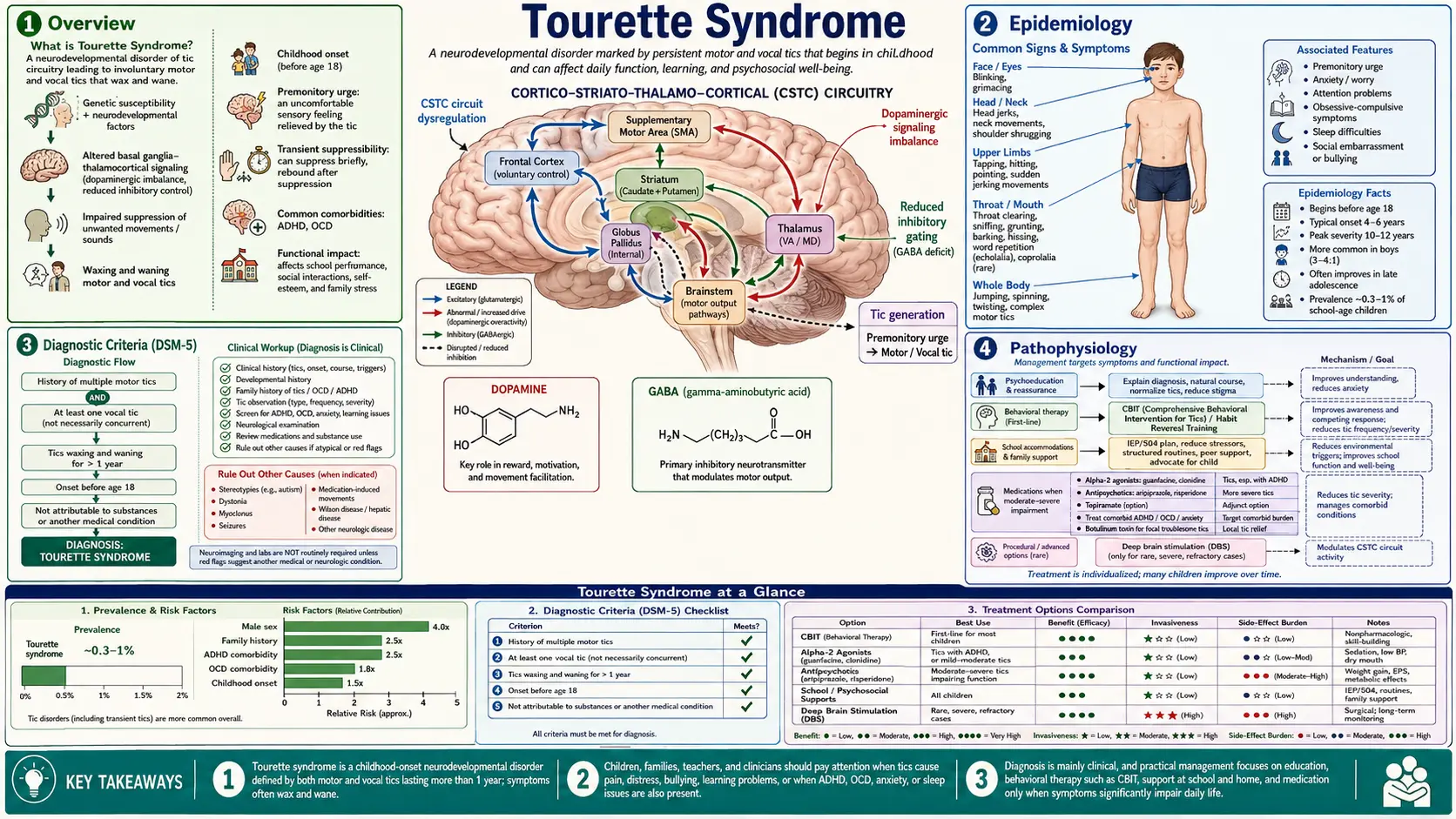
Table of Contents
Overview
Tourette syndrome (TS) is a neurodevelopmental disorder defined by multiple motor tics and at least one vocal (phonic) tic, present for at least one year, with onset before age 18 (CDC summary of the DSM-5-TR criteria). A 2025 historical review notes that descriptions of tics go back to the 1400s and that the syndrome was formally characterized in 1885 by the French physician Georges Gilles de la Tourette, whose name it carries (Vippa and Martindale, PMID 41410877).
Four findings about Tourette syndrome that are often not widely known:
- TS is not rare. A 2015 meta-analysis of 21 population-based studies put the prevalence of TS in children at 0.3% to 0.9%, and the authors judged the true rate likely to be at the higher end of that range (Scharf, PMID 25487709).
- Coprolalia (involuntary swearing) is not typical. In an international database of 597 referred patients, coprolalia occurred at some point in life in 19.3% of males and 14.6% of females — about one in five referred patients — and it is not required for the diagnosis (Freeman, PMID 19183216).
- Tics usually lessen after childhood. A review of long-term outcome studies found that tics typically reach their worst between ages 10 and 12 and decline during adolescence; by early adulthood roughly three-quarters of children with TS have greatly diminished tics and over one-third are tic free (Bloch and Leckman, PMID 19913654).
- Co-occurring conditions are the rule. In 1,374 people with TS, lifetime prevalence of any co-occurring psychiatric condition was 85.7%, and 72.1% met criteria for OCD or ADHD (Hirschtritt, PMID 25671412). Bloch and Leckman note that tics are often not the most enduring or impairing symptoms.
TS is one of several tic disorders. Persistent (chronic) motor or vocal tic disorder involves motor tics or vocal tics, but not both, for at least one year; provisional tic disorder involves tics present for less than one year (CDC summary of the DSM-5-TR criteria). In a 2012 meta-analysis, transient tic disorder was the most common tic disorder in children, affecting 2.99% (Knight, PMID 22759682).
Epidemiology
A meta-analysis of 13 studies of children estimated TS prevalence at 0.77% (95% CI 0.39–1.51%); in two adult studies it was 0.05%. Tic disorders were more common in special education populations (Knight, PMID 22759682). A second meta-analysis refined the childhood estimate to 0.3% to 0.9% and found that studies of clinically referred cases gave lower estimates than population-based studies (Scharf, PMID 25487709).
Key epidemiological findings:
- Sex: In the Knight meta-analysis, TS affected 1.06% of boys and 0.25% of girls.
- Age of onset: Tics typically begin between ages 4 and 6 and reach their worst-ever severity between ages 10 and 12 (Bloch and Leckman, PMID 19913654).
- Family history: In a Swedish population register study of 4,826 people with TS or chronic tic disorders, first-degree relatives had a much higher risk of tic disorders than relatives of unaffected people (odds ratio 18.69), risk fell with genetic distance, and heritability was estimated at 0.77 (Mataix-Cols, PMID 26083307). In a small Danish study of 14 identical-twin pairs in which at least one twin had a tic disorder, nine pairs were concordant for TS or a chronic tic disorder (Pedersen, PMID 34794811).
The Scharf meta-analysis concluded that the true population prevalence is likely at the higher end of published estimates, given the methodological limitations of most studies.
Diagnostic Criteria (DSM-5)
The CDC summarizes the DSM-5-TR criteria for Tourette syndrome as follows:
- Two or more motor tics and at least one vocal tic.
- Tics present for at least one year.
- Onset before age 18.
- Not caused by medications, drugs or another medical condition.
Other DSM-5 Tic Disorders
- Persistent (Chronic) Motor or Vocal Tic Disorder: one or more motor tics or one or more vocal tics (not both) for at least one year, with the same exclusions, in a person not previously diagnosed with TS.
- Provisional Tic Disorder: one or more motor and/or vocal tics for less than one year, with the same exclusions, in a person not previously diagnosed with TS or a persistent tic disorder.
Pathophysiology
Anatomical and neuroimaging studies point to abnormal basal ganglia and dopaminergic function in TS, and research on striatal inhibitory mechanisms and on how the basal ganglia learn habits complements those findings (Albin and Mink, PMID 16430974). A 2019 genome-wide study implicated gene regulation within cortico-striatal circuits as a fundamental mechanism (Yu, PMID 30818990).
Basal Ganglia and Striatal Interneurons
In a post-mortem study of 5 people with TS, the striatum (caudate and putamen) showed a 50%–60% decrease in both parvalbumin-positive (GABAergic) interneurons and cholinergic interneurons, with no difference in medium spiny neurons; the authors propose that this may impair cortical and thalamic control of striatal firing (Kataoka, PMID 19941350). A 2025 single-cell study of 6 TS brains and 6 controls found interneurons decreased by about 50%, along with activation of immune responses in microglia (Wang, PMID 39892689).
Dopamine
Evidence for a dopamine role includes trials in which dopamine-blocking antipsychotics (haloperidol, risperidone, aripiprazole and others) reduced tics more than placebo (Pringsheim 2019 systematic review, PMID 31061209; Farhat 2023 network meta-analysis, PMID 36528030). Drugs that lower dopamine release a different way, the VMAT2 inhibitors, did not separate from placebo on their primary outcome in pivotal trials (see Treatment).
Other Neurotransmitters
A rare mutation in the gene for L-histidine decarboxylase, the enzyme that makes histamine, was found in one two-generation family with TS, pointing to a role for histamine signaling (Ercan-Sencicek, PMID 20445167). The alpha-2 adrenergic agonist clonidine reduced tics more than placebo with moderate confidence in the 2019 AAN systematic review (PMID 31061209).
Neuroimaging Findings
- In MRI scans of 154 children and adults with TS and 130 controls, caudate nucleus volumes were significantly smaller in TS (Peterson, PMID 12695320). Kataoka describes a 5% decrease in caudate volume as the most consistent structural finding.
- In a functional MRI study of 10 adults, the supplementary motor area, anterior cingulate, insula and parietal operculum were active in the 2 seconds before a tic, and sensorimotor areas and cerebellum at tic onset (Bohlhalter, PMID 16520330).
The Premonitory Urge
Many people with TS describe an uncomfortable urge before a tic. In a questionnaire study of 135 people aged 8 to 71 with tic disorders, 93% reported premonitory urges, most often in the palms, shoulders, midline abdomen and throat; 84% said tics brought a feeling of relief, and 92% described their tics as a fully or partly voluntary response to the urge (Leckman, PMID 8417589). Behavioral therapy for tics works with this urge (see Treatment).
Clinical Presentation
Tics are sudden, rapid, recurrent movements or vocalizations. They are classified by complexity (simple vs. complex) and by type (motor vs. vocal/phonic). Tics characteristically wax and wane (Robertson, PMID 10686169).
Motor Tics
Simple motor tics:
- Eye blinking
- Nose twitching, facial grimacing
- Head jerking or nodding
- Shoulder shrugging
- Abdominal tensing, arm or leg jerking
Complex motor tics (sequential movements that appear more purposeful):
- Touching objects or other people
- Jumping, bending, twisting
- Copropraxia — obscene gestures; in the Freeman database study it occurred in 5.9% of males and 4.9% of females (PMID 19183216)
- Echopraxia — imitating the movements of others
Vocal (Phonic) Tics
Simple vocal tics:
- Throat clearing
- Sniffing, grunting, barking, squeaking
- Hissing or clicking sounds
Complex vocal tics:
- Words or phrases out of context
- Echolalia — repeating the words of others
- Palilalia — repeating one's own last words or syllables
- Coprolalia — involuntary obscene or socially inappropriate words. In the Freeman study it occurred in 19.3% of males and 14.6% of females, began at a mean age of about 11 (about 5 years after tic onset), and was one of the first symptoms in 11% of those who had it (PMID 19183216). It is not required for the diagnosis.
Characteristic Tic Behaviors
- Partial voluntary control: most people in the Leckman questionnaire study described their tics as fully or partly a voluntary response to an urge, with relief after the tic (PMID 8417589).
- Waxing and waning: tic type, location, frequency and severity change over time (Robertson, PMID 10686169).
Natural History
A review of long-term outcome studies describes the typical course (Bloch and Leckman, PMID 19913654):
- Ages 4–6: tics typically begin.
- Ages 10–12: tics reach their worst-ever severity.
- Adolescence: on average, tic severity declines.
- Early adulthood: roughly three-quarters of children with TS have greatly diminished tics, and over one-third are tic free.
The same review found that OCD and other anxiety and depressive disorders are more common during adolescence and early adulthood in people with TS than in the general population, and that tics are often not the most enduring or impairing symptoms. It describes measures that support self-esteem, such as strong friendships and the exploration of interests, as crucial to good adult outcomes. In an MRI study, smaller lenticular nucleus volumes were proposed as a possible marker for persistence of tics into adulthood (Peterson, PMID 12695320).
Comorbidities
In the largest structured-interview study (1,374 people with TS), 85.7% had at least one lifetime co-occurring psychiatric condition and 57.7% had two or more; the age of greatest risk for the onset of most of them was 4 to 10 years (Hirschtritt, PMID 25671412). A 2009 review put co-occurring neuropsychiatric conditions at approximately 90% of patients, most commonly ADHD and OCD (Cavanna, PMID 19359447).
ADHD and OCD
In the Hirschtritt study, 72.1% of people with TS met criteria for OCD or ADHD. The authors found that some other conditions, including mood and disruptive behavior disorders, may be mediated by co-occurring OCD or ADHD.
In a 16-week randomized trial in 136 children with ADHD and a chronic tic disorder, both methylphenidate and clonidine improved ADHD, the combination gave the greatest benefit, and the share reporting worse tics was no higher with methylphenidate (20%) than with clonidine alone (26%) or placebo (22%); measured tic severity fell in all active groups. The authors concluded that earlier advice to avoid methylphenidate in these children was not supported by the trial (Tourette's Syndrome Study Group, PMID 11865128).
Anxiety, Mood and Other Conditions
Mood, anxiety and disruptive behavior disorders each occurred in approximately 30% of people with TS in the Hirschtritt study. TS was associated with a higher risk of anxiety and a lower risk of substance use disorders independent of OCD and ADHD, while the high rate of mood disorders (29.8%) may be accounted for by co-occurring OCD. A 2009 review put the lifetime risk of depression at 10% of patients and reported a high prevalence of personality disorders in preliminary studies (Cavanna, PMID 19359447).
Diagnosis
The CDC states that there is no single test, such as a blood test, to diagnose TS; health professionals look at the person's symptoms to diagnose TS and other tic disorders. The tic disorders differ by the type of tic present and how long symptoms have lasted.
Clinical History
The 2019 American Academy of Neurology (AAN) guideline includes recommendations on counseling about the natural history of tic disorders, on assessment for co-occurring disorders, and on periodic reassessment of the need for ongoing therapy (Pringsheim, PMID 31061208). Elements a clinical history commonly covers:
- Age at first tic and type of first tic
- All motor and vocal tics over the course of the illness
- Duration (more or less than one year)
- Presence of premonitory urges
- Impact on school, work and relationships
- Family history of tics, OCD and ADHD
- Co-occurring conditions (ADHD, OCD, anxiety, depression)
- Medications and substances, since the criteria exclude tics caused by medications, drugs or another medical condition
PANDAS and PANS
PANDAS (pediatric autoimmune neuropsychiatric disorder associated with streptococcus) and the broader category PANS (pediatric acute-onset neuropsychiatric syndrome) are proposed syndromes of acute onset. A 2013 consensus conference of clinicians and researchers set out to clarify the diagnostic boundaries of PANS and proposed recommendations for the evaluation of suspected cases (Chang, PMID 25325534).
Standardized Assessment Tools
The Yale Global Tic Severity Scale (YGTSS) was the main tic outcome measure in the CBIT, aripiprazole, VMAT2 inhibitor and deep brain stimulation trials described below. Its total tic score ranges from 0 to 50, with a score above 15 indicating clinically significant tics in the pediatric CBIT trial (Piacentini, PMID 20483969).
Treatment
The 2019 AAN practice guideline made 46 recommendations on the assessment and management of tics. It states that treatment options should be individualized and chosen collaboratively by patient, caregiver and clinician, weighing benefits, harms and co-occurring disorders; the options it lists are watchful waiting, the Comprehensive Behavioral Intervention for Tics (CBIT) and medication, with separate recommendations on deep brain stimulation for adults with severe, treatment-refractory tics. It also covers psychoeducation for teachers and peers (Pringsheim, PMID 31061208). Decisions about treatment belong with a clinician.
1. Psychoeducation
The AAN guideline includes recommendations on counseling about the natural history of tic disorders and on psychoeducation for teachers and peers (PMID 31061208).
2. Behavioral Therapy (CBIT)
The AAN systematic review found high confidence that CBIT was more likely than psychoeducation and supportive therapy to reduce tics (Pringsheim, PMID 31061209). CBIT is built around habit reversal training: learning to notice the premonitory urge and to perform a competing response.
A randomized controlled trial in 126 children aged 9 to 17 with Tourette or chronic tic disorder compared 8 sessions of behavior therapy over 10 weeks with supportive therapy and education. Tic scores fell from 24.7 to 17.1 with behavior therapy versus 24.6 to 21.1 with the control treatment, and 52.5% versus 18.5% were rated much or very much improved. Tic worsening was reported by 4% of children, and 87% of available responders still showed benefit 6 months after treatment (Piacentini, JAMA 2010; PubMed PMID: 20483969). A parallel trial in 122 adults aged 16 to 69 found 38.1% much or very much improved with behavior therapy versus 6.4% with supportive treatment, with continued benefit at 6 months among those assessed (Wilhelm, Arch Gen Psychiatry 2012; PubMed PMID: 22868933).
3. Medication
The 2019 AAN systematic review found moderate confidence that haloperidol, risperidone, aripiprazole, tiapride, clonidine, onabotulinumtoxinA injections, 5-ling granule, Ningdong granule, and deep brain stimulation of the globus pallidus were probably more likely than placebo to reduce tics, and low confidence for pimozide, ziprasidone, metoclopramide, guanfacine, topiramate and tetrahydrocannabinol. Harms included weight gain, drug-induced movement disorders, raised prolactin, sedation, and effects on heart rate, blood pressure and ECGs (Pringsheim, PMID 31061209). The 2012 Canadian guideline made strong recommendations for clonidine and guanfacine (children only) and only weak recommendations for the antipsychotics because of their high rates of side effects (Pringsheim, PMID 22397999).
Alpha-2 adrenergic agonists:
- Clonidine: more effective than placebo for tics in a network meta-analysis of 39 trials (Farhat, PMID 36528030). In the children's ADHD-and-tics trial, clonidine improved ADHD and moderate or severe sedation was reported by 28% (PMID 11865128).
- Guanfacine: low confidence of benefit in the AAN review. An 8-week pilot trial of extended-release guanfacine in 34 children with chronic tic disorders found no meaningful difference from placebo on tic severity (Murphy, PMID 28723227).
Antipsychotics:
- In the Farhat network meta-analysis, first- and second-generation antipsychotics were the most effective drug classes for tics and did not differ from each other; aripiprazole and risperidone each outperformed clonidine. The authors describe alpha-2 agonists as an option for those who elect not to take antipsychotics (PMID 36528030).
- Aripiprazole: in an 8-week trial in 133 children and adolescents aged 7 to 17, both doses reduced tic scores more than placebo; 69% (low dose) and 74% (high dose) were much or very much improved versus 38% on placebo. The most common adverse events were sedation, somnolence and fatigue (Sallee, PMID 28686474).
VMAT2 inhibitors:
- Valbenazine: across 6 completed trials in adults and children with TS, valbenazine trended toward greater improvement than placebo, but the difference on the primary outcome did not reach statistical significance; the review's authors concluded that further investigation for TS was unlikely (Farber, PMID 33682568).
- Deutetrabenazine: approved in the US for Huntington chorea and tardive dyskinesia. Two randomized trials in children and adolescents aged 6 to 16 with TS, one flexible-dose (119 participants) and one fixed-dose (158 participants), did not meet their primary efficacy endpoint (Jankovic, PMID 34609495; Coffey, PMID 34661664).
Treatment of co-occurring ADHD:
- Methylphenidate and clonidine: see the 2002 trial described under Comorbidities (PMID 11865128).
- Atomoxetine: in an 18-week randomized trial in 117 children aged 7 to 17 with ADHD and TS, atomoxetine improved ADHD symptoms more than placebo and was associated with greater reduction of tic severity on two of three measures; pulse rate, nausea, decreased appetite and weight loss increased (Spencer, PMID 17934184).
4. Deep Brain Stimulation (DBS)
Updated recommendations from an international DBS registry group describe candidates as people with a DSM-5 diagnosis of TS and severe motor and vocal tics that cause significant impairment despite exhaustive medical and behavioral treatment, evaluated by a multidisciplinary team at an experienced DBS center. The group removed an earlier suggested age limit of 25 and advises ethics committee review for anyone under 18; it notes a higher risk of post-DBS complications in TS and that the optimal surgical target remains unknown (Schrock, PMID 25476818).
In the international registry of 185 patients with medically refractory TS treated at 31 institutions in 10 countries (most commonly at the centromedian thalamic region or the globus pallidus internus), the mean total YGTSS score fell from 75.01 at baseline to 41.19 one year after implantation. The overall adverse event rate was 35.4%, including intracranial hemorrhage in 2 patients; the most common stimulation-related effects were dysarthria (6.3%) and paresthesia (8.2%) (Martinez-Ramirez, PMID 29340590).
Living with Tourette Syndrome
The burden of TS often extends beyond tics. Bloch and Leckman found that tics are often not the most enduring or impairing symptoms, and that co-occurring OCD, anxiety and depressive disorders are more common in adolescence and early adulthood (PMID 19913654).
School and Social Environment
The 2019 AAN guideline includes recommendations on psychoeducation for teachers and peers (PMID 31061208). The same body of research describes self-esteem, friendships and the exploration of interests as crucial to positive adult outcomes (Bloch and Leckman, PMID 19913654).
Peer Support and Community
The 2019 AAN guideline panel of 9 physicians and 2 psychologists also included 2 patient representatives, one from a chapter of the Tourette Association of America (Pringsheim, PMID 31061208).
Recent Research and Advances
Genetics
A 2019 genome-wide association meta-analysis of 4,819 people with TS and 9,488 controls found one genome-wide significant locus (in FLT3 on chromosome 13), which did not replicate in a population sample. Common variants in evolutionarily conserved regions explained 92.4% of TS heritability, and a polygenic risk score predicted TS and tic spectrum disorders and correlated with worst-ever tic severity. The authors concluded that, genetically, tic disorders form a continuous spectrum (Yu, PMID 30818990). Rare variants have been reported in single families or small samples, including in SLITRK1 (Abelson, PMID 16224024) and in the histidine decarboxylase gene (Ercan-Sencicek, PMID 20445167).
Immune Findings
A 2025 single-cell study of post-mortem basal ganglia found activation of immune responses in microglia in TS brains alongside interneuron loss (Wang, PMID 39892689). The PANDAS/PANS concept remains under study (Chang, PMID 25325534).
Drug Development
VMAT2 inhibitors have not shown a significant effect on the primary tic outcome in pivotal trials: valbenazine in 6 trials (Farber, PMID 33682568) and deutetrabenazine in two pediatric trials (PMID 34609495, 34661664).
Remote Behavioral Therapy
In the ORBIT trial, 224 children and adolescents aged 9 to 17 in England were randomized to 10 weeks of online, therapist-supported exposure and response prevention for tics or online psychoeducation. At 3 months tic scores fell by 4.5 points (16%) with the online therapy versus 1.6 points (6%) with psychoeducation, an adjusted difference of 2.29 points; the authors describe it as an efficient way to widen access to behavioral therapy (Hollis, PMID 34480868).
Transcranial Magnetic Stimulation (TMS)
A 2024 meta-analysis of five sham-controlled randomized comparisons found that TMS did not significantly reduce tic severity, though it found a moderate reduction in premonitory urge severity; the authors describe the support for TMS for tics as limited (Steuber, PMID 38479346).
Key Research Papers
- Robertson MM. Tourette syndrome, associated conditions and the complexities of treatment. Brain. 2000;123(3):425–462. — PubMed PMID: 10686169 · doi:10.1093/brain/123.3.425
- Leckman JF. Tourette's syndrome. Lancet. 2002;360(9345):1577–1586. — PubMed PMID: 12443611 · doi:10.1016/S0140-6736(02)11526-1
- Knight T, Steeves T, Day L, Lowerison M, Jette N, Pringsheim T. Prevalence of tic disorders: a systematic review and meta-analysis. Pediatr Neurol. 2012;47(2):77–90. — PubMed PMID: 22759682 · doi:10.1016/j.pediatrneurol.2012.05.002
- Piacentini J, Woods DW, Scahill L, et al. Behavior therapy for children with Tourette disorder: a randomized controlled trial. JAMA. 2010;303(19):1929–1937. — PubMed PMID: 20483969 · doi:10.1001/jama.2010.607
- Wilhelm S, Peterson AL, Piacentini J, et al. Randomized trial of behavior therapy for adults with Tourette syndrome. Arch Gen Psychiatry. 2012;69(8):795–803. — PubMed PMID: 22868933 · doi:10.1001/archgenpsychiatry.2011.1528
- Bloch MH, Leckman JF. Clinical course of Tourette syndrome. J Psychosom Res. 2009;67(6):497–501. — PubMed PMID: 19913654 · doi:10.1016/j.jpsychores.2009.09.002
- Tourette’s Syndrome Study Group. Treatment of ADHD in children with tics: a randomized controlled trial. Neurology. 2002;58(4):527–536. — PubMed PMID: 11865128 · doi:10.1212/wnl.58.4.527
- Pringsheim T, Doja A, Gorman D, et al. Canadian guidelines for the evidence-based treatment of tic disorders: pharmacotherapy. Can J Psychiatry. 2012;57(3):133–143. — PubMed PMID: 22397999 · doi:10.1177/070674371205700302
- Cavanna AE, Servo S, Monaco F, Robertson MM. The behavioral spectrum of Gilles de la Tourette syndrome. J Neuropsychiatry Clin Neurosci. 2009;21(1):13–23. — PubMed PMID: 19359447 · doi:10.1176/jnp.2009.21.1.13
- Albin RL, Mink JW. Recent advances in Tourette syndrome research. Trends Neurosci. 2006;29(3):175–182. — PubMed PMID: 16430974 · doi:10.1016/j.tins.2006.01.001
- Schrock LE, Mink JW, Woods DW, et al. Tourette syndrome deep brain stimulation: a review and updated recommendations. Mov Disord. 2015;30(4):448–471. — PubMed PMID: 25476818 · doi:10.1002/mds.26094
- Jankovic J. Tourette's syndrome. N Engl J Med. 2001;345(16):1184–1192. — PubMed PMID: 11642235 · doi:10.1056/NEJMra010032
- Pringsheim T, Okun MS, Müller-Vahl K, et al. Practice guideline recommendations summary: Treatment of tics in people with Tourette syndrome and chronic tic disorders. Neurology. 2019;92(19):896–906. — PubMed PMID: 31061208 · doi:10.1212/WNL.0000000000007466
- Pringsheim T, Holler-Managan Y, Okun MS, et al. Comprehensive systematic review summary: Treatment of tics in people with Tourette syndrome and chronic tic disorders. Neurology. 2019;92(19):907–915. — PubMed PMID: 31061209 · doi:10.1212/WNL.0000000000007467
- Farhat LC, Behling E, Landeros-Weisenberger A, et al. Comparative efficacy, tolerability, and acceptability of pharmacological interventions for the treatment of children, adolescents, and young adults with Tourette's syndrome: a systematic review and network meta-analysis. Lancet Child Adolesc Health. 2023;7(2):112–126. — PubMed PMID: 36528030 · doi:10.1016/S2352-4642(22)00316-9
- Sallee F, Kohegyi E, Zhao J, et al. Randomized, Double-Blind, Placebo-Controlled Trial Demonstrates the Efficacy and Safety of Oral Aripiprazole for the Treatment of Tourette's Disorder in Children and Adolescents. J Child Adolesc Psychopharmacol. 2017;27(9):771–781. — PubMed PMID: 28686474 · doi:10.1089/cap.2016.0026
- Murphy TK, Fernandez TV, Coffey BJ, et al. Extended-Release Guanfacine Does Not Show a Large Effect on Tic Severity in Children with Chronic Tic Disorders. J Child Adolesc Psychopharmacol. 2017;27(9):762–770. — PubMed PMID: 28723227 · doi:10.1089/cap.2017.0024
- Farber RH, Angelov A, Kim K, Carmack T, Thai-Cuarto D, Roberts E. Clinical development of valbenazine for tics associated with Tourette syndrome. Expert Rev Neurother. 2021;21(4):393–404. — PubMed PMID: 33682568 · doi:10.1080/14737175.2021.1898948
- Jankovic J, Coffey B, Claassen DO, et al. Safety and Efficacy of Flexible-Dose Deutetrabenazine in Children and Adolescents With Tourette Syndrome: A Randomized Clinical Trial. JAMA Netw Open. 2021;4(10):e2128204. — PubMed PMID: 34609495 · doi:10.1001/jamanetworkopen.2021.28204
- Coffey B, Jankovic J, Claassen DO, et al. Efficacy and Safety of Fixed-Dose Deutetrabenazine in Children and Adolescents for Tics Associated With Tourette Syndrome: A Randomized Clinical Trial. JAMA Netw Open. 2021;4(10):e2129397. — PubMed PMID: 34661664 · doi:10.1001/jamanetworkopen.2021.29397
- Martinez-Ramirez D, Jimenez-Shahed J, Leckman JF, et al. Efficacy and Safety of Deep Brain Stimulation in Tourette Syndrome: The International Tourette Syndrome Deep Brain Stimulation Public Database and Registry. JAMA Neurol. 2018;75(3):353–359. — PubMed PMID: 29340590 · doi:10.1001/jamaneurol.2017.4317
- Hirschtritt ME, Lee PC, Pauls DL, et al. Lifetime prevalence, age of risk, and genetic relationships of comorbid psychiatric disorders in Tourette syndrome. JAMA Psychiatry. 2015;72(4):325–33. — PubMed PMID: 25671412 · doi:10.1001/jamapsychiatry.2014.2650
- Scharf JM, Miller LL, Gauvin CA, Alabiso J, Mathews CA, Ben-Shlomo Y. Population prevalence of Tourette syndrome: a systematic review and meta-analysis. Mov Disord. 2015;30(2):221–8. — PubMed PMID: 25487709 · doi:10.1002/mds.26089
- Freeman RD, Zinner SH, Müller-Vahl KR, et al. Coprophenomena in Tourette syndrome. Dev Med Child Neurol. 2009;51(3):218–27. — PubMed PMID: 19183216 · doi:10.1111/j.1469-8749.2008.03135.x
- Mataix-Cols D, Isomura K, Pérez-Vigil A, et al. Familial Risks of Tourette Syndrome and Chronic Tic Disorders. A Population-Based Cohort Study. JAMA Psychiatry. 2015;72(8):787–93. — PubMed PMID: 26083307 · doi:10.1001/jamapsychiatry.2015.0627
- Pedersen JH, Skytthe A, Bybjerg-Grauholm J, et al. Concordance and comorbidities among monozygotic twins with tic disorders. J Psychiatr Res. 2022;146:297–303. — PubMed PMID: 34794811 · doi:10.1016/j.jpsychires.2021.11.019
- Kataoka Y, Kalanithi PS, Grantz H, et al. Decreased number of parvalbumin and cholinergic interneurons in the striatum of individuals with Tourette syndrome. J Comp Neurol. 2010;518(3):277–91. — PubMed PMID: 19941350 · doi:10.1002/cne.22206
- Wang Y, Fasching L, Wu F, et al. Interneuron Loss and Microglia Activation by Transcriptome Analyses in the Basal Ganglia of Tourette Disorder. Biol Psychiatry. 2025;98(3):260–270. — PubMed PMID: 39892689 · doi:10.1016/j.biopsych.2024.12.022
- Peterson BS, Thomas P, Kane MJ, et al. Basal Ganglia volumes in patients with Gilles de la Tourette syndrome. Arch Gen Psychiatry. 2003;60(4):415–24. — PubMed PMID: 12695320 · doi:10.1001/archpsyc.60.4.415
- Bohlhalter S, Goldfine A, Matteson S, et al. Neural correlates of tic generation in Tourette syndrome: an event-related functional MRI study. Brain. 2006;129(Pt 8):2029–37. — PubMed PMID: 16520330 · doi:10.1093/brain/awl050
- Leckman JF, Walker DE, Cohen DJ. Premonitory urges in Tourette's syndrome. Am J Psychiatry. 1993;150(1):98–102. — PubMed PMID: 8417589 · doi:10.1176/ajp.150.1.98
- Yu D, Sul JH, Tsetsos F, et al. Interrogating the Genetic Determinants of Tourette's Syndrome and Other Tic Disorders Through Genome-Wide Association Studies. Am J Psychiatry. 2019;176(3):217–227. — PubMed PMID: 30818990 · doi:10.1176/appi.ajp.2018.18070857
- Abelson JF, Kwan KY, O'Roak BJ, et al. Sequence variants in SLITRK1 are associated with Tourette's syndrome. Science. 2005;310(5746):317–20. — PubMed PMID: 16224024 · doi:10.1126/science.1116502
- Ercan-Sencicek AG, Stillman AA, Ghosh AK, et al. L-histidine decarboxylase and Tourette's syndrome. N Engl J Med. 2010;362(20):1901–8. — PubMed PMID: 20445167 · doi:10.1056/NEJMoa0907006
- Spencer TJ, Sallee FR, Gilbert DL, et al. Atomoxetine treatment of ADHD in children with comorbid Tourette syndrome. J Atten Disord. 2008;11(4):470–81. — PubMed PMID: 17934184 · doi:10.1177/1087054707306109
- Chang K, Frankovich J, Cooperstock M, et al. Clinical evaluation of youth with pediatric acute-onset neuropsychiatric syndrome (PANS): recommendations from the 2013 PANS Consensus Conference. J Child Adolesc Psychopharmacol. 2015;25(1):3–13. — PubMed PMID: 25325534 · doi:10.1089/cap.2014.0084
- Hollis C, Hall CL, Jones R, et al. Therapist-supported online remote behavioural intervention for tics in children and adolescents in England (ORBIT): a multicentre, parallel group, single-blind, randomised controlled trial. Lancet Psychiatry. 2021;8(10):871–882. — PubMed PMID: 34480868 · doi:10.1016/S2215-0366(21)00235-2
- Steuber ER, McGuire JF. A meta-analysis of transcranial magnetic stimulation in Tourette syndrome. J Psychiatr Res. 2024;173:34–40. — PubMed PMID: 38479346 · doi:10.1016/j.jpsychires.2024.02.057
- Vippa T, Martindale JM. Tourette Syndrome Through the Ages: A Historical and Contemporary Overview. J Child Neurol. 2026;41(4):600–608. — PubMed PMID: 41410877 · doi:10.1177/08830738251404102
PubMed Topic Searches
Search PubMed for the latest peer-reviewed research on Tourette syndrome:
- PubMed: Tourette syndrome treatment review
- PubMed: Habit reversal training CBIT tics
- PubMed: Tourette syndrome ADHD comorbidity
- PubMed: Tourette syndrome OCD
- PubMed: Alpha-2 agonist guanfacine tics
- PubMed: Aripiprazole Tourette syndrome
- PubMed: Valbenazine VMAT2 tic disorder
- PubMed: Tourette syndrome natural history prognosis
- PubMed: Tourette syndrome pathophysiology corticostriatal
- PubMed: PANDAS streptococcal tic disorder
- PubMed: Deep brain stimulation Tourette syndrome
- PubMed: Tourette syndrome prevalence epidemiology