IDOL Enzyme: A New Drug Target for Alzheimer's Disease
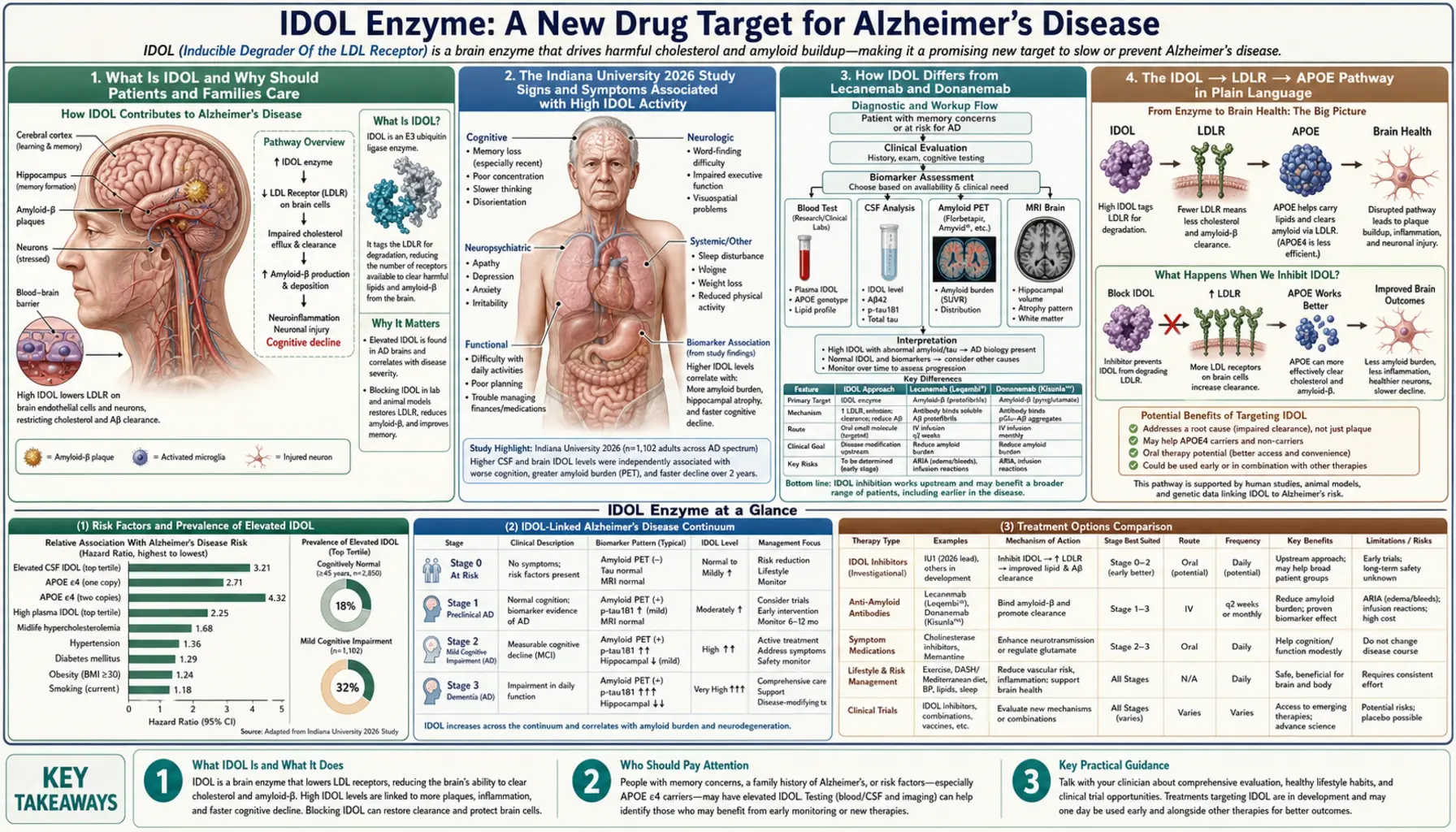
Table of Contents
- What Is IDOL and Why Researchers Are Studying It
- The Indiana University Mouse Study (December 2025)
- How IDOL Differs from Lecanemab and Donanemab
- The IDOL → LDLR → APOE Pathway in Plain Language
- APOE4 and the Genetic Link
- Where IDOL Is in the Drug Development Pipeline
- What Is Available Now
- Combination Therapies: What Is Known
- Cautions and Open Questions
- Key Research Papers
- Connections
- Featured Videos
What Is IDOL and Why Researchers Are Studying It
IDOL — short for Inducible Degrader of the LDL Receptor, also known by its gene name MYLIP — is an E3 ubiquitin ligase: an enzyme that tags the low-density lipoprotein receptor (LDLR) on its inner, cytoplasmic end and so marks it for degradation. A 2009 study identified this role while examining how cells regulate their cholesterol uptake (PubMed PMID: 19520913). LDLR is one of several receptors that bind apolipoprotein E (APOE), a lipid-carrying protein in the brain, and the APOE gene is the major genetic risk factor for Alzheimer's disease (PubMed PMID: 22393530).
In 2015 a team that included Jungsu Kim reported that mice lacking the Idol gene throughout the body had more LDLR and less APOE in the brain, less soluble and insoluble amyloid-beta, a smaller amyloid plaque burden and less neuroinflammation; the authors called IDOL a potential enzyme target for treatment (PubMed PMID: 26582899). In December 2025 Kim's group at Indiana University School of Medicine published a mouse study asking which brain cells are responsible: they found that deleting Idol in neurons, but not in microglia (the brain's immune cells), reduced amyloid build-up (PubMed PMID: 41384508).
All of this evidence comes from mice. No IDOL-blocking drug has been tested in people. This article describes what the mouse studies found, how the approach differs from the approved anti-amyloid antibodies, and what is still unknown.
The Indiana University Mouse Study (December 2025)
The study, by Hande Karahan, Jungsu Kim and colleagues at Indiana University School of Medicine, was published in Alzheimer's & Dementia in December 2025; the university announced it in a press release on February 12, 2026 (PubMed PMID: 41384508). It is a mouse study. The researchers used 5XFAD mice, a model that carries five familial Alzheimer's mutations in two human genes and builds up amyloid rapidly, with deposits beginning at about 2 months of age (PubMed PMID: 17021169). They bred these mice so that the Idol gene was switched off either in neurons or in microglia, then examined the brains of female mice at 4 months of age.
According to the paper's full text:
- Microglial deletion: removing Idol from microglia did not change insoluble amyloid-beta (Aβ40 or Aβ42) in the cortex, and did not significantly change brain LDLR or APOE.
- Neuronal deletion — amyloid: removing Idol from neurons lowered insoluble Aβ40 and Aβ42 in the cortex by 69% and 61%, and soluble Aβ40 and Aβ42 there by 34% and 45%. In the hippocampus, insoluble Aβ40 and Aβ42 fell by 30% and 25%. Stained brain sections showed less plaque. These groups had 11 to 12 mice each.
- Neuronal deletion — receptors and APOE: brain LDLR rose and APOE fell. Two other APOE receptors that IDOL also targets, APOER2 and VLDLR (receptors for the signalling protein Reelin), rose as well.
- Glial activation: staining for activated microglia and astrocytes (gliosis) was reduced.
- Gene activity: single-nucleus RNA sequencing, done on two mice per group, found changes in inhibitory neurons and in genes linked to synaptic organization.
The paper did not test memory or behaviour. The authors write that future research should determine whether inhibiting neuronal IDOL can change Alzheimer's-related pathology and cognitive outcomes. They also note that, because IDOL is an enzyme and enzymes are highly druggable targets, blocking it with a drug is a promising strategy to study. In the university's press release, Karahan said the team had expected microglia, the main IDOL-producing cell type in the brain, to be the main driver, and Kim said the team's next steps include developing strategies to target the enzyme and assessing the safety and effects of compounds in preclinical models (IU School of Medicine press release).
The study was not the first to link IDOL to amyloid in living animals. Besides the 2015 whole-body knockout work (PubMed PMID: 26582899), a 2020 study in male APP/PS1 mice, another amyloid model, lowered IDOL in the adult brain with an antisense oligonucleotide. It reported less amyloid pathology and better spatial learning and memory, and its authors linked the effect to increased phagocytic clearance of amyloid, with lysosomal and phagocytic genes switched on in microglia (PubMed PMID: 31964754). The 2025 study's new finding concerns which cells matter: in its model, neurons did and microglia did not.
How IDOL Differs from Lecanemab and Donanemab
Two anti-amyloid antibodies are approved in the United States for early Alzheimer's disease. The FDA granted lecanemab accelerated approval in January 2023 and converted it to traditional approval on July 6, 2023 (FDA, July 2023). The FDA approved donanemab in July 2024 (FDA, July 2024). Both are antibodies that target amyloid: lecanemab binds soluble amyloid-beta protofibrils, and donanemab was designed to clear amyloid plaque.
In their phase 3 trials, both showed less clinical decline than placebo, with side effects:
- Lecanemab (CLARITY-AD, 1,795 participants, 18 months): the 18-point CDR-SB score worsened by 1.21 with lecanemab and 1.66 with placebo. Amyloid-related imaging abnormalities with edema or effusions (ARIA-E) occurred in 12.6% of the lecanemab group and infusion-related reactions in 26.4%. The authors describe "moderately less decline" than placebo, with adverse events (PubMed PMID: 36449413).
- Donanemab (TRAILBLAZER-ALZ 2, 1,736 participants, 76 weeks): the CDR-SB difference from placebo was −0.7 in the combined population. ARIA-E occurred in 24.0% of the donanemab group (52 people with symptoms) and 2.1% of the placebo group, and three deaths in the donanemab group and one in the placebo group were considered treatment-related (PubMed PMID: 37459141).
The FDA describes ARIA as most commonly temporary swelling in areas of the brain, sometimes with small spots of bleeding in or on the surface of the brain; donanemab's prescribing information carries a boxed warning for ARIA (FDA, July 2024).
The IDOL approach is different in kind. Instead of an antibody that targets amyloid directly, it would aim to raise the brain's own APOE receptors by blocking the enzyme that breaks them down. In the 2015 and 2025 mouse studies, removing IDOL raised brain LDLR, lowered brain APOE and lowered amyloid. Whether this would have fewer or different side effects than the antibodies is unknown, because no IDOL-targeting drug has been given to people.
The IDOL → LDLR → APOE Pathway in Plain Language
APOE is a major lipid (fat and cholesterol) carrier in the brain and in the fluid around brain cells (PubMed PMID: 33679311). In the brain it is made mainly by glial cells. It binds to receptors of the LDL-receptor family — LDLR, APOER2, VLDLR and LRP1 — and it also binds amyloid-beta. A 2012 review describes substantial evidence that APOE affects how amyloid-beta clumps together and is cleared from the brain (PubMed PMID: 22393530).
IDOL attaches ubiquitin tags to LDLR, which leads to the receptor's breakdown; the 2025 paper describes this as lysosomal degradation (PubMed PMID: 19520913; PubMed PMID: 41384508). More IDOL activity means fewer LDL receptors. The chain the researchers propose is:
- IDOL tags LDLR with ubiquitin.
- The tagged receptor is broken down, leaving fewer receptors on the cell.
- With fewer receptors, less APOE is taken up and cleared.
- In mouse models, reducing APOE has reduced amyloid deposits, and raising LDLR lowered both APOE and amyloid (as summarized in the 2025 paper's introduction).
Removing IDOL interrupts the chain at the first step. In the 2015 whole-body knockout and in the 2025 neuron-only knockout, mice lacking IDOL had more brain LDLR, less brain APOE and less amyloid (PubMed PMID: 26582899; PubMed PMID: 41384508). The 2025 authors also cite human genetic findings that loss-of-function mutations in APOE were associated with delayed onset of Alzheimer's, whatever the person's APOE type, as part of their reason for testing whether lowering APOE levels could help.
APOE4 and the Genetic Link
The APOE gene has three common forms: ε2, ε3 and ε4. Carrying ε4 raises the risk of Alzheimer's disease compared with the more common ε3, while ε2 lowers it (PubMed PMID: 23296339). A 1997 meta-analysis of 5,930 patients and 8,607 controls found, among white participants in clinic- or autopsy-based studies, odds ratios for Alzheimer's of 3.2 with one ε4 copy (ε3/ε4) and 14.9 with two (ε4/ε4). The association was weaker among African American and Hispanic participants and stronger among Japanese participants (ε4/ε4 odds ratio 33.1) (PubMed PMID: 9343467). In a 1993 study of 42 families with late-onset Alzheimer's, risk rose from 20% to 90%, and the mean age at onset fell from 84 to 68 years, as the number of ε4 copies increased (PubMed PMID: 8346443).
A 2019 review concludes that a major way APOE4 raises risk is by driving earlier and more abundant amyloid pathology, and that APOE4 is either harmful or less efficient in several brain processes, including lipid transport, synaptic integrity, glucose metabolism and the function of brain blood vessels (PubMed PMID: 31367008). In a 2017 mouse study, raising astrocyte APOE4, but not APOE3, during the early "seeding" stage of amyloid formation increased amyloid deposits and lengthened the time amyloid-beta stayed in the brain (PubMed PMID: 29216449).
The 2025 IDOL study did not use mice carrying human APOE4, so it does not show whether the effect differs between APOE types. The authors note that the forms of APOE bind LDLR differently and that the effects of APOE–LDLR interactions may depend on context (PubMed PMID: 41384508).
Where IDOL Is in the Drug Development Pipeline
IDOL inhibition is at the preclinical stage: the evidence comes from mice and cells. A search of ClinicalTrials.gov in October 2026 for "MYLIP" or "inducible degrader of LDL receptor" returned no registered trials.
The FDA describes the clinical stages a new drug passes through (FDA: Step 3, Clinical Research):
- Investigational New Drug (IND) application — drug developers must submit one to the FDA before clinical research in people begins.
- Phase 1 — 20 to 100 healthy volunteers or people with the condition, lasting several months, to study safety and dosage.
- Phase 2 — up to several hundred people with the condition, lasting several months to 2 years, to study efficacy and side effects.
- Phase 3 — 300 to 3,000 volunteers with the condition, lasting 1 to 4 years, to study efficacy and monitor adverse reactions. Lecanemab's traditional approval was based on its phase 3 trial, CLARITY AD (FDA, July 2023).
The same FDA page states that about 70% of drugs move on from phase 1 and about 33% from phase 2.
What Is Available Now
There is no IDOL inhibitor for people: none is approved, and none was found in the ClinicalTrials.gov search described above. The approved anti-amyloid antibodies, lecanemab and donanemab, are described in the section on how IDOL differs from them.
Research on lowering dementia risk in general is summarized on the main Alzheimer's Disease page. One example: in the Finnish FINGER trial, 1,260 at-risk people aged 60 to 77 were randomly assigned to a two-year programme of diet, exercise, cognitive training and vascular-risk monitoring, or to general health advice. The between-group difference in the yearly change of a composite cognitive test score was 0.022 (p=0.030); adverse events, mostly musculoskeletal pain, occurred in 7% of the intervention group and 1% of controls (PubMed PMID: 25771249).
Decisions about genetic testing, treatment or trial participation belong with a clinician.
Combination Therapies: What Is Known
The 2025 IDOL study tested a genetic deletion on its own; it did not test any drug, and it did not combine IDOL deletion with an anti-amyloid antibody or any other treatment (PubMed PMID: 41384508). The authors suggest that targeting neuronal IDOL may offer several benefits at once, by lowering amyloid and gliosis and by raising the Reelin receptors that are important for synapses.
In the press release, Karahan pointed out that patients are usually diagnosed after a substantial amount of amyloid has built up, and said that "not only decreasing amyloid levels but also increasing resilience to these pathological changes could maximize clinical benefits" (IU School of Medicine press release). No study has reported whether an IDOL-targeting drug would add anything to the existing antibodies, or work at all in people.
Cautions and Open Questions
Mice, not people. The 2025 findings come from one mouse model, in female mice only, examined at 4 months of age, with the gene removed genetically (after birth, in the neuron model) rather than blocked by a drug. The 5XFAD model carries five mutations of the kind that cause familial (inherited) Alzheimer's disease and builds up very high amyloid levels rapidly (PubMed PMID: 17021169). The study did not measure memory, and its gene-activity analysis used two mice per group (PubMed PMID: 41384508).
A history of failed amyloid trials. A 2014 review noted that several large phase 3 trials targeting amyloid-beta production or clearance had failed to show efficacy, which led researchers to re-examine the amyloid hypothesis and look for other targets (PubMed PMID: 24392696).
IDOL outside the brain. IDOL also controls LDLR outside the brain. In the 2009 study, lowering IDOL in liver cells raised LDLR and LDL uptake, and adding extra IDOL to mouse liver lowered LDLR and raised blood LDL (PubMed PMID: 19520913). The 2015 study reports earlier work showing that IDOL contributes little to the regulation of liver LDLR in mice, whereas it is a main regulator of LDLR in the brain (PubMed PMID: 26582899). What a drug that blocks IDOL throughout the body would do in people has not been studied.
More than one receptor. IDOL also targets APOER2 and VLDLR, receptors for the signalling protein Reelin, and neuronal Idol deletion raised both in the 2025 study. The authors note that the effects of APOE–receptor interactions may depend on context: for example, in a tauopathy model, mice with APOE2 had more tau pathology than those with APOE3 or APOE4. They state that studies should consider amyloid, tau and other pathologies together to understand the net effect (PubMed PMID: 41384508).
No human data. There is no information yet on how an IDOL-targeting drug would be tolerated, how it would reach the brain, or how its effect on brain LDLR and APOE would be measured in people.
Key Research Papers
- Karahan H, Hartigan K, Al-Amin MM, et al. "Deletion of neuronal Idol ameliorates Alzheimer's disease-related pathologies via APOE receptors." Alzheimer's & Dementia 2025 Dec;21(12):e70949. Mouse study. — PubMed PMID: 41384508 (Editorial note, October 2026: corrected from an entry that gave a different title and the year 2026. The university announced the study in an IU School of Medicine press release on February 12, 2026.)
- Zelcer N, et al. "LXR Regulates Cholesterol Uptake Through Idol-Dependent Ubiquitination of the LDL Receptor." Science 2009. — PubMed PMID: 19520913
- Liu CC et al. "ApoE4 Accelerates Early Seeding of Amyloid Pathology." Neuron 2017. — PubMed PMID: 29216449
- van Duijn S et al. "Idol/Mylip and the regulation of LDL receptor levels." Curr Opin Lipidol 2010. — Search PubMed (Editorial note, October 2026: no record with this title was found in PubMed or Crossref; the citation could not be verified and is not used for any statement on this page.)
- Chiang K, Koo EH. "Emerging therapeutics for Alzheimer's disease." Annu Rev Pharmacol Toxicol 2014. — PubMed PMID: 24392696
- Sims R et al. "The multiplex model of APOE genetics in Alzheimer disease." Nat Genet 2017. — Search PubMed (Editorial note, October 2026: no record with this title was found in PubMed or Crossref; the citation could not be verified and is not used for any statement on this page.)
- Yamazaki Y et al. "Apolipoprotein E and Alzheimer disease: pathobiology and targeting strategies." Nat Rev Neurol 2019. — PubMed PMID: 31367008
- van Dyck CH et al. "Lecanemab in early Alzheimer's disease." N Engl J Med 2023. — PubMed PMID: 36449413
- Sims JR et al. "Donanemab in early symptomatic Alzheimer's disease: the TRAILBLAZER-ALZ 2 randomized clinical trial." JAMA 2023. — PubMed PMID: 37459141 (Editorial note, October 2026: this entry previously linked PMID 41082199, a different 2025 donanemab paper.)
- Husain MA et al. "APOE and Alzheimer's disease: from lipid transport to physiopathology and therapeutics." Front Neurosci 2021. — PubMed PMID: 33679311
- Holtzman DM, Herz J, Bu G. "Apolipoprotein E and apolipoprotein E receptors: normal biology and roles in Alzheimer disease." Cold Spring Harb Perspect Med 2012. — PubMed PMID: 22393530
- Corder EH et al. "Gene dose of apolipoprotein E type 4 allele and the risk of Alzheimer's disease in late onset families." Science 1993. — PubMed PMID: 8346443
- Patel T, Bhatt DL. "PCSK9 inhibitors in clinical practice: bringing it all together." Am J Cardiol 2019. — Search PubMed (Editorial note, October 2026: no record with this title was found in PubMed or Crossref; the citation could not be verified and is not used for any statement on this page.)
- Choi J, Gao J, Kim J, et al. "The E3 ubiquitin ligase Idol controls brain LDL receptor expression, ApoE clearance, and Aβ amyloidosis." Sci Transl Med 2015;7(314):314ra184. Mouse study. — PubMed PMID: 26582899
- Gao J, Littman R, Diamante G, et al. "Therapeutic IDOL reduction ameliorates amyloidosis and improves cognitive function in APP/PS1 mice." Mol Cell Biol 2020;40(8):e00518-19. Mouse study. — PubMed PMID: 31964754
- Oakley H, Cole SL, Logan S, et al. "Intraneuronal beta-amyloid aggregates, neurodegeneration, and neuron loss in transgenic mice with five familial Alzheimer's disease mutations: potential factors in amyloid plaque formation." J Neurosci 2006;26(40):10129-40. — PubMed PMID: 17021169
- Farrer LA, Cupples LA, Haines JL, et al. "Effects of age, sex, and ethnicity on the association between apolipoprotein E genotype and Alzheimer disease. A meta-analysis." JAMA 1997;278(16):1349-56. — PubMed PMID: 9343467
- Liu CC, Kanekiyo T, Xu H, Bu G. "Apolipoprotein E and Alzheimer disease: risk, mechanisms and therapy." Nat Rev Neurol 2013;9(2):106-18. — PubMed PMID: 23296339
- Ngandu T, Lehtisalo J, Solomon A, et al. "A 2 year multidomain intervention of diet, exercise, cognitive training, and vascular risk monitoring versus control to prevent cognitive decline in at-risk elderly people (FINGER): a randomised controlled trial." Lancet 2015;385(9984):2255-63. — PubMed PMID: 25771249
PubMed Topic Searches
- PubMed: IDOL enzyme, LDL receptor, Alzheimer
- PubMed: MYLIP ubiquitin ligase, LDLR, neuron
- PubMed: APOE4 amyloid plaque clearance, drug target
- PubMed: LDL receptor, APOE, brain, Alzheimer clearance
- PubMed: Lecanemab, donanemab, amyloid removal, clinical trial
- PubMed: Alzheimer prevention, APOE genetic risk, therapy
Connections
- Neurology
- Alzheimer's Disease
- Dementia
- Parkinson's Disease
- APOE Genetic Testing
- Amyloid PET Scan
- High Cholesterol
- Vitamin E and Neurological Health
- Magnesium and Brain Function
- Taurine and Neuroprotection
- Blueberries and Cognitive Health
- POTS and Neurological Overlap
- MCAS and Neuroinflammation
- Natural Remedies Overview
- May 28, 2026 News
- Diseases Index