Acute Kidney Injury: History and Discovery
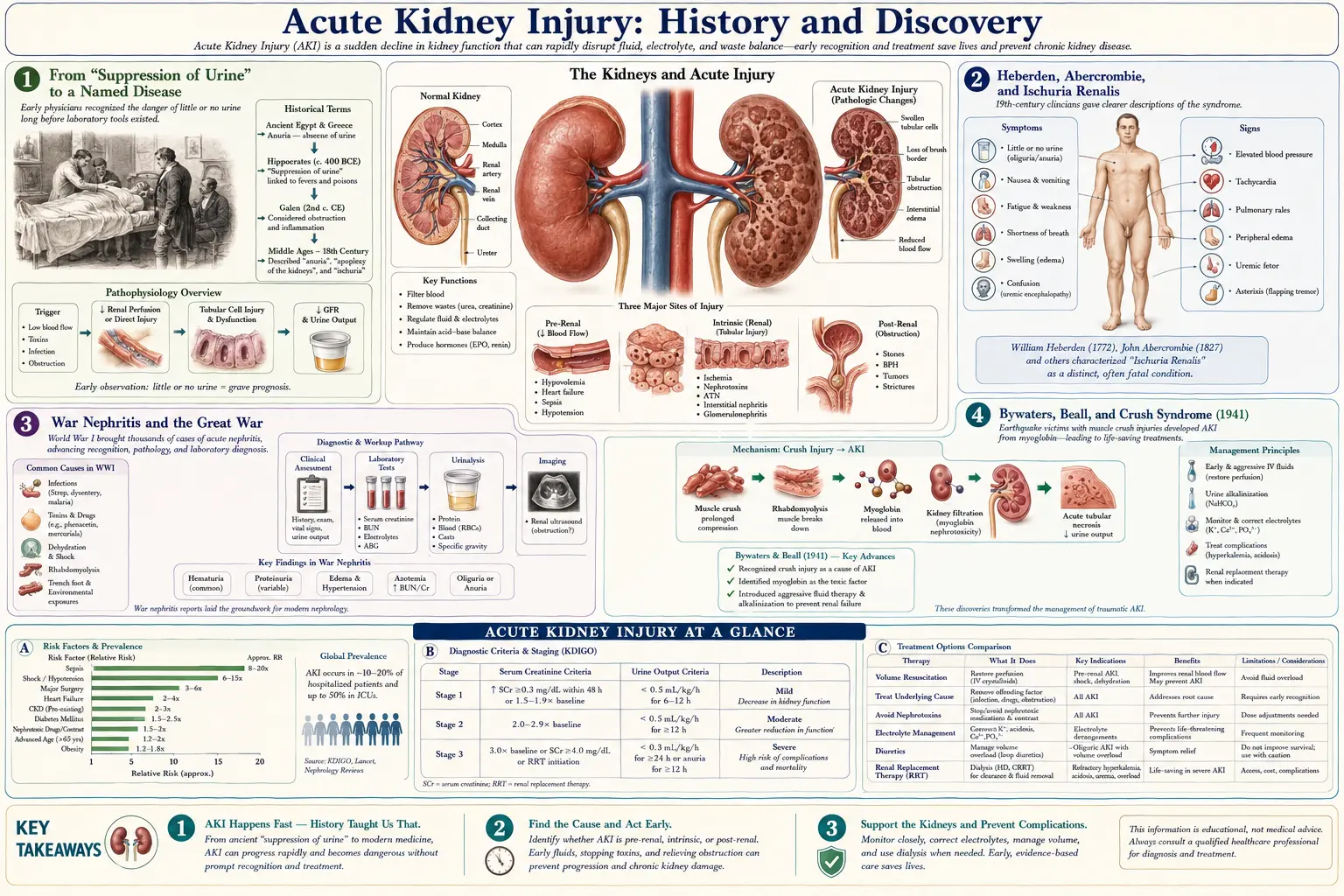
Acute kidney injury (AKI) — a rapid, often reversible fall in kidney function — was for most of medical history called acute renal failure, and before that simply “suppression of urine.” Its clinical picture was sketched by William Heberden in 1802 under the name ischuria renalis, sharpened by the wartime experience of “war nephritis” in World War I, and given its lasting modern foundation in 1941, when Eric Bywaters and Desmond Beall described crush syndrome with acute tubular necrosis in patients pulled from the rubble of the London Blitz. Willem Kolff’s artificial kidney (1943) delivered the first effective treatment. In the 2000s the field deliberately renamed the condition acute kidney injury to recognize that even small, early drops in kidney function matter — formalized by the RIFLE criteria (ADQI, 2004), then AKIN (2007), and KDIGO (2012). This page traces that history. It is educational, not medical advice; AKI is a medical emergency, and anyone with sudden swelling, a sharp drop in urine output, or confusion should seek care.
Table of Contents
- From “Suppression of Urine” to a Named Disease
- Heberden, Abercrombie, and Ischuria Renalis
- War Nephritis and the Great War
- Bywaters, Beall, and Crush Syndrome (1941)
- Acute Tubular Necrosis and the “Forgotten” Letter
- Kolff’s Artificial Kidney and the First Treatment
- Renaming the Disease: RIFLE, AKIN, and KDIGO
- Pre-Renal, Intrinsic, and Post-Renal
- Legacy and Modern Understanding
- Research Papers and References
- Connections
- Featured Videos
From “Suppression of Urine” to a Named Disease
For most of recorded medicine, the sudden failure of the kidneys was visible only by its most dramatic external sign: a person stopped passing urine, swelled, grew drowsy and confused, and often died within days. Ancient and early-modern physicians noted “suppression of urine” without any clear idea of the organ failure behind it, because the physiology of how urine is actually formed was not understood until the nineteenth century. As the nephrologist-historian Garabed Eknoyan has written, recognition of acute renal failure was slow to emerge precisely because it lacked a name, lacked a single recognizable cause, and could not be tied to kidney function until the science of the kidney itself matured.
The result is that acute kidney injury has carried a long succession of labels: suppression of urine, ischuria renalis, acute Bright’s disease, war nephritis, traumatic uraemia, lower-nephron nephrosis, acute tubular necrosis, acute renal failure, and finally acute kidney injury. Each name reflects what its era could see and measure. This page follows that arc — not as a parade of trivia, but because the renaming of the disease in our own century, from “failure” to “injury,” is itself one of the most consequential events in its history.
A note on sources and honesty is in order, because real patients and families read pages like this. Where a discoverer, a date, or a “first” is stated below, it has been checked against more than one source. Where the record is genuinely uncertain — for example, who truly described a condition first — that uncertainty is stated plainly rather than smoothed over.
Heberden, Abercrombie, and Ischuria Renalis
The first reasonably clear clinical description of acute renal failure is usually credited to the English physician William Heberden (1710–1801), in his Commentaries on the History and Cure of Diseases, published posthumously in 1802. In a chapter on “Ischuria” he distinguished a renal form — ischuria renalis, a true failure of the kidneys to make urine — from a mere blockage of the bladder outlet, and he recorded its grim natural history with care, noting that total suppression had occasionally lasted seven days with recovery, but had also proved fatal as early as the fourth day, with most fatal cases ending on the sixth or seventh.
A fuller account came in 1821 from the Scottish physician John Abercrombie (1780–1844), whose paper “Observations on Ischuria Renalis” expanded the clinical picture. These early-nineteenth-century descriptions matter because they fixed the idea that suppression of urine could arise from the kidney itself — a conceptual step that had to precede any understanding of why. They are named here as historical primary texts rather than as modern citations.
Through the rest of the nineteenth century the condition was often folded into “acute Bright’s disease,” after Richard Bright’s landmark 1827 work linking dropsy, protein in the urine, and diseased kidneys. The vocabulary of the era blurred what we would now separate into glomerular disease, nephrotic states, and acute kidney injury — a blurring that the twentieth century would slowly untangle.
War Nephritis and the Great War
The First World War produced a striking epidemic of kidney disease among soldiers that came to be called trench nephritis or war nephritis. Appearing among troops from the spring of 1915, it announced itself with breathlessness, swelling of the face and legs, headache, sore throat, and albumin and casts in the urine — a sudden onset of albuminuria, hypertension, oedema, and dyspnoea. It was a major medical problem of the war: by one well-cited account it accounted for roughly 5% of medical admissions and more than 10% of military hospital bed occupancy, with on the order of 35,000 British and 2,000 American casualties.
Physicians of the day argued vigorously over whether war nephritis was an old disease in new circumstances or something genuinely new, and over whether its cause was infective, toxic, or dietary. No single cause was ever firmly established, and its features — an evanescent course, frequent relapses, relatively low early mortality — did not fit neatly with the post-streptococcal nephritis of peacetime. Its lasting importance to the history of acute kidney injury is less about a settled diagnosis than about attention: the Great War forced organized medicine to confront acute kidney disease at scale, in previously healthy young men, and to study it systematically.
The war also generated the first careful observations of kidney failure after crushing injury. In his later writing, Bywaters credited German pathologists of the First World War — notably Frankenthal (1916) and Hackradt (1917), who described soldiers buried in collapsed trenches — with recognizing the link between crush trauma and fatal renal damage years before his own work. This earlier, largely German-language literature is an important and honest qualification to any claim that crush-related kidney failure was “discovered” in 1941.
Bywaters, Beall, and Crush Syndrome (1941)
The landmark that anchors the modern history of acute kidney injury was published in the British Medical Journal on 22 March 1941. Titled “Crush injuries with impairment of renal function,” it was written by Eric G. L. Bywaters and Desmond Beall at the British Postgraduate Medical School (Hammersmith Hospital), and it described four patients pulled from buildings collapsed in the London Blitz. Each had been trapped for hours under fallen masonry; each came in with a crushed, swollen limb, dark red-to-brown urine, and shock, and each then developed progressive kidney failure and died.
Bywaters and Beall drew the parts together into a recognizable clinical entity — what became known as crush syndrome. They connected the muscle injury, the pigment in the urine (from muscle breakdown), the shock, and the fatal renal failure into a single causal story, and they supported it with autopsy findings, including a now-famous photomicrograph of pigmented casts plugging the kidney tubules. The paper’s influence is reflected in its 1998 reprinting in the Journal of the American Society of Nephrology as a foundational classic of nephrology.
It is worth being precise about what was new. The association between crush injury and kidney failure had been glimpsed in the First World War, as Bywaters himself acknowledged. What the 1941 paper added was a clear, integrated, experimentally-minded account in the English-language literature at the very moment — the Blitz — when such injuries were tragically common, together with the laboratory and pathological detail needed to make the syndrome teachable and, eventually, treatable. Bywaters went on to reproduce features of the syndrome experimentally, helping establish the mechanism.
Acute Tubular Necrosis and the “Forgotten” Letter
The kidney damage Bywaters and Beall documented — injured, dying cells lining the kidney’s filtering tubules — is what later came to be called acute tubular necrosis (ATN), still the most common cause of intrinsic acute kidney injury today. In the 1940s this picture also travelled under names such as “lower-nephron nephrosis” before the cleaner term acute tubular necrosis prevailed. ATN reframed acute renal failure as something happening to a specific part of the kidney for identifiable reasons — sustained low blood flow (ischaemia) or toxins, including the muscle pigment myoglobin released in crush injury — rather than as a mysterious, whole-organ shutdown.
An honest history must include a footnote that Bywaters himself insisted on. About four months after the 1941 paper, he published a short letter in the BMJ explicitly crediting the earlier First World War observations, including the German pathologists noted above. A 2016 historical review in the Giornale Italiano di Nefrologia recovered this “forgotten letter” and argued that it has been unfairly neglected — a reminder that the famous 1941 paper built on real prior work, and that Bywaters was scrupulous in saying so.
This is the kind of nuance that matters for accuracy. Bywaters and Beall are rightly celebrated for the definitive 1941 description of crush syndrome and its renal pathology; they did not, and did not claim to, discover from nothing that crushing injury could destroy the kidneys. Both statements are true, and a trustworthy account keeps them together.
Kolff’s Artificial Kidney and the First Treatment
Describing a disease is not the same as being able to treat it, and for centuries acute renal failure had no treatment at all beyond rest, fluids, and hope. That changed during the same war that produced crush syndrome. In 1943, in the Netherlands under Nazi occupation, the physician Willem Johan Kolff (1911–2009) built the first practical artificial kidney — the rotating drum dialyzer. Working under severe wartime shortages, he improvised it from cellophane sausage casing as the dialysis membrane, wrapped around a wooden drum that rotated through a bath of dialysate, with parts drawn from materials at hand.
Kolff began treating patients in 1943, but the early attempts could not yet reliably reverse the course of the disease. The breakthrough widely cited as the first life clearly saved by dialysis came in 1945, when a patient in acute renal failure recovered after treatment on his machine. Hemodialysis gave medicine, for the first time, a way to take over the kidneys’ cleansing work long enough for an injured kidney to recover — transforming acute renal failure from a frequently fatal diagnosis into one that could often be survived.
Kolff is justly remembered as a father of artificial organs; after emigrating to the United States he contributed to the development of the artificial heart as well. For the history of acute kidney injury, his rotating drum is the hinge on which prognosis turned: after 1945, the central clinical question shifted from whether a patient with acute renal failure could be kept alive to how best to support the kidney — with dialysis when needed — until it healed.
Renaming the Disease: RIFLE, AKIN, and KDIGO
For most of the twentieth century the condition was called acute renal failure, but that name carried a hidden problem. “Failure” implies a late, severe, all-or-nothing event — the kidneys have stopped — whereas a growing body of evidence showed that even small early rises in serum creatinine were linked to worse outcomes and higher mortality. The field needed a single agreed definition that could capture the disease early and grade its severity. There was, remarkably, no consensus definition at all; studies used dozens of different cut-offs, making research hard to compare.
The turning point came in 2004, when the Acute Dialysis Quality Initiative (ADQI) — with Rinaldo Bellomo, Claudio Ronco, John Kellum, Ravindra Mehta, and Paul Palevsky among the authors — published the RIFLE criteria. RIFLE staged the condition across Risk, Injury, Failure and two outcome classes, Loss and End-stage, using changes in serum creatinine or urine output. Three years later, in 2007, the Acute Kidney Injury Network (AKIN) refined RIFLE and, crucially, advanced the term “acute kidney injury (AKI)” to deliberately replace “acute renal failure” — the very name change this page is about — precisely to signal that the whole spectrum, including mild early injury, deserved attention. AKIN flagged increases in serum creatinine as small as 0.3 mg/dL within 48 hours.
The two systems were then harmonized. In 2012 the Kidney Disease: Improving Global Outcomes (KDIGO) work group published a single clinical-practice guideline that merged RIFLE and AKIN into the staging definition now used worldwide: AKI is diagnosed by a rise in serum creatinine of 0.3 mg/dL or more within 48 hours, a rise to 1.5 times baseline within 7 days, or urine output below 0.5 mL/kg/h for 6 hours. The shift from “failure” to “injury” was not cosmetic: it reframed the condition as a continuum to be caught early, and it standardized the language so that clinicians and researchers across the world could finally mean the same thing by the same word.
Pre-Renal, Intrinsic, and Post-Renal
Running alongside the renaming is an older organizing idea that remains the everyday backbone of how clinicians think about acute kidney injury: sorting its causes by where the problem lies relative to the kidney. Pre-renal AKI comes from too little blood reaching the kidneys — dehydration, blood loss, heart failure, or severe infection — so the kidney tissue is initially intact but starved of flow, and function often rebounds quickly once circulation is restored. Intrinsic (or intra-renal) AKI is damage to the kidney tissue itself, with acute tubular necrosis — the very lesion Bywaters and Beall documented — the most common form. Post-renal AKI is an obstruction blocking the outflow of urine, such as a stone, an enlarged prostate, or a tumour.
This three-part scheme is valuable because it is both historical and practical. It echoes the nineteenth-century insight that “suppression of urine” could arise from the kidney itself rather than only from a blocked bladder, and it maps directly onto treatment: restore blood flow, support and protect injured tissue, or relieve the obstruction. The modern KDIGO staging tells a clinician how severe an episode of AKI is; the pre-renal / intrinsic / post-renal framework helps tell them why it is happening and what to do about it. The two approaches are complementary, and together they structure how acute kidney injury is taught and treated today.
Legacy and Modern Understanding
The history of acute kidney injury is, in a sense, a history of widening attention. It began with a single visible sign — no urine — and a name, ischuria renalis, that described that sign and little more. War forced medicine to study acute kidney disease at scale; crush syndrome localized the damage to the kidney tubules; the artificial kidney made survival possible; and the modern definitions pushed recognition earlier and earlier, until even a 0.3 mg/dL nudge in a blood test became a warning worth heeding. Each step let clinicians see more of a disease that had always been there.
That widening is not merely academic. AKI is now recognized as common in hospitalized and critically ill patients, as a strong predictor of death, and as a risk factor for later chronic kidney disease — an organ injury, not just an organ failure. The deliberate choice of the word injury over failure in the 2000s encoded a hopeful idea: that catching the harm early, and supporting the kidney while it heals, changes outcomes. The discoverers in this story — Heberden, the war-nephritis investigators, Bywaters and Beall, Kolff, and the ADQI, AKIN, and KDIGO groups — each enlarged what could be seen, named, treated, or prevented.
For readers using this page to understand their own or a loved one’s diagnosis, the practical takeaways — what AKI is, what causes it, how it is staged, and how it is managed today — are covered in depth on the main Acute Kidney Injury page. AKI is a medical emergency; this historical account is offered for understanding and context, never as a substitute for the care of a clinician.
Research Papers and References
The list below combines landmark and peer-reviewed sources on the history and definition of acute kidney injury with curated PubMed topic-search links into the historical literature. Historical primary texts (Heberden’s Commentaries, 1802; Abercrombie’s 1821 “Observations on Ischuria Renalis”) are named in the article as historical sources rather than as modern citations. Each link opens in a new tab.
- Bywaters EGL, Beall D. Crush injuries with impairment of renal function. British Medical Journal. 1941;1(4185):427–432. — PMID 20783577
- Bywaters EGL, Beall D. Crush injuries with impairment of renal function. 1941 (reprinted classic). Journal of the American Society of Nephrology. 1998;9(2):322–332. — PMID 9527411
- Eknoyan G. Emergence of the concept of acute renal failure. American Journal of Nephrology. 2002;22(2–3):225–230. — doi:10.1159/000063766
- Bellomo R, Ronco C, Kellum JA, Mehta RL, Palevsky P; ADQI Workgroup. Acute renal failure — definition, outcome measures, animal models, fluid therapy and information technology needs: the Second International Consensus Conference of the Acute Dialysis Quality Initiative (ADQI) Group. Critical Care. 2004;8(4):R204–R212. — doi:10.1186/cc2872
- Mehta RL, Kellum JA, Shah SV, et al; Acute Kidney Injury Network. Acute Kidney Injury Network: report of an initiative to improve outcomes in acute kidney injury. Critical Care. 2007;11(2):R31. — doi:10.1186/cc5713
- KDIGO Acute Kidney Injury Work Group. KDIGO Clinical Practice Guideline for Acute Kidney Injury. Kidney International Supplements. 2012;2(1):1–138. — doi:10.1038/kisup.2012.1
- Atenstaedt RL. The medical response to trench nephritis in World War One. Kidney International. 2006;70(4):635–640. — PMID 16820794
- Professor Eric G.L. Bywaters, acute kidney injury and the “forgotten” letter. Giornale Italiano di Nefrologia. 2016. — PMID 26913877
- History of acute renal failure and acute kidney injury — PubMed: history of acute renal failure / AKI
- Willem Kolff and the history of the artificial kidney / dialysis — PubMed: Kolff artificial kidney history
- Crush syndrome, rhabdomyolysis and acute kidney injury — PubMed: crush syndrome and AKI
- Acute tubular necrosis — pathology and history — PubMed: acute tubular necrosis
- RIFLE, AKIN and KDIGO definitions of acute kidney injury — PubMed: RIFLE / AKIN / KDIGO definitions
- Trench nephritis / war nephritis in World War I — PubMed: trench nephritis history
External Authoritative Resources
- NIDDK (NIH) — Kidney Disease information
- KDIGO — Acute Kidney Injury Clinical Practice Guideline
- PubMed — History of acute kidney injury
Connections
- Nephrology & Hepatology
- Acute Kidney Injury (main page)
- Kidney Disease
- Glomerulonephritis
- Nephrotic Syndrome
- All Conditions