Pancreatitis: History and Discovery
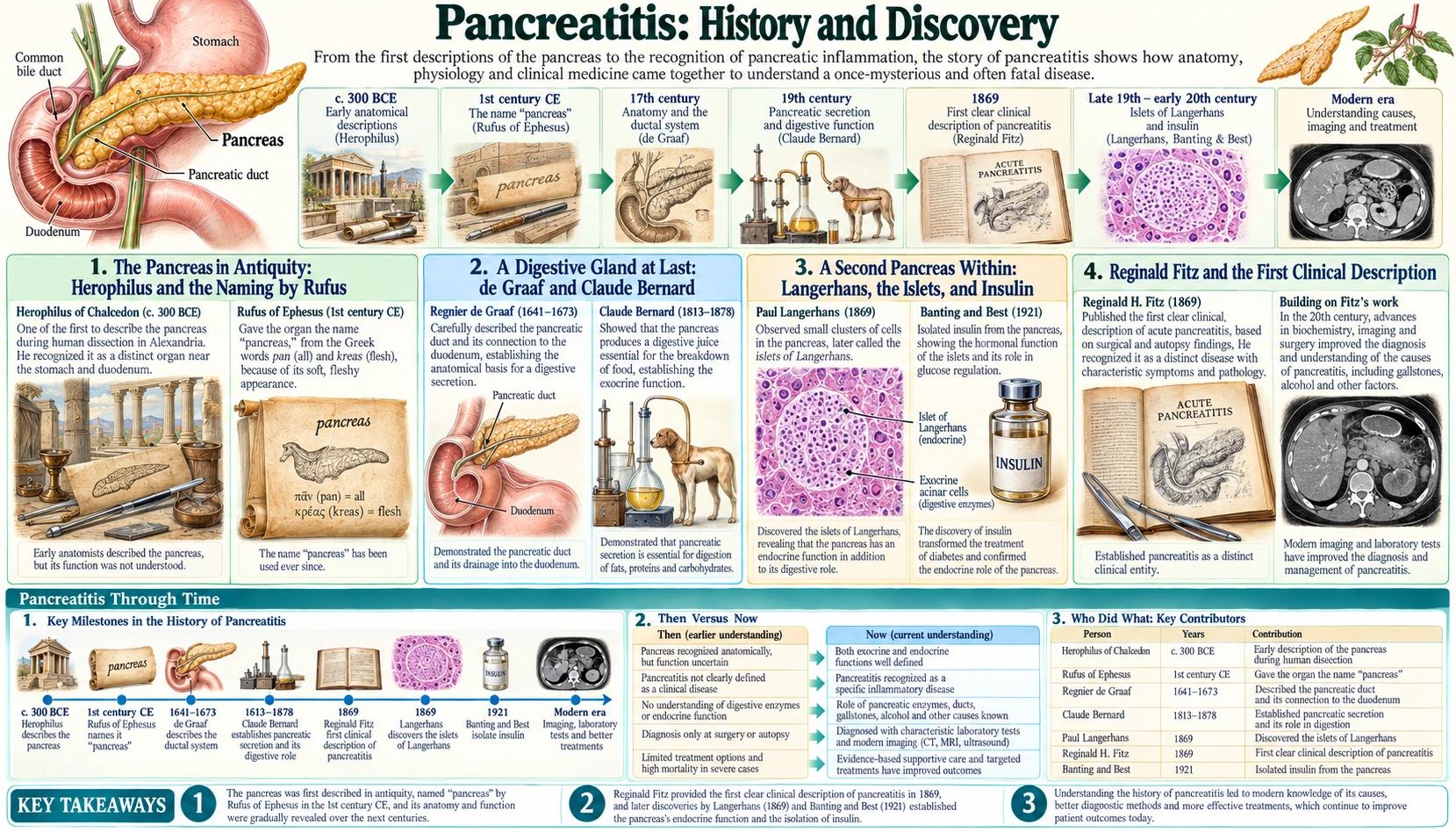
The story of pancreatitis is really three intertwined stories: the slow discovery of the pancreas itself as an organ, the much later recognition that it could turn destructively on the body, and the dawning understanding of why it does so. The gland was glimpsed in antiquity, named for its plain, meat-like appearance, and long misunderstood as a mere cushion. Only in the seventeenth and nineteenth centuries did its role in digestion become clear, and only in 1889 did the Boston physician Reginald Fitz give the acute disease its first systematic clinical description. The idea that the pancreas can digest itself — the “autodigestion” theory of Hans Chiari (1896) — remains the conceptual core of how we understand the disease today. This page traces that history with care for what was actually established, what was hypothesis, and what remains genuinely uncertain.
Table of Contents
- The Pancreas in Antiquity: Herophilus and the Naming by Rufus
- A Digestive Gland at Last: de Graaf and Claude Bernard
- A Second Pancreas Within: Langerhans, the Islets, and Insulin
- Reginald Fitz and the First Clinical Description (1889)
- Hans Chiari and the Autodigestion Theory (1896)
- Naming the Causes: Gallstones, Alcohol, and Opie's Common Channel
- Seeing the Pancreas: ERCP and Modern Diagnosis
- From Description to Mechanism: The Modern Picture
- Key Research Papers
- Connections
- Featured Videos
The Pancreas in Antiquity: Herophilus and the Naming by Rufus
The pancreas is an awkward organ to discover. It lies deep in the upper abdomen, behind the stomach, soft and pale and unremarkable, with no obvious duct visible to the naked eye and no dramatic function that an ancient anatomist could infer from dissection. It is therefore unsurprising that, while the heart, liver, and brain were the subject of elaborate theory from the earliest medical writing, the pancreas was barely noticed. The organ is generally credited to Herophilus of Chalcedon (c. 335–280 BCE), the great Alexandrian anatomist often called the father of anatomy, who is said to have noted the gland in his dissections in the third century BCE. Almost nothing of his own writing survives, so this attribution reaches us second-hand through later authors, and it should be read as a credible tradition rather than a documented first.
The name we still use was supplied a few centuries later by Rufus of Ephesus, a Greek physician active around the first to second century CE. Rufus called the organ pánkreas — from the Greek pân (“all”) and kréas (“flesh” or “meat”) — literally “all flesh.” The name is purely descriptive: unlike most structures an anatomist encounters, the pancreas contains no bone and no cartilage and is of fairly uniform, meaty consistency throughout, so it appeared to be made entirely of flesh. This is one of the rare anatomical terms whose ancient etymology is both secure and self-explanatory, and it has survived unchanged for nearly two thousand years.
For most of the next millennium and a half, the pancreas remained a structure without a purpose. Galen, the towering medical authority of the Roman world, regarded it largely as a protective cushion or bolster supporting the stomach and the great blood vessels behind it — a kind of anatomical packing material. That view, like so much of Galenic doctrine, went essentially unchallenged through the medieval period. The organ had a name and a location, but its true work would not be understood until the experimental anatomists of the seventeenth century turned their attention to it.
A Digestive Gland at Last: de Graaf and Claude Bernard
The first real progress came from the Dutch physician and anatomist Regnier de Graaf (1641–1673). In 1664, while still remarkably young, de Graaf published a treatise on the pancreas in which he described a now-famous experiment: working on a living dog, he cannulated the pancreatic duct — reportedly using a hollow quill from a bird — and collected the fluid that drained from it through a temporary fistula. This was the first time anyone had captured pancreatic juice as a distinct secretion and demonstrated that the pancreas is a gland that actively produces a fluid, not a passive cushion. De Graaf's interpretation of what that juice did was largely mistaken by modern standards, but his technique — the temporary pancreatic fistula — was a genuine breakthrough and became a foundational method of experimental physiology.
The function of that juice was finally clarified almost two centuries later by the French physiologist Claude Bernard (1813–1878), one of the founders of modern experimental medicine. In work culminating around 1856, Bernard used pancreatic fistulae in dogs and rabbits to show that pancreatic juice does the heavy lifting of digestion in the small intestine: it breaks down (emulsifies and saponifies) neutral fats into absorbable fatty acids, and it acts on starches and proteins as well. This established the pancreas as the body's master digestive gland — the source of the enzymes that dismantle a meal. Crucially for the later understanding of pancreatitis, Bernard's work made clear just how powerful those secretions are: the pancreas manufactures enzymes capable of digesting fat, starch, and protein, which is precisely why their premature activation inside the gland would prove so dangerous.
By the second half of the nineteenth century, then, the pancreas had at last been understood as an exocrine digestive organ. The stage was set for two further discoveries that would define the modern field: the recognition that the gland also has a hidden endocrine function, and the realization that its own digestive enzymes could destroy it.
A Second Pancreas Within: Langerhans, the Islets, and Insulin
In February 1869, a German medical student named Paul Langerhans (1847–1888) submitted a doctoral thesis at the Berlin Pathological Institute titled, in translation, “Contributions to the Microscopic Anatomy of the Pancreas.” Examining the gland under the microscope, Langerhans described small clusters of cells scattered throughout the tissue that stained differently from the surrounding acinar (enzyme-producing) cells — little “islands” embedded in the digestive gland. He honestly admitted that he did not know what these cell clusters did. Decades later they would be named the islets of Langerhans in his honor, and they would turn out to be the endocrine heart of the organ.
It is worth being precise here, because the history is easy to blur. The islets are the source of insulin, and their failure causes diabetes mellitus — a different disease from pancreatitis. Insulin itself was not isolated until 1921–1922, by Frederick Banting, Charles Best, J.J.R. Macleod, and James Collip in Toronto, work that earned a Nobel Prize and transformed type 1 diabetes from a death sentence into a manageable condition. Pancreatitis, by contrast, is primarily a disease of the exocrine pancreas — the acinar tissue and ducts that make and carry digestive enzymes. The two functions share one organ, which is why severe or chronic pancreatitis can sometimes damage enough islets to cause secondary diabetes, but the discovery of the islets and of insulin belongs to the parallel history of diabetes rather than to pancreatitis proper.
This dual nature of the pancreas — an exocrine digestive factory wrapped around a million endocrine islets — is one of the things that makes the organ so consequential and its diseases so varied. The history of pancreatitis is the history of the first system; the history of diabetes is the history of the second. Langerhans, who died of tuberculosis at only forty-one, lived to see neither fully understood.
Reginald Fitz and the First Clinical Description (1889)
Knowing the anatomy and physiology of the pancreas is not the same as recognizing its diseases at the bedside. Through most of the nineteenth century, acute pancreatitis was a hidden killer: patients died suddenly of catastrophic abdominal pain, and at autopsy their pancreas might be found hemorrhagic, necrotic, or studded with the chalky deposits of fat necrosis — but the condition had no clear name, no agreed clinical picture, and no way to be diagnosed in a living patient. It was, in effect, a disease known only to the morgue.
This changed decisively in 1889, when Reginald Heber Fitz (1843–1913), the Shattuck Professor of Pathological Anatomy at Harvard and a physician at the Massachusetts General Hospital, delivered the Middleton-Goldsmith Lecture before the New York Pathological Society. His paper — published that February in the Boston Medical and Surgical Journal under the title “Acute Pancreatitis: A Consideration of Pancreatic Hemorrhage, Hemorrhagic, Suppurative, and Gangrenous Pancreatitis, and of Disseminated Fat-Necrosis” — is universally regarded as the first systematic clinical and pathological description of the disease. Fitz reviewed the existing literature and a series of cases, distinguished the forms the disease could take, and, critically, argued that acute pancreatitis could and should be recognized during life rather than only at autopsy. The same Reginald Fitz had, a few years earlier (1886), performed the comparable service for appendicitis, coining that term and clarifying its surgical management — a remarkable double contribution to the recognition of acute abdominal disease.
Fitz's achievement was one of synthesis and clinical clarity rather than the discovery of a brand-new entity — scattered case reports of fatal pancreatic disease predate him. But by gathering the picture together, naming its forms, and insisting it could be diagnosed in the living patient, he effectively founded acute pancreatitis as a recognized clinical condition. His 1889 paper is the document modern pancreatologists point to as the starting line of the disease's clinical history.
Hans Chiari and the Autodigestion Theory (1896)
Fitz described what the disease looked like; the question of why the pancreas was destroying itself was answered, in concept, a few years later. In 1896 the Austrian pathologist Hans Chiari (1851–1916), then working in Prague, published a paper in the Zeitschrift für Heilkunde proposing that pancreatitis is fundamentally a disease of self-digestion. Chiari is credited with coining the term autodigestion (German Selbstverdauung) and with the memorable idea that in pancreatitis “the organ succumbs to its own digestive properties” that the gland is digested by the very enzymes it manufactures to digest food.
The insight was possible because the groundwork in enzyme chemistry had recently been laid. The physiologist Wilhelm Kühne had isolated and named trypsin — the pancreas's powerful protein-splitting enzyme — in the 1870s, and Chiari was fully aware of this discovery. His proposal was that, under normal conditions, these proteolytic enzymes are kept safely inactive until they reach the intestine, but that in pancreatitis this safeguard fails: the enzymes become activated prematurely within the pancreas and begin to break down the gland's own tissue. It is essential to label this correctly for the reader: in 1896 the autodigestion theory was a hypothesis — a brilliant and ultimately well-supported one, but a mechanistic proposal, not a proven fact. Chiari could not directly demonstrate the cascade he imagined.
What is striking is how durable the hypothesis has proved. Modern molecular pancreatology has confirmed Chiari's central intuition in considerable detail: digestive enzymes are indeed secreted by acinar cells as inactive precursors called zymogens (for example, trypsinogen, the precursor of trypsin), and the premature, intracellular activation of trypsinogen to trypsin is now understood to be an early triggering event in acute pancreatitis. Genetic work on hereditary pancreatitis, which centers on mutations in the cationic trypsinogen gene (PRSS1), has reinforced the trypsin-centric view, even as researchers continue to debate how much of the full-blown disease — with its inflammation and organ failure — is driven by trypsin itself versus by separate inflammatory pathways. The autodigestion concept that began as Chiari's 1896 hypothesis has, in other words, matured into the verified backbone of how the disease is understood — with the honest caveat that the complete mechanism is still an area of active research.
Naming the Causes: Gallstones, Alcohol, and Opie's Common Channel
Recognizing the disease and proposing its mechanism still left the practical question that matters most to patients: what sets the autodigestion off? Two answers came to dominate, and they remain the two leading causes of acute pancreatitis worldwide today: gallstones and alcohol.
The gallstone connection received its classic explanation from the American pathologist Eugene Lindsay Opie (1873–1971) at Johns Hopkins in 1901. In the same year Opie advanced two related ideas. The better-known is the “common channel” hypothesis: in many people the bile duct and the pancreatic duct join into a shared common channel just before emptying into the duodenum, and Opie proposed that a gallstone impacted at that outlet (the ampulla of Vater) could create a connection through which bile refluxes back up into the pancreatic duct, triggering pancreatitis. His companion idea was that an obstructing stone could simply block the pancreatic duct's outflow, causing enzymes to back up and the gland to inflame. Modern understanding favors the obstruction/outflow-blockage mechanism over literal bile reflux as the dominant pathway, but Opie's work decisively tied gallstones to pancreatitis and framed a debate that continued for a century. The relationship is two-way in the clinic: gallstone disease causes pancreatitis, which is one reason the two conditions are managed together.
The role of alcohol as the other leading cause was established more gradually, through accumulating clinical and epidemiological observation across the twentieth century rather than by a single landmark paper, and it is now firmly recognized: heavy, sustained alcohol use is a principal cause of both acute attacks and of chronic pancreatitis, in which repeated injury leads to permanent scarring, calcification, and loss of both digestive and (sometimes) insulin-producing function. A range of other causes is also recognized today — high blood triglycerides, certain medications, high blood calcium, genetic mutations (the hereditary pancreatitis described above), trauma, and pancreatitis occurring as a complication of the ERCP procedure discussed in the next section — but gallstones and alcohol remain the two that account for the large majority of cases.
Seeing the Pancreas: ERCP and Modern Diagnosis
For all the conceptual progress, the deep, hidden position of the pancreas long made it one of the hardest organs to examine in a living patient. The twentieth century gradually solved this. A major milestone was endoscopic retrograde cholangiopancreatography (ERCP), first reported by the American surgeon William S. McCune and colleagues (Paul Shorb and Herbert Moscovitz) in the Annals of Surgery in 1968. Their technique threaded a side-viewing endoscope down to the duodenum, cannulated the papilla, and injected contrast dye backward (retrograde) up the bile and pancreatic ducts so they could be seen on X-ray. For the first time, the previously invisible ductal anatomy of the pancreas could be imaged directly in a patient.
ERCP has a double relationship with pancreatitis that is worth stating plainly. It became an enormously important tool — especially in gallstone pancreatitis, where an endoscope can be used not just to look but to remove a stone obstructing the common channel and relieve the blockage Opie had described. At the same time, ERCP is itself one of the recognized causes of acute pancreatitis: irritating or instrumenting the pancreatic duct can provoke an attack (so-called post-ERCP pancreatitis), which is why the procedure is now used more selectively and often for treatment rather than diagnosis alone.
For diagnosis, ERCP has largely been superseded by safer methods. The blood test for elevated pancreatic enzymes — serum amylase, and later the more specific lipase — gave clinicians a simple way to confirm an attack in the living patient, finally delivering the bedside diagnosis Fitz had argued was possible. Cross-sectional imaging, particularly CT scanning (and MRI/MRCP, a non-invasive magnetic-resonance way of imaging the ducts), now lets physicians see the inflamed or necrotic gland directly and grade the severity of an attack. Together, enzyme testing and modern imaging turned acute pancreatitis from Fitz's autopsy diagnosis into a condition routinely recognized within hours of a patient's arrival.
From Description to Mechanism: The Modern Picture
Looking back, the history of pancreatitis is a near-textbook example of how medical knowledge is built in layers, each generation answering a different question. Antiquity gave the organ a name (Rufus's “all flesh”) but no function. The seventeenth and nineteenth centuries gave it a function (de Graaf's pancreatic juice; Bernard's demonstration that it digests fat and more). The late nineteenth century gave the disease a clinical identity (Fitz, 1889) and a mechanism in concept (Chiari's 1896 autodigestion hypothesis). The twentieth century named its causes (Opie's gallstone work in 1901; the steadily established role of alcohol) and learned to see it (ERCP, enzyme tests, CT and MRI).
The modern era has been about turning Chiari's hypothesis into verified molecular detail. Researchers now describe pancreatitis as beginning inside the acinar cell, where digestive zymogens are normally packaged and kept inert; under the right insult, trypsinogen is activated to trypsin prematurely and within the cell, setting off a cascade of further enzyme activation, cell injury, and a powerful inflammatory response that can spill over into the bloodstream and, in severe cases, cause failure of distant organs. Genetic discoveries — mutations in PRSS1 causing hereditary pancreatitis, and in protective genes such as SPINK1 and CFTR — have anchored the trypsin-centered view while also showing the picture is more layered than a single switch. There is genuine, ongoing scientific debate about how much of the severe disease is driven by trypsin itself versus independent inflammatory pathways, and this page deliberately presents that as an open question rather than a settled fact.
What has not changed in over a century is the central image Hans Chiari supplied in 1896: a powerful digestive gland that, when its own safeguards fail, begins to consume itself. That this idea — born as a careful hypothesis — still organizes a sophisticated modern research field is a fitting close to a history that runs from a Greek anatomist puzzling over a piece of boneless flesh to laboratories mapping the activation of a single enzyme. For the present-day clinical picture, causes, symptoms, and treatment of the disease, see the main Pancreatitis article.
Key Research Papers
The references below combine a small number of peer-reviewed historical and review papers (with DOIs or PMIDs where a specific source is well established) with curated PubMed topic-search links into the historical and mechanistic literature on the pancreas and pancreatitis. Several foundational works named in the article — Herophilus's lost writings, Rufus of Ephesus on naming the organ, de Graaf's 1664 treatise, Claude Bernard's 1856 memoir, Langerhans's 1869 thesis, and Chiari's 1896 paper in the Zeitschrift für Heilkunde — are cited in the text as historical primary sources rather than as modern indexed citations. Each link opens at its source (National Library of Medicine or the publisher) in a new tab.
- Fitz RH. Acute Pancreatitis: A Consideration of Pancreatic Hemorrhage, Hemorrhagic, Suppurative, and Gangrenous Pancreatitis, and of Disseminated Fat-Necrosis. Boston Medical and Surgical Journal. 1889;120(8):181–187. — doi:10.1056/NEJM188902211200801 (The first systematic clinical description.)
- Howard JM, Hess W. Acute pancreatitis at its centenary: the contribution of Reginald Fitz. Annals of Surgery. 1990. — PubMed PMID: 2194439
- Busnardo AC, DiDio LJA, Tidrick RT, Thomford NR. History of the pancreas. American Journal of Surgery. 1983;146(5):539–550. — Search PubMed (Herophilus, Rufus, de Graaf, and the naming of the organ.)
- Navarro S. A brief history of the anatomy and physiology of a mysterious and hidden gland called the pancreas. Gastroenterología y Hepatología. 2014. PubMed: history of the anatomy and physiology of the pancreas. — PubMed PMID: 25288309
- Chiari H. The autodigestion theory of acute pancreatitis (1896) — historical reviews of the self-digestion concept. PubMed: Chiari autodigestion theory of pancreatitis
- Saluja AK, Lerch MM, Phillips PA, Dudeja V. Why does pancreatic overstimulation cause pancreatitis? (Premature intra-acinar trypsinogen activation.) Annual Review of Physiology. 2007. PubMed: premature trypsinogen activation in pancreatitis
- Whitcomb DC, et al. Hereditary pancreatitis is caused by a mutation in the cationic trypsinogen gene (PRSS1). Nature Genetics. 1996. PubMed: PRSS1 cationic trypsinogen and hereditary pancreatitis. — Search PubMed
- Opie EL. The common channel hypothesis: gallstones, the ampulla of Vater, and the etiology of acute pancreatitis (1901) — historical analyses. PubMed: Opie common channel theory of gallstone pancreatitis
- McCune WS, Shorb PE, Moscovitz H. Endoscopic cannulation of the ampulla of Vater: a preliminary report. Annals of Surgery. 1968;167(5):752–756. (The first ERCP.) PubMed PMID: 5646296
- Regnier de Graaf and the experimental study of pancreatic juice (the 1664 pancreatic fistula). PubMed: de Graaf and the discovery of pancreatic juice
- Claude Bernard and the digestion of fat by pancreatic juice (mid-19th-century physiology). PubMed: Claude Bernard and pancreatic digestion of fat
- Paul Langerhans, the islets of Langerhans, and the early microscopy of the pancreas (1869). PubMed: Paul Langerhans and the islets of the pancreas
- The role of alcohol in acute and chronic pancreatitis — pathogenesis and epidemiology. PubMed: alcohol in the pathogenesis of pancreatitis
- The complex role of trypsin in pancreatitis: culprit, mediator, or epiphenomenon? (modern mechanistic debate). PubMed: the role of trypsin in pancreatitis
External Authoritative Resources
Connections
- Gastroenterology
- Pancreatitis (main article)
- All Conditions
- Gallbladder Disease
- Diabetes
- Cirrhosis
- Peptic Ulcer Disease
- Celiac Disease