Vertigo and Ménière's Disease: History and Discovery
Vertigo — the false sensation that the world is spinning — has been described since antiquity, and the very word comes from the Latin vertere, “to turn.” For most of recorded history, physicians blamed such spinning attacks on the brain. The decisive turn came in 1861, when the French physician Prosper Ménière argued before the French Academy of Medicine that a specific cluster of episodic vertigo, fluctuating hearing loss, and tinnitus arose not from the brain but from a disorder of the inner ear — the labyrinth. That single reframing relocated an entire class of balance disorders from the skull to the ear, and the syndrome later took his name. The microscopic finding most associated with the disease, endolymphatic hydrops (a swelling of inner-ear fluid), was demonstrated only much later — independently and in the same year, 1938, by Charles Hallpike & Hugh Cairns in Britain and Kyoshiro Yamakawa in Japan. This page traces that history honestly, separating the ancient symptom from the named disease, and the man who described it from the pathology discovered after his death.
Table of Contents
- Vertigo as an Ancient Symptom
- The Brain Theory and the “Apoplectic” View
- Prosper Ménière and the Inner-Ear Insight (1861)
- Charcot, the Eponym, and a Posthumous Honour
- Endolymphatic Hydrops: The 1938 Parallel Discovery
- Correlate or Cause? An Honest Caveat
- Tools That Localized the Inner Ear
- Legacy and Modern Understanding
- Key Research Papers
- Connections
- Featured Videos
Vertigo as an Ancient Symptom
It is essential to begin with a distinction that is easy to blur: vertigo is a symptom, not a disease. It is the specific, often violent illusion that you or your surroundings are spinning or tilting, and it is only one kind of “dizziness” (which also includes lightheadedness, imbalance, and faintness). As a lived human experience, vertigo is almost certainly as old as humanity itself, and written descriptions of spinning, reeling, and staggering reach back to the earliest medical texts of the ancient Greek world. The English word itself preserves the sensation: it derives from the Latin vertigo, from vertere, “to turn” or “to whirl.”
Classical and medieval physicians grouped vertigo together with headache, “scotomata” (visual disturbance), and fainting, and they generally regarded it as a derangement of the head or the “animal spirits” of the brain. Because the inner ear is buried in the densest bone in the body and is invisible to the unaided eye, there was no way for ancient or early-modern observers to connect a spinning attack to the tiny fluid-filled chambers behind the eardrum. The symptom was real, frequently recorded, and genuinely disabling — but its true anatomical home would stay hidden for roughly two thousand years.
The Brain Theory and the “Apoplectic” View
By the first half of the nineteenth century, the prevailing medical explanation for sudden, severe vertigo placed the fault firmly in the brain. Recurrent attacks of violent spinning, especially when accompanied by staggering, nausea, vomiting, and sometimes collapse, were commonly attributed to a condition described in the language of the day as congestion cérébrale apoplectiforme — an “apoplectiform cerebral congestion,” essentially a near-stroke or a threatened apoplexy involving an excess of blood in the head. This framing carried real consequences for patients: the standard therapeutic response of the era included bloodletting, purging, and other measures aimed at relieving the supposed congestion of the brain.
Within this model, the ear was simply not on the map of balance. The semicircular canals and the rest of the membranous labyrinth had been described anatomically — the canals were known structures — but their function was not understood, and the connection between the auditory organ and the sense of equilibrium had not been established in clinical medicine. A patient who suffered roaring tinnitus and progressive deafness alongside their vertigo was, under the brain theory, experiencing two separate problems that happened to coincide. The conceptual leap that was missing was the idea that the ringing ear, the failing hearing, and the spinning attack might all be the same organ failing in the same event.
Prosper Ménière and the Inner-Ear Insight (1861)
Prosper Ménière (1799–1862) was a French physician who, late in his career, served as chief physician at the Imperial Institution for Deaf-Mutes in Paris, a post that placed him in daily contact with diseases of the ear and hearing. In 1861 he presented a now-famous paper to the Académie impériale de médecine (the French Academy of Medicine), with the work appearing that same year in the Gazette médicale de Paris. In it, Ménière advanced a then-radical claim: that a recognizable syndrome of episodic vertigo, fluctuating hearing loss, and tinnitus originates in a disorder of the inner ear — the labyrinth — and not in the brain.
Ménière marshalled several lines of argument. He drew on clinical observation of patients in whom violent vertigo, deafness, and ear noise rose and fell together; he reasoned by analogy from cases in which ear disease was associated with balance disturbance; and he was influenced by reports that the semicircular canals, when damaged in animals, produced disordered movement and loss of equilibrium. From these, he concluded that the auditory apparatus could be suddenly affected so as to cause tinnitus and diminished hearing, and that the same inner-ear lesion could produce attacks of vertigo, an uncertain reeling gait, falling, and the accompanying nausea and vomiting. He went so far as to suggest the semicircular canals as the likely seat of the lesion — a strikingly prescient localization, given how little of the inner ear's physiology was then understood.
The significance of 1861 is not that Ménière discovered the cause of the disease — he did not, and the precise cause remains debated today — but that he relocated the problem. By placing episodic vertigo-with-deafness in the ear rather than the brain, he opened an entirely new territory for otology and laid the foundation for the modern field of vestibular (balance) medicine. Tragically, he had little time to defend or extend his idea: Ménière died in 1862, only a year after presenting it, and recognition of his contribution came chiefly after his death.
Charcot, the Eponym, and a Posthumous Honour
Ménière did not name a disease after himself, and the eponym “Ménière's disease” is therefore a posthumous tribute rather than a self-coinage. The credit for attaching his name to the syndrome belongs to the celebrated neurologist Jean-Martin Charcot, who in 1874 wrote of vertige ab aure laesa (“vertigo from a damaged ear”) and used the term maladie de Ménière — Ménière's disease. Charcot's endorsement carried great weight, and it helped cement both the eponym and the underlying idea that this particular vertigo was a disease of the ear.
This sequence matters for historical accuracy. Ménière (the man) described and localized the syndrome in 1861; Charcot (a different physician) named it after him in 1874; and the pathology would be demonstrated by others still later. Conflating these steps — treating the 1861 description as if it had also proven the cause, or attributing the naming to Ménière himself — is a common error. The honest account is that the disease bears Ménière's name because of a clinical insight that other physicians, beginning with Charcot, judged important enough to immortalize.
Endolymphatic Hydrops: The 1938 Parallel Discovery
For more than seven decades after 1861, Ménière's disease was a clinical diagnosis — defined by its symptom triad — without a confirmed microscopic correlate. That changed in 1938, in one of the more remarkable coincidences in the history of otology: the characteristic inner-ear pathology was reported independently and in the same year by two groups working on opposite sides of the world. In Britain, Charles Skinner Hallpike and the neurosurgeon Hugh Cairns examined the temporal bones of patients who had had Ménière's disease; in Japan, Kyoshiro Yamakawa independently examined comparable specimens. Both arrived at the same finding.
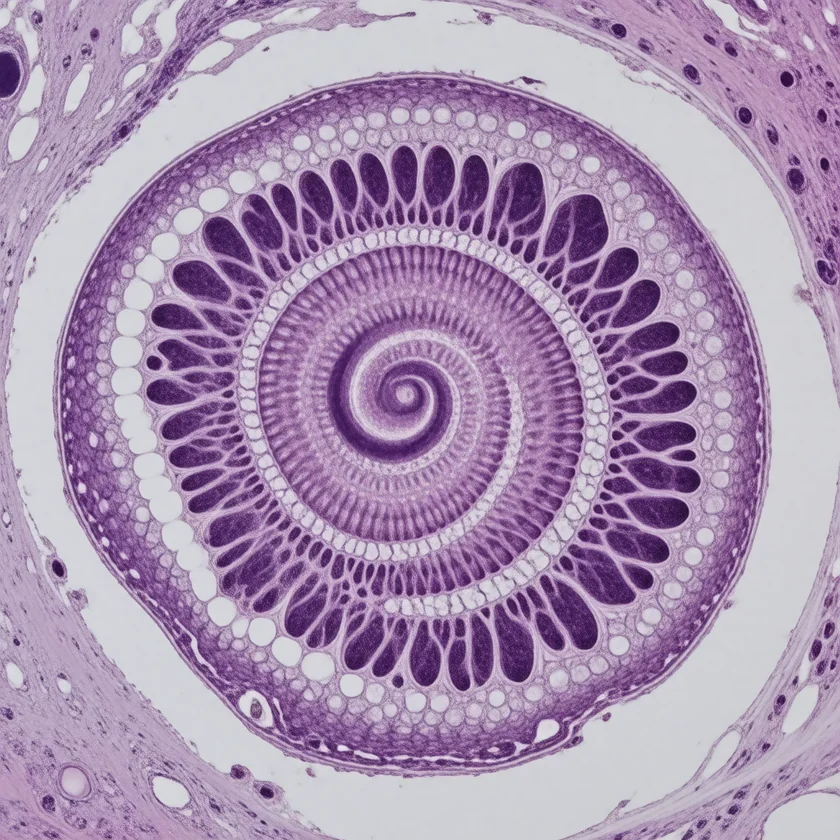
What they saw is called endolymphatic hydrops: a swelling, or over-distension, of the fluid-filled endolymphatic space within the membranous labyrinth. Under the microscope this appeared as a ballooning of the scala media (the cochlear duct), with the delicate Reissner's membrane bulged outward into the neighbouring fluid space, and a similar distension of the saccule. In plain terms, the inner ear's endolymph compartment was over-full and stretched. Endolymphatic hydrops quickly became regarded as the histopathologic hallmark of Ménière's disease — the physical, tissue-level signature that finally gave the clinical syndrome an anatomical face, vindicating Ménière's intuition that the lesion lay in the ear.
It is worth pausing on the dual, simultaneous nature of this discovery. Two separate teams, with no coordination and amid the geopolitical tensions of 1938, converged on the identical pathology. This kind of independent, parallel discovery — common in the history of science — strengthens confidence that the observation was real and not an artifact of one laboratory's methods, and it is why the finding is conventionally credited jointly to Hallpike and Cairns and to Yamakawa.
Correlate or Cause? An Honest Caveat
Here accuracy requires real care, because the history is often oversimplified. For most of the twentieth century, endolymphatic hydrops was treated as the cause of Ménière's disease, and the condition was frequently labelled “idiopathic endolymphatic hydrops.” But the modern picture is more nuanced, and it would be wrong to present hydrops as a settled, proven cause. Hydrops is best described, on current evidence, as the strongly associated histopathologic correlate of the disease — not a fully established causal mechanism.
The reason for this caution is concrete. Careful study of large collections of human temporal bones has shown that essentially all patients with diagnosed Ménière's disease do have hydrops in at least one ear — but hydrops has also been found post-mortem in the ears of people who never had any symptoms of the disease in life. In other words, the swelling can be present without producing the illness, which means hydrops cannot be the whole story. This is the central point of a much-cited 2016 re-evaluation, fittingly titled “What is Ménière's disease? A contemporary re-evaluation of endolymphatic hydrops.” Modern researchers now debate whether hydrops is a primary driver of the disease or, at least in part, a secondary marker — an epiphenomenon — of some deeper disturbance of inner-ear fluid regulation, immunity, or blood supply.
Modern imaging has added a further layer. With specialized delayed gadolinium-enhanced magnetic resonance imaging (MRI), clinicians can now visualize endolymphatic hydrops in living patients — something impossible in 1938 — and studies using this technique find that the degree of hydrops correlates well with hearing loss, while its relationship to the vertigo attacks themselves is looser and less predictable. The honest summary is therefore: Ménière correctly placed the disease in the ear (1861); Hallpike, Cairns, and Yamakawa correctly identified its characteristic swelling (1938); but the ultimate cause of Ménière's disease remains, to this day, not fully resolved. Hydrops is the fingerprint, not yet the proven culprit.
Tools That Localized the Inner Ear
Ménière's idea could only become a working diagnosis once physicians had tools to test the inner ear directly, and much of the late nineteenth and twentieth centuries was spent building exactly such tools. The foundation was laid in physiology: in the 1870s and 1890s, work on the function of the semicircular canals and the vestibular sense — including the influential studies associated with the Austrian physiologist Robert Bárány, who received the Nobel Prize in 1914 for his work on the vestibular apparatus — established that the labyrinth is genuinely the organ of balance, turning Ménière's clinical hunch into accepted physiology.
On the clinical side, two families of bedside and laboratory tests gradually made the inner ear examinable. Caloric testing — irrigating the ear canal with warm or cool water or air to provoke and measure the resulting eye movements (nystagmus) — allowed a physician to probe each labyrinth's responsiveness separately; Bárány's name is closely tied to this method. Audiometry, the formal measurement of hearing thresholds, made it possible to document the fluctuating, characteristically low-frequency hearing loss of Ménière's disease objectively rather than by impression. The same Charles Hallpike of the 1938 hydrops discovery later lent his name (with John Dix) to the Dix–Hallpike maneuver of 1952, a positional test that helped distinguish inner-ear causes of vertigo from one another — further cementing the principle that vertigo can and should be localized within the ear.
The cumulative effect of these instruments was to convert “vertigo” from a vague brain complaint into a measurable, localizable inner-ear phenomenon. By the late twentieth century a physician could test the labyrinth's reflexes, chart the hearing loss, and — eventually — image the hydrops itself, completing the long arc that began with Ménière pointing, against the consensus of his age, away from the brain and toward the ear.
Legacy and Modern Understanding
The lasting legacy of this history is conceptual: Prosper Ménière is remembered not for curing a disease but for founding a way of thinking. By insisting that episodic vertigo with deafness and tinnitus is a disease of the ear, he effectively opened the discipline of neuro-otology — the study of the inner ear's roles in both hearing and balance — and gave clinicians permission to look for the source of dizziness below the skull. Every modern vestibular clinic, every caloric test and balance-function lab, every gadolinium magnetic resonance imaging hunting for hydrops, descends in a direct line from his 1861 paper.
Modern medicine defines Ménière's disease much as Ménière sketched it: a chronic inner-ear disorder marked by recurrent spontaneous attacks of vertigo lasting minutes to hours, fluctuating and often progressive sensorineural hearing loss, tinnitus, and a sensation of fullness or pressure in the affected ear. International diagnostic criteria (notably the 2015 consensus of the Bárány Society and allied otolaryngology bodies, the latter society itself named after the vestibular-physiology pioneer) formalize these features. Treatment today aims at controlling attacks and protecting hearing — through dietary salt reduction, diuretics, and a graded ladder of interventions — precisely because the root cause Ménière first suspected in the labyrinth still cannot be cured, only managed.
Perhaps the most honest tribute to Ménière is that the open question he raised is still open. He was right that the disease lives in the ear; later workers were right that hydrops is its signature; and contemporary research, with tools he could not have imagined, is still trying to determine why the inner ear's fluid balance fails. That a clinical insight from 1861, defended by a man who died the following year, remains the organizing framework for an active field more than a century and a half later is the measure of how much one well-placed idea can turn.
Key Research Papers
The references below combine peer-reviewed historical and pathophysiological reviews with curated PubMed topic-search links. Historical primary sources — Ménière's 1861 memoir in the Gazette médicale de Paris and Charcot's 1874 use of the eponym — are named in the text as historical documents rather than as modern citations. Each link opens at its source (PubMed or the publisher) in a new tab.
- Pearce JMS. Hydrops in the labyrinth: Prosper Ménière (1799–1862) and his disease. European Neurology. 2010;64(5):288–292. — doi:10.1159/000321416
- Baloh RW. Prosper Ménière and his disease. Archives of Neurology. 2001;58(7):1151–1156. — doi:10.1001/archneur.58.7.1151
- Foster CA, Breeze RE. Endolymphatic hydrops in Ménière's disease: cause, consequence, or epiphenomenon? Otology & Neurotology. 2013;34(7):1210–1214. — doi:10.1097/MAO.0b013e31829e83df
- Merchant SN, Adams JC, Nadol JB Jr. Pathophysiology of Ménière's syndrome: are symptoms caused by endolymphatic hydrops? Otology & Neurotology. 2005;26(1):74–81. — doi:10.1097/00129492-200501000-00013
- Lopez-Escamez JA, Carey J, Chung WH, et al. Diagnostic criteria for Ménière's disease (Bárány Society consensus). Journal of Vestibular Research. 2015;25(1):1–7. — doi:10.3233/VES-150549
- Naganawa S, Nakashima T. Visualization of endolymphatic hydrops with MR imaging in patients with Ménière's disease and related pathologies: current status. Magnetic Resonance in Medical Sciences. 2014;13(1):1–13. — doi:10.5005/jp/books/11995_7
- “What is Ménière's disease? A contemporary re-evaluation of endolymphatic hydrops” (full text, PubMed Central) — PMC4833790
- Histopathology of Ménière's disease (Hallpike & Cairns / Yamakawa 1938 findings reviewed; PubMed Central) — PMC5344024
- Prosper Ménière — biography and 1861 inner-ear localization — PubMed: Prosper Ménière history
- Endolymphatic hydrops — Hallpike, Cairns, and Yamakawa 1938 — PubMed: endolymphatic hydrops 1938 discovery
- Endolymphatic hydrops as correlate vs. cause of Ménière's disease — PubMed: hydrops cause versus correlate
- Robert Bárány and the physiology of the vestibular apparatus — PubMed: Bárány vestibular history
- History of vertigo and the localization of balance to the inner ear — PubMed: history of vertigo and the inner ear