Morphea (Localized Scleroderma)
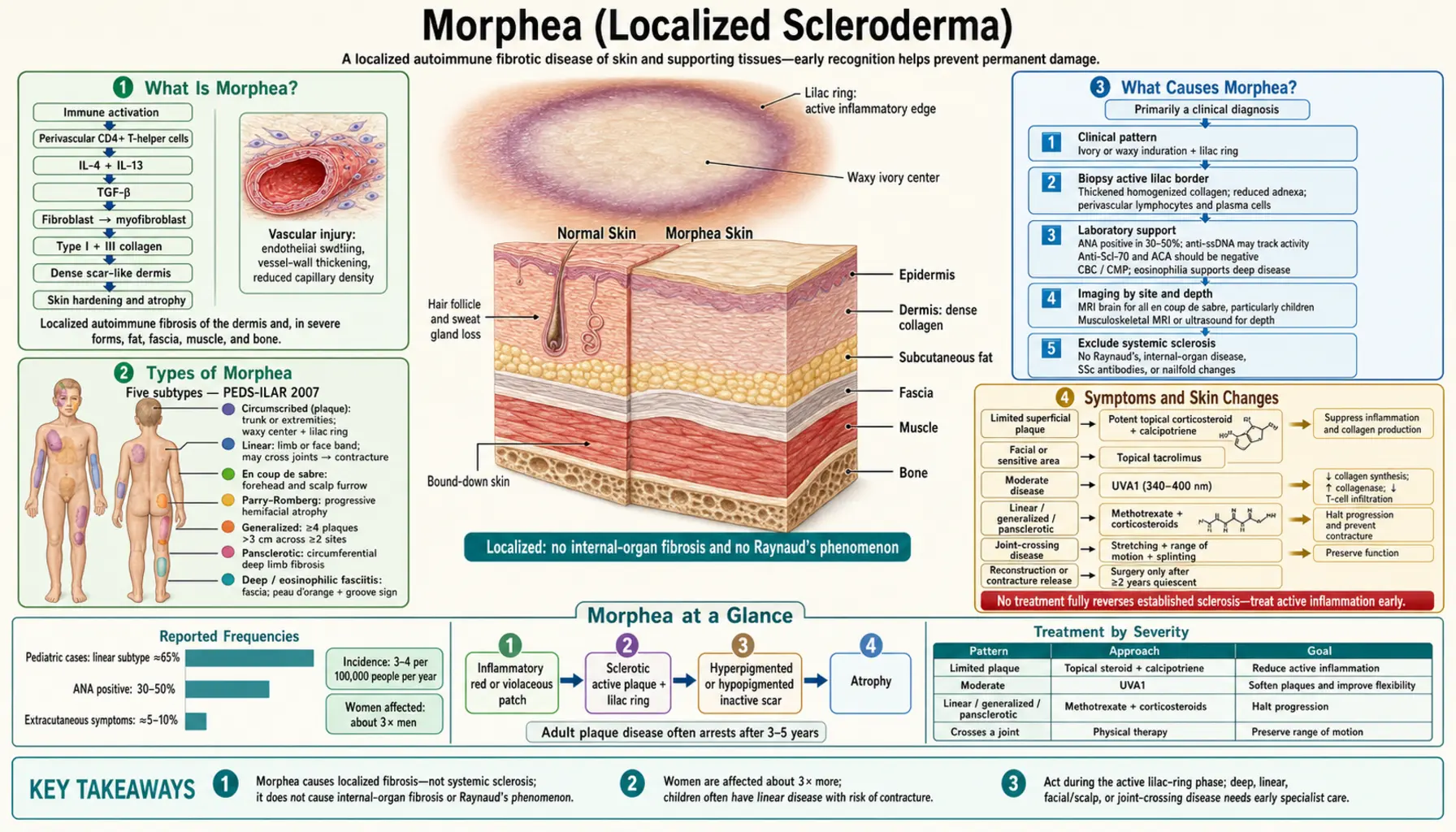
Morphea is a localized form of scleroderma characterized by fibrosis of the skin and subcutaneous tissue that produces hardened, waxy plaques at specific sites. Unlike systemic sclerosis, morphea does not involve internal organs, does not cause Raynaud's phenomenon, and does not carry the same life-threatening risks to the heart, lungs, or kidneys. It is an autoimmune inflammatory condition that ranges from mild self-limited plaques in adults to severe, disfiguring contractures and bone involvement in children — making early recognition and appropriate treatment critically important.
Table of Contents
- What Is Morphea?
- Types of Morphea
- What Causes Morphea?
- Symptoms and Skin Changes
- Linear Morphea and Children
- How Morphea Is Diagnosed
- Treatment Options
- Morphea in Children and Long-Term Outlook
- Key Research Papers
- Connections
- Featured Videos
What Is Morphea?
Morphea — also called localized scleroderma — is a rare autoimmune skin disease in which the immune system triggers abnormal fibrosis (scar-like thickening) of the dermis and, in more severe forms, the underlying subcutaneous fat, fascia, muscle, and even bone. The word "scleroderma" means "hard skin," but morphea is emphatically a localized form, confined to the skin and its immediate supporting tissue.
The condition is fundamentally different from systemic sclerosis (SSc), the form most people think of when they hear "scleroderma." In systemic sclerosis, fibrosis spreads internally to affect the esophagus, lungs, heart, and kidneys, and Raynaud's phenomenon (blanching and color changes in fingers from cold or stress) is nearly universal. Morphea has none of these features: no Raynaud's, no internal organ fibrosis, and none of the specific autoantibodies (anti-Scl-70 / anti-topoisomerase I or anti-centromere/ACA) that define systemic sclerosis. Patients and families must understand this distinction clearly, because a diagnosis of morphea does not mean they have or will develop the systemic disease.
Morphea is uncommon but not vanishingly rare. Population-based studies estimate an incidence of approximately 3–4 cases per 100,000 people per year. Women are affected about three times more often than men. Adults most commonly develop morphea between ages 30 and 50, though children are also affected — and children more often develop the aggressive linear subtype. Antinuclear antibodies (ANA) are positive in 30–50% of patients, confirming the autoimmune character of the disease even without systemic features.
In Europe, Borrelia burgdorferi (the bacterium that causes Lyme disease) has been proposed as a trigger in some cases, based on seroprevalence studies and occasional antibiotic responses. This association has not been confirmed in North American populations, where Borrelia cannot be reliably cultured from morphea lesions and treatment with antibiotics does not improve the skin disease.
Types of Morphea
Morphea is not one disease — it is a spectrum. The PEDS-ILAR 2007 classification (Pediatric Rheumatology European Society / International League of Associations for Rheumatology) defines five subtypes, which differ in depth of involvement, distribution, severity, and prognosis.
1. Circumscribed (Plaque) Morphea
This is the most common form, accounting for roughly half to two-thirds of all cases. Lesions appear as oval or round indurated (hardened) plaques on the trunk, breasts, or extremities. The classic appearance has two zones: a waxy, ivory-white or yellowish central sclerotic area surrounded by a lilac ring (also called the lilac border or violaceous border) — a halo of purplish-red inflammation at the expanding active edge. This lilac ring is pathognomonic of active morphea: it marks the inflammatory front where immune cells are still actively driving fibrosis into surrounding tissue. As the disease enters a late, burnt-out phase, the lilac ring disappears and the center leaves residual hyperpigmentation and skin atrophy. Circumscribed morphea is largely confined to the dermis and does not cross fascia or muscle — it looks and feels alarming but rarely causes functional impairment.
2. Linear Morphea
Linear morphea presents as a band or streak of sclerosis that follows a linear pattern along a limb or the face. Unlike plaque morphea, linear disease penetrates deep: it crosses the dermis into subcutaneous fat, fascia, muscle, and in severe cases to the periosteum and bone. Crossing a joint causes contracture — permanent restriction of joint movement that can be profoundly disabling. Linear morphea is the dominant subtype in children and is the form with the highest risk of long-term disability.
- En coup de sabre ("sword strike"): Linear morphea of the forehead and scalp, producing a linear depressed furrow resembling the wound from a sword blow. It may extend into the scalp causing localized hair loss and can track along the trigeminal nerve distribution. Brain involvement (MRI white matter lesions, seizures) is a recognized complication requiring neurological monitoring.
- Parry-Romberg syndrome (progressive hemifacial atrophy): A more severe and extensive variant in which one entire half of the face progressively atrophies — skin, fat, muscle, and bone — causing dramatic facial asymmetry. It overlaps with en coup de sabre and may represent the same disease on a spectrum of severity.
3. Generalized Morphea
Generalized morphea is defined by the presence of four or more plaques larger than 3 cm spanning at least two distinct anatomic sites. The plaques tend to coalesce over time. Despite the widespread skin involvement, generalized morphea still does not affect internal organs in the way systemic sclerosis does, though extracutaneous symptoms (fatigue, arthralgias) are more common than in localized plaque disease.
4. Pansclerotic Morphea
This is the rarest and most severe form. Fibrosis extends circumferentially around an entire limb (or multiple limbs), engulfing skin, subcutaneous tissue, fascia, muscle, and sometimes bone. It causes profound restriction of movement, recurrent infections in atrophic skin, and carries the worst prognosis of all morphea subtypes. The total body surface area of involvement creates a restrictive physiology similar to severe burn contracture.
5. Deep Morphea / Eosinophilic Fasciitis
Deep morphea (also called subcutaneous morphea) and the related condition eosinophilic fasciitis (Shulman syndrome) primarily involve the deep dermis, subcutaneous fat, and fascia rather than the surface skin. The overlying skin may show a characteristic peau d'orange (orange-peel) texture and a groove sign — a linear depression along superficial veins when the arm is elevated, caused by tethering of skin to deep fascial fibrosis. Eosinophilic fasciitis is often triggered by heavy exertion and is associated with peripheral blood eosinophilia.
What Causes Morphea?
Morphea is an autoimmune inflammatory fibrotic disease. The sequence of events that leads from immune activation to permanent skin hardening is now reasonably well understood, even if the initial trigger in any individual patient often cannot be identified.
Immune activation and T-cell inflammation
The earliest histological change in morphea is an inflammatory infiltrate around blood vessels in the deep dermis — predominantly CD4+ T-helper cells with a mix of CD8+ T-cells, macrophages, and plasma cells. The T-cell infiltrate shows a Th2-polarized cytokine profile, with elevated interleukin-4 (IL-4) and IL-13 — the same cytokines central to allergic inflammation and fibrosis in other organs. This distinguishes morphea from some other inflammatory skin diseases (like psoriasis, which is Th17-dominant).
TGF-beta and fibroblast activation
The inflammatory milieu triggers the release of transforming growth factor-beta (TGF-β), the master regulator of fibrosis throughout the body. TGF-β drives resting fibroblasts in the dermis to become myofibroblasts — activated, contractile cells that produce vast quantities of type I and type III collagen. This collagen overproduction replaces the normal elastic dermis with dense, acellular scar tissue. Over months to years, the dermis thickens, the skin adnexal structures (hair follicles, sweat glands, sebaceous glands) are compressed and destroyed, and the skin loses its ability to move and fold normally.
Vascular injury
Early morphea lesions show endothelial cell swelling, vessel wall thickening, and reduced capillary density — findings strikingly similar to those seen in systemic sclerosis. Vascular injury likely precedes or parallels fibroblast activation, and complement deposition has been found in vessel walls at active lesion edges. The vascular component may explain why the lilac ring (peripheral inflammation + neovascularization) appears around active lesions.
Genetic and autoimmune predisposition
HLA associations have been identified in morphea, though these differ from those in systemic sclerosis. The 30–50% ANA positivity rate confirms systemic immune dysregulation even in a localized skin disease. Anti-single-stranded DNA (anti-ssDNA) antibodies — more specific to morphea than to other connective tissue diseases — are found in a subset of patients and may correlate with disease activity. Morphea co-occurs with other autoimmune diseases (thyroid disease, lichen sclerosus, vitiligo, inflammatory bowel disease) at higher rates than expected by chance.
Environmental and infectious triggers
Trauma, radiation therapy, and certain medications have been reported as triggers in individual cases. In Europe, Borrelia burgdorferi serology is positive in a higher proportion of morphea patients than controls, and Borrelia DNA has occasionally been detected in lesional skin biopsies — suggesting molecular mimicry or direct infection as a triggering mechanism in genetically susceptible individuals. This association is not consistently found in North America and should not drive antibiotic treatment decisions outside of confirmed active Lyme disease.
Symptoms and Skin Changes
The clinical course of plaque morphea follows a recognizable sequence of stages, though not every patient progresses through all stages at the same pace.
Stage 1: Inflammatory (erythematous/violaceous) patch
The earliest morphea lesion is an erythematous (red) or violaceous (purplish-red) patch of skin that may feel slightly thickened or indurated but has not yet developed the full waxy hardness of established sclerosis. Patients at this stage often report pruritus (itching), a burning or tight sensation, and sometimes mild tenderness. Because the lesion looks like a bruise, an area of inflammation, or a patch of eczema, this early stage is frequently misdiagnosed, delaying correct treatment by months to years.
Stage 2: Sclerotic (active) plaque with lilac ring
Over weeks to months, the center of the inflammatory patch develops characteristic ivory-white or yellowish waxy induration — the hallmark of established morphea sclerosis. The overlying skin feels bound-down, cannot be easily folded or pinched, and loses its normal surface texture. The active lilac ring persists around the perimeter as long as the disease is expanding. At this stage, the plaque is at its largest and most inflamed, and treatment has the greatest chance of halting further progression.
Stage 3: Hyperpigmented scar (inactive)
The natural history of plaque morphea in adults is eventual spontaneous arrest of disease activity after an average of 3–5 years. The lilac ring fades, the central induration softens, and what remains is a flat, discolored scar with a brownish hyperpigmented appearance. Some patients experience hypopigmentation (lighter than normal skin) rather than hyperpigmentation in the scar center.
Stage 4: Atrophy
The final stage is dermal atrophy — permanent thinning and loss of elasticity in the affected skin and sometimes the underlying subcutaneous fat. Hair follicles and sweat glands may be permanently destroyed. Though the inflammatory disease has resolved, the cosmetic and functional consequences of the scar remain.
Systemic symptoms
Morphea is largely a skin-limited disease, but a minority of patients — approximately 5–10% — report extracutaneous symptoms. These include arthralgias (joint pain without frank arthritis), fatigue, and — specifically in en coup de sabre linear morphea — neurological symptoms including headaches, seizures, and cognitive changes from brain involvement. Uveitis (inflammation inside the eye) occurs in a small but important proportion of patients with linear morphea, particularly en coup de sabre, and can cause visual loss if unrecognized. This makes routine ophthalmology monitoring a standard recommendation for linear morphea patients.
Linear Morphea and Children
Linear morphea is the subtype that causes the most serious long-term harm, and it is disproportionately a disease of children. Understanding why it is so dangerous — and why early aggressive treatment is essential — is critically important for parents and caregivers.
Why linear morphea is more dangerous in children
Children's connective tissue is actively growing. When fibrosis spreads along a limb and crosses a joint, the scarring tethers the joint and prevents normal range of motion — causing a contracture. Unlike adult contractures from injury or stroke, morphea contractures in children develop while the skeleton is still growing, meaning the affected limb may grow shorter than the opposite limb, and muscle atrophy can develop from disuse. If a hand or foot is involved, fine motor function may be permanently impaired.
Contracture prevention is the primary goal
For children with linear morphea crossing or threatening a joint, the treatment goal is explicit: prevent the contracture from developing or worsening. This requires early initiation of systemic immunosuppressive therapy (see Treatment section) combined with intensive physical therapy. Range-of-motion exercises, stretching, and splinting must begin early and continue throughout active disease — and often for months or years after apparent disease arrest, because residual fibrosis continues to tighten as growth continues.
En coup de sabre and brain involvement
Linear morphea of the forehead and scalp (en coup de sabre) carries a specific risk of central nervous system involvement that goes beyond the visible skin lesion. MRI brain imaging in en coup de sabre patients has revealed white matter lesions, calcifications, and other inflammatory changes in up to 30–40% of patients who have neurological symptoms — and occasionally in asymptomatic patients as well. Presenting neurological symptoms include:
- Seizures (new-onset epilepsy in the context of en coup de sabre should trigger urgent MRI)
- Headaches
- Cognitive or behavioral changes
- Facial pain or sensory changes
It is now standard practice to obtain an MRI of the brain in all children with en coup de sabre morphea, even if they have no neurological symptoms. Children with confirmed brain involvement require co-management between dermatology, rheumatology, and pediatric neurology.
Parry-Romberg syndrome
Parry-Romberg syndrome (progressive hemifacial atrophy) is now understood as the severe end of the en coup de sabre spectrum. Rather than a focal linear groove, the entire half of the face progressively loses fat, muscle mass, and eventually bone — producing striking facial asymmetry that worsens through adolescence. Reconstructive surgery is ultimately required in most cases, but only after the disease has been quiescent for at least 2 years, because operating during active disease accelerates recurrence.
Ophthalmologic monitoring
Any child with linear morphea of the face, scalp, or upper body — and any child with morphea and unexplained visual symptoms — should have regular ophthalmologic examinations to screen for uveitis. Uveitis in morphea can be asymptomatic, particularly the chronic anterior variety, and if caught late it has already caused structural damage to the iris and lens.
How Morphea Is Diagnosed
Morphea is primarily a clinical diagnosis — made by recognizing the morphology and distribution of lesions in the right clinical context. Laboratory tests and imaging support the diagnosis and guide management but rarely make or break it in experienced hands.
Clinical recognition
The key features a dermatologist looks for are:
- Ivory-white or waxy central induration with a lilac ring at the active edge
- Distribution and pattern (plaque, linear band, hemifacial)
- Absence of Raynaud's phenomenon and absence of nailfold capillaroscopy changes (which would suggest systemic sclerosis)
- Absence of the systemic symptoms of SSc (dysphagia, dyspnea, renal crisis)
Skin biopsy
A punch biopsy from the indurated center (or preferably the active lilac border) confirms the diagnosis histologically. Pathology shows:
- Thickened, homogenized (sclerotic) collagen bundles filling the dermis
- Marked reduction or absence of adnexal structures (hair follicles, sweat glands) trapped in fibrosis
- Perivascular and interstitial lymphocytic and plasma cell infiltrate at the active edge
- Subcutaneous involvement in linear and deep subtypes
Biopsy cannot reliably distinguish morphea from early systemic sclerosis on histology alone — clinical context is essential.
Laboratory testing
- ANA: Positive in 30–50% of morphea patients; does not indicate systemic sclerosis unless accompanied by specific anti-Scl-70 or anti-centromere antibodies
- Anti-ssDNA: More specific for morphea than for SSc; positivity may correlate with disease activity and number of lesions
- Anti-Scl-70 (anti-topoisomerase I) and ACA: Should be negative in morphea; positivity raises concern for systemic sclerosis
- CBC and CMP: Baseline screening; eosinophilia supports deep morphea/eosinophilic fasciitis
- Borrelia serology: Reasonable in European patients or those with tick exposure history; not routinely indicated in North America
Imaging
- MRI brain: Recommended for all en coup de sabre patients, particularly children, even without neurological symptoms
- Musculoskeletal MRI or ultrasound: Can assess depth of fascial and muscle involvement in linear morphea, guide biopsy, and monitor response to treatment — an emerging research tool becoming more widely used clinically
- Thermography: Detects increased skin temperature at active inflammatory edges; used in research settings to non-invasively track disease activity
Ruling out systemic sclerosis
The most important differential to exclude is systemic sclerosis (SSc). The absence of Raynaud's phenomenon, internal organ involvement, SSc-specific autoantibodies, and nailfold capillaroscopy changes is reassuring. When any of these features are present, rheumatology consultation and more extensive workup are indicated. Morphea and SSc very rarely co-exist in the same patient.
Treatment Options
Treatment of morphea is tailored to the subtype, depth, extent, and severity of disease, and to whether the patient is a child or adult. The overarching goals are: suppress active inflammation before permanent fibrosis sets in, prevent contractures and functional impairment, and manage cosmetic consequences. No treatment fully reverses established sclerosis, so early intervention is more effective than treating late-stage disease.
Topical therapy — for localized plaque morphea
Patients with limited, superficial plaque morphea that does not threaten joints or function can often be managed with topical agents alone:
- Potent topical corticosteroids (e.g., clobetasol propionate 0.05%) applied to active plaques suppress local inflammation. They are most effective at the inflammatory (lilac ring) stage and have limited effect on established sclerosis.
- Topical calcipotriene (calcipotriol) — a vitamin D3 analog — reduces fibroblast proliferation and collagen production independently of corticosteroids. The combination of a potent topical steroid plus topical calcipotriene is superior to either agent alone, based on controlled trial data.
- Topical tacrolimus (0.1% ointment) — a calcineurin inhibitor — has been used for facial and sensitive-area lesions where prolonged potent steroid use risks skin atrophy, as well as for lesions in children.
Phototherapy — for moderate disease
UVA1 phototherapy (wavelengths 340–400 nm) is the most evidence-based phototherapy modality for morphea. Unlike UVB light, which acts mainly on the epidermis, UVA1 wavelengths penetrate deep into the dermis and subcutaneous tissue — directly targeting the fibrotic zone where morphea lives. UVA1 suppresses fibroblast collagen synthesis, induces collagenase activity, and reduces T-cell infiltration. Controlled trials and multiple case series show softening of established plaques, reduction of the lilac ring, and improved skin flexibility. Medium-dose UVA1 (50 J/cm²) is typically effective with an acceptable side-effect profile; high-dose UVA1 (130 J/cm²) may produce faster responses at the cost of greater erythema and long-term UV exposure risk. Narrowband UVB is less effective for morphea because it does not penetrate deeply enough to reach the dermal fibrosis.
Systemic immunosuppression — for linear, generalized, or pansclerotic morphea
Children with linear morphea threatening joints, and adults with generalized or pansclerotic disease, require systemic therapy. The first-line combination is:
- Methotrexate (MTX) — 15–25 mg per week (oral or subcutaneous injection), the anchor of systemic morphea therapy. MTX suppresses T-cell activation and downstream fibrosis signaling. Multiple studies, including controlled trials in pediatric linear morphea, show that MTX slows disease progression, reduces new lesion formation, and — most critically — prevents contractures when started early. Treatment is continued for 2–3 years in children with linear disease; premature discontinuation risks relapse.
- Corticosteroids (oral prednisolone, typically pulsed IV methylprednisolone in severe cases) — combined with MTX for induction of remission. Pulse IV corticosteroids (30 mg/kg/day for 3 consecutive days monthly, for 3–6 months) are used in severe linear morphea in children to rapidly suppress the inflammatory phase before structural damage occurs. Oral prednisone may bridge the 4–8 week delay before MTX reaches full effect.
Mycophenolate mofetil (MMF) is used as an alternative or adjunct to MTX in patients who cannot tolerate MTX (hepatotoxicity, nausea) or who have inadequate response. MMF inhibits lymphocyte proliferation and has anti-fibrotic activity. Retrospective case series support its efficacy in generalized and linear morphea.
Physical and occupational therapy
For any patient with linear morphea that crosses a joint — child or adult — physical therapy is a non-negotiable part of treatment. Stretching, range-of-motion exercises, and splinting prevent and treat contractures. Even when immunosuppression halts new inflammation, existing fibrosis continues to tighten as patients grow (in children) or as normal aging reduces tissue compliance. Physical therapy must be maintained throughout active disease and beyond.
Emerging antifibrotic therapies
Given that morphea is fundamentally a fibrotic disease, agents that target fibrosis pathways directly are under investigation. Nintedanib and pirfenidone — approved for idiopathic pulmonary fibrosis — both target TGF-β signaling pathways relevant to morphea. Case reports and small series have reported benefit in severe refractory disease, and formal clinical trials are underway. Biologic agents targeting IL-4/IL-13 signaling (dupilumab) have also been reported to help in individual cases, reflecting the Th2 cytokine profile of morphea inflammation.
Surgery
Surgical release of established contractures is occasionally indicated, but only after the morphea has been clinically quiescent for at least 2 years. Operating during active disease predictably leads to rapid recurrence and worsening fibrosis at the surgical site. Fat grafting and reconstructive procedures for hemifacial atrophy in Parry-Romberg syndrome are performed by plastic surgeons experienced in inflammatory conditions, following the same quiescent-period rule.
Morphea in Children and Long-Term Outlook
Childhood morphea deserves special emphasis because it is more common than many clinicians realize, it is more aggressive than adult morphea, and the window for preventing permanent disability is relatively narrow.
Incidence and distribution in children
Morphea represents about 3% of pediatric rheumatology referrals in tertiary centers, and pediatric dermatology practices see it regularly. In children, linear morphea accounts for approximately 65% of cases — the reverse of the adult distribution where plaque morphea predominates. This means most children with morphea are at risk for the most serious complication: contracture.
Monitoring during treatment
Children on methotrexate require regular monitoring: CBC and liver function tests at baseline, then monthly for the first 3–6 months, then every 1–3 months thereafter. Folic acid supplementation (1 mg/day or 5 mg/week) reduces nausea and mucositis without reducing MTX's immunosuppressive efficacy. Children with en coup de sabre require ophthalmology follow-up every 6–12 months and neurology assessment if any neurological symptoms emerge. Serial MRI brain imaging may be indicated in those with established brain lesions.
Growth and bone effects
Linear morphea involving a limb can cause the affected limb to grow more slowly than the unaffected side, resulting in leg length discrepancy or arm length discrepancy. Leg length discrepancy above 2 cm typically requires orthopedic management (shoe lifts, timed epiphysiodesis, or limb-lengthening procedures). Regular measurement of limb lengths is part of monitoring in children with limb-involved linear morphea.
School and functional impact
Children with significant morphea — particularly those with contractures, facial involvement, or systemic immunosuppression — may require school accommodations. Physical education modifications, hand therapy support for writing, and psychosocial support for coping with a visible skin condition in the social environment of school are all legitimate needs that the care team should address proactively.
Long-term outlook
Most adults with plaque morphea can expect their disease to self-limit over 3–5 years, leaving residual hyperpigmentation, skin atrophy, and sometimes mild cosmetic disfigurement — but no functional impairment and no internal organ involvement. Recurrence is possible, most often in the first 2 years after apparent remission. Patients who develop new lesions or notice a returning lilac ring at old sites should return to their dermatologist promptly. Children with linear morphea have a more guarded prognosis: established contractures may not fully resolve even with optimal treatment, and some degree of permanent joint limitation, limb length discrepancy, or facial asymmetry is a realistic outcome even when treatment is started early. This makes prevention — through early diagnosis and early aggressive treatment — the only reliably effective strategy.
Key Research Papers
- Fett N, Werth VP. Update on morphea: Part I. Epidemiology, clinical presentation, and pathogenesis. J Am Acad Dermatol. 2016;74(5):781–792 — Search PubMed
- Kreuter A, Hyun J, Stucker M, Sommer A, Altmeyer P, Gambichler T. A randomized controlled study of low-dose UVA1, medium-dose UVA1, and narrowband UVB phototherapy in the treatment of localized scleroderma. J Am Acad Dermatol. 2009;60(4):S34 — Search PubMed
- Mirsky L, Chakkittakandiyil A, Laxer RM, O'Brien C, Pope E. Relapse after systemic treatment in paediatric morphea. Br J Dermatol. 2012;166(2):443–445 — Search PubMed
- Torok KS. Pediatric scleroderma: systemic or localized forms. Pediatr Clin North Am. 2012;59(2):381–405 — Search PubMed
- Zwischenberger BA, Jacobe HT. A systematic review of morphea treatments and therapeutic algorithm. J Am Acad Dermatol. 2011;65(5):925–941 — Search PubMed
- Leitenberger JJ, Cayce RL, Haley RW, Adams-Huet B, Bergstresser PR, Jacobe HT. Distinct autoimmune syndromes in morphea: a review of 245 adult and pediatric cases. Arch Dermatol. 2009;145(5):545–550 — Search PubMed
- Florez-Pollack S, Kunzler E, Jacobe HT. Morphea: Current concepts. Clin Dermatol. 2018;36(4):475–486 — Search PubMed
- Careta MF, Romiti R. Localized scleroderma: clinical spectrum and therapeutic update. An Bras Dermatol. 2015;90(1):62–73 — Search PubMed
- Jacobe HT, Cayce R, Nguyen J. UVA1 phototherapy is effective in darker skin: a review of 101 patients of Fitzpatrick skin types I–V. Br J Dermatol. 2014;163(5):1148–1150 — Search PubMed
- Sehgal VN, Verma P, Sharma S, Sehgal S, Chatterjee K, Khurana A. Localized scleroderma/morphea. Int J Dermatol. 2012;51(9):1019–1030 — Search PubMed
- Kreuter A. Localized scleroderma. Dermatol Ther. 2012;25(2):135–147 — Search PubMed
- Denvir H, Ng WJ, Ahmed K, Tsang V. Morphea: A comprehensive review of its pathophysiology, treatment updates, and outcomes. Dermatol Ther. 2021;34(1):e14523 — Search PubMed
Connections
- Dermatology
- Lichen Sclerosus
- Psoriasis
- Lichen Planus
- DRESS Syndrome
- Pemphigus Vulgaris
- Vitiligo
- Systemic Lupus Erythematosus
- Systemic Sclerosis — the internal-organ form of scleroderma that morphea must be distinguished from.