Keratosis Pilaris
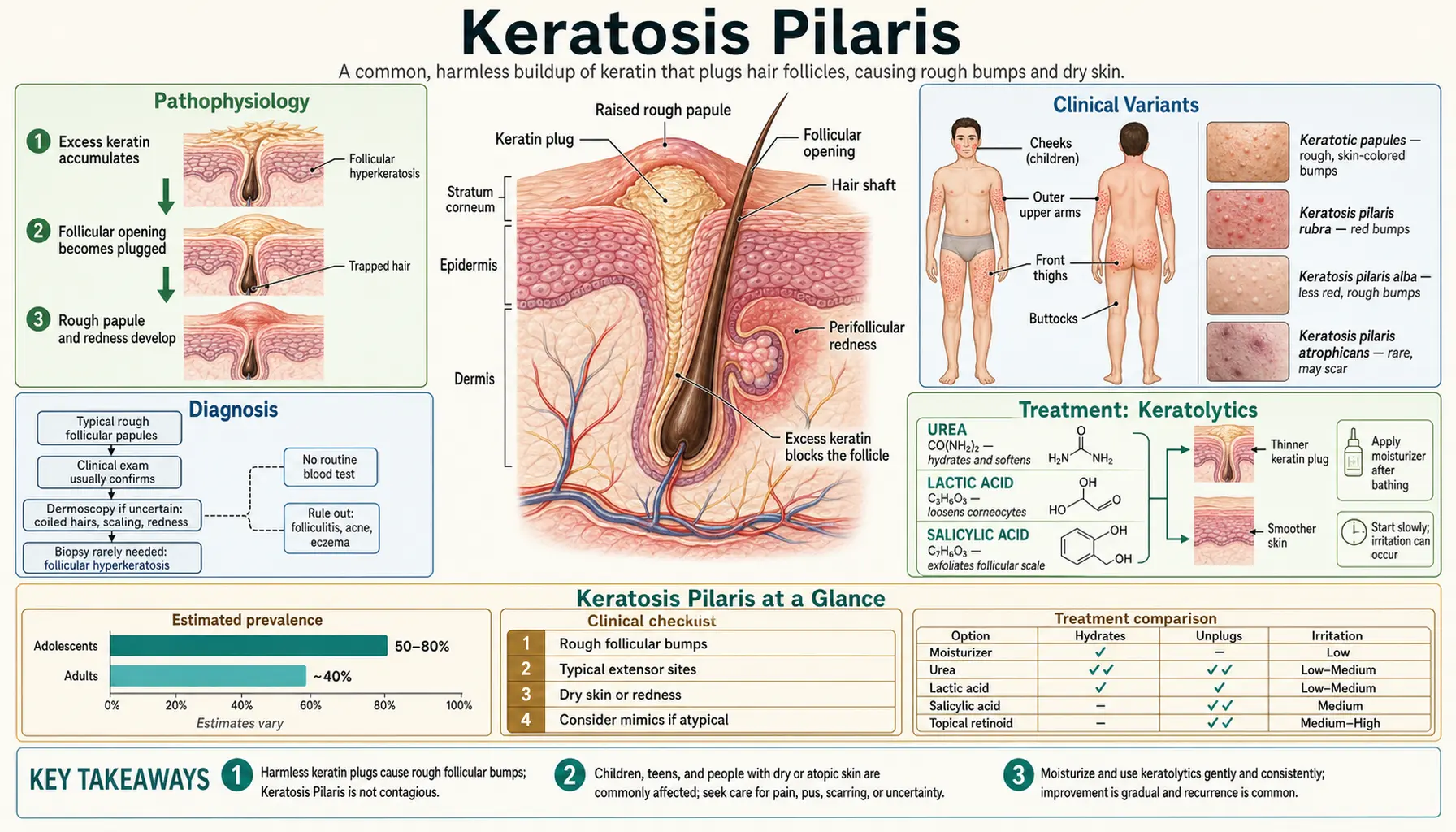
Keratosis pilaris (KP) is an extremely common, benign genetic skin condition affecting 50–80% of adolescents and 40% of adults worldwide — caused by abnormal cornification of hair follicles that produces the characteristic rough, sandpaper-like bumps most often found on the upper arms, thighs, and buttocks.
Table of Contents
- Pathophysiology
- Clinical Variants
- Diagnosis
- Treatment: Keratolytics
- Treatment: Topical Retinoids
- Treatments for Erythema
- Special Populations and Natural History
- Prognosis and Patient Counseling
- Key Research Papers
- PubMed Searches
- Connections
- Featured Videos
1. Pathophysiology
Keratosis pilaris arises from a defect in the normal process of follicular cornification — the orderly shedding of dead skin cells from hair follicle openings. At the molecular level, the condition is strongly linked to loss-of-function variants in the filaggrin gene (FLG), the same gene implicated in atopic dermatitis and ichthyosis vulgaris.
Filaggrin and the Skin Barrier
Filaggrin is synthesized as a large precursor protein called profilaggrin, stored in keratohyalin granules of the stratum granulosum. During terminal keratinocyte differentiation, profilaggrin is cleaved into individual filaggrin monomers that cross-link keratin filaments into tight bundles within corneocytes — giving the stratum corneum its structural integrity and mechanical resilience. Filaggrin is then further degraded into small hygroscopic amino acids and their derivatives (urocanic acid, pyrrolidone carboxylic acid) that collectively constitute the natural moisturizing factor (NMF), which retains water within the cornified layer and maintains skin surface pH.
When FLG is mutated or underexpressed, three downstream problems emerge:
- Barrier defect: Cornified cells fail to pack tightly, creating microscopic gaps that allow water to escape (transepidermal water loss, TEWL) and allergens, irritants, and microbes to penetrate.
- Reduced NMF: Less filaggrin means fewer hygroscopic breakdown products, resulting in a drier, more brittle stratum corneum — explaining why KP worsens in low-humidity environments.
- Microbiome dysbiosis: A compromised barrier and altered pH shift the skin microbiome toward pro-inflammatory species, amplifying perifollicular inflammation.
Follicular Plugging Mechanism
The characteristic bumps of KP are follicular keratinous plugs formed within the infundibulum (upper segment) of vellus hair follicles. Excess keratin accumulates at the follicular ostium, trapping the fine vellus hair within a compact plug. The trapped hair may coil beneath the surface or perforate the follicular wall, triggering a perifollicular inflammatory response. This inflammation generates the surrounding erythema — an important distinction from infectious folliculitis: KP inflammation is sterile, not caused by bacterial or fungal invasion.
Genetics
KP follows an autosomal dominant inheritance pattern with incomplete penetrance, meaning a single mutant FLG allele is sufficient to cause the condition but not everyone who carries the variant will express it clinically. Concordance studies in twins show high heritability. Many patients have a parent who recalls similar "chicken skin" on their own arms, though it may have improved by adulthood. The strong genetic overlap with atopic dermatitis and ichthyosis vulgaris means these three conditions frequently coexist — a patient presenting with KP should be screened for eczema and evaluated for ichthyosis features.
Biopsy Findings
Skin biopsy is rarely needed for diagnosis but is occasionally performed when the presentation is atypical. Histology shows dilated follicular ostia occluded by compact lamellar keratinous plugs, sometimes containing a coiled vellus hair. Mild perifollicular lymphocytic infiltrate is present in erythematous variants. The sebaceous glands and dermis are otherwise unremarkable.
2. Clinical Variants
KP encompasses a spectrum of clinical presentations that share the same underlying follicular plugging mechanism but differ in location, degree of inflammation, and risk of scarring.
Keratosis Pilaris Rubra
The most visually striking variant, KP rubra features pronounced perifollicular erythema — a red halo surrounding each follicular plug — giving the skin a diffusely flushed, inflamed appearance. It most commonly involves the cheeks (particularly in children), upper outer arms, and anterior thighs. The erythema can persist even when the follicular plugs themselves are reduced with treatment, making this variant the most frustrating to manage cosmetically.
KP Alba
In KP alba, erythema is minimal or absent. The follicular papules are skin-colored or slightly whitish, reflecting predominantly keratinous scale with little inflammatory component. This variant is the most prevalent form in adults and is more amenable to keratolytic treatment alone.
KP Atrophicans Faciei (Ulerythema Ophryogenes)
This rare, scarring variant affects the lateral eyebrows and adjacent cheeks, causing erythema, follicular plugging, and progressive scarring alopecia of the outer third of the eyebrows. The eyebrow loss can be permanent. It is associated with systemic syndromes — particularly Noonan syndrome and cardio-facio-cutaneous (CFC) syndrome, both involving RAS-MAPK pathway mutations. Any child presenting with ulerythema ophryogenes should be evaluated for these syndromes.
Atrophoderma Vermiculata
An exceptionally rare variant producing a reticulated, pitted, "worm-eaten" texture on the cheeks due to atrophic follicular scarring. It typically manifests in mid-childhood and progresses through adolescence. Unlike ordinary KP, the scarring is largely irreversible, and treatment is primarily aimed at halting progression rather than restoration.
KP with Ichthyosis
In patients carrying two loss-of-function FLG alleles (compound heterozygotes or homozygotes), KP commonly co-presents with ichthyosis vulgaris — fine white scaling on the trunk and limbs resembling fish scales — and atopic dermatitis. This triad (ichthyosis vulgaris + KP + atopic dermatitis) is recognized as a distinct clinical phenotype with a more severe barrier defect and higher inflammatory burden.
Distribution Rules
Regardless of variant, KP has characteristic predilection sites: the posterior upper arms are the most common location in all age groups, followed by the anterior thighs, buttocks, and (in children) cheeks. The face involvement decreases as children age. KP never involves the palms or soles — follicular plugging on plantar surfaces suggests an alternative diagnosis.
Seasonal Variation
KP follows a predictable seasonal pattern: worsening in winter and dry climates (low humidity drives TEWL and disrupts the barrier) and improving in summer (higher ambient humidity, increased sun exposure — UV may have a mild immunomodulatory effect on perifollicular inflammation). Patients who relocate to humid climates often report dramatic improvement.
3. Diagnosis
KP is a clinical diagnosis made at the bedside based on the characteristic appearance and distribution of lesions. Laboratory studies and biopsy are not required in typical presentations.
Clinical Features
The classic presentation is multiple discrete, rough, follicular papules 1–2 mm in diameter distributed symmetrically over the posterior upper arms or anterior thighs. Individual papules may be skin-colored, white, or surrounded by erythematous halos. Running a fingertip over affected skin produces a sandpaper-like sensation. Pruritus is variable — mild in most patients, absent in many, occasionally bothersome in inflamed variants. There is no vesiculation, exudate, or crusting in uncomplicated KP.
Biopsy (When Needed)
Punch biopsy to 4 mm depth is occasionally performed when the diagnosis is uncertain. Histological findings: dilated follicular ostia with compact lamellar keratinous plugs; mild perifollicular lymphocytic infiltrate; no significant dermal inflammation or vascular changes; sebaceous glands normal. A trapped coiled vellus hair within the plug is a specific histological sign.
Differential Diagnosis
- Milia: Deeper, pearly-white, subepidermal cysts containing keratin; found on the face around eyes; no follicular association; firm on palpation; distinct histology (epidermal-lined cysts).
- Acne vulgaris: Involves open/closed comedones and inflammatory lesions (papules, pustules, nodules) within sebaceous follicles predominantly on the face, chest, and back; not follicular vellus-hair-unit based; sebum production is a key driver.
- Lichen planopilaris: Violaceous, pruritic, scarring follicular condition; leads to permanent alopecia on scalp; skin lesions have wickham striae; autoimmune etiology.
- Phrynoderma (vitamin A deficiency): Follicular hyperkeratosis with similar-looking plugs, but occurs in the context of nutritional deficiency (rare in high-income countries); systemic features of vitamin A deficiency present (night blindness, xerophthalmia).
- Folliculitis (bacterial/fungal): Pustular and tender; lesions are inflammatory papulopustules rather than firm keratinous plugs; culture may be positive for Staphylococcus aureus, Pseudomonas (hot tub folliculitis), or Malassezia (pityrosporum folliculitis).
- Pityriasis rubra pilaris (PRP): Orange-red follicular papules coalescing into plaques with islands of normal skin; hallmark waxy palmoplantar keratoderma; salmon-colored face; nail changes; distinguished by involvement of palms/soles (never in KP).
- Eruptive vellus hair cysts: Asymptomatic skin-colored to brown follicular papules on the chest and abdomen of children and young adults; contain multiple vellus hairs on histology; may resolve spontaneously.
4. Treatment: Keratolytics
There is no cure for KP. Treatment aims to soften and dissolve follicular plugs, reduce perifollicular inflammation, and restore the skin barrier. Management is chronic — consistent daily care is required to maintain results, and discontinuing treatment leads to recurrence within weeks.
Moisturization and Gentle Cleansing (Cornerstone)
The foundation of KP management is restoring the compromised skin barrier through consistent moisturization. Ceramide-containing emollients are preferred because ceramides are the predominant lipid in the lamellar bodies that seal the intercorneocyte spaces — precisely the structural element deficient in FLG-mutant skin. Products such as CeraVe Moisturizing Cream, Cetaphil RestoraDerm, and Vanicream Moisturizing Cream provide ceramides without fragrance, dyes, or comedogenic ingredients.
Practical moisturization rules: apply within 3 minutes of bathing ("soak and seal" technique) to trap transepidermal moisture; use lukewarm — not hot — water (hot water strips lipids and worsens barrier defect); choose fragrance-free, soap-free cleansers; avoid loofah scrubbing (micro-abrasion worsens perifollicular inflammation); apply moisturizer at least twice daily.
Alpha-Hydroxy Acids (AHAs)
Ammonium lactate 12% lotion (AmLactin, Lac-Hydrin) is widely considered first-line pharmacological therapy for KP. Lactic acid is an AHA that loosens the corneodesmosomes holding corneocytes together, allowing the keratinous plug to shed more readily. It also acts as a humectant, drawing water into the stratum corneum. Applied once or twice daily, ammonium lactate typically produces noticeable smoothing within 4–8 weeks. Mild stinging on broken skin is expected and usually diminishes with continued use.
Glycolic acid at 6–12% concentration is an alternative AHA available in lotions, creams, and chemical peels. It has smaller molecular weight than lactic acid and penetrates the follicular infundibulum more readily, which may make it more effective for stubborn cases. Both AHAs should be avoided near the eyes and on open skin.
Urea
Urea is both a keratolytic and a humectant — at lower concentrations (10–20%) it primarily acts as a humectant, while at higher concentrations (20–40%) it disrupts the hydrogen bonds holding keratin fibers together, dissolving plugs. Urea 20–40% cream (Eucerin UreaRepair, Carmol 40) is particularly effective for thick, stubborn KP plaques and may be used in combination with lactic acid. It can sting on excoriated or eroded skin. Urea-containing products should be used with caution in children and avoided on the face.
Salicylic Acid
Salicylic acid 2–6% in wash or lotion formulations exploits its lipophilicity to penetrate the lipid-rich follicular canal — making it uniquely "folliculotropic" compared to water-soluble AHAs. It disrupts corneocyte cohesion within the plug and has mild anti-inflammatory properties. Salicylic acid washes (e.g., 2% in a body wash) are convenient for large body-surface-area involvement. Avoid in children under 2 years old — systemic salicylate absorption through compromised skin can cause salicylism (tinnitus, metabolic acidosis).
5. Treatment: Topical Retinoids
Topical retinoids address the root cause of KP by normalizing follicular keratinization at the molecular level — reducing the excess keratin production in the infundibulum that forms the plug in the first place. They are particularly useful for patients who respond inadequately to keratolytics alone or who have the KP rubra variant with prominent erythema.
Tretinoin
Tretinoin 0.025–0.05% cream is the most studied retinoid for KP. It binds retinoic acid receptors (RARs) in keratinocytes, downregulating genes responsible for excess keratin production and normalizing the differentiation program of follicular epithelium. This prevents new plug formation while lactic acid or urea dissolves existing plugs — making combination therapy more effective than either alone.
Initiation protocol: apply a pea-sized amount to affected areas on alternate evenings for the first 2 weeks, then advance to every evening as tolerated. The retinoid dermatitis (dryness, flaking, erythema) is expected during the first 4–6 weeks and diminishes as skin adapts. Patients should apply moisturizer 20–30 minutes after tretinoin or use the "sandwich technique" (moisturizer → tretinoin → moisturizer). Tretinoin is absolutely contraindicated in pregnancy (teratogenic) — all patients of reproductive potential require counseling.
Tazarotene
Tazarotene (0.05–0.1% cream or gel) is a more potent, receptor-selective retinoid that may be more effective for thick, hyperkeratotic KP plaques but carries a higher risk of retinoid dermatitis. It is typically reserved for patients who have tolerated tretinoin without adequate response. Like tretinoin, it is teratogenic.
Adapalene
Adapalene 0.1% gel (Differin, now OTC in the US) is the best-tolerated retinoid option, with lower receptor-binding affinity and less irritant potential than tretinoin or tazarotene. It is an excellent starting point for patients with sensitive skin or for adolescents who are new to retinoid therapy. Initiation: apply 3 times per week, increasing to nightly as tolerated over 4–6 weeks. OTC availability makes it accessible without a prescription, though patients should be counseled that improvement takes 8–12 weeks of consistent use.
Combination Strategy
The most effective regimen for moderate-to-severe KP combines moisturization with a morning keratolytic and an evening retinoid:
- Morning: Gentle soap-free cleanser → ceramide moisturizer → ammonium lactate 12% lotion or glycolic acid cream
- Evening: Lukewarm shower → pat dry → ceramide moisturizer (wait 20 min) → adapalene or tretinoin cream to affected areas
This approach addresses both plug dissolution (AHA/urea) and prevention of new plug formation (retinoid) while supporting barrier repair (ceramides). Patients should be counseled that maintenance is indefinite — this is a management strategy, not a cure.
6. Treatments for Erythema
The perifollicular erythema of KP rubra is the component most distressing to patients — particularly on visible areas like cheeks and upper arms — and is also the hardest to treat. Keratolytics can smooth the skin texture but often leave persistent redness, requiring targeted vascular or anti-inflammatory therapy.
Vascular Laser and Light Therapies
The pulsed dye laser (PDL) operating at 585 nm or 595 nm targets oxyhemoglobin in the dilated perifollicular capillaries without damaging surrounding tissue (selective photothermolysis). Treatment sessions typically involve multiple passes with a 10 mm spot and standard fluences; no anesthesia is required for most patients though a cooling spray is applied. Erythema reduction is visible after 2–3 sessions, with full benefit at 4–6 sessions spaced 4–6 weeks apart. Effects can be durable (months to years) but are not permanent.
Intense pulsed light (IPL) uses a broad-spectrum filtered light source (typically 560–1200 nm) to achieve similar vascular targeting with a larger treatment footprint — useful for extensive involvement of the upper arms or thighs. Efficacy for erythema is comparable to PDL, though individual response varies. Fractional laser (non-ablative 1550 nm or ablative CO2) can be combined with PDL in the same session to address both erythema and surface texture simultaneously — an approach gaining traction in published case series.
Topical Anti-Inflammatory Agents
Azelaic acid 10–20% (Finacea, Skinoren) has a dual mechanism relevant to KP: it normalizes aberrant keratinization in the follicular epithelium and exerts direct anti-inflammatory effects by inhibiting reactive oxygen species in neutrophils. At 15–20% concentration it provides meaningful erythema reduction over 8–12 weeks of twice-daily application. It is well tolerated, non-teratogenic (safe in pregnancy), and can be combined with lactic acid or a retinoid.
Low-potency topical corticosteroids (e.g., hydrocortisone 1% or desonide 0.05%) may transiently reduce perifollicular erythema during acute flares, but are not appropriate for maintenance use: prolonged application causes skin atrophy, telangiectasia, and tachyphylaxis. They should be limited to a 1–2 week course on acutely inflamed areas and not applied to the face of children.
Calcineurin Inhibitors
Tacrolimus 0.1% ointment and pimecrolimus 1% cream are off-label options for the inflammatory component of KP rubra, particularly on facial lesions (cheeks in children) where the atrophy risk of topical corticosteroids is especially unwanted. They suppress T-lymphocyte-mediated perifollicular inflammation without causing skin atrophy or tachyphylaxis — making them suitable for longer-term use on sensitive areas. The FDA black-box warning (theoretical malignancy risk with prolonged use) should be discussed with patients and caregivers, though the clinical evidence for an actual risk remains limited.
7. Special Populations and Natural History
Infants and Young Children
KP is common in infancy, presenting most notably on the cheeks as rough, red papules that alarm parents who fear acne or a rash. The cheek involvement in toddlers can be striking but is entirely benign and typically improves through childhood without treatment. First-line management in this age group is limited to gentle soap-free cleansing with fragrance-free wash and twice-daily ceramide moisturizer. Salicylic acid is contraindicated under 2 years; retinoids are avoided under 12 years; urea should be used cautiously. Parental reassurance is as important as any topical therapy.
Adolescents
Prevalence peaks during adolescence (up to 80%), coinciding with hormonal changes that increase keratinocyte proliferation and sebum production. For teenagers, KP carries a disproportionate psychosocial burden: self-consciousness about wearing short sleeves or shorts, avoidance of swimming pools or beach activities, and social comparison amplified by social media. Adolescents are also the demographic most likely to have encountered viral misinformation about KP "cures" — dietary changes, supplements, and home remedies that lack clinical evidence. Realistic counseling that KP is a chronic genetic condition managed (not cured) by consistent skincare is essential. Adapalene 0.1% OTC is an appropriate first prescription-strength option for teenagers who want to pursue treatment beyond moisturizer.
Pregnancy
KP may flare during pregnancy due to hormonal influences on keratinocyte turnover. Management options are limited by safety constraints: tretinoin, tazarotene, and all systemic retinoids are absolutely contraindicated. Lactic acid 12% and ceramide moisturizers are considered safe for topical use in pregnancy. Urea has limited safety data in pregnancy and should be used conservatively and not on large body surface areas. Azelaic acid is Pregnancy Category B (animal studies show no harm; no adequate human trials) and is generally considered acceptable. Topical calcineurin inhibitors are Pregnancy Category C — use only when benefit clearly outweighs risk.
Adults
Approximately 40% of adults carry KP, though prevalence declines with age as barrier function evolves. Many adults self-manage with over-the-counter lactic acid lotions without ever seeking medical advice. Those who present to a dermatologist are often motivated by cosmetic concerns about the erythematous variant or frustrated by years of failed home remedies. Adult patients may respond better to vascular laser for erythema than younger patients, as cumulative sun exposure provides some background photodamage that laser treatment can address simultaneously.
8. Prognosis and Patient Counseling
Natural Course
KP is a benign, non-contagious condition with no risk of malignant transformation, systemic complications, or spread beyond the characteristic distribution. The natural history is one of slow improvement with age: approximately 70% of patients experience meaningful reduction in severity by adulthood, and many report near-complete resolution by their 30s. However, "improvement by adulthood" is not the same as resolution — a subset of patients retain KP throughout their adult life, and environmental factors (dry climates, harsh soaps, stress) can trigger recurrences even in those who had previously improved.
Environmental Modifiers
Patients benefit from understanding the environmental factors they can control:
- Climate and humidity: Dry winter air and low-humidity climates (arid regions, heated indoor air) reliably worsen KP. A humidifier in the bedroom during winter months can produce noticeable improvement. Air travel (very low cabin humidity) often triggers visible flares.
- Swimming pools: Chlorinated water is both a barrier irritant and a desiccant. Patients should shower immediately after pool use and apply moisturizer promptly.
- Hot showers and baths: Hot water dissolves the surface lipid film and disrupts barrier function. Switching to lukewarm showers is one of the most impactful low-cost interventions.
- Friction and tight clothing: Repeated friction from tight fabrics (jeans on affected thighs, sleeve hems on upper arms) can worsen perifollicular inflammation. Loose, breathable clothing during flares is advisable.
Managing Patient Expectations
Patient satisfaction hinges on realistic expectations, which require honest counseling at the first visit:
- There is no cure for KP — the genetic basis cannot be altered by any current therapy.
- Improvement with treatment takes weeks (4–8 weeks for keratolytics; 8–12 weeks for retinoids; 3–6 months for full benefit of laser).
- Stopping treatment leads to regression within weeks to months — maintenance is indefinite.
- The texture (follicular plugs) responds better to treatment than the redness (erythema), which often requires laser therapy for significant improvement.
- Social media "cures" — oil cleansing, dietary changes, apple cider vinegar — lack clinical evidence; some (undiluted acids, aggressive physical scrubbing) actively worsen KP by disrupting the barrier.
Overlapping Conditions
Approximately 40% of KP patients have concurrent atopic dermatitis, driven by the same FLG barrier defect. When eczema is present, KP management must be integrated into a broader atopic skin regimen — this often means prioritizing barrier repair and avoiding topical retinoids on actively inflamed eczematous patches. Severe, early-onset KP (especially with cheek involvement and associated eczema) in young children should prompt investigation for food allergies, particularly egg and peanut, which can drive barrier inflammation. Contact dermatitis can complicate KP when patients experiment aggressively with multiple keratolytic products simultaneously — patch testing may be warranted in patients who worsen despite a seemingly logical regimen.
9. Key Research Papers
- Gruber R, et al. "Filaggrin genotype and skin barrier function in keratosis pilaris." J Invest Dermatol. 2011;131(5):1152–1158. — Search PubMed
- Brown SJ, McLean WH. "One remarkable molecule: filaggrin." J Invest Dermatol. 2012;132(3 Pt 2):751–762. PMID 22158554
- Mevorah B, et al. "The prevalence of accentuated palmoplantar markings and keratosis pilaris in atopic dermatitis, autosomal dominant ichthyosis and control dermatological patients." Br J Dermatol. 1985;112(6):679–685. — Search PubMed
- Zhu T, et al. "Treatment of keratosis pilaris: A systematic review." J Cosmet Dermatol. 2022;21(6):2286–2293. — Search PubMed
- Chamlin SL, et al. "Ceramide-dominant barrier repair lipids alleviate childhood atopic dermatitis: changes in barrier function provide a sensitive indicator of disease activity." J Am Acad Dermatol. 2002;47(2):198–208. PMID 12140467
- Smith SR, et al. "Use of 585-nm pulsed dye laser in the treatment of keratosis pilaris rubra." Dermatol Surg. 2008;34(4):506–508. — Search PubMed
- Kuster W, Wilms B. "Keratosis pilaris in the family practice." Arch Dermatol Res. 2005. PubMed Search
- Hwang S, Schwartz RA. "Keratosis pilaris: A common follicular hyperkeratosis." Cutis. 2008;82(3):177–180. PMID 18856156
- Castela E, et al. "Effects of topical steroids on epithelial permeability barrier in neonates." Pediatr Dermatol. 2014;31(1):24–29. — Search PubMed
- Pennington BE, et al. "Urea for keratolysis." J Dermatolog Treat. 2010;21(1):2–5. PubMed Search
- Inamadar AC, Palit A. "Keratosis pilaris: A clinical review." Indian J Dermatol Venereol Leprol. 2003;69(2):101–103. — Search PubMed
- Sator PG, et al. "Comparison of laser treatments for acne scars and keratosis pilaris." J Eur Acad Dermatol Venereol. 2008;22(3):300–303. — Search PubMed
10. PubMed Searches
- Keratosis pilaris treatment
- Keratosis pilaris and filaggrin
- Keratosis pilaris retinoid therapy
- Keratolytic treatment keratosis pilaris
- Pulsed dye laser keratosis pilaris
11. Connections
- Dermatology
- Eczema (Atopic Dermatitis)
- Contact Dermatitis
- Folliculitis
- Psoriasis
- Acne
- Rosacea
- Seborrheic Dermatitis
- Vitamin A (retinoids connection)
- Impetigo