Strep Diagnosis: Rapid Antigen Tests and Throat Culture
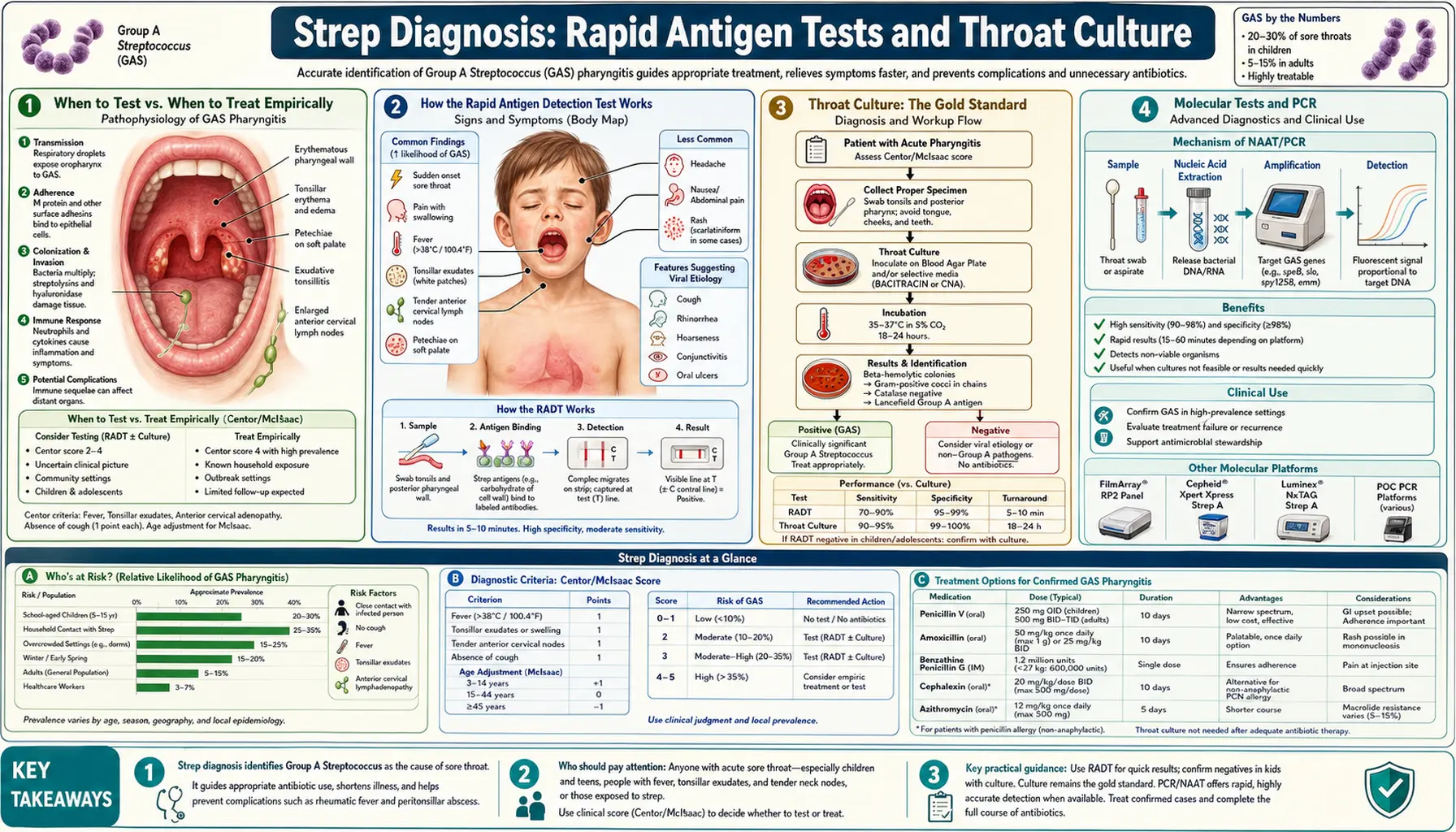
A sore throat can be caused by group A Streptococcus (GAS, Streptococcus pyogenes) or, far more often, by a virus. This page sets out what guidelines and diagnostic studies report about clinical scores, rapid antigen tests, throat culture, molecular tests, antibody tests and testing for invasive disease. The 2012 Infectious Diseases Society of America (IDSA) guideline states that inappropriate antimicrobial use for upper respiratory tract infections, including acute pharyngitis, has been a major contributor to antimicrobial resistance, and that treatment of GAS pharyngitis within 9 days of the onset of illness is effective in preventing acute rheumatic fever (PubMed PMID: 22965026).
- When Guidelines Call for Testing
- How the Rapid Antigen Detection Test Works
- Throat Culture: The Gold Standard
- Molecular Tests and PCR
- ASO Titer and Anti-DNase B
- Testing for Invasive Disease
- When Testing Is Not Recommended
- Interpreting Results with Clinical Context
- Key Research Papers
- Connections
When Guidelines Call for Testing
The CDC states that viruses are the most common cause of pharyngitis in all age groups, that clinicians can diagnose viral pharyngitis from the history and examination when clear viral symptoms are present, and that the examination cannot tell viral from group A strep pharyngitis when those symptoms are absent (CDC: Clinical guidance for strep throat). The IDSA guideline recommends swabbing the throat and testing for GAS by rapid antigen detection test (RADT) and/or culture, because clinical features alone do not reliably discriminate between GAS and viral pharyngitis except when overt viral features such as rhinorrhea, cough, oral ulcers and/or hoarseness are present (PubMed PMID: 22965026).
Clinical scores estimate how likely GAS is before a test is done. The Centor score comes from a 1981 study of adults with a sore throat in an urban emergency room, in which four findings predicted a positive culture (PubMed PMID: 6763125):
- Tonsillar exudates
- Swollen, tender anterior cervical nodes
- Lack of a cough
- History of fever
In that study, patients with all 4 findings had a 56% probability of a positive culture; with 3, 32%; with 2, 15%; with 1, 6.5%; and with none, 2.5% (PubMed PMID: 6763125).
McIsaac’s 1998 study of 521 patients aged 3 to 76 years at a Toronto family medicine centre developed an age-appropriate score ranging from 0 to 4. Its sensitivity for GAS was 83.1%, compared with 69.4% for usual physician care (p = 0.06), and among patients aged 3 to 14 it was 96.9% versus 70.6%. Following the score’s recommendations would have reduced initial antibiotic prescriptions by 48% compared with observed prescribing, without any increase in throat culture use (PubMed PMID: 9475915).
A 2012 validation study of 206,870 patients aged 3 years or older seen at a US retail health chain found that, among patients 15 or older, 7% with a Centor score of 0 tested positive for GAS, 12% with 1, 21% with 2, 38% with 3 and 57% with 4; by McIsaac score (all patients 3 or older) the shares were 8%, 14%, 23%, 37% and 55% for scores 0 to 4 (PubMed PMID: 22566485).
How guidelines use the scores differs:
- The 2012 European (ESCMID) guideline states that in patients with 3–4 Centor criteria physicians can consider a rapid antigen test, and that antibiotics should not be used to relieve symptoms in patients with 0–2 Centor criteria (PubMed PMID: 22432746).
- The IDSA guideline states that many studies have shown clinical scoring systems can be useful in predicting the likelihood of streptococcal infection, but that laboratory confirmation is essential for a precise diagnosis because physicians often greatly overestimate the probability that GAS is the cause (PubMed PMID: 22965026).
- For adults, the IDSA guideline notes that a clinical algorithm without microbiological confirmation has been suggested as an acceptable alternative, and states that this strategy would result in treatment of an unacceptably large number of adults with nonstreptococcal pharyngitis (PubMed PMID: 22965026).
- A 2009 primary care review describes the modified Centor score as a way to help decide which patients need no testing, throat culture or RADT, or empiric antibiotic therapy (PubMed PMID: 19275067).
How the Rapid Antigen Detection Test Works
An RADT detects GAS directly from a throat swab. The 2016 Cochrane review describes RADTs as offering diagnosis at the point of care within five to 10 minutes, compared with throat culture (PubMed PMID: 27374000), and the IDSA guideline describes the main disadvantage of throat culture as the delay (overnight or longer) in obtaining results (PubMed PMID: 22965026).
The IDSA guideline describes the test types: the first RADTs used latex agglutination methods, were relatively insensitive and had unclear end points; newer tests based on enzyme immunoassay offer increased sensitivity and a more sharply defined end point; and RADTs are not all equal in their performance characteristics (PubMed PMID: 22965026). The Cochrane review found the sensitivity of enzyme immunoassay and optical immunoassay tests comparable (85.4% versus 86.2%) (PubMed PMID: 27374000).
Reported accuracy against throat culture:
- IDSA guideline: currently available RADTs are highly specific (approximately 95%), false-positive results are highly unusual, and the sensitivity of most tests is 70%–90% (PubMed PMID: 22965026). A 2004 review gives the same ranges (specificity 95% or greater, sensitivity between 70% and 90%) (PubMed PMID: 15258094).
- 2016 Cochrane review (98 studies in children): summary sensitivity 85.6% (95% CI 83.3–87.6) and summary specificity 95.4% (95% CI 94.5–96.2), with substantial heterogeneity in sensitivity across studies. The authors expected that of 100 children with strep throat, 86 would be detected by the rapid test and 14 missed (PubMed PMID: 27374000).
- 2014 meta-analysis (48 studies): overall summary sensitivity 0.86 and specificity 0.96, with similar estimates for pediatric data (PubMed PMID: 25201792).
The IDSA guideline also describes spectrum bias: the sensitivities of RADTs and throat culture are greater when the pretest probability of GAS pharyngitis is greater (PubMed PMID: 22965026). Its description of swab collection (from the surface of the tonsils or tonsillar fossae and the posterior pharyngeal wall) is given in the throat culture section below (PubMed PMID: 22965026).
Throat Culture: The Gold Standard
The CDC describes throat culture as the gold standard diagnostic test (CDC: Clinical guidance for strep throat). The IDSA guideline states that culture of a throat swab on a sheep-blood agar plate has been the standard, and that if performed correctly, culture of a single throat swab on a blood agar plate is 90%–95% sensitive for detection of GAS pharyngitis (PubMed PMID: 22965026).
Swab collection: the IDSA guideline states that the manner in which the swab is obtained has an important impact on the yield of streptococci; specimens are obtained from the surface of either tonsils (or tonsillar fossae) and the posterior pharyngeal wall, and other areas of the oral pharynx and mouth are not acceptable sites. It adds that a swab from an uncooperative child whose neck is not immobilized may be neither adequate nor representative, and that false-negative results may occur if an antibiotic was taken shortly before the swab (PubMed PMID: 22965026).
Timing: the guideline describes incubating a plated culture at 35°C–37°C for 18–24 hours before reading, and re-examining at 48 hours plates that are negative at 24 hours. It states that the number of GAS colonies on the plate overlaps too much between acute infection and carriage to tell them apart on that basis alone (PubMed PMID: 22965026).
Back-up culture after a negative RADT:
- Children and adolescents: the IDSA guideline recommends that a negative RADT be backed up by a throat culture, because RADT sensitivities are below 90% in most studied populations of children and adolescents and GAS causes 20%–30% of their acute pharyngitis (PubMed PMID: 22965026). The CDC likewise lists a throat culture after a negative RADT for children older than 3 years (CDC: Clinical guidance for strep throat).
- Adults: the IDSA guideline states that routine back-up cultures are not necessary for adults in usual circumstances, because of the low incidence of GAS pharyngitis in adults and the generally exceptionally low risk of subsequent acute rheumatic fever; it adds that physicians who wish to ensure maximal sensitivity may continue to use conventional throat culture or to back up negative RADTs with a culture (PubMed PMID: 22965026). The CDC states that a throat culture after a negative RADT is not routinely indicated outside the pediatric group above (CDC: Clinical guidance for strep throat).
- Other guidance: the ESCMID guideline states that if a rapid antigen test is performed, throat culture is not necessary after a negative result (PubMed PMID: 22432746), and the 2014 meta-analysis concluded that RADTs may not require culture backup for negative tests in most low-incidence rheumatic fever settings (PubMed PMID: 25201792).
Positive RADTs do not need a back-up culture because they are highly specific, according to the IDSA guideline (PubMed PMID: 22965026).
Molecular Tests and PCR
Nucleic acid amplification tests (NAATs), including PCR-based tests, detect GAS genetic material rather than an antigen. The CDC’s scarlet fever guidance lists a positive RADT, NAAT or throat culture as confirmation of scarlet fever (CDC: Clinical guidance for scarlet fever).
Reported accuracy: a 2021 meta-analysis of 38 studies (17,411 test results) of rapid nucleic acid tests, most often performed in a laboratory, found a summary sensitivity of 97.5% (95% CI 96.2–98.3) and a summary specificity of 95.1% (95% CI 93.6–96.3) against throat culture. In 13 studies that compared the two directly, the nucleic acid tests were more sensitive than RADTs (96.8% versus 82.3%), with no difference in specificity. The authors concluded that the tests’ accuracy may allow their use as stand-alone tests, and that further studies should evaluate them in point-of-care settings (PubMed PMID: 33964409).
The 2014 meta-analysis found that molecular-based tests had the best diagnostic accuracy, and described them as having the highest sensitivity but not being true point-of-care tests (PubMed PMID: 25201792).
The IDSA guideline’s point about carriers (below) was written about culture and RADTs: neither accurately differentiates acutely infected people from asymptomatic carriers with an intercurrent viral pharyngitis (PubMed PMID: 22965026).
ASO Titer and Anti-DNase B
Anti-streptolysin O (ASO) and anti-DNase B are blood tests for antibodies made after a GAS infection. The IDSA guideline states that measuring anti-streptococcal antibody titers is often useful for diagnosing the nonsuppurative sequelae of GAS pharyngitis, such as acute rheumatic fever and acute glomerulonephritis, and does not recommend them in the routine diagnosis of acute pharyngitis because they reflect past rather than current events (PubMed PMID: 22965026).
Timing: the IDSA guideline states that ASO and anti-DNase B titers may not reach maximum levels until 3–8 weeks after acute GAS pharyngeal infection and may remain elevated for months even without active infection (PubMed PMID: 22965026). The CDC states that streptococcal pharyngitis or skin infection typically precedes the onset of acute rheumatic fever by 1 to 5 weeks (CDC: Clinical guidance for acute rheumatic fever), and that post-streptococcal glomerulonephritis (PSGN) follows GAS pharyngitis after a latent period of approximately 10 days and skin infections by up to 3 weeks (CDC: Clinical guidance for post-streptococcal glomerulonephritis).
How the tests are used:
- The CDC states that there is no definitive diagnostic test for acute rheumatic fever; the Jones criteria and supplemental testing are used (CDC: Clinical guidance for acute rheumatic fever).
- For PSGN, the CDC lists isolation of GAS from the throat or from skin lesions, or elevated streptococcal antibodies, as evidence of a preceding infection, with low total hemolytic complement and C3 among the laboratory findings (CDC: Clinical guidance for post-streptococcal glomerulonephritis).
Throat versus skin infection: a 2022 New Zealand study of 887 children found that children with GAS-positive sore throat had the highest mean ASO titres and children with GAS-positive skin infection had the highest mean anti-DNase B titres. Using a two-fold rise or upper-limit-of-normal cut-offs of ASO 450 IU/ml and anti-DNase B 400 U/ml, 62.1% of children with GAS-positive sore throat had serologically confirmed GAS pharyngitis and 37.9% had GAS detected without a serological response. Healthy Māori and Pacific children had higher titres than healthy European/Other children (PubMed PMID: 34710392).
Reference ranges vary by laboratory and population; the cut-offs above are the ones that study used.
Testing for Invasive Disease
Invasive GAS disease includes streptococcal toxic shock syndrome (STSS) and necrotizing fasciitis. The CDC states that STSS is diagnosed using the Council of State and Territorial Epidemiologists 2010 case definition, which requires hypotension and multi-organ involvement as well as isolation of group A strep bacteria; it notes that the differential diagnosis early in STSS is broad and that patients are often misdiagnosed (CDC: Clinical guidance for streptococcal toxic shock syndrome).
For necrotizing fasciitis, the CDC’s clinical guidance states (CDC: Clinical guidance for necrotizing fasciitis):
- CT or MRI can detect subcutaneous and fascial edema or tissue gas, and imaging may be helpful but should never delay surgical exploration.
- Prompt surgical exploration, Gram stain and culture are to be obtained expeditiously; a Gram stain can be highly informative about whether GAS is the cause.
- Leukocytosis, thrombocytopenia, elevated creatine phosphokinase and azotemia are common laboratory results.
A 2019 meta-analysis of 23 studies (5,982 patients) of adults with a soft tissue infection concerning for necrotizing soft tissue infection found that CT had a sensitivity of 88.5% and specificity of 93.3%, and plain radiography 48.9% and 94.0%. Fever had a pooled sensitivity of 46.0% and hypotension 21.0%, and a Laboratory Risk Indicator for Necrotizing Fasciitis (LRINEC) score of 6 or more had a sensitivity of 68.2% and specificity of 84.8%. The authors concluded that the absence of any one examination feature is not sufficient to rule the infection out, that LRINEC should not be used to rule it out, and that high clinical suspicion warrants early surgical consultation (PubMed PMID: 29672405).
On treatment, the CDC describes penicillin and clindamycin used together as first-line antibiotics for STSS, along with fluid resuscitation and removal of the source of infection where possible, and early, aggressive surgical exploration and debridement as the primary treatment of necrotizing fasciitis (CDC: Clinical guidance for streptococcal toxic shock syndrome) (CDC: Clinical guidance for necrotizing fasciitis). Invasive disease is covered in more detail on the Invasive GAS and Necrotizing Fasciitis page.
When Testing Is Not Recommended
The IDSA guideline states that only 20%–30% of patients with sore throats seen in primary care are likely to have GAS pharyngitis, while nationally up to 70% receive antimicrobial prescriptions; GAS causes only 5%–15% of acute pharyngitis in adults (PubMed PMID: 22965026).
Features the IDSA guideline lists as strongly suggesting a viral cause (PubMed PMID: 22965026):
- Conjunctivitis
- Cough
- Hoarseness
- Coryza (runny or blocked nose)
- Anterior stomatitis and discrete ulcerative lesions in the mouth
- Viral exanthem (a viral-type rash)
- Diarrhea
The guideline states that testing for GAS usually is not recommended for children or adults whose clinical and epidemiological features strongly suggest a viral cause, and that diagnostic studies for GAS are not indicated for children under 3 because acute rheumatic fever is rare at that age, although selected children under 3 with other risk factors, such as an older sibling with GAS infection, may be considered for testing (PubMed PMID: 22965026). It adds that selective testing based on clinical features increases the proportion of positive results that reflect true infection rather than carriage (PubMed PMID: 22965026).
The carrier state: the IDSA guideline states that during winter and spring in temperate climates as many as 20% of asymptomatic school-age children may be GAS carriers, that carriers may be colonized for 6 months or more, and that they are unlikely to spread the organism to close contacts and are at very low risk, if any, of complications. It states that GAS carriers do not ordinarily justify efforts to identify them nor generally require antimicrobial therapy, and that GAS is much more difficult to eradicate from carriers (PubMed PMID: 22965026). A 2010 meta-analysis of 29 studies put the prevalence of GAS carriage among well children with no signs or symptoms of pharyngitis at 12% (95% CI 9%–14%) (PubMed PMID: 20696723). A 2009 review likewise describes chronic carriers as being at low risk of transmitting disease or developing invasive infection (PubMed PMID: 19275067).
Antibiotic resistance: the IDSA guideline states that penicillin-resistant GAS has never been documented (PubMed PMID: 22965026), and the CDC states that there has never been a report of a clinical GAS isolate resistant to penicillin or cephalosporins (CDC: Clinical guidance for strep throat). The guideline states that GAS strains resistant to macrolides have been highly prevalent in some areas of the world and have caused treatment failures, that macrolide resistance among pharyngeal isolates in most areas of the United States has been around 5%–8%, and that clindamycin resistance among US isolates is approximately 1% (PubMed PMID: 22965026). A Norwegian study of invasive cases from 2004 to 2018 found antimicrobial resistance in S. pyogenes remained low apart from a transient outbreak of an erythromycin- and clindamycin-resistant clone in 2010–2012 (PubMed PMID: 32477287). A 2014 review describes antibiotic overprescribing as a particular problem in primary care, where viruses cause most infections, and lists valid rapid point-of-care tests among the interventions to reduce overuse (PubMed PMID: 25436105).
Untreated strep throat: the IDSA guideline describes streptococcal pharyngitis as usually self-limited, with fever and symptoms commonly resolving within a few days even without treatment. It states that early treatment leads to a more rapid clinical cure and decreases transmission, that the predominant rationale for treatment is to prevent suppurative and nonsuppurative complications, and that treatment of pharyngitis does not affect the development of poststreptococcal glomerulonephritis (PubMed PMID: 22965026). The CDC states that there is insufficient evidence to determine whether antimicrobial therapy can prevent PSGN (CDC: Clinical guidance for post-streptococcal glomerulonephritis).
Interpreting Results with Clinical Context
The IDSA guideline states that neither throat culture nor RADT accurately differentiates acutely infected people from asymptomatic carriers with an intercurrent viral pharyngitis, but that both allow physicians to withhold antibiotics from the great majority of patients whose results are negative (PubMed PMID: 22965026). How guidelines treat common results:
- Positive RADT or culture: the CDC states that patients of any age with a positive RADT or throat culture need antibiotics (CDC: Clinical guidance for strep throat). The IDSA guideline names penicillin or amoxicillin as the drug of choice for those not allergic, usually for 10 days, and lists a first-generation cephalosporin (for those not anaphylactically sensitive), clindamycin or clarithromycin for 10 days, or azithromycin for 5 days for penicillin-allergic patients (PubMed PMID: 22965026).
- Negative RADT in a child or adolescent: the IDSA guideline recommends a back-up throat culture (PubMed PMID: 22965026).
- Negative RADT in an adult: the IDSA guideline states that a routine back-up culture is not necessary in usual circumstances (PubMed PMID: 22965026).
- Clear viral features: the IDSA guideline states that testing usually is not recommended, and the CDC states that viral pharyngitis is not treated with antibiotics (PubMed PMID: 22965026) (CDC: Clinical guidance for strep throat).
- Repeated positive tests: the IDSA guideline states that a patient with recurrent episodes of pharyngitis and laboratory evidence of GAS may be having more than one true episode, or may be a chronic carrier experiencing repeated viral infections; it states that most people with multiple such episodes over months to years are likely chronic carriers. It lists special situations in which eradicating carriage may be considered, including community outbreaks of acute rheumatic fever, acute poststreptococcal glomerulonephritis or invasive GAS infection (PubMed PMID: 22965026).
- After treatment: the IDSA guideline does not recommend routine follow-up throat cultures or RADTs, and states that 7%–37% of children treated with an appropriate antibiotic still have a positive culture at the end of therapy, most of whom are actually carriers (PubMed PMID: 22965026).
For symptom relief, the ESCMID guideline recommends ibuprofen or paracetamol (PubMed PMID: 22432746). Decisions about testing and treatment belong with a clinician.
Key Research Papers
- Shulman ST, Bisno AL, Clegg HW, et al. Clinical practice guideline for the diagnosis and management of group A streptococcal pharyngitis: 2012 update by the Infectious Diseases Society of America. Clin Infect Dis. 2012;55(10):e86-e102. — PubMed PMID: 22965026
- Bisno AL, Gerber MA, Gwaltney JM Jr, Kaplan EL, Schwartz RH. Practice guidelines for the diagnosis and management of group A streptococcal pharyngitis. Infectious Diseases Society of America. Clin Infect Dis. 2002;35(2):113-125. — PubMed PMID: 12087516
- McIsaac WJ, White D, Tannenbaum D, Low DE. A clinical score to reduce unnecessary antibiotic use in patients with sore throat. CMAJ. 1998;158(1):75-83. — PubMed PMID: 9475915
- Centor RM, Witherspoon JM, Dalton HP, Brody CE, Link K. The diagnosis of strep throat in adults in the emergency room. Med Decis Making. 1981;1(3):239-246. — PubMed PMID: 6763125
- Fine AM, Nizet V, Mandl KD. Large-scale validation of the Centor and McIsaac scores to predict group A streptococcal pharyngitis. Arch Intern Med. 2012;172(11):847-852. — PubMed PMID: 22566485
- Pelucchi C, Grigoryan L, Galeone C, et al. Guideline for the management of acute sore throat. Clin Microbiol Infect. 2012;18 Suppl 1:1-28. — PubMed PMID: 22432746
- Lean WL, Arnup S, Danchin M, Steer AC. Rapid diagnostic tests for group A streptococcal pharyngitis: a meta-analysis. Pediatrics. 2014;134(4):771-781. — PubMed PMID: 25201792
- Gerber MA, Shulman ST. Rapid diagnosis of pharyngitis caused by group A streptococci. Clin Microbiol Rev. 2004;17(3):571-580. — PubMed PMID: 15258094
- Choby BA. Diagnosis and treatment of streptococcal pharyngitis. Am Fam Physician. 2009;79(5):383-390. — PubMed PMID: 19275067
- Oppegaard O, Skrede S, Mylvaganam H, Kittang BR. Emerging threat of antimicrobial resistance in β-hemolytic streptococci. Front Microbiol. 2020;11:797. — PubMed PMID: 32477287
- Llor C, Bjerrum L. Antimicrobial resistance: risk associated with antibiotic overuse and initiatives to reduce the problem. Ther Adv Drug Saf. 2014;5(6):229-241. — PubMed PMID: 25436105
- Cohen JF, Bertille N, Cohen R, Chalumeau M. Rapid antigen detection test for group A streptococcus in children with pharyngitis. Cochrane Database Syst Rev. 2016;7:CD010502. — PubMed PMID: 27374000
- Dubois C, Smeesters PR, Refes Y, et al. Diagnostic accuracy of rapid nucleic acid tests for group A streptococcal pharyngitis: systematic review and meta-analysis. Clin Microbiol Infect. 2021;27(12):1736-1745. — PubMed PMID: 33964409
- Shaikh N, Leonard E, Martin JM. Prevalence of streptococcal pharyngitis and streptococcal carriage in children: a meta-analysis. Pediatrics. 2010;126(3):e557-e564. — PubMed PMID: 20696723
- Bennett J, Moreland NJ, Williamson DA, et al. Comparison of group A streptococcal titres in healthy children and those with pharyngitis and skin infections. J Infect. 2022;84(1):24-30. — PubMed PMID: 34710392
- Fernando SM, Tran A, Cheng W, et al. Necrotizing soft tissue infection: diagnostic accuracy of physical examination, imaging, and LRINEC score: a systematic review and meta-analysis. Ann Surg. 2019;269(1):58-65. — PubMed PMID: 29672405