Strep Throat and Pharyngitis: Symptoms, Signs, and When to Test
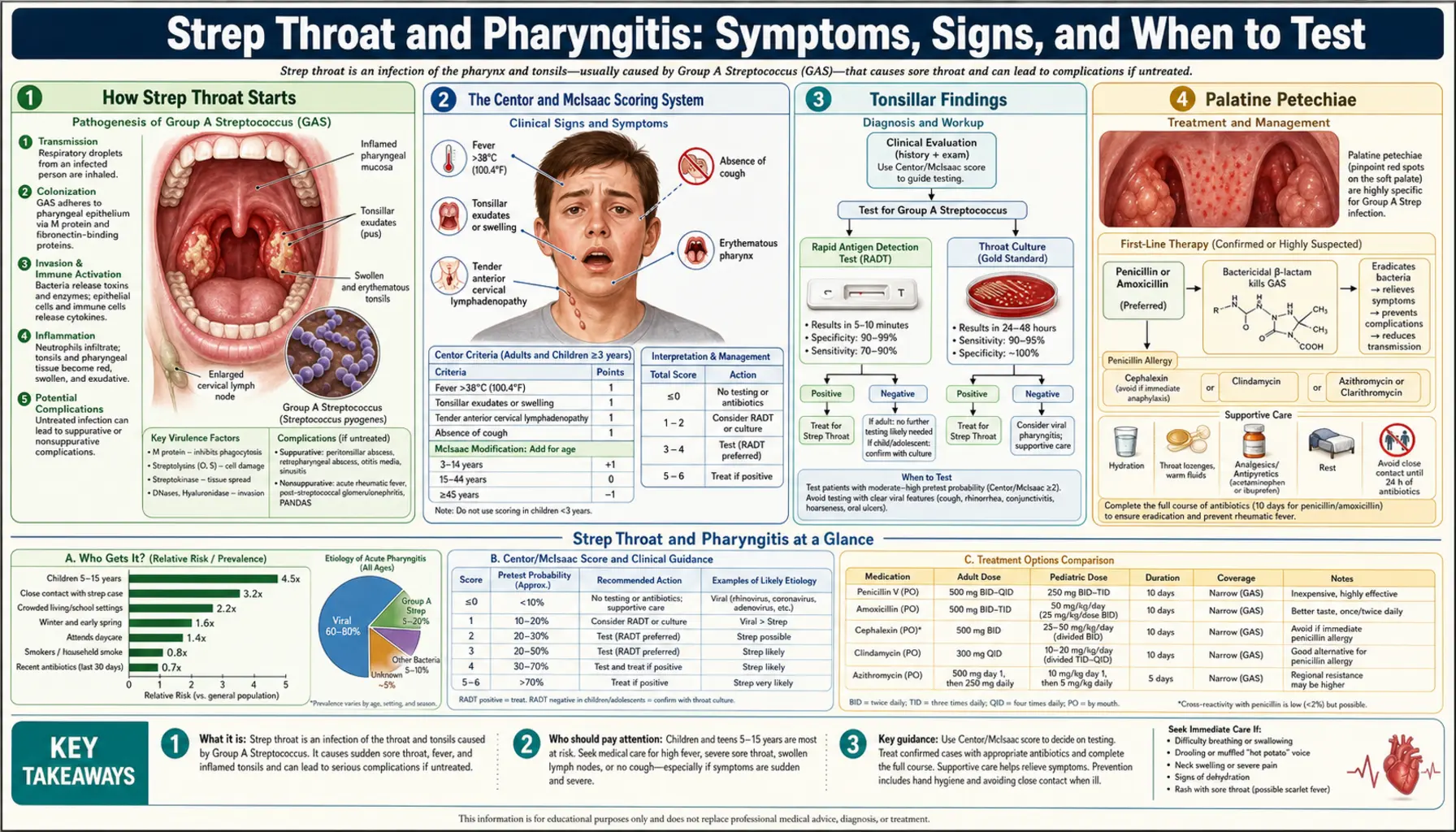
- How Strep Throat Starts
- The Centor and McIsaac Scoring System
- Tonsillar Findings
- Palatine Petechiae
- Anterior Cervical Lymphadenopathy
- Scarlet Fever Rash
- Symptoms in Children vs Adults
- When to Suspect Peritonsillar Abscess
- Differentiating From Viral Pharyngitis
- Key Research Papers
- Connections
How Strep Throat Starts
Strep throat is a throat infection caused by group A Streptococcus (GAS), also called Streptococcus pyogenes. The CDC lists fever, pain with swallowing and a sudden onset of sore throat among its signs and symptoms, gives the incubation period as approximately 2 to 5 days, and states that close contact with another person with strep throat is the most common risk factor (CDC: Clinical guidance for strep throat).
The 2012 Infectious Diseases Society of America (IDSA) guideline lists these features as suggesting GAS as the cause of a sore throat (PubMed PMID: 22965026):
- Sudden onset of sore throat
- Age 5–15 years
- Fever and headache
- Nausea, vomiting and abdominal pain
- Tonsillopharyngeal inflammation and patchy tonsillopharyngeal exudates
- Palatal petechiae (tiny red spots on the roof of the mouth)
- Tender anterior cervical lymph nodes
- Presentation in winter and early spring
- A history of exposure to strep pharyngitis
- A scarlatiniform rash (the rash of scarlet fever)
The CDC states that patients with GAS pharyngitis typically don’t have cough, rhinorrhea (runny nose), hoarseness, oral ulcers or conjunctivitis (CDC: Clinical guidance for strep throat).
Some children carry GAS in the throat without being ill. The IDSA guideline states that as many as 20% of asymptomatic school-age children may be GAS carriers (PubMed PMID: 22965026). A 2010 meta-analysis of 29 studies put the prevalence of GAS carriage among well children with no signs or symptoms of pharyngitis at 12% (95% CI 9%–14%) (PubMed PMID: 20696723).
The Centor and McIsaac Scoring System
The Centor score comes from a 1981 study of adults who came to an urban emergency room with a sore throat. Four findings predicted a positive throat culture for GAS (PubMed PMID: 6763125):
- Tonsillar exudates
- Swollen, tender anterior cervical nodes
- Lack of a cough
- History of fever
In that study, patients with all 4 findings had a 56% probability of a positive culture; with 3, 32%; with 2, 15%; with 1, 6.5%; and with none, 2.5% (PubMed PMID: 6763125).
The McIsaac score adjusts the Centor score for age: a 2012 validation study describes it as adding one point for patients under 15 years and subtracting one point for those 45 years and older (PubMed PMID: 22566485). In McIsaac’s 1998 study of 521 patients aged 3 to 76 years at a Toronto family medicine centre, the score ranged from 0 to 4; its sensitivity for GAS was 83.1%, compared with 69.4% for usual physician care, and among patients aged 3 to 14 it was 96.9% versus 70.6%. Following the score’s recommendations would have reduced initial antibiotic prescriptions by 48% compared with observed prescribing, without any increase in throat culture use (PubMed PMID: 9475915).
The 2012 validation study analysed 206,870 patients aged 3 years or older who came to a US retail health chain with a painful throat. Among patients 15 or older, the share testing positive for GAS was 7% with a Centor score of 0, 12% with 1, 21% with 2, 38% with 3 and 57% with 4; by McIsaac score (all patients 3 or older) it was 8%, 14%, 23%, 37% and 55% for scores 0 to 4 (PubMed PMID: 22566485).
A 2011 meta-analysis of studies in adults found the Centor score well calibrated. As a rule for considering antibiotics (a score of 3 or more) it had a specificity of 0.82 and a post-test probability of 12% to 40% based on a prior prevalence of 5% to 20%, and the authors concluded it should be used with caution in low-prevalence settings such as primary care (PubMed PMID: 21631919).
How guidelines use the scores differs:
- A table in the 2012 validation study summarises earlier CDC and American College of Physicians guidance as: score 0–1, do not test and do not treat; score 2, treat if the rapid test is positive; score 3, treat if the rapid test is positive or treat empirically; score 4, treat empirically (PubMed PMID: 22566485).
- The 2012 European (ESCMID) sore throat guideline states that in patients with 3–4 Centor criteria physicians can consider a rapid antigen test, and that antibiotics should not be used to relieve symptoms in patients with 0–2 Centor criteria (PubMed PMID: 22432746).
- The 2012 IDSA guideline states that the signs and symptoms of streptococcal and nonstreptococcal pharyngitis overlap too broadly for diagnosis to be made with the requisite diagnostic precision on clinical grounds alone, and bases its recommendations on rapid antigen testing and throat culture (PubMed PMID: 22965026).
Tonsillar Findings
The tonsils are two pads of lymphatic tissue at the back of the throat, one on each side. The IDSA guideline lists tonsillopharyngeal inflammation and patchy tonsillopharyngeal exudates (white or yellowish patches) among the features that suggest GAS (PubMed PMID: 22965026).
A 2000 review of 9 large prospective studies in JAMA found that the most useful findings for raising the likelihood of strep throat were tonsillar exudate, pharyngeal exudate and exposure to strep throat in the previous 2 weeks (positive likelihood ratios 3.4, 2.1 and 1.9), and that the absence of tender anterior cervical nodes, tonsillar enlargement or exudate lowered it (negative likelihood ratios 0.60, 0.63 and 0.74). No individual element of the history or examination was accurate enough by itself to rule strep throat in or out (PubMed PMID: 11147989).
Exudate is not unique to GAS. A 2018 meta-analysis of 8 studies found that tonsillar exudate had the highest positive likelihood ratio for both group A and non-group A streptococcal pharyngitis (1.53 versus 1.71), and that the signs and symptoms of the two were generally similar (PubMed PMID: 29045629).
A one-sided swelling around a tonsil can be a sign of peritonsillar abscess, covered in its own section below.
Palatine Petechiae
Petechiae are tiny pin-point red or purple spots. On the palate (the roof of the mouth) they are one of the features the IDSA guideline lists as suggesting GAS as the cause of a sore throat (PubMed PMID: 22965026).
Palatal petechiae also occur with infectious mononucleosis (mono, caused by Epstein-Barr virus). A 2021 meta-analysis of 17 studies found that palatal petechiae (positive likelihood ratio 1.32–11.40), posterior cervical lymphadenopathy (3.16), splenomegaly (2.39) and axillary or inguinal lymphadenopathy (3.05) were moderately useful for ruling in mono, and that most clinical findings had limited value in ruling it out when absent (PubMed PMID: 34772769).
Anterior Cervical Lymphadenopathy
The anterior cervical lymph nodes sit at the front of the neck, below the angle of the jaw. Swollen, tender anterior cervical nodes are one of the four Centor findings (PubMed PMID: 6763125), and the IDSA guideline lists anterior cervical adenitis (tender nodes) among the features suggesting GAS (PubMed PMID: 22965026). In the 2000 JAMA review, the absence of tender anterior cervical nodes had a negative likelihood ratio of 0.60 (PubMed PMID: 11147989).
Node location also points elsewhere: in the 2021 mono meta-analysis, posterior cervical lymphadenopathy (nodes toward the back of the neck) and axillary or inguinal lymphadenopathy were moderately useful for ruling in infectious mononucleosis (PubMed PMID: 34772769).
Scarlet Fever Rash
The CDC describes scarlet fever as caused by pyrogenic exotoxin-producing Streptococcus pyogenes and states that it is most common among children 5 through 15 years of age (CDC: Clinical guidance for scarlet fever). The CDC’s clinical guidance describes (CDC: Clinical guidance for scarlet fever):
- The rash: erythematous (red), blanches on pressure and has a sandpaper quality
- Where it starts: it begins on the trunk and quickly spreads outward, usually sparing the palms and soles
- Pastia’s lines: an accentuation of the red rash in flexor creases
- The face: it may appear flushed, while the area around the mouth may appear pale
- Duration and peeling: the rash usually persists for about one week and desquamation (peeling) may follow
- The tongue: a yellowish white coating with red papillae may initially cover it, and the eventual disappearance of the coating can result in a “strawberry tongue”
The CDC states that penicillin or amoxicillin is the antibiotic of choice to treat scarlet fever, the same drugs it names for strep throat, and that a rapid antigen detection test, a nucleic acid amplification test or a throat culture can confirm scarlet fever with pharyngitis (CDC: Clinical guidance for scarlet fever) (CDC: Clinical guidance for strep throat). Its guidance also lists possible complications, including abscesses, ear infections, acute rheumatic fever and post-streptococcal glomerulonephritis (CDC: Clinical guidance for scarlet fever).
Scarlet fever has returned in several countries. In England, notification rates rose from 8.2 to 27.2 per 100,000 between 2013 and 2014 and reached 33.2 per 100,000 in 2016, the highest number of cases (19,206) and rate since 1967. The median age of cases in 2014 was 4 years, one in 40 cases was admitted to hospital, and the most common strain types were emm3 (43%), emm12 (15%), emm1 (11%) and emm4 (9%); the authors stated that the reasons for the escalation were unclear (PubMed PMID: 29191628). An outbreak that began in mainland China and Hong Kong in 2011 was mainly caused by macrolide- and tetracycline-resistant emm12 strains, and a genome study found that acquisition of a superantigen toxin gene (ssa) and of mobile elements carrying multidrug-resistance genes triggered the expansion of scarlet fever-associated emm12 lineages in Hong Kong (PubMed PMID: 25401300).
Symptoms in Children vs Adults
The IDSA guideline describes GAS pharyngitis as primarily a disease of children 5–15 years of age, and states that GAS causes 20%–30% of sore throats in children and 5%–15% in adults (PubMed PMID: 22965026); the CDC gives the same figures (CDC: Clinical guidance for strep throat). Other estimates vary with the setting:
- A 2010 meta-analysis found a pooled GAS prevalence of 37% among children of all ages who came in with a sore throat, and 24% among children younger than 5 (PubMed PMID: 20696723).
- In the 2012 US retail-clinic study, 23% of patients 15 or older and 27% of all patients 3 or older tested positive (PubMed PMID: 22566485).
Young children: the CDC states that strep throat is rare in children younger than 3 years (CDC: Clinical guidance for strep throat). The IDSA guideline states that diagnostic studies for GAS are not indicated for children under 3 because acute rheumatic fever is rare at that age, and that selected children under 3 with other risk factors, such as an older sibling with GAS infection, may be considered for testing (PubMed PMID: 22965026).
Rheumatic fever: the IDSA guideline states that the risk of a first attack of acute rheumatic fever is extremely low in adults (PubMed PMID: 22965026). In the 2021 Cochrane review, antibiotics reduced acute rheumatic fever within two months compared with placebo or no treatment (Peto odds ratio 0.36; 18 studies, 12,249 participants); most of the trials were done in the 1950s, when rheumatic fever was much more common, and its overall prevalence was very low, particularly in the later studies (PubMed PMID: 34881426).
Testing after a negative rapid test: the IDSA guideline states that in children and adolescents a negative rapid antigen test should be backed up by a throat culture, while routine back-up cultures are not necessary for adults in usual circumstances (PubMed PMID: 22965026). The CDC likewise advises confirming a negative rapid test with a throat culture in symptomatic children aged 3 years or older (CDC: Clinical guidance for strep throat).
Household contacts and recurrences: the IDSA guideline states that testing or empiric treatment of asymptomatic household contacts is not routinely recommended, and states that it does not recommend tonsillectomy solely to reduce the frequency of GAS pharyngitis (PubMed PMID: 22965026). A 2009 review likewise concluded that the benefits of tonsillectomy or adenoidectomy were too small to outweigh the costs and surgical risks, and that chronic carriers are at low risk of transmitting disease or developing invasive infection (PubMed PMID: 19275067).
When to Suspect Peritonsillar Abscess
A peritonsillar abscess (also called quinsy) is a collection of pus beside a tonsil. A 2017 review describes it as the most common deep infection of the head and neck, occurring primarily in young adults, with the diagnosis usually made on the clinical presentation and examination (PubMed PMID: 28409615). The review lists these symptoms and findings (PubMed PMID: 28409615):
- Fever and sore throat
- Dysphagia (difficulty swallowing)
- Trismus (difficulty opening the mouth)
- A “hot potato” voice (a muffled voice)
The same review describes drainage of the abscess, antibiotics and supportive care for hydration and pain as the cornerstones of treatment, with most patients managed as outpatients. It describes the infections as polymicrobial, with antibiotics effective against GAS and oral anaerobes as first-line therapy, and states that prompt recognition and treatment are important to avoid complications such as airway obstruction, aspiration, or spread into the deep tissues of the neck (PubMed PMID: 28409615).
A 2020 review of published cases of complicated peritonsillar abscess found 17 different complications; the most often described were descending mediastinitis (113 cases), parapharyngeal and retropharyngeal abscess (96), necrotizing fasciitis (38) and Lemierre’s syndrome (35). Among these complicated cases, 70% were male, 49% were over 40, and overall mortality was 10% (PubMed PMID: 32731900). In the 2021 Cochrane review, antibiotics for sore throat reduced quinsy within two months compared with placebo or no treatment (Peto odds ratio 0.16; 8 studies, 2,433 participants) (PubMed PMID: 34881426).
Differentiating From Viral Pharyngitis
A 2001 review in the New England Journal of Medicine describes the large majority of acute pharyngitis as a benign, self-limited infection that is usually viral, and the task as identifying the patients who need specific antimicrobial therapy (PubMed PMID: 11172144).
The IDSA guideline lists these features as suggesting a viral cause (PubMed PMID: 22965026):
- Conjunctivitis
- Coryza (runny or blocked nose)
- Cough
- Diarrhea
- Hoarseness
- Discrete ulcerative stomatitis (mouth ulcers)
- A viral exanthem (a viral-type rash)
Clinical features alone do not settle the question. The IDSA guideline states that the signs and symptoms of GAS and nonstreptococcal pharyngitis overlap so broadly that accurate diagnosis on clinical grounds alone is usually impossible (PubMed PMID: 22965026). The 2000 JAMA review found no single element of the history or examination accurate enough to rule strep throat in or out (PubMed PMID: 11147989), and the 2011 meta-analysis found that individual signs and symptoms are not powerful enough to tell GAS pharyngitis apart from other sore throats (PubMed PMID: 21631919).
The IDSA guideline states that testing for GAS usually is not recommended when the clinical features strongly suggest a viral cause (for example cough, rhinorrhea, hoarseness and oral ulcers), and that positive rapid antigen tests do not need a back-up culture because they are highly specific (PubMed PMID: 22965026). A 2016 Cochrane review of 98 studies in children found a summary sensitivity of 85.6% and specificity of 95.4% for rapid antigen tests against throat culture; the authors expected that of 100 children with strep throat, 86 would be detected by the rapid test and 14 missed (PubMed PMID: 27374000).
On treatment, the IDSA guideline names penicillin or amoxicillin as the treatments of choice, with recommendations for penicillin-allergic patients that include clindamycin (PubMed PMID: 22965026). The 2021 Cochrane review of 29 trials (15,337 cases of sore throat) found that antibiotics reduced sore throat at day three (risk ratio 0.70) and at one week (risk ratio 0.50), though 82% of people in the placebo or no-treatment groups were symptom-free by one week; antibiotics reduced headache but did not significantly reduce fever at day three (PubMed PMID: 34881426). For symptom relief, the ESCMID guideline recommends ibuprofen or paracetamol (PubMed PMID: 22432746).
Key Research Papers
- Shulman ST, Bisno AL, Clegg HW, et al. Clinical practice guideline for the diagnosis and management of group A streptococcal pharyngitis: 2012 update by the Infectious Diseases Society of America. Clin Infect Dis. 2012;55(10):e86-e102. — PubMed PMID: 22965026
- Bisno AL, Gerber MA, Gwaltney JM Jr, Kaplan EL, Schwartz RH. Practice guidelines for the diagnosis and management of group A streptococcal pharyngitis. Infectious Diseases Society of America. Clin Infect Dis. 2002;35(2):113-125. — PubMed PMID: 12087516
- Bisno AL. Acute pharyngitis. N Engl J Med. 2001;344(3):205-211. — PubMed PMID: 11172144
- Centor RM, Witherspoon JM, Dalton HP, Brody CE, Link K. The diagnosis of strep throat in adults in the emergency room. Med Decis Making. 1981;1(3):239-246. — PubMed PMID: 6763125
- McIsaac WJ, White D, Tannenbaum D, Low DE. A clinical score to reduce unnecessary antibiotic use in patients with sore throat. CMAJ. 1998;158(1):75-83. — PubMed PMID: 9475915
- Ebell MH, Smith MA, Barry HC, Ives K, Carey M. The rational clinical examination. Does this patient have strep throat? JAMA. 2000;284(22):2912-2918. — PubMed PMID: 11147989
- Aalbers J, O’Brien KK, Chan WS, et al. Predicting streptococcal pharyngitis in adults in primary care: a systematic review of the diagnostic accuracy of symptoms and signs and validation of the Centor score. BMC Med. 2011;9:67. — PubMed PMID: 21631919
- Fine AM, Nizet V, Mandl KD. Large-scale validation of the Centor and McIsaac scores to predict group A streptococcal pharyngitis. Arch Intern Med. 2012;172(11):847-852. — PubMed PMID: 22566485
- Shaikh N, Leonard E, Martin JM. Prevalence of streptococcal pharyngitis and streptococcal carriage in children: a meta-analysis. Pediatrics. 2010;126(3):e557-e564. — PubMed PMID: 20696723
- Cohen JF, Bertille N, Cohen R, Chalumeau M. Rapid antigen detection test for group A streptococcus in children with pharyngitis. Cochrane Database Syst Rev. 2016;7:CD010502. — PubMed PMID: 27374000
- Spinks A, Glasziou PP, Del Mar CB. Antibiotics for treatment of sore throat in children and adults. Cochrane Database Syst Rev. 2021;12:CD000023. — PubMed PMID: 34881426
- Pelucchi C, Grigoryan L, Galeone C, et al. Guideline for the management of acute sore throat. Clin Microbiol Infect. 2012;18 Suppl 1:1-28. — PubMed PMID: 22432746
- Choby BA. Diagnosis and treatment of streptococcal pharyngitis. Am Fam Physician. 2009;79(5):383-390. — PubMed PMID: 19275067
- Hayes CS, Williamson H Jr. Management of group A beta-hemolytic streptococcal pharyngitis. Am Fam Physician. 2001;63(8):1557-1564. — PubMed PMID: 11327431
- Thai TN, Dale AP, Ebell MH. Signs and symptoms of Group A versus Non-Group A strep throat: a meta-analysis. Fam Pract. 2018;35(3):231-238. — PubMed PMID: 29045629
- Cai X, Ebell MH, Haines L. Accuracy of signs, symptoms, and hematologic parameters for the diagnosis of infectious mononucleosis: a systematic review and meta-analysis. J Am Board Fam Med. 2021;34(6):1141-1156. — PubMed PMID: 34772769
- Galioto NJ. Peritonsillar abscess. Am Fam Physician. 2017;95(8):501-506. — PubMed PMID: 28409615
- Klug TE, Greve T, Hentze M. Complications of peritonsillar abscess. Ann Clin Microbiol Antimicrob. 2020;19(1):32. — PubMed PMID: 32731900
- Lamagni T, Guy R, Chand M, et al. Resurgence of scarlet fever in England, 2014-16: a population-based surveillance study. Lancet Infect Dis. 2018;18(2):180-187. — PubMed PMID: 29191628
- Davies MR, Holden MT, Coupland P, et al. Emergence of scarlet fever Streptococcus pyogenes emm12 clones in Hong Kong is associated with toxin acquisition and multidrug resistance. Nat Genet. 2015;47(1):84-87. — PubMed PMID: 25401300