Mycoplasma pneumoniae
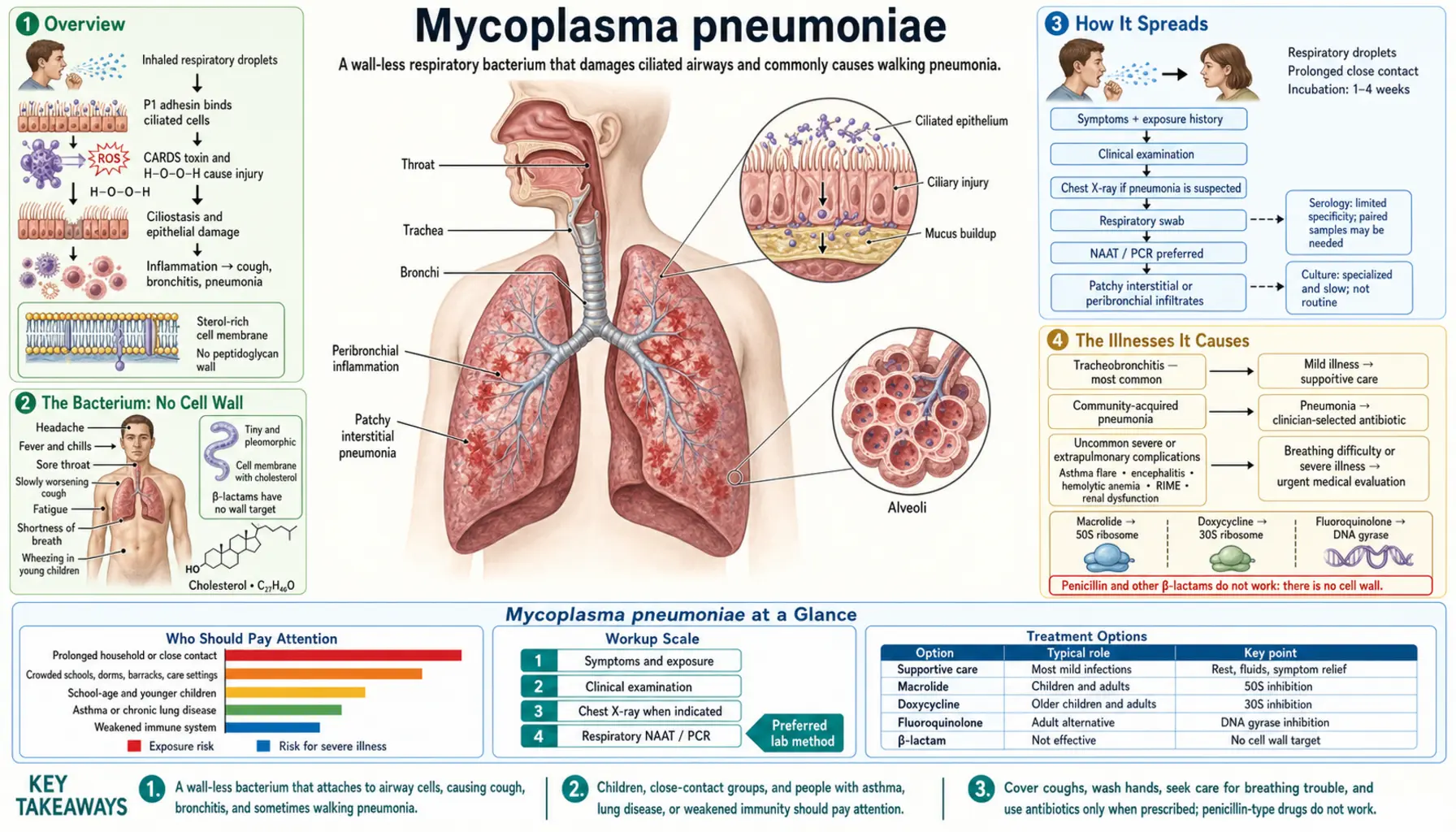
Mycoplasma pneumoniae is the germ behind what most people know as “walking pneumonia” — a chest infection mild enough that many people keep going to school or work while they have it. It is one of the most common causes of respiratory infection in school-age children and young adults, and it tends to sweep through households, classrooms, and dorms in slow waves. The illness it causes is usually not dramatic, but it has one very memorable feature: a dry, hacking cough that can drag on for weeks after everything else has faded. This bacterium is also unusual biologically — it is one of the smallest free-living organisms known, and it has no cell wall at all, a quirk that turns out to matter a great deal when it comes to choosing an antibiotic. This page explains what M. pneumoniae is, how it spreads, the range of illnesses it can cause (including some surprising complications beyond the lungs), how it is diagnosed and treated, and the honest bottom line on how worried to be.
Table of Contents
Overview
Mycoplasma pneumoniae is a bacterium that infects the respiratory tract — the nose, throat, windpipe, and lungs. It is a leading cause of community-acquired pneumonia (pneumonia caught in everyday life, rather than in a hospital), particularly in children over five, teenagers, and adults under forty. Depending on the year and the setting, it can account for anywhere from a small fraction to a third or more of pneumonia cases in these age groups.
Most infections are mild. Many people who catch M. pneumoniae get nothing worse than a lingering cough, a sore throat, or a bout of bronchitis, and some carry the organism with no symptoms at all. Only a minority go on to develop true pneumonia. Because the pneumonia it causes is typically less severe than the classic bacterial pneumonias, it earned the nickname “atypical” or “walking” pneumonia.
The infection is not new or exotic — it circulates year-round in most of the world and flares into larger community epidemics roughly every three to seven years. What makes it worth understanding is a combination of three things: how easily it spreads in close-contact settings, its strange wall-less biology (which dictates which antibiotics work), and a small but genuine risk of complications reaching well beyond the lungs.
The Bacterium: No Cell Wall
Mycoplasma pneumoniae is remarkable even among bacteria. It is one of the smallest free-living, self-replicating organisms known — its genome is tiny, and the cell itself is a fraction of the size of a typical bacterium such as E. coli. It has pared its biology down to a bare minimum, which is why it grows slowly and is fussy about the nutrients it needs.
Its single most important feature, though, is what it is missing: a cell wall. Nearly all bacteria are enclosed in a rigid outer wall built from a mesh called peptidoglycan. Mycoplasma species have none — each cell is bounded only by a soft membrane, which lets it take on flexible, changeable shapes. This one fact has two large consequences:
- Penicillins and related antibiotics do not work. The entire beta-lactam family — penicillin, amoxicillin, ampicillin, and the cephalosporins — kills bacteria by sabotaging cell-wall construction. If there is no wall to attack, these drugs have no target. This is the key clinical point: a patient with walking pneumonia who is prescribed amoxicillin will often fail to improve, precisely because the drug cannot touch this organism. Effective antibiotics have to attack something else, such as the bacterium’s ability to build proteins.
- It is invisible on a Gram stain. The Gram stain, the oldest and most common way of looking at bacteria under a microscope, works by staining the cell wall. With no wall to hold the dye, M. pneumoniae simply does not show up — one reason it went unrecognized for so long and remains hard to catch in an ordinary lab.
To cause disease, the bacterium uses a specialized attachment tip — a tapered structure carrying an adhesin protein (called P1) that lets it grip tightly onto the cells lining the airways. Once anchored, it damages those cells and the tiny hair-like cilia that normally sweep mucus and debris out of the lungs. Losing that clearing action is part of why the cough becomes so persistent.
How It Spreads
M. pneumoniae passes from person to person through respiratory droplets — the small sprays released when an infected person coughs, sneezes, or talks closely. It is not as explosively contagious as measles or influenza; instead, it generally needs fairly close, repeated contact to spread. That makes crowded, close-living environments its natural home:
- Households — it is common for the infection to move slowly through a family over weeks, one member at a time.
- Schools and daycare — school-age children are a major reservoir and frequently bring it home.
- College dormitories and military barracks — classic settings for outbreaks among young adults living in close quarters.
- Nursing homes and other institutions, where residents share indoor air for long periods.
A defining feature is its long incubation period: it usually takes one to four weeks (often two to three) from exposure to the first symptoms — considerably longer than most common respiratory viruses. Because each person can be infectious for a stretch before and after they feel sick, and because the incubation is so drawn out, outbreaks tend to be slow-moving and can smolder for months rather than exploding and burning out quickly. This slow tempo is one reason a single classroom or family can see cases trickling in over an entire season.
The Illnesses It Causes
Infection with M. pneumoniae covers a wide spectrum, from no symptoms at all to serious disease. Most of the time it stays in the upper airway and stays mild. The common presentations, from most to least frequent, include:
- Tracheobronchitis — inflammation of the windpipe and the airways of the lungs. This is actually the most common illness the bacterium causes: a nagging cough, low fever, and chest discomfort without full-blown pneumonia.
- Sore throat (pharyngitis) and general upper-respiratory symptoms, sometimes with hoarseness or a runny nose.
- Atypical (“walking”) pneumonia — the presentation the organism is named for, though only a minority of infections (often cited as under ten percent) progress this far. The pneumonia is usually mild and patchy.
- Ear and sinus involvement in some cases, historically including painful eardrum inflammation.
Complications beyond the lungs (extrapulmonary disease). One of the more surprising things about M. pneumoniae is that a meaningful share of complications occur outside the respiratory tract. These are thought to arise partly from the immune system’s reaction to the infection — in some cases antibodies raised against the bacterium cross-react with the body’s own tissues (a process called molecular mimicry). Recognized extrapulmonary complications include:
- Skin and mucous membranes. Rashes are common, ranging from mild spots to erythema multiforme (target-shaped lesions). A distinctive and more severe pattern seen mainly in children and young people is Mycoplasma pneumoniae-induced rash and mucositis (MIRM) — prominent painful sores of the mouth, eyes, and genitals with a relatively limited skin rash. MIRM is now recognized as its own entity, separate from (though historically confused with) Stevens-Johnson syndrome.
- Blood. The infection can trigger autoimmune hemolytic anemia, in which the immune system produces “cold agglutinin” antibodies that attack the person’s own red blood cells. Usually mild, occasionally significant.
- Nervous system. M. pneumoniae is one of the more notable infectious triggers of encephalitis (brain inflammation) in children, and has been linked to aseptic meningitis, Guillain-Barré syndrome, transverse myelitis, and other neurological problems. These are uncommon but can be serious.
- Heart, joints, and kidneys may rarely be involved (for example, inflammation of the heart muscle or lining), though these are far less frequent.
Symptoms & Why It’s “Walking”
Unlike the classic bacterial pneumonias that hit suddenly and hard, M. pneumoniae illness usually comes on gradually, over several days. A typical course starts with headache, tiredness, a scratchy or sore throat, and a low-grade fever — symptoms easy to mistake for an ordinary cold or the flu. Then the hallmark arrives:
- A persistent, dry, hacking cough that becomes the dominant complaint. It often starts dry and may later bring up small amounts of mucus. Crucially, this cough can linger for three, four, or more weeks — well after the fever and other symptoms have gone.
- Low-grade fever and malaise rather than the high, shaking fevers of severe bacterial pneumonia.
- Wheezing or chest tightness in some people; the infection can also aggravate asthma.
The nickname “walking pneumonia” captures the central paradox: the person genuinely has pneumonia, but feels sick enough only to be run-down, not bedridden. They keep walking around — going to school, to work, to the store — while quietly spreading it. Clinicians often describe another mismatch: the chest X-ray can look worse than the patient. Someone who appears only mildly unwell may show surprisingly patchy or streaky shadows on their film. This gap between how bad the pictures look and how well the patient seems is itself a clue that points toward an atypical organism like Mycoplasma.
Diagnosis
Diagnosing M. pneumoniae is genuinely tricky, because in its early stages it looks like a cold, the flu, or many other respiratory infections. Doctors often suspect it based on the clinical picture: a school-age child or young adult with a gradual-onset, lingering cough, a chest X-ray that looks worse than the person feels, and — tellingly — a lack of response to amoxicillin or a similar penicillin-type drug. When testing is needed, the options are:
- PCR (polymerase chain reaction). Testing a throat or nasal swab (or sputum) for the bacterium’s genetic material is the modern test of choice. It is fast and sensitive, and M. pneumoniae is now commonly included in the multiplex respiratory panels that test for many germs at once.
- Blood antibody tests (serology). Measuring the immune response (IgM and IgG antibodies) can confirm infection, but has drawbacks: early IgM may be absent, and the most reliable confirmation needs two blood samples weeks apart (an “acute” and a “convalescent” sample), which is too slow to guide immediate treatment.
- Cold agglutinins. Historically, doctors used a simple test for “cold agglutinin” antibodies that clump red cells in the cold. It can support the diagnosis but is nonspecific and misses many cases, so it has largely been replaced by PCR.
- Culture (growing the organism) is possible but so slow and insensitive — taking weeks — that it is essentially never used for ordinary patient care. And because it has no cell wall, remember that a routine Gram stain will not show it at all.
Treatment & Antibiotic Resistance
Many mild M. pneumoniae infections — a sore throat or bronchitis without pneumonia — get better on their own with rest, fluids, and time, and do not strictly require antibiotics. When treatment is warranted (for pneumonia, more severe illness, or vulnerable patients), the choice of drug is dictated by that missing cell wall. The effective antibiotics all work by attacking the bacterium’s protein-building machinery or its DNA, not its wall:
- Macrolides — azithromycin, clarithromycin, and erythromycin — are the usual first-line choice, especially in children, because they are effective and generally well tolerated. Azithromycin’s short, convenient course makes it a common pick.
- Tetracyclines — chiefly doxycycline — work well and are a standard alternative, particularly in adults. They were traditionally avoided in very young children because of concerns about tooth staining, though short courses of doxycycline are now considered acceptable in children when needed.
- Fluoroquinolones — such as levofloxacin and moxifloxacin — are also effective and are generally reserved for adults or for cases where other drugs cannot be used.
The growing problem of macrolide resistance. Over the past two decades, strains of M. pneumoniae that resist macrolide antibiotics have spread. Resistance comes from a single small change (a point mutation) in the bacterium’s ribosome — the very machinery macrolides target. The problem is dramatically worse in parts of East Asia: in China and Japan, resistance rates have at times exceeded 90 percent of tested strains, whereas in North America and much of Europe the rates have historically been lower (often in the single digits to low tens of percent), though they appear to be rising. Practically, this means that if a patient with confirmed or suspected Mycoplasma pneumonia does not start improving within a couple of days of a macrolide — especially the fever — doctors will often switch to doxycycline or a fluoroquinolone, which remain reliably active.
Prevention
There is currently no vaccine against M. pneumoniae. Efforts to develop one over the years have not yielded a licensed product, so prevention rests entirely on reducing spread. Because the bacterium travels in respiratory droplets and thrives on close contact, the sensible measures are the familiar ones:
- Cover coughs and sneezes with a tissue or the elbow, and dispose of tissues promptly.
- Wash hands regularly with soap and water, especially after coughing, sneezing, or contact with a sick person.
- Stay home when sick where possible, to avoid seeding schools, workplaces, and dorms.
- Improve indoor air in crowded shared spaces through ventilation.
In some institutional outbreaks — for example in a family, a barracks, or a care facility with several cases — doctors occasionally use preventive antibiotics for close contacts, but this is a case-by-case decision and not a routine practice. For the general public, ordinary respiratory hygiene is the realistic tool. Because carriers can spread the organism before they feel unwell, no strategy prevents it completely, which is part of why community waves recur every few years.
The Honest Bottom Line
For the great majority of people, Mycoplasma pneumoniae is a mild, self-limiting illness. The typical experience is a cold-like start followed by an annoyingly persistent dry cough, then a full recovery — often without any antibiotics at all. It is more of a nuisance than a threat for most healthy children and adults, and the lingering cough, though frustrating, is not usually a sign of anything dangerous.
That said, it deserves respect. A minority of infections progress to genuine pneumonia that benefits from the right antibiotic — and getting the right one matters, because the penicillin-family drugs so often reached for first simply do not work against this wall-less germ. More serious pneumonia is more likely in people with weakened immune systems, sickle cell disease, or significant asthma or lung disease. And while the complications outside the lungs — the severe skin-and-mucosa reactions, the autoimmune anemia, the neurological problems — are uncommon, they are real and occasionally serious.
The practical takeaways: a cough that drags on for weeks after a cold, especially in a young person, is worth mentioning to a clinician; a walking-pneumonia diagnosis that is not improving on amoxicillin is a reason to ask about an atypical organism; and red-flag symptoms — real difficulty breathing, confusion or other neurological changes, or a spreading rash with painful mouth or eye sores — warrant prompt medical attention. Reassuring in the usual case, but not to be dismissed.
Key Research Papers
- Waites KB, Talkington DF. Mycoplasma pneumoniae and its role as a human pathogen. Clinical Microbiology Reviews. 2004;17(4):697–728. — The foundational modern review of the organism’s biology, clinical illnesses, diagnosis, and treatment. — doi:10.1128/CMR.17.4.697-728.2004
- Waites KB, Xiao L, Liu Y, Balish MF, Atkinson TP. Mycoplasma pneumoniae from the respiratory tract and beyond. Clinical Microbiology Reviews. 2017;30(3):747–809. — Comprehensive update covering pulmonary and extrapulmonary disease, pathogenesis, and molecular diagnostics. — doi:10.1128/CMR.00114-16
- Atkinson TP, Balish MF, Waites KB. Epidemiology, clinical manifestations, pathogenesis and laboratory detection of Mycoplasma pneumoniae infections. FEMS Microbiology Reviews. 2008;32(6):956–973. — Reviews how the bacterium attaches to and damages the airway and the range of disease it produces. — doi:10.1111/j.1574-6976.2008.00129.x
- Jain S, Williams DJ, Arnold SR, et al. Community-acquired pneumonia requiring hospitalization among U.S. children. New England Journal of Medicine. 2015;372(9):835–845. — The large CDC EPIC study; M. pneumoniae was among the most common bacterial causes in hospitalized children, especially older ones. — doi:10.1056/NEJMoa1405870
- Kutty PK, Jain S, Taylor TH, et al. Mycoplasma pneumoniae among children hospitalized with community-acquired pneumonia. Clinical Infectious Diseases. 2019;68(1):5–12. — Detailed U.S. surveillance data on how often the organism is found in children with pneumonia and how detection compares by method. — doi:10.1093/cid/ciy419
- Canavan TN, Mathes EF, Frieden I, Shinkai K. Mycoplasma pneumoniae-induced rash and mucositis as a syndrome distinct from Stevens-Johnson syndrome and erythema multiforme: a systematic review. Journal of the American Academy of Dermatology. 2015;72(2):239–245. — The paper that defined MIRM as its own entity separate from Stevens-Johnson syndrome. — doi:10.1016/j.jaad.2014.06.026
- Narita M. Classification of extrapulmonary manifestations due to Mycoplasma pneumoniae infection on the basis of possible pathogenesis. Frontiers in Microbiology. 2016;7:23. — Organizes the many complications outside the lungs (neurological, blood, skin) by their likely mechanisms. — doi:10.3389/fmicb.2016.00023
- Meyer Sauteur PM, Unger WWJ, Nadal D, Berger C, Vink C, van Rossum AMC. Infection with and carriage of Mycoplasma pneumoniae in children. Frontiers in Microbiology. 2016;7:329. — Examines the important problem that the bacterium can be carried without illness, complicating diagnosis. — doi:10.3389/fmicb.2016.00329
- Bébéar C, Pereyre S, Peuchant O. Mycoplasma pneumoniae: susceptibility and resistance to antibiotics. Future Microbiology. 2011;6(4):423–431. — Explains which antibiotic classes work against the wall-less organism and how resistance arises. — doi:10.2217/fmb.11.18
- Pereyre S, Goret J, Bébéar C. Mycoplasma pneumoniae: current knowledge on macrolide resistance and treatment. Frontiers in Microbiology. 2016;7:974. — Reviews the global rise of macrolide-resistant strains and the treatment implications. — doi:10.3389/fmicb.2016.00974
- Morozumi M, Ubukata K, Takahashi T. Macrolide-resistant Mycoplasma pneumoniae: characteristics of isolates and clinical aspects of community-acquired pneumonia. Journal of Infection and Chemotherapy. 2010;16(2):78–86. — Japanese data documenting the high prevalence and clinical impact of macrolide resistance in East Asia. — doi:10.1007/s10156-009-0021-4
- Cao B, Zhao CJ, Yin YD, et al. High prevalence of macrolide resistance in Mycoplasma pneumoniae isolates from adult and adolescent patients with respiratory tract infection in China. Clinical Infectious Diseases. 2010;51(2):189–194. — Landmark report showing the majority of Chinese isolates were macrolide-resistant. — doi:10.1086/653535