Enterococcus
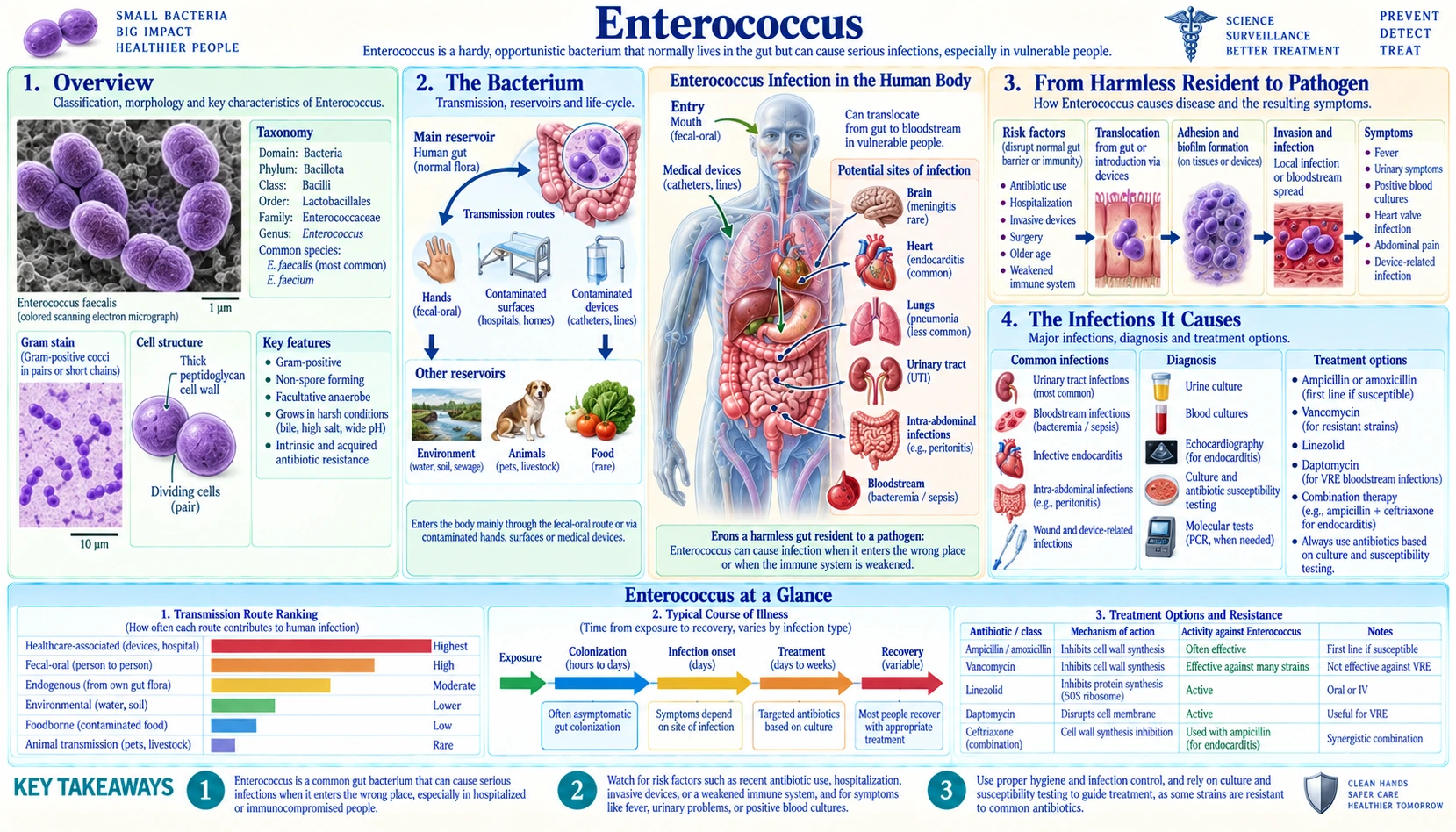
Enterococcus is a group of bacteria that most of us carry every day without ever knowing it. They live quietly in the human gut — part of the normal community of microbes in the intestines — and for the vast majority of healthy people they cause no harm at all. But these same organisms are also among the most stubborn and troublesome germs in modern hospitals. When a person is seriously ill, has a tube or catheter placed in the body, or has recently taken heavy doses of antibiotics, this ordinary gut resident can slip into places it does not belong and cause a difficult infection. Two species matter most in humans: Enterococcus faecalis and Enterococcus faecium. This page explains what these bacteria are, how a harmless resident becomes a dangerous opportunist, the infections it causes — including the classic and serious problem of infective endocarditis — and why vancomycin-resistant enterococci (VRE) have become such a headache for doctors trying to treat them.
Table of Contents
Overview
Enterococcus bacteria are a genus of Gram-positive cocci — round cells that usually appear in pairs or short chains under the microscope. Their name literally means “gut berry,” and it fits: their natural home is the gastrointestinal tract of humans and animals, where they are ordinary members of the healthy microbiome. Being found on a routine stool sample or a skin swab is usually meaningless; they are supposed to be there.
What makes enterococci important in medicine is not what they do in a healthy body but what they can do in a sick one. They are classic opportunistic pathogens — germs that take advantage of a weakened host or a breach in the body’s defenses. In hospitals they are consistently among the leading causes of bloodstream infections, urinary tract infections, and heart-valve infections, particularly in patients who are critically ill, have implanted devices, or have already been treated with strong antibiotics.
Alongside their opportunism, enterococci carry a second, larger problem: they are unusually good at resisting antibiotics. Some of that resistance is built in from birth (called intrinsic resistance), and some they have acquired over decades of antibiotic use — most notoriously resistance to vancomycin, long a drug of last resort. The combination of “lives everywhere,” “survives everything,” and “resists many drugs” is exactly why public-health agencies track them so closely.
The Bacterium
Enterococci were once lumped in with the streptococci — specifically the “group D streptococci” and only became their own genus, Enterococcus, in 1984 once genetic tools showed they were distinct. Physically they are catalase-negative, non-spore-forming, facultatively anaerobic cocci, meaning they can grow with or without oxygen.
Their most striking feature is toughness. Enterococci survive conditions that kill most other bacteria:
- They tolerate bile salts and a wide range of acidity, which is exactly what a gut-dwelling organism needs to survive the digestive tract.
- They grow in high salt (the classic laboratory test uses 6.5% sodium chloride broth) and across a broad temperature range, roughly 10–45°C.
- They can withstand brief heating and drying, which lets them persist on hospital surfaces — bed rails, blood-pressure cuffs, door handles, and medical equipment — for days to weeks. This environmental hardiness is a major reason they spread so easily between patients.
Two species account for nearly all human disease:
- Enterococcus faecalis has historically caused the majority of enterococcal infections — on the order of two-thirds to three-quarters of clinical isolates. It tends to remain susceptible to the workhorse antibiotic ampicillin, which makes it comparatively easier to treat.
- Enterococcus faecium causes fewer infections overall but is far more likely to be drug-resistant. The great majority of vancomycin-resistant and ampicillin-resistant enterococci belong to this species, and its share of serious hospital infections has been rising.
Knowing which species is involved therefore matters enormously — it often decides whether an infection is straightforward or a serious therapeutic challenge.
From Harmless Resident to Pathogen
If enterococci live peacefully in nearly everyone’s gut, why do they cause disease at all? The answer is that they are opportunists, not aggressors. They rarely attack a healthy, intact body. Instead they wait for an opening, and modern medicine — for all its benefits — creates those openings.
Several things have to line up for a harmless resident to become a pathogen:
- A breach in the body’s barriers. A urinary catheter, an intravenous line, abdominal surgery, or a damaged gut wall gives enterococci a route from where they belong (the intestine) to where they do not (the bloodstream, the urinary tract, the abdominal cavity, a heart valve).
- A weakened host. People whose immune defenses are compromised — by cancer chemotherapy, transplantation, critical illness, or advanced age — are far less able to keep an opportunist in check.
- Prior antibiotics. This is the great irony. Broad-spectrum antibiotics, especially cephalosporins and vancomycin, kill off the competing bacteria in the gut but leave enterococci — which are naturally resistant to those drugs — standing. Freed from competition, they multiply and come to dominate, dramatically increasing the odds that they will cause an infection or spread to another patient.
Enterococci also carry modest virulence tools — substances that help them stick to tissues and medical devices, form protective biofilms, and resist being cleared — but they are not highly aggressive germs. Their success as pathogens comes far more from being in the right place at the right time, in the right vulnerable host, than from any dramatic weaponry. This is worth remembering: for an ordinary healthy person, Enterococcus in the gut is not something to fear.
The Infections It Causes
When enterococci do cause disease, a handful of infection types account for most of it. Nearly all are healthcare-associated.
Urinary tract infections
The urinary tract is the single most common site of enterococcal infection. Most cases are complicated or catheter-associated UTIs — infections in people with a urinary catheter, an anatomical abnormality, or a recent urological procedure — rather than the simple bladder infections seen in otherwise healthy young women. E. faecalis is the usual culprit.
Bloodstream infections (bacteremia)
Enterococci are a leading cause of hospital-acquired bloodstream infections. The bacteria typically enter the blood from an infected urinary tract, an intra-abdominal source, or a contaminated intravascular catheter. Enterococcal bacteremia is serious in its own right and also raises the alarm for the next entry on this list, because the bacteria can seed a heart valve.
Infective endocarditis
Infection of the heart valves — infective endocarditis — is the classic and most feared enterococcal disease. Enterococci are one of the top three causes of infective endocarditis worldwide. The organism travels through the bloodstream (often from a urinary or gastrointestinal source) and lodges on a heart valve, where it forms a clump of bacteria, fibrin, and platelets called a vegetation. This is a slow, grinding infection that can destroy the valve, throw off infected fragments to other organs, and prove fatal if not treated with weeks of carefully chosen antibiotics. Enterococcal endocarditis is notoriously hard to cure because the bacteria are only slowly killed by the available drugs — a point we return to under treatment.
Intra-abdominal, pelvic, and wound infections
Because enterococci live in the gut, they frequently turn up in infections that spill out of the abdomen — after a perforated bowel, appendicitis, diverticulitis, or abdominal surgery. These infections are usually polymicrobial, meaning enterococci are found alongside other gut bacteria such as E. coli and anaerobes, and the treatment has to cover the whole mix. Enterococci can also infect surgical wounds and pressure sores.
Less common infections
More rarely, enterococci cause meningitis (particularly in newborns or after neurosurgery), infections of prosthetic joints and other implanted hardware, and neonatal sepsis.
Who’s Most at Risk
Enterococcal infection is overwhelmingly a disease of vulnerable, hospitalized people. The main risk factors overlap heavily:
- Prolonged hospitalization, especially time in an intensive care unit.
- Indwelling devices — urinary catheters, central venous lines, feeding tubes, and prosthetic material — each of which provides a surface for the bacteria to colonize and a route past the body’s defenses.
- A weakened immune system — from cancer and its treatment, organ or bone-marrow transplantation, or long-term steroids.
- Prior treatment with broad-spectrum antibiotics, particularly cephalosporins and vancomycin, which clear the competition and let resistant enterococci flourish.
- Serious underlying illness — kidney failure requiring dialysis, liver disease, major abdominal or urological surgery, and severe burns.
- Pre-existing heart-valve disease or a prosthetic valve, which raises the specific risk of endocarditis if the bacteria reach the bloodstream.
- Advanced age. Older adults carry more of these risk factors and mount weaker immune responses.
By contrast, a healthy person living outside the hospital, with no catheters and no recent heavy antibiotics, is at very low risk of enterococcal disease even though they carry the bacteria in their gut every day.
Diagnosis
Enterococcal infection is diagnosed by growing the bacteria from the right body site and then testing which antibiotics will work. The laboratory steps matter because they directly steer treatment.
- Culture from the infected site. A urine culture, wound swab, or fluid sample can grow enterococci. Because these bacteria are hardy, they grow readily on standard laboratory media. Distinguishing a true infection from harmless colonization — especially in urine — requires clinical judgment, since finding the organism does not always mean it is causing disease.
- Blood cultures. For suspected bloodstream infection or endocarditis, multiple sets of blood cultures are drawn. Persistently positive blood cultures — the same organism growing again and again — are a red flag for endocarditis or an infected device.
- Species identification and susceptibility testing. The lab identifies whether the organism is E. faecalis or E. faecium and tests it against key antibiotics — ampicillin, vancomycin, and high-level gentamicin among them. This panel decides the treatment plan, because E. faecalis and a vancomycin-resistant E. faecium are treated very differently.
- Echocardiography. When endocarditis is suspected, an ultrasound of the heart — first a standard transthoracic echocardiogram, then often a more detailed transesophageal echocardiogram — looks for vegetations on the valves and for valve damage. Diagnosis combines these imaging findings with the blood-culture results using established criteria.
The Antibiotic-Resistance Problem
This is the heart of why enterococci matter, and it is worth understanding in two parts: what they are born with, and what they have acquired.
Intrinsic resistance — the drugs that never worked
Enterococci are naturally resistant to several whole classes of antibiotics right out of the gate:
- Cephalosporins — an enormous and widely used family of antibiotics — simply do not work against enterococci. This is a crucial clinical fact: a patient treated with a cephalosporin for another infection is not being treated for any enterococcus that is also present, and, worse, the cephalosporin clears competing bacteria and lets enterococci overgrow.
- Low doses of aminoglycosides (such as gentamicin) cannot penetrate the enterococcal cell well enough to work alone.
- They also shrug off clindamycin and, in the body, trimethoprim-sulfamethoxazole, which can look effective in a lab dish but fails in living tissue.
This built-in resistance already narrows the toolbox considerably before any acquired resistance is added.
Acquired resistance — and the rise of VRE
Over decades of antibiotic use, enterococci — especially E. faecium — have picked up additional resistance, often by swapping genes with other bacteria:
- Ampicillin resistance. Ampicillin is the go-to drug for E. faecalis, but many E. faecium strains have become resistant to it, closing off the first-line option.
- High-level aminoglycoside resistance. This eliminates the synergy trick (described under treatment) that doctors rely on to cure endocarditis, making those infections much harder to clear.
- Vancomycin resistance — VRE. Vancomycin was long the reliable fallback when penicillins failed. Then enterococci acquired genes (the best known are called vanA and vanB) that rebuild the bacterial cell wall so vancomycin can no longer grab hold. The result is vancomycin-resistant enterococci (VRE) — now one of the most important healthcare-associated resistant pathogens in the world. VRE is overwhelmingly E. faecium, and it is tracked as a serious threat by public-health agencies precisely because it takes away a drug that used to be a dependable rescue.
When an infection is caused by VRE, the remaining options are few. The two mainstays are:
- Linezolid, an oxazolidinone antibiotic that works against most VRE and has the practical advantage of an oral form with excellent absorption. It is bacteriostatic (it stops the bacteria from multiplying rather than killing them outright), and long courses can suppress the bone marrow, so it needs monitoring.
- Daptomycin, a bactericidal (bacteria-killing) drug given intravenously, often at higher-than-standard doses for enterococci and sometimes combined with a second agent for the most serious infections such as endocarditis.
Neither is a perfect answer, and resistance to both has been reported, which is why preventing VRE in the first place is so important.
Treatment
How an enterococcal infection is treated depends almost entirely on the species and its resistance pattern — which is why the laboratory work described above is so central.
Ampicillin-susceptible E. faecalis
Most E. faecalis infections remain susceptible to ampicillin (or penicillin), which is the treatment of choice. For a straightforward urinary tract infection, ampicillin alone — or another active drug — is often enough.
Combination therapy for endocarditis
Serious deep infections, above all endocarditis, are different. Cell-wall antibiotics like ampicillin only slow enterococci rather than reliably killing them, and to cure an infected heart valve you need to actually kill the bacteria. The long-standing solution is synergy: combining a cell-wall drug (ampicillin) with an aminoglycoside (gentamicin). The first drug damages the cell wall enough to let the second drug get inside, and together they become bactericidal where neither is alone. This is why enterococcal endocarditis is treated with two antibiotics for a prolonged course of four to six weeks.
Two complications shape this approach:
- If the strain has high-level resistance to gentamicin, the synergy trick fails. A widely used alternative for E. faecalis endocarditis is a double beta-lactam combination — ampicillin plus ceftriaxone — which has been shown to be as effective as ampicillin plus gentamicin while avoiding the kidney and hearing toxicity of aminoglycosides. This is especially valuable in older patients, who are both the most likely to get enterococcal endocarditis and the most vulnerable to aminoglycoside side effects.
- If the organism is a resistant E. faecium — ampicillin-resistant, and often vancomycin-resistant — then treatment shifts to linezolid or daptomycin, as described in the resistance section, often guided by an infectious-disease specialist.
Because the stakes and the choices are so specific, serious enterococcal infections are almost always managed in consultation with infectious-disease and, for endocarditis, cardiology and cardiac-surgery teams. Infected devices — catheters, lines, and sometimes prosthetic valves — frequently have to be removed for treatment to succeed.
Prevention
Because enterococci spread mainly within healthcare settings and thrive on hospital surfaces, prevention is largely a matter of infection control and wise antibiotic use rather than anything an individual does at home.
- Hand hygiene. Consistent hand cleaning by everyone caring for a patient — before and after every contact — is the single most effective way to stop enterococci, including VRE, from moving between patients.
- Contact precautions for VRE. Patients known to carry or be infected with VRE are often cared for with gloves and gowns and, where possible, in a single room, to keep the organism from contaminating shared equipment and other patients.
- Thorough environmental cleaning. Because enterococci survive on surfaces for a long time, rigorous cleaning and disinfection of rooms and shared medical devices is essential.
- Device stewardship. Placing urinary catheters and intravenous lines only when truly needed, and removing them as soon as possible, closes the main doorways enterococci use to cause infection.
- Antibiotic stewardship. Using antibiotics — especially cephalosporins and vancomycin — only when appropriate reduces the selective pressure that lets resistant enterococci and VRE flourish in the first place. This is arguably the most important long-term defense.
For the general public, there is no special diet, supplement, or home measure that meaningfully reduces enterococcal risk, and none is needed — carrying these bacteria in the gut is normal and healthy.
The Honest Bottom Line
Enterococcus is a study in context. In the gut of a healthy person, it is a harmless — even normal — resident, and it is not something to worry about or try to eliminate. Its danger is entirely situational: it emerges in hospitals, in people who are already seriously ill, and in bodies that have been opened up by catheters, surgery, or the collateral damage of broad-spectrum antibiotics.
The organism’s real menace is not aggression but resistance. Its intrinsic toughness, its ability to survive on surfaces, and above all the rise of vancomycin-resistant strains have steadily narrowed the drugs that can treat it. Even so, the situation is far from hopeless: most E. faecalis infections are still curable with ampicillin, endocarditis remains treatable with the right combination of drugs given long enough, and even VRE can usually be treated with linezolid or daptomycin. What protects patients most is not a single wonder drug but disciplined infection control and careful, restrained use of antibiotics — the same measures that keep this ordinary gut microbe in the place it belongs.
Key Research Papers
- Arias CA, Murray BE. The rise of the Enterococcus: beyond vancomycin resistance. Nat Rev Microbiol. 2012;10(4):266–278. — Landmark review of enterococcal biology, adaptation to the hospital, and the many faces of their drug resistance. — doi:10.1038/nrmicro2761
- Lebreton F, Manson AL, Saavedra JT, Straub TJ, Earl AM, Gilmore MS. Tracing the enterococci from Paleozoic origins to the hospital. Cell. 2017;169(5):849–861.e13. — Traces the ancient evolutionary origins that made enterococci so hardy and pre-adapted to survive on modern hospital surfaces. — doi:10.1016/j.cell.2017.04.027
- Gilmore MS, Lebreton F, van Schaik W. Genomic transition of enterococci from gut commensals to leading causes of multidrug-resistant hospital infection in the antibiotic era. Curr Opin Microbiol. 2013;16(1):10–16. — Explains how antibiotic use turned harmless gut residents into multidrug-resistant hospital pathogens. — doi:10.1016/j.mib.2013.01.006
- Murray BE. The life and times of the Enterococcus. Clin Microbiol Rev. 1990;3(1):46–65. — Classic foundational review of enterococcal microbiology, clinical infections, and resistance. — doi:10.1128/CMR.3.1.46
- Fisher K, Phillips C. The ecology, epidemiology and virulence of Enterococcus. Microbiology (Reading). 2009;155(Pt 6):1749–1757. — Reviews where enterococci live, how they spread, and the modest virulence tools they use to cause disease. — doi:10.1099/mic.0.026385-0
- Miller WR, Munita JM, Arias CA. Mechanisms of antibiotic resistance in enterococci. Expert Rev Anti Infect Ther. 2014;12(10):1221–1236. — Detailed account of both intrinsic and acquired resistance, including the vancomycin-resistance genes. — doi:10.1586/14787210.2014.956092
- Cattoir V, Leclercq R. Twenty-five years of shared life with vancomycin-resistant enterococci: is it time to divorce? J Antimicrob Chemother. 2013;68(4):731–742. — Reviews the epidemiology and clinical burden of VRE and the challenges of controlling it. — doi:10.1093/jac/dks469
- O’Driscoll T, Crank CW. Vancomycin-resistant enterococcal infections: epidemiology, clinical manifestations, and optimal management. Infect Drug Resist. 2015;8:217–230. — Practical guide to treating VRE, including the roles of linezolid and daptomycin. — doi:10.2147/IDR.S54125
- Arias CA, Contreras GA, Murray BE. Management of multidrug-resistant enterococcal infections. Clin Microbiol Infect. 2010;16(6):555–562. — Clinical review of how to approach ampicillin- and vancomycin-resistant enterococcal infections. — doi:10.1111/j.1469-0691.2010.03214.x
- Reyes K, Bardossy AC, Zervos M. Vancomycin-resistant enterococci: epidemiology, infection prevention, and control. Infect Dis Clin North Am. 2016;30(4):953–965. — Focuses on the infection-control and stewardship measures that limit VRE spread. — doi:10.1016/j.idc.2016.07.009
- Fernández-Hidalgo N, Almirante B, Gavaldà J, et al. Ampicillin plus ceftriaxone is as effective as ampicillin plus gentamicin for treating Enterococcus faecalis infective endocarditis. Clin Infect Dis. 2013;56(9):1261–1268. — Key study supporting the double beta-lactam regimen that avoids aminoglycoside toxicity. — doi:10.1093/cid/cit052
- Baddour LM, Wilson WR, Bayer AS, et al. Infective endocarditis in adults: diagnosis, antimicrobial therapy, and management of complications: a scientific statement from the American Heart Association. Circulation. 2015;132(15):1435–1486. — Authoritative guideline including recommended antibiotic regimens for enterococcal endocarditis. — doi:10.1161/CIR.0000000000000296