Bacillus Subtilis Safety: Side Effects, Contraindications, and Risks
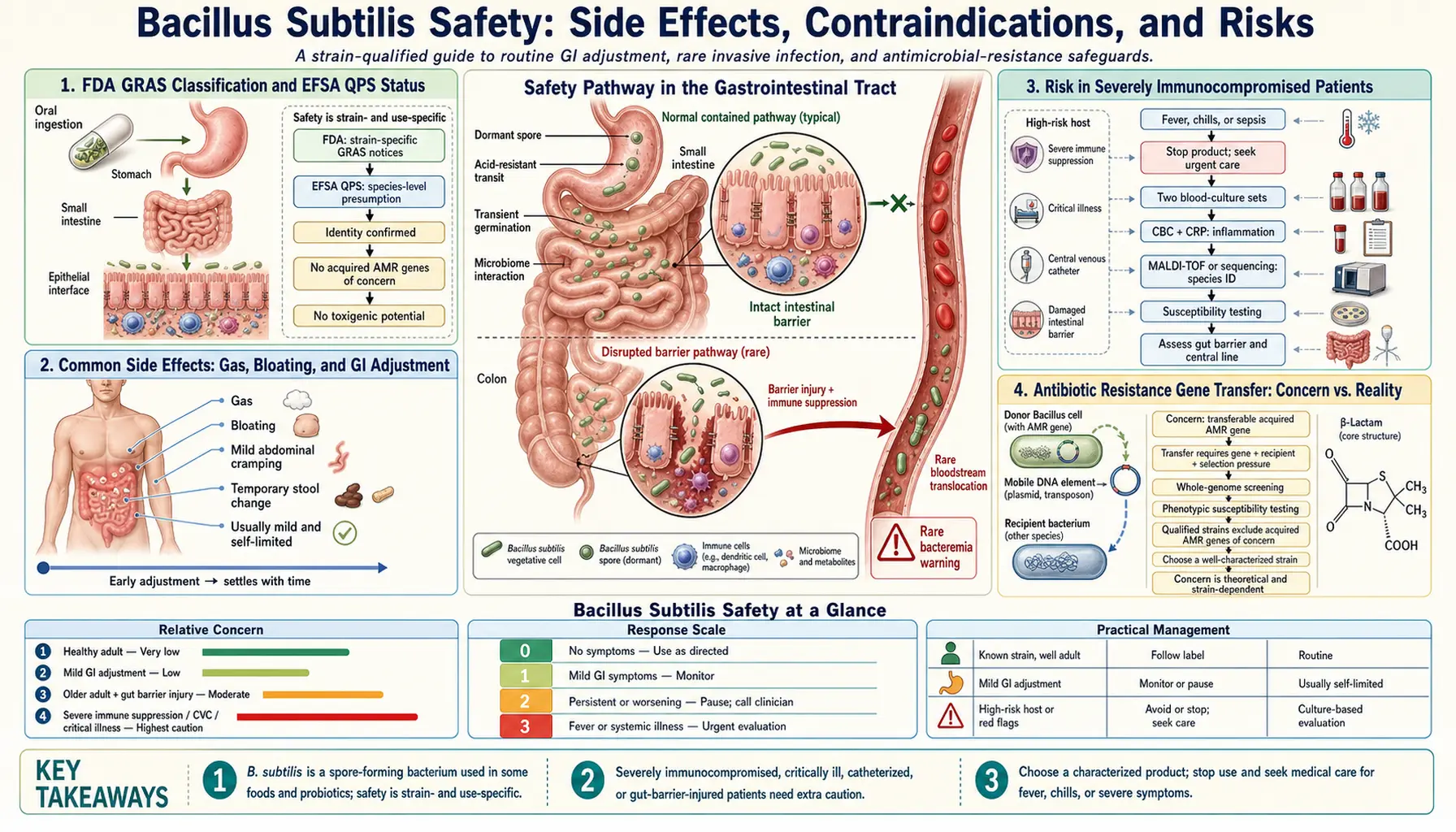
Bacillus subtilis is one of the most thoroughly studied probiotic bacteria in the world, and for good reason: its safety record across decades of human use is remarkably clean. The U.S. Food and Drug Administration has granted it Generally Recognized as Safe (GRAS) status, meaning independent scientific experts agree it poses no harm when used as intended in food and supplements. For healthy adults and most children, B. subtilis probiotic supplements carry a low risk profile — mild, transient digestive adjustment is about as bad as it gets for the vast majority of people. That said, no supplement is risk-free for everyone. People with severely weakened immune systems, those awaiting organ transplants, or patients in intensive care should speak with their doctor before starting any live-organism supplement. This page walks through what the evidence actually says — both the reassurance and the honest caveats.
- FDA GRAS Classification and EFSA QPS Status
- Common Side Effects: Gas, Bloating, and GI Adjustment
- Risk in Severely Immunocompromised Patients
- Antibiotic Resistance Gene Transfer: Concern vs. Reality
- Product Quality: CFU Accuracy and Species Contamination
- Safe Use in Pregnancy and Children
- Dose Ranges from Clinical Trials
- Overall Risk-Benefit Assessment
- Key Research Papers
- Connections
FDA GRAS Classification and EFSA QPS Status
The U.S. Food and Drug Administration's GRAS designation is not automatically handed out. It requires either a formal FDA review or a well-documented independent expert panel determination concluding that a substance is safe under its intended conditions of use. Bacillus subtilis holds GRAS status for use as a direct-fed microbial in food and supplement products. This places it in the same safety tier as many widely consumed food ingredients — not a pharmaceutical drug with extensive clinical trial requirements, but also not an untested novel compound.
Across the Atlantic, the European Food Safety Authority (EFSA) evaluates probiotic bacteria through its Qualified Presumption of Safety (QPS) framework. B. subtilis has been granted QPS status, meaning EFSA's panel of microbiologists considers it safe for use in food-chain applications based on its long history of safe use and the substantial body of published scientific literature. QPS is the European equivalent of a green light for human and animal probiotic use.
What does GRAS actually mean for you as a consumer? It means regulators have reviewed the available evidence — toxicology studies, human use data, case reports — and concluded that B. subtilis as used in probiotic supplements does not pose a safety risk to the general population. It does not mean the FDA individually tested every B. subtilis product on the market (they didn't), and it does not mean zero risk exists for every individual in every circumstance. Think of it as a well-earned baseline of trust built on decades of evidence.
B. subtilis has also been consumed by humans for centuries through fermented foods, most notably natto, a traditional Japanese fermented soybean dish in which B. subtilis var. natto is the primary fermenting organism. Populations eating natto regularly show no unusual adverse event patterns, providing real-world human safety data spanning generations.
Common Side Effects: Gas, Bloating, and GI Adjustment
The most frequently reported side effects from B. subtilis probiotic supplements are mild and temporary digestive symptoms — primarily increased gas and bloating during the first few days to two weeks of use. Some people also notice slightly looser stools or a mild change in bowel frequency when they first start taking a probiotic.
Why does this happen? Your gut is home to trillions of microorganisms that have settled into a particular ecological balance. Introducing a new bacterial strain — even a beneficial one — temporarily disrupts that balance. Resident microbes and the newcomer compete for nutrients and space, producing fermentation byproducts (including gases like hydrogen and carbon dioxide) in the process. Your immune system in the gut lining (called the gut-associated lymphoid tissue, or GALT) also mounts a low-level recognition response to any new microbial arrival. Both of these processes together create the temporary bloating and gas that many first-time probiotic users notice.
For the vast majority of people, these symptoms resolve on their own within one to two weeks as the gut microbiome adjusts. Clinical trials consistently report that adverse event rates in B. subtilis probiotic groups are similar to or only marginally higher than placebo groups, and the events that do occur are almost uniformly mild and self-limiting.
Practical tips if you experience adjustment symptoms:
- Start with a lower dose (some products offer half-dose options) and build up over one to two weeks.
- Take the supplement with food rather than on an empty stomach — this slows microbial transit through the stomach and can reduce sudden GI stimulation.
- Stay well-hydrated; adequate water intake supports normal stool formation.
- If symptoms persist beyond two to three weeks or are severe, stop the supplement and consult a healthcare provider.
True allergic reactions to B. subtilis itself are exceedingly rare in supplement use. However, some B. subtilis-based products are manufactured in facilities that also handle allergens like soy, dairy, or gluten — always check the label if you have food allergies.
Risk in Severely Immunocompromised Patients
Here is where honest caution matters. While B. subtilis is safe for the overwhelming majority of people, there is a theoretical and occasionally documented risk in patients whose immune systems are severely compromised.
The concern is bacteremia — bacteria crossing from the gut into the bloodstream. In a healthy person with an intact gut barrier and a functioning immune system, this is extremely unlikely even with live probiotic supplementation. The gut lining and local immune defenses rapidly eliminate any bacteria that breach the intestinal wall. But in a patient with severely disrupted gut integrity (from chemotherapy, radiation, or critical illness) combined with an immune system that cannot mount an effective response (profound neutropenia, solid organ transplant on high-dose immunosuppression, advanced untreated HIV with very low CD4 counts), the calculus changes.
Case reports of bacteremia or sepsis linked to Bacillus species — including B. subtilis — in immunocompromised patients exist in the medical literature, though they are rare. It is worth noting that these cases often involve patients in intensive care settings with multiple risk factors, and the actual causative link to a probiotic supplement (rather than environmental Bacillus exposure, which is ubiquitous) is not always definitively established.
Nevertheless, the conservative clinical approach is clear: patients in these high-risk categories should not start any live probiotic — including B. subtilis — without discussion with their treating physician or infectious disease team. The risk is low in absolute terms but not zero, and for a patient who is already fighting serious illness, even a low-probability risk deserves careful consideration.
High-risk groups who should consult a doctor before using B. subtilis supplements:
- Patients with profound neutropenia (absolute neutrophil count below 500 cells/µL), including those undergoing induction chemotherapy for leukemia or bone marrow transplant preparation.
- Solid organ transplant recipients on high-dose immunosuppressive regimens in the early post-transplant period.
- People with advanced, untreated HIV infection with CD4 counts below 200 cells/µL.
- Patients with active central venous catheters, intestinal perforation risk, or critical illness requiring ICU admission.
- Premature neonates in intensive care settings (though this applies to all probiotics, not B. subtilis specifically).
For people with moderate immune suppression — well-controlled HIV, stable autoimmune disease on standard doses of a single immunosuppressant, or mild chemotherapy for solid tumors — the risk is far less clear-cut and warrants individual discussion with your medical team rather than a blanket avoidance recommendation.
Antibiotic Resistance Gene Transfer: Concern vs. Reality
One concern that sometimes appears in discussions about probiotic bacteria is the theoretical possibility of antibiotic resistance gene transfer. The worry: if a probiotic bacterium carries genes for antibiotic resistance, could it transfer those genes to harmful bacteria in the gut, making infections harder to treat?
This is a legitimate scientific question that researchers have taken seriously. The reassuring finding is that B. subtilis strains approved and commercially used as probiotics have been genomically characterized, and the strains in use do not carry the clinically relevant, mobile antibiotic resistance elements that would pose a real transfer risk.
B. subtilis does carry some intrinsic resistance genes — most notably, natural resistance to certain beta-lactam antibiotics related to its cell wall structure. But "intrinsic" resistance is very different from "acquired" and "transferable" resistance. Intrinsic resistance is hardwired into the chromosome and cannot be easily transferred to other bacteria through the plasmids or mobile genetic elements (transposons, integrons) that enable resistance spread in clinical settings.
EFSA's QPS scientific committee specifically evaluates antibiotic resistance as part of the QPS qualification process. B. subtilis has passed this evaluation, meaning EFSA concluded that the resistance characteristics of this species do not pose a safety concern for its use in food-chain applications. The key distinction regulators apply is whether resistance is intrinsic (species-specific, chromosomally encoded, non-transferable) versus acquired and mobile (potentially spreadable to pathogens). B. subtilis falls in the former category for its relevant resistance traits.
Genomic surveillance studies of probiotic strains continue to be published, and the consensus remains that commercially used B. subtilis probiotic strains do not present a meaningful antibiotic resistance transfer risk. This remains an active area of research, and regulators appropriately continue to monitor it.
Product Quality: CFU Accuracy and Species Contamination
One of the less-discussed but genuinely important safety considerations for any probiotic supplement is product quality — specifically, whether what is on the label matches what is in the bottle, and whether the product is free from contamination with unintended microorganisms.
CFU count accuracy: Colony Forming Units (CFU) indicate the number of viable bacteria in a dose. Independent testing of commercial probiotic products has repeatedly found significant variation between labeled and actual CFU counts — some products contain far fewer viable organisms than stated, particularly if storage conditions were poor (heat, humidity, and light all degrade live bacteria). For B. subtilis, this matters less than for fragile organisms like Lactobacillus species because B. subtilis forms hardy spores that survive adverse conditions far better. Still, room-temperature storage, expiration dating, and moisture exposure all affect product potency.
Species contamination — the B. cereus concern: This is the more important quality issue for B. subtilis products specifically. Bacillus cereus is a closely related species that can cause food poisoning and, in rare cases, more serious infections. Because B. cereus and B. subtilis are morphologically similar and easy to confuse in low-quality manufacturing, some B. subtilis-labeled products have been found to contain B. cereus contamination on independent testing. B. cereus produces toxins (cereulide and diarrheal enterotoxins) that B. subtilis does not, making contamination genuinely harmful rather than merely inconvenient.
How to reduce your risk of getting a low-quality product:
- Choose products certified by independent third-party testing organizations: USP (United States Pharmacopeia), NSF International, or ConsumerLab. These organizations test for identity, potency, and contamination.
- Look for products from manufacturers who disclose the specific strain (not just the species) — for example, B. subtilis DE111 or B. subtilis QST713. Named strains indicate a manufacturer who tracks their material.
- Store products according to label instructions and check expiration dates.
- Be cautious with very low-cost products from unknown manufacturers, particularly those without third-party certification.
Safe Use in Pregnancy and Children
Data on B. subtilis supplementation specifically during pregnancy are limited — most probiotic pregnancy research focuses on Lactobacillus and Bifidobacterium species. The absence of data is not the same as evidence of harm, but it does mean there is no strong evidence base from which to make confident recommendations either way.
The general consensus among obstetric practitioners is that probiotics with established safety records — including B. subtilis — are unlikely to be harmful in healthy pregnancies, but that their use should be discussed with your obstetrician or midwife. This is especially true in the first trimester when organogenesis is occurring, and for pregnant people with any complications (preterm labor risk, immunosuppression, or cervical incompetence).
Fermented soy products containing B. subtilis (like natto) are consumed regularly during pregnancy in Japan without evidence of harm at the population level — providing some real-world reassurance, though this is not a substitute for controlled clinical data.
In children, probiotic use is common and generally well-tolerated. Pediatric trials using various probiotic species — including some that include B. subtilis — have not shown safety signals in children beyond the usual mild GI adjustment symptoms seen in adults. However, parents should discuss probiotic use for young children, particularly infants under 12 months, with their pediatrician. Premature neonates or infants with underlying medical conditions represent a different risk category requiring specialist guidance.
Dose Ranges from Clinical Trials
Understanding what doses have actually been studied — and what is available in typical supplements — helps put safety in context.
Clinical trials evaluating B. subtilis probiotic effects have generally used doses in the range of 1 × 10⁹ CFU (1 billion CFU) to 1 × 10¹⁰ CFU (10 billion CFU) per day. This range encompasses most of the published human research and represents doses at which both efficacy signals and safety data have been collected. Most trials use once-daily dosing, though some studies use divided doses twice daily.
Commercial B. subtilis supplements typically fall within this range, though some products use lower doses (around 500 million CFU) and some combination probiotic products include B. subtilis as one of multiple strains at varying CFU levels. Multi-strain products complicate dose interpretation because the total CFU count may be shared among several species.
Dose-response relationships for B. subtilis probiotics have not been thoroughly characterized — meaning we don't have strong data proving that higher doses are more effective or riskier. The very high doses sometimes used in agricultural applications (far exceeding human supplement doses) are not relevant to human probiotic safety discussions.
For healthy adults using B. subtilis as a probiotic supplement, doses in the 1 to 10 billion CFU range have a well-documented safety record in clinical trials. There is no evidence that doses within this range cause dose-dependent harm in otherwise healthy individuals. Exceeding these doses substantially (into the tens of billions CFU range) has not been systematically studied for safety and represents an area of genuine uncertainty.
Overall Risk-Benefit Assessment
Pulling everything together, how should you think about B. subtilis safety?
For healthy adults: The risk profile is very favorable. FDA GRAS status, EFSA QPS designation, decades of safe consumption in fermented foods, and consistent clinical trial safety data all point to low risk. Mild GI adjustment symptoms for a week or two are the most likely adverse experience, and these resolve on their own. The evidence base for digestive and immune benefits is meaningful, making the risk-benefit balance positive for most healthy adults who want to try a B. subtilis-containing probiotic.
For people with moderate health conditions (well-controlled diabetes, stable autoimmune disease, mild immune suppression): individual medical history matters. The risk is likely still low, but discussing probiotic use with your primary care provider is reasonable — not because harm is likely, but because your provider's awareness of everything you are taking supports better overall care.
For severely immunocompromised patients: The calculus shifts. While absolute risk remains low even in this population, the consequence of a bacteremic infection in someone with profound neutropenia or recent organ transplant is severe. The conservative recommendation — discuss with your specialist before starting any live probiotic — is appropriate here. In some clinical settings, live probiotics are actively contraindicated in high-risk immunocompromised patients; in others, the decision is made case-by-case based on the specific clinical picture.
Product quality is a real risk that is entirely within your control: Choose third-party certified products from manufacturers who identify their specific strain. This simple step eliminates the most avoidable safety risk associated with B. subtilis supplementation — the possibility of receiving a contaminated or mislabeled product.
The bottom line is that Bacillus subtilis is among the better-characterized probiotic organisms from a safety standpoint. Its regulatory approvals on two continents, its history in traditional foods, and its clinical trial record together paint a reassuring picture for most people. The caveats are real but narrow — primarily affecting a specific and identifiable high-risk population, and primarily addressable through product quality choices.
Key Research Papers
- Lefevre M et al. Safety assessment of Bacillus subtilis ATCC PTA-6737 in healthy adults: a randomized trial. Regulatory Toxicology and Pharmacology. 2015. — Search PubMed
- Sanders ME et al. Safety assessment of probiotics for human use. Gut Microbes. 2010. — Search PubMed
- Bernardeau M et al. Safety and efficacy of probiotic Bacillus in animal husbandry — implications for human safety. Veterinary Research. 2009. — Search PubMed
- Urdaci MC et al. Bacillus clausii probiotic strains: antimicrobial and immunomodulatory activities; context for Bacillus probiotic safety evaluation. Journal of Clinical Gastroenterology. 2004. — Search PubMed
- Ionta V et al. Probiotic safety in immunocompromised patients: a systematic review. Clinical Infectious Diseases. 2019. — Search PubMed
- Spinler JK et al. Human-derived probiotic Lactobacillus reuteri demonstrate antimicrobial activities targeted against diverse enteric bacterial pathogens — cross-species probiotic safety context. Anaerobe. 2008. — Search PubMed
- Rea MC et al. Gut microbiota and antibiotic resistance gene monitoring in probiotic safety assessment. FEMS Microbiology Letters. 2017. — Search PubMed
- Cutting SM. Bacillus probiotics. Food Microbiology. 2011. — Search PubMed
- Sorokulova I. Biological basis for the use of bacilli as probiotics. Journal of Molecular Microbiology and Biotechnology. 2008. — Search PubMed
- Elshaghabee FM et al. Bacillus as potential probiotics: status, concerns, and future perspectives. Frontiers in Microbiology. 2017. — Search PubMed
- Hong HA et al. The use of bacterial spore formers as probiotics. FEMS Microbiology Reviews. 2005. — Search PubMed
Connections
- All Bacteria
- Bacillus Subtilis Hub
- B. subtilis Benefits & Safety Overview
- Probiotic Supplements Using B. subtilis
- B. subtilis Probiotic Uses
- Probiotics in Food