Methylene Blue: History and Discovery
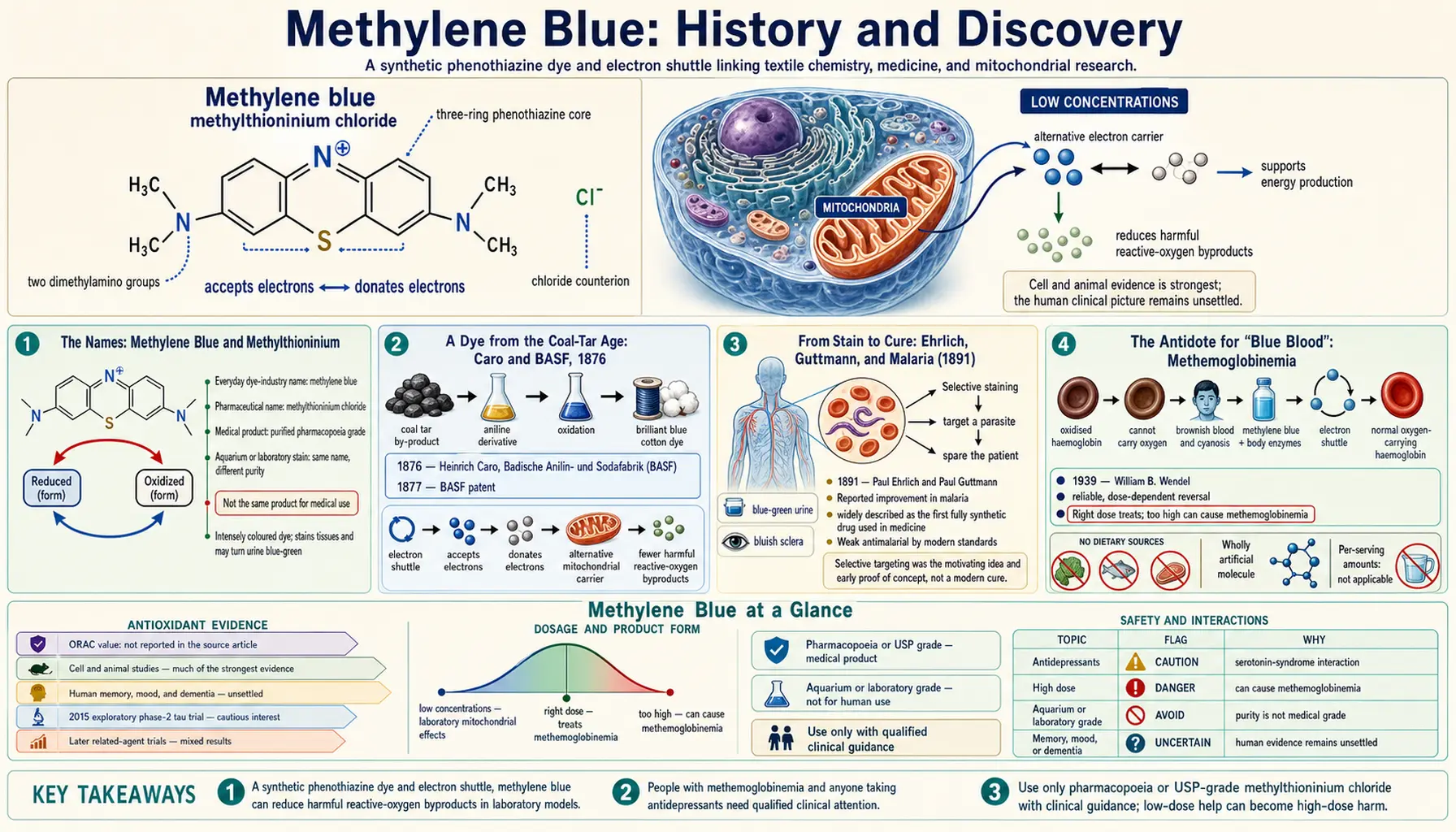
Methylene blue began not in a laboratory but in the synthetic-dye industry: it was first synthesised in 1876 by the German chemist Heinrich Caro as a textile dye (Wiklund 2007), at the chemical company Badische Anilin- und Soda-Fabrik, BASF (Krafts 2011). By 1891 it had been given to patients with malaria, and reviews describe it as the first synthetic drug (Schirmer 2011) and the oldest known synthetic antimalarial (Wainwright & Amaral 2005). From there its story runs through Paul Ehrlich's staining and malaria work, its use as an antidote for methemoglobinemia ("blue blood"), and the phenothiazine chemistry from which chlorpromazine, an early antipsychotic drug, was developed. This article sets out what the historical record supports, gives a source for each name and date, and marks the places where a famous claim is less certain than it sounds.
Table of Contents
- The Names: Methylene Blue and Methylthioninium
- A Dye from the Coal-Tar Age: Caro and BASF, 1876
- From Stain to Cure: Ehrlich, Guttmann, and Malaria (1891)
- The Antidote for "Blue Blood": Methemoglobinemia
- From Dye Chemistry to Antipsychotics: The Phenothiazines
- Rediscovery: Mitochondria, Memory, and Alzheimer’s
- From Coal-Tar Dye to Modern Antioxidant
- Key Research Papers
- Connections
- Featured Videos
The Names: Methylene Blue and Methylthioninium
The everyday name methylene blue is a dye-industry name. The international name of the medicine is methylthioninium chloride, the name under which the World Health Organization lists it as an essential medicine (WHO eEML). Its chemical name, 3,7-bis(dimethylamino)phenothiazinium chloride (Wainwright & Amaral 2005), spells out its structure: a three-ring phenothiazine core carrying two dimethylamino groups. That phenothiazine skeleton is the thread that, as a later section shows, connects a textile dye to a family of later medicines.
The colour is the reason the compound exists at all. Methylene blue is an intensely coloured dye that stains tissues and fabrics, and in people it colours the urine: the US label reports discoloured urine and skin after intravenous doses (FDA label, 2023). Its ability to stain some cells and structures but not others is what first drew physicians to it. The idea commonly told as the starting point of Paul Ehrlich's work is that a dye that picks out a parasite under the microscope might also act against that parasite inside the body.
One more naming point matters. The substance sold as an aquarium treatment or a laboratory stain shares the name "methylene blue" but is not made to the same standard: only the pharmaceutical grade is made and tested to a pharmacopoeial monograph for medicines. The grades, and what has and has not been measured in them, are covered on the companion page on pharmaceutical and industrial methylene blue.
A Dye from the Coal-Tar Age: Caro and BASF, 1876
Methylene blue is a product of the nineteenth-century synthetic-dye industry, the era when chemists made new colours from coal-tar chemicals and when those colours built some of the first large chemical companies. It was first synthesised in 1876 by Heinrich Caro for use as a textile dye (Wiklund 2007), at Badische Anilin- und Soda-Fabrik (BASF), a chemical company (Krafts 2011). The chemist, the company and the year agree across the reviews cited on this page. A patent date of 1877 is often repeated, but no indexed source for it was found, so it is not given here.
Because methylene blue is a synthetic molecule that did not exist in nature until a chemist made it, naming a single discoverer is appropriate here — unlike a plant medicine, which emerges from the accumulated practice of many cultures.
Methylene blue entered the world as a commercial product of the dye industry, not as a remedy. Its medical uses followed because a textile colour turned out to have biological effects. That is why the same molecule appears in the dye industry of the 1870s and on the World Health Organization's Model List of Essential Medicines today, where methylthioninium chloride has been listed as a specific antidote since 1979 (WHO eEML).
From Stain to Cure: Ehrlich, Guttmann, and Malaria (1891)
The move from dye to drug centres on the German physician and scientist Paul Ehrlich, who later shared the 1908 Nobel Prize in Physiology or Medicine for work on immunity (Nobel Prize, 1908). Reviews credit Ehrlich with introducing methylene blue to biology (Oz 2011) and describe phenothiazine dyes as first used by him for histochemical stains of malaria parasites (Ohlow 2011); Robert Koch used methylene blue six years after its synthesis, when he discovered the tubercle bacillus (Krafts 2011). Ehrlich was interested in why certain dyes stained some cells and tissues but not others, and the story commonly told is that this selectivity led him towards the idea of a drug aimed at a pathogen — the "magic bullet" for which he later became known.
In 1891, the physician Paul Guttmann and Ehrlich reported giving methylene blue to patients with malaria (Guttmann & Ehrlich 1891). A 2018 systematic review summarises that report as two patients, both cured, with urogenital symptoms in one (Lu 2018). Reviews describe methylene blue as the first synthetic antimalarial to be used (Lu 2018), as the oldest known synthetic antimalarial drug (Wainwright & Amaral 2005) and as the first synthetic drug (Schirmer 2011).
Two qualifications belong here. First, methylene blue stopped being used against malaria after newer synthetic antimalarials were developed (Lu 2018), but the same review does not describe it as a weak drug: across the 21 studies it included — older case series and recent controlled trials of combination regimens — methylene blue was consistently shown to be highly effective, with mild urogenital and gastrointestinal symptoms and blue urine as the reported side effects, and the authors discuss it as a possible partner drug for artemisinin-based combination therapy (Lu 2018). Second, "the first synthetic drug" is a characterisation rather than an undisputed title: Ehrlich and A. Leppmann had already published a paper in 1890 on the pain-relieving action of methylene blue (Ehrlich & Leppmann 1890). What the reviews agree on is that methylene blue's role in the history of antimalarials can be linked directly to standard drugs such as chloroquine (Wainwright & Amaral 2005), and that methylene blue eventually led to the discovery of the neuroleptic drug families (Wainwright 2002).
The Antidote for "Blue Blood": Methemoglobinemia
While methylene blue fell out of use for malaria, it kept a different medical role. In methemoglobinemia, the iron of haemoglobin is oxidised from the ferrous to the ferric form (methaemoglobin), which does not carry oxygen; the condition presents with symptoms of tissue hypoxia and a "cyanosis" that does not respond to oxygen therapy (Bradberry 2003). It can be hereditary or acquired (Lu 2018), and most occupational cases are caused by aromatic compounds such as amino- and nitro-derivatives of benzene (Bradberry 2003). Methylene blue acts as an electron shuttle: it interacts with methaemoglobin and the red cell's enzyme systems to reduce it back to haemoglobin (Clifton & Leikin 2003), an antidotal action that depends on NADP+ and is weaker or absent in glucose-6-phosphate dehydrogenase (G6PD) deficiency (Bradberry 2003).
Two papers from the 1930s belong to this part of the history. In 1933 Matilda Moldenhauer Brooks published "Methylene blue as antidote for cyanide and carbon monoxide poisoning" in JAMA (Brooks 1933), and in 1939 William B. Wendel published "The Control of Methemoglobinemia with Methylene Blue" in the Journal of Clinical Investigation (Wendel 1939). A 2011 review describes methylene blue as the first line of treatment in methemoglobinemias (Oz 2011). A 2003 toxicology review notes that no controlled trial of its efficacy has been performed, but that clinical experience suggests it can increase the rate of conversion of methaemoglobin back to haemoglobin some 6-fold (Bradberry 2003). In the United States, a methylene blue injection (5 mg/mL) was approved in 2016, under accelerated approval, for acquired methemoglobinemia (FDA label, 2023).
The same chemistry has a second side. In the presence of haemolysis, high-dose methylene blue (20–30 mg/kg) can itself start methaemoglobin formation (Bradberry 2003); the US label reports mild methemoglobinemia (up to 7%) after large cumulative intravenous doses of 7 mg/kg or more (FDA label, 2023); and a 2016 Alzheimer's trial excluded people taking medicines that carry warnings of methaemoglobinaemia because the oxidised form of the molecule has been shown to induce the condition at high doses (Gauthier 2016). An antidote for methemoglobinemia that can also cause it at high doses is a recurring theme in the compound's modern story.
From Dye Chemistry to Antipsychotics: The Phenothiazines
The most far-reaching chapter in methylene blue's history concerns what chemists built from its chemical family. Methylene blue is a phenothiazinium dye, and a 2011 review calls the phenothiazine structure, rooted in the early days of organic dye chemistry, pharmacology's first lead structure (Ohlow 2011). A history of chlorpromazine traces the phenothiazines to the German dye industry at the end of the nineteenth century, naming the chemists Graebe, Liebermann and Bernthsen, and reports that up to 1940 they were used as antiseptics, anthelmintics and antimalarials (López-Muñoz 2005). Clinical use of N-substituted phenothiazines as antihistamines followed in the 1940s, and as sedatives and antipsychotics in the 1950s (Ohlow 2011).
The pivotal moment came in December 1950, when chlorpromazine was synthesised at the Rhône-Poulenc laboratories in France, by a team that the review names as Charpentier, Courvoisier and Koetschet, in the course of post-war French research on antihistamines (López-Muñoz 2005). Laborit introduced it in anaesthesiology, and it entered psychiatry in 1952, through two Paris hospital groups: Val-de-Grâce (Laborit, Hamon, Paraire) and Sainte-Anne (Delay and Deniker). The same review describes the phenothiazines as the first family of antipsychotic agents, and calls the discovery of chlorpromazine's antipsychotic properties a fundamental event for the practice of psychiatry and for the genesis of the "psychopharmacological revolution" (López-Muñoz 2005).
Language matters here: chlorpromazine is a member of methylene blue's chemical family, not methylene blue itself, and the two are different drugs with different actions. What the reviews support is that methylene blue eventually led to the discovery of the neuroleptic drug families (Wainwright 2002), and that the phenothiazine structure went on to serve as a lead structure for several drug classes (Ohlow 2011).
Rediscovery: Mitochondria, Memory, and Alzheimer’s
For much of the twentieth century methylene blue was used as an antidote, a surgical and diagnostic dye and a laboratory reagent. The renewed scientific interest in it grows out of the same electron-shuttling chemistry. A 2018 review describes how methylene blue can reroute electrons in the mitochondrial electron transfer chain directly from NADH to cytochrome c, increasing the activity of complex IV and promoting mitochondrial activity while mitigating oxidative stress, and reports that in cell and animal studies it reduced neurodegeneration in models of stroke, Alzheimer's disease, Parkinson's disease and traumatic brain injury (Tucker 2018). This is the basis for the modern framing of methylene blue as a mitochondrial and antioxidant-related compound.
A second strand of research came from neurology. In 1996, Claude Wischik and colleagues reported that methylene blue blocked the binding of tau — the protein whose tangles are a hallmark of Alzheimer's disease — in the laboratory, though at a higher concentration than may be achieved clinically; in the same study, neuroleptic phenothiazines were inactive (Wischik 1996). An exploratory phase 2 trial of methylthioninium in 321 people with mild or moderate Alzheimer's disease, published in 2015, reported benefits at the 138 mg/day dose on some outcomes and concluded that further study was warranted (Wischik 2015). A 15-month phase 3 trial of a related compound, leuco-methylthioninium (LMTM), in 891 participants, published in 2016, found no treatment benefit on its coprimary outcomes; its authors wrote that the results do not suggest benefit of LMTM as an add-on treatment for mild to moderate Alzheimer's disease (Gauthier 2016). The 2011 review by R. Heiner Schirmer and colleagues, "Lest we forget you — methylene blue…", surveyed the history of the compound and this renewed interest in malaria and Alzheimer's disease (Schirmer 2011).
Much of the mitochondrial and neuroprotective evidence is from cell and animal studies, and the human clinical picture for memory, mood and dementia remains unsettled. The evidence, mechanisms, dosing reports and safety findings — above all the serotonin-syndrome interaction with many antidepressants — are covered on the main Methylene Blue page and the Benefits articles. This history is concerned only with how a dye came to be studied for the brain at all.
From Coal-Tar Dye to Modern Antioxidant
Taken together, methylene blue's history runs from a textile dye (1876) to an early synthetic antimalarial (1891), to an antidote for methemoglobinemia (papers from the 1930s; WHO essential-medicines listing since 1979; US approval of a 5 mg/mL injection in 2016), to the chemical family that produced chlorpromazine (1950), and to modern research into mitochondria and neurodegeneration. At almost every step the history is anchored to named people, named institutions and datable publications.
The dye-industry origin also explains a modern quality question: the aquarium and laboratory grades share the name but are not made to a pharmacopoeial monograph for medicines. And the molecule's best-known paradox — an antidote for methemoglobinemia that can cause the same condition at high doses — is documented in toxicology reviews and in modern trial exclusion criteria (Bradberry 2003; Gauthier 2016).
A long history shows what a compound has been used for and where it came from; it does not show that every modern use is proven or safe. Decisions about medicines belong with a clinician.
Key Research Papers
The list below gathers peer-reviewed reviews and primary papers that document methylene blue's history and pharmacology, together with regulatory and reference sources and PubMed topic searches. Author names, titles, and journals are given as plain text; only the stable PMID, DOI or source address is hyperlinked, and each opens in a new tab.
- Schirmer RH, Adler H, Pickhardt M, Mandelkow E. "Lest we forget you — methylene blue…". Neurobiology of Aging. 2011;32(12):2325.e7-2325.e16. — PubMed PMID: 21316815
- Oz M, Lorke DE, Hasan M, Petroianu GA. Cellular and molecular actions of methylene blue in the nervous system. Medicinal Research Reviews. 2011;31(1):93-117. — PubMed PMID: 19760660
- Wainwright M, Crossley KB. Methylene blue — a therapeutic dye for all seasons? Journal of Chemotherapy. 2002;14(5):431-443. — PubMed PMID: 12462423
- Wendel WB. The control of methemoglobinemia with methylene blue. Journal of Clinical Investigation. 1939;18(2):179-185. — doi:10.1172/JCI101033
- Wischik CM, Staff RT, Wischik DJ, et al. Tau aggregation inhibitor therapy: an exploratory phase 2 study in mild or moderate Alzheimer's disease. Journal of Alzheimer's Disease. 2015;44(2):705-720. — PubMed PMID: 25550228
- Ostrovsky A, Afzal M. Methylene blue. In: StatPearls. StatPearls Publishing. — NCBI Bookshelf: NBK557593
- Wiklund L, Basu S, Miclescu A, Wiklund P, Ronquist G, Sharma HS. Neuro- and cardioprotective effects of blockade of nitric oxide action by administration of methylene blue. Annals of the New York Academy of Sciences. 2007;1122:231-244. — PubMed PMID: 18077576
- Krafts K, Hempelmann E, Oleksyn BJ. In search of the malarial parasite: biographical sketches of the blood stain contributors. Parasitology Research. 2011;109(3):521-529. — PubMed PMID: 21660627
- Guttmann P, Ehrlich P. Über die Wirkung des Methylenblau bei Malaria. Berliner Klinische Wochenschrift. 1891;28. Reprinted in: The Collected Papers of Paul Ehrlich. 1960:9-14 (reprint; the 1891 original is not indexed). — doi:10.1016/b978-0-08-009056-6.50006-3
- Ehrlich P, Leppmann A. Ueber schmerzstillende Wirkung des Methylenblau. Deutsche Medizinische Wochenschrift. 1890;16(23):493-494. — doi:10.1055/s-0029-1209911
- Wainwright M, Amaral L. The phenothiazinium chromophore and the evolution of antimalarial drugs. Tropical Medicine & International Health. 2005;10(6):501-511. — PubMed PMID: 15941412
- Lu G, Nagbanshi M, Goldau N, Mendes Jorge M, Meissner P, Jahn A, Mockenhaupt FP, Müller O. Efficacy and safety of methylene blue in the treatment of malaria: a systematic review. BMC Medicine. 2018;16(1):59. — PubMed PMID: 29690878
- Bradberry SM. Occupational methaemoglobinaemia. Mechanisms of production, features, diagnosis and management including the use of methylene blue. Toxicological Reviews. 2003;22(1):13-27. — PubMed PMID: 14579544
- Clifton J 2nd, Leikin JB. Methylene blue. American Journal of Therapeutics. 2003;10(4):289-291. — PubMed PMID: 12845393
- Brooks MM. Methylene blue as antidote for cyanide and carbon monoxide poisoning. JAMA. 1933;100:59. — doi:10.1001/jama.1933.02740010061028
- Ohlow MJ, Moosmann B. Phenothiazine: the seven lives of pharmacology's first lead structure. Drug Discovery Today. 2011;16(3-4):119-131. — PubMed PMID: 21237283
- López-Muñoz F, Alamo C, Cuenca E, Shen WW, Clervoy P, Rubio G. History of the discovery and clinical introduction of chlorpromazine. Annals of Clinical Psychiatry. 2005;17(3):113-135. — PubMed PMID: 16433053
- Tucker D, Lu Y, Zhang Q. From mitochondrial function to neuroprotection — an emerging role for methylene blue. Molecular Neurobiology. 2018;55(6):5137-5153. — PubMed PMID: 28840449
- Wischik CM, Edwards PC, Lai RY, Roth M, Harrington CR. Selective inhibition of Alzheimer disease-like tau aggregation by phenothiazines. Proceedings of the National Academy of Sciences of the USA. 1996;93(20):11213-11218. — PubMed PMID: 8855335
- Gauthier S, Feldman HH, Schneider LS, et al. Efficacy and safety of tau-aggregation inhibitor therapy in patients with mild or moderate Alzheimer's disease: a randomised, controlled, double-blind, parallel-arm, phase 3 trial. Lancet. 2016;388(10062):2873-2884. — PubMed PMID: 27863809
- U.S. Food and Drug Administration, Drugs@FDA. Methylene blue injection, 5 mg/mL, for intravenous use: prescribing information (NDA 204630), revised November 2023 — accessdata.fda.gov
- World Health Organization. Electronic Essential Medicines List (eEML): methylthioninium chloride, specific antidotes, first added 1979 — list.essentialmeds.org
- The Nobel Prize in Physiology or Medicine 1908 (Ilya Mechnikov and Paul Ehrlich, "in recognition of their work on immunity") — nobelprize.org
PubMed Topic Searches
- Methylene blue history and medical uses — PubMed: methylene blue history and Ehrlich
- Phenothiazine dyes and the origin of chlorpromazine — PubMed: phenothiazine history and chlorpromazine