PQQ (Pyrroloquinoline Quinone): History and Discovery
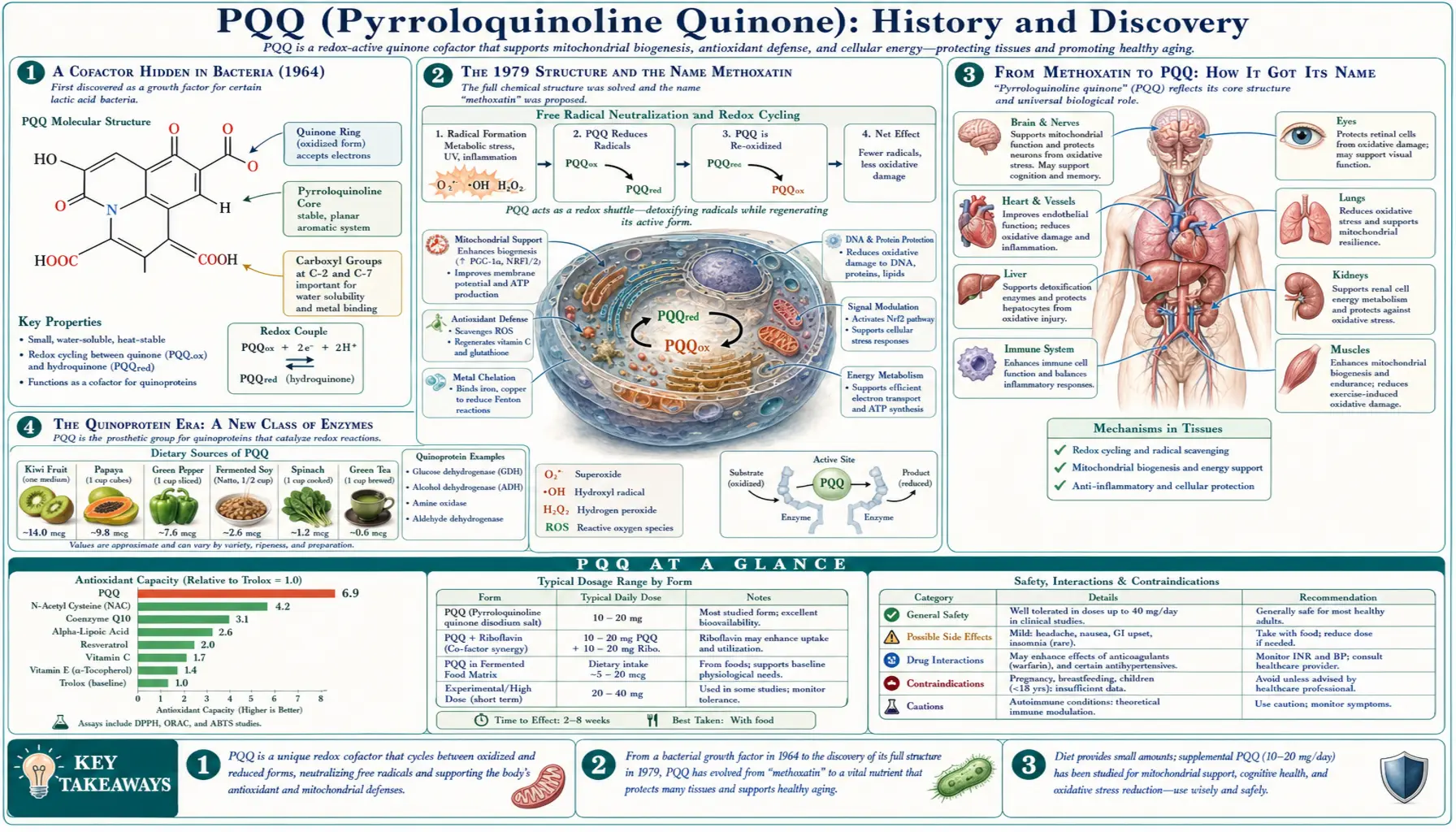
Unlike a herb with thousands of years of folk use behind it, the story of PQQ is almost entirely a scientific one, and a fairly recent one at that. PQQ was not handed down by tradition — it was teased out of bacteria in the laboratory, its structure solved by X-ray crystallography, and its place in human nutrition argued over in the pages of Nature. This article traces what the documented record actually supports: a strange cofactor first glimpsed in microbes in 1964, the 1979 structure that revealed a brand-new kind of redox molecule, the names it picked up along the way, a high-profile and contested claim in 2003 that it was a missing vitamin, and the discovery in 2010 that it can switch on the growth of new mitochondria. Where the record is firm we say so; where a claim was disputed or remains unsettled — as several here genuinely are — we say that too.
Table of Contents
- A Cofactor Hidden in Bacteria (1964)
- The 1979 Structure and the Name "Methoxatin"
- From Methoxatin to PQQ: How It Got Its Name
- The Quinoprotein Era: A New Class of Enzymes
- The 2003 "Vitamin B14" Claim
- The 2005 Rebuttal and PQQ's Status Today
- Where PQQ Comes From: Diet and Breast Milk
- Mitochondrial Biogenesis and the Supplement Era (2010–)
- Research Papers and References
- Connections
- Featured Videos
A Cofactor Hidden in Bacteria (1964)
For most of the twentieth century, biochemists believed living things ran on a short list of redox cofactors — the small helper molecules that enzymes use to shuttle electrons. Two families dominated the textbooks: the nicotinamide cofactors (NAD and NADP, built from vitamin B3) and the flavins (FAD and FMN, built from vitamin B2, riboflavin). The idea that there might be a third, entirely separate family was not on anyone's map.
The first crack in that picture came in 1964, when the Norwegian biochemist Jens Gabriel Hauge was studying a glucose-oxidizing enzyme from a bacterium then called Bacterium anitratum (today classified in the genus Acinetobacter). Hauge found that the enzyme depended on a redox-active group that was clearly neither a nicotinamide nor a flavin. He had stumbled onto something new. His best guess at the time was that it might be a naphthoquinone — a reasonable hypothesis that later turned out to be wrong, but his central observation held up: there really was a previously unrecognized cofactor at work.
Over the following years other groups kept running into the same mysterious group, particularly in the alcohol- and methanol-oxidizing enzymes of bacteria that live on simple one-carbon compounds. The cofactor was tantalizing precisely because no one could pin down its chemical structure — it was bound up inside enzymes and resisted easy identification. What the 1960s and 1970s established was therefore a puzzle rather than an answer: a genuinely novel redox cofactor existed in bacteria, but chemistry had not yet caught up to it.
The 1979 Structure and the Name "Methoxatin"
The puzzle was solved in 1979. A team at the University of Cambridge — Stanley A. Salisbury, Hugh S. Forrest, William B. T. Cruse, and Olga Kennard — succeeded in freeing the elusive cofactor from a bacterial alcohol dehydrogenase, crystallizing it, and determining its structure by X-ray crystallography. Their paper, "A novel coenzyme from bacterial primary alcohol dehydrogenases," appeared in Nature in 1979. They gave the molecule the name methoxatin, and the structure they revealed was striking: a flat, three-ringed (tricyclic) ortho-quinone unlike any cofactor previously known.
This was the moment PQQ stopped being a rumour and became a defined chemical entity. The structure explained why earlier guesses (including Hauge's naphthoquinone idea) had missed the mark — the real molecule was a fused pyrrole-pyridine-benzene system carrying three carboxylic-acid groups, something no one had anticipated. The same year, the Dutch biochemist Johannis A. (Hans) Duine and colleagues in Delft were independently characterizing the prosthetic group of methanol dehydrogenase and publishing supporting spectroscopic evidence for a quinone structure, so the 1979 identification rests on more than one laboratory's work.
It is worth being precise about what was "discovered" here and what was not. No single person discovered PQQ the way one might discover a comet; it had been glimpsed by several groups over fifteen years. What Salisbury, Forrest, Cruse, and Kennard did was specific and datable: they determined its molecular structure and gave science its first clear look at what would soon be recognized as a third class of redox cofactor.
From Methoxatin to PQQ: How It Got Its Name
The molecule arrived in the literature with more than one name, which is a common fate for compounds discovered by separate groups at almost the same time. The Cambridge group's coinage, methoxatin, reflected its association with methanol-metabolizing enzymes. But as its full chemical architecture became clear, a more descriptive name took hold in the early 1980s: pyrroloquinoline quinone, abbreviated PQQ.
That name is essentially a map of the molecule. "Pyrrolo" points to the pyrrole ring, "quinoline" to the fused pyridine-and-benzene portion, and "quinone" to the reactive carbonyl groups that do the electron-carrying work. Its formal chemical name — 4,5-dihydro-4,5-dioxo-1H-pyrrolo[2,3-f]quinoline-2,7,9-tricarboxylic acid — spells out the same structure in full. Today "PQQ" is the dominant term in both research and the supplement aisle, while "methoxatin" survives mostly as a historical synonym you will still see in older papers and chemical databases.
The Quinoprotein Era: A New Class of Enzymes
Once PQQ's structure was known, the 1980s became the decade of working out what it actually does. The answer reshaped a corner of biochemistry. PQQ turned out to be the founding member of a family of enzymes that came to be called quinoproteins — enzymes that use a quinone cofactor, rather than NAD or a flavin, to carry out oxidation reactions. In bacteria this is no minor sideline: PQQ-dependent dehydrogenases let microbes oxidize alcohols and sugars, and they are central to how methylotrophic bacteria make a living from methanol and methane.
Establishing PQQ as the third great redox cofactor — alongside the nicotinamides and the flavins — was a genuine milestone, and Hans Duine and his collaborators in Delft did much of the work that cemented it. This bacterial role is the part of PQQ's biology that is least disputed and best understood. It also set up the central question that would dominate the next phase of the story and remains the most interesting tension in PQQ's history: if this cofactor is so important in microbes, does it do anything in us?
The 2003 "Vitamin B14" Claim
The question of a role in mammals came to a head in 2003, in one of the most talked-about — and most contested — episodes in PQQ's history. Researchers Takaoki Kasahara and Tadafumi Kato, working at the RIKEN Brain Science Institute in Japan, published a short paper in Nature titled "A new redox-cofactor vitamin for mammals." They reported that an enzyme they believed was involved in the mouse's handling of the amino acid lysine appeared to depend on PQQ — and concluded that PQQ should be regarded as a new vitamin.
The claim caused a stir well beyond the laboratory. Press coverage at the time billed it as potentially the first new vitamin identified in decades, and the molecule picked up the popular label "vitamin B14," slotting it into the familiar B-vitamin numbering alongside B2 (riboflavin) and B3 (niacin). It is worth stressing that "vitamin B14" was a proposed and popularly attached designation, not an officially adopted classification — and, as the next section shows, it did not survive scientific scrutiny.
The 2005 Rebuttal and PQQ's Status Today
The vitamin claim did not stand unchallenged for long. In 2005, Nature published two pointed responses. Leigh M. Felton and Chris Anthony argued that the 2003 conclusion rested on a flawed sequence analysis: the enzyme Kasahara and Kato pointed to was not, on closer inspection, a PQQ-dependent dehydrogenase at all, but a protein with a seven-bladed "β-propeller" fold that databases had been mislabelling as a PQQ-binding motif. Separately, Robert Rucker and colleagues reported that when they tried to reproduce the underlying biochemistry — the supposed disruption of lysine metabolism in PQQ-deprived rodents — the predicted effects simply did not appear.
Two honest clarifications belong here, because this episode is often misreported. First, the 2003 paper was rebutted, not formally retracted — the scientific community judged its specific "new vitamin" conclusion unsupported, but the original article was answered in print rather than withdrawn. Second, rejecting the vitamin claim is not the same as saying PQQ does nothing in mammals. The narrow assertion that fell apart was that PQQ is an essential dietary vitamin acting as the cofactor for a specific human lysine-metabolizing enzyme.
So where does that leave PQQ today? It has no established classical vitamin status: there is no defined human deficiency disease and no official recommended intake. At the same time, a large body of later work shows PQQ is biologically active when taken at supplemental doses. The fair, current description — and the one used across this site — is that PQQ is a conditionally beneficial bioactive compound: not a proven essential nutrient, but a molecule with real, measurable effects on cells. The detailed evidence for those effects, with its strengths and limits, is covered on the main PQQ page and in the PQQ Benefits articles.
Where PQQ Comes From: Diet and Breast Milk
If PQQ is not a classical vitamin, where do people actually get it? The groundwork for answering this was laid in 1995, when Toshihide Kumazawa and colleagues published "Levels of pyrroloquinoline quinone in various foods" in the Biochemical Journal. Using gas chromatography–mass spectrometry, they detected free PQQ in every food they tested, at concentrations on the order of a few to a few dozen nanograms per gram — in other words, PQQ is genuinely widespread in the diet, but only in trace amounts.
Later analyses filled in which foods are comparatively rich: fermented soybeans (natto), parsley, green peppers, kiwi fruit, and green tea tend to sit near the top, with spinach, celery, and other vegetables contributing smaller amounts. Even so, the total intake is small — typical dietary PQQ is usually estimated in the range of a fraction of a milligram per day, far below the 10–40 mg doses used in supplement trials. This gap between what food provides and what produces measurable effects in studies is exactly why PQQ is researched as a supplement rather than treated as an ordinary micronutrient.
One observation from this nutritional literature did more than any other to keep the "is it important for us?" question alive: PQQ is present in human breast milk, and at higher concentrations than in cow's milk. To many researchers, the fact that mother's milk reliably delivers a small dose of PQQ to infants hinted at some developmental role — a hint, not a proof, but a recurring reason the molecule has continued to attract attention as a possible "vitamin-like" nutrient.
Mitochondrial Biogenesis and the Supplement Era (2010–)
The discovery that most reshaped PQQ's modern reputation came in work published around 2010 by Winyoo Chowanadisai, Robert Rucker, and colleagues at the University of California, Davis, in the Journal of Biological Chemistry. Studying mouse cells, they found that PQQ does something few nutrients do: it triggers mitochondrial biogenesis — the creation of new mitochondria inside the cell. Mechanistically, PQQ prompted phosphorylation of the signalling protein CREB and increased expression of PGC-1α, the master regulator that orchestrates the building of new mitochondria. When the researchers silenced CREB or PGC-1α, the effect disappeared — strong evidence that this pathway was doing the work.
This was a turning point because it gave PQQ a clear, distinctive mechanism that did not depend on the discredited vitamin claim. Where most antioxidants merely soak up reactive molecules, PQQ appeared to act as a signal that tells cells to expand their energy-producing machinery — the same kind of response normally triggered by exercise and calorie restriction. It is this finding, more than anything else, that moved PQQ from the bacterial-biochemistry literature into the world of energy, cognition, and healthy-aging supplements.
The decade that followed brought commercial PQQ (notably the fermentation-derived BioPQQ, later joined by synthetic disodium-salt versions) and a run of small human trials — mostly from Japan and Korea — examining effects on cognition, sleep, fatigue, and markers of inflammation, often pairing PQQ with CoQ10. Two cautions close the historical record honestly. First, much of the foundational mechanistic work is from cell and animal studies, and the human trials are generally small and short; an interesting mechanism is a reason to investigate, not proof of benefit. Second, PQQ's journey — from a baffling smudge in a 1960s bacterial enzyme, to a solved structure, to a rejected vitamin, to a mitochondrial signalling molecule — is a useful reminder of how science actually moves: by claim, challenge, and correction, not in a straight line.
Research Papers and References
The list below gathers the key primary papers behind PQQ's documented history — its 1979 structure, the contested 2003 vitamin claim and the 2005 responses, the food-content survey, and the 2010 mitochondrial-biogenesis work — together with curated PubMed topic searches. Author names, titles, and journals are given as plain text; only the stable DOI or PMID is hyperlinked, and each opens in a new tab.
- Salisbury SA, Forrest HS, Cruse WBT, Kennard O. A novel coenzyme from bacterial primary alcohol dehydrogenases. Nature. 1979;280(5725):843-844. — doi:10.1038/280843a0 · PMID: 471057
- Kumazawa T, Sato K, Seno H, Ishii A, Suzuki O. Levels of pyrroloquinoline quinone in various foods. Biochemical Journal. 1995;307(Pt 2):331-333. — doi:10.1042/bj3070331 · PMID: 7733865
- Kasahara T, Kato T. Nutritional biochemistry: A new redox-cofactor vitamin for mammals. Nature. 2003;422(6934):832. — doi:10.1038/422832a · PMID: 12712191
- Felton LM, Anthony C. Biochemistry: role of PQQ as a mammalian enzyme cofactor? Nature. 2005;433(7025):E10; discussion E11-12. — doi:10.1038/nature03322 · PMID: 15689995
- Rucker R, Storms D, Sheets A, Tchaparian E, Fascetti A. Biochemistry: is pyrroloquinoline quinone a vitamin? Nature. 2005;433(7025):E10-11; discussion E11-12. — doi:10.1038/nature03323 · PMID: 15689994
- Chowanadisai W, Bauerly KA, Tchaparian E, Wong A, Cortopassi GA, Rucker RB. Pyrroloquinoline quinone stimulates mitochondrial biogenesis through cAMP response element-binding protein phosphorylation and increased PGC-1α expression. Journal of Biological Chemistry. 2010;285(1):142-152. — doi:10.1074/jbc.M109.030130 · PMID: 19861415
- Pyrroloquinoline quinone — discovery, structure, and history — PubMed: PQQ discovery, structure, and history
- Pyrroloquinoline quinone as a vitamin — the "vitamin B14" debate — PubMed: PQQ vitamin debate in mammals
External Authoritative Resources
- NCCIH — Herbs and Supplements at a Glance
- MedlinePlus — PQQ (Pyrroloquinoline Quinone)
- PubMed — All research on Pyrroloquinoline Quinone
Connections
- PQQ (Pyrroloquinoline Quinone)
- PQQ Benefits
- All Antioxidants
- CoQ10 (natural pairing)
- NAD+ & NMN
- Alpha Lipoic Acid
- Methylene Blue
- Natto (Food Source)