Molecular Hydrogen
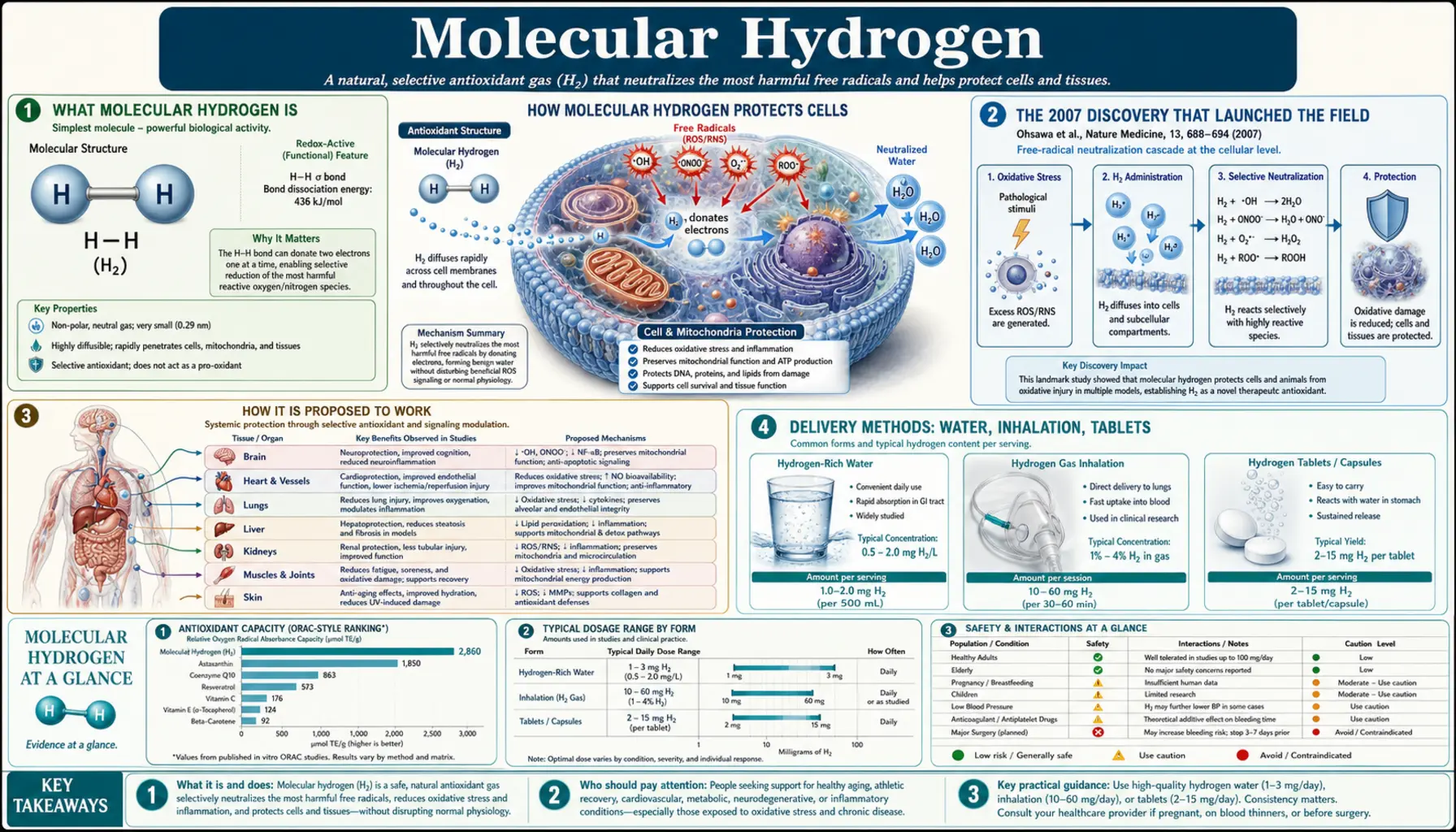
Molecular hydrogen — written H2, the two-atom gas that makes up the lightest, simplest molecule in the universe — has become one of the most heavily marketed ideas in the wellness world. It is sold as "hydrogen water," as gas you breathe from a small machine, and as tablets that fizz in a glass. The claims range from reasonable (it may reduce some markers of oxidative stress) to wildly overstated (that it cures dozens of unrelated diseases). This page tries to separate the two. There is a real, published scientific story here that began with a striking 2007 laboratory paper, and there are dozens of small human trials. But the honest summary is that the evidence is early, small in scale, frequently funded by the companies that sell the products, and far from proving the sweeping benefits on the label. Below we walk through what molecular hydrogen actually is, how it is proposed to work, how it is delivered, what human studies have really found, whether it is safe, and how to read the marketing with a skeptical eye.
Table of Contents
- What Molecular Hydrogen Is
- The 2007 Discovery That Launched the Field
- How It Is Proposed to Work
- Delivery Methods: Water, Inhalation, Tablets
- The Solubility and Dose Problem
- What Human Trials Actually Show
- Exercise, Fatigue, and Recovery
- Safety and Side Effects
- Hype vs. Evidence
- The Honest Bottom Line
- Research Papers
- Connections
- Featured Videos
What Molecular Hydrogen Is
Molecular hydrogen is a colorless, odorless, tasteless gas made of two hydrogen atoms bound together. It is the same H2 that is familiar from chemistry class and, in bulk, from industrial and rocket fuel — but the amounts used in the wellness context are tiny and non-flammable in the concentrations dissolved in water or delivered by low-flow inhalers.
Two physical properties are the whole basis of the health interest:
- It is extraordinarily small. H2 is the smallest molecule that exists, so in theory it can diffuse quickly across cell membranes and even reach compartments like the mitochondria and the cell nucleus that larger antioxidants struggle to enter.
- It is chemically mild. Unlike a strong reducing agent, hydrogen is a fairly weak, selective reactant at body temperature. The core claim — which we examine carefully below — is that this mildness lets it neutralize only the most damaging free radicals while leaving the useful, signaling free radicals alone.
It is worth being clear about what molecular hydrogen is not. It is not the same as "hydrogen" in an acid-base sense (the hydrogen ion, H+, that determines pH). "Hydrogen water" is not the same thing as "alkaline water," even though the two are often marketed together and confused. And a hydrogen molecule is not a vitamin, mineral, or nutrient your body requires — you do not have a hydrogen deficiency.
The 2007 Discovery That Launched the Field
The modern field traces almost entirely to a single paper. In 2007, Ohsawa and colleagues published a study in Nature Medicine reporting that molecular hydrogen behaved as a "therapeutic antioxidant" by selectively neutralizing the most reactive oxygen species while sparing others (Ohsawa et al., 2007). In cell-culture experiments, dissolved H2 reduced the hydroxyl radical (•OH) and peroxynitrite (ONOO−) — two of the most destructive oxidants in biology — but did not react appreciably with hydrogen peroxide, nitric oxide, or superoxide, which cells use as ordinary signaling molecules. In a rat model of stroke, breathing hydrogen gas reduced the size of the injured brain area.
This "selectivity" idea was genuinely novel and is what set hydrogen apart from earlier antioxidant hype. Most dietary antioxidants are indiscriminate: mop up too many free radicals and you can actually blunt healthy processes like exercise adaptation or immune signaling. A molecule that removes only the worst actors would, in principle, avoid that trap. The 2007 paper was rigorous laboratory work and remains the intellectual foundation of everything that followed.
The crucial caveat is one of scale. A single elegant experiment in cells and rodents is a beginning, not a conclusion. The selectivity that looks clean in a test tube is harder to demonstrate at the low hydrogen concentrations achievable in a living human who drinks a glass of hydrogen water. As we will see, translating this founding observation into proven human benefit has been slow and inconsistent.
How It Is Proposed to Work
Researchers have proposed several overlapping mechanisms. It is important to hold these loosely: most are supported by cell and animal work, and the field is still debating which (if any) dominate in people.
1. Selective radical scavenging
This is the original Ohsawa hypothesis: H2 directly reacts with and neutralizes the hydroxyl radical and peroxynitrite, the oxidants most associated with damage to DNA, lipids, and proteins, while ignoring the milder reactive species the body uses for normal signaling.
2. Cell-signaling and gene-expression effects
A competing (and increasingly favored) explanation is that hydrogen's low, transient concentrations are simply too small to scavenge a meaningful fraction of the body's radicals directly. Instead, hydrogen may act as a signaling molecule, nudging cells to change which genes and enzymes they switch on. Work by Iuchi and colleagues suggested hydrogen alters a free-radical chain reaction that generates oxidized lipid mediators, which in turn influence gene expression (Iuchi et al., 2016). Downstream, several studies report changes in the Nrf2 pathway (the master regulator of the body's own antioxidant enzymes) and in inflammatory signaling.
3. Anti-inflammatory and anti-apoptotic effects
Across many animal models, hydrogen exposure is associated with lower levels of inflammatory cytokines and reduced programmed cell death after injury. Comprehensive reviews cataloguing hundreds of studies describe a broad but shallow pattern: small benefits reported across a huge range of organs and conditions (Ohta, 2014; Ichihara et al., 2015).
That very breadth is a double-edged sword. When a single intervention is reported to help the brain, heart, liver, muscles, skin, and metabolism all at once, a scientist's instinct should be caution, not excitement — a truly universal remedy is rare, and broad "everything" claims often reflect small, noisy, easily-published positive results rather than one powerful underlying effect.
Delivery Methods: Water, Inhalation, Tablets
Because H2 is a gas, getting a measurable amount into the body is the central practical challenge. Three approaches dominate.
Hydrogen-rich water
The most common consumer product. Water is infused with H2 gas, usually to a concentration of roughly 0.5 to 1.6 parts per million (about 0.8 to 1.6 milligrams per liter at saturation). This is what was used in most of the metabolic-syndrome and diabetes pilot studies (Nakao et al., 2010; Kajiyama et al., 2008; Song et al., 2013). The main drawback is that hydrogen escapes quickly: an open glass loses much of its gas within minutes, and many "hydrogen water" machines or sachets deliver far less than advertised or produce mostly hydrogen ions and pH change rather than dissolved H2 gas.
Inhalation
Breathing low-concentration hydrogen gas (typically 1–4%, kept below the flammable range) through a nasal cannula or mask delivers a larger and more sustained dose than water can. Inhalation was used in the cardiology pilot studies, including a first-in-human trial of hydrogen inhalation after heart attack (Katsumata et al., 2017). It requires a machine and is the method most used in the more serious clinical research.
Hydrogen-producing tablets
Tablets — usually elemental magnesium plus an acid such as malic or tartaric acid — react with water to release H2 on the spot. Dropped into a sealed bottle, they can generate a higher transient concentration than a standard machine. They also add a dose of magnesium, which has its own physiological effects and can loosen the stool, a confound worth remembering when a product "makes you feel different."
The Solubility and Dose Problem
Hydrogen's greatest strength — its tiny size and low reactivity — is also the root of its biggest practical weakness. Consider the numbers honestly:
- Fully saturated hydrogen water holds only about 1.6 milligrams of H2 per liter. A liter of hydrogen water therefore delivers a fraction of a single milligram of active molecule — a minuscule amount compared with the grams of vitamin C or the hundreds of milligrams of other antioxidants people take.
- Hydrogen is volatile: it diffuses out of water and out of the body rapidly. Blood levels rise within minutes of drinking and fall almost as fast. Any benefit is likely to come from brief, repeated pulses rather than a steady level.
- Much of what is marketed as "hydrogen water" is really alkaline or ionized water whose measurable H2 content is negligible. Independent testing of consumer devices routinely finds concentrations well below what the studies used.
This is exactly why researchers increasingly favor the "signaling molecule" explanation over direct scavenging: the amount of hydrogen you can actually get into your bloodstream is far too small to neutralize a meaningful share of the free radicals a body produces every second. If hydrogen does anything useful, it is more plausibly by triggering the body's own defenses than by acting as a bulk antioxidant sponge. Either way, the dose reality should temper any expectation of dramatic effects.
What Human Trials Actually Show
There are now dozens of human trials, and this is where a rigorous reader has to slow down. The pattern across them is remarkably consistent: small sample sizes, short durations, modest changes in laboratory markers rather than in how people feel or how long they live, and frequent involvement of hydrogen-product companies.
Metabolic health
Some of the better-known work looked at metabolic syndrome and diabetes. An open-label pilot in people with potential metabolic syndrome reported improved antioxidant markers and a drop in "bad" LDL cholesterol after drinking hydrogen water (Nakao et al., 2010). A later randomized study reported that hydrogen water lowered LDL and improved HDL function in a similar group (Song et al., 2013). In type 2 diabetes and impaired glucose tolerance, a small trial found improvements in some lipid and glucose measures (Kajiyama et al., 2008). These are genuinely interesting signals — but they are small, short, and measure biomarkers, not hard outcomes like heart attacks prevented.
Neuromuscular and mitochondrial conditions
A randomized, double-blind, placebo-controlled crossover trial tested hydrogen-enriched water in mitochondrial and inflammatory myopathies and found some improvement in a subset of measures (Ito et al., 2011). Again: small numbers, mixed results.
Cardiology
The first-in-human pilot of hydrogen inhalation after a heart attack examined whether it could limit the harmful remodeling of heart muscle. It was explicitly a feasibility and safety pilot — too small to prove clinical benefit — and its authors framed it that way (Katsumata et al., 2017). It is a reasonable proof-of-concept, not a green light.
Reviews that pool this literature (Ohta, 2014; Ohta, 2015; Ichihara et al., 2015) describe encouraging trends but repeatedly call for larger, longer, independently funded, placebo-controlled trials. That call has been made for over a decade and remains largely unmet. Until it is, the honest verdict is "promising biomarker signals, unproven clinical benefit."
Exercise, Fatigue, and Recovery
One of the most popular uses is among athletes, and the rationale is elegant: intense exercise generates a burst of free radicals, and a selective antioxidant might dampen the damaging ones without blunting the beneficial exercise adaptations that indiscriminate antioxidants (like high-dose vitamin C and E) are known to impair.
A frequently cited pilot in elite athletes reported that hydrogen-rich water blunted the rise in blood lactate and reduced the drop in muscle function during intense exercise (Aoki et al., 2012). Reviews of hydrogen in sports medicine describe a scattering of small studies pointing toward faster recovery, reduced perceived fatigue, and better lactate handling (Ostojic, 2015). But once more the studies are tiny, results are inconsistent between trials, and publication bias — the tendency for small positive results to get published while null results sit in a drawer — is a serious concern in this literature.
If you are an athlete curious about hydrogen, the fair framing is: it is unlikely to hurt you, the plausibility is higher than for many recovery gimmicks, but you should not expect a meaningful edge, and the money may be better spent on sleep, protein, and training.
Safety and Side Effects
On safety, molecular hydrogen looks reassuring in the short term. Across the human studies, hydrogen water and low-concentration inhalation have been well tolerated with few reported adverse effects, which is one reason the research has been allowed to proceed. Hydrogen is a normal byproduct of gut bacteria fermenting fiber, so the body is continually exposed to far larger internal amounts than a glass of hydrogen water adds.
Some honest caveats remain:
- Flammability of pure gas. Concentrated hydrogen gas is flammable and explosive. Reputable inhalation devices keep concentrations below the flammable threshold, but home electrolysis gadgets should be treated with respect.
- Magnesium load from tablets. Hydrogen tablets deliver magnesium, which in larger amounts can cause loose stools and matters for people with kidney disease.
- Long-term data are thin. Most trials last days to weeks. There is no large, long-term safety database, simply because the sustained studies have not been done.
- Opportunity cost and false reassurance. The real risk is rarely the hydrogen itself — it is that someone uses it in place of proven treatment for a serious condition. Hydrogen water is not a substitute for managing diabetes, heart disease, or any diagnosed illness with evidence-based care.
Hype vs. Evidence
Molecular hydrogen sits in an awkward middle ground: the underlying science is real and interesting, yet the marketing has run far ahead of it. Here is how to keep the two apart.
Red flags in the marketing
- "Cures everything" claims. When a product is said to help brain fog, wrinkles, joints, diabetes, cancer, and athletic performance all at once, that breadth is a warning sign, not a selling point.
- Confusing hydrogen with alkaline/ionized water. These are different things; the pH change has no proven benefit, and it is often used to distract from a device's low actual H2 output.
- Industry-funded evidence. A large share of the positive human studies involve researchers or funding connected to hydrogen-product companies. That does not make them wrong, but it demands extra skepticism and independent replication.
- Biomarkers dressed up as outcomes. "Lowered oxidative-stress marker X" is not the same as "prevented disease Y." Most hydrogen trials measure the former and imply the latter.
- Cherry-picked citations. Sellers cite the encouraging 2007 Nature Medicine paper and small positive pilots while ignoring the field's own repeated calls for larger, better trials.
What the evidence fairly supports
A balanced reading: hydrogen has a plausible, selective mechanism; it is very safe over the short term; and small trials show modest improvements in some oxidative-stress and metabolic markers. What the evidence does not yet support is any claim that it treats or prevents a specific disease, extends lifespan, or delivers benefits you would notice in daily life. "Interesting and low-risk" is not the same as "proven and worth the money."
The Honest Bottom Line
Molecular hydrogen is a rare case of a wellness trend with a legitimate scientific seed. The 2007 discovery of selective radical scavenging was real science, the safety record is good, and the mechanism — especially the newer signaling interpretation — is biologically reasonable. If you enjoy hydrogen water and can afford it, there is little evidence it will harm you.
But the gap between that modest reality and the marketing is enormous. The human trials are small, short, biomarker-focused, and often industry-adjacent; the achievable doses are tiny; and the sweeping health claims on product pages are not supported. After nearly two decades, the field still lacks the large, long, independently funded trials that would settle whether hydrogen does anything a healthy person would notice. Until those exist, treat hydrogen as an intriguing research topic and a low-risk curiosity — not as a treatment, and certainly not as a reason to spend heavily or to delay proven care. Fundamentals like sleep, movement, a whole-food diet, and managing real medical conditions will do far more for oxidative stress than any glass of fizzy water.
Research Papers
- Ohsawa I, Ishikawa M, Takahashi K, et al. Hydrogen acts as a therapeutic antioxidant by selectively reducing cytotoxic oxygen radicals. Nature Medicine. 2007;13(6):688–694. doi:10.1038/nm1577 — the seminal paper: dissolved H2 selectively neutralized the hydroxyl radical and peroxynitrite in cells and shrank stroke injury in rats.
- Ohta S. Molecular hydrogen as a preventive and therapeutic medical gas: initiation, development and potential of hydrogen medicine. Pharmacology & Therapeutics. 2014;144(1):1–11. doi:10.1016/j.pharmthera.2014.04.006 — a leading review that catalogs broad reported effects while stressing the need for larger clinical trials.
- Ohta S. Molecular hydrogen as a novel antioxidant: overview of the advantages of hydrogen for medical applications. Methods in Enzymology. 2015;555:289–317. doi:10.1016/bs.mie.2014.11.038 — discusses delivery methods, dosing, and why the signaling model is gaining ground over bulk scavenging.
- Ichihara M, Sobue S, Ito M, et al. Beneficial biological effects and the underlying mechanisms of molecular hydrogen — comprehensive review of 321 original articles. Medical Gas Research. 2015;5:12. doi:10.1186/s13618-015-0035-1 — a wide survey showing the "broad but shallow" pattern of small positive studies across many organs.
- Iuchi K, Imoto A, Kamimura N, et al. Molecular hydrogen regulates gene expression by modifying the free radical chain reaction-dependent generation of oxidized phospholipid mediators. Scientific Reports. 2016;6:18971. doi:10.1038/srep18971 — mechanistic evidence for hydrogen acting as a signaling molecule rather than a direct bulk antioxidant.
- Nakao A, Toyoda Y, Sharma P, Evans M, Guthrie N. Effectiveness of hydrogen rich water on antioxidant status of subjects with potential metabolic syndrome — an open label pilot study. Journal of Clinical Biochemistry and Nutrition. 2010;46(2):140–149. doi:10.3164/jcbn.09-100 — small open-label pilot reporting improved antioxidant markers and lower LDL (no placebo control).
- Song G, Li M, Sang H, et al. Hydrogen-rich water decreases serum LDL-cholesterol levels and improves HDL function in patients with potential metabolic syndrome. Journal of Lipid Research. 2013;54(7):1884–1893. doi:10.1194/jlr.M036640 — small controlled study of lipid changes with hydrogen water.
- Kajiyama S, Hasegawa G, Asano M, et al. Supplementation of hydrogen-rich water improves lipid and glucose metabolism in patients with type 2 diabetes or impaired glucose tolerance. Nutrition Research. 2008;28(3):137–143. doi:10.1016/j.nutres.2008.01.008 — small crossover trial in diabetes/IGT reporting modest metabolic marker changes.
- Ito M, Ibi T, Sahashi K, Ichihara M, Ito M, Ohno K. Open-label trial and randomized, double-blind, placebo-controlled, crossover trial of hydrogen-enriched water for mitochondrial and inflammatory myopathies. Medical Gas Research. 2011;1(1):24. doi:10.1186/2045-9912-1-24 — one of the few placebo-controlled crossover designs; mixed results in a small sample.
- Katsumata Y, Sano F, Abe T, et al. The effects of hydrogen gas inhalation on adverse left ventricular remodeling after percutaneous coronary intervention for ST-elevated myocardial infarction — first pilot study in humans. Circulation Journal. 2017;81(7):940–947. doi:10.1253/circj.CJ-17-0105 — a first-in-human feasibility/safety pilot of hydrogen inhalation after heart attack (not powered to prove benefit).
- Aoki K, Nakao A, Adachi T, Matsui Y, Miyakawa S. Pilot study: effects of drinking hydrogen-rich water on muscle fatigue caused by acute exercise in elite athletes. Medical Gas Research. 2012;2(1):12. doi:10.1186/2045-9912-2-12 — small athlete pilot reporting blunted lactate rise and preserved muscle function.
- Ostojic SM. Molecular hydrogen in sports medicine: new therapeutic perspectives. International Journal of Sports Medicine. 2015;36(4):273–279. doi:10.1055/s-0034-1395509 — review of the small, inconsistent exercise-recovery literature and its limitations.
Connections
- Antioxidants (overview)
- Glutathione
- NAC (N-Acetylcysteine)
- Melatonin
- CoQ10
- Alpha-Lipoic Acid
- Astaxanthin
- Metabolic Syndrome
- Type 2 Diabetes
- Exercise
- Inflammatory Markers
- hs-CRP
- Remedies (overview)
- Lab Tests (overview)