Anthocyanins: The Blue-Purple Pigment Antioxidants in Berries
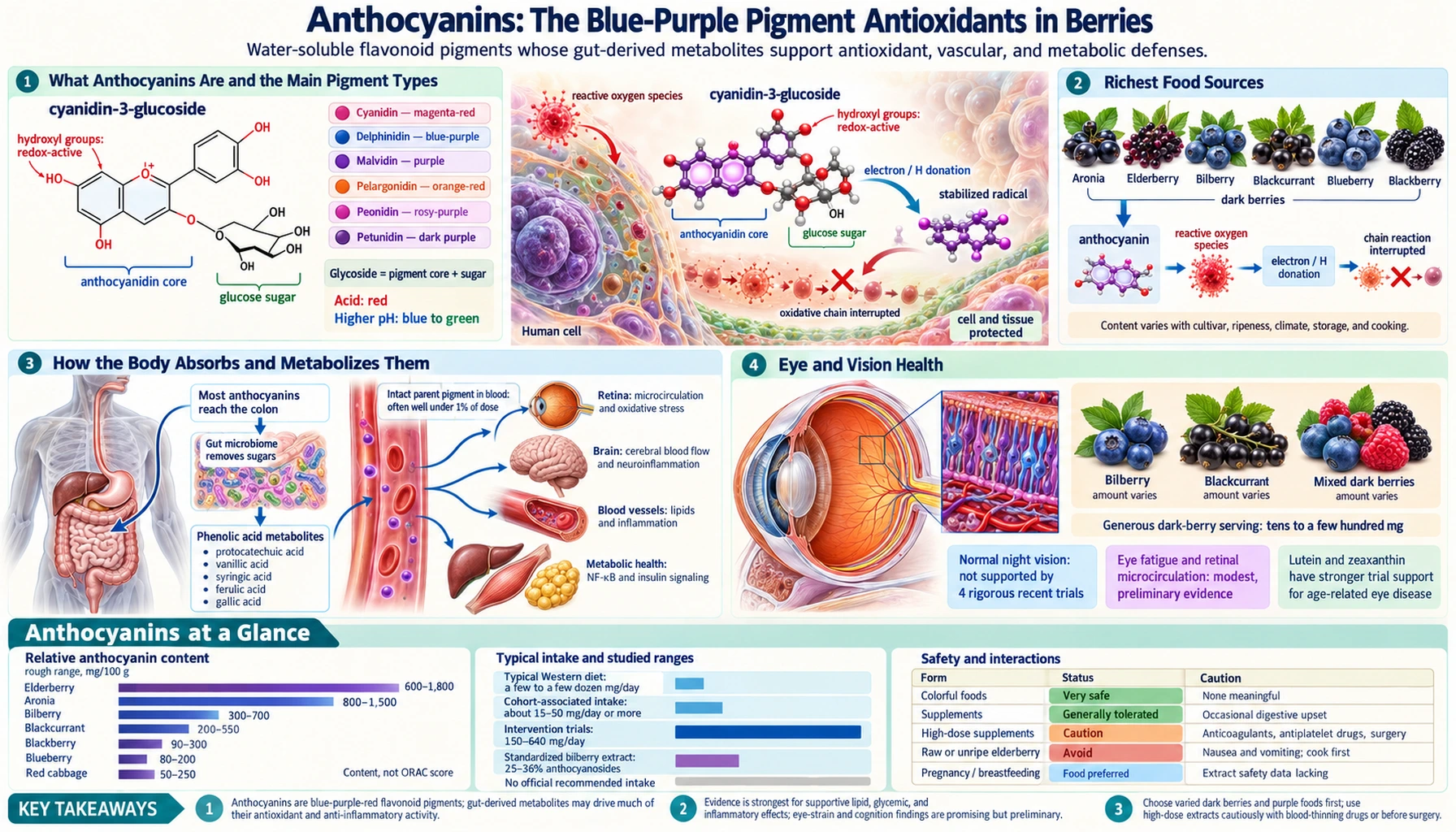
Anthocyanins are the water-soluble pigments that paint blueberries, blackcurrants, elderberries, black rice, purple corn, red cabbage, and red and purple grapes their deep blue, purple, and red colors. They belong to the flavonoid family of plant polyphenols. In test-tube assays they scavenge reactive oxygen species; in people, the trials described below report effects on blood lipids, inflammatory markers, blood-vessel function and gut bacteria. The word comes from the Greek anthos (flower) and kyanos (blue).
This article covers what anthocyanins are, which foods contain the most, how the body handles them (poorly as the intact pigment, much better once their breakdown products are counted), and what human studies report for eye health, brain and cognition, the heart and blood vessels, and metabolic health. Throughout, it separates what randomized trials have shown from what is only suggested by population studies or laboratory work — for anthocyanins the gap between the two is wide, and a lot of marketing lives in that gap.
Table of Contents
- What Anthocyanins Are and the Main Pigment Types
- Richest Food Sources
- How the Body Absorbs and Metabolizes Them
- Eye and Vision Health
- Brain and Cognition
- Cardiovascular and Blood-Pressure Effects
- Metabolic and Anti-Inflammatory Effects
- Forms and Doses Used in Trials
- Safety
- Key Research Papers
- Connections
- Featured Videos
What Anthocyanins Are and the Main Pigment Types
Anthocyanins are glycosides — pigment cores with one or more sugars attached. The colored core is called an anthocyanidin (or aglycone). A USDA survey of more than 100 common foods found only six aglycones in the foods that contained anthocyanins (Wu 2006), and each has a slightly different chemical decoration that shifts its hue. The foods named below are those where the USDA flavonoid database (Release 3.3) lists that aglycone as a main one:
- Cyanidin — magenta-red; the largest share of U.S. intake, estimated at 45% (Wu 2006). Main pigment of elderberries, chokeberries, blackberries, red cabbage, cherries and raspberries.
- Delphinidin — blue-purple; prominent in bilberries, blackcurrants, blueberries and eggplant; 21% of U.S. intake.
- Malvidin — purple; the main aglycone of red grapes and cultivated and wild blueberries; 15% of U.S. intake.
- Pelargonidin — orange-red; the main pigment of strawberries and red radishes.
- Peonidin — rosy-purple; in cranberries, alongside cyanidin, and in blueberries and bilberries.
- Petunidin — dark purple; a partner pigment in blueberries and bilberries.
In food these cores almost never appear bare. They are joined to sugars such as glucose, galactose, or arabinose to form the glycosides we actually eat — for example cyanidin-3-glucoside, a widespread anthocyanin and the one used in the human isotope-tracer studies described below, and malvidin-3-glucoside in grapes. Wu 2006 found that the sugar groups and acylation patterns varied from food to food, which is why a blueberry, a strawberry and a red grape can all be “anthocyanin-rich” yet look and behave differently. Color also shifts with acidity: anthocyanins are red in acid and turn blue-to-green as pH rises, which is why red cabbage is a classic kitchen pH indicator.
Richest Food Sources
Anthocyanin content varies enormously with cultivar, ripeness, climate, storage and cooking. The figures below are the mean values in the USDA Database for the Flavonoid Content of Selected Foods, Release 3.3 (2018), in mg per 100 g of fresh edible food, with each food's USDA NDB number. Two cautions apply. The database lists each of the six anthocyanidins separately and deliberately does not include totals, and it reports them as aglycones (the glycoside values were converted to the bare pigment core), so its numbers run lower than totals measured as glycosides. Values are shown for the main anthocyanidin(s) in each food:
- Elderberries, raw (NDB 09088) — cyanidin 485.26 mg/100 g (94 data points).
- Chokeberry (aronia), raw (NDB 99012) — cyanidin 344.07 mg/100 g.
- Red cabbage, raw (NDB 11112) — cyanidin 209.83 mg/100 g.
- Blackberries, raw (NDB 09042) — cyanidin 99.95 mg/100 g.
- Bilberry (wild European blueberry), raw (NDB 99357) — delphinidin 97.59, cyanidin 85.26, petunidin 42.69, malvidin 39.22 and peonidin 20.45 mg/100 g.
- Blackcurrants (European black currants), raw (NDB 09083) — delphinidin 89.62 and cyanidin 62.46 mg/100 g.
- Eggplant, raw (NDB 11209) — delphinidin 85.69 mg/100 g (a single data point).
- Blueberries, cultivated, raw (NDB 09050) — malvidin 67.59, delphinidin 35.43, petunidin 31.53, peonidin 20.29 and cyanidin 8.46 mg/100 g.
- Blueberries, wild (lowbush), raw (NDB 97085) — malvidin 57.16, delphinidin 37.59, petunidin 23.52 and cyanidin 19.35 mg/100 g.
- Radishes, raw (NDB 11429) — pelargonidin 63.13 mg/100 g.
- Raspberries, raw (NDB 09302) — cyanidin 45.77 mg/100 g.
- Red grapes, raw (NDB 97074) — malvidin 39.00 mg/100 g.
- Cranberries, raw (NDB 09078) — peonidin 30.54 and cyanidin 29.88 mg/100 g.
- Sweet cherries, raw (NDB 09070) — cyanidin 30.21 mg/100 g.
- Strawberries, raw (NDB 09316) — pelargonidin 24.85 mg/100 g.
- Purple sweet potato, cooked (NDB 99385) — cyanidin 10.60 mg/100 g (a single data point).
- Plums, raw (NDB 09279) — cyanidin 5.63 mg/100 g.
- Red onions, raw (NDB 99055) — delphinidin 4.28 and cyanidin 3.19 mg/100 g.
Black rice and purple corn are also colored by anthocyanins but have no entry in the USDA table. Measured as glycosides, the USDA survey behind much of the database (Wu 2006) found total anthocyanins ranging from 0.7 mg/100 g in one gooseberry variety to 1,480 mg/100 g in chokeberry, and estimated average U.S. intake at 12.5 mg a day per person. A review of berry chemistry notes that a single serving of berry fruit or a berry drink can supply tens to hundreds of milligrams (McGhie 2007).
A note on “ORAC” scores. Lists that rank berries by antioxidant power usually quote ORAC (oxygen radical absorbance capacity), a test-tube assay. The USDA published an ORAC table for foods and withdrew it in 2012, stating that there is no evidence the beneficial effects of polyphenol-rich foods can be attributed to their antioxidant properties, that test-tube antioxidant values cannot be extrapolated to effects in people, and that ORAC values were routinely misused to promote foods and supplements. An ORAC number is therefore not evidence of a health effect, and none is used on this page.
How the Body Absorbs and Metabolizes Them
Here is the central paradox of anthocyanins: they are potent antioxidants in a test tube, yet as intact pigments they are absorbed very poorly. A review of 97 human bioavailability studies placed anthocyanins among the least well-absorbed polyphenols (Manach 2005), and most earlier studies recovered less than 1% of an ingested anthocyanin dose, because they measured only the parent pigment and its direct conjugates (as summarized by de Ferrars 2014). For years this made researchers wonder how berries could have any effect at all if so little of the colored compound got in.
The resolution came from tracer studies. In 2013 a team gave 8 men 500 mg of cyanidin-3-glucoside labelled with the stable isotope carbon-13, so that every breakdown product could be followed (Czank 2013). Counting all of the labelled products, the relative bioavailability was 12.38% of the dose (5.37% excreted in urine and 6.91% exhaled in breath), and 43.9% of the label was recovered overall in urine, breath and feces. The labelled metabolites peaked in blood at about 10.25 hours and remained in circulation for up to 48 hours; the authors concluded that anthocyanins are more bioavailable than previously perceived. A follow-up analysis of the same design identified 17 labelled compounds in blood — including the parent pigment, its degradation products protocatechuic acid and phloroglucinaldehyde, and many further metabolites — with hippuric acid and ferulic acid the most abundant (de Ferrars 2014). In that analysis the parent anthocyanin made up only 2% of the labelled compounds found in the circulation.
Much of the breakdown happens in the colon, where bacteria strip off the sugars and split the pigment core into smaller phenolic acids. Because these metabolites far outnumber the parent pigment in blood and linger for many hours, researchers increasingly think that much of the “anthocyanin effect” seen in trials may be a metabolite effect. In the 2019 six-month blueberry trial, anthocyanin-derived phenolic acid metabolites rose in serum and urine in step with the dose (Curtis 2019).
Two possibilities follow, both still under study: the make-up of a person's gut bacteria may change how much of these metabolites they produce from the same berries, and the food matrix, fiber and dose may change the yield — one proposed reason whole berries and extracts do not always behave identically in trials. The tracer studies above were single doses of one purified anthocyanin in small groups of men.
Eye and Vision Health
Anthocyanins — especially from bilberry and blackcurrant — have a long folk reputation for sharpening eyesight, often told through a World War II story that British Royal Air Force pilots ate bilberry jam to improve their night vision. The story is widely repeated; the controlled trials did not bear out the night-vision claim.
A systematic review of placebo-controlled trials (Canter 2004) found 30 trials with outcomes relevant to vision in reduced light, 12 of them placebo-controlled, nearly all in healthy people with normal or above-average eyesight. The 4 most recent were randomized controlled trials and all were negative; a fifth randomized trial and 7 non-randomized controlled trials reported positive effects. Negative results went with more rigorous methods, but also with lower doses and extracts from different regions. The authors concluded that the hypothesis that bilberry improves normal night vision is not supported by rigorous clinical studies, and that there had been no rigorous research at all in people whose night vision is impaired by eye disease.
Newer randomized trials have looked instead at eye fatigue from screen work. In 88 office workers with lower baseline scores, 480 mg a day of a bilberry extract for 8 weeks lessened a screen-induced drop in one objective measure (critical flicker fusion) and eased several subjective symptoms, but not near-point accommodation (Ozawa 2015). In 109 healthy adults, 240 mg a day of a standardized bilberry extract for 12 weeks improved an objective measure of ciliary-muscle strain after screen tasks (Kosehira 2020). These are modest, short trials of specific extracts. For age-related macular degeneration, the large AREDS2 trial (4,203 participants at risk of advanced disease) tested the carotenoids lutein and zeaxanthin: adding them to the earlier AREDS formula did not further reduce progression in the primary analysis, though the investigators judged them a possible substitute for beta carotene, which was linked to more lung cancers in former smokers (AREDS2 2013). No anthocyanin trial on this page studied macular degeneration. In summary, the evidence does not support bilberry or blackcurrant anthocyanins for night vision or serious eye disease; small trials report modest effects on screen-related eye strain.
Brain and Cognition
Berry anthocyanins are an active area of brain-aging research, with promising but early human evidence. In the Nurses' Health Study, 16,010 women aged 70 or older who ate more blueberries and strawberries showed slower cognitive decline over follow-up; the authors estimated that higher berry intake delayed cognitive aging by up to 2.5 years (Devore 2012). This is an observational finding and cannot show cause and effect.
Trials are small. In a pilot study, 9 older adults with early memory changes who drank wild blueberry juice for 12 weeks improved on paired-associate learning and word-list recall (Krikorian 2010). In a randomized, placebo-controlled trial in older adults with mild cognitive impairment, 16 weeks of blueberry supplementation increased brain activation on functional MRI in frontal and parietal regions during a working-memory task, but produced no clear improvement in working-memory performance itself (Boespflug 2018).
A double-blind randomized controlled trial in 61 healthy adults aged 65–80 gave 26 g a day of freeze-dried wild blueberry powder (302 mg anthocyanins, equivalent to about 178 g of fresh berries) or a matched placebo (Wood 2023). After 12 weeks the blueberry group had better flow-mediated dilation (a measure of artery function), 24-hour ambulatory systolic blood pressure 3.59 mmHg lower than placebo, better immediate word recall and better accuracy on a task-switching test. Cerebral blood flow and gut-microbiota composition, which the trial examined as possible links, did not change. A corrigendum to this paper was published in 2025.
Proposed mechanisms include improved blood flow and reduced inflammation, mostly from animal and laboratory work. The caveats: the human trials are small, use different berries, doses and cognitive tests, and results are mixed. They do not show that berries or anthocyanins treat or prevent dementia.
Cardiovascular and Blood-Pressure Effects
This is where separating epidemiology from randomized trials matters most. In three U.S. cohorts — 87,242 women in the Nurses' Health Study II, 46,672 women in the Nurses' Health Study and 23,043 men in the Health Professionals Follow-Up Study, followed for 14 years — people in the highest fifth of anthocyanin intake (mostly from blueberries and strawberries) had an 8% lower risk of developing high blood pressure than those in the lowest fifth, and 12% lower among people aged 60 or younger, with no clear association above 60 (Cassidy 2011). In 93,600 women aged 25–42 in the Nurses' Health Study II, followed for 18 years, the highest fifth of anthocyanin intake was associated with a lower risk of myocardial infarction (hazard ratio 0.68) (Cassidy 2013). Pooling 15 prospective cohorts, high anthocyanin intake was associated with lower risk of coronary heart disease (relative risk 0.83) and of cardiovascular death (relative risk 0.91) (Xu 2021).
Population studies cannot prove cause and effect, and the randomized-trial picture is more nuanced. The same meta-analysis pooled 44 randomized controlled trials and found that neither purified anthocyanins nor anthocyanin-rich berries produced substantial improvements in blood pressure or in flow-mediated dilation (a measure of artery function) overall. Purified anthocyanins did lower LDL cholesterol and triglycerides, raise HDL cholesterol, and reduce the inflammatory markers C-reactive protein and TNF-alpha; anthocyanin-rich berries lowered total cholesterol and C-reactive protein (Xu 2021).
Individual trials add detail. In 21 healthy men, a blueberry drink improved flow-mediated dilation within 1–2 hours and again at 6 hours, rising with intake up to 766 mg of total blueberry polyphenols and then plateauing (Rodriguez-Mateos 2013). In 150 adults with high cholesterol, 320 mg a day of purified berry anthocyanins for 12 weeks improved flow-mediated dilation and HDL cholesterol and lowered LDL cholesterol compared with placebo, an effect the authors tied to the nitric oxide–cGMP pathway (Zhu 2011). In a trial its authors described as the longest-duration randomized trial to that date, 115 adults with metabolic syndrome ate the equivalent of 1 cup (150 g) or half a cup (75 g) of blueberries a day, or a placebo, for 6 months (Curtis 2019): the 1-cup amount improved flow-mediated dilation by 1.45% and arterial stiffness, but insulin resistance (the primary endpoint), blood pressure and pulse-wave velocity did not change, and half a cup had no effect on any measure. A correction to that paper was published later in 2019.
The overall picture is layered: habitual berry-rich eating tracks with lower hypertension and heart-attack risk in observational data; purified anthocyanins improve blood lipids and inflammatory markers in pooled trials; but pooled trials do not show a blood-pressure effect. A few individual trials, including the wild-blueberry trial above, did report lower blood pressure. Hypertension and Cardiovascular Disease are covered in the Hypertension and Cardiovascular Disease pages.
Metabolic and Anti-Inflammatory Effects
Anthocyanins overlap with the cardiovascular story but deserve their own note because the metabolic trial data are more consistent. A 2025 systematic review and meta-analysis of 29 randomized trials (2,006 participants with metabolic-syndrome risk factors) found that anthocyanin supplementation significantly lowered LDL cholesterol, triglycerides, total cholesterol, fasting blood glucose and HbA1c, and raised HDL cholesterol (Pan 2025). Effects on weight, waist circumference, blood pressure, insulin and insulin resistance (HOMA-IR) were not significant overall, and the authors cautioned that in some subgroups — depending on dose, duration, health status and formulation — anthocyanin interventions may raise systolic and diastolic blood pressure.
Specific trials point to mechanisms. In 120 adults with abnormal blood lipids, 160 mg of berry anthocyanins twice daily for 12 weeks raised HDL cholesterol by 13.7% and lowered LDL cholesterol by 13.6%, alongside lower activity of cholesteryl ester transfer protein (Qin 2009). A drink providing 600 mg of blackcurrant anthocyanins, taken just before a high-carbohydrate meal, reduced the early rise in blood glucose and insulin; 150 mg and 300 mg did not differ from placebo (Castro-Acosta 2016). On the gut side, 6 weeks of a wild blueberry drink increased Bifidobacterium in a small crossover trial (Vendrame 2011), whereas the 12-week wild-blueberry trial above found no change in gut-microbiota composition (Wood 2023). Most trials are short (weeks to a few months) and use varied doses and products, and none tested anthocyanins as a replacement for established treatment. Related topics: Diabetes and Oxidative Stress.
Forms and Doses Used in Trials
There is no official recommended intake for anthocyanins — they are not essential nutrients. Average U.S. intake has been estimated at 12.5 mg a day (Wu 2006). The trials on this page used:
- Whole or freeze-dried blueberries — 26 g a day of freeze-dried wild blueberry powder, supplying 302 mg anthocyanins and equivalent to about 178 g fresh (Wood 2023); 150 g a day (1 cup) of blueberries, while 75 g had no effect (Curtis 2019).
- Purified berry anthocyanins — 320 mg a day (Zhu 2011), or 160 mg twice daily (Qin 2009).
- Bilberry extracts — 240 mg a day of a standardized extract (Kosehira 2020) and 480 mg a day of an extract (Ozawa 2015) in the screen-fatigue trials.
- Blackcurrant extract — a single 600 mg dose of anthocyanins before a meal (Castro-Acosta 2016).
The anthocyanin content of foods falls with processing and storage; that topic is covered in Sources and Stability. Supplement forms include standardized bilberry extracts, blackcurrant and elderberry extracts, and purified anthocyanin capsules; the composition of commercial bilberry extracts is discussed under Safety. Related polyphenol antioxidants include resveratrol (from grape skin), French Maritime Pine Bark and grape seed extract (proanthocyanidins), quercetin, and the green-tea catechin EGCG.
Safety
- As food, anthocyanins have been eaten in colorful fruits and vegetables throughout human history.
- Supplements in trials. In the 8-week bilberry-extract trial there were no severe adverse events in either group (Ozawa 2015). Most trials on this page lasted weeks to a few months.
- Platelet effect. In a 28-day crossover trial in 16 sedentary adults, 320 mg a day of anthocyanins reduced ADP-induced platelet aggregation by 29% and lowered several markers of platelet activation (Thompson 2017). Whether this matters for people taking anticoagulant or antiplatelet drugs, or before surgery, was not tested; decisions about supplements alongside such medicines belong with a clinician.
- Raw elderberry. A 1984 CDC report described 11 people who became ill (8 were flown to a hospital and 1 was admitted overnight), with nausea, vomiting, abdominal cramps and weakness after drinking juice pressed from wild elderberries crushed together with their leaves and branches. The report notes that fresh leaves, flowers, bark, young buds and roots contain a glucoside that can produce hydrocyanic acid, that uncooked berries may cause nausea, and that the berries may be safe particularly if cooked (CDC 1984).
- Pregnancy and breastfeeding: berries are ordinary foods; the trials on this page report no data on concentrated extracts in pregnancy or breastfeeding.
- Product composition. A 2014 analysis of commercial bilberry extracts reported that pharmacopeial HPLC identification methods may not be sufficient to detect adulteration, and described anthocyanin-profile clues to it (Govindaraghavan 2014).
Key Research Papers
Peer-reviewed studies and agency sources behind the points above, spanning anthocyanin bioavailability and gut metabolism, food content, eye and brain outcomes, and cardiovascular, metabolic and safety findings. Author names, titles, and journals are plain text; only the closing identifier links to the paper or source.
- Xu L, Tian Z, Chen H, Zhao Y, Yang Y. Anthocyanins, anthocyanin-rich berries, and cardiovascular risks: systematic review and meta-analysis of 44 randomized controlled trials and 15 prospective cohort studies. Frontiers in Nutrition 2021;8:747884. — doi:10.3389/fnut.2021.747884
- Pan J, Liang J, Xue Z, Meng X, Jia L. Effect of dietary anthocyanins on the risk factors related to metabolic syndrome: a systematic review and meta-analysis. PLOS ONE 2025;20(2):e0315504. — doi:10.1371/journal.pone.0315504
- Cassidy A, O'Reilly ÉJ, Kay C, Sampson L, Franz M, Forman JP, et al. Habitual intake of flavonoid subclasses and incident hypertension in adults. The American Journal of Clinical Nutrition 2011;93(2):338–347. — doi:10.3945/ajcn.110.006783
- Wood E, Hein S, Mesnage R, Fernandes F, Abhayaratne N, Xu Y, et al. Wild blueberry (poly)phenols can improve vascular function and cognitive performance in healthy older individuals: a double-blind randomized controlled trial. The American Journal of Clinical Nutrition 2023;117(6):1306–1319. — doi:10.1016/j.ajcnut.2023.03.017 (corrigendum 2025: PubMed PMID: 40782825)
- Canter PH, Ernst E. Anthocyanosides of Vaccinium myrtillus (bilberry) for night vision—a systematic review of placebo-controlled trials. Survey of Ophthalmology 2004;49(1):38–50. — doi:10.1016/j.survophthal.2003.10.006
- de Ferrars RM, Czank C, Zhang Q, Botting NP, Kroon PA, Cassidy A, et al. The pharmacokinetics of anthocyanins and their metabolites in humans. British Journal of Pharmacology 2014;171(13):3268–3282. — doi:10.1111/bph.12676
- McGhie TK, Walton MC. The bioavailability and absorption of anthocyanins: towards a better understanding. Molecular Nutrition & Food Research 2007;51(6):702–713. — doi:10.1002/mnfr.200700092
- Wu X, Beecher GR, Holden JM, Haytowitz DB, Gebhardt SE, Prior RL. Concentrations of anthocyanins in common foods in the United States and estimation of normal consumption. Journal of Agricultural and Food Chemistry 2006;54(11):4069–4075. — doi:10.1021/jf060300l
- Czank C, Cassidy A, Zhang Q, Morrison DJ, Preston T, Kroon PA, et al. Human metabolism and elimination of the anthocyanin, cyanidin-3-glucoside: a (13)C-tracer study. The American Journal of Clinical Nutrition 2013;97(5):995–1003. — PubMed PMID: 23604435
- Manach C, Williamson G, Morand C, Scalbert A, Rémésy C. Bioavailability and bioefficacy of polyphenols in humans. I. Review of 97 bioavailability studies. The American Journal of Clinical Nutrition 2005;81(1 Suppl):230S–242S. — PubMed PMID: 15640486
- Cassidy A, Mukamal KJ, Liu L, Franz M, Eliassen AH, Rimm EB. High anthocyanin intake is associated with a reduced risk of myocardial infarction in young and middle-aged women. Circulation 2013;127(2):188–196. — PubMed PMID: 23319811
- Devore EE, Kang JH, Breteler MM, Grodstein F. Dietary intakes of berries and flavonoids in relation to cognitive decline. Annals of Neurology 2012;72(1):135–143. — PubMed PMID: 22535616
- Krikorian R, Shidler MD, Nash TA, Kalt W, Vinqvist-Tymchuk MR, Shukitt-Hale B, et al. Blueberry supplementation improves memory in older adults. Journal of Agricultural and Food Chemistry 2010;58(7):3996–4000. — PubMed PMID: 20047325
- Boespflug EL, Eliassen JC, Dudley JA, Shidler MD, Kalt W, Summer SS, et al. Enhanced neural activation with blueberry supplementation in mild cognitive impairment. Nutritional Neuroscience 2018;21(4):297–305. — PubMed PMID: 28221821
- Rodriguez-Mateos A, Rendeiro C, Bergillos-Meca T, Tabatabaee S, George TW, Heiss C, et al. Intake and time dependence of blueberry flavonoid-induced improvements in vascular function: a randomized, controlled, double-blind, crossover intervention study with mechanistic insights into biological activity. The American Journal of Clinical Nutrition 2013;98(5):1179–1191. — PubMed PMID: 24004888
- Curtis PJ, van der Velpen V, Berends L, Jennings A, Feelisch M, Umpleby AM, et al. Blueberries improve biomarkers of cardiometabolic function in participants with metabolic syndrome—results from a 6-month, double-blind, randomized controlled trial. The American Journal of Clinical Nutrition 2019;109(6):1535–1545. — PubMed PMID: 31136659 (corrigendum: PubMed PMID: 31667509)
- Zhu Y, Xia M, Yang Y, Liu F, Li Z, Hao Y, et al. Purified anthocyanin supplementation improves endothelial function via NO-cGMP activation in hypercholesterolemic individuals. Clinical Chemistry 2011;57(11):1524–1533. — PubMed PMID: 21926181
- Qin Y, Xia M, Ma J, Hao Y, Liu J, Mou H, et al. Anthocyanin supplementation improves serum LDL- and HDL-cholesterol concentrations associated with the inhibition of cholesteryl ester transfer protein in dyslipidemic subjects. The American Journal of Clinical Nutrition 2009;90(3):485–492. — PubMed PMID: 19640950
- Castro-Acosta ML, Smith L, Miller RJ, McCarthy DI, Farrimond JA, Hall WL. Drinks containing anthocyanin-rich blackcurrant extract decrease postprandial blood glucose, insulin and incretin concentrations. The Journal of Nutritional Biochemistry 2016;38:154–161. — PubMed PMID: 27764725
- Vendrame S, Guglielmetti S, Riso P, Arioli S, Klimis-Zacas D, Porrini M. Six-week consumption of a wild blueberry powder drink increases bifidobacteria in the human gut. Journal of Agricultural and Food Chemistry 2011;59(24):12815–12820. — PubMed PMID: 22060186
- Ozawa Y, Kawashima M, Inoue S, Inagaki E, Suzuki A, Ooe E, et al. Bilberry extract supplementation for preventing eye fatigue in video display terminal workers. The Journal of Nutrition, Health & Aging 2015;19(5):548–554. — PubMed PMID: 25923485
- Kosehira M, Machida N, Kitaichi N. A 12-week-long intake of bilberry extract (Vaccinium myrtillus L.) improved objective findings of ciliary muscle contraction of the eye: a randomized, double-blind, placebo-controlled, parallel-group comparison trial. Nutrients 2020;12(3):600. — PubMed PMID: 32106548
- Age-Related Eye Disease Study 2 (AREDS2) Research Group. Lutein + zeaxanthin and omega-3 fatty acids for age-related macular degeneration: the Age-Related Eye Disease Study 2 (AREDS2) randomized clinical trial. JAMA 2013;309(19):2005–2015. — PubMed PMID: 23644932
- Thompson K, Hosking H, Pederick W, Singh I, Santhakumar AB. The effect of anthocyanin supplementation in modulating platelet function in sedentary population: a randomised, double-blind, placebo-controlled, cross-over trial. British Journal of Nutrition 2017;118(5):368–374. — PubMed PMID: 28901892
- Govindaraghavan S. Pharmacopeial HPLC identification methods are not sufficient to detect adulterations in commercial bilberry (Vaccinium myrtillus) extracts. Anthocyanin profile provides additional clues. Fitoterapia 2014;99:124–138. — PubMed PMID: 25250894
- Centers for Disease Control (CDC). Poisoning from elderberry juice—California. MMWR Morbidity and Mortality Weekly Report 1984;33(13):173–174. — PubMed PMID: 6422238 (full text: CDC MMWR)
- Haytowitz DB, Wu X, Bhagwat S. USDA Database for the Flavonoid Content of Selected Foods, Release 3.3. U.S. Department of Agriculture, Agricultural Research Service, Nutrient Data Laboratory, March 2018. — USDA ARS (PDF)
- U.S. Department of Agriculture, Agricultural Research Service. Oxygen Radical Absorbance Capacity (ORAC) of Selected Foods, Release 2 (2010) — withdrawal notice, last modified 16 May 2012. — USDA ARS (archived copy)
PubMed Topic Searches
- PubMed: Anthocyanin bioavailability and metabolism
- PubMed: Anthocyanins, gut microbiota, and protocatechuic acid
- PubMed: Anthocyanins and blood pressure (randomized trials)
- PubMed: Blueberry anthocyanins and cognition in older adults
- PubMed: Bilberry anthocyanins and eye/vision
- PubMed: Anthocyanins and blood lipids
- PubMed: Anthocyanins, metabolic syndrome, and glucose
- PubMed: Cyanidin-3-glucoside and inflammation